


If you are asking what Perl is, our answer at TechTide Solutions is simple. Perl is a mature, general-purpose language. It was built to handle text, automate repetitive system work, and connect tools that were never designed to cooperate. We still see it in production because businesses keep useful systems alive for practical reasons, not nostalgic ones.
The market picture is easy to exaggerate in either direction. Perl is no longer a default pick for most new products, yet it is not gone. In the TIOBE index it still held #13 in May 2026, which tells us it sits in specialist territory rather than the graveyard. We think that is the right frame for the language today.
What Is Perl and Why Does It Still Matter?

Perl still matters because software estates age slowly. Teams inherit scripts, reporting jobs, deployment hooks, and admin panels that quietly keep revenue moving. The language is also still maintained, with 5.42.2 listed as a current maintenance release. That matters more to us than hot takes.
1. What Makes Perl a General-Purpose Programming Language
Perl began as a practical language for scanning text, extracting data, and printing reports. Over time, it grew far beyond that starting point. Its own documentation describes the shift clearly. Perl moved from text-heavy utilities into a broader language used for one-liners, scripts, and full applications. That range is why we call it general-purpose, even if its personality is still rooted in text work.
2. How Perl Expanded Beyond Text Manipulation
That expansion happened because the original strengths were so useful. If a language can read ugly files, reshape strings, call system tools, and print clean output, people keep finding new jobs for it. We have seen that pattern in old ETL jobs, nightly reconciliations, compliance exports, and internal admin utilities that no one planned as grand software products.
3. Where Perl Still Fits in Modern Development
Today, Perl fits best where text, files, logs, and Unix-style workflows still dominate. We reach for it less often on new customer-facing platforms. We still respect it in operations code, inherited internal tools, and long-running systems where replacement cost is higher than maintenance cost. That is not glamorous. It is just honest engineering.
Recommended reading: What Is C Sharp? Key Features, Use Cases, and How to Learn It
Core Features That Define Perl
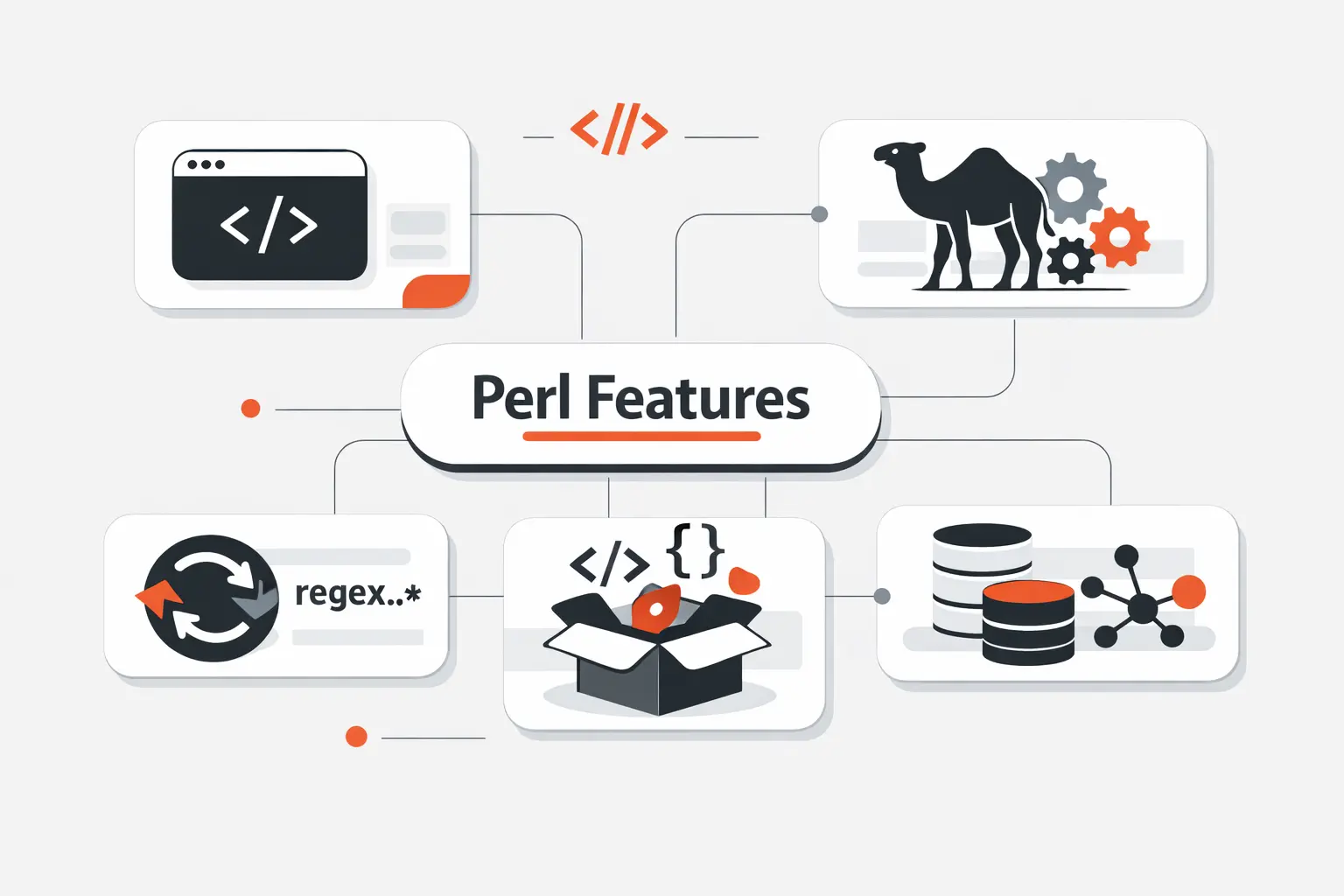
Perl’s core traits explain both its appeal and its reputation. It was shaped by developers who wanted fast answers, expressive syntax, and direct access to the operating system. That gives the language unusual reach. It also explains why style discipline matters so much once a codebase grows.
1. Features Borrowed From Unix and Other Languages
Perl openly borrows from Unix tools such as sed, awk, and the shell. That is why regular expressions feel native in Perl. It is also why pipes, file handling, and command-line habits feel close at hand. The trade-off is familiar to us. Perl can be concise and expressive, but it can also become dense if a team writes clever code instead of readable code.
2. Perl as a Glue Language for Connecting Systems
We still think of Perl as a classic glue language. It is good at standing between systems, reading one format, translating it, then passing the result onward. That can mean wrapping a command-line tool, normalizing CSV files, calling an API, or turning database output into a report. When teams say, “we just need something to bridge these pieces,” Perl still makes practical sense.
3. Embedding Perl in Databases and Web Servers
Perl also works inside larger platforms. PostgreSQL includes stored functions inside PostgreSQL, and classic web stacks have long used mod_perl or similar patterns to keep Perl close to the request cycle. We do not see that as mainstream web fashion anymore. We do see it as proof that Perl was built to live inside real systems, not just run as throwaway scripts.
4. Text Processing, Markup Support, and Flexible Programming Styles
Text remains Perl’s home turf. Its regular expressions are still excellent, its Unicode support is mature, and the language supports procedural, object-oriented, and functional styles. It also carries built-in documentation conventions through POD, which helps utilities ship with readable help text. In skilled hands, that flexibility is liberating. In careless hands, it becomes a maintenance problem.
Recommended reading: Dark Programming Language: What Darklang Is, Why It Stood Out, and What Happened to It
What Is Perl Used for Today?

When clients ask us what Perl is used for today, the answer is less about shiny new apps and more about dependable background work. Perl shows up in parsing jobs, report generators, automation scripts, web utilities, and technical domains that value mature tooling over fashion.
1. Text Manipulation, Parsing, and Report Generation
This is still the most natural use case. Perl reads flat files, config dumps, structured text, and odd exports with very little ceremony. It is strong at filtering records, extracting fields, normalizing inconsistent input, and printing reports in the exact shape a business or analyst expects. If the input is ugly, Perl is often unusually patient with it.
2. Log Management, System Administration, and Automation
System teams still use Perl for scheduled jobs, log triage, alert preprocessing, permission audits, and server maintenance helpers. We would not build a whole platform around tiny shell-and-file chores. We would absolutely keep Perl in the toolbox for jobs that run every hour, touch many files, and need better error handling than a brittle shell script.
3. Web Development and Server-Side Tasks
Yes, Perl still has a place on the server side. A familiar example is Bugzilla, which supports XML-RPC and JSON-RPC interfaces and can run under Apache with mod_perl. That is the pattern we still see most often. Perl serves internal tools, admin pages, service endpoints, and long-lived web applications built to solve a concrete business problem.
4. Database, Cloud, and Virtual Machine Workflows
In modern infrastructure work, Perl is rarely the star. It is more often the coordinator. It reads from a database, calls a cloud or VM tool, validates the result, then writes a clean output somewhere else. That role sounds humble, but it is common. The more mixed your environment is, the more useful a steady glue layer becomes.
Recommended reading: What Is C? Understanding the C Programming Language
Specialized Perl Use Cases

Beyond the common jobs, Perl still survives in a few specialized corners. Some are legacy heavy and research driven. Some exist because CPAN has collected useful building blocks for decades. We would not pretend these niches are massive. We would say they are real.
1. Speech Recognition and Text to Speech Workflows
Speech work is a niche case, not Perl’s center of gravity. Even so, CPAN still includes modules for simple text-to-speech wrappers and older PocketSphinx-based recognition workflows. Our view is cautious here. Perl can orchestrate these jobs, especially in legacy stacks, but we would usually choose another language for a brand-new speech product.
2. Software Testing and Ongoing Quality Checks
Testing is a better story. The Test2 family gives Perl teams a mature base for unit tests, tool building, and ongoing quality checks. That matters because older codebases live or die by regression coverage. We like Perl best when a team pairs its expressive scripting power with disciplined tests. Without that, the language’s flexibility turns against you.
3. Security Checks and Network Support Tasks
Perl also remains useful for security-adjacent and network support tasks. It is fast to script around logs, access rules, config files, and socket-driven utilities. For a concrete example, Netdisco describes itself as a web-based network management tool that collects device data through SNMP, CLI, and APIs. That is exactly the kind of practical systems territory where Perl still feels at home.
4. Bioinformatics and Research-Driven Applications
Bioinformatics is one of the clearest specialized holdouts. BioPerl still offers open source tools for bioinformatics, genomics, and life science work. We have long believed that domain tools outlast trends when they encode years of hard-won research logic. Perl survives in science for the same reason it survives in operations. Useful code gets renewed more often than it gets rewritten.
Recommended reading: Computer Programming Languages: Types, Use Cases, and How to Choose
Pros and Cons of Perl

We do not think Perl deserves either blind loyalty or lazy ridicule. It has real advantages. It also has real costs. Once we put both on the table, the decision gets much easier.
1. Benefits Like Cross-Platform Support and Open-Source Flexibility
The upside starts with portability, mature libraries, and an old but active ecosystem. Perl runs across major operating systems, works comfortably with Unix habits, and remains open source to the core. For teams that already have years of scripts and modules in place, that continuity is a serious advantage. You are not buying novelty. You are buying predictability.
2. Challenges Around Readability, Portability, and Performance
The downside is readability drift. Perl gives developers many ways to solve the same problem, and not all of them age well. Dense punctuation, inconsistent team style, and older module assumptions can make maintenance expensive. Performance is another trade-off. Perl is quick enough for many automation tasks, but it is not the first tool we choose for compute-heavy services.
3. How to Decide Whether Perl Fits Your Use Case
Our rule is simple. Choose Perl when the job is text heavy, system adjacent, and already connected to existing Perl assets. Skip it when you need a beginner-friendly codebase, broad hiring reach, or a fresh application stack that several teams will extend for years. The right answer is usually economic, not ideological.
Recommended reading: Hardest Programing Language: How Difficulty Works and Which Languages Challenge Developers Most
Perl Compared With Python

When people compare Perl with Python, they are usually choosing between two scripting traditions. Both can automate tasks, read files, talk to services, and support back-end work. The real difference is less about raw capability and more about ergonomics, team habits, and the kind of code you expect to maintain.
1. Where Perl and Python Overlap as Scripting Languages
The overlap is broad. Both languages handle command-line tools, data cleanup, quick prototypes, and integration code well. They can sit near databases and HTTP APIs. They reward developers who understand the operating system around them. If your problem is mainly orchestration, either language can do the work.
2. Key Differences in Syntax, Structure, and Readability
The feel is very different. Python pushes one dominant style and reads cleanly to newcomers. Perl gives more expressive shortcuts, more punctuation, and more room for local idioms. We would call Python easier to read at first glance. We would call Perl faster for certain text and regex-heavy tasks once you know its habits.
3. Which Language Is Easier to Pick Up for Different Goals
For most beginners, Python is easier to learn. Its syntax is calmer, teaching material is broader, and the mental model is more uniform. Perl becomes easier only when your goal is narrow and practical, such as editing large batches of text, taming old Unix workflows, or maintaining a codebase that already speaks Perl.
Should You Learn Perl Today?

Should you learn Perl today? We think that depends on why you are learning it. A first language, a career hedge, and a tool for a specific environment are three different questions. They deserve three different answers.
1. Who Benefits Most From Learning Perl
The biggest winners are system administrators, DevOps engineers, SREs, bioinformatics researchers, and developers who inherit older production systems. If your day is full of logs, file formats, shell tools, batch jobs, and long-lived internal software, Perl can pay back quickly. It is especially useful when you need to read old scripts with confidence instead of fear.
2. When Perl Makes Sense for Scripting and Automation
Perl makes sense when the problem is mostly scripting and automation. Need to rename files from messy rules, parse audit logs, clean export files, or glue a few services together? Perl is still sharp. We also like it when a team wants small tools with strong regex support and low ceremony around text handling.
3. When Another Language May Be a Better Starting Point
If you are starting from zero, market reach matters. In Stack Overflow’s 2025 survey, Perl accounted for 3.4% of professional developers, so Python or JavaScript will usually give beginners a larger community, more tutorials, and a wider hiring market. We would learn Perl first only when the work in front of you already depends on it.
Frequently Asked Questions About Perl

We hear the same questions from founders, junior developers, and teams inheriting old tools. Here are the answers we find most useful in practice.
1. Is Perl a Dead Language?
No. It is less common, but it is still maintained and still visible in industry tracking. We would call it mature and specialized, not dead.
2. What Was Perl Originally Used For?
It started as a language for scanning text files, extracting information, and printing reports. System management became a natural second home soon after.
3. Is Perl Easier Than Python?
Usually no. Python is easier for most new developers. Perl becomes easier when you already understand its conventions and your work is dominated by text processing or Unix automation.
4. Why Is Perl Less Common Today?
Readability concerns, Python’s rise, and a smaller learning pipeline all played a role. Once hiring and community momentum shift, language adoption usually follows.
5. Can Perl Still Be Used for Web Development?
Yes. It can still power server-side code, service endpoints, and long-lived internal applications. The modern question is not whether it can, but whether it is the best choice for the team around it.
6. What Is Perl Best Used for Today?
Today, Perl is best at automation, text manipulation, report generation, legacy maintenance, and specialized technical domains where existing libraries and scripts already carry business value.
How TechTide Solutions Helps Build Custom Software

At TechTide Solutions, we care less about language mythology and more about business fit. Some clients need a clean rebuild. Others need a careful bridge between old logic and new interfaces. We do both, and we do not force a rewrite just to chase fashion.
1. Building Custom Web, Automation, and Data Solutions
We build custom web platforms, internal tools, automation pipelines, and data workflows around the systems a client actually uses. If a company has Perl scripts that still do valuable work, we can keep the useful parts, test them properly, and place modern services around them. That is often cheaper and safer than a dramatic replacement.
2. Integrating Existing Systems With Modern Web and Cloud Workflows
We also integrate existing systems with current web and cloud workflows. That can mean wrapping old scripts behind APIs, moving scheduled jobs into managed environments, connecting databases to dashboards, or replacing fragile file handoffs with controlled services. The goal is steady progress, not needless disruption.
3. Designing Tailored Software Around Unique Business Needs
Our design process starts with constraints. Who maintains the code, what must stay running, where the data lives, and how fast the team needs to move. Sometimes Perl remains part of the answer. Sometimes it becomes a migration source. Either way, we shape the software around the business, not the trend cycle.
Final Thoughts on What Is Perl
Perl is a practical, expressive, and sometimes messy language. It grew from text extraction into a full general-purpose tool. It still matters wherever old systems, log-heavy workflows, and domain-specific automation remain valuable.
We would not recommend Perl as the default starting point for most new developers or most new SaaS products. We would absolutely recommend understanding it when your systems depend on it, when your problem is mostly text and automation, or when replacing it would cost more than improving it. That is where Perl still earns its keep.

