


At TechTide Solutions, we treat Python frameworks as architecture decisions, not fashion choices. The same team might need Django for a customer portal, FastAPI for a typed service layer, and Streamlit for an internal analytics app. That matters even more now because Gartner projects $644 billion in 2025 in worldwide generative AI spending, which means more ordinary products now need AI endpoints, dashboards, and model workflows living beside classic web features.
This guide is not a popularity contest. We ranked these Python frameworks by fit, trade-offs, ecosystem quality, and how quickly a real team can reach a safe first release. Our rule is simple. If a framework removes weeks of glue code without creating a worse problem six months later, it belongs on the shortlist. Below, we compare 20 options across full-stack web apps, APIs, data products, dashboards, and AI-heavy builds.
Quick Comparison of Python Frameworks
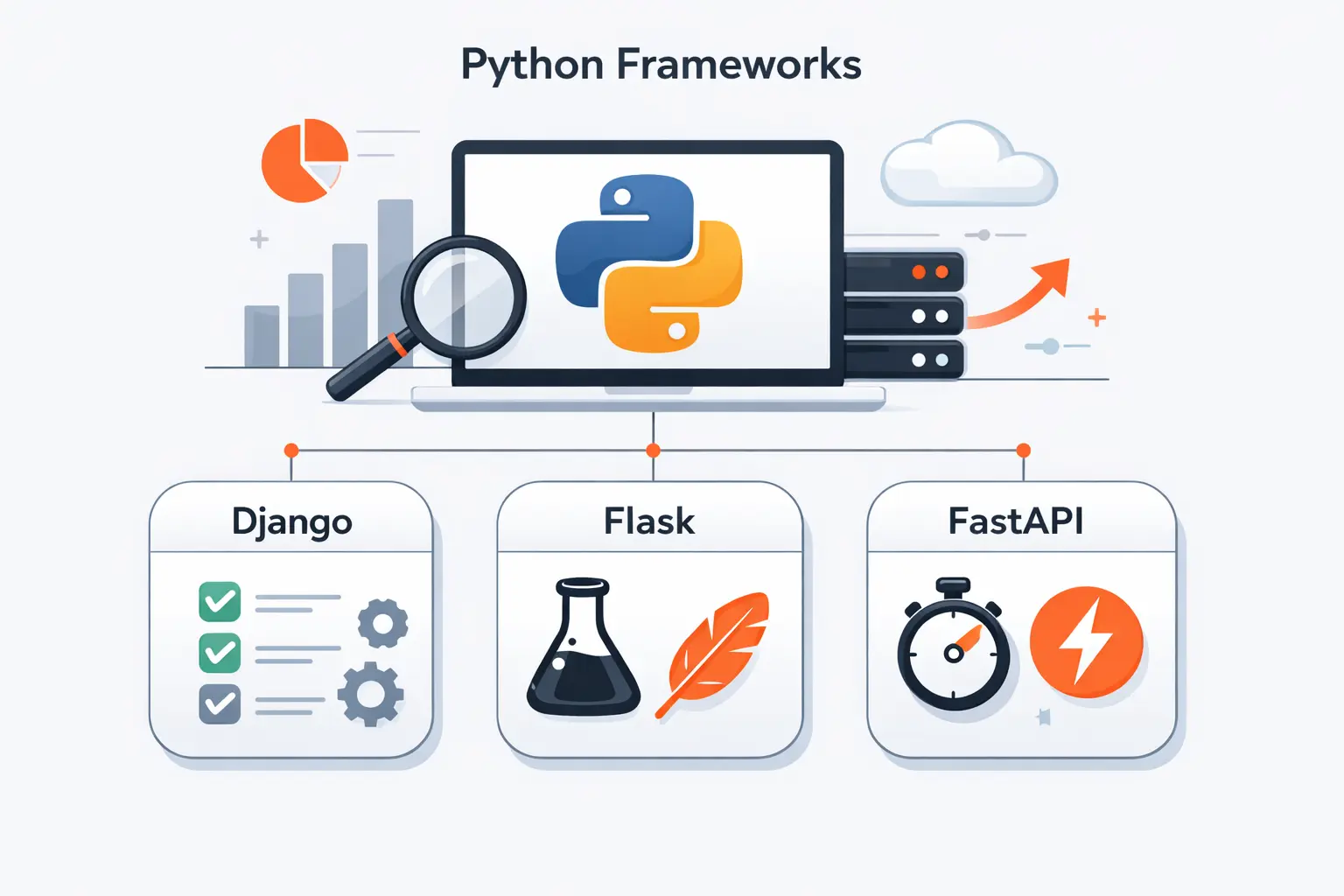
If you want the short version first, start here. This table summarizes the first 10 frameworks from our main list and where we think each one fits best.
| Tool | Best for | From price | Trial/Free | Key limits |
|---|---|---|---|---|
| Django | Full-stack SaaS and secure back offices | $0 | Free OSS | More opinionated, heavier for tiny APIs |
| FastAPI | Typed APIs and AI backends | $0 | Free OSS | Not full-stack, you assemble more pieces |
| Flask | Lean MVPs and custom stacks | $0 | Free OSS | Extension sprawl can creep in |
| Streamlit | Internal data apps and AI demos | $0 | Free OSS | Public cloud starter is public-only |
| Dash | Analytical dashboards | $0 | Free OSS | Callback graphs get complex at scale |
| PyTorch | Model training and LLM experiments | $0 | Free OSS | Not a web or admin framework |
| TensorFlow | Production ML pipelines and edge ML | $0 | Free OSS | Broader, steeper ecosystem |
| Starlette | Lean async services | $0 | Free OSS | Few batteries included |
| Pyramid | Long-lived custom web apps | $0 | Free OSS | Smaller ecosystem |
| CherryPy | Small OO web apps and admin tools | $0 | Free OSS | Older WSGI-era feel |
Recommended reading: Top 20 Marketing Project Management Software for Smarter Campaign Planning in 2026
Top 20 Python Frameworks Across Web, Data, and AI
We ordered this list by how often we would seriously shortlist each option for new work. That puts proven defaults near the top, specialized tools in the middle, and older but still useful frameworks in context instead of on nostalgia alone.
1. Django
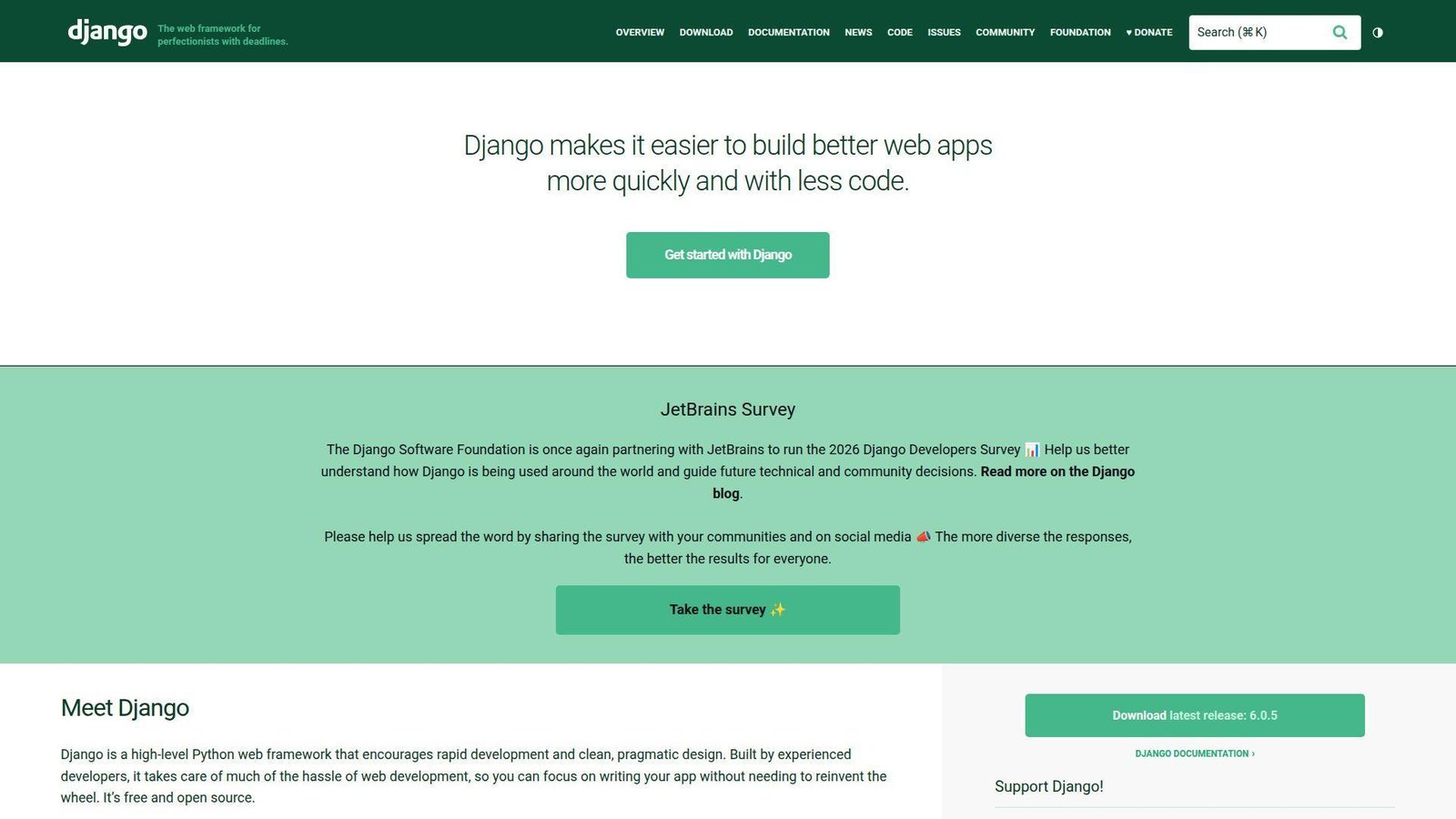
Django is stewarded by the Django Software Foundation and a large contributor community. Best for: product teams building secure SaaS apps and agencies shipping client portals or admin-heavy platforms.
- Built-in ORM, auth, admin, forms, and templates → you can stand up CRUD-heavy internal workflows without assembling five separate packages.
- Mature package ecosystem and clear conventions → teams usually skip several rounds of custom plumbing for auth, CMS, payments, search, and background jobs.
- Opinionated project structure → most teams reach first useful back-office value in days, not weeks.
From $0/mo. There is no trial because the framework is free and open source. There are no built-in project, seat, or request caps, so your real ceiling is set by hosting, schema design, and your own code quality.
Honest drawbacks: Django can feel heavy for a tiny API or a very experimental prototype. Async support keeps improving, but the center of gravity is still full-stack server apps, not minimal async services.
Verdict: If you need a serious business app with auth, admin, forms, and strong defaults, Django helps you get to a trustworthy first release fast. It beats Flask at built-ins and trails FastAPI on API-first ergonomics.
2. FastAPI
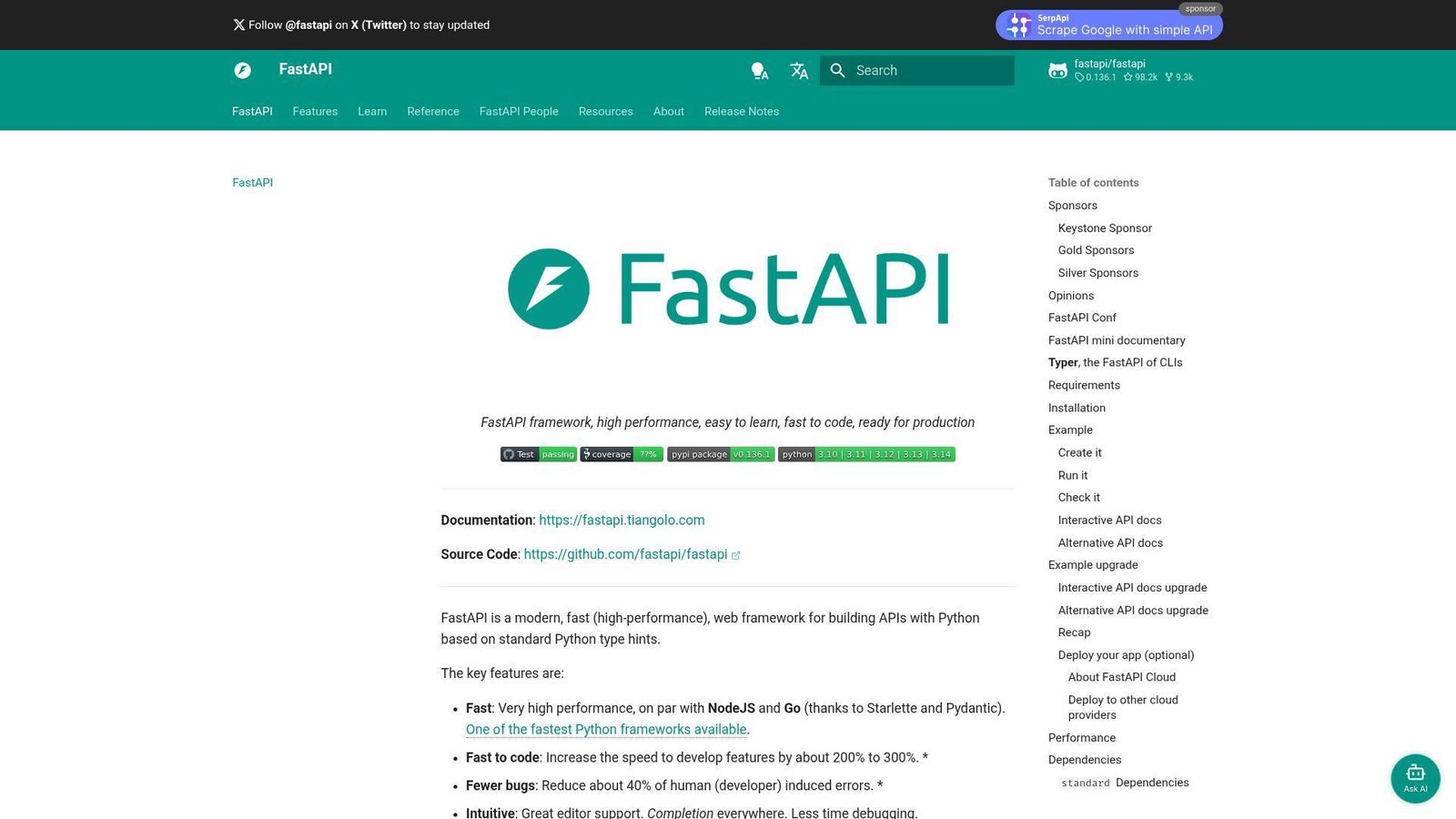
FastAPI is led by Sebastián Ramírez and a fast-moving open-source community, with a design that leans heavily on modern Python typing and ASGI. Best for: backend teams building APIs and AI product teams exposing inference, retrieval, or agent endpoints.
- Type hints, validation, and OpenAPI generation → every endpoint starts with a clearer contract and usable docs from day one.
- Security helpers, dependency injection, and background tasks → you remove a chunk of hand-written request parsing and auth wiring.
- Interactive docs and small code surface → most teams get a real endpoint, validation, and docs live in the first session.
From $0/mo. There is no trial because the framework itself is free. The core framework has no seat or project caps, but you will still choose your own ORM, admin layer, jobs setup, and deployment stack.
Honest drawbacks: FastAPI is not a full-stack product framework. Once your service grows, you still need decisions around migrations, admin tools, long-running jobs, and broader application structure. Async also adds mental overhead for teams coming from classic sync Flask or Django work.
Verdict: If you are building APIs first, FastAPI is the cleanest default on this list. It helps you ship typed, documented services in hours, not days. It beats Flask at validation and docs, and trails Django when you need more batteries included.
3. Flask
Flask is maintained by the Pallets team and remains one of the clearest introductions to Python web development. Best for: solo developers building MVPs and engineering teams that want to choose each major layer themselves.
- Minimal core and blueprints → you can shape the project around your domain instead of around framework ceremony.
- Huge extension ecosystem → adding auth, forms, ORM support, admin, or rate limiting usually takes fewer implementation steps than building those pieces by hand.
- Simple request model → most teams hit time-to-first-value within a few hours.
From $0/mo. There is no trial because Flask is a framework package, not a paid platform. There are no built-in seat or app caps, which is good, but it also means structure and consistency are your job.
Honest drawbacks: Flask projects can age badly if every feature arrives through a different extension and no one owns architecture. You also do not get typed validation and auto-generated API docs out of the box the way you do in FastAPI.
Verdict: If you want freedom and you have the discipline to keep the stack coherent, Flask is still a smart choice. It beats Django on flexibility and trails FastAPI on modern API ergonomics.
4. Streamlit
Streamlit was built for Python-first app creation and now sits under Snowflake, with a clear focus on data scientists and AI builders. Best for: analysts building internal dashboards and ML teams turning notebooks into usable apps.
- Pure Python scripting model → notebook logic becomes a clickable app without a separate front-end build.
- Widgets, charts, and compatibility with common data libraries → teams often reuse existing pandas, Plotly, and model code with far fewer translation steps.
- Simple local run and quick deploy paths → first useful internal app often lands the same day.
From $0/mo. There is no trial for the open-source framework. Streamlit Community Cloud is free, but it is aimed at public apps, and private production-style deployment pushes you toward Snowflake or another hosting path.
Honest drawbacks: once an app grows into a complex workflow with many states, pages, and permission rules, the simple script model starts to creak. Fine-grained front-end control is also limited compared with a custom React stack.
Verdict: If you need to get stakeholders using a data app fast, Streamlit is hard to beat. It beats Dash on raw speed to first screen and trails Dash on more controlled app structure.
5. Dash
Dash comes from the Plotly team and is built around interactive analytical applications in Python. Best for: analytics teams shipping dashboards and enterprises that need richer callback-driven reporting than a notebook-style tool usually gives.
- Component layout plus callbacks → charts, filters, and tables react to user input without writing a custom front end.
- Close fit with Plotly graphing and hosted options → moving from analysis to a shareable analytics product takes fewer handoffs.
- Clear app structure for analytical UI → a working internal dashboard often appears in a day or two when the data source is ready.
From $0/mo for open-source Dash. There is no trial for the core framework. Plotly’s hosted plans start free but stay tight, so buyers should read hosting limits carefully before promising a private rollout to executives or clients.
Honest drawbacks: large Dash apps can turn into callback spaghetti if nobody manages state and component boundaries. It is also less natural than Streamlit for quick exploratory demos.
Verdict: If the product itself is analysis, Dash is one of the strongest Python choices available. It beats Streamlit on controlled reactive layouts and trails it on beginner speed.
6. PyTorch
PyTorch is stewarded through the PyTorch Foundation and a large open ecosystem, with a strong identity in model experimentation and deployment tooling. Best for: ML researchers fine-tuning models and AI product teams moving fast on training, inference, and LLM workflows.
- Eager execution and the `torch.nn` stack → model ideas are easier to test, inspect, and revise during active experimentation.
- Distributed training and production tools like TorchServe → moving from local proof of concept to larger jobs usually takes fewer rewrites.
- Deep tutorial library → most teams can train or fine-tune something useful in the first day.
From $0/mo. There is no trial because the framework is free and open source. There are no built-in seat or model caps, but web UI, auth, admin, and product workflow layers are outside the framework and must be planned separately.
Honest drawbacks: PyTorch is not a product framework. If your app needs human workflows, permissions, billing, or dashboards, you still need FastAPI, Django, Streamlit, or another layer around it.
Verdict: If you care most about research speed, LLM experimentation, or flexible model development, PyTorch stays near the top of the list. It beats TensorFlow on experimentation feel and trails TensorFlow on end-to-end platform breadth.
7. TensorFlow
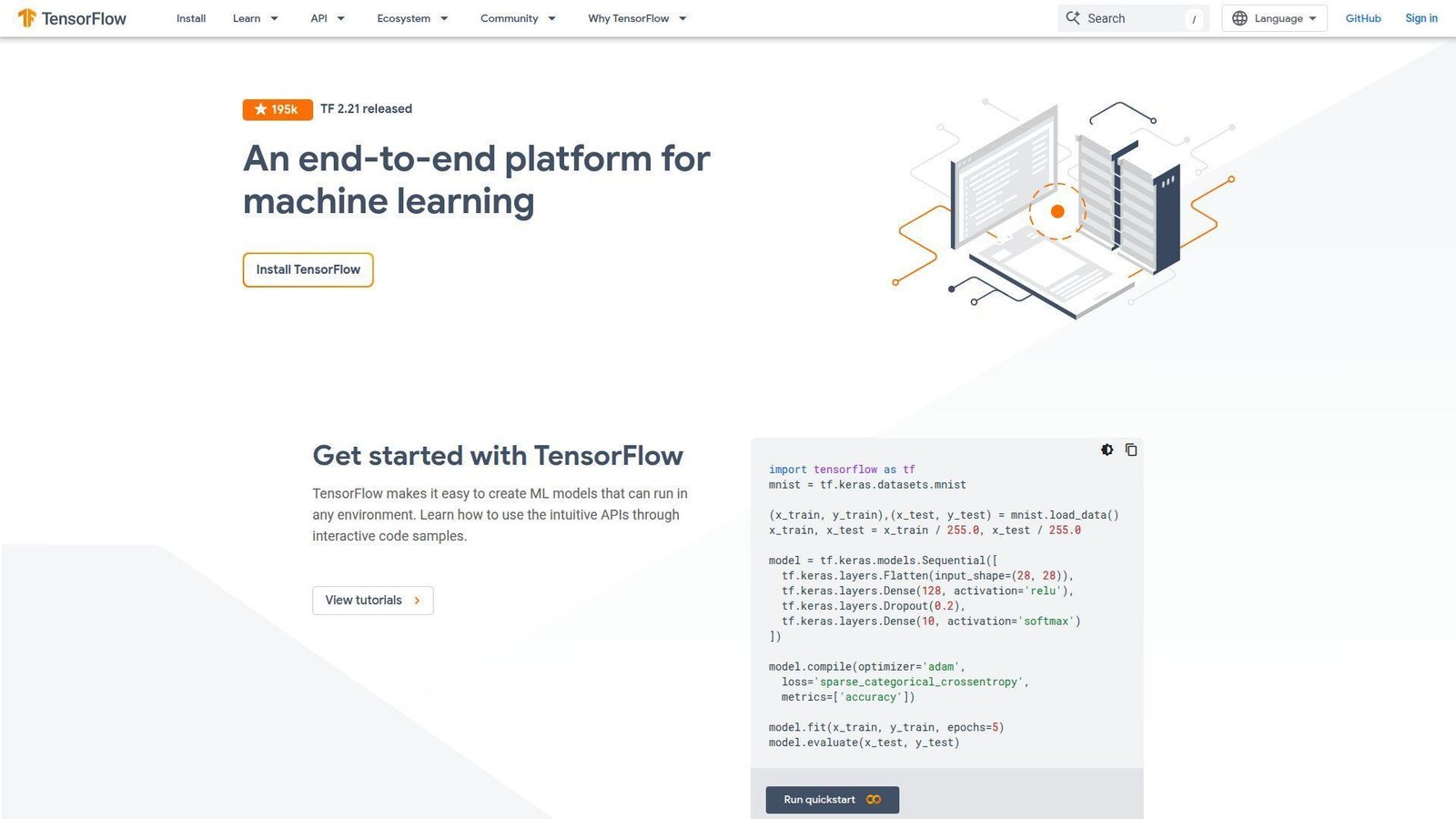
TensorFlow is led through Google’s ecosystem and still offers one of the widest production ML surfaces in Python. Best for: ML platform teams building repeatable pipelines and product teams that care about edge deployment, training, and serving in one broader stack.
- TensorFlow, TensorFlow Lite, and TFX together → one family can cover training, deployment, mobile, and pipeline needs.
- Models, datasets, and production-oriented tooling → teams skip a lot of custom orchestration once standards are established.
- Rich tutorials and case studies → first baseline model is quick, even if mastery takes longer.
From $0/mo. There is no trial because the framework is open source. There are no built-in seat or request caps in the framework itself, though production deployment choices can add infrastructure and ops complexity fast.
Honest drawbacks: many developers still find TensorFlow less intuitive than PyTorch for experimentation. The ecosystem is broad enough that small teams can end up carrying more machinery than they really need.
Verdict: If you want a production-oriented ML ecosystem with reach into edge and pipelines, TensorFlow still deserves a serious look. It beats PyTorch on platform breadth and trails it on day-one developer comfort.
8. Starlette
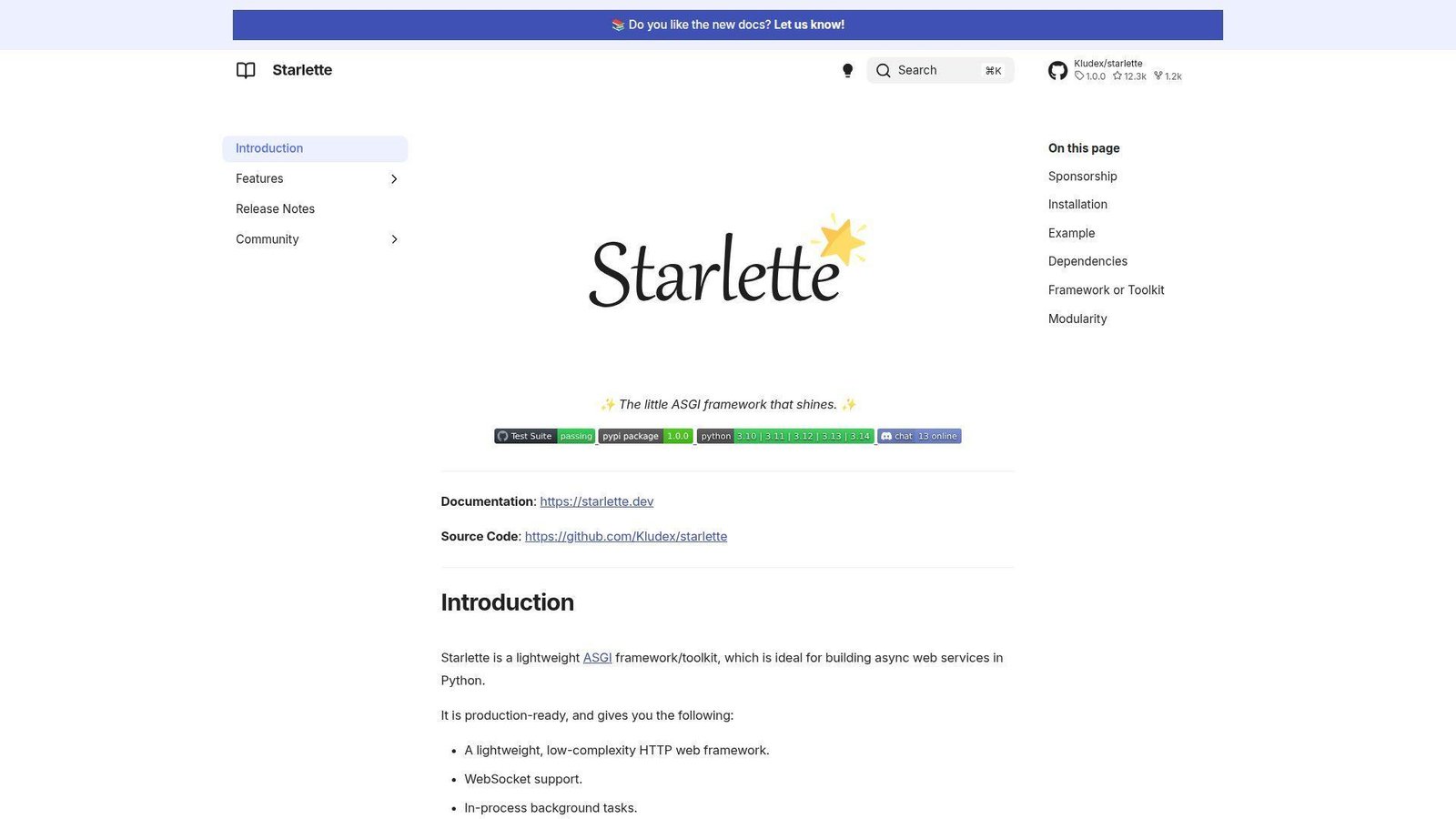
Starlette comes from a lightweight ASGI-first ecosystem and is best understood as a toolkit as much as a framework. Best for: backend engineers who want lean async services and teams that prefer composing their own stack carefully.
- Routing, responses, middleware, websockets, and background tasks → you get the async essentials without a lot of extra surface area.
- Compatibility with modern ASGI tooling → fewer translation steps when pairing it with Uvicorn, httpx, or custom service layers.
- Small API footprint → first async service can be standing in under an hour.
From $0/mo. There is no trial and no vendor cap because Starlette is open source. The trade-off is that you assemble more of the stack yourself, including validation, admin layers, and broader product conventions.
Honest drawbacks: if your team wants batteries included, Starlette can feel too bare. It rewards strong engineering judgment but gives less guidance to mixed-skill teams.
Verdict: If you want async control without framework bulk, Starlette is a sharp option. It beats Flask on async-native design and trails FastAPI on API ergonomics and docs.
9. Pyramid
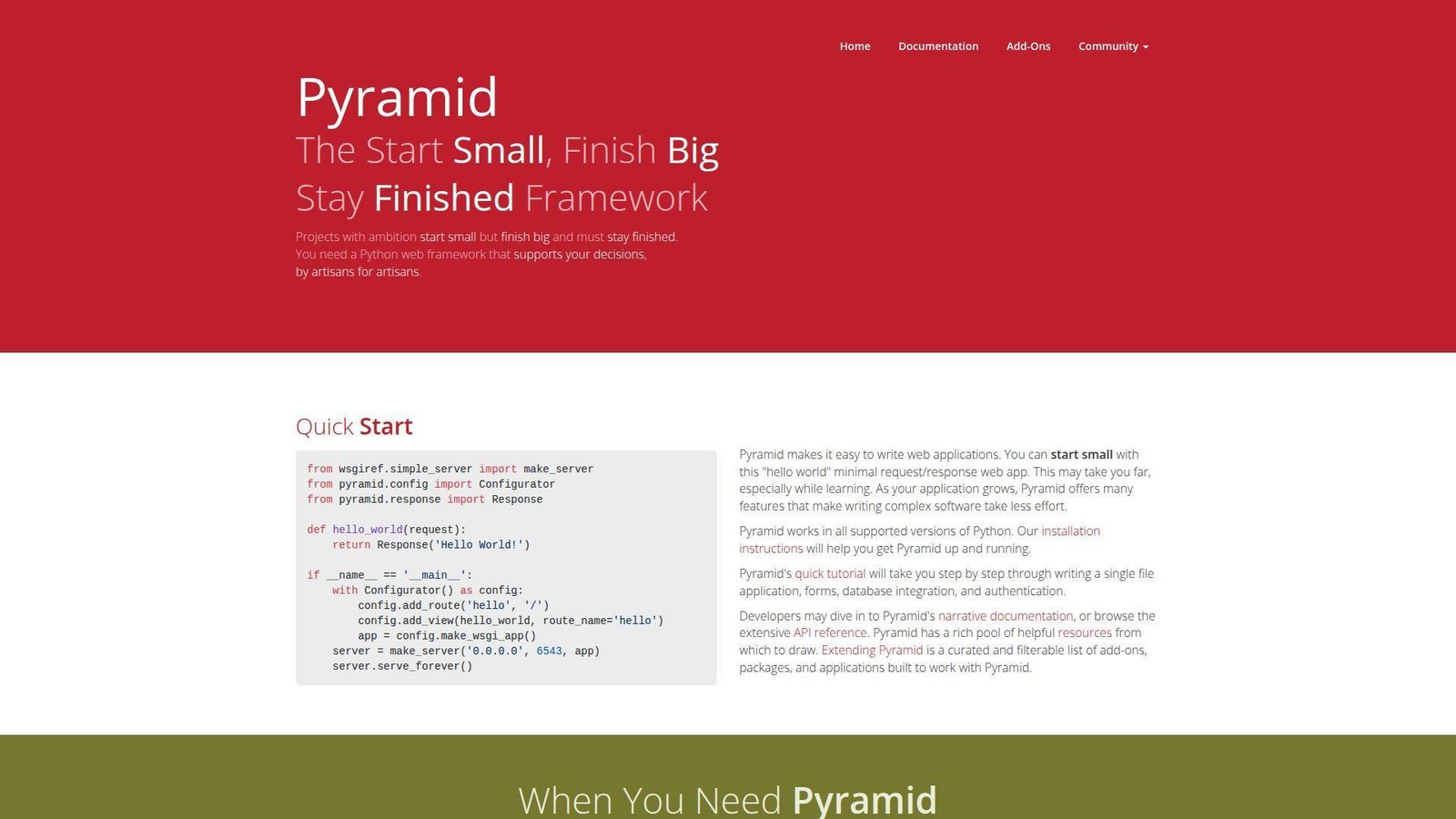
Pyramid is maintained by the Pylons community and has always positioned itself between tiny microframeworks and heavier full-stack systems. Best for: teams building long-lived custom systems and engineers who dislike fighting framework magic later.
- Start small, finish big philosophy → you can begin with a tiny app and still grow into a larger architecture cleanly.
- Add-on system and configurable stack → teams keep more freedom around templating, security, and data layers.
- Separation between configuration and application code → first setup takes a bit longer, but large refactors usually hurt less.
From $0/mo. There is no trial because the framework is free and open source. There are no hard seat or app limits in Pyramid itself, which makes it attractive for teams that care more about architectural longevity than vendor plans.
Honest drawbacks: Pyramid’s ecosystem is smaller now, and fresh learning material is thinner than what you get with Django, Flask, or FastAPI. Hiring for existing Pyramid experience is also harder.
Verdict: If you are building a custom web application expected to live for years, Pyramid is more practical than its current visibility suggests. It beats Flask at scale-up structure and trails Django on out-of-the-box momentum.
10. CherryPy
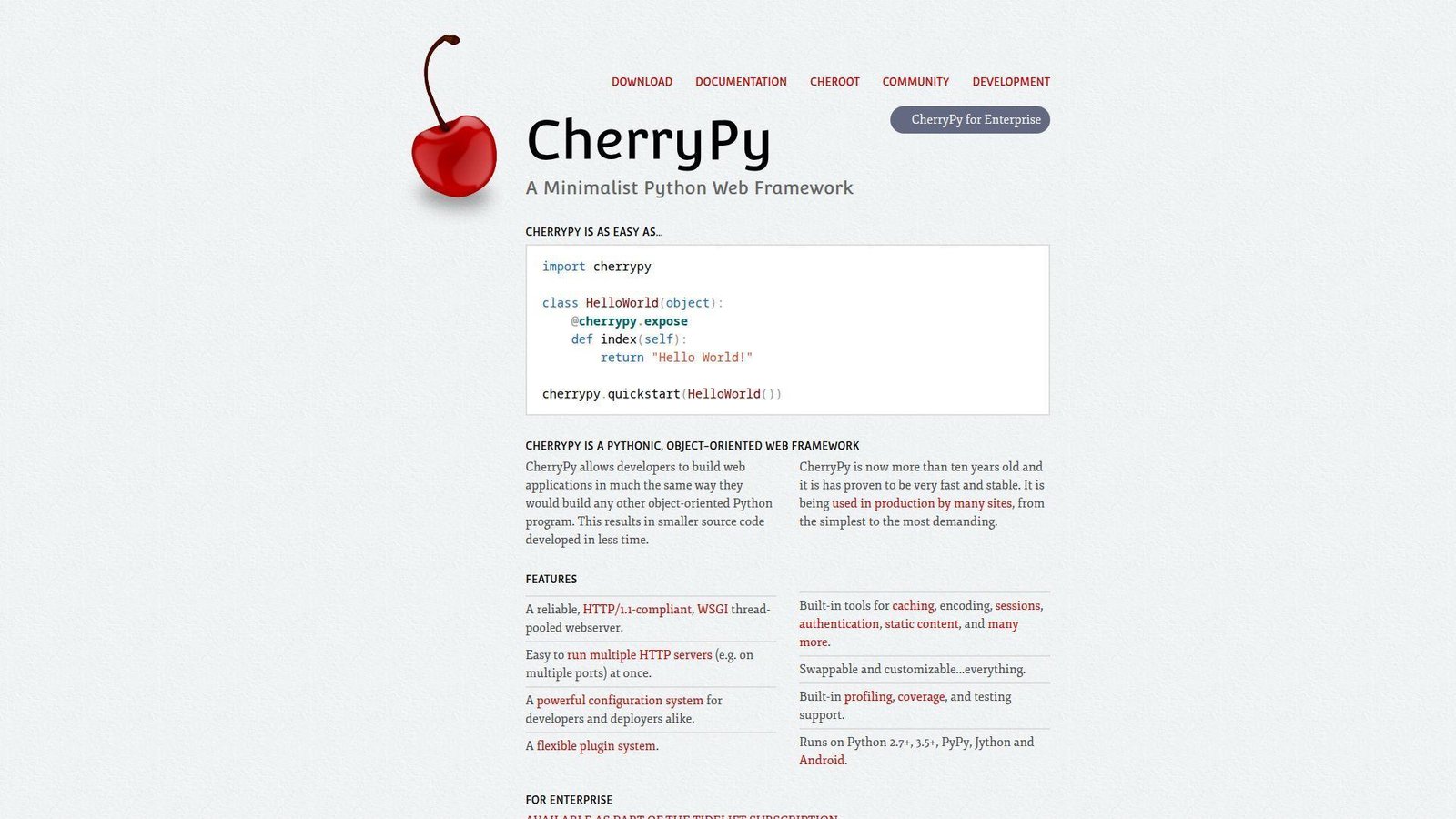
CherryPy is a long-running open-source project with an object-oriented style that still feels distinct in Python web work. Best for: Python-first engineers building small services or internal admin tools and teams that value an older, direct programming model.
- Class-based, object-oriented request handling → code often reads like ordinary Python instead of framework ceremony.
- Built-in server-side tools for sessions, auth, caching, and configuration → fewer dependencies for straightforward internal systems.
- Quickstart style → a small tool can be working in an afternoon.
From $0/mo. There is no trial, and there are no built-in seat or project caps. The framework is easy to start, but you should expect fewer modern ecosystem conveniences than newer ASGI-first options provide.
Honest drawbacks: CherryPy feels more WSGI-era than current async frameworks. Community mindshare is smaller, which affects examples, integrations, and how easy it is to find teammates who already know it.
Verdict: If you want a direct, Pythonic web framework with a stable old-school feel, CherryPy still works. It beats Bottle on server-side features and trails Starlette and FastAPI on modern async patterns.
11. Tornado
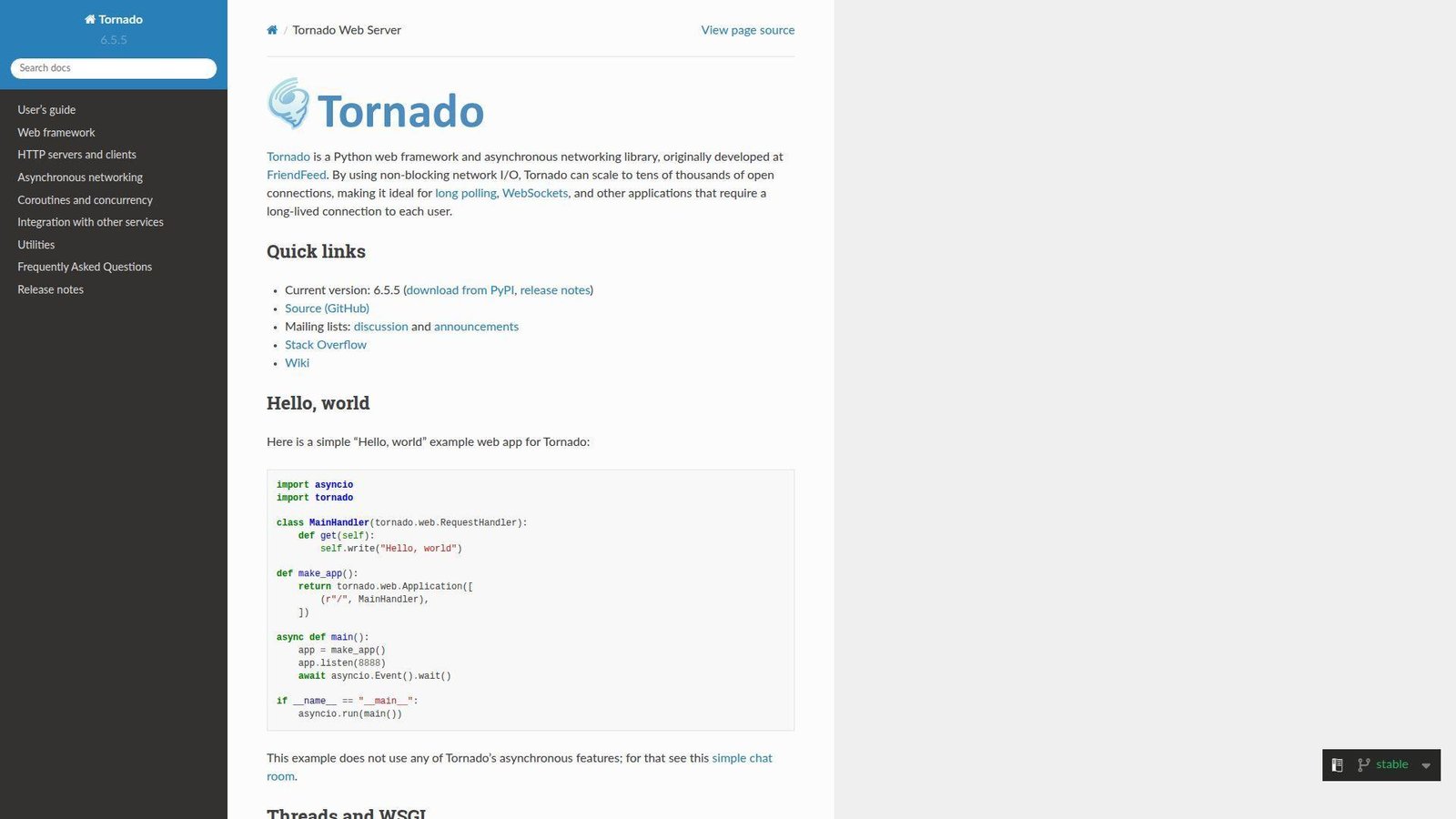
Tornado started at FriendFeed and grew into a well-known async networking and web framework with a strong realtime story. Best for: teams building websocket-heavy systems and services that need to hold many long-lived connections at once.
- Non-blocking network I/O and long connection handling → chat, notifications, streaming, and device sessions stay natural.
- `asyncio` integration → you can mix Tornado with modern async Python libraries instead of living in a separate world.
- Built-in web plus networking tools → first realtime service often arrives within a day when requirements are clear.
From $0/mo. There is no trial because Tornado is free and open source. There are no built-in seat or request caps, though the real design constraint is whether your team is comfortable with Tornado’s async-first model.
Honest drawbacks: Tornado is less pleasant than FastAPI for plain JSON CRUD. It is also not based on WSGI in the way older Python web developers may expect, so some assumptions and middleware habits do not transfer neatly.
Verdict: If concurrency is the hard part of your product, Tornado earns its place. It beats Django on long-lived connection work and trails FastAPI for ordinary API development.
12. Bottle
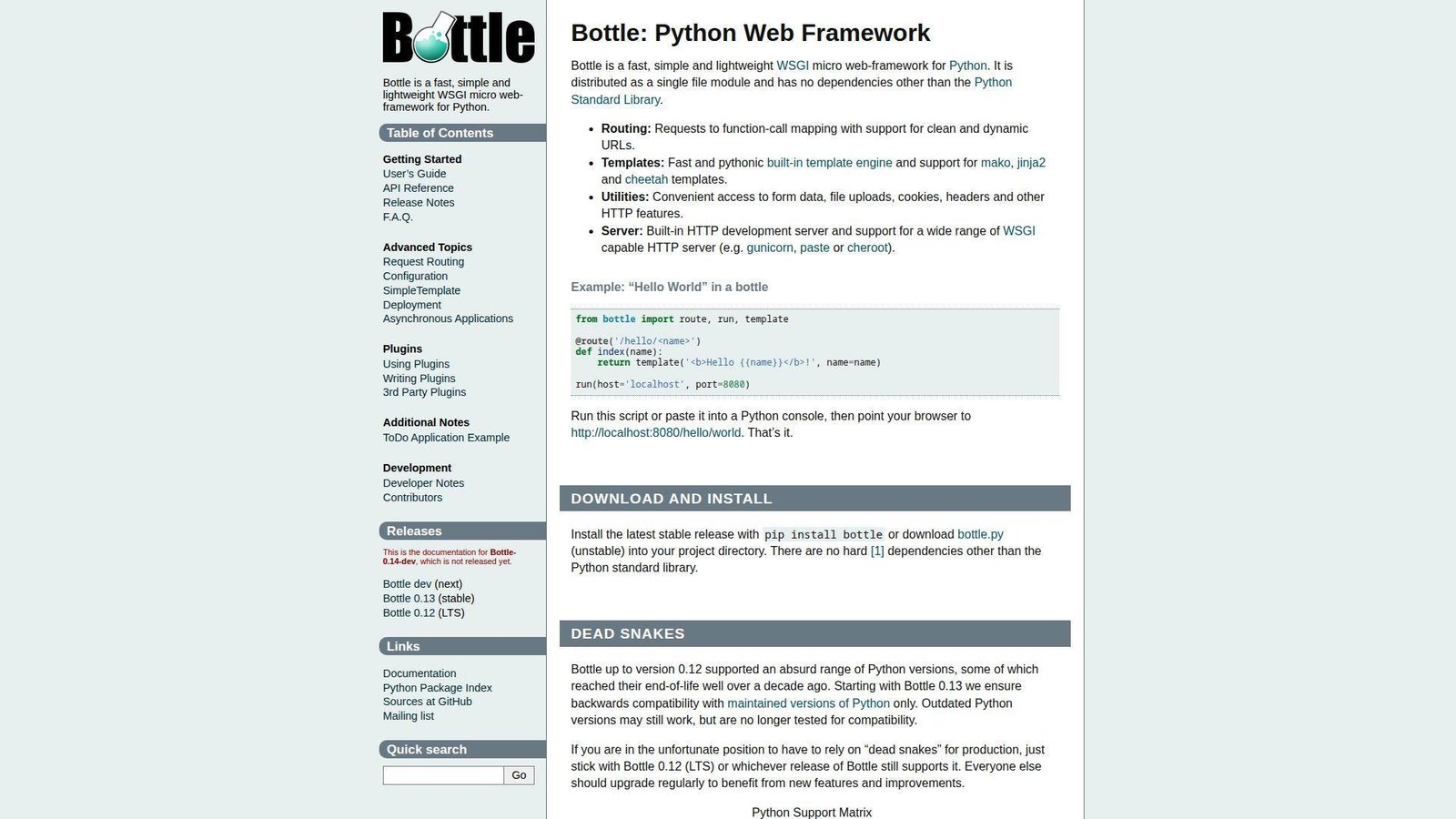
Bottle is a famously small project with a single-file feel and almost no startup friction. Best for: tiny services, scripts with HTTP endpoints, and developers teaching or learning the basics of routing and request handling.
- Single-file distribution and no external dependencies → you can drop it into utilities and constrained environments very quickly.
- Simple routing, request utilities, and templating → basic tools arrive without much ceremony.
- Minimal install footprint → first endpoint often appears in minutes.
From $0/mo. There is no trial because Bottle is free to install and use. There are no seat or project caps in the framework, but the practical cap is how fast a growing app outgrows its intentionally tiny design.
Honest drawbacks: Bottle reaches its ceiling fast on larger apps. It is sync, sparse, and intentionally modest, so most production concerns still become your problem.
Verdict: If you want the lightest possible Python web start, Bottle stays charming and useful. It beats Flask on footprint and trails Flask on ecosystem depth.
13. Falcon
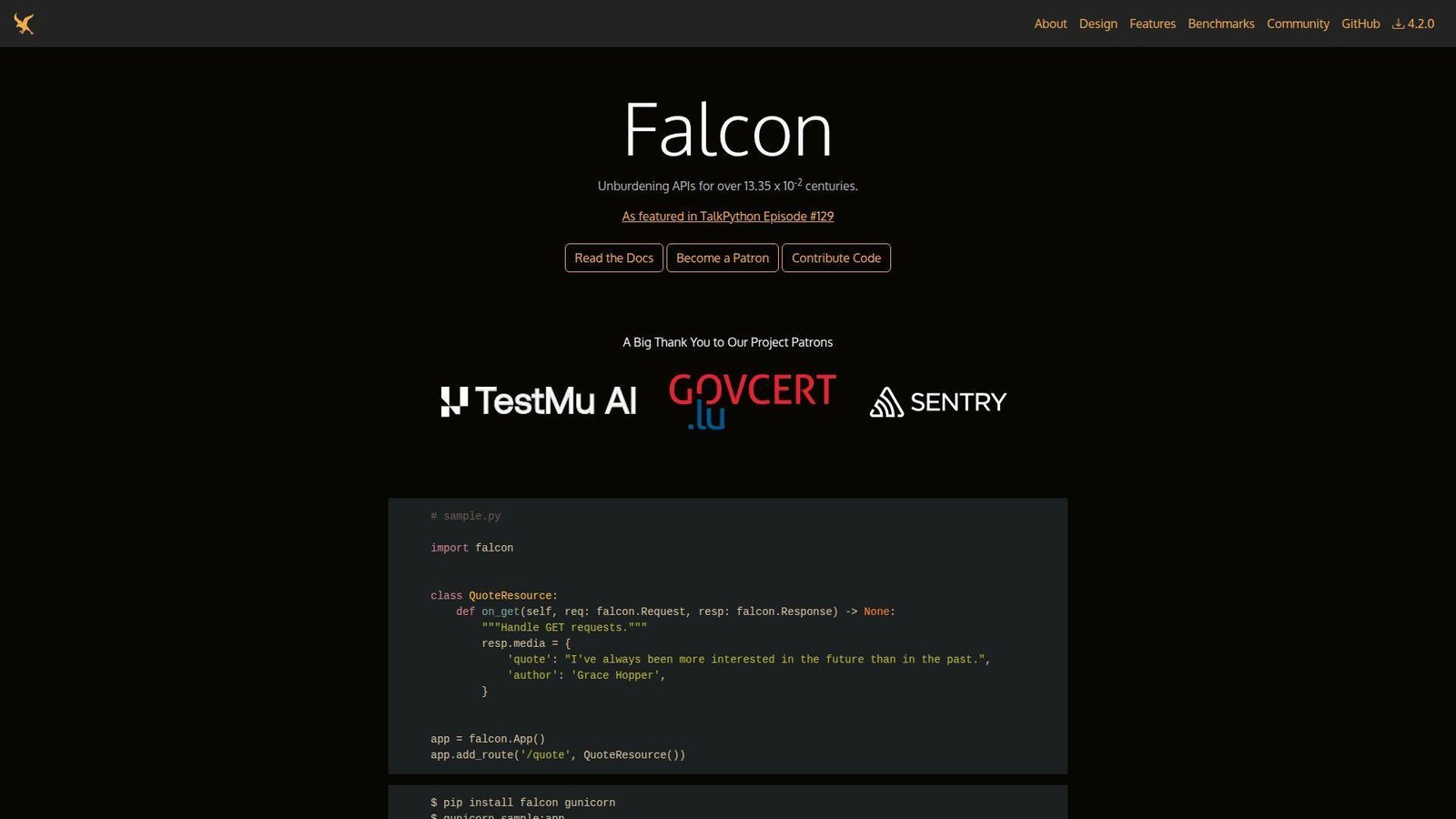
Falcon is a community API framework with a clear bias toward performance, HTTP correctness, and low overhead. Best for: backend platform teams and teams building microservices where request efficiency and explicit behavior matter more than full-stack convenience.
- Minimal REST-focused design → cleaner service boundaries and lower per-request overhead.
- ASGI and WSGI support with websockets and middleware → fewer migration headaches when mixing older and newer deployment models.
- Explicit, debug-friendly behavior → first service comes online quickly and stays easier to reason about later.
From $0/mo. There is no trial because Falcon is open source. The framework has no built-in seat or usage caps, but it also leaves admin, ORM choices, and many developer-experience layers up to you.
Honest drawbacks: Falcon can feel too bare for generalist teams or product teams that need dashboards, auth UI, or batteries included. The speed story is strong, but speed is not the only buying criterion.
Verdict: If you want a disciplined API framework with tight control, Falcon is excellent. It beats Flask on API shape and trails FastAPI on auto docs and validation.
14. aiohttp
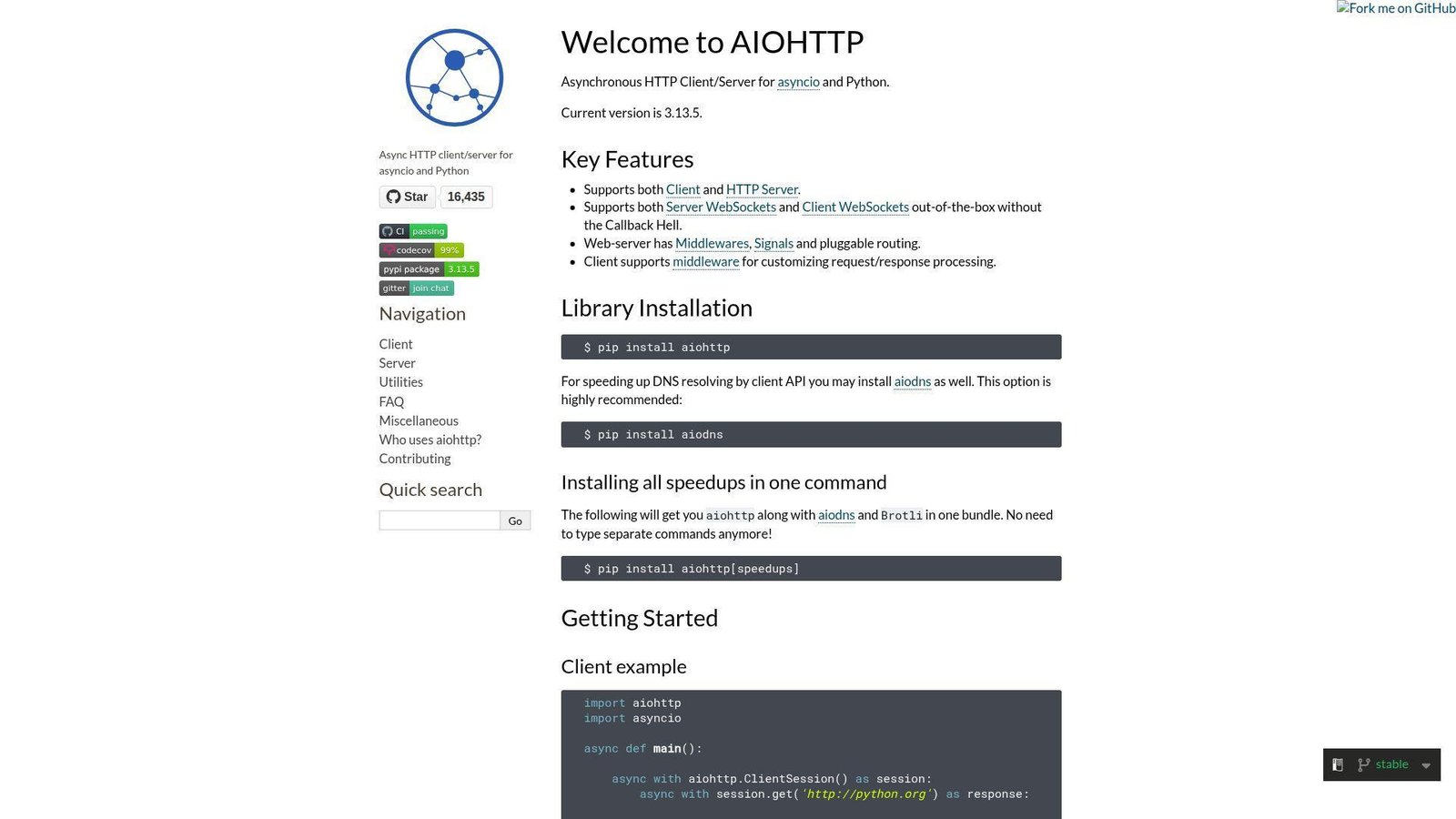
aiohttp comes from the aio-libs ecosystem and is unusual because it serves both async client and server needs well. Best for: teams building gateways, proxies, crawlers, or backend services that both receive traffic and call many upstream APIs.
- HTTP client and server in one library → fewer moving pieces when your service is both consumer and provider.
- Native websockets, middleware, and signals → streaming and event-driven use cases take fewer add-ons.
- `asyncio`-first design → a working proxy or integration service can be useful in a day.
From $0/mo. There is no trial because aiohttp is open source. There are no built-in seat or app caps, but schema-driven API tooling and polished docs UX are lighter than what FastAPI gives you by default.
Honest drawbacks: if your goal is a classic public REST API with strict typing and automatic docs, aiohttp is not the cleanest first pick. It shines more in network plumbing than in product-style backend ergonomics.
Verdict: If the hard part of your system is async HTTP work, aiohttp is a smart buy. It beats FastAPI for combined client-server plumbing and trails it for conventional API product work.
15. Reflex
Reflex is a newer company-backed Python app platform with an open-source framework at its center. Best for: Python teams building internal tools and teams that want a full-stack Python path without hiring a separate front-end specialist right away.
- Full-stack Python approach → one language covers UI, backend logic, and app behavior, which simplifies small-team execution.
- Builder, deployment, and agent tooling → fewer handoffs between prototype, testing, and hosted app management.
- Low-friction first run → many teams can demo a working internal app in a day.
From $0/mo. There is no trial requirement. The free tier includes the open-source framework, shared compute, AI builder credits, unlimited collaborators, and a limited hosted footprint, while enterprise pricing is custom.
Honest drawbacks: highly custom front-end interactions still have a higher ceiling in a React plus API stack. Company-backed convenience is attractive, but it can also pull teams toward the platform layer faster than they expect.
Verdict: If you want Python to cover both application logic and UI, Reflex is one of the most interesting modern options on the market. It beats Streamlit on product structure and trails a custom React stack on front-end freedom.
16. LangChain
LangChain is maintained by LangChain Inc. and now sits inside a broader agent engineering ecosystem that also includes LangGraph and LangSmith. Best for: AI teams building agent workflows and product teams that need model, tool, retrieval, and evaluation plumbing without starting from scratch.
- Reusable agent and model building blocks → early prototypes move faster than they do with raw provider SDKs alone.
- LangSmith tracing, evaluation, and deployment → debugging tool calls and prompt behavior takes fewer blind guesses.
- Clear path from quick-start abstractions to lower-level orchestration → first proof of concept can happen quickly, then harden over time.
From $0/mo for the open-source framework packages. There is no trial for the framework itself. If you add LangSmith, the hosted tooling starts with a free developer tier and then moves to seat-based paid plans with usage limits.
Honest drawbacks: the ecosystem evolves fast, so examples age quickly. High-level abstractions can also confuse teams that have not yet decided when to use plain provider SDKs, LangChain, or LangGraph.
Verdict: If you are shipping LLM features and want observability plus reusable workflow pieces, LangChain is a strong accelerator. It beats rolling your own on speed and trails narrower SDKs on simplicity.
17. TurboGears
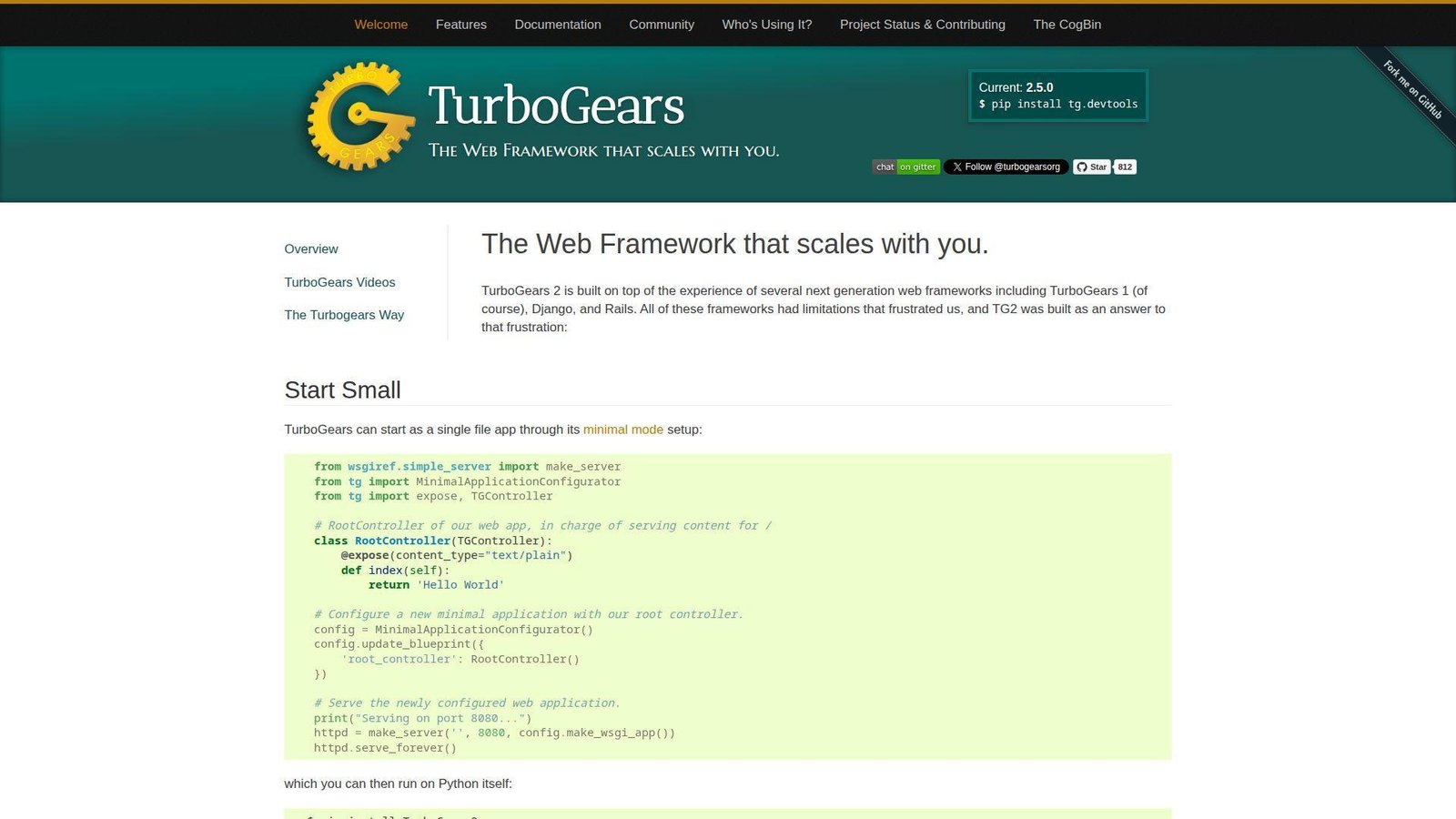
TurboGears remains a live Python web framework with a hybrid identity that can work in minimal or fuller-stack modes. Best for: teams that like classic Python web engineering and want more structure than Flask without adopting Django’s full set of defaults.
- Microframework and full-stack modes in one project line → you can start lean and keep a path upward.
- Controllers, templating, ORM support, and tooling → fewer setup decisions than a bare microframework.
- Quickstart plus Gearbox tools → first scaffold arrives fast enough for a serious evaluation.
From $0/mo. There is no trial because TurboGears is free and open source. There are no built-in project or seat caps in the framework, which keeps adoption simple for teams already comfortable with self-hosted Python stacks.
Honest drawbacks: mindshare is much smaller than Django, Flask, or FastAPI. That affects tutorials, package examples, and how easy it is to hire someone who has touched it before.
Verdict: If you want a less fashionable but still capable Python web option, TurboGears is more alive than many developers assume. It beats Flask on full-stack path and trails Django on community gravity.
18. CubicWeb
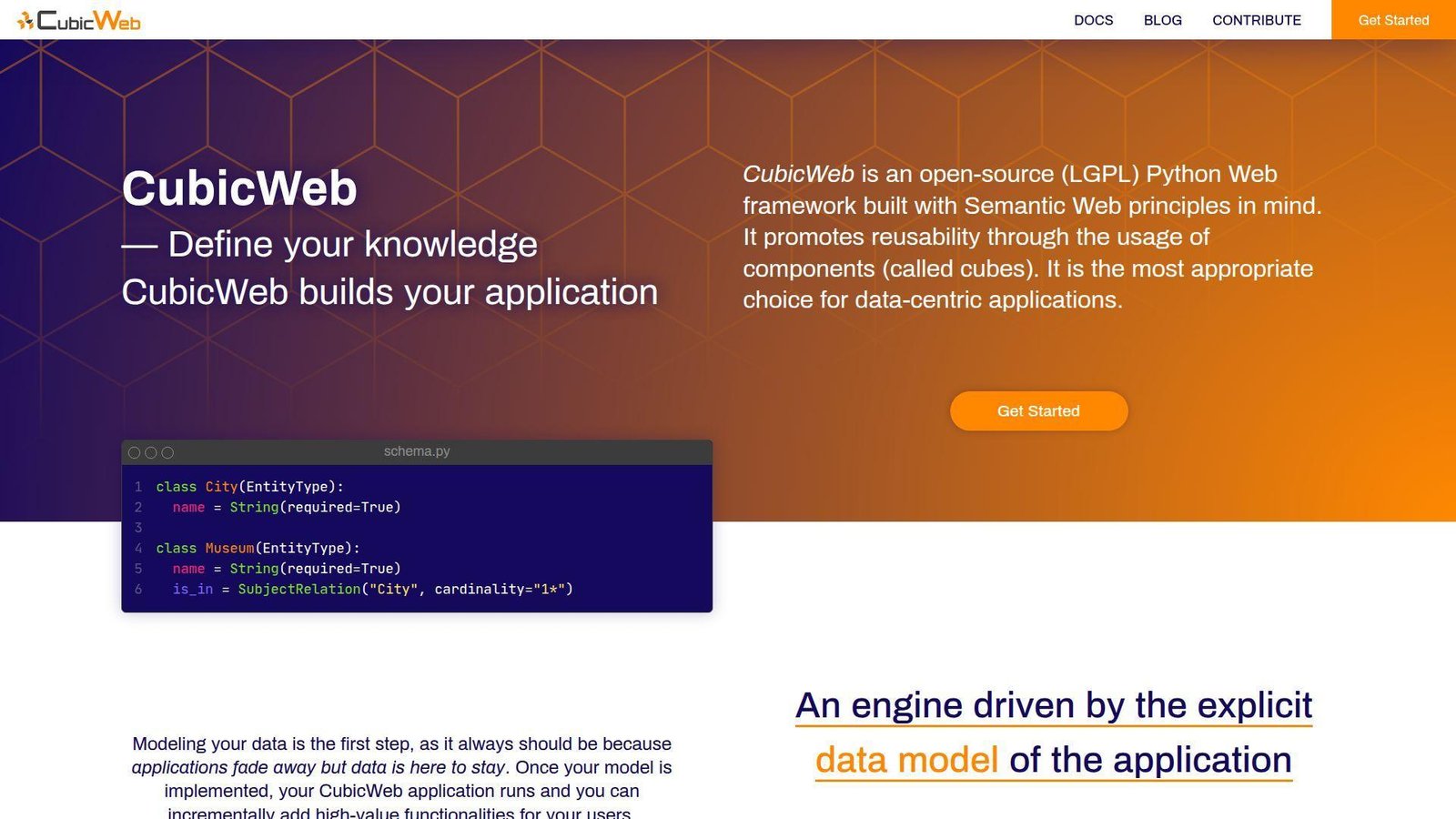
CubicWeb is a Logilab-led framework built around data modeling, entity relationships, and knowledge-heavy applications. Best for: teams building archives, research platforms, knowledge systems, and other data-centric applications where relationships are the product.
- Schema-first entity and relation modeling → complex data structures become a first-class design concern instead of an afterthought.
- Security tied closely to the data model and query layer → permission logic takes fewer custom steps in relationship-heavy systems.
- Reusable cubes and data-oriented architecture → early setup takes effort, but long-term domain structure can stay cleaner.
From $0/mo. There is no trial because CubicWeb is open source. The framework itself has no seat cap, but it is specialized enough that your real limit is team familiarity and willingness to adopt its worldview.
Honest drawbacks: this is not a mainstream general web framework. If your team thinks in standard Django or Flask patterns, CubicWeb will feel like a bigger conceptual jump than most alternatives.
Verdict: If your hardest problem is linked, permission-sensitive data, CubicWeb can be a better fit than a generic web framework. It beats mainstream tools on data modeling and trails them on hiring familiarity.
19. web.py
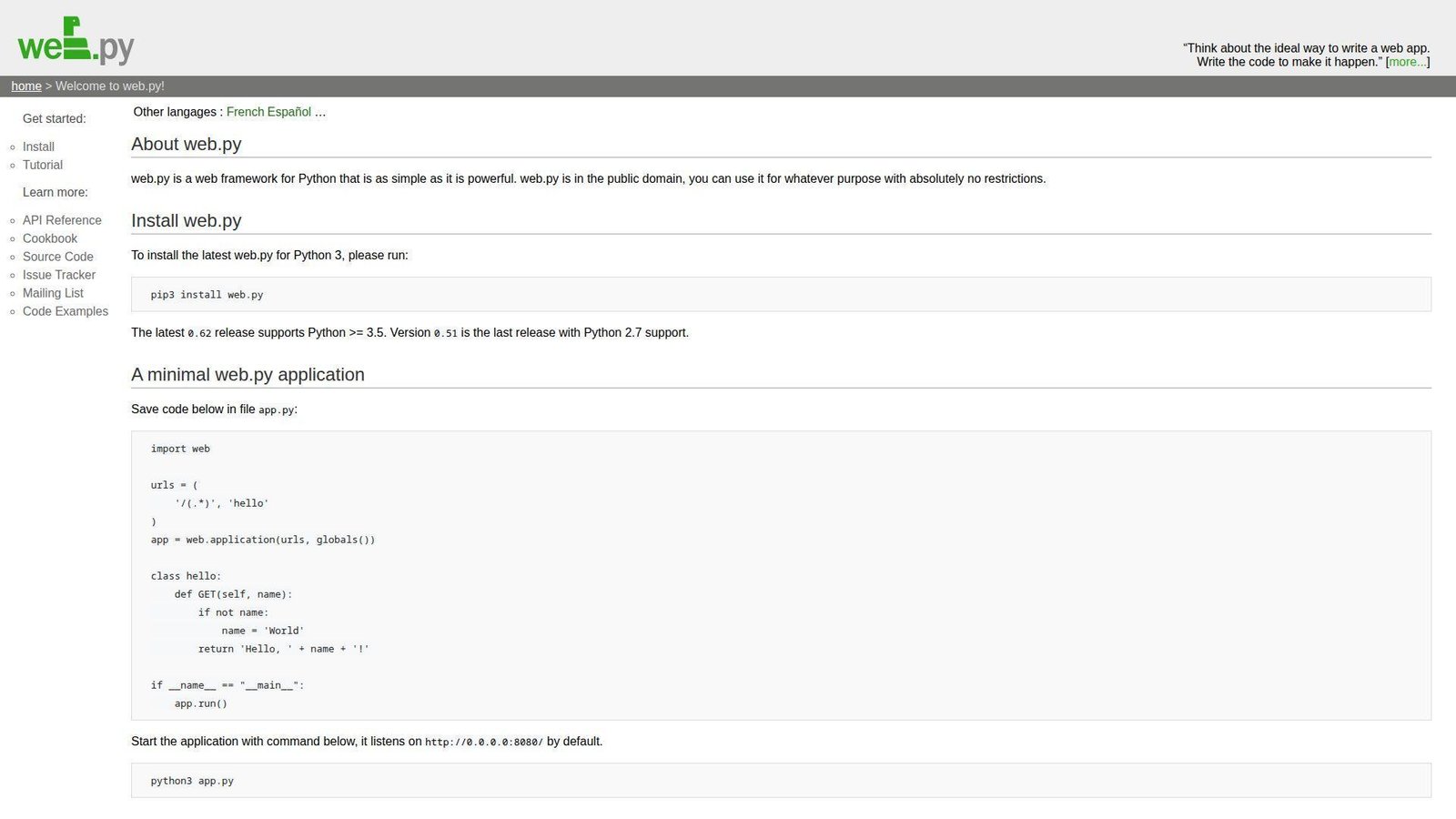
web.py started with Aaron Swartz and is now carried by a small maintainer group that keeps its tiny, direct style intact. Best for: hackers, side projects, and developers who want a framework that feels close to plain Python.
- Tiny API surface → request flow and routing stay easy to understand.
- Plain-Python approach → there is less framework-specific language to learn before writing useful code.
- Minimal setup → first working app usually takes minutes.
From $0/mo. There is no trial because web.py is a free package. There are no built-in seat or app caps, but there is also far less built-in product infrastructure than teams usually want for larger systems.
Honest drawbacks: the ecosystem is thin and the pace is quiet. If you need async-first design, admin, batteries-included security layers, or a deep extension market, you will feel the limits quickly.
Verdict: If you want the lightest old-school Python web experience possible, web.py is still appealing. It beats heavier stacks on readability and trails almost every modern option on ecosystem depth.
20. Lona
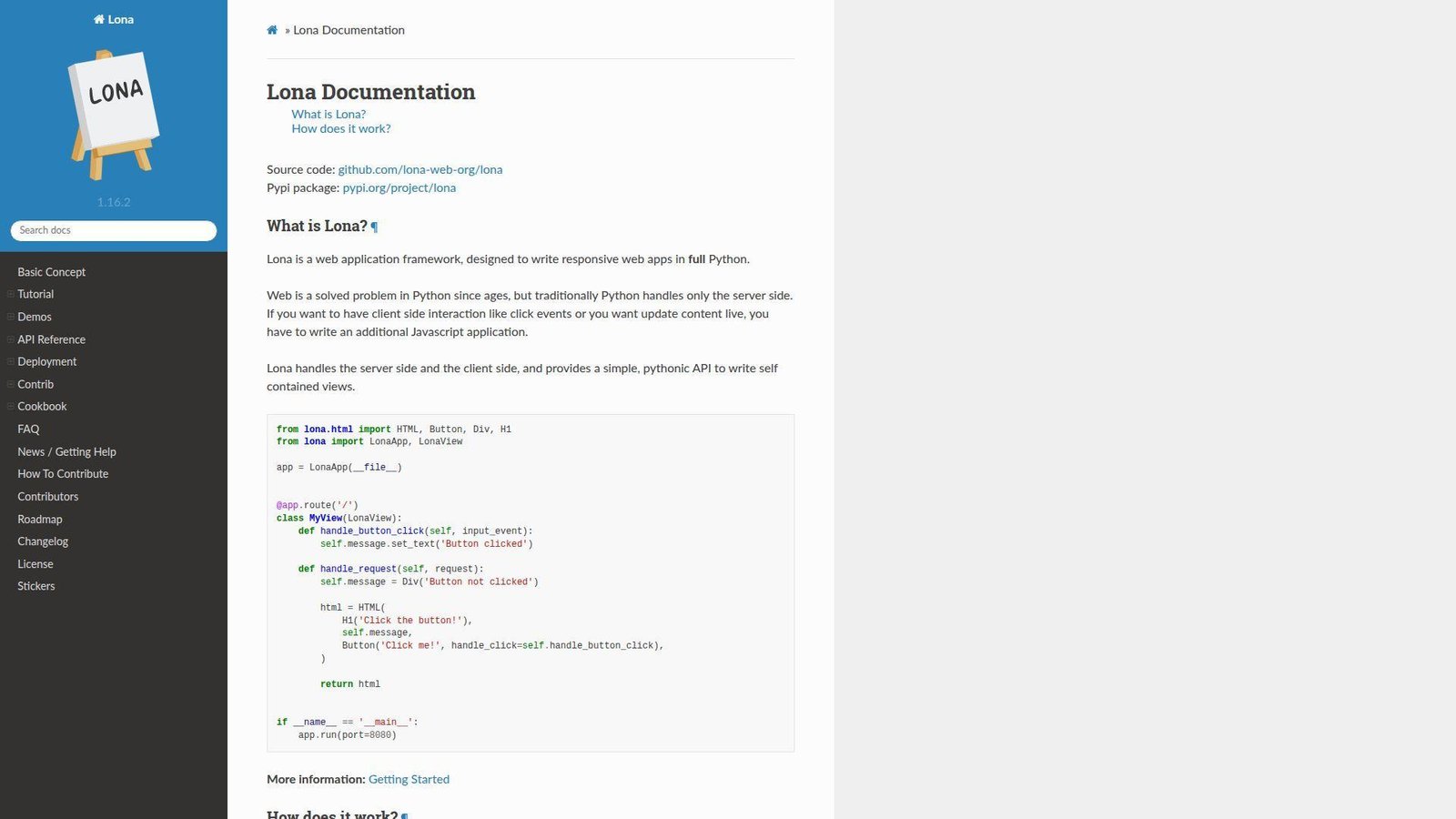
Lona was created by Florian Scherf and sits in a niche corner of the Python world focused on reactive web apps written mostly in Python. Best for: Python developers building internal tools and teams that want more interactivity than Streamlit-style pages without writing much JavaScript.
- Server-driven reactive app model → you can build interactive views while staying largely in Python.
- Frontend protocol and live interaction support → fewer custom steps than bolting a separate JavaScript app onto a Python backend.
- Focused docs and demos → first interactive app can arrive quickly if the model fits your team.
From $0/mo. There is no trial because Lona is open source. There are no framework seat caps, and self-hosting is yours to control, but the ecosystem is small enough that you should expect more self-reliance than with bigger names.
Honest drawbacks: the community is niche, and highly custom front-end behavior still pushes you toward more mainstream web stacks. That makes Lona more of a deliberate specialist choice than a default recommendation.
Verdict: If you want a Python-first route to reactive interfaces, Lona is more interesting than its visibility suggests. It beats Streamlit on interaction model control and trails Reflex on broader commercial ecosystem support.
Recommended reading: Top 20 Free Website Hosting Providers and Builders for Beginners and Small Businesses
How to Choose Python Frameworks by Use Case
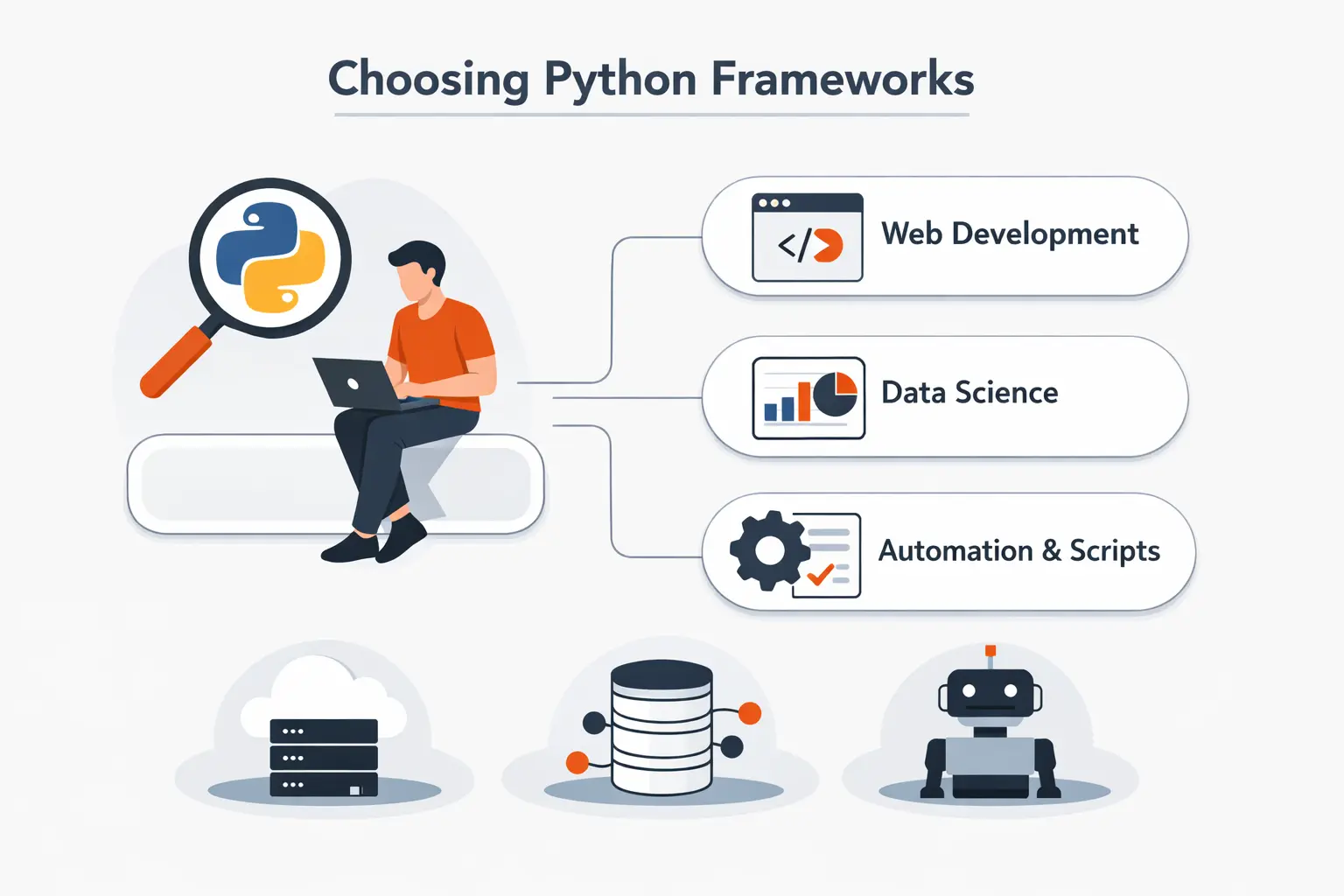
Choosing well is less about raw popularity and more about matching the framework to the job. We usually decide by five filters: product shape, concurrency needs, security burden, team skill level, and how expensive a rewrite would be if the first version works.
1. Full-Stack Python Frameworks for Secure, Scalable Web Apps
When a product needs accounts, admin screens, forms, ORM-backed data, and security defaults, we start with Django. Its built-in admin and security posture reduce the amount of infrastructure a team has to invent. We look at TurboGears when a team wants a classic full-stack path with more flexibility, and Pyramid when the app is expected to grow into a custom architecture over years instead of quarters.
The buying question is simple. Do you want a framework that decides more up front, or one that asks your team to decide more later? For most business apps, Django is still the safest answer because secure defaults and boring CRUD are where budgets either stay healthy or quietly leak away.
2. Microframeworks for Lean MVPs and Flexible Customization
Flask is still our default microframework recommendation because it stays small without feeling toy-like. Bottle and web.py are better fits when you want tiny footprint and very direct control. CherryPy sits in a slightly different spot because it gives you more server-side tools in an object-oriented style. The trade-off with all of them is the same: you move faster at the start, then pay back that freedom with architecture work once auth, admin, jobs, and standards pile up.
3. API-First and Async Frameworks for High-Concurrency Services
For typed JSON APIs, FastAPI is our first stop because it bundles validation, docs, and a clean developer experience. Starlette is the lighter toolkit choice when you want more control and less opinion. Falcon works well when explicit REST behavior and low overhead matter.
Tornado and aiohttp are the frameworks we reach for when the connection model itself is the product problem. If you are building websockets, gateways, streaming services, or high-churn async integrations, those two deserve more attention than they usually get in generic “best framework” lists.
4. Data and AI Frameworks for Dashboards, Models, and LLM Workflows
For internal analytics, quick adoption matters. Streamlit says it is trusted by over 90% of Fortune 50 companies, and that matches what we see in practice. It wins when a Python-heavy team needs a usable interface without staffing a separate front-end program first.
Dash is the stronger pick when the app is really a controlled analytics product and not just a fast demo. Plotly’s hosted free tier starts with 1 publicly viewable app, which is fine for evaluation but not enough for a serious private stakeholder rollout.
For agentic and LLM-heavy work, tooling quality now matters almost as much as model quality. LangSmith’s free developer plan includes 5k base traces / mo, which makes early debugging affordable, but you should expect to outgrow that quickly once multiple teams or workflows are involved.
We also think Python-only UI stacks are becoming more credible. Reflex highlights Autodesk saving 25% of their development time, which helps explain why teams that do not want a split Python-plus-React org are taking a closer look at it.
For the model layer itself, our rule is plain. PyTorch is the easier choice for experimentation and fast iteration. TensorFlow becomes more attractive when the conversation shifts toward repeatable pipelines, edge deployment, or broader ML platform standardization.
5. Documentation, Community, Security, and Long-Term Ecosystem Fit
We never judge a framework only by how elegant the hello-world feels. We want evidence that the ecosystem can stretch. TensorFlow’s published case studies include scientific workloads scaled to 27,000+ Nvidia V100 Tensor Core GPUs, which tells us the ecosystem still matters for industrial ML even if your own project is far smaller.
In ordinary product work, long-term fit usually comes down to boring things: docs quality, hiring pool, package choice, security guidance, and release confidence. That is why Django, Flask, FastAPI, PyTorch, and TensorFlow keep showing up. Bigger ecosystems are not always better, but they are often safer when a project moves from prototype to payroll.
Recommended reading: Top 20 Free Digital Business Cards for Easy Networking and Better Contact Sharing
Frequently Asked Questions About Python Frameworks
These are the questions we hear most often once a shortlist becomes a real buying or architecture decision. The answers are short, but the trade-offs matter.
1. What Is the Most Used Python Framework?
There is no single winner across every subcategory. In our view, Django is still the default full-stack answer, FastAPI dominates many new API shortlists, and Flask remains common because it is easy to learn and easy to bend into custom stacks.
2. Is Flask Still Relevant in 2026?
Yes. As of May 14, 2026, Flask still has current stable documentation and a clear place in the market. We would not choose it for every project, but it remains one of the best starting points for lean web apps and custom Python stacks.
3. Is Django a Framework or a Library?
Django is a framework. More specifically, it is a high-level Python web framework with strong built-in conventions around data models, templates, auth, admin, and security.
4. Is web2py Dead?
As of May 14, 2026, we would call web2py dormant in the mainstream, not literally dead. The official site is still online and the GitHub organization still exists, but we almost never see it on serious greenfield shortlists now. That is an inference from its ongoing presence, not a statement that the project has no users.
5. What Is the Difference Between Django and Flask?
Django gives you a much more complete product framework from the start. Flask gives you a lighter core and asks you to assemble more of the stack yourself. We usually describe it this way: Django is faster when the app looks like a business product, while Flask is faster when the team wants more architectural freedom.
6. Which Python Framework Is Best for APIs?
FastAPI is our default answer for most new APIs because it combines validation, typing, security helpers, and docs cleanly. We would also shortlist Falcon or Starlette for leaner control, and Tornado or aiohttp when the hard problem is realtime connections or async network plumbing rather than standard CRUD APIs.
7. Which Python Framework Should Beginners Learn First?
For pure web basics, we still like Flask first because the request cycle is easy to see. Django is a smart first choice if you are a beginner who already knows you want to build full-stack web products. If the goal is APIs, start with FastAPI. If the goal is data apps, Streamlit is the fastest way to make something people can actually click.
8. Which Python Frameworks Are Best for Data Apps, Dashboards, and AI Tools?
We usually start with Streamlit for data apps. For more controlled analytical dashboards, Dash is stronger. PyTorch and TensorFlow still lead model development. For LLM workflows and agent tooling, LangChain is useful. For Python-first internal tools with more application structure, Reflex is now worth real consideration.
Recommended reading: Top 20 Best Website Builder Platforms for Your Next Site
How TechTide Solutions Supports Custom Python Development
Framework selection mistakes are rarely syntax mistakes. They are usually product mistakes. We get involved when a team is choosing between two or three good options and wants a grounded decision based on delivery speed, long-term maintainability, and business constraints.
1. Custom Web Apps, APIs, and Internal Tools Tailored to Your Needs
We build Python products around the job the software has to do, not around the loudest framework on social media. That means we may recommend Django for a secure back-office system, FastAPI for a service layer, Streamlit for an internal analytics tool, or a mixed stack when one framework should not be forced to do every job.
Our goal is simple. We want the first version to ship fast without making version two miserable.
2. Software Architecture and Framework Selection for Scalable Products
We help clients compare frameworks against concrete criteria: auth needs, concurrency model, data complexity, deployment shape, front-end expectations, team skill level, and compliance risk. If a framework saves time now but creates avoidable complexity in the next release cycle, we say so plainly.
That often means pressure-testing a shortlist with a small prototype before committing the whole product to it. A little skepticism up front saves a lot of rework later.
3. End-to-End Development Support From Planning to Optimization
We support the full path from discovery and architecture to implementation, testing, deployment, and performance tuning. We also help teams untangle older Python codebases that started in Flask, Django, or a microframework and now need a cleaner growth path.
If your team already has a shortlist, we can help you turn it into a real decision instead of another round of internal debate.
Recommended reading: Top 20 Free AI Flyer Generator Tools for Fast, Professional Designs
Conclusion: Choosing the Right Python Framework for Your Project
There is no single best Python framework. There is only the best match for the kind of product you are building right now. In our view, Django remains the safest full-stack default, FastAPI is the strongest API-first choice, Flask stays relevant for lean custom builds, Streamlit and Dash own different sides of the data-app space, and PyTorch, TensorFlow, LangChain, and Reflex matter when AI becomes part of the product instead of a side experiment.
If you are down to two finalists, ask one blunt question. Which framework removes the most custom work without boxing your team into a worse architecture next quarter? Start there, pressure-test the loser, and if you want a second opinion, bring us the shortlist.

