

In our world at TechTide Solutions, “web development” is less a single skill and more a living system: product thinking, design, code, infrastructure, data, and the unglamorous work of keeping everything running on Tuesday afternoon when nobody is watching. Done well, it turns a browser into a business channel—sales, support, operations, analytics, and sometimes the entire product itself.
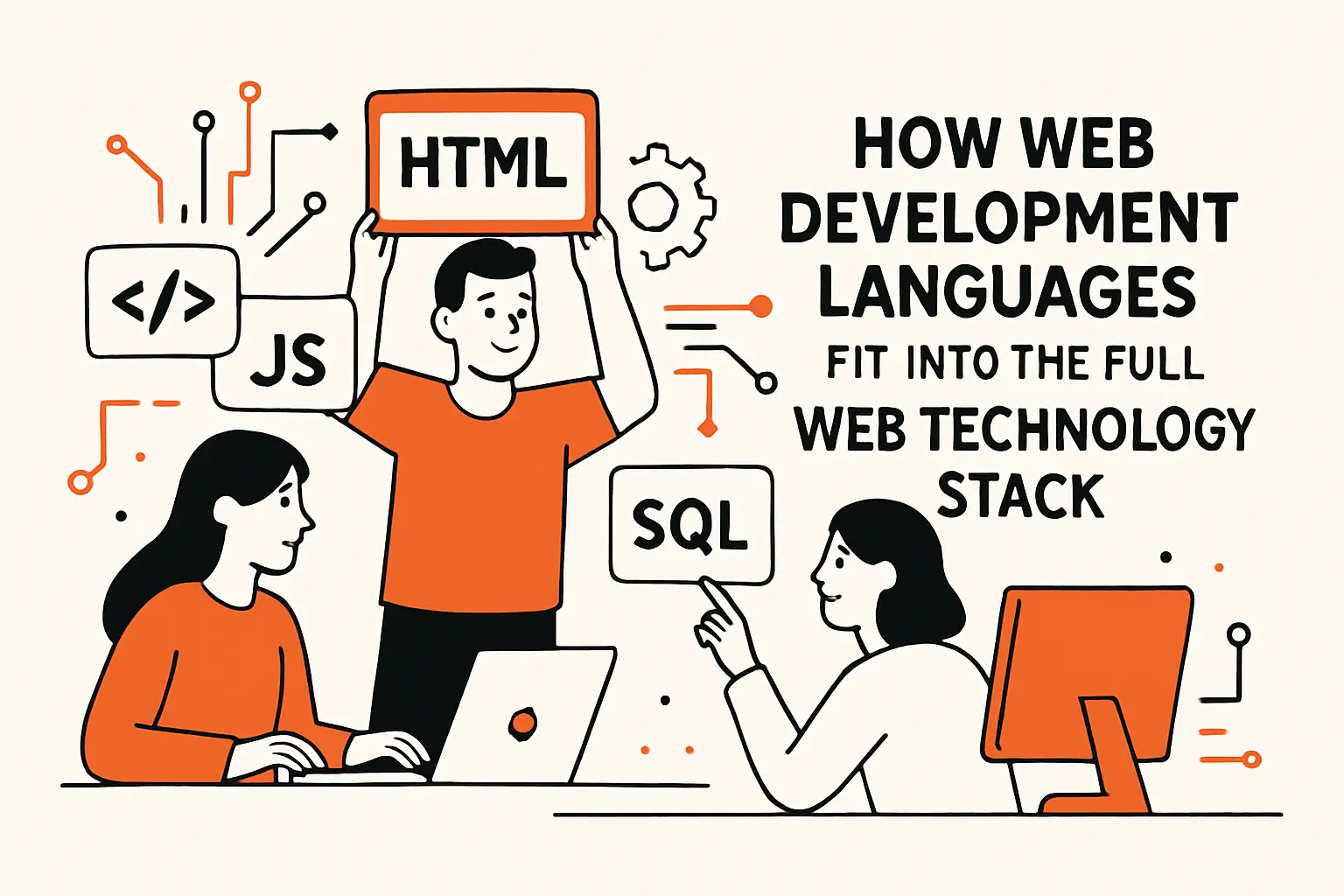
How web development languages fit into the full web technology stack
1. What “web development” includes: building, creating, and maintaining websites
Maintenance is where the language conversation becomes real. Choosing a stack isn’t only about building v1; it’s about debugging v17, onboarding new engineers, responding to security advisories, and making small safe changes under pressure. That is why we treat language decisions as operational decisions, not just developer preferences.
2. Frontend and backend as the two major areas of web development
Most teams naturally split web work into front end (what users see and interact with) and back end (what systems validate, calculate, store, and integrate). Front end languages are optimized for UI composition, accessibility, and responsiveness under unreliable networks and diverse devices. Back end languages are optimized for correctness, concurrency, observability, and integration with identity, payments, and data stores.
Across client and server boundaries, the architecture choice is often more important than the language. A thoughtfully designed API can let a React front end talk to a Python service today and a Java service tomorrow without forcing the UI team to rewrite everything. Put differently: boundaries create freedom, and freedom is what keeps businesses moving quickly without breaking everything.
3. Programming languages vs coding languages and why the terms overlap in practice
Purists distinguish “programming languages” (general-purpose, expressive, computational) from “coding languages” (sometimes used loosely for markup or styling). In everyday delivery, teams use the words interchangeably because the work interlocks: HTML shapes the document, CSS shapes presentation, JavaScript shapes behavior, and the backend shapes the rules.
From a teaching perspective, we find it more helpful to talk about “layers of intent.” Markup describes meaning, styling describes appearance, scripting describes interaction, and server code describes business behavior and trust boundaries. When teams align on intent, they stop arguing about terminology and start shipping consistent experiences.
4. Version control and deployment as core parts of a reliable development workflow
Language knowledge alone doesn’t make software reliable; workflow does. Version control (almost always Git), code review, automated tests, and repeatable deployments are the difference between “works on my machine” and “works for customers.” In practice, every language choice also implies tooling choices—linters, formatters, test runners, dependency managers, and build pipelines.
Operationally, deployment strategy shapes how you code. A serverless backend nudges you toward stateless functions and fast cold starts, while containerized services nudge you toward explicit configuration, health checks, and predictable resource usage. Once deployment is treated as a first-class feature, language decisions get clearer because the constraints become visible.
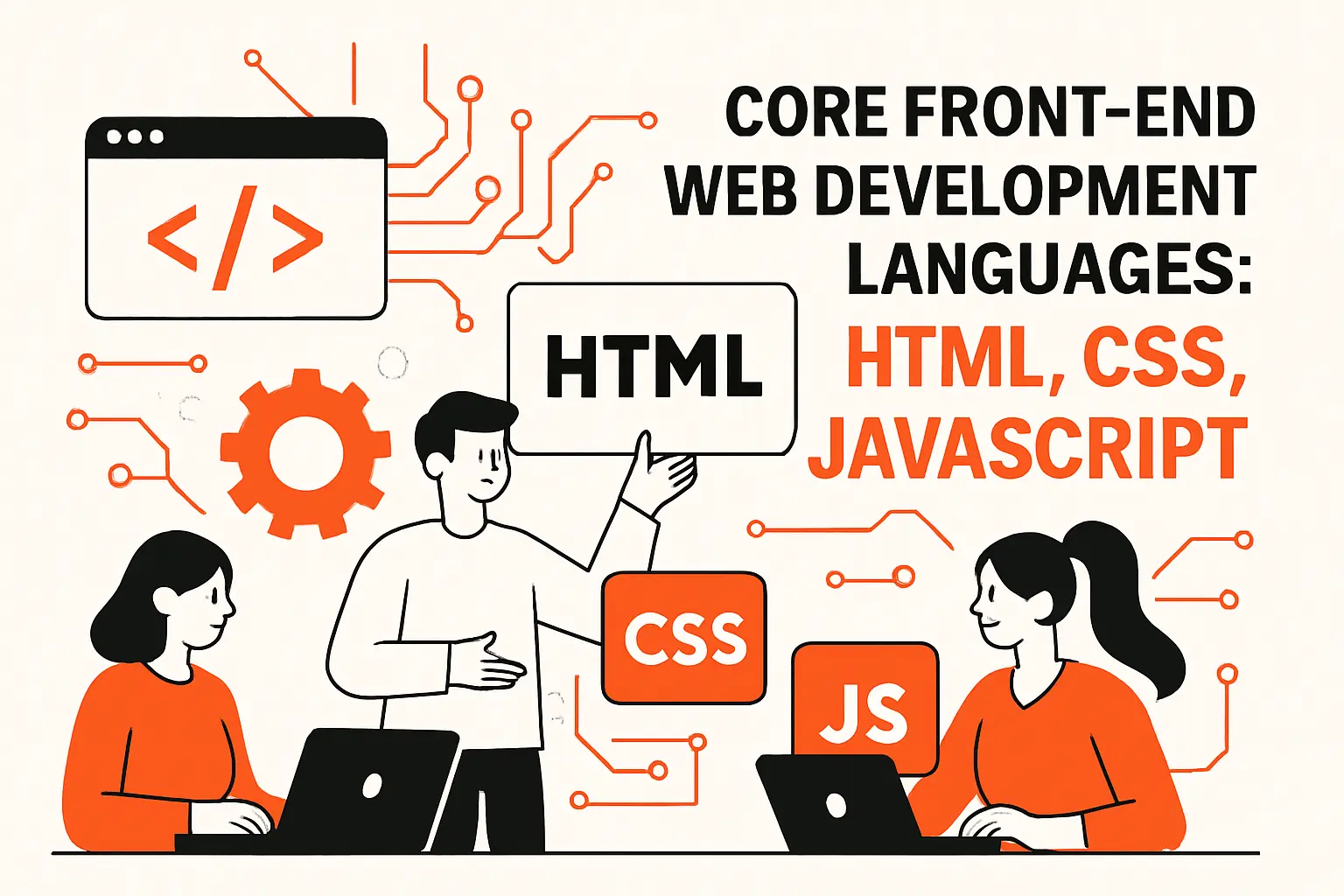
Core front-end web development languages: HTML, CSS, and JavaScript
1. HTML HyperText Markup Language for page structure and content
HTML is the contract between your content and the browser. Semantics are not “nice-to-have”; they shape accessibility, SEO, and long-term maintainability. In our audits, the most expensive UI rewrites often start with an HTML foundation that treated everything like a generic container instead of a document with structure.
Practically, strong HTML makes everything else easier. As a result, CSS selectors stay simpler and JavaScript event handling becomes more predictable. Meanwhile, assistive technologies can interpret intent without hacks. When teams use semantic elements consistently, they avoid brittle ARIA workarounds and make UI refactors less intimidating.
2. CSS Cascading Style Sheets for layout, typography, colors, and visual styling
CSS is frequently underestimated because it “looks easy” until a design system scales. Specificity, inheritance, and the cascade are powerful, but they also punish inconsistency. In product teams, CSS architecture is where “quick fixes” quietly turn into a long-term tax on every UI change.
Good CSS today is about constraints: tokens, spacing scales, component boundaries, and predictable layering. From our perspective, the right goal is not “perfect visual output,” but “controlled change,” because businesses change branding, add features, and localize content far more often than they redesign from scratch.
3. JavaScript for interactivity, dynamic behavior, and rich user experiences
JavaScript is the language of the browser runtime, so it’s the unavoidable engine behind interactivity: form validation, dynamic navigation, offline-first behavior, real-time updates, and UI state. For businesses, it’s also the bridge between product intent and user experience—where friction either disappears or multiplies.
Technically, the biggest JavaScript lesson is that the browser is an event-driven environment. Event loops, async I/O, and rendering lifecycles mean that performance problems often look like “random slowness” unless teams measure them. When we see a page that “feels heavy,” we usually find avoidable re-renders, oversized bundles, or chatty network calls—not a lack of talent.
Why JavaScript’s ubiquity changes stack decisions
Because JavaScript runs on almost every modern site, it becomes a hiring and ecosystem advantage. W3Techs reports that 98.9% of all the websites use JavaScript as a client-side programming language, which means your developers, tools, and debugging workflows tend to converge around it.
4. TypeScript as a JavaScript superset that adds type declarations and better tooling support
TypeScript is the adult conversation many JavaScript teams eventually need. Static typing and richer tooling reduce whole categories of production issues: mismatched API payloads, misused component props, and refactors that silently break edge cases. In larger organizations, TypeScript also becomes a communication tool—turning assumptions into compile-time feedback.
Tradeoffs still exist. Compile time, type complexity, and “type gymnastics” can slow teams if conventions aren’t agreed upon. When we introduce TypeScript into an existing codebase, we typically focus on the boundaries first—API clients, shared models, and core UI components—because that is where correctness has the highest business impact.
5. Browser graphics with JavaScript: Canvas and SVG
Canvas and SVG are the two workhorse graphics models in the browser. SVG behaves like a retained-mode scene graph—elements exist, can be styled, and can respond to events—so it’s great for icons, diagrams, and interactive charts that need accessibility hooks. Canvas is immediate-mode—pixels are painted—so it’s better for dense animations, games, and data visualizations that must push many frames efficiently.
From a business lens, the graphics choice is less about cool demos and more about maintainability and user needs. If the visualization must be searchable, selectable, and accessible, SVG tends to win. If the experience is about speed and fluid motion, Canvas tends to win, provided the team can invest in performance testing and careful rendering strategies.
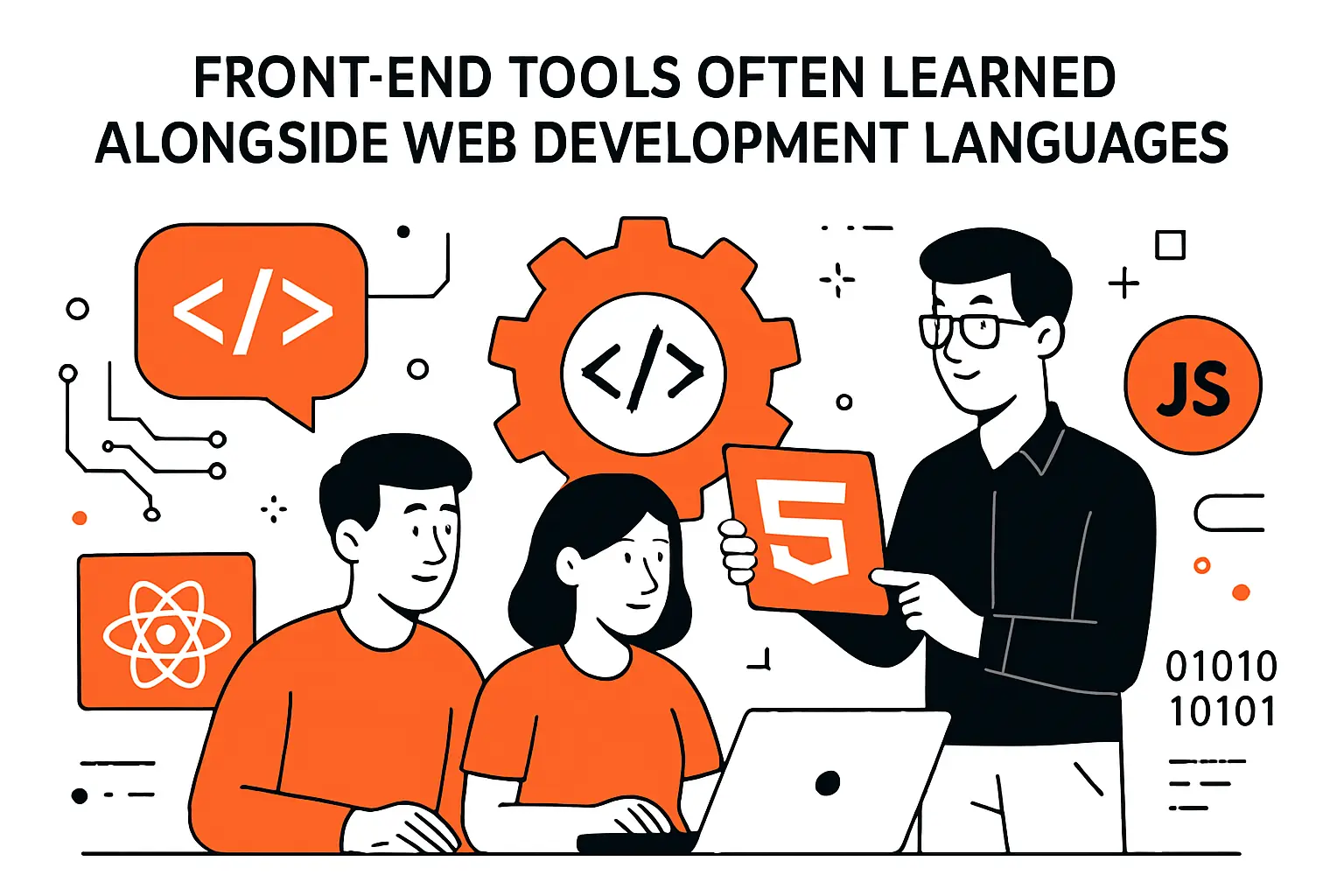
Front-end tools often learned alongside web development languages
1. React for building user interfaces with reusable components and state management
React’s core value proposition is composability: UIs built from components that can be reused, tested, and evolved. In real products, that maps directly to business reality—features ship iteratively, and UI surfaces expand across dashboards, admin panels, customer portals, and embedded experiences. Component systems keep that growth from becoming chaos.
In our experience, React teams succeed when they treat state as a design problem, not just a library choice. The hardest bugs aren’t “how do we render,” but “who owns this data,” “when is it stale,” and “what happens if the request fails.” When those rules are explicit, React becomes a clean canvas for product iteration instead of a tangle of effects.
Governance matters more than hype
Long-term framework stability is a business risk question, not a social media question. Meta has described how React and React Native are transitioning to a foundation model in Introducing the React Foundation: The New Home for React & React Native, and we read announcements like that as signals about stewardship and ecosystem resilience.
2. Vue for flexible UI development and a gentle learning curve
Vue often shines when a team wants productivity without a heavyweight mental model. Its template syntax feels approachable, and its incremental adoption story works well for companies modernizing a legacy UI gradually rather than rewriting everything. In migrations, that incremental path is frequently the difference between “we improved the product” and “we got stuck in rewrite purgatory.”
Architecturally, Vue handles the same core realities as other modern frameworks. It supports component boundaries, client side routing, state management patterns, and testing strategies. What feels different is often cultural, not technical. Many teams find it easier to keep velocity high with Vue. They often do that without a large platform team enforcing patterns from day one.
3. Angular for scalable and maintainable web applications with an opinionated toolkit
Angular is the “batteries included” choice: consistent patterns, dependency injection, and strong conventions. For organizations building large internal tools—workflow-heavy apps, admin consoles, and regulated enterprise UIs—opinionation can be a feature. A predictable architecture reduces internal variance, which reduces maintenance cost.
That same opinionation can feel heavy for small teams shipping quickly. When we evaluate Angular, we ask whether the project needs strong guardrails: consistent module structure, standardized testing, and a cohesive dependency strategy. If the answer is yes, Angular can help prevent long-term entropy that otherwise shows up as fragile builds and inconsistent UI behavior.
Back-end web development languages and server-side environments

1. JavaScript with Node.js for server-side services and APIs
Node.js lets JavaScript run on the server. That is compelling for teams who want one language across front end and back end. Shared validation logic, domain types, and developer skills reduce friction. This matters most in early-stage products, where iteration speed can be existential.
Under the hood, Node’s event-driven model rewards asynchronous I/O and careful error handling. When we build Node APIs, we invest heavily in observability, request timeouts, and resource controls because a single blocked event loop can degrade performance for many concurrent users. Put another way: the model is powerful, but it demands discipline.
2. Python for back-end development, including Django for full-featured web applications
Python remains a practical backend language. It is expressive, widely taught, and backed by mature libraries. Those libraries cover web development, data work, automation, and AI adjacent tasks. For businesses, that makes Python a useful bridge. It connects product features with analytics pipelines, experimentation systems, and internal automation that keeps operations lean.
Framework choice shapes the experience. Django is a “batteries included” web framework—ORM, admin, authentication patterns—so it can accelerate delivery for teams building CRUD-heavy apps or internal platforms. Meanwhile, lighter frameworks can be better when the API surface is the product and architectural control matters more than built-in conveniences.
3. PHP for server-side scripting and database-backed dynamic web pages
PHP is still a serious part of the web’s real estate, and ignoring it is more ideology than strategy. The modern PHP ecosystem (with frameworks, dependency management, and testing culture) supports maintainable systems—especially in content-driven businesses, ecommerce, and marketing-heavy organizations where CMS integration is a first-class requirement.
Market reality is blunt: W3Techs reports that 72.4% of all the websites whose server-side programming language we know use PHP, which makes it both a legacy surface area and a hiring ecosystem. When we inherit PHP systems, our playbook focuses on boundaries, test coverage, and incremental modernization rather than reckless rewrites.
4. Java and C# for scalable, platform-driven back-end development
Java and C# tend to dominate when organizations care about long-lived services, predictable performance, and strong enterprise tooling. These ecosystems shine in regulated environments and large organizations because they pair mature frameworks with strong monitoring, dependency management, and security practices.
From a platform view, Java and C# also align naturally with polyglot microservice architectures. Teams can expose stable APIs while evolving implementation details, and platform engineers can standardize deployment, logging, tracing, and identity across many services. When the business expects the system to exist for years, boring consistency becomes a competitive advantage.
5. Ruby and Ruby on Rails for building web apps with an established framework ecosystem
Rails is famous for developer productivity: conventions, scaffolding, and a cohesive framework that encourages shipping. For startups and internal products, that speed matters because learning is the real output early on. In those settings, Ruby can be a strong choice when the team values clarity and iteration over micro-optimizing throughput.
Scaling Ruby systems is absolutely possible, but the path looks different than in JVM ecosystems. Successful Rails teams invest in caching, background jobs, and database performance tuning early, and they often split workloads into services as complexity grows. When we evaluate Rails, we ask whether the organization is prepared to treat data modeling and performance as continuous work.
6. Additional options used in web development: Go, .NET, Kotlin, Swift, and Perl
Go shows up when teams want simple concurrency, fast builds, and predictable deployment artifacts. Kotlin is often chosen when teams want modern language ergonomics while staying close to Java and the JVM ecosystem. Swift appears in web-adjacent scenarios when Apple platform work intersects with web services and shared business logic.
Perl is less common in new builds, yet it still exists in automation-heavy environments and long-running internal tooling. The practical takeaway is that “web development language” is rarely a single answer; it’s a portfolio decision driven by constraints, staffing, and the maturity of the organization’s operational practices.
Databases, APIs, and data formats that web developers rely on
1. Why web applications use databases to store and organize user data, content, and transactions
Most web apps exist to remember something: users, subscriptions, orders, content, permissions, and events. Databases are where business truth lives, and that makes data modeling a business decision disguised as a technical one. In delivery work, we treat schema design as product design because it shapes what features are easy, what reports are possible, and what compliance stories are defensible.
Reliability also starts at the data layer. A perfectly coded UI cannot compensate for inconsistent data constraints, missing indexes, or unclear ownership of records. When teams struggle with “mysterious bugs,” the root cause is often an ambiguous data model rather than a missing framework feature.
2. Relational SQL databases: table-based data with MySQL and PostgreSQL
Relational databases remain the default choice for transactional systems because they enforce constraints and support expressive queries. MySQL and PostgreSQL are common because they are mature, well-understood, and supported across cloud providers. For most line-of-business applications, the relational model fits naturally: orders contain line items, users have roles, invoices have payments.
In practical engineering, SQL success is less about choosing “the best database” and more about designing predictable access patterns. Indexing strategy, query shape, and connection management determine whether a system feels snappy or sluggish. When we diagnose performance, we often find that a few carefully designed queries beat a pile of application-side filtering every time.
3. NoSQL databases for flexible scaling: MongoDB, Cassandra, and Redis
NoSQL is not a single category; it’s a set of tradeoffs. Document stores like MongoDB can reduce friction for rapidly changing schemas and nested data. Wide-column stores like Cassandra can fit high-throughput event workloads. In-memory systems like Redis can radically improve perceived performance when used for caching, rate limiting, or ephemeral session data.
What we push teams to decide upfront is the consistency story. Some business domains demand strict transactional correctness; others can tolerate eventual consistency if it buys throughput and resilience. When the organization names those requirements early, database selection stops being religious and becomes a clear mapping from business risk to technical design.
4. APIs and data exchange formats for web communication: JSON and XML
APIs are the seams that let products evolve without rewrites. JSON dominates modern web APIs because it maps naturally to JavaScript objects and is lightweight to parse, while XML persists in enterprise integrations, legacy systems, and some regulated data interchange workflows. The best teams treat the API contract as a product: versioning, documentation, backward compatibility, and clear error semantics.
In our builds, the most important “format decision” is consistency. A predictable API style reduces onboarding time and prevents subtle bugs that only show up in production. Once contracts are stable, teams can change languages behind the API boundary without forcing customers—or internal consumers—to pay the migration cost.
Web development languages in 2026: what the Stack Overflow survey and other lists highlight
1. Stack Overflow 2025: Python adoption accelerated from 2024 to 2025
Developer surveys are imperfect, but they are useful as trend signals—especially when they align with what we see in client work. Python’s momentum is not just about web backends; it’s also about the gravitational pull of AI tooling, data workflows, and automation scripts that leak into production services over time.
Stack Overflow’s technology section explicitly notes that Python saw 7 percentage point increase from 2024 to 2025, and Rust is yet again the most admired programming language (72%), and we interpret that as a sign that modern web teams are being shaped by two forces at once: rapid product iteration and a renewed interest in correctness and performance.
2. Stack Overflow 2025: Rust remains the most admired programming language
Rust’s “most admired” reputation matters even if your company never ships a line of Rust. Admiration often signals developer experience: safety, tooling quality, and confidence during refactors. When a language earns loyalty, it tends to influence adjacent ecosystems through ideas—type safety, better package management, and stricter build discipline.
From our perspective, the more interesting business implication is hiring and retention. Engineers gravitate toward stacks that feel modern and safe, and teams that ignore that reality sometimes struggle to keep senior talent engaged. Even without adopting Rust broadly, borrowing its mindset—explicitness, correctness, and performance measurement—can raise engineering standards across the stack.
3. BrowserStack 2025: JavaScript remains the most popular language for web development, with Python and TypeScript gaining traction
Most “top languages” lists are partly educational content and partly market observation, yet they can still help teams communicate a shared baseline. BrowserStack frames the current landscape clearly by stating that JavaScript remains the most popular language for web development, but other languages like Python and TypeScript are quickly gaining traction for their unique advantages, and we agree with the spirit of that claim because it matches what we see in modern product roadmaps.
In delivery, the traction story often looks like this: JavaScript (and increasingly TypeScript) dominates UI and full-stack prototypes, while Python becomes a bridge into data-heavy features and AI-enabled workflows. When those worlds meet, the winning teams are the ones who design clean interfaces—APIs, event streams, or shared schemas—so that language differences don’t become organizational bottlenecks.
4. BrowserStack 2025: 13 best web development languages list and how it spans both front-end and back-end needs
A mixed list that includes HTML, CSS, JavaScript, and server-side languages makes a subtle point: web development is inherently cross-layer. Markup and styling are not “lesser” skills; they are foundational, and backend languages are not optional if the product needs identity, payments, or persistence. That blend reflects how real teams work—switching contexts constantly between UI detail and system behavior.
Our practical advice is to treat lists as a map, not a mandate. The “best language” is rarely best in isolation; it’s best in a system that includes deployment, monitoring, security practices, and a team that can maintain it. Once those conditions are acknowledged, a list becomes useful as a starting point for stack conversations rather than a final answer.
Real-world usage patterns: popular websites and community advice
1. Why large, dynamic websites commonly use a mix of client-side coding, server-side coding, and database technology
Large sites are rarely monoliths in a single language because product complexity forces specialization. A modern web experience usually includes a client application, multiple backend services, caching layers, search infrastructure, analytics pipelines, and a database strategy that separates transactional truth from derived views. Each layer has different performance and reliability constraints, so language diversity becomes a rational outcome.
What matters more than the specific mix is the contract discipline between parts. Clear APIs, stable data models, and consistent observability let a system evolve safely. When those foundations are weak, adding another language amplifies confusion; when they are strong, adding another language can be a healthy way to choose the right tool for a specific job.
2. Examples from major sites: Google, Facebook, YouTube, WordPress.com, and Netflix
Big platforms are famously polyglot, and we view them as proofs of principle rather than templates to copy. Google’s ecosystem spans multiple languages because different products optimize for different constraints: performance-critical systems, rapid internal tooling, and massive-scale distributed services. Meanwhile, Facebook’s influence on front-end engineering is visible in the React ecosystem and its broader component-driven design patterns.
WordPress.com reflects how durable “web classics” can be, since W3Techs reports that 43.0% of all the websites, that is a content management system market share of 60.1% use WordPress, underscoring how content-centric stacks keep winning in marketing-heavy and publishing-heavy business models. On Netflix’s side, we often point teams to the open-source DGS framework as an example of production-grade web API engineering described directly in GraphQL for Java with Spring Boot made easy.
3. Developer community guidance on learning order: start with HTML, CSS, and JavaScript, then expand to Node.js and beyond
Learning order matters because each layer builds intuition for the next. HTML teaches structure and accessibility thinking, CSS teaches layout and constraints, and JavaScript teaches interaction and state. That progression mirrors how browsers actually work, so the mental model stays coherent instead of becoming a memorized pile of framework commands.
Once the front-end core is in place, adding Node.js makes the full loop visible. Students start seeing requests, responses, authentication, data persistence, and deployment together. From there, another backend language feels easier to learn. The underlying web concepts already make sense. Only syntax and ecosystem change; the fundamentals stay the same.
4. When to add a second back-end language: Java as an option for scalable server-side systems
A second backend language becomes valuable when the organization hits a scaling inflection point. That usually means more teams, more services, stricter reliability expectations, and deeper integration needs. At that stage, standardization can reduce cognitive load across the stack. Meanwhile, a mature ecosystem makes security patching, monitoring, and dependency control more predictable.
Java is a common “second language” choice because it pairs strong performance with a huge ecosystem and enterprise-friendly tooling. In our experience, the decision works best when the team treats Java as part of a platform strategy—shared libraries, golden paths for service setup, and consistent operational patterns—rather than as a purely technical upgrade.
How TechTide Solutions helps teams deliver with web development languages
1. Custom software development built around real customer needs and product goals
At TechTide Solutions, we start with the user journey and the business constraint, not the framework logo. A customer portal has different needs than a real-time operations dashboard; an internal admin tool has different risk tolerance than a public signup funnel. Language selection only becomes meaningful once goals, timelines, and integration surfaces are clear.
In practice, we build a shared vocabulary with stakeholders: what “fast” means, what “secure” means, what “scalable” means, and what success looks like after launch. That clarity prevents teams from optimizing for the wrong thing—like shaving milliseconds off a page while ignoring the onboarding friction that actually loses revenue.
2. Language and stack selection for scalable, maintainable web applications
Stack selection is where we earn our keep, because tradeoffs are rarely obvious from tutorials. Team skill, hiring market, existing infrastructure, compliance needs, and integration complexity often matter more than raw benchmark performance. When those constraints are mapped, the right language choice usually becomes surprisingly narrow.
Instead of promising a “perfect stack,” we optimize for maintainability under change. That typically means clear boundaries, shared types where appropriate, strong testing discipline, and a deployment strategy that matches the team’s operational maturity. Under those conditions, a JavaScript-heavy stack, a Python-heavy stack, or a JVM-heavy stack can all be excellent.
3. End-to-end delivery: front end, back end, databases, APIs, and deployment
End-to-end delivery is where language decisions either pay off or fall apart. A clean React UI doesn’t help if the API is inconsistent; a fast Go service doesn’t help if the database model is ambiguous; a beautiful schema doesn’t help if deployment is manual and fragile. Real reliability emerges only when the entire pipeline is designed intentionally.
Operational readiness is part of “done” in our shop. Logging, tracing, error budgets, rollback plans, and security patch workflows are treated as features because they protect customer experience. When teams ship with those disciplines in place, they can evolve languages and frameworks over time without putting the business at risk.
Conclusion: building a practical roadmap for learning and using web development languages
1. Start with the fundamentals and layer complexity: structure, style, interactivity, then server-side
Fundamentals compound. Semantic HTML makes CSS simpler, disciplined CSS makes UI behavior easier to reason about, and solid JavaScript fundamentals make frameworks feel like tools rather than magic. Once that base is stable, server-side development becomes less intimidating because requests, state, and rendering already make sense.
For learners, the best roadmap is the one that produces working projects early. Building small, complete loops—page to API to database to deployment—creates intuition that no playlist can replace. Momentum matters, and nothing creates momentum like shipping something real.
2. Choose web development languages based on project requirements, team expertise, and performance needs
Language choice is strategy disguised as syntax. Requirements like real-time collaboration, heavy data processing, regulated compliance, or deep CMS integration naturally push stacks in different directions. Team expertise matters just as much, because the best language on paper becomes the worst language in practice if nobody can maintain it confidently.
From a market perspective, web budgets remain anchored in broader IT spending priorities: Gartner forecasted that Worldwide IT spending is expected to total $5.43 trillion in 2025, an increase of 7.9% from 2024, and we read that as a reminder that web language decisions sit inside larger investment cycles tied to cloud, security, and modernization.
3. Plan for real-world delivery: databases, APIs, version control, and deployment readiness
Planning for delivery means treating “the boring parts” as first-class: migrations, rollback strategies, data integrity, API versioning, secrets management, and automated releases. Languages are only as effective as the systems that surround them, and the surrounding systems are what keep revenue flowing when change arrives unexpectedly.
Next step: if we were choosing a learning path or a delivery stack together, which constraint would you want to optimize for first—speed to market, long-term maintainability, hiring simplicity, or raw performance under load?