
At Techtide Solutions, we treat “trending languages” as a business signal, not a popularity contest. Language momentum affects hiring velocity, cloud bills, security posture, and the long tail of maintenance that determines whether software becomes an asset or a tax.
Market context matters because language choices are downstream of budget reality: enterprise buyers are still funding modernization, data, and AI-heavy roadmaps, and Gartner forecasts worldwide IT spending will total $6.08 trillion in 2026 as organizations keep investing in platforms, infrastructure, and software delivery at scale.
What follows is how we (as builders, not armchair rank-watchers) reconcile the year’s leading indexes and surveys with hiring reality, architectural durability, and the on-the-ground developer experience that shows up in code reviews, incidents, and upgrades.
What “top trending programming languages” means in 2026: popularity, demand, and developer sentiment
1. Popularity signals vs. hiring demand vs. long-term maintainability
Popularity is the easiest metric to measure and the easiest to misread. Search volume, tutorial traffic, and social buzz often correlate with learning activity, not production readiness. Hiring demand, meanwhile, can lag actual usage because organizations rarely rewrite core systems just because a new language looks elegant on a conference slide.
Maintainability is where we insist on being stubborn. A language can be trendy and still be costly if it encourages fragmented tooling, unstable dependencies, or a culture of “ship now, patch later.” In our delivery work, maintainability shows up as predictable build pipelines, manageable dependency graphs, reproducible environments, and a team’s ability to onboard without tribal knowledge becoming a bottleneck.
What We Look For Before We Call A Language “Strategic”
Beyond syntax, we evaluate the operational footprint: observability ergonomics, security scanning maturity, deployment friction, and how gracefully a stack handles version drift across services. When those pieces are weak, the language decision becomes an SRE problem disguised as a developer preference.
2. How major rankings and surveys measure momentum: usage, interest, and ecosystem activity
Rankings rarely measure the same thing. Some track “mindshare” (what people talk about), others approximate “installed base” (what legacy and current systems run), and surveys measure “self-reported work” (what respondents used recently). Each lens is useful, but only if we remember what it ignores.
Indexes are typically proxies: search engines, courses, books, job postings, Q&A activity, and vendor footprint. Surveys, in contrast, lean on respondent composition: industry mix, geography, seniority, and whether professional developers are overrepresented. Put bluntly, a language can look dominant in an index and still be a niche inside your local hiring market, or inside your domain (embedded, fintech, healthcare, gaming).
3. Community perspective: “popular” depends on your goals, domain, and constraints
“Popular” is not a universal good; it is a fit-for-purpose claim. A systems team optimizing latency budgets cares about determinism, memory control, and profiling tools. A data team cares about libraries, notebooks, and integration with warehouses and workflow orchestrators. A product team shipping web experiences cares about iteration speed, UI ecosystems, and the realities of browser and mobile distribution.
From our side of the table, we’ve watched teams win with “boring” languages because the ecosystem was stable, hiring was predictable, and operational patterns were well understood. Conversely, we’ve seen technically impressive stacks stumble because the organization underestimated staffing, tooling glue, and the ongoing cost of being early.
TIOBE Index January 2026: top trending programming languages and the biggest shifts from 2025

1. What the TIOBE Index measures and how to interpret it for strategy
TIOBE is best treated as an attention-and-availability indicator. Its methodology reflects signals like the number of skilled engineers, courses, and vendor activity, then leans on a broad set of web sources. That makes it useful for answering a pragmatic question: “If we bet on this, will we find people, training, and a durable ecosystem?”
Strategically, we like TIOBE when validating “mainstream viability,” not when forecasting technical superiority. A high rank can imply strong institutional adoption, which often means better enterprise tooling, more mature security practices, and more predictable long-term support. At the same time, the index can understate newer ecosystems that grow primarily through private repos, internal platforms, or AI-assisted development workflows.
2. January 2026 top languages snapshot: leaders, risers, and fallers
In the January 2026 snapshot, Python remains the gravitational center of general-purpose development, buoyed by AI, automation, and back-end usage, and TIOBE shows Python at 22.61% in its ratings scale, which aligns with what we see when clients ask for data-heavy features and rapid prototyping under business pressure.
Close behind, the “systems and platform” layer stays crowded: C-family languages keep their hold because performance, hardware adjacency, and decades of code don’t evaporate. Java and C# continue to matter because enterprises still run on them, and because both ecosystems have strong tooling and deployment storylines. Meanwhile, watchlist languages (not always top-ranked yet) tend to cluster around two themes we keep hearing in architecture reviews: safer systems programming and stronger typing for large codebases.
3. 2025 headline takeaways: C# Language of the Year, embedded strength for C, and watchlist moves like TypeScript and Zig
TIOBE’s year-over-year narrative is a reminder that “enterprise gravity” persists. C# earning a “language of the year” nod (in TIOBE’s framing) underscores how much modern .NET work has expanded beyond Windows-only assumptions, especially as cross-platform runtime realities improved and cloud-native patterns became routine.
Embedded strength for C is less about hype and more about physics: microcontrollers, constrained environments, and long product lifecycles reward simplicity and predictable performance. On the watchlist side, we see two different kinds of “next bets.” TypeScript is the bet on scaling teams and codebases with guardrails. Zig represents the bet on explicit control without inheriting every historical compromise of older systems languages, and its visibility rising in indexes mirrors the curiosity we hear from engineers tired of fighting build complexity.
Stack Overflow Developer Survey 2025: the languages developers actually used this year
1. Most-used languages by respondents: JavaScript, HTML/CSS, SQL, Python, and beyond
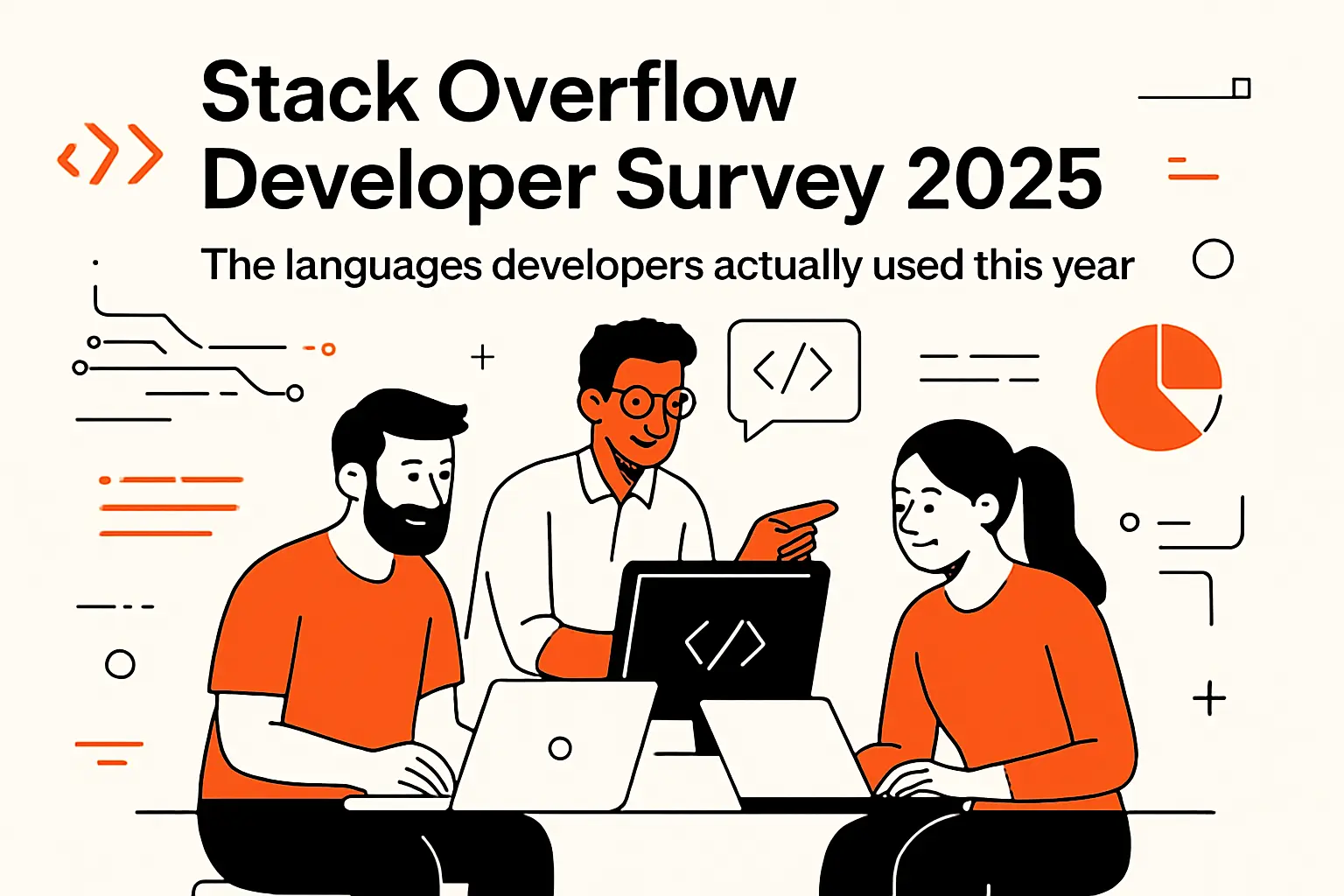
Survey “worked with” data is valuable because it highlights what developers touched recently, not what organizations merely list in a strategy deck. Stack Overflow’s results reinforce a practical truth: web languages and database skills remain foundational because most software products are, at some layer, a web app backed by data.
JavaScript and HTML/CSS show up because user interfaces ship value. SQL shows up because data persists, and someone must query and shape it. Python shows up because it has become the connective tissue between automation, analytics, and increasingly AI-adjacent application features. Beyond that core, the long tail includes enterprise stalwarts and fast-moving modern languages that teams pull in when specific constraints (performance, reliability, developer productivity) dominate.
2. Python’s acceleration: where growth is coming from across real-world work
Python’s momentum isn’t just a “data science story” anymore; it’s a “software delivery story.” In practice, teams reach for Python when they want fast iteration in services, jobs, prototypes that harden into products, or internal tooling that automates operational toil.
Stack Overflow’s own commentary calls out the shape of that momentum: Python’s adoption accelerated with a +7 percentage point jump from 2024 to 2025 as demand converged around AI-oriented work, back-end development, and general automation needs inside organizations that are trying to do more with leaner teams.
Our Practical Read
From our delivery vantage point, Python’s “acceleration” often begins as experimentation, then solidifies into production once teams put guardrails around dependency management, testing discipline, and performance boundaries. When those controls are missing, Python can still ship quickly, but the operational debt arrives on schedule.
3. How “worked with” and “want to work with” reveals early trend direction
The “worked with” set tells us what’s currently paying bills. The “want to work with” set is where trend direction becomes visible before it hits job postings en masse. When a language is heavily “desired,” we read it as an indicator of developer curiosity plus perceived career leverage, which can eventually translate into grassroots adoption inside teams.
In our own hiring and project intake conversations, desire often correlates with pain points: developers want stronger correctness guarantees, easier concurrency models, or tooling that makes large refactors less terrifying. That desire can be a leading indicator for what organizations will trial in greenfield services, even if the core platform remains on older, proven stacks for years.
Stack Overflow 2025 “Admired vs Desired”: where satisfaction and hype diverge
1. Most admired languages: Rust leads, with strong showings from newer and niche options
Admiration is one of our favorite signals because it often reflects lived experience: developers used a language and would choose it again. In that sense, admiration can be a proxy for ergonomics, reliability, and “how often did this make us regret our decision mid-project?”
Stack Overflow’s admired view continues to position Rust as a satisfaction leader, and the survey explicitly lists Rust as the most admired language at 72% in that category, which matches the pattern we see when teams prioritize memory safety and correctness under performance constraints.
2. High-interest growth signals: TypeScript, Go, Zig, Elixir, and other “next step” targets
High-interest languages tend to cluster around “next step” narratives. TypeScript is the next step for teams that built a JavaScript product and now need scale without chaos. Go is the next step for teams building infrastructure-facing services that value simplicity, fast builds, and predictable deployment. Elixir often appears when concurrency and resilience are central, especially for real-time experiences.
Zig sits in a different category: it’s frequently explored by engineers who want explicit control and modern tooling without inheriting all the complexity baggage of older ecosystems. In our experience, these “next step” targets usually enter organizations through a single service, a CLI tool, an internal platform component, or a performance-critical module that benefits from a sharper fit.
3. Reading the gap: when “desired” doesn’t match real adoption yet
A gap between desire and adoption doesn’t mean the language is a fad; it often means the migration path is hard. Enterprises can admire a language and still avoid it because training costs, hiring risk, and ecosystem gaps are real constraints. Regulated environments add additional friction when tooling maturity and compliance workflows matter as much as runtime performance.
We also see another gap driver in 2026: AI-assisted coding reduces the friction of trying a new language, but it does not remove the cost of operating that language in production. Toolchains, security scanning, dependency governance, and incident response still demand expertise, and that’s where desire alone fails to pay the bill.
IEEE Spectrum Top Programming Languages 2025: rankings plus the AI disruption to trend tracking

1. Spectrum and Jobs rankings: Python at the top and SQL as a durable resume skill
IEEE Spectrum’s rankings are compelling because they intentionally split perspectives: the “Spectrum” view (weighted toward IEEE member interests) and the “Jobs” view (weighted toward employer demand). That distinction mirrors how we advise clients: a language can be intellectually important yet not commercially urgent, or commercially urgent yet unglamorous.
In practical terms, the message is steady: Python sits at the top of the general conversation, and SQL remains a career-stable skill because data work is not optional in modern products. On projects where analytics, reporting, and operational visibility matter, SQL tends to become a shared language across engineering, data, and even business stakeholders.
2. How IEEE Spectrum builds rankings: proxy metrics merged from multiple public sources
Spectrum is explicit about using proxy signals rather than claiming omniscience. Their methodology begins by tracking 64 programming languages and combining measures from multiple public sources (search interest, Q&A behavior, research mentions, open source activity, and job signals) into composite scores.
We respect the transparency because it highlights the real challenge: language popularity is multidimensional. Proxy-based rankings are useful for a broad map of the terrain, especially when you want to avoid the trap of judging a language solely by social media volume or a single job board snapshot.
3. AI and vibe coding effects: fewer public questions and weaker visibility into real-world language popularity
AI assistance is warping the measurement layer underneath many rankings. Developers who would have asked public questions are increasingly asking private assistants, which means traditional “public signal” metrics weaken even if real usage stays strong.
IEEE Spectrum makes that disruption concrete by noting that Stack Exchange questions posted per week in 2025 fell to 22 percent of what it was in 2024 across the languages evaluated, and that kind of drop changes how we should interpret any popularity proxy that depends on Q&A activity.
Why This Matters To Businesses
When visibility drops, organizations can overreact to noisy signals and underinvest in the skills they actually need. Our recommendation is to pair public rankings with internal telemetry: codebase composition, build pipeline metrics, defect profiles, and hiring funnel data that reflects your actual market.
Itransition’s in-demand programming languages for 2025: what hiring signals emphasize
1. Recruiter demand leaders and what they suggest about near-term hiring
Hiring signals are often the most actionable because they constrain delivery. A language can be technically ideal, but if your organization cannot staff it quickly, roadmaps slip and quality degrades under time pressure. Recruiter demand also reveals where organizations are spending money now, not where engineers hope the industry goes.
Itransition’s roundup emphasizes that JavaScript talent remains heavily sought, including a claim that 41.57% of recruiters seek JavaScript developers, which aligns with the reality that front ends, full-stack apps, and web-centric platforms continue to dominate most product portfolios.
2. Top 14 list overview: Python through Swift and how demand spans web, systems, and mobile
A hiring-oriented list tends to be broader than a pure popularity list because it must span multiple business domains. Web remains a large share of demand, so JavaScript and its typed companions stay prominent. Systems and performance work keep C-family languages relevant. Enterprise stacks keep Java and C# in steady demand. Mobile ecosystems preserve a lane for platform-first languages, especially where user experience and device integration are non-negotiable.
From our perspective, the important insight is not “which language won,” but “what portfolio of work exists.” When demand spans web, systems, and mobile, the winning strategy is usually a complementary stack rather than a single-language monoculture.
3. How companies should choose: hiring availability, project fit, and avoiding near-term obsolescence
Choosing a language is choosing a labor market. Teams should ask: can we hire seniors, not just learners? Can we onboard without relying on a few specialists? Does the ecosystem support secure defaults, mature frameworks, and long-term maintenance?
Fit matters just as much. A data-heavy workflow can justify Python, but the surrounding platform still needs durable service boundaries, reliable storage, and operational discipline. A high concurrency product may justify a different runtime model. Even then, success depends on system decomposition, testing, and deployment. In our experience, obsolescence risk is rarely about the language disappearing. More often, the ecosystem fragments or the talent pool tightens as trends shift.
BairesDev’s “top 20 essential programming languages”: why the staples keep winning
1. How the list is structured: TIOBE-based inclusion without strict ranking order
Not every list tries to be a leaderboard. Some aim to be a pragmatic shortlist: a set of languages that are broadly useful, widely understood, and dependable for outsourcing or staffing. BairesDev explicitly frames its shortlist as the top 20 essential programming languages while also describing a broader set without insisting that strict ordering captures real-world value.
We tend to agree with the “shortlist mindset.” In business, languages are tools, and tool selection is constrained by deadlines, reliability needs, and staffing. A sensible shortlist helps teams avoid analysis paralysis while still leaving room for domain-optimized choices when constraints justify them.
2. Foundational and performance-critical work: C and C++ relevance across systems and tooling
C and C++ keep winning in foundational layers because the world is full of constraints: device limits, latency budgets, and the need to integrate with low-level platforms. Compilers, runtimes, databases, drivers, and a surprising amount of “invisible infrastructure” still depends on these ecosystems.
In our architecture work, we rarely recommend C or C++ for general application logic unless performance demands are unmistakable. Still, many organizations benefit from a small pocket of expertise for performance critical paths, security sensitive modules, or integration layers. There, control over memory and execution matters more than developer convenience.
3. Versatile general-purpose workhorses: Python and Java across web apps, enterprise, data, and AI
General-purpose workhorses win because they are flexible enough to serve multiple teams. Python shows up in automation, back ends, data pipelines, and AI feature work. Java continues to power enterprise systems where stability, mature tooling, and predictable deployment patterns matter.
From the Techtide Solutions viewpoint, these languages succeed when organizations enforce healthy boundaries. Python works best when performance-sensitive components are isolated and interfaces are explicit. Java works best when teams resist overengineering and keep services cohesive and observable. In both cases, maintainability is less about the language itself and more about the practices the ecosystem makes easy—or hard—to sustain.
Learning roadmap: choosing languages by paradigm, project type, and career goals
1. Major language families: procedural, functional, object-oriented, scripting, and logic approaches
A learning roadmap is easier when framed around paradigms rather than brand names. Procedural thinking teaches explicit control flow and state changes. Object-oriented design teaches interface boundaries, encapsulation, and modeling tradeoffs. Functional patterns teach immutability, composability, and safer concurrency. Scripting emphasizes automation and glue code. Logic approaches shift problem-solving toward constraints and inference.
Across client projects, we see the best engineers mix paradigms fluently. A “trending language” is often just a new packaging of familiar ideas with better ergonomics, safer defaults, or a more coherent ecosystem. Learning paradigms helps you transfer skill when the trend cycle inevitably moves on.
2. Web development paths: JavaScript versatility across front end and back end
Web development is still the fastest route from idea to user feedback. That speed helps explain why JavaScript dominates real product delivery. Start with front end fundamentals like rendering, state, accessibility, and performance. Then expand into server side work where requests, auth, caching, and integration matter most.
At Techtide Solutions, we often recommend adding a typed layer once a project grows beyond a small team. Typed tooling reduces regression risk during refactors, improves API contracts, and makes onboarding less dependent on unwritten conventions. Done well, that shift turns a codebase from “fast to start” into “safe to change,” which is the real long-term advantage.
3. Data and application backbones: SQL for relational databases in web applications
SQL remains a backbone skill because relational data is still the default shape for most business systems: customers, orders, invoices, permissions, content, and audit trails. Even when organizations add search engines, caches, or analytics warehouses, a relational store is frequently the system of record.
Learning SQL well means more than memorizing syntax. It requires data modeling, indexing intuition, and awareness of how query planners behave. You also need to avoid turning simple features into database bottlenecks. In production, knowing SQL quickly becomes knowing how data behaves under load. That skill travels well across industries and tech stacks.
4. Career-goal matching: front end vs back end language combinations and progression
Career goals shape the best pairing strategy. Front-end specialization rewards depth in UI performance, design systems, and cross-platform constraints. Back-end specialization rewards depth in API design, distributed systems tradeoffs, and data reliability. Full-stack paths reward the ability to stitch the two together while still respecting architectural boundaries.
Rather than chasing every trend, we advise building a “home stack” plus a “stretch language.” A home stack gives you employability and speed. A stretch language forces you to learn different constraints: stronger safety, different concurrency models, or lower-level performance thinking. That combination tends to produce engineers who can make good tradeoffs instead of just writing fashionable code.
TechTide Solutions: turning language trends into custom software that fits your customers

1. Tech stack strategy: selecting from top trending programming languages based on product requirements
Our approach starts with product truth: who the users are, what needs to be reliable, where the data lives, and how the organization will staff the system for years. Only then do we map language choices to constraints like latency, security, regulatory expectations, integration needs, and time-to-market pressure.
In practice, we often land on a portfolio: a web-facing layer optimized for iteration speed, a data layer optimized for correctness and governance, and a systems layer (when needed) optimized for performance and safety. Trend awareness helps us avoid dead ends, but requirement clarity is what prevents expensive rewrites.
2. Custom web and mobile development: building tailored applications with the right frameworks and tooling
Language selection is inseparable from framework and tooling selection. For web applications, that means choosing ecosystems with healthy upgrade paths, predictable deployment, and security scanning support. For mobile, it means respecting platform conventions so that performance, battery usage, and UX polish don’t become afterthoughts.
From our delivery experience, the biggest wins come from aligning tools with team behavior. A stack that encourages consistent code style, strong testing practices, and clean CI/CD pipelines will outperform a theoretically “better” language that forces teams to fight their toolchain. Productivity is not just how fast code is written; it is how safely change can be shipped.
3. Future-proofing delivery: scaling, modernization, and maintenance as language trends evolve
Future-proofing is not “picking the perfect language.” It is designing systems that can change without collapsing. That usually means modular architectures, clear API contracts, and data models that can evolve without breaking every downstream consumer.
In modernization work, we prefer incremental migration patterns: isolate seams, extract services or modules, and replace pieces when the business case is clear. Language trends evolve, but architecture that supports change protects your investment. When trends shift, a well-designed system lets you adopt what’s useful while keeping the core stable.
Conclusion: how to act on language trends without chasing hype

1. Combine multiple signals: indexes, surveys, and hiring demand to validate your shortlist
Single-source trend reading is how teams get whiplash. Indexes tell us about broad visibility and ecosystem gravity. Surveys tell us what developers actually touched and enjoyed recently. Hiring signals tell us what organizations are paying for and how hard staffing will be.
Our recommendation is to build a shortlist using multiple signals, then pressure-test it against your domain constraints. A language can be “top trending” and still be wrong for your regulatory environment, your deployment model, or your team’s experience level.
2. Optimize for outcomes: team skills, ecosystem maturity, and long-term supportability
Outcomes are what customers feel: reliability, speed, usability, and trust. Ecosystem maturity influences those outcomes through frameworks, libraries, security tooling, and the availability of experienced engineers who can debug production issues calmly rather than experimentally.
Supportability is the silent constraint. Teams should prefer stacks where upgrades are routine rather than traumatic, where dependencies are well governed, and where operational patterns are documented and common. In our experience, the “best language” is the one that your organization can run responsibly under pressure.
3. Build for change: keep your architecture adaptable as “top trending” inevitably shifts
Trends shift because the industry shifts: AI changes how we write code, platforms evolve, and business constraints tighten or loosen. Betting on adaptability means investing in clean interfaces, strong observability, and disciplined engineering practices that outlive any single language’s moment in the spotlight.
As Techtide Solutions, we’ll end with one practical next step. Pick one product area to modernize this quarter. Then ask which language choice would reduce risk the most: hiring, security, or maintenance. Finally, define a small, measurable pilot to validate that choice.