
We’re TechTide Solutions, and we’ve spent the last several years building, securing, and scaling distributed systems for banks, retailers, logistics networks, and crypto‑native startups. Market context matters: blockchain’s business value‑add is projected to exceed .1 trillion by 2030, a reminder that useful ledgers win when they are embedded into everyday workflows rather than hyped in isolation.
Top 20 blockchain companies and services to know

From our vantage point at Techtide Solutions, 2025 marks blockchain’s graduation to quietly critical infrastructure. It is no longer just an interesting experiment. The catalysts are not only crypto price cycles. Rather, they are straight line business drivers. Think 24/7 settlement windows and programmable money. Add tokenized collateral and deposits with verifiable supply chains. Include tamper evident ledgers and composable identity. Finally, real time risk telemetry ties decisions to reality. We’ve watched banks pilot delivery‑versus‑payment on permissioned rails while gaming studios ship on-chain economies to millions.
We have learned the hard way that governance, key management, privacy, and compliance matter as much as throughput or fees. So we profiled twenty firms and services instead of ranking hype. These are the ones decision makers will buy from, build on, or benchmark against this year. Each vignette shows where they play and what makes them distinctive. We include when we would recommend them, with notes from work in finance, supply chain, gaming, and web3 infrastructure.
1. IBM
IBM’s blockchain work sits squarely in enterprise and regulated supply chains, underpinned by deep contributions to Hyperledger Fabric. With a global workforce exceeding 250,000, the company has operated for over a century. It was founded in 1911 and remains headquartered in Armonk, New York. In blockchain, IBM focuses on provenance, trade documentation, pharma serialization, and food safety. They often package Fabric with integration, security, and managed services across hybrid clouds.
IBM’s enterprise blockchain has attention in food traceability and trade. Third party awards are sporadic. We assess by program durability and ecosystem gravity, not trophies.
Services and proof. They deploy a permissioned ledger with clear governance across identity, endorsement, and ordering. Then they integrate with ERP, MES, and PLM systems. Firms can audit in minutes instead of days. Food Trust with major grocers crystallized Fabric channel models and private data collections. Those patterns enable selective confidentiality. We have seen reference architectures handle batch and streaming ingestion. They preserve chain of custody across flows. Even when consortia sunset, like TradeLens, the lessons endure. Onboarding, data standards, and dispute resolution continue delivering dividends.
Ideal Fit: Global manufacturers, retailers, and logistics networks that need verifiable provenance, selective privacy, and integration into SAP/Oracle stacks. Best for programs with compliance triggers (FSMA, DSCSA, ESG) and a tolerance for consortium governance mechanics over pure decentralization.
2. Coinbase
Coinbase straddles consumer, institutional trading, and developer tooling. It has roughly several thousand employees, has been operating for ~13 years (founded 2012), and is based in the United States with a remote‑first posture and San Francisco roots. Coinbase’s product surface spans retail brokerage, advanced trading, custody, staking where permitted, institutional prime brokerage, and the Base L2 for developers.
Awards: Coinbase was added to the S&P 500 on May 19, 2025, a mainstream milestone that quietly signals index‑level scrutiny on governance, risk, and reporting, not just growth.
Services & proof: We’ve integrated Coinbase Prime for clients who require qualified custody, segregated cold storage, liquidity across multiple venues, and post‑trade reporting that maps to audit needs. For asset managers, the Aladdin–Coinbase Prime workflows demonstrated that crypto rails can sync with traditional risk and portfolio management. Base, built on the OP Stack, gives developers sensible defaults for fees and contract tooling. That helps product teams reach EVM without running their own infrastructure.
Ideal fit includes regulated U.S. institutions needing an all in one stack for execution, custody, and reporting. Fintechs also seek reliable fiat to crypto on ramps with bank friendly compliance. Additionally, teams may prefer a layer two with strong developer ergonomics and enterprise friendly posture.
3. TechTide Solutions

We are a software engineering firm with a dedicated blockchain and digital‑assets practice, blending product strategy with hands‑on development. Our team operates primarily from Ho Chi Minh City and North America, with a core of roughly 100–150 engineers, designers, and product managers. We’ve been shipping blockchain‑adjacent systems for ~5 years, typically where ledgers meet payments, identity, gaming economies, or audit‑grade back‑office data.
We don’t chase awards; we chase outcomes. When we do public demos, it’s usually because a client’s go‑live required a novel integration, not a stage.
Services and proof. Our sweet spot is stitching real time systems with auditable key management. We connect ledger databases or chains to analytics and back office systems. Then we have built custody workflows using MPC and HSMs. We design tokenized loyalty and in game economies with circuit breakers and oracle risk guards. We also build SQL Ledger style audit trails that make auditors smile. For privacy, we use selective disclosure with Fabric private data. We add account abstraction with session keys for safer interactions. Where warranted, we deploy zero knowledge circuits to prove attributes without exposing PII.
Ideal fit: product owners who want shipping momentum, not whitepapers. Think Series B plus fintechs, bank innovation pods, and game studios. This helps when compliance is heavy, payments cross borders, or integration with existing ERP is mandatory.
4. Binance
Binance operates one of the largest global crypto exchanges by volume, with thousands of employees, in market for ~8 years (founded 2017), and operational hubs including Dubai. Beyond spot and derivatives, the company supports staking in eligible jurisdictions, a launchpad, and BNB Chain for developers. Whatever your view of the brand, liquidity and product breadth are the twin magnets for active traders and market‑makers.
Awards: Regulatory progress matters more than plaques. Binance FZE received a VASP license in Dubai on April 18, 2024, and the exchange held a 29.9% spot market share in June 2025, according to independent market data.
Services & proof: For qualified users, the derivatives venue offers deep liquidity and instruments across perps, options, and structured products. Connectivity spans retail UIs to FIX and WebSocket gateways. Engineering teams prize API stability under load and broad instrument coverage. Meanwhile, governance teams track compliance pivots and restructuring closely for institutional mandates.
Ideal Fit: Professional traders and liquidity providers who value market depth, breadth of instruments, and low latency. Additionally, global fintechs needing a broad asset cabinet—assuming risk committees accept jurisdictional specifics and counterparty policies.
5. Ripple
Ripple focuses on cross‑border remittances and real‑time gross settlement, with ~600–1,000 employees, operating since 2012, and headquartered in San Francisco. The firm’s network couples fiat on/off ramps and messaging with optional use of XRP for on‑demand liquidity where permitted, aiming at treasury efficiency for payment firms and banks.
Awards: Ripple’s payments stack has been recognized in industry awards, including Best Cross‑border Payments Platform Platinum Winner at a respected sector awards program.
Payment service providers tap Ripple corridors to reduce pre funding. They also improve payout reliability in emerging markets with patchy correspondent networks. Strategically, the company works with central banks and consultancies on CBDC pilots. It bridges messaging and legal workstreams with technical rails. That helps regulators retain optionality across public and permissioned settlement.
Ideal fit includes licensed MSBs, regional banks, and fintechs moving high velocity cross border flows. They need predictable fees and fast delivery windows. They also require a regulatory posture that satisfies AML and capital controls.
6. R3
R3 builds Corda, a permissioned DLT used by banks, market infrastructures, and regulated institutions. With a few hundred employees, in market for ~10 years (founded 2014), and headquartered in London, R3 tailors its stack for legal finality, identity‑anchored transactions, and private workflows—features that map well to securities post‑trade and wholesale money projects.
R3’s model is more “in production with market infrastructures” than “collect trophies,” and that sober stance is exactly what many CIOs prefer.
Services & proof: We’ve worked on programs where Corda’s design choices—flows, not broadcasts; UTXO‑style state objects; compatibility with existing PKI and HSMs—fit hand‑in‑glove with legal settlement and privacy requirements. Interop has improved via bridges and messaging gateways, which matters as tokenized assets meet traditional RTGS. For operational line‑of‑defense teams, Corda’s observability and deterministic upgrade pathways help with change control.
Ideal Fit: FMIs, custodians, and bank treasury teams that demand deterministic settlement semantics, privacy by default, and the ability to align technical finality with legal finality under existing law.
7. Chainlink Labs

Chainlink Labs operates the oracle network and related services (Proof of Reserve, VRF, CCIP) that connect smart contracts to off‑chain data and cross‑chain messages. With several hundred employees, operating since 2017, and distributed globally, the company’s footprint spans DeFi, tokenization pilots, and increasingly enterprise integrations where “data correctness” is existential.
Awards: Chainlink was named among the World Economic Forum’s Technology Pioneers 2020, and SWIFT’s tokenization experiments involved more than a dozen major financial institutions with Chainlink’s interoperability tech as abstraction.
Services & proof: In our builds, oracles are where DeFi theory meets real‑world chaos. We’ve implemented Chainlink Proof of Reserve to minimize collateral drift risk, and we’ve seen CCIP simplify cross‑chain operations by externalizing the message‑passing layer. In tokenization pilots with banks, Chainlink’s data feeds and interop glue help reconcile the “bank‑grade” appetite for determinism with multi‑chain realities.
Ideal Fit: Protocol teams and enterprises that need high‑integrity data feeds, auditable randomness, or a cross‑chain control plane to keep asset, risk, and governance state consistent across networks.
8. Alchemy

Alchemy is a developer platform—nodes, indexing, analytics, and tooling—for Ethereum and multiple L2s/alt‑L1s. With a few hundred employees, founded in 2017, and headquartered in San Francisco, its promise is uptime, performance, and observability so product teams don’t babysit infrastructure.
While Alchemy has appeared on prominent startup lists, we prioritize engineering SLOs over awards and have found its reliability competitive for multi‑region deployments.
Services & proof: We’ve shipped dapps where Alchemy’s enhanced APIs—Transfers, Mempool, Notify—reduced backend complexity, and we’ve leaned on their WebSockets for low‑latency eventing. For teams moving to L2s, the minimal code changes to switch chains is a real productivity lever, and their NFT APIs have been useful when metadata quirks become product fires.
Ideal Fit: Startup and enterprise engineering teams that want a managed web3 infra layer with strong docs, good support, and a pricing model they can forecast—especially for production workloads where “works most of the time” isn’t acceptable.
9. Kraken
Kraken is a crypto exchange and staking provider with a long reputation for security‑first engineering. Operating since 2011, with roughly a few thousand employees and U.S. roots, Kraken serves both retail and institutional clients with a focus on governance, transparency, and product restraint where rules are ambiguous.
Awards: Regulatory milestones matter. Kraken’s EU expansion included a Dutch authorization, with its entity obtaining registration on 7 February 2024 to provide crypto services in the Netherlands.
Services & proof: We’ve integrated Kraken for clients prioritizing security assurances: regular proof‑of‑reserves attestations, strict operational controls, and conservative listing standards. For staking, jurisdictional guardrails are critical; Kraken’s product scoping and custody segregation are helpful when compliance officers need crisp boundaries between agency vs. principal and between programmatic yield vs. securities exposure.
Ideal Fit: Institutions that view counterparty and operational risk as first‑class concerns, and retail users who want a balance of breadth and conservatism without sacrificing API and reporting quality.
10. Circle
Circle issues USDC and provides settlement and treasury APIs for businesses, with ~1,000 employees, operating since 2013, and headquartered in Boston. As stablecoins professionalize, Circle positions itself as a regulated, attested issuer with bank‑grade partners for reserve management and transparency.
Awards: In Asia, Circle’s regulatory traction includes a Major Payment Institution license in Singapore, enabling digital payment token services alongside money transfer permissions.
Services & proof: We’ve implemented USDC settlement for payouts, B2B cross‑border flows, and marketplace disbursements. Programmability (webhooks, idempotent APIs), composability across chains (Ethereum, Solana, and others), and treasury features like allow‑listed wallets let finance and risk teams embed controls. Partnerships with card networks and payment processors extend fiat rails reach, which eases CFO concerns about “who’s on the other side.”
Ideal Fit: Platforms that need always‑on dollars with predictable settlement, programmatic controls, and clean audit trails—fintechs, exchanges, SaaS platforms, and marketplace operators connecting multiple stakeholders across borders.
11. Block
Block is the parent of Square, Cash App, TBD, and hardware efforts like Bitkey, with ~11,000+ employees, operating since 2009, and based in the San Francisco Bay Area. The strategic throughline is commerce, banking access, and bitcoin‑centric infrastructure, from point‑of‑sale to peer‑to‑peer to self‑custody.
Awards: Block climbed the Fortune list to No. 179 on the 2025 Fortune 500, an unusual feat for a firm still pushing frontier rails like self‑custody and mining.
Services & proof: We’ve seen Cash App’s on‑ramp act as training wheels for newcomers, while Square’s merchant ecosystem has been a bridge for bitcoin acceptance experiments. TBD’s tbDEX vision and Bitkey’s user experience work nudge self‑custody toward mass‑market viability—important if firms want to separate execution from custody risk over time. On the merchant side, Square’s APIs plus banking features create a full‑stack cash flow cockpit ripe for on‑chain settlement experiments.
Ideal Fit: SMBs that value unified commerce and payouts, consumer apps exploring self‑custody experiences, and enterprises piloting bitcoin settlement or treasury as part of a broader modernization arc.
12. Amazon Managed Blockchain
Amazon Managed Blockchain (AMB) is AWS’s managed service for standing up nodes on permissioned frameworks and selected public networks. Backed by AWS’s massive workforce and two‑decade cloud maturity, AMB has been in market since 2019 and is operated from AWS’s Seattle base of gravity.
Awards: A meaningful milestone for enterprises was the general availability of Ethereum support on March 2, 2021, giving teams a managed path to public‑chain connectivity.
Services & proof: AMB reduces toil—no patching node clients, no babysitting disk growth—and lets us enforce IAM around RPC endpoints. In permissioned contexts, it streamlines Fabric network lifecycle and certificate management. When enterprise guardrails are required—CloudTrail, KMS, VPC—internal audits get easier. Still, we watch version cadence and region support closely for latency-sensitive apps.
Ideal Fit: AWS-standardized enterprises seeking minimal infrastructure overhead for chain connectivity. Useful for prototyping with Fabric or exposing controlled Ethereum RPC inside existing VPCs with known security postures.
13. Microsoft Azure Blockchain Service
Azure Blockchain Service (ABS) offered a managed consortium ledger experience but was sunset, with Microsoft pivoting toward ledger‑style features in other services (SQL Ledger, Confidential Ledger) and partner‑led Quorum on Azure. Microsoft employs hundreds of thousands, launched ABS in the late 2010s, and operates globally from Redmond.
Awards: The most relevant “announcement” for buyers is that ABS was retired on September 10, 2021, helpful context when planning migrations or choosing Azure’s current primitives for tamper‑evident data.
Services & proof: For customers we’ve helped, SQL Ledger adds cryptographic digests to database rows, enabling tamper-evidence. Azure Confidential Ledger provides an append-only store backed by TEEs. That combo suits teams wanting proof without running a consortium network. Partner options like ConsenSys Quorum on Azure cover managed, permissioned EVM needs.
Ideal Fit: Azure-standardized enterprises seeking verifiable data structures and auditability without blockchain-as-a-service. Teams needing EVM compatibility and private transactions can leverage Quorum. The result is pragmatic assurance with familiar Azure controls.
14. JPMorgan Kinexys
Kinexys is JPMorgan’s rebranded blockchain business (formerly Onyx), integrating digital payments, assets, and information networks. It sits inside one of the world’s largest banks, giving it both distribution and strict compliance DNA. The unit has been operating since the late 2010s and is headquartered within JPMorgan’s global footprint in New York and beyond.
Awards: Beyond branding, we look for verifiable operational milestones—like enabling 24/7 dollar payments for corporate clients via partners, which is a precise business outcome that treasury teams actually feel.
Services & proof: We’ve followed Kinexys’ Tokenized Collateral Network and JPM Coin—now Kinexys Digital Payments—closely. These workflows let institutions pledge MMFs and other assets as intraday collateral without leaving the underlying ledger, compressing settlement and reducing liquidity drag. Meanwhile, for cross-chain settlement with public networks, the unit’s DvP tests show a credible path to synchronized fiat and tokenized-asset legs under bank-grade controls—useful for asset-servicing groups modernizing without burning the old world down.
Ideal Fit: Multinationals and financial institutions seeking bank-operated, permissioned settlement rails with global reach. Additionally, collateral managers aiming to unlock intraday liquidity while maintaining risk and reporting guardrails.
15. Hyperledger Fabric
Overview: Hyperledger Fabric is an open-source, permissioned DLT under the Linux Foundation. It features a modular architecture: pluggable consensus, MSP/identity, channels, and private data. First released in 2016–2017, the project is supported by a global community. Governance is distributed within Hyperledger, not centralized in a single company.
Fabric’s awards are production deployments that survive board cycles. Credibility rests on mature privacy and governance patterns, not marketing accolades.
Services & proof: We deploy Fabric where multi-party workflows demand data minimization and auditable sharing. Channels and private data collections keep sensitive fields off shared ledgers. Meanwhile, auditors still gain necessary visibility. The endorsement policy mechanism aligns with segregation-of-duties controls. Ordering services—Raft or third-party BFT—fit consortium politics and operator mixes. Integration with PKI and HSMs tends to soothe security teams.
Ideal Fit: Consortia and enterprises with explicit identity and privacy requirements, from food traceability to trade documentation, where broadcast‑to‑everyone models are a non‑starter.
16. HSBC Orion

HSBC Orion is the bank’s tokenization and digital assets platform, used for digital bonds and, more recently, tokenized gold. They employs ~200,000+, has operated for over 150 years, and is headquartered in London. Orion reflects a “regulated issuer and custodian first” approach—build products clients already buy, but settle and service them on modern rails.
Awards: Orion’s commercial milestones include launching what HSBC touted as Hong Kong’s first retail product in Hong Kong using distributed ledger technology and independent coverage of Orion’s platform launch for tokenized bonds in 2023.
Services & proof: We’ve analyzed Orion’s digital bond issuance with public sector counterparties—workflows align with existing roles (issuer, CSD, paying agent), but reduce reconciliation steps and enable instant couponing. The tokenized gold work shows how bank‑grade custody and retail distribution can meet on a chain while respecting KYC/AML. For treasurers, the interesting angle is lifecycle operations and interoperability with wCBDC pilots, not just issuance day headlines.
Ideal Fit: Sovereigns, banks, and large corporates seeking tokenized debt issuance or asset‑backed tokens from a household‑name bank, where operational control, compliance, and custody trump experimentation for its own sake.
17. Amazon QLDB
Amazon Quantum Ledger Database (QLDB) is a centralized, serverless ledger database with an immutable journal and cryptographic verification (Merkle tree digests). Operated by AWS and available since 2019, QLDB serves teams that need a tamper‑evident log without running a multi‑party blockchain network. It’s part of AWS’s broader portfolio from Seattle.
Overview: QLDB rarely appears on awards rosters. Its value is architectural—append-only journal, queryable state, and cryptographic proofs that satisfy audit and compliance.
Services & proof: We’ve used QLDB to build verifiable audit trails for entitlement changes, claims processing, and high-integrity supply chains where one operator must prove nothing changed silently. You get SQL-like queries over materialized state with mathematically provable lineage back to the journal, backed by KMS and IAM.
Ideal Fit: Enterprises that don’t need multi-party consensus but do need tamper-evidence, replay, and verifiability—especially regulated sectors where auditors must trace state to original transactions.
18. Mythical Games

Mythical Games builds games and an underlying platform that weaves digital ownership into mainstream experiences. With a few hundred employees, founded in 2018, and headquartered in Los Angeles, Mythical focuses on “fun first, chain second,” using blockchain to enable economies, collectibles, and player‑driven markets without making users feel like they’re doing key management homework.
Industry awards are not the best signal for game platforms; we evaluate live ops metrics, retention, and economy health.
Services & proof: The studio’s titles have brought licensed IP and racing to on‑chain economies, and the Mythical Platform abstracts wallets, custody, and fraud controls so game teams can ship content. From our product perspective, Mythical’s approach to custodial vs. self‑custodial transition and fraud tooling (chargebacks, botting) are what make or break publisher adoption—not just chain selection.
Ideal Fit: Publishers and studios that want to pilot player‑owned assets without subjecting users to crypto UX, plus IP holders experimenting with digital collectibles that have utility beyond static NFTs.
19. Algorand

Algorand is a layer‑1 blockchain based on pure proof‑of‑stake with aims of fast finality and low fees. The protocol’s roots are academic, led by cryptographer Silvio Micali, with a lean core team and ecosystem entities across Boston and internationally. It’s been live since 2019, with emphasis on predictable performance and a state‑proof architecture.
Awards: Founder Silvio Micali received the 2012 ACM A.M. Turing Award, recognition that underscores the project’s cryptographic rigor.
Services & proof: We’ve evaluated Algorand for use cases that value deterministic finality over maximum throughput heroics. Stateless smart contracts (TEAL), rekeying, and Algorand Standard Assets make it friendly for tokenization projects where fee stability and minimal chain‑reorg risk are non‑negotiable. Its state proofs have interesting interop potential for light‑client‑style verification on other networks.
Ideal Fit: Public‑sector proofs of concept, tokenization pilots for financial institutions, and consumer apps that prioritize predictable finality and low, stable fees with a smaller validator surface.
20. Chainalysis
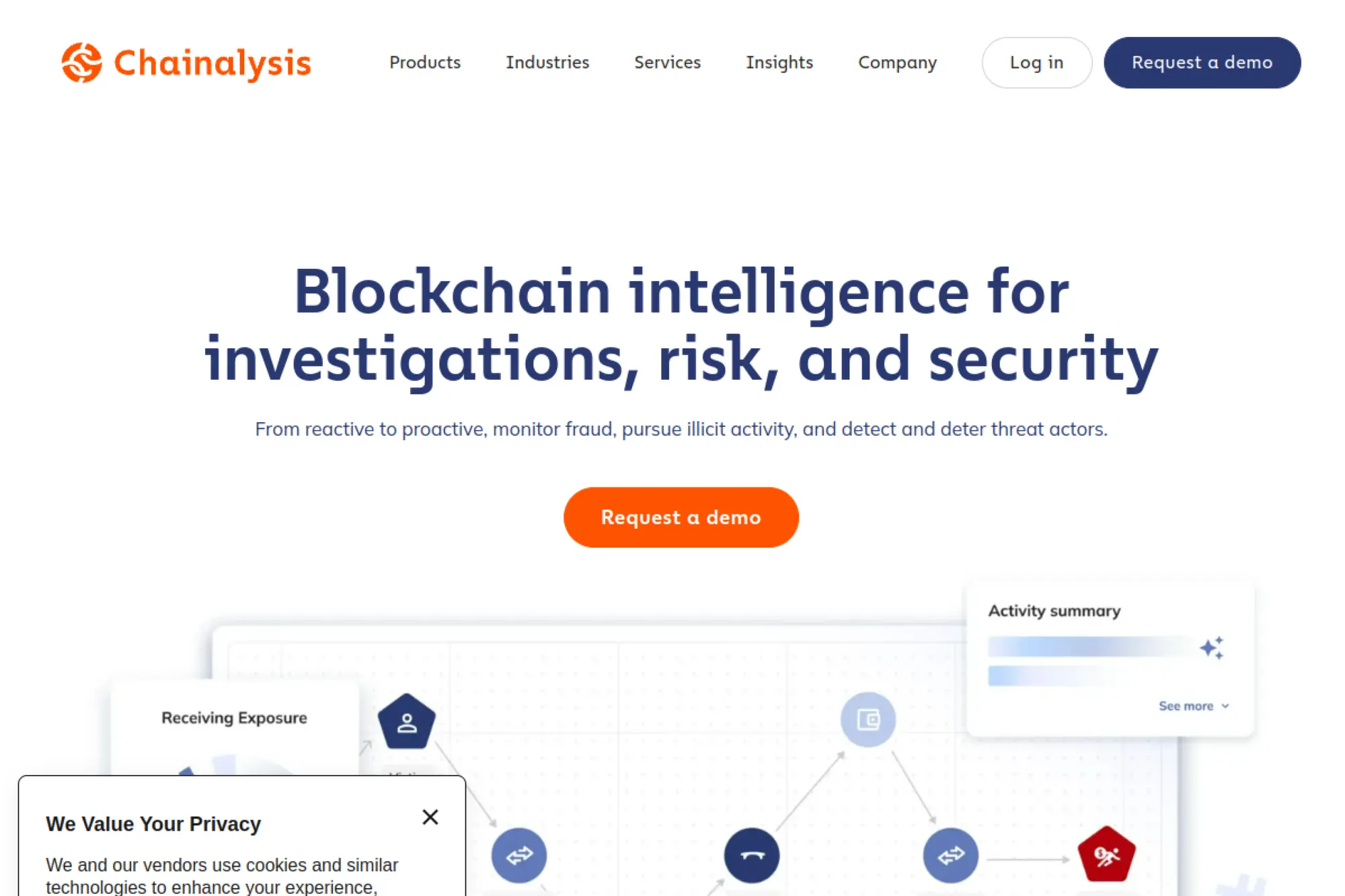
Chainalysis provides blockchain analytics, investigations, sanctions screening, and market intelligence. With ~1,000 employees, founded in 2014, and headquartered in New York, it serves governments, exchanges, banks, and compliance teams who must trace funds, quantify exposure, and meet regulatory obligations across multiple chains.
Awards: Chainalysis was named to the TIME100 Most Influential Companies 2023, recognizing its role in making crypto flows legible to law enforcement and compliance officers.
Services & proof: In our programs, Chainalysis KYT and Reactor have become the lingua franca for explaining risk to non‑crypto stakeholders—board committees, regulators, banks’ correspondent teams. For exchanges and fintechs, real‑time monitoring and case management reduce manual review cycles and help prove that compliance isn’t a veneer. As tokenization grows, their entity resolution across stablecoins, bridges, and mixers remains central to risk scoring.
Ideal Fit: Any entity holding or touching digital assets at scale—exchanges, neobanks, custodians, payment processors—as well as traditional banks onboarding digital asset exposure under MiCAR, Travel Rule, and local AML regimes.
Curious how to map these choices to your architecture, risk appetite, and go‑to‑market timeline? Tell us your top two use cases—payments, tokenization, compliance analytics, gaming economies—and we’ll sketch a build‑vs‑buy plan that gets you to a credible pilot in 90 days without painting you into a corner.
What blockchain companies do in 2025: core categories and use cases
Market snapshot: digital asset monetization is broadening beyond speculative trading into payments, data, and infrastructure, with the global Digital Assets market projected to reach $100.2bn by 2025, reinforcing why product leaders are packaging blockchains as services rather than stand‑alone experiments. From our vantage point, categories have stabilized even as underlying stacks evolve.
1. Crypto exchanges and brokerage blockchain companies
Centralized and decentralized venues now behave more like regulated market utilities than novelty apps. The leaders differentiate on custody models, liquidity partnerships with market makers, and compliance tooling that mirrors capital‑markets surveillance. We advise clients to probe for segregation of customer assets, deterministic trade‑matching designs, and exit ramps that integrate custodial wallets with enterprise treasury—because the real risk surface hides in operational handoffs. In practice, we’ve seen brokerages win share by offering token‑listed treasuries and corporates get comfortable once settlement and reporting feed straight into ERP and tax systems.
2. Enterprise blockchain companies and distributed ledger consulting
Enterprise providers sell outcomes (fewer disputes, faster reconciliations) rather than chains. The best deploy permissioned ledgers for verifiable state transitions, add privacy‑preserving proofs, and wrap all of it in change‑management. We’ve found joint governance playbooks—clear membership rules, on‑chain/off‑chain data boundaries, and API‑level SLAs—to be predictive of success. When communities span competitors, neutral governance beats vendor control every time.
3. Web3 developer infrastructure and node platforms
RPC, indexing, and data pipelines are the plumbing behind dApps, risk analytics, and compliance. Node platforms compete on uptime under bursty traffic, full‑archive indexing, and private transaction relays that curb frontrunning. We look for providers that expose verifiable receipts, deterministic throughput under load, and signed snapshots for auditability. The underrated differentiator: solid SDKs that abstract chain quirks without boxing you in.
Deep build note
Across client work, we favor a “dual‑stack”: one provider for real‑time writes and another for analytics ingest, with a message bus normalizing events into a warehouse. That split gives resilience and lets security teams layer their own anomaly detection over mempool and state data.
4. Blockchain analytics and compliance solutions
Risk teams need entity resolution, anomaly scoring, and case‑management that speaks to existing AML processes. Modern analytics tools fuse graph linkage with heuristics around mixers, bridges, and cross‑chain flows. When we evaluate vendors, we go beyond glossy dashboards: what’s their false positive rate on your asset mix; can they backtest typologies; and will they emit machine‑readable alerts your investigators can triage without re‑keying?
5. Stablecoin issuers and on‑chain payments
Stablecoins evolved into programmable cash rails. Issuers winning mindshare publish attestation cadences, maintain diversified reserves, and support granular controls for enterprise wallets. Card networks and PSPs increasingly treat tokenized balances as a settlement rail alongside traditional schemes. For CFOs, the unlock is operational—always‑on treasury moves and tighter cash positioning—once policy engines, invoice matching, and accounting rules sit on top.
6. Cross‑border payments and real‑world asset tokenization
Two narratives are converging: instant, message‑rich cross‑border flows and tokenized assets that settle against bank‑grade deposits or regulated stablecoins. In production, we’ve seen corporates accelerate intragroup funding and FX netting by combining permissioned rails for cash with public‑chain tokens for assets—bridged via oracles that enforce delivery‑versus‑payment. The hard part isn’t cryptography; it’s governance, dispute resolution, and data residency across jurisdictions.
7. Gaming and NFT‑focused blockchain companies
Studios now design around wallet‑abstracted UX, off‑chain ordering, and on‑chain settlement to avoid gas‑spikes ruining gameplay. Platforms with robust creator economies focus on enforceable royalty logic, fraud controls for asset minting, and liquidity backstops through AMMs or order books. Our take: the winners treat NFTs as access and state synchronization, not just collectibles.
8. Decentralized identity and verifiable credentials
Verifiable credentials finally left the lab. The productive pattern we implement is privacy‑preserving attestations coupled with selective disclosure, anchored to a ledger for timestamping rather than data storage. That yields smooth KYC re‑use, vendor onboarding, and cross‑border compliance while keeping PII off‑chain. The proxy battle is wallet UX and governance of credential schemas so that verifiers trust what they’re seeing.
9. Mining and staking infrastructure providers
Institutional staking resembles prime brokerage: slashing insurance, non‑custodial validator control, and audit trails for governance votes. On the mining side, economics now hinge on vertically integrated energy strategy and grid partnerships. Our counsel is to model protocol changes as first‑class counterparty risk and demand provider attestations for key management and validator segregation.
10. Layer‑1 protocols and chain interoperability
Base layers compete on finality, data availability, and developer ergonomics; interoperability layers connect economic islands. Rather than bet on a single chain, most enterprises adopt a hub‑and‑spoke model—permissioned cores for sensitive state, public chains for liquidity—and rely on cross‑chain messaging with explicit trust boundaries. We harden that design with circuit‑breakers, rate limits, and insurance‑backed bridges where policy allows.
Enterprise adoption in blockchain companies: big tech and banks shaping 2025
Market snapshot: finance leaders are moving from pilots to targeted rollouts, with 23% indicating their treasury will use crypto for payments or investments in the near term, which aligns with what we see in always‑on cash management, programmable FX, and on‑chain collateral.
1. IBM Hyperledger Fabric and enterprise DLT platforms
Fabric remains the default for consortium networks that need modular privacy and explicit membership. IBM‑backed deployments succeed when channels map to real legal boundaries and private data collections keep sensitive fields off shared state. We typically blend Fabric with confidential compute for off‑chain analytics, then anchor proofs on‑chain to keep auditors happy without leaking trade secrets.
2. Microsoft Azure Blockchain Service and confidential ledger tools
Azure retired its earlier managed blockchain service and steered enterprise customers toward confidential ledger constructs built on trusted execution environments. In practice that means tamper‑evident logs, attested enclaves, and consortium governance without the operational drag of running full nodes. We like this pattern for regulated audit trails, especially where multi‑party append‑only logs integrate directly with data platforms and key vaults.
3. Amazon Managed Blockchain alongside QLDB ledger
AWS offers a split: Managed Blockchain for permissioned networks and QLDB for centralized, cryptographically verifiable journals. We often pair them—QLDB to capture authoritative system‑of‑record events and a Fabric network to coordinate across firms—then stream both into a warehouse for reconciliation and analytics. The result is simpler recovery, crisp lineage, and fewer disputes.
4. Alphabet Google Cloud Blockchain Node Engine and BigQuery analytics
For data‑centric programs, BigQuery’s public blockchain datasets and the managed node engine are a potent combo: hosted nodes for reliable write/read paths and curated tables for analytics without running indexers. Our enterprise pattern uses private nodes for transaction submission, then a governed data lake for forensics, growth analytics, and risk scoring.
5. JPMorgan Kinexys with Liink and JPM Coin
J.P. Morgan rebranded its blockchain stack under Kinexys, aligning informational networks (Liink), tokenized deposits, and asset rails. What matters to treasurers is the pragmatic capability: always‑on settlement, programmable treasury, and integration with bank‑grade controls. In our experience, Kinexys‑style rails slot neatly into existing cash‑management while opening doors to tokenized collateral and cross‑chain settlement tests with oracles.
6. HSBC Orion for digital bonds and tokenized assets
Orion industrializes digital securities: primary issuance, lifecycle actions, and connectivity to market infrastructure. The nuance many miss is how custody and CSD connectivity are abstracted so that buyside operations barely change while issuers gain programmability. We treat Orion‑like platforms as the front door for tokenized funds, bonds, and structured notes with clean hooks for on‑chain cash legs.
7. Accenture multiparty systems and digital identity initiatives
Accenture’s playbook couples multiparty data sharing with verifiable credentials and wallet UX, then wraps it in change‑management for complex ecosystems. We’ve collaborated on designs where credential issuance ties to existing KYC, allowing suppliers and customers to reuse attestations across networks. The value shows up in cycle‑time reduction and fewer exceptions rather than marketing gloss.
8. Alibaba AntChain and Blockchain‑as‑a‑Service
AntChain emphasizes production‑grade workflows in trade, supply chains, and data provenance. What stands out is the blend of ledger, digital identity, and policy controls so enterprises can move from proofs‑of‑concept to run‑rate transactions. We’ve seen real gains when cross‑border platforms standardize data schemas and enforce access with verifiable policies at the API layer.
9. Samsung SDS Nexledger and mobile blockchain security
Nexledger shows how mobile‑first enterprises bring blockchain into authentication, e‑documents, and supply chain events. Its strengths lie in standardized APIs, configurable consensus options, and performance accelerators for permissioned settings. For mobile security teams, binding device identity to transaction authorization—with ledger proofs for auditors—beats bolt‑on signatures post‑facto.
10. Walmart supply chain traceability with enterprise blockchain
Walmart’s food traceability shows the enterprise pattern: standardized supplier onboarding, event capture from farm to shelf, and selective transparency. The trick isn’t logging every datapoint on-chain; anchor tamper-evident proofs and keep rich data off-chain. That way, brands, regulators, and retailers can verify the same story without oversharing.
How TechTide Solutions helps build custom blockchain solutions
Market snapshot: tokenized finance isn’t theoretical—analysts estimate tokenized financial asset capitalization could reach $2 trillion by 2030, which aligns with the projects we see moving from pilot to production where cash legs, identity, and compliance are built‑in from day one.
1. Discovery and requirements workshops tailored to your use case
We start by mapping incentives across your ecosystem, not just features. In facilitated workshops, we co‑design governance, data classification (on‑chain vs. off‑chain), and operating controls with legal and security at the table. You’ll leave with an architecture baseline, a value‑at‑risk/benefit model, and a phased roadmap that your CFO and CISO can both sign.
What you get
Reference architectures, threat models, and a migration plan that respects current systems—plus a proof matrix tying every ledger write to an explicit business outcome.
2. Custom dApp, smart contract, and system integration development
Our engineers build contracts with explicit state machines, role‑based access, and upgrade paths, then wire them to your ERP, treasury, and data platforms through event‑driven middleware. We design for observability and auditability: deterministic tests, formal verification where warranted, and signed receipts for every critical transaction.
Integration patterns we favor
Permissioned cores for sensitive workflows; public chains for liquidity and discovery; oracles with explicit trust models; and privacy layers that prove properties without exposing payloads.
3. Security, compliance, and ongoing support aligned to your stack
Security is a first‑class feature. We implement key ceremonies, policy‑as‑code for approvals, runtime monitors for anomalous contract behavior, and segregated roles for developers versus operators. Our post‑go‑live runbooks include incident response, disaster recovery, and compliance evidence collection—because resilience is the product.
How to choose blockchain companies in 2025: evaluation criteria and next steps
Market snapshot: investor selectivity is rising as fintech funding fell to $33.7B in 2024, so procurement teams should expect clearer value cases, cleaner unit economics, and stronger security posture from vendors. We use the following rubric when we’re on your side of the table.
1. Location and presence in your target markets
Favor partners with compliance and delivery capabilities where you operate. Local data‑handling norms, identity frameworks, and payment rails vary widely; boots‑on‑the‑ground expertise de‑risks timelines.
2. Specialized blockchain expertise and technology focus
Ask which chains, identity stacks, and privacy techniques they’ve shipped in production. Depth beats breadth: a team that can explain why they chose a particular consensus or privacy primitive for your risk profile is worth its weight.
3. Client satisfaction validated by independent reviews
Look for third‑party assessments, security certifications, and named references. Even better, speak with a client’s risk or operations lead rather than only product sponsors to learn how the system behaves under stress.
4. Portfolio depth and relevance to your industry
Patterns repeat across industries: supply chain attestations resemble clinical data sharing; tokenized deposits rhyme with internal cash pools. A vendor who can show analogous wins will shorten discovery and avoid dead ends.
5. Team size, skills, and transparent price ranges
Insist on access to the actual builders and architects, not just account managers. Clear staffing plans, skill matrices, and pricing guardrails help you forecast and govern change requests.
6. Industries served and domain experience
Domain literacy matters. Payments, capital markets, healthcare, and retail have different control objectives. Choose a partner who speaks your regulatory language and can design controls that fit.
7. Security standards and regulatory compliance readiness
Demand threat models, key‑management designs, and formal SDLC controls tailored to your specific environment. For regulated programs, map controls to your audit frameworks and require evidence from day one.
8. Maintenance, support, and long‑term partnership approach
Blockchains are living systems. Expect SLAs, upgrade paths, and proactive posture management—plus a roadmap that keeps pace with protocol changes, privacy enhancements, and identity standards.
Curious where your use case fits—and what an end‑to‑end plan would look like on your stack? Let’s run a short discovery sprint together and pressure‑test both value and risk before you commit to a build.