


Is vibe coding legal for businesses, founders, and developers? At Techtide Solutions, we think the honest answer is yes, but only in a narrow sense. Using AI to generate code is usually lawful. Shipping that code inside a commercial product is where the real legal work starts. The pressure to move fast is obvious, with worldwide generative AI spending projected at $644 billion in 2025. But speed does not settle ownership, licensing, privacy, or security. We are not acting as lawyers here. We are sharing the practical risk map we use when teams want to move from prompt-built demos to real software.
Is Vibe Coding Legal in Practice
Before we argue about statutes, we separate tool access from business exposure. A company can be allowed to use an AI coding product. It can still ship something that breaks a license, mishandles data, or fails a customer audit. That is the distinction we care about most in practice.
1. Tool Legality Versus Real-World Legal Exposure
Most AI coding products are sold for commercial use, so the act of prompting a model to write code is not usually the legal problem. The legal problem is what ends up in the repo, what third-party terms attach to it, what customer data enters the workflow, and what promises your company makes downstream. We tell founders this all the time: a lawful tool can still help create an unlawful deployment.
2. Human Accountability for AI-Generated Code
Human accountability does not disappear because a model wrote the first draft. In vendor terms, the customer typically remains responsible for inputs, outputs, and fit for use. That lines up with our own view. AI can accelerate authorship, but it cannot sign a release, defend an infringement claim, explain a breach to regulators, or justify why a design choice was reasonable. A person or company still owns that burden.
3. Prototype, Testing, and Production Risk Levels
A throwaway prototype on fake data is one risk class. A production system that touches payroll, health records, customer billing, or identity is another. Risk rises each time the code moves closer to real users, real money, or regulated data. That is why we are comfortable with prompt-heavy experimentation in sandboxes, but far stricter once software needs access control, auditability, monitoring, and incident response.
Recommended reading: AI-Driven Decision Making: How It Works, Benefits, and Real-World Use Cases
What Vibe Coding Means and Why It Raises Legal Questions
When we say vibe coding, we mean a prompt-first style of building in which the human describes intent and the AI generates much of the code. The term entered mainstream developer language after Andrej Karpathy popularized it. The appeal is obvious. The legal questions follow from the same thing that makes it fast, namely less direct authorship, less direct review, and often less awareness of what the machine actually produced.
1. AI Agents, Prompting, and Minimal Manual Coding
In this workflow, builders do far more specifying than typing. They prompt, accept diffs, rerun tests, and ask the model to refactor or regenerate. That can be useful. It can also hide the line between code a human genuinely understood and code a human merely approved because the demo seemed to work. We think that line matters legally and operationally.
2. Nontechnical Builders, Founders, and Software-Enabled Businesses
Nontechnical founders can now assemble working software far earlier than before. We like that shift. It makes product discovery cheaper. But it also means people with little background in licensing, authentication, data flows, or deployment are making choices that used to be made by engineers. In our experience, that is where vibe coding stops being a clever shortcut and starts becoming a governance issue.
3. Working Software Versus Production-Ready Systems
A screen that loads and a button that submits do not prove production readiness. Production software needs predictable behavior under bad inputs, failed integrations, expired tokens, and dependency updates. It also needs secure defaults, test coverage, logging, and recovery plans. We often inherit projects that work on a laptop but fall apart under ordinary production stress.
Recommended reading: DSPy vs LangChain: Key Differences, Best Use Cases, and How to Choose
Copyright, Ownership, and Authorship in Vibe-Coded Software
Copyright, ownership, and authorship are where the article title becomes real. Teams often assume that if a model generated code for them, they own it in the same way they would own fully human-written code. Sometimes they have a contract right against the tool vendor. That is not the same thing as having clean copyright or a clean ownership chain for every part of the finished product.
1. Pure AI Output and Copyright Questions
In the United States, copyright still depends on human authorship. The Copyright Office has said that when a person supplies only prompts and the system determines the expressive elements, the generated material is not protected as that person’s authored work. For businesses, the takeaway is simple. Pure machine output can be commercially useful, but its copyright position is weaker than many pitch decks assume.
2. Human Revision and Protectable Contributions
The picture changes when humans do meaningful creative work. If a team substantially edits generated code, chooses structure, rewrites logic, adds tests, designs flows, or creatively arranges human and AI material, those human contributions can be protected. Patent law points in a similar direction, with the USPTO focusing on significant human contribution rather than treating AI activity itself as inventorship. We read the current U.S. guidance as favoring real supervision and real revision, not passive acceptance. In other words, prompting helps, but authorship and inventorship still follow human control.
3. Employer, Contractor, and Vendor Ownership Issues
Even when the output is protectable, ownership can still get messy. Employee-created work may belong to the company if it was made within the scope of employment. Contractor-created work is trickier, and many founders are far too casual about it. In U.S. law, the work-made-for-hire doctrine is narrower than people expect, so we usually want express written IP assignments, clear repository access rules, and company-controlled tool accounts. Otherwise, a product can have three different ownership stories before launch day.
Recommended reading: What Is ChromaDB? A Practical Guide to Features, Use Cases, and Trade-Offs
Is Vibe Coding Legal When Open Source and APIs Are Involved
Third-party code is where many AI-assisted projects get blindsided. The model may feel like the main dependency, but the harder questions usually involve open source licenses, API contracts, model-provider restrictions, and what evidence you kept about where critical code came from. This is boring work. It is also the work that saves deals.
1. Open Source Notices, Copyleft Duties, and Reuse Risk
AI-generated code can resemble public code, import libraries you did not intend to use, or nudge teams into sloppy copy-paste habits. That is why it matters that GitHub Copilot ships a code referencing feature for potentially relevant license matches. Permissive licenses such as MIT and Apache usually still require notices. Copyleft licenses can impose stronger share-alike duties, and the AGPL can reach modified software offered over a network. We never assume “the model wrote it” is a license defense.
2. API and Platform Restrictions on Use, Monetization, and Branding
Platform terms can be just as important as copyright. OpenAI’s business agreement allocates ownership rights in input and output, but the same terms say output may not be unique, restrict some uses, and place responsibility for evaluating outputs on the customer. They also warn that not all services are designed for protected health information without a healthcare addendum. We infer from that mix that contract rights help, but they do not give a free pass on exclusivity, compliance, or healthcare use.
3. Code Review, Monitoring, and Infringement Exposure
Good review is more than looking for syntax mistakes. We want code review, dependency review, secret scanning, vulnerability scanning, and a traceable record of why a risky block was accepted. If an infringement or security issue appears later, your best defense is often a disciplined review trail. That matters even more because vendor protections can narrow or disappear when customers ignore built-in safeguards or modify output without care.
Recommended reading: How to Build a Rag Chatbot: A Practical Rag and Langchain Blueprint From Prototype to Production
Is Vibe Coding Legal for Software That Handles Personal or Sensitive Data
Once vibe-coded software touches personal or sensitive data, the legal conversation changes fast. At that point, teams are not just debating authorship. They are deciding how personal data is collected, stored, shared, retained, deleted, and secured. The method used to write the code does not lower those duties.
1. Privacy Obligations for Collection, Storage, Consent, and Disclosure
If your software handles customer profiles, employee data, payment details, or health information, privacy law applies to the workflow, not to the romantic story of how the app was built. California’s regulations explain how businesses must handle consumer rights requests. HIPAA sets rules for electronic protected health information. The FTC’s Safeguards Rule requires covered financial institutions to secure customer information. For us, the practical rule is simple: map the data first, then decide what AI tools may touch it.
2. Security Vulnerabilities, Breach Exposure, and Audit Trails
Security is the area where false confidence does the most damage. Code can look polished and still be risky. In Veracode’s large evaluation of model-generated code, only 55% of generations were secure. That is why we insist on audit trails, approval logs, test results, and repeatable scans before release. If a breach happens, regulators and customers will ask what controls existed, not whether the assistant sounded confident.
3. Cyber Compliance Requirements for Regulated Software
Regulated software needs more than good intentions. Healthcare systems need administrative, physical, and technical safeguards for protected health information. Financial institutions under FTC jurisdiction need a written information security program. Some AI vendor contracts add their own limits on handling protected data. We usually tell teams not to let consumer-grade prompt workflows anywhere near regulated production data until counsel, security, and the vendor paperwork all line up.
Recommended reading: What Is Retrieval Augmented Generation: A Practical Guide to RAG for Building Grounded AI
When Vibe Coding Makes Sense and When to Bring in Experts
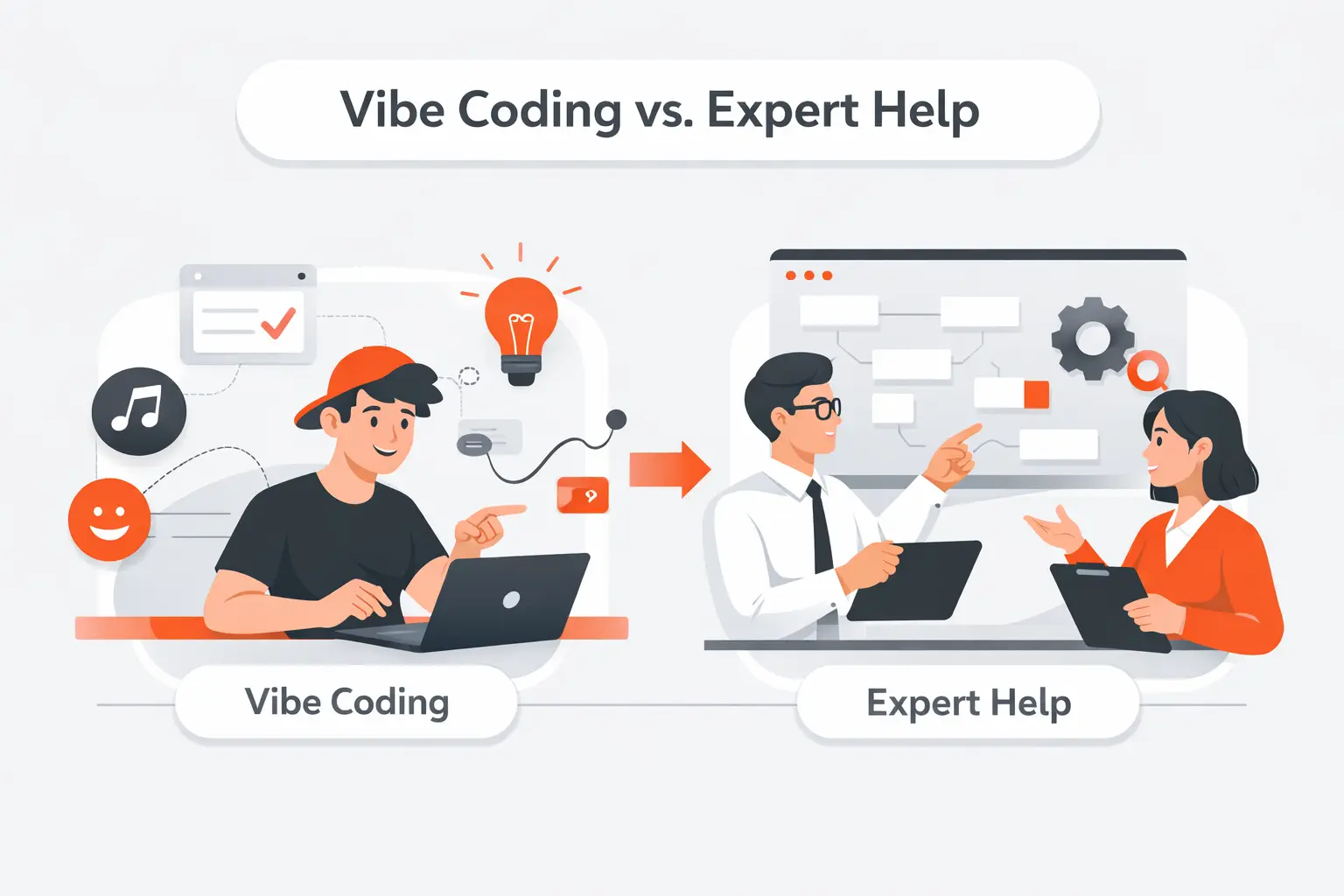
We are not anti-vibe-coding. We use AI every week. The right question is where it belongs. In our shop, that answer depends on exposure, not hype. The same method that is smart for a prototype can be reckless for a customer-facing workflow.
1. Low-Risk Prototypes, Internal Tools, and Learning Projects
Vibe coding makes good sense for mockups, admin dashboards on fake data, one-off scripts, QA helpers, internal reporting tools, and learning projects. It is also great for exploring product ideas before a team commits real budget. We like it as a discovery tool because it shortens the path from vague concept to testable interface. The key is to keep the exposure small and the data synthetic.
2. High-Risk Production Systems and Confidential Workflows
We bring in experienced engineers, security reviewers, and often counsel when the software affects money, rights, safety, or regulated data. That includes authentication systems, healthcare workflows, finance tools, employment screening, customer billing, and confidential internal automations. These are not good places to rely on unreviewed generated code or on personal AI accounts with unclear data handling.
3. Enterprise Integrations, Maintenance, and Long-Term Support
The moment a system connects to ERP data, identity providers, payment systems, or core analytics, the real work shifts to maintenance. Who owns the dependency updates? Who rotates secrets? And wh rewrites brittle generated code six months later? AI can help start the build, but long-term support still depends on humans who understand the stack well enough to keep it healthy.
4. Build Versus Buy Decisions for Legal and Business Teams
Sometimes the safer move is to buy a mature product instead of vibe-building a custom one. That is especially true when the workflow is common, regulated, or audit-heavy. We have seen legal and business teams save months by buying a vetted platform with known contracts, support, and security docs instead of owning a homemade tool forever. The same Gartner forecast that showed heavy AI spending also noted that many CIOs are scrutinizing self-development and leaning toward commercial products for more predictable value.
How Controlled Vibe Coding Reduces Legal Risk
If a company wants the speed of vibe coding without the usual chaos, it needs guardrails. We do not mean vague culture slogans. We mean contracts, approved tools, sandbox rules, review gates, and clear release criteria. Governance sounds slow until you compare it with a rewrite, a breach, or an IP dispute.
1. Corporate Structure, Contributor Agreements, and IP Clarity
Start with the paper trail. Use company-controlled repos, company-controlled tool accounts, employment IP clauses, contractor assignments, and written contributor terms. If a founder prototypes on a personal account and a contractor later patches it from another personal account, the ownership chain gets fuzzy fast. We prefer boring clarity over clever speed here, because investors and acquirers do too.
2. Professional Code Review, Senior Oversight, and Release Readiness
Our baseline is senior human review before release, and we usually anchor that gate on the Secure Software Development Framework. That means testing, security review, dependency checks, logging, and clear go-live criteria. We are happy to let AI draft code. We are not willing to let AI declare that code ready for production on its own.
3. Sandboxes, Data Classification, and Shadow IT Governance
Controlled experimentation matters. We separate sandbox work from production, classify data before it touches a prompt, block secrets from consumer tools, and steer teams toward enterprise plans when business data is involved. GitHub’s own policies differ by plan, and OpenAI’s enterprise commitments differ from consumer defaults. That is exactly why shadow IT around AI tooling is a governance problem, not a harmless shortcut.
4. Contracts, Disclaimers, Insurance, and Customer Risk Allocation
We also like to decide risk allocation before the first dispute. Good customer contracts can define acceptance criteria, security responsibilities, limits of liability, incident notice duties, and IP expectations. Vendor terms matter too, because indemnities often have conditions and exclusions. We view cyber insurance and well-drafted SOWs as backup brakes, not as substitutes for disciplined engineering.
Frequently Asked Questions About Vibe Coding Legality
By the time teams reach procurement or launch, the same questions tend to repeat. Here is how we answer them when clients ask for the blunt version. The short theme is consistent: vibe coding is real, useful, and risky in very ordinary ways.
1. How Reliable and Legitimate Is Vibe Coding in Practice
It is legitimate as a development workflow. It is unreliable as an unreviewed source of truth. We trust it for drafts, spikes, and acceleration. We do not trust it as a legal shield or a release sign-off. If the code matters, humans still need to read it, test it, and own it.
2. Can Nontechnical Builders Learn Vibe Coding Effectively
Yes, especially for prototypes and internal tools. In fact, many nontechnical builders now create surprisingly good first versions. But effective learning still requires help with architecture, authentication, data modeling, deployment, and compliance. We think the best nontechnical builders use AI to widen their reach, then pull experts in before risk compounds.
3. Can Businesses Own and Protect Vibe-Coded Software
Often yes, but the answer has layers. A business can often secure contract rights from the tool provider and ownership from employees or contractors. It can also protect the human-authored parts of the finished product. What it cannot safely assume is that every machine-determined output carries the same copyright strength as fully human-created code.
4. When Is Buying Better than Building with Vibe Coding
Buying is usually better when the problem is standard, the vendor market is mature, or the compliance burden is heavy. We especially lean that way for legal operations, finance workflows, and regulated record systems. Custom building makes more sense when the process is something that truly makes the business different.
5. When Do You Need Expert Review for Vibe-Coded Software
You need expert review before launch if the product touches real users, customer data, billing, identity, regulated industries, or core business logic. We also want review when the codebase is meant to last, not just impress in a demo. If failure would cost real money or trigger a legal response, the review should happen before release, not after the first incident.
How TechTide Solutions Builds Custom Software for Real Business Needs
This is where we stop speaking in generalities and speak from our own practice. At Techtide Solutions, we often meet clients after an AI-built prototype proves demand but exposes limits. Our job is not to sneer at the prototype. Our job is to turn the useful parts into software a business can actually operate.
1. Turning Early Vibe Coding Concepts into Production-Ready Products
We usually start by separating what is valuable from what is accidental. A prompt-built prototype may reveal the right workflow, screen flow, or customer need even if the underlying code is messy. We preserve the insight, rewrite critical paths, define ownership, choose stable infrastructure, and put the product on a maintainable footing. That keeps the speed benefit while removing the guesswork.
2. Adding Security Review, Compliance Controls, and Scalable Architecture
From there, we add the parts demos skip. That means authentication, authorization, schema validation, logging, secrets handling, backups, monitoring, and compliance-aware data flows. When needed, we work beside internal legal and security teams so the software matches how the business actually handles risk, not how a model casually imagined it.
3. Developing Custom Web, Mobile, and Software Solutions Tailored to Each Team
We build custom web, mobile, and business software around the way each team really works. Sometimes that means a net-new platform. Sometimes it means replacing fragile AI-generated sections inside an existing app. Either way, we care about the same end state: code your team can understand, support, audit, and grow.
Final Verdict on Whether Vibe Coding Is Legal
1. Faster Creation, Ongoing Accountability
Our final view is simple. Vibe coding is legal as a tool choice in many business settings, and it is undeniably fast. But the faster creation gets, the more important human accountability becomes. The code may arrive in seconds. The legal responsibility does not.
2. Ownership, Data, and Third-Party Terms as Core Issues
The core issues are not mystical. They are ownership, authorship, open source duties, platform terms, privacy, and security. If a team can answer those clearly, vibe coding becomes manageable. If it cannot, the project is still running on vibes, just with a bigger budget.
3. Human Review, Governance, and Release Readiness
We believe the best use of vibe coding is controlled, supervised, and humble. Let AI accelerate drafts. Let humans own architecture, review, compliance, and release readiness. That is the line between a clever demo and software a serious business can stand behind.

