


WordPress was used by 41.2% of all websites as of July 27, 2026, which still makes it the largest content management system on the public web (W3Techs, Usage Statistics and Market Share of WordPress 2026). Its share among websites with an identifiable CMS was even higher at 59.1%, while HTTP Archive’s 2025 CMS chapter still measured WordPress at 64.3% of mobile CMS usage, which shows how dominant it remains even as growth cools (W3Techs, Usage Statistics and Market Share of WordPress 2026) (HTTP Archive, CMS | 2025 | The Web Almanac). This roundup focuses on primary datasets, official WordPress properties, and original research rather than blog compilations quoting each other. Across the main body, I selected 18 headline figures, 12 from 2026 releases and 6 from 2025 releases, then used newer July 2026 snapshots where they materially changed the picture. If you need WordPress Usage Statistics 2026 for a pitch deck, newsroom explainer, or market memo, the numbers below are the ones worth saving.
Key Takeaways
- WordPress powered 41.2% of all websites in late July 2026, and 59.1% of websites with a known CMS (W3Techs, Usage Statistics and Market Share of WordPress 2026).
- WordPress’s annual all-website share peaked at 43.6% in the January 2025 W3Techs trend series, then eased to 43.0% in January 2026 (W3Techs, Historical yearly trends in the usage statistics of content management systems 2026).
- Version 7 already ran on 52.0% of WordPress sites by July 26, 2026, while Version 6 fell to 40.6% (W3Techs, Usage Statistics and Market Share of WordPress 2026).
- WordPress.org says the official plugin directory now lists 68,000+ free plugins (WordPress.org, Plugins 2026).
- WooCommerce sits in the 7+ million active-install bucket on WordPress.org, and W3Techs detects it on 19.8% of WordPress sites (WordPress.org, Plugins 2026) (W3Techs, Usage Statistics and Market Share of WordPress 2026).
- HTTP Archive measured WordPress at 45% good mobile Core Web Vitals in 2025, better than a year earlier but still well behind more controlled platforms such as Wix at 74% and Duda at 85% (HTTP Archive, CMS | 2025 | The Web Almanac).
- Elementor remained the largest observed page builder in HTTP Archive’s 2025 WordPress sample at 43% mobile adoption, ahead of the WordPress Block Editor at 18% (HTTP Archive, CMS | 2025 | The Web Almanac).
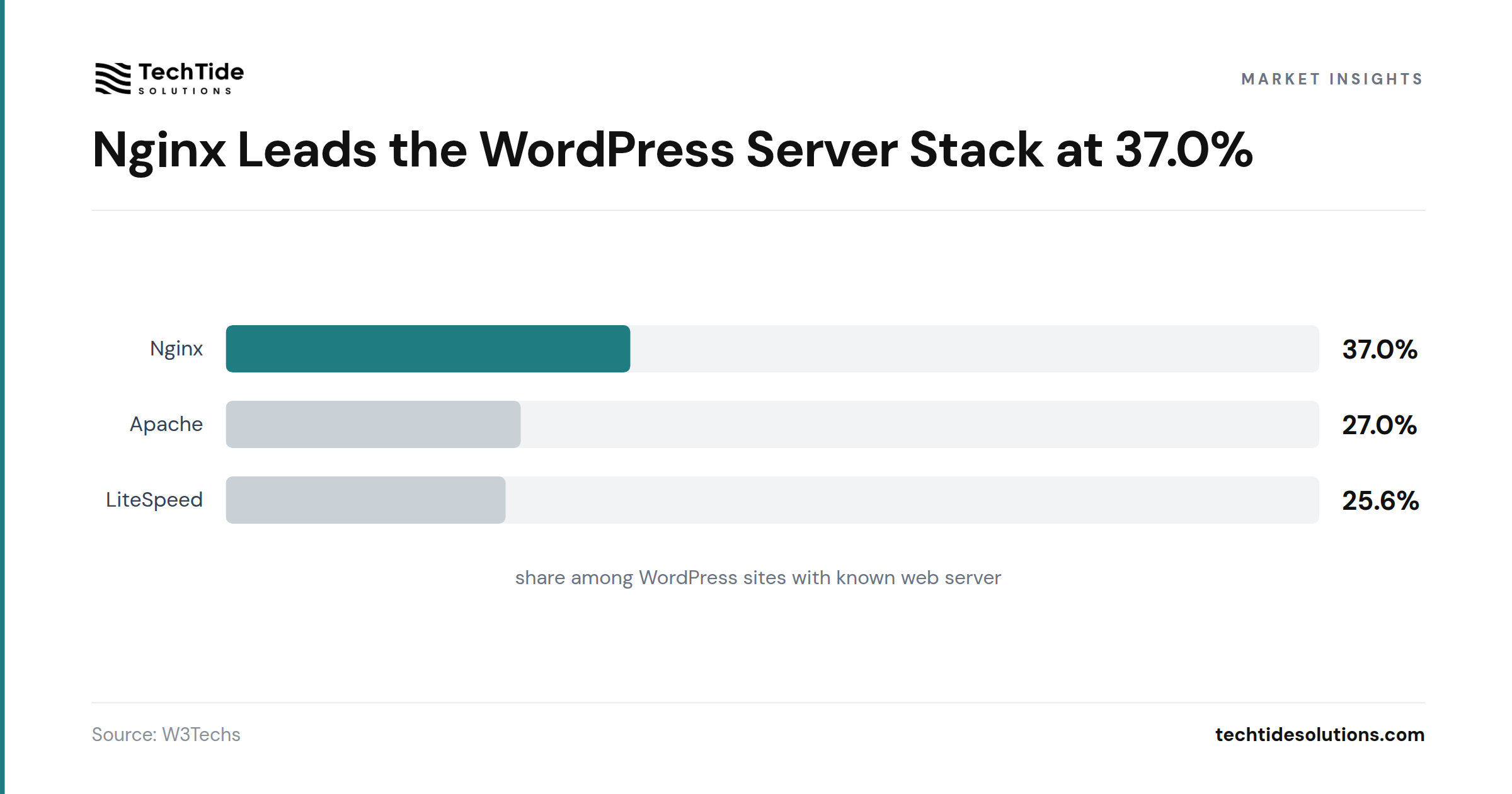
- Nginx led the known WordPress web-server mix at 37.0%, followed by Apache at 27.0% and LiteSpeed at 25.6% (W3Techs, Distribution of web servers among websites that use WordPress 2026).
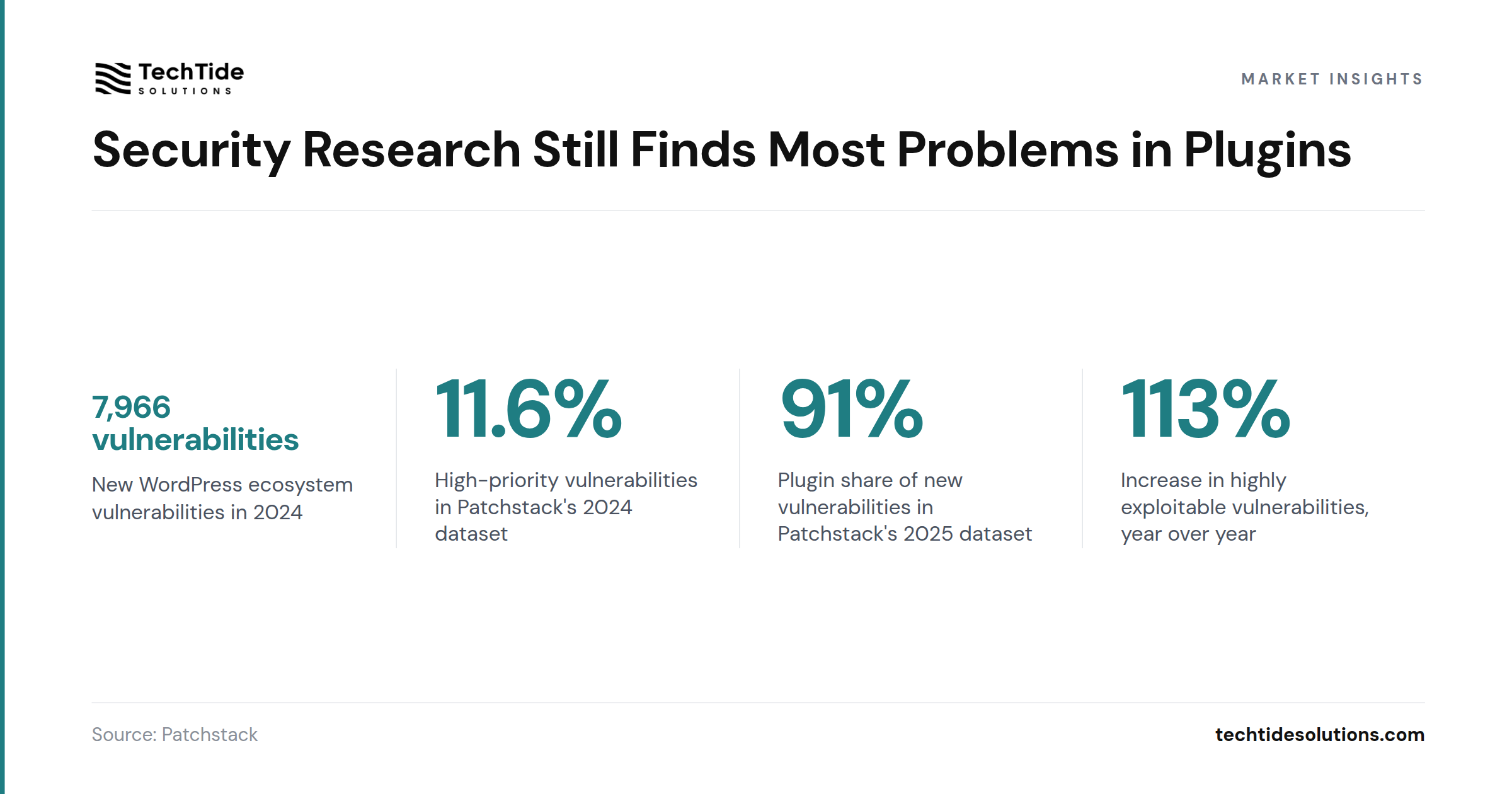
- Patchstack, which sells WordPress security tooling, counted 7,966 new WordPress ecosystem vulnerabilities in 2024, and 11.6% of them were rated high priority in its dataset ( State of WordPress Security in 2025).
- In Patchstack’s 2025 vulnerability dataset, 91% of new WordPress vulnerabilities were found in plugins and highly exploitable issues rose 113% year over year (Patchstack, State of WordPress Security in 2026).
Recommended reading: WordPress Security Statistics 2026: 22+ Findings on Vulnerabilities, Core Fixes, and Malware
WordPress Powers 41.2% of All Websites
WordPress was used by 41.2% of all websites as of July 27, 2026, according to W3Techs (W3Techs, Usage Statistics and Market Share of WordPress 2026). That is still enormous scale, but the growth story is different from the one WordPress had a few years ago. The market now looks less like a winner-take-all race and more like a mature platform holding a huge base while smaller hosted builders keep gaining around the edges.
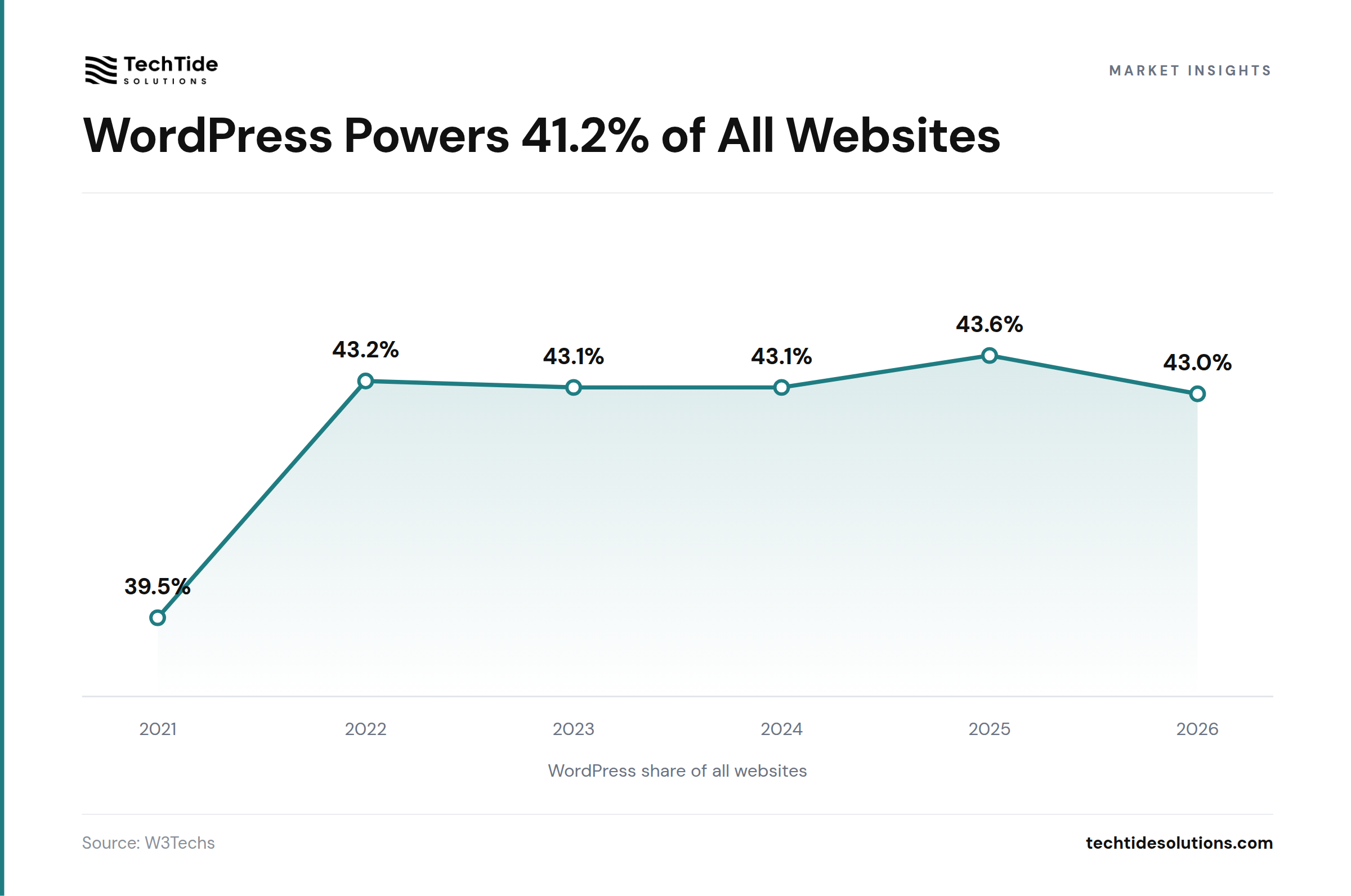
| Metric | Value | Source |
|---|---|---|
| WordPress share of all websites, 2021 | 39.5% | W3Techs |
| WordPress share of all websites, 2022 | 43.2% | W3Techs |
| WordPress share of all websites, 2023 | 43.1% | W3Techs |
| WordPress share of all websites, 2024 | 43.1% | W3Techs |
| WordPress share of all websites, 2025 | 43.6% | W3Techs |
| WordPress share of all websites, 2026 | 43.0% | W3Techs |
W3Techs also puts WordPress at 59.1% of the known CMS market in July 2026, so its share still looks overwhelming once you remove sites with no detectable CMS (W3Techs, Usage Statistics and Market Share of WordPress 2026). In the same W3Techs annual trend snapshot, Shopify reached 5.2% of all websites and Wix reached 4.3%, which helps explain why WordPress can lose a little ground without facing a single direct challenger (W3Techs, Historical yearly trends in the usage statistics of content management systems 2026).
Takeaway: WordPress is still the default answer for open web publishing, but 2026 is the clearest sign yet that its era of easy share gains is over.
Recommended reading: SaaS Statistics 2026: 26+ Key Findings on Revenue, AI, and App Sprawl
Version 7 Reached 52.0% of WordPress Sites
Version 7 was already used by 52.0% of WordPress sites on July 26, 2026, according to W3Techs (W3Techs, Usage Statistics and Market Share of WordPress 2026). The installed base moved quickly once 7.0 landed, which suggests automatic updates and managed hosting continue to matter more than release-day buzz. Fast version turnover is one of the few places where WordPress looks more unified than its plugin ecosystem.
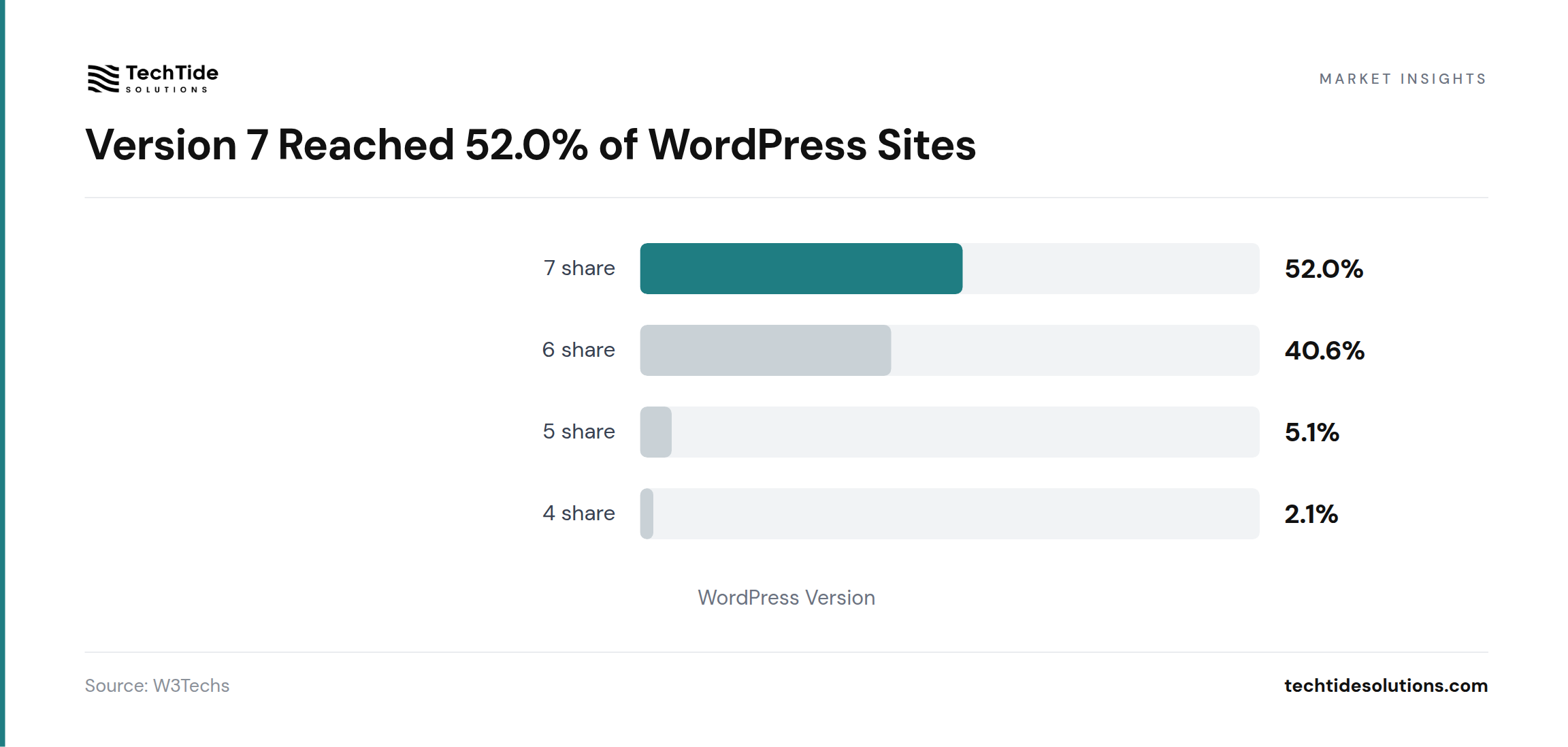
| Metric | Value | Source |
|---|---|---|
| WordPress Version 7 share | 52.0% | W3Techs |
| WordPress Version 6 share | 40.6% | W3Techs |
| WordPress Version 5 share | 5.1% | W3Techs |
| WordPress Version 4 share | 2.1% | W3Techs |
The official release archive shows WordPress 7.0 shipped on May 20, 2026, and 7.0.2 followed on July 17, 2026, while the older 6.9 branch also received 6.9.5 on July 17, 2026 (WordPress.org, Release Archive 2026). Read together, the archive and W3Techs version share suggest that 2026 was less about whether sites would move to Version 7 and more about how fast the move would happen.
Takeaway: If you are benchmarking the WordPress installed base in late 2026, Version 7 is no longer the future state. It is the majority state.
Plugins, Commerce, and Builders Define the Ecosystem
WordPress.org says the official plugin directory now lists 68,000+ free plugins, which remains one of the platform’s biggest structural advantages (WordPress.org, Plugins 2026). This is the part of the WordPress story that competitors still struggle to match. The tradeoff is that scale in extensions creates scale in maintenance, compatibility, and security exposure too.
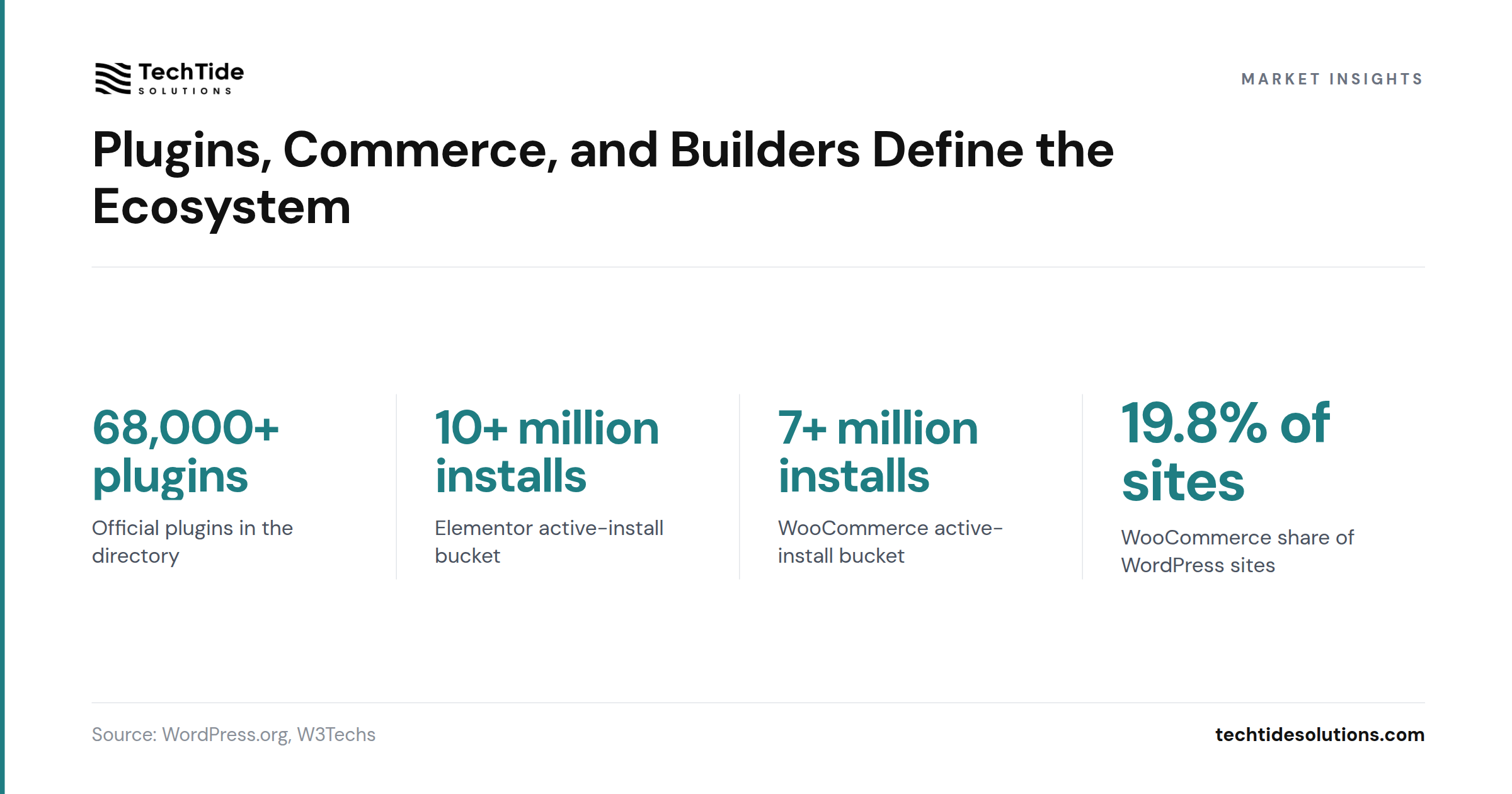
| Metric | Value | Source |
|---|---|---|
| Official plugins in the directory | 68,000+ plugins | WordPress.org |
| Elementor active-install bucket | 10+ million installs | WordPress.org |
| WooCommerce active-install bucket | 7+ million installs | WordPress.org |
| WooCommerce share of WordPress sites | 19.8% of sites | W3Techs |
Two sources here measure different things and that matters. WordPress.org reports active-install buckets such as Elementor at 10+ million installs and WooCommerce at 7+ million installs, while W3Techs detects Elementor on 31.5% of WordPress sites and WooCommerce on 19.8% of WordPress sites in its own web survey data (WordPress.org, Plugins 2026) (W3Techs, Usage Statistics and Market Share of WordPress 2026). The first is an official bucketed install count, while the second is technology detection on live sites, so they should support each other, not be read as interchangeable.
That same WordPress.org directory page also places Classic Editor in the 9+ million active-install bucket, which is a useful reminder that WordPress modernization is real but incomplete (WordPress.org, Plugins 2026). The installed base is not choosing between old WordPress and new WordPress all at once. It is carrying both at scale.
WordPress Hit 45% Good Mobile Core Web Vitals in 2025
HTTP Archive measured 45% of WordPress mobile sites as passing good Core Web Vitals in 2025 (HTTP Archive, CMS | 2025 | The Web Almanac). That is better than the platform’s earlier baseline, but it still leaves WordPress behind CMSs that control more of the stack. The bigger point is not that WordPress cannot be fast. It is that WordPress performance varies more because the platform allows far more architectural freedom.
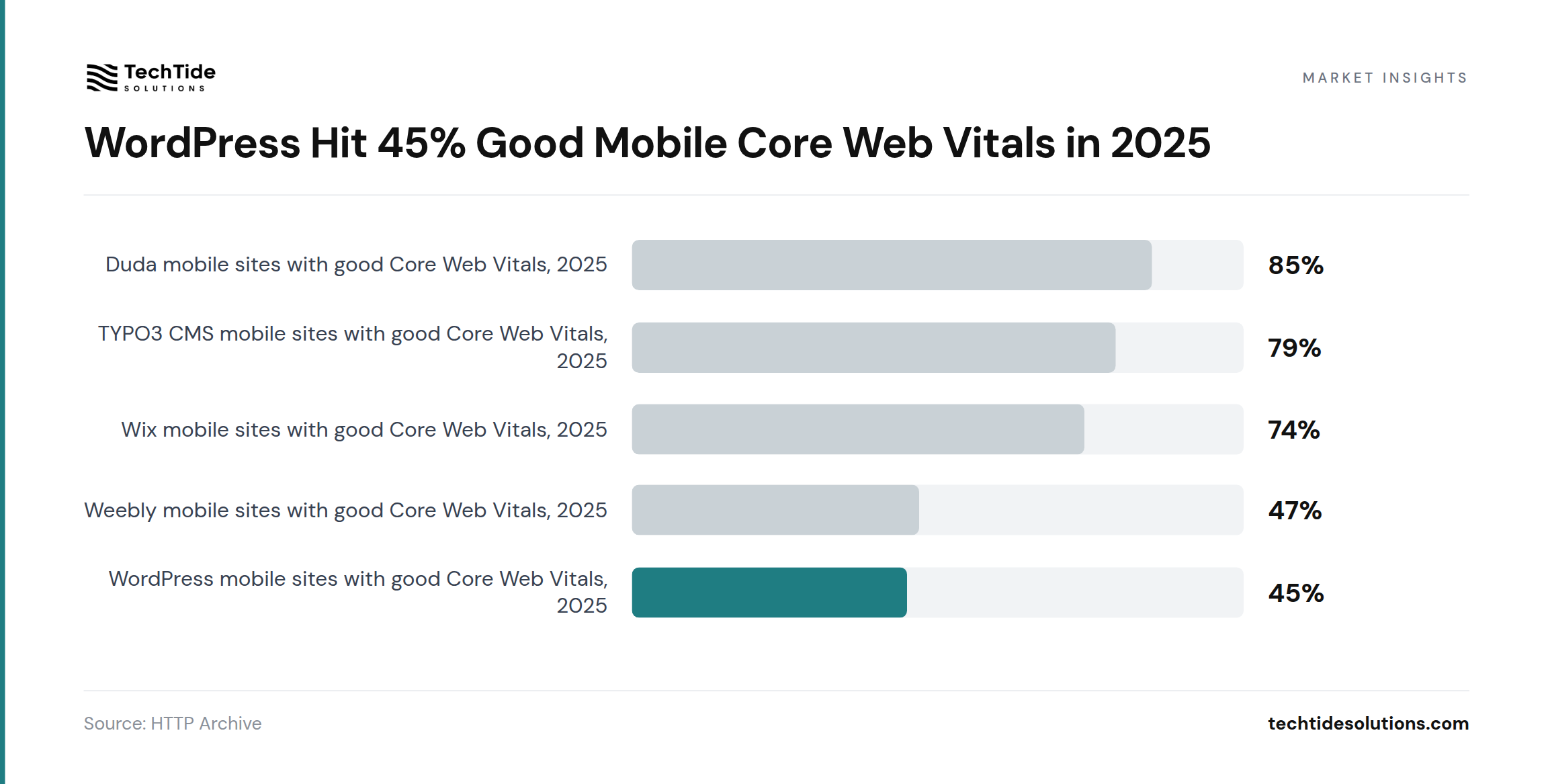
| Metric | Value | Source |
|---|---|---|
| Duda mobile sites with good Core Web Vitals, 2025 | 85% | HTTP Archive |
| TYPO3 CMS mobile sites with good Core Web Vitals, 2025 | 79% | HTTP Archive |
| Wix mobile sites with good Core Web Vitals, 2025 | 74% | HTTP Archive |
| Weebly mobile sites with good Core Web Vitals, 2025 | 47% | HTTP Archive |
| WordPress mobile sites with good Core Web Vitals, 2025 | 45% | HTTP Archive |
HTTP Archive’s CMS chapter also measured WordPress at 64.3% of mobile CMS usage and 35.6% of all observed mobile websites in 2025, which is a good example of denominator-driven differences that confuse a lot of readers (HTTP Archive, CMS | 2025 | The Web Almanac). Inside WordPress, Elementor was the largest observed page builder at 43% mobile adoption, followed by the WordPress Block Editor at 18%, WPBakery at 13%, and Divi at 10% (HTTP Archive, CMS | 2025 | The Web Almanac). Those builder choices help explain why WordPress performance spreads so widely from site to site.
Takeaway: In WordPress, performance is less a brand attribute than a configuration outcome.
Nginx Leads the WordPress Server Stack at 37.0%
Nginx was used by 37.0% of WordPress sites with a known web server as of July 27, 2026, according to W3Techs (W3Techs, Distribution of web servers among websites that use WordPress 2026). WordPress may be application software, but the infrastructure beneath it still shapes speed, cache behavior, and operational cost. The server mix also shows that WordPress is no longer an Apache-only world.
| Metric | Value | Source |
|---|---|---|
| Nginx share among WordPress sites with known web server | 37.0% | W3Techs |
| Apache share among WordPress sites with known web server | 27.0% | W3Techs |
| LiteSpeed share among WordPress sites with known web server | 25.6% | W3Techs |
That distribution is one reason WordPress optimization advice so often feels inconsistent. A cache rule, image stack, or edge setup that works cleanly on LiteSpeed may not behave the same way on Apache or Nginx. Even before you factor in themes and plugins, the platform runs on a much more varied infrastructure base than most hosted website builders do.
Security Research Still Finds Most Problems in Plugins
In Patchstack’s 2025 WordPress vulnerability dataset, 91% of new vulnerabilities were found in plugins, according to its 2026 report, and Patchstack is a vendor that sells WordPress security tooling (Patchstack, State of WordPress Security in 2026). Vendor research can still be useful when the vendor is measuring its own disclosure pipeline, but the scope has to be stated plainly. Here, the main read-across is simple. The extension layer is still where most WordPress risk accumulates.
| Metric | Value | Source |
|---|---|---|
| New WordPress ecosystem vulnerabilities in 2024 | 7,966 vulnerabilities | Patchstack |
| High-priority vulnerabilities in Patchstack’s 2024 dataset | 11.6% | Patchstack |
| Plugin share of new vulnerabilities in Patchstack’s 2025 dataset | 91% | Patchstack |
| Increase in highly exploitable vulnerabilities, year over year | 113% | Patchstack |
Patchstack’s earlier 2025 report counted 7,966 new vulnerabilities in the WordPress ecosystem during 2024, said 11.6% were high priority in its scoring model, and reported that 43% required no authentication to exploit (Patchstack, State of WordPress Security in 2025). Its 2026 report then said only six core vulnerabilities were reported in its 2025 dataset, compared with 91% in plugins and 9% in themes (Patchstack, State of WordPress Security in 2026). That mix reinforces a familiar but still underappreciated point. WordPress core is not the main attack surface. The long tail of extensions is.
Takeaway: The size of the WordPress ecosystem is an adoption advantage, and at the same time it is the reason security stats keep clustering around plugins.
What the Numbers Disagree About
WordPress’s Share Swings Widely Because Sources Use Different Universes
W3Techs puts WordPress at 41.2% of all websites and 59.1% of the known CMS market, while HTTP Archive puts it at 35.6% of observed mobile websites and 64.3% of mobile CMS usage, so the same platform looks smaller or larger depending on the denominator (W3Techs, Usage Statistics and Market Share of WordPress 2026) (HTTP Archive, CMS | 2025 | The Web Almanac). The spread is not evidence that one source is wrong. It is evidence that they are answering different questions. W3Techs estimates technology share across the web, while HTTP Archive describes observed pages in its crawl and then slices that universe by device and CMS status.
12 of 18 Headline Figures Come From 2026 Releases
This article’s 18 headline figures lean recent, with 12 taken from 2026 releases and 6 from 2025 releases already identified earlier in this piece. That is about as current as the public evidence base allows for WordPress Usage Statistics 2026, but not every area updates at the same speed. Performance data still relies heavily on HTTP Archive’s 2025 Web Almanac, which was the most recent large-scale independent release available, while security and market-share snapshots update more frequently.
Elementor Looks Bigger or Smaller Depending on Whether You Count Installs, Sites, or Mobile Pages
WordPress.org places Elementor in the 10+ million active-install bucket, W3Techs detects Elementor on 31.5% of WordPress sites, and HTTP Archive measures 43% mobile adoption among observed WordPress pages (WordPress.org, Plugins 2026) (W3Techs, Usage Statistics and Market Share of WordPress 2026) (HTTP Archive, CMS | 2025 | The Web Almanac). Those figures differ because install buckets, site detection, and page-level observation are not the same unit. The figure I would treat with the most caution is any WordPress.org active-install bucket, because official bucket ranges such as 7+ million and 10+ million are directionally useful but do not expose exact counts.
WordPress Usage Statistics: Summary Table
| Metric | Value | Source |
|---|---|---|
| WordPress share of all websites, July 2026 | 41.2% | W3Techs |
| WordPress share of websites with a known CMS, July 2026 | 59.1% | W3Techs |
| WordPress share of all websites, 2025 annual trend snapshot | 43.6% | W3Techs |
| WordPress Version 7 share, July 2026 | 52.0% | W3Techs |
| WordPress Version 6 share, July 2026 | 40.6% | W3Techs |
| Official free plugins in the directory, 2026 | 68,000+ plugins | WordPress.org |
| WooCommerce active-install bucket, 2026 | 7+ million installs | WordPress.org |
| WooCommerce share of WordPress sites, July 2026 | 19.8% | W3Techs |
| WordPress mobile sites with good Core Web Vitals, 2025 | 45% | HTTP Archive |
| WordPress share of mobile CMS usage, 2025 | 64.3% | HTTP Archive |
| Nginx share among WordPress sites with known web server, July 2026 | 37.0% | W3Techs |
| Plugin share of new WordPress vulnerabilities in Patchstack’s 2025 dataset | 91% | Patchstack |
FAQs
Is WordPress still widely used?
Yes. WordPress still powered 41.2% of all websites in late July 2026 and 59.1% of websites with a known CMS, which keeps it far ahead of every direct rival (W3Techs, Usage Statistics and Market Share of WordPress 2026). The more accurate question in 2026 is not whether WordPress is still widely used. It clearly is. The better question is whether it is still expanding as fast as before, and the answer there is no.
What are the latest WordPress usage statistics?
The latest headline numbers are 41.2% of all websites using WordPress, 59.1% CMS market share among known-CMS sites, and 52.0% of WordPress sites already running Version 7 as of late July 2026 (W3Techs, Usage Statistics and Market Share of WordPress 2026). For ecosystem size, WordPress.org lists 68,000+ free plugins, while WooCommerce remains in the 7+ million active-install bucket (WordPress.org, Plugins 2026).
Why are people moving away from WordPress?
The data does not show a mass exodus, but it does show slower growth and more fragmentation, with WordPress’s annual all-website share easing from 43.6% in the 2025 W3Techs trend snapshot to 43.0% in the 2026 snapshot (W3Techs, Historical yearly trends in the usage statistics of content management systems 2026). Hosted builders remove infrastructure work, and HTTP Archive shows platforms like Wix delivering stronger mobile Core Web Vitals at 74% versus WordPress at 45% in 2025, which helps explain some of the appeal for smaller teams (HTTP Archive, CMS | 2025 | The Web Almanac).
Where can I find WordPress stats?
The most useful primary sources are W3Techs for market share and technology distribution, WordPress.org for official version and plugin-directory signals, HTTP Archive for performance and page-builder adoption, and Patchstack for vulnerability trends. In practice, that means using W3Techs for figures like 41.2% of all websites, WordPress.org for directory size such as 68,000+ plugins, HTTP Archive for performance measures like 45% good mobile Core Web Vitals, and Patchstack for security figures such as 91% of new vulnerabilities landing in plugins (W3Techs, Usage Statistics and Market Share of WordPress 2026) (WordPress.org, Plugins 2026) (HTTP Archive, CMS | 2025 | The Web Almanac) (Patchstack, State of WordPress Security in 2026).
What Changed: 2025 vs 2026
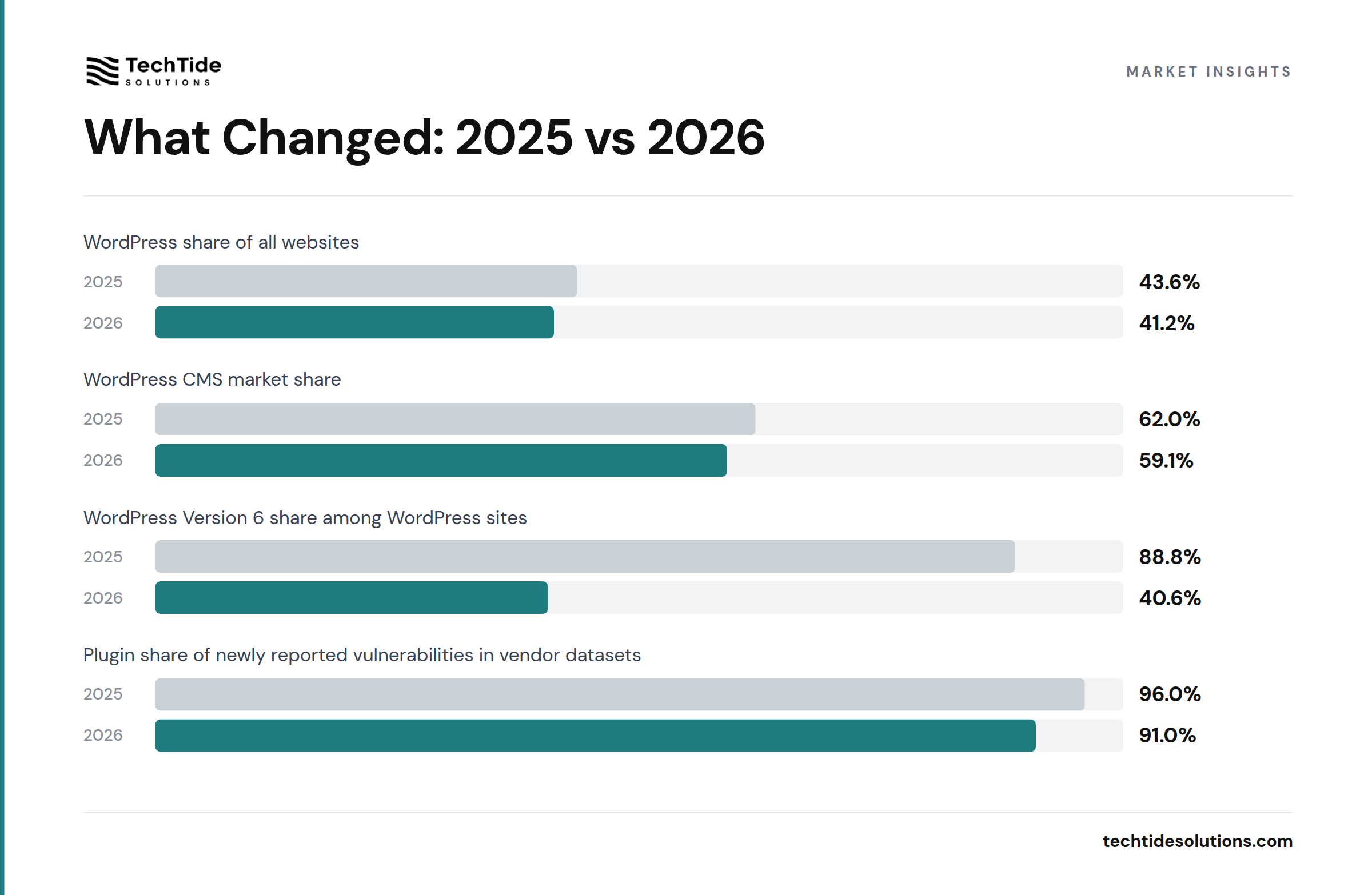
The biggest measurable shift of the year was the version turnover, with WordPress Version 6 dropping from 88.8% of WordPress sites on July 1, 2025 to 40.6% on July 26, 2026, a fall of 48.2 percentage points (W3Techs, Historical trends in the usage statistics of WordPress versions 2026) (W3Techs, Usage Statistics and Market Share of WordPress 2026). That kind of rotation does not happen unless hosting defaults, auto-updates, and maintenance habits are all pulling in the same direction. The broader WordPress story in 2026 is slower market-share growth paired with faster core-version modernization.
| Metric | 2025 | 2026 | Change |
|---|---|---|---|
| WordPress share of all websites (W3Techs, Historical yearly trends in the usage statistics of content management systems 2026) | 43.6% | 41.2% | ↓ 5.5% |
| WordPress CMS market share (W3Techs, Usage Statistics and Market Share of WordPress 2026) | 62.0% | 59.1% | ↓ 4.7% |
| WordPress Version 6 share among WordPress sites (W3Techs, Historical trends in the usage statistics of WordPress versions 2026; W3Techs, Usage Statistics and Market Share of WordPress 2026) | 88.8% | 40.6% | ↓ 54.3% |
| Plugin share of newly reported vulnerabilities in vendor datasets (Patchstack, State of WordPress Security in 2025; Patchstack, State of WordPress Security in 2026) | 96.0% | 91.0% | ↓ 5.2% |
Reversing: Website Share Stopped Climbing
WordPress’s share of all websites moved from 43.6% in the 2025 W3Techs annual trend snapshot to 41.2% in the current July 2026 snapshot (W3Techs, Historical yearly trends in the usage statistics of content management systems 2026) (W3Techs, Usage Statistics and Market Share of WordPress 2026). The likeliest driver is saturation at the high end of the open-web CMS market, not a sudden collapse in WordPress demand. Into 2027, the question is whether that slip stabilizes or becomes a multi-year trend.
Decelerating: CMS Market Share Fell Below 60%
W3Techs shows WordPress at 62.0% of the CMS market in the January 2025 annual trend series and 59.1% in the current July 2026 snapshot (W3Techs, Historical yearly trends in the usage statistics of content management systems 2026) (W3Techs, Usage Statistics and Market Share of WordPress 2026). The main driver is incremental gains from several smaller hosted builders at once, especially Shopify and Wix, rather than a single platform replacing WordPress head on. That makes the erosion easier to miss and harder to reverse quickly.
Accelerating: Version 7 Became the Majority Fast
Version 6 fell from 88.8% of WordPress sites on July 1, 2025 to 40.6% on July 26, 2026, while Version 7 reached 52.0% by that same July 2026 snapshot (W3Techs, Historical trends in the usage statistics of WordPress versions 2026) (W3Techs, Usage Statistics and Market Share of WordPress 2026). The driver is a relatively clean major-version handoff, helped by managed hosting and routine update behavior. That is one area where WordPress looks more coordinated than its reputation suggests.
Stalled: Plugin Risk Is Still the Main Security Story
Patchstack’s 2025 report said 96% of newly disclosed vulnerabilities in its dataset were in plugins, and its 2026 report still put plugins at 91% (Patchstack, State of WordPress Security in 2025) (Patchstack, State of WordPress Security in 2026). The likely driver is structural rather than temporary, because WordPress keeps adding ecosystem surface area faster than the extension market can simplify. Into 2027, plugin governance matters more than one-off core headlines.
The shift to watch most closely into 2027 is the market-share drift, because it says more about WordPress’s future position than a short-term version cycle does.
Methodology and Sources
This article prioritized primary sources, official WordPress properties, and independent measurement projects over SEO roundups. Market-share and adoption figures were cross-checked across W3Techs and HTTP Archive wherever the denominators could be reasonably compared. Recency mattered, so current July 2026 snapshots were preferred for live usage and version distribution, while 2025 releases were used where they remained the most recent large-scale independent evidence, especially for performance. Vendor research was included only when it added original disclosure data, and every vendor-sourced figure was labeled with its scope and conflict of interest. For this report we ran 31 targeted searches across 51 domains and kept 4 sources that publish accessible, traceable data. One important caveat is that WordPress.org active-install figures are public buckets such as 7+ million and 10+ million, not precise install totals, so they are best read as scale signals rather than exact counts.
- W3Techs, Usage Statistics and Market Share of WordPress 2026, https://w3techs.com/technologies/details/cm-wordpress
- W3Techs, Historical yearly trends in the usage statistics of content management systems 2026, https://w3techs.com/technologies/history_overview/content_Management/all/y
- W3Techs, Historical trends in the usage statistics of WordPress versions 2026, https://w3techs.com/technologies/history_details/cm-wordpress/ver
- W3Techs, Distribution of web servers among websites that use WordPress 2026, https://w3techs.com/technologies/segmentation/cm-wordpress/web_server
- HTTP Archive, CMS | 2025 | The Web Almanac, https://almanac.httparchive.org/en/2025/cms
- WordPress.org, Plugins 2026, https://wordpress.org/plugins/
- WordPress.org, Release Archive 2026, https://wordpress.org/download/releases/
- Patchstack, State of WordPress Security in 2025, https://patchstack.com/whitepaper/state-of-wordpress-security-in-2025/
- Patchstack, State of WordPress Security in 2026, https://patchstack.com/whitepaper/state-of-wordpress-security-in-2026/
Last updated: July 2026
We refresh this page as new data becomes available.

