
Real-time software has stopped being a novelty. It is now a baseline expectation in modern products. In that climate, Gartner’s cloud forecast matters because it sets the pace for always-on systems, and it points to $723.4 billion in 2025 for worldwide public cloud end-user spending. Our thesis at Techtide Solutions is simple. WebSockets earn their keep when you must move small facts fast, in both directions, without ceremony. Yet they also demand operational maturity. A WebSocket is not “just a faster HTTP.” It is a different contract with different failure modes.
Over the past decade, we have watched teams rediscover the same lesson. Latency is a product feature, not only a network property. When users track a delivery, co-edit a document, or watch a live ops dashboard, they notice delays instantly. WebSockets can remove whole classes of jitter caused by repeated requests. Still, the best architecture is the one you can run safely. Our goal here is practical clarity, not protocol mystique.
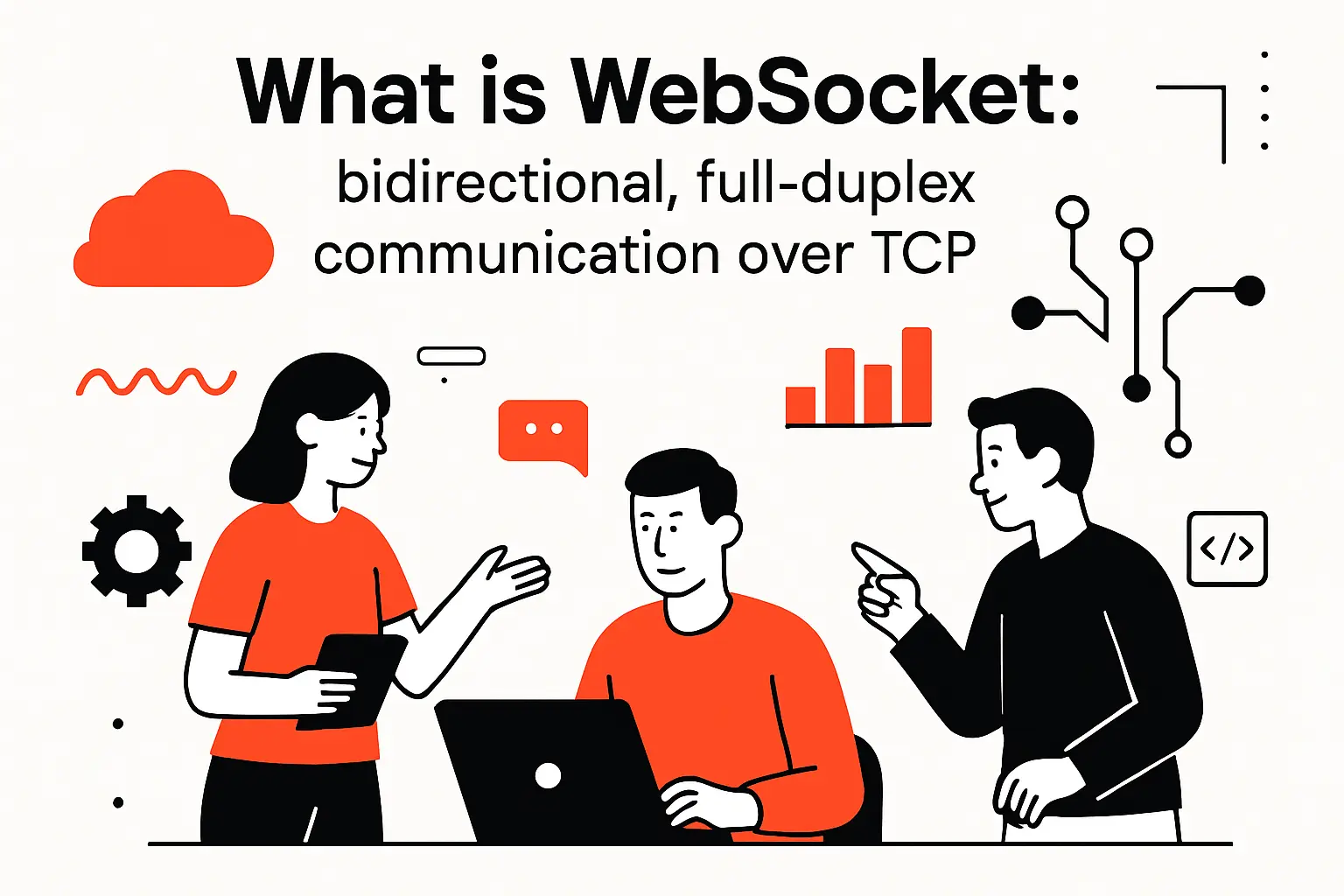
What is WebSocket: bidirectional, full-duplex communication over TCP
Market demand keeps pushing software toward “right now” experiences. McKinsey’s personalization research captures that pressure, noting 71 percent of consumers expect companies to deliver personalized interactions as a default. That expectation quietly forces more event-driven UX. WebSockets are one of the cleanest primitives for those events. They let clients and servers talk continuously, instead of taking turns.
1. WebSocket protocol standardization and specs: RFC 6455 and the WHATWG living standard
WebSocket has two “homes” that matter to builders. One home defines the wire protocol used between client and server. The other home defines how browsers expose WebSockets to JavaScript. When we design systems, we treat them as related but distinct layers.
The protocol layer is described in the IETF WebSocket Protocol specification. It defines the handshake, framing, masking rules, and closure semantics. The browser-facing layer is tracked in the WebSockets Living Standard. That living standard matters because browsers evolve behavior at the edges. Those edges include error surfaces, timing, and subtle compatibility constraints.
2. Persistent, low-latency connections designed for realtime client-server messaging
A WebSocket connection is persistent by design. Once established, both parties can send messages at any time. That is the heart of “full-duplex.” We are no longer waiting for a request to justify a response. Instead, the connection itself is the shared context.
In our experience, this changes product design choices. Teams stop batching UI updates “to be safe.” Designers can show presence, typing, and incremental progress without hacks. Operationally, it also changes cost shapes. You trade bursts of request overhead for a steady pool of open connections.
3. WebSocket protocol vs the browser WebSocket API
From the server’s viewpoint, WebSocket is a protocol upgrade and a framing format. From the browser’s viewpoint, WebSocket is an API with events and a send method. Those are not the same abstraction. The server might support extensions, subprotocols, or custom auth gates. The browser API stays deliberately small.
At Techtide Solutions, we often see confusion here during incidents. A browser “close” event is not always a protocol close handshake. A server “disconnect” may actually be a proxy timeout. Clear mental separation helps debugging. It also shapes testing, because unit tests can cover API logic while integration tests cover protocol behavior.
WebSocket vs HTTP and polling: key differences and when to avoid WebSockets
Digital behavior is becoming more continuous, not more episodic. Deloitte’s connectivity research highlights recurring digital engagement costs, including households spending US$183 monthly on tech services and software subscriptions. That “always-on” reality is the habitat where server push shines. Even so, not every product needs an always-open channel. Many do better with simpler tools.
1. HTTP request-response vs WebSocket server push for realtime updates
HTTP is a request-response protocol in practice. The client asks, then the server answers, then the exchange ends. Polling repeats that pattern on a timer. Long polling stretches it, but still relies on repeated requests. WebSockets flip the psychology. The server can speak first, whenever it has news.
Consider a fraud-detection screen in a back-office tool. Under polling, you choose a refresh cadence and accept stale windows. Under WebSockets, the server can push a “risk changed” event immediately. That shift can reduce operator hesitation. It can also reduce duplicated effort, because the UI stops re-fetching unchanged state.
2. Lower overhead by reducing repeated HTTP requests and headers
Polling burns overhead in places teams forget. Each request carries headers, cookies, and routing work. Each response repeats status lines and metadata. The payload might be tiny, yet the wrapper remains bulky. WebSockets amortize much of that wrapper cost across the session.
In production, this matters most for “chatty” interfaces. Dashboards are a common example. Another is multiplayer coordination where small state deltas matter. We have seen systems where the business payload was modest. The overhead dominated anyway. A WebSocket approach reduced noise and improved perceived responsiveness.
3. When not to use WebSockets: one-time fetches, infrequent updates, and RESTful workflows
Some workflows want the opposite of persistence. A product catalog fetch is a classic one. So is a static settings page. Infrequent updates rarely justify an always-open socket. Operational simplicity is a feature too. HTTP caching, CDNs, and idempotent REST patterns shine here.
We also avoid WebSockets when intermediaries are hostile. Some enterprise networks terminate idle connections aggressively. Some compliance teams demand inspection patterns that are easier with standard HTTP logs. In those contexts, WebSockets can still work, but the effort may outweigh value. A pragmatic alternative can be Server-Sent Events or periodic refresh with good caching.
Establishing a WebSocket connection: the HTTP Upgrade handshake
Security budgets are expanding because threats keep scaling with connectivity. Gartner’s security forecast frames this reality, projecting $213 billion in 2025 for worldwide end-user spending on information security. For WebSockets, that emphasis is timely. The handshake is deceptively simple, yet it is also an attack surface. Validation decisions made here ripple through your whole system.
1. Client handshake essentials: Upgrade, Connection, Sec-WebSocket-Key, and Sec-WebSocket-Version
The WebSocket handshake begins as an HTTP request. The client asks the server to upgrade the connection. It includes headers indicating upgrade intent and connection behavior. It also includes a WebSocket key used to prevent certain proxy caching issues. A version header signals which WebSocket framing rules are expected.
In our builds, we treat the handshake as the first policy checkpoint. That checkpoint is where we verify allowed origins and routes. It is also where we decide whether the request is authenticated enough. Some teams wait until after upgrade. We rarely recommend that. Early rejection is cleaner and cheaper.
Key practical reminder
During debugging, developers often focus on the JavaScript client. Network tooling should focus on the upgrade request. Browser devtools and reverse-proxy logs are both useful. A missing upgrade header is a common culprit. Another culprit is a proxy that strips or normalizes headers unexpectedly.
2. Server acceptance: 101 Switching Protocols and Sec-WebSocket-Accept
The server responds by agreeing to switch protocols. It returns an acceptance header derived from the client key. That derivation uses a fixed recipe. The recipe exists to prove that the server understood the WebSocket request. It also prevents certain intermediaries from replaying the handshake incorrectly.
We like to test this path with raw tools during early development. A minimal client can reveal server mistakes quickly. Common mistakes include miscomputed acceptance values and missing connection directives. Another frequent issue is returning an HTTP success response rather than a protocol switch. In that case, the browser will not treat the channel as a WebSocket.
3. ws:// and wss:// schemes, typical ports, and proxy/firewall considerations
Two schemes exist in practice. One is unencrypted, which is generally unsuitable for production. The other is encrypted and rides on TLS. From a business perspective, the encrypted path is the default. It protects credentials and reduces network tampering risks. It also aligns with modern browser expectations.
Proxy and firewall behavior is the real-world wrinkle. Some reverse proxies need explicit configuration to pass upgrade headers. A common pattern is to terminate TLS at a load balancer and forward clear traffic to app servers. That can work, but it changes threat boundaries. In regulated environments, we often terminate TLS as close to the app as feasible.
WebSocket messaging and framing: text, binary, and control frames
Device fleets and event streams keep multiplying. Statista’s IoT forecast underlines the scale, projecting 19.8 billion in 2025 for IoT devices worldwide. Those devices frequently send tiny updates that still need reliability. WebSocket framing exists to move those updates efficiently. The framing details matter when you tune performance or debug edge cases.
1. Message types: UTF-8 text and binary payloads
WebSockets can carry text or binary messages. Text is often JSON, because it is easy to inspect and log. Binary is often used for efficiency or for structured formats. We have used binary payloads for telemetry batches and for compact state diffs. Either choice can be correct. The deciding factor is usually observability and compatibility.
For business systems, we prefer a message envelope. That envelope carries a type and a correlation key. It also supports versioning. Without an envelope, payloads become ambiguous as features grow. Ambiguity turns into breakage during iterative releases. A small structure early can prevent large rewrites later.
2. Frame structure basics: FIN, opcode, payload length, and client-to-server masking
On the wire, a “message” is carried by frames. Frames have flags that describe whether a message is complete. They also include an opcode that signals the frame’s role. Payload length can be small or extended. Clients also mask payload bytes before sending to servers.
Masking surprises many teams at first. The reason is defensive. It reduces the risk of certain proxy cache poisoning and interpretation issues. For server implementations, it means you must correctly unmask client frames. When we audit WebSocket libraries, masking correctness is a must-have. Bugs here become data corruption under load.
3. Fragmentation, ping/pong heartbeat, and the close handshake lifecycle
Fragmentation allows large messages to arrive in parts. That can help with memory use and streaming-like behavior. Yet fragmentation also complicates application logic. Many libraries reassemble fragments for you. Some expose partial frames. We prefer reassembly in the transport layer, not the business layer.
Heartbeat frames help detect broken connections. Networks can fail silently. Mobile radios sleep. Wi-Fi roams. Load balancers forget idle sockets. Ping and pong messages keep the connection honest. Closure is also a protocol, not a crash. A clean close handshake reduces ghost connections and lowers surprise reconnect storms.
Real-time use cases powered by WebSockets
Software is becoming more conversational and more autonomous. Gartner’s agentic AI outlook signals that shift, predicting 40% of enterprise applications will be integrated with task-specific AI agents by the end of 2026. Agents and assistants thrive on fast feedback loops. WebSockets are not “AI tech,” yet they often carry the events AI features depend on. The clearest use cases remain human-centric, though. Let’s name the big ones.
1. Chat apps, instant messaging, and presence-style interactions
Chat is the canonical WebSocket example for good reason. It requires bidirectional flow. The client sends messages and typing signals. The server broadcasts updates to multiple recipients. Presence indicators are also inherently real-time. Users notice when “online” status lags behind reality.
At Techtide Solutions, we treat chat as a systems test. It reveals message ordering assumptions quickly. It also reveals fan-out stress points. The “presence” problem is especially instructive. Presence is not only a boolean. It is a probabilistic view of connectivity. Designing it well requires humility about networks.
Production pattern we trust
Prefer server authority for presence transitions and session cleanup.
Emit idempotent events so reconnects do not duplicate state changes.
Keep payloads small and structured for low-latency fan-out.
2. Live notifications, realtime dashboards, and financial market-style tickers
Notifications look simple until scale arrives. A “bell icon” can hide a complex stream. Users expect immediate delivery for approvals, alerts, and workflow assignments. Dashboards add another layer. They present a constantly changing world, yet they must stay readable. WebSockets help by sending deltas, not full refreshes.
A market-style ticker is a useful mental model. The UI does not ask “what is the price now?” repeatedly. Instead, it subscribes to a feed and renders updates. The same idea applies to logistics tracking, uptime monitoring, and incident response consoles. In those environments, speed reduces confusion. Clarity reduces costly mistakes.
3. Collaborative editing, multiplayer gaming, and IoT device updates
Collaborative editing depends on shared state and conflict handling. WebSockets provide fast transport for operations. They do not solve concurrency alone. That is where algorithms like OT or CRDTs enter. In our experience, transport and conflict resolution must be designed together. Otherwise, the system works only on good networks.
Multiplayer games have similar demands. Latency and packet loss shape player experience directly. Many games use UDP, yet WebSockets can still fit certain casual genres and admin tools. IoT updates also map well. Devices can stream telemetry and receive commands. The business value is rapid diagnosis and faster remediation, not protocol elegance.
Building browser WebSocket clients with the WebSocket API
The same market forces that fuel real-time backends also reshape frontend engineering. The cloud growth and security spend we already cited are not abstract. They translate into more event-driven user interfaces. Browser WebSockets are a common bridge between those worlds. A well-built client favors resilience over cleverness. That mindset is what keeps real-time features from becoming incident generators.
1. Creating a WebSocket object and negotiating subprotocols
The browser client starts with a constructor call. Most teams pass a secure WebSocket URL and attach handlers. Subprotocol negotiation is the underused feature here. A subprotocol is a formal agreement about message semantics. It is not encryption, not compression. It is an application-level contract.
We recommend reading the browser WebSocket interface documentation before committing to patterns. Browser APIs also constrain headers you can set. That matters for auth design. If you need custom handshake headers, browsers will resist. In that case, you will likely rely on cookies, URL tokens, or a prior HTTP exchange.
// Minimal shape, with app-defined messagesconst socket = new WebSocket("wss://example.com/realtime", ["app.v1"]);2. Core event flow: open, message, error, close, and reconnect handling patterns
Event flow is straightforward, yet subtle in practice. Open means the handshake completed. Message means data arrived. Error is often vague, because browsers avoid leaking details. Close indicates the connection ended, but not always why. Reconnect logic must treat close as normal. It must also avoid creating storms.
Our default approach uses a state machine. That state machine lives outside UI components. A single connection should serve multiple views. Reconnects should include jitter and caps. The client should also pause reconnect attempts when the user is offline. A background tab can also change timing behavior. Testing under tab throttling is worth doing early.
Reconnect rule we enforce
Back off gradually, and reset backoff only after stable uptime.
Buffer outbound messages carefully, and drop those that are no longer relevant.
Expose connection health to the UI so users understand delays.
3. Backpressure and streaming considerations: WebSocketStream and Streams API concepts
Classic WebSockets make backpressure awkward. The send method can queue data faster than the network drains it. Under stress, memory grows quietly. That risk shows up in dashboards with bursty streams. It also appears in binary upload workflows. When teams ignore backpressure, real-time becomes fragile.
One emerging approach is Using WebSocketStream to write a client style APIs. They integrate with streams and expose flow control more naturally. The conceptual backdrop is the Streams Standard. Even if you do not adopt WebSocketStream today, Streams concepts are still useful. They encourage you to think in producers and consumers. That framing makes overload visible and manageable.
Designing WebSocket servers: validation, routing, and operations
Server-side real-time is where engineering meets operations. The market data we referenced earlier signals more cloud infrastructure and more security scrutiny. Those realities raise the bar for server design. A WebSocket server is not only a router of messages. It is a long-lived session manager. It is also a target. Good servers act like good bouncers. They are friendly, strict, and consistent.
1. Server responsibilities: parsing handshake requests, responding correctly, and tracking connected clients
A WebSocket server must correctly parse upgrade requests. It must validate headers and compute acceptance. It must also track active connections and their metadata. That metadata usually includes auth identity, tenant, roles, and subscriptions. The tracking structure is part of your scalability story. It determines how you broadcast and how you evict stale clients.
In our architecture reviews, we look for explicit routing. “Broadcast to all” rarely survives production. Tenancy boundaries matter. Topic subscriptions matter. Backpressure matters too. If one slow client blocks others, you have a convoy problem. A robust server isolates slow consumers and drops data deliberately when needed.
2. Security considerations: Origin validation, TLS with WSS, authentication approaches, and input validation
Security starts before the socket opens. Origin validation helps reduce cross-site abuse in browsers. TLS is non-negotiable for sensitive traffic. Authentication must also fit the browser constraint set. Cookie-based sessions can work well. Token-based approaches can also work, but token refresh must be planned.
Input validation is where real attacks show up. A socket is a wide pipe. Attackers can flood it with malformed frames or oversized payloads. Rate limiting and message size caps are essential. We also recommend reading WebSocket Security Cheat Sheet guidance as a baseline. From there, tailor controls to your domain. Financial workflows demand stricter auditing than casual chat.
Auth pattern we like for browsers
Use an HTTP login flow first, then open the socket with cookies.
Authorize each message type server-side, not only at connection time.
Log security-relevant events without logging sensitive payload content.
3. Extensions and subprotocols: negotiating capabilities and structuring payloads
Extensions can change transport behavior. Compression is the common example. Compression can save bandwidth, but it can also increase CPU and amplify certain risks. Subprotocols are different. They help you formalize your application messages. They also let multiple “apps” share one endpoint cleanly.
We structure payloads with explicit types. We also include a request identifier for correlation. For request-response patterns over WebSockets, correlation is essential. It prevents race confusion and simplifies retries. A message should also carry a version marker for safe evolution. Without versioning, payload changes become breaking changes. Breaking changes create forced deploy coordination.
4. Implementation options: reverse proxies and common WebSocket libraries
Implementation choices should match your operating model. Some teams run dedicated WebSocket gateways. Others embed WebSockets inside monolith app servers. Reverse proxies often sit in front. Those proxies must support upgrades correctly. Many issues blamed on “WebSockets” are really proxy misconfigurations.
At Techtide Solutions, we choose libraries that are boring and well-tested. Node has several options, including “ws,” plus higher-level wrappers. Java and .NET ecosystems also have mature choices. In Go, popular libraries exist too. Socket.IO can be helpful when you need fallbacks, though it is not pure WebSocket semantics. Whatever you choose, test with real load and real intermediaries. A laptop-only test will mislead you.
TechTide Solutions: custom WebSocket development tailored to customer needs
Business appetite for real-time is growing, but tolerance for instability is shrinking. The market signals we cited earlier point to more investment and more scrutiny. That combination is why we treat WebSockets as a product capability, not a code feature. At Techtide Solutions, we build WebSocket systems around requirements and constraints first. Protocol comes second. Operations comes third, but it never comes last.
1. Requirements-driven solution design for realtime features
Every real-time feature hides a question about truth. What counts as “current” in your domain. Is it acceptable to be eventually consistent. Must you be strictly ordered. Does the UI need every event, or only the newest state. Those answers shape the entire design.
We start with a domain map and an event taxonomy. Then we define message contracts and failure behavior. In a logistics product, we might send location deltas and status transitions. In a healthcare ops view, we might send assignment changes and readiness flags and in a trading-adjacent dashboard, we might send price deltas and alert triggers. Each domain wants different guarantees. Treating them the same invites trouble.
Discovery questions we ask early
Which updates are critical, and which are cosmetic?
How should the UI behave when the socket drops?
Where is the system of record when events disagree?
2. Custom WebSocket client and server development aligned to product workflows
Alignment is our main differentiator. We do not build a “socket service” in isolation. We build a workflow engine that happens to use sockets. That means we connect WebSockets to identity, billing, and audit trails. It also means we map socket events to user journeys.
For example, we once modernized an internal dispatch console for a service business. Operators needed immediate updates, but also needed trust. We designed events as small, verifiable changes. We used server-side authorization per action and also built replay-friendly state snapshots so reconnects were seamless. The result was calmer operations during peak periods. Calm is an underrated KPI.
3. Production-grade delivery: performance tuning, security hardening, and scale planning
Scaling WebSockets is not only “more pods.” Connection state is sticky by nature. You must decide where session metadata lives. You must also decide how broadcasts happen across instances. Pub-sub backplanes can help. So can partitioned topics. Observability also matters. Without it, you will guess during outages.
Security hardening includes strict origin checks and message validation. It also includes safe logging and careful error surfaces. Performance tuning often includes batching and coalescing. It also includes dropping non-critical updates under pressure. That last point is uncomfortable, but it is honest. Real-time does not mean “never lose a cosmetic event.” It means “protect core truth while staying responsive.”
Conclusion: choosing WebSockets and evaluating alternatives
Real-time is no longer a niche requirement. The cloud and security market signals we referenced earlier reflect that shift in budgets and priorities. Yet WebSockets are still a deliberate choice. They impose operational complexity, especially at scale. They also reward teams who build strong contracts and strong runbooks. In our experience, the right decision is the one you can sustain.
1. Decision factors: realtime bidirectional needs, connection scale, and operational complexity
Bidirectional immediacy is the primary reason to choose WebSockets. If clients only need server-to-client updates, a simpler channel may work. If updates are rare, HTTP is usually enough. And if you need presence and rapid user feedback, WebSockets can be ideal. The real question is scale. How many concurrent connections must you carry reliably. That answer shapes cost and architecture.
Operational complexity is the hidden tax. You must handle reconnect storms and partial failures, manage idle timeouts and keepalives, monitor message rates and queue growth. And also plan for deploys without breaking sessions. If your team is not ready, start smaller. You can evolve into WebSockets later with a sound event model.
2. Alternatives to consider: Server-Sent Events, long polling, and other realtime transport options
Server-Sent Events are a strong option for one-way streams. They work well for notifications and dashboards. They also integrate cleanly with HTTP infrastructure. Long polling remains useful in hostile networks. It is not elegant, but it is robust. Message brokers can also serve internal real-time needs without exposing sockets publicly.
Other modern transports exist too. Some teams explore WebTransport for certain latency profiles. Others use gRPC streaming outside browsers. The best alternative depends on who the client is and what the network permits. If you are considering WebSockets for a new feature, we suggest a small pilot first. Which workflow in your product would benefit most from “always-on” truth, and what would it cost to keep it stable?