

At Techtide Solutions, we treat Scrum as both a compass for product discovery and a governor for delivery risk. The wider technology climate sets the tone: industry investment keeps rising, with worldwide IT spending expected to exceed $6.08 trillion in 2026, which puts pressure on teams to turn strategy into shipped outcomes with minimal waste. Scrum’s genius is that it creates a simple, social architecture—roles, artifacts, and events—that channels uncertainty into testable increments. We’ve seen the framework work in regulated fintech, heavy-industry IoT, and consumer apps precisely because it values evidence over ego and learning over lore.
What follows is our field-tested map of Scrum—its intent, components, and craft—infused with practical heuristics we use when building software products and platforms for clients across sectors. We’ll connect Scrum’s ideas back to lean operations, modern product management, and socio‑technical thinking so you can see not just how it works, but why it works.
what is scrum: lightweight framework based on empiricism and lean thinking
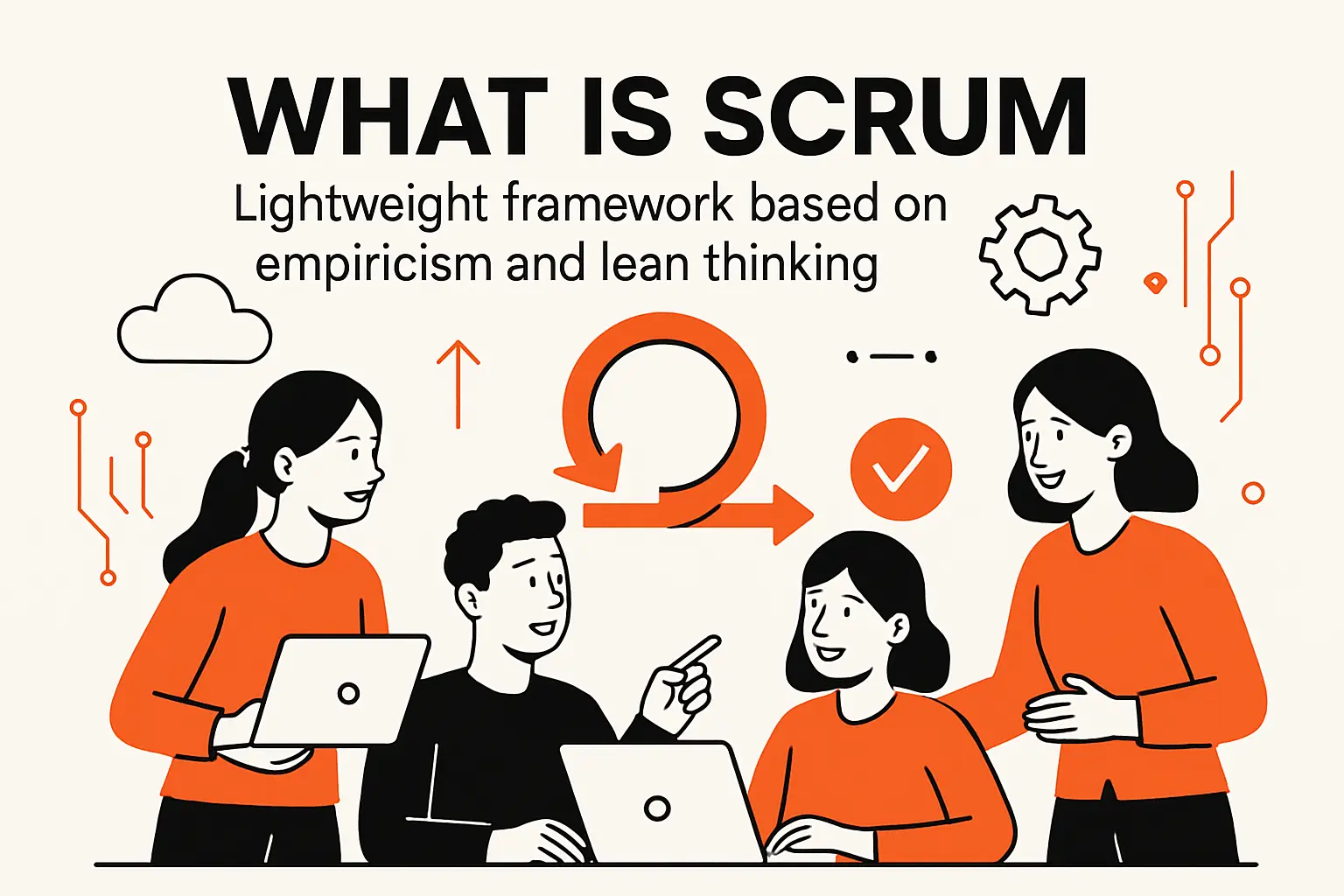
Scrum emerged to address complex work where cause and effect aren’t clear up front, and it thrives in markets shaped by fast-moving investment and innovation. Consider how artificial intelligence has altered capital allocation: AI startups captured 37% of venture funding in the last full year, concentrating attention on short feedback loops and adaptive roadmaps—exactly where Scrum shines by design. When uncertainty is normal, empiricism beats prediction.
1. Empiricism in Scrum: transparency, inspection, adaptation
Scrum’s roots are pragmatic: if knowledge emerges through experience, then we must see the work clearly (transparency), examine it regularly (inspection), and change course quickly (adaptation). We treat these not as buzzwords but as engineering constraints. Transparency isn’t posting a plan; it’s rendering the present truth visible. We like lightweight “information radiators” that make priorities, progress, and quality states obvious without meetings—backlog columns that actually mean something, story maps that show flow and risk, a definition-of-done that clarifies when something is truly complete.
Inspection is the routine, disciplined look at reality. In practice, we inspect artifacts, behavior, and outcomes. Are backlog items written in a way that prompts conversation rather than dictating solutions? Is the branching strategy helping or hindering integration? Are customers changing how they behave because of what we shipped? Adaptation then follows naturally: we adjust the plan, architecture, or working agreement. The smallest possible reversible change is best—test a slice, observe, then double down or roll back. That pattern, repeated, is the real engine of Scrum.
Heuristic we use
When a client’s environment feels ambiguous, we design “sensors” into the product and the process. Feature flags, telemetry, and small release batches become our early-warning system; working agreements on code review and test depth become our guardrails. The point isn’t perfection; it’s constant measurement and correction.
2. Scrum values: commitment, courage, focus, openness, respect
Scrum only works when its values are lived, not laminated. Commitment means owning the outcome, not just the task. Courage is the freedom to surface risk early. Focus is the antidote to vanity work. Openness turns blockers into a team’s problem, not a person’s shame. Respect is acknowledging that product discovery and engineering craft require different skills and both matter. We coach teams to inspect how these values show up in everyday rituals—pull requests, planning conversations, and stakeholder updates—because values only matter at the point of friction. When a team protects focus under pressure from a last-minute executive request, that’s Scrum’s moral backbone doing its job.
Signal check
We ask: are sprint goals consistently met? Do developers feel safe proposing simpler solutions? Are stakeholders genuinely engaged in reviews? When the answers skew negative, we don’t rewrite processes first; we repair trust and clarity, then revisit mechanics.
3. Small, cross-functional Scrum Teams around 10 people
Scrum’s emphasis on small, cross-functional teams aligns with how knowledge flows in complex systems: fewer handoffs, tighter feedback loops, and clearer accountability. In our experience, product outcomes improve when the team spans product, design, engineering, and QA with shared context and autonomy. The team’s size forces tradeoffs; it teaches prioritization. When a capability doesn’t fit inside the team, we treat it like a service with a clear interface and latency expectations, rather than a shadow member who attends a meeting but can’t change the work.
Socio-technical lens
Small teams enable socio-technical coherence—architecture that mirrors team cognition. We often apply “you build it, you run it” principles so operating constraints shape design. Teams who own telemetry and on-call naturally build for observability and resilience; that’s Scrum’s values expressed as system design.
4. Short cycles called sprints deliver incremental value
Sprints time-box uncertainty into digestible bets. Each cycle aims to ship something that behaves like a product, not a prototype—usable by a real person, with quality good enough to keep. Lean thinking calls this reducing batch size; product management calls it derisking assumptions. Either way, the cadence creates a drumbeat that helps stakeholders engage in reality rather than in roadmaps. In practice, we encourage teams to orient around outcomes (what changes for the user) rather than output (what we built). When teams aim at outcomes, they naturally split work to deliver capability earlier, which compounds learning.
Scrum roles: product owner, scrum master, developers

Clear accountabilities prevent the “everyone is responsible, therefore no one is responsible” trap. Interestingly, executive structures are evolving in ways that support this clarity: nearly 63% of technology leaders now report directly to the CEO, a signal that product and platform decisions are business decisions. Scrum’s roles operationalize that idea at the team level: someone chooses the next most valuable problem, someone protects the system that turns ideas into increments, and the builders own the engineering reality.
1. Product Owner: prioritizes and maintains the product backlog
We coach Product Owners (POs) to become outcome curators, not requirement clerks. The PO’s backlog is a narrative about value: what users can achieve next and why it matters now. We like to work backward from a short problem statement—what changes in the user’s world when we ship this?—and then map the smallest coherent slice that delivers that change. Refinement is where the PO’s skill shows: clarifying acceptance criteria, aligning stakeholders around tradeoffs, and ruthlessly pruning anything that doesn’t move a chosen metric or strategic theme.
Patterns that help
We lean on product discovery tools—story mapping to visualize coverage and gaps, opportunity solution trees to avoid local maxima, and impact mapping to keep goals and behaviors connected. In regulated contexts, the PO becomes the translator between compliance language and user value, turning obligations into product criteria rather than paperwork.
2. Scrum Master: facilitator, coach, and servant leader for the team
Scrum Masters (SMs) maintain the health of the system by making the work visible and the learning deliberate. We look for SMs who can coach at three levels: individual (mindsets and habits), team (working agreements and flow), and organization (removing structural impediments). Their currency is influence, not authority. The best SMs are pattern spotters—naming where the process is drifting from intent, facilitating tough conversations, and adjusting the environment so the team can focus on outcomes.
Anti-pattern we watch for
When the SM becomes a project manager-in-disguise, the team externalizes ownership. We counter this by having developers run parts of ceremonies, rotating facilitation, and tying every process change to a learning goal.
3. Developers: cross-functional members who build the product
Developers in Scrum own the technical plan and the quality standard. They turn backlog intent into design, code, tests, and integrated behavior. We emphasize engineering practices that amplify Scrum’s feedback loops: continuous integration, test automation at multiple layers, mob or pair programming for tricky areas, and trunk-based development for fast integration. This is not process theater; it’s how you get empirical data quickly and safely.
Quality as a habit
Done means usable, operable, and maintainable. We schedule time for refactoring as part of the work, not as debt to be paid later, and we teach teams to link tech decisions to business impact: modularity speeds change, observability reduces guesswork, and strong test suites buy agility when stakes are high.
4. Keep Product Owner and Scrum Master responsibilities distinct
The PO decides what constitutes value; the SM shepherds the process that creates it. Combining the two typically degrades both: prioritization gets biased by process convenience, or process health gets sacrificed to feature pressure. We’ve seen the temptation in lean organizations; our rule of thumb is simple—separate accountabilities, foster tight partnership. The PO narrates “why now,” the SM asks “what would make learning faster,” and developers answer “how do we build the smallest next truth.”
Scrum artifacts: product backlog, sprint backlog, increment with definition of done

Artifacts are Scrum’s memory and promise. They capture intent, make plans testable, and keep the product in a continuously usable state. There’s also a direct business reason to treat them seriously: companies with exceptional developer velocity have revenue growth that is four to five times faster, and strong artifacts are part of the scaffolding that enables that outcome. The thread that ties artifacts together is clarity—about value, about plan, and about quality.
1. Product backlog is an ordered, evolving list of customer-facing work
The product backlog should read like a customer journey, not a tug-of-war among departments. We structure it into themes that reflect outcomes, then nest items by the narratives users care about. Items near the top are crisp and testable; items further down are fuzzier by design. We reserve capacity each sprint for refinement to keep the top of the backlog “ready enough,” and we explicitly track assumptions so we can kill bad ideas quickly.
Discovery in public
We often run a weekly discovery cadence where the PO, a designer, and one developer explore uncertainties on a single slice. The outputs—notes, sketches, test results—live where developers work, not in an isolated research tool. This reduces translation errors and keeps discovery and delivery intertwined.
2. Sprint backlog is the team’s plan and forecast for the sprint
The sprint backlog is not a contract; it’s a forecast with visible tradeoffs. We like to capture not just tasks but also tests, data collection steps, and integration touchpoints. The plan changes as we learn—sometimes the simplest thing is to remove a work item if it no longer serves the sprint goal. Good sprint backlogs help non-technical stakeholders understand what “building the thing” actually entails, which builds trust when we pivot.
Flow-aware planning
We teach teams to highlight items that carry risk—cross-team dependencies, complex migrations, unfamiliar libraries—so they get extra attention during the sprint. The trick is to keep the plan honest rather than optimistic, with the sprint goal acting as the steady north.
3. Increment is a usable outcome that meets the team’s definition of done
The increment is proof. It demonstrates not only that software exists, but that it behaves, performs, and can be supported in production-like conditions. A robust definition of done (DoD) removes ambiguity: tests pass at agreed levels, observability is in place, docs are updated where they matter, and any feature toggles are in a safe default state. Every increment that meets DoD is shippable—even if you choose to release on a different cadence—so learning can happen whenever you need it.
DoD as strategy
We sometimes add product-specific quality gates to DoD for a period—accessibility checks for a civic portal, data lineage notes for a finance platform—so that quality learning is baked into delivery rather than bolted on. Teams feel the difference quickly: discussions move from “Can we ship?” to “Is the behavior valuable?”
Scrum events: sprint, sprint planning, daily scrum, sprint review, sprint retrospective
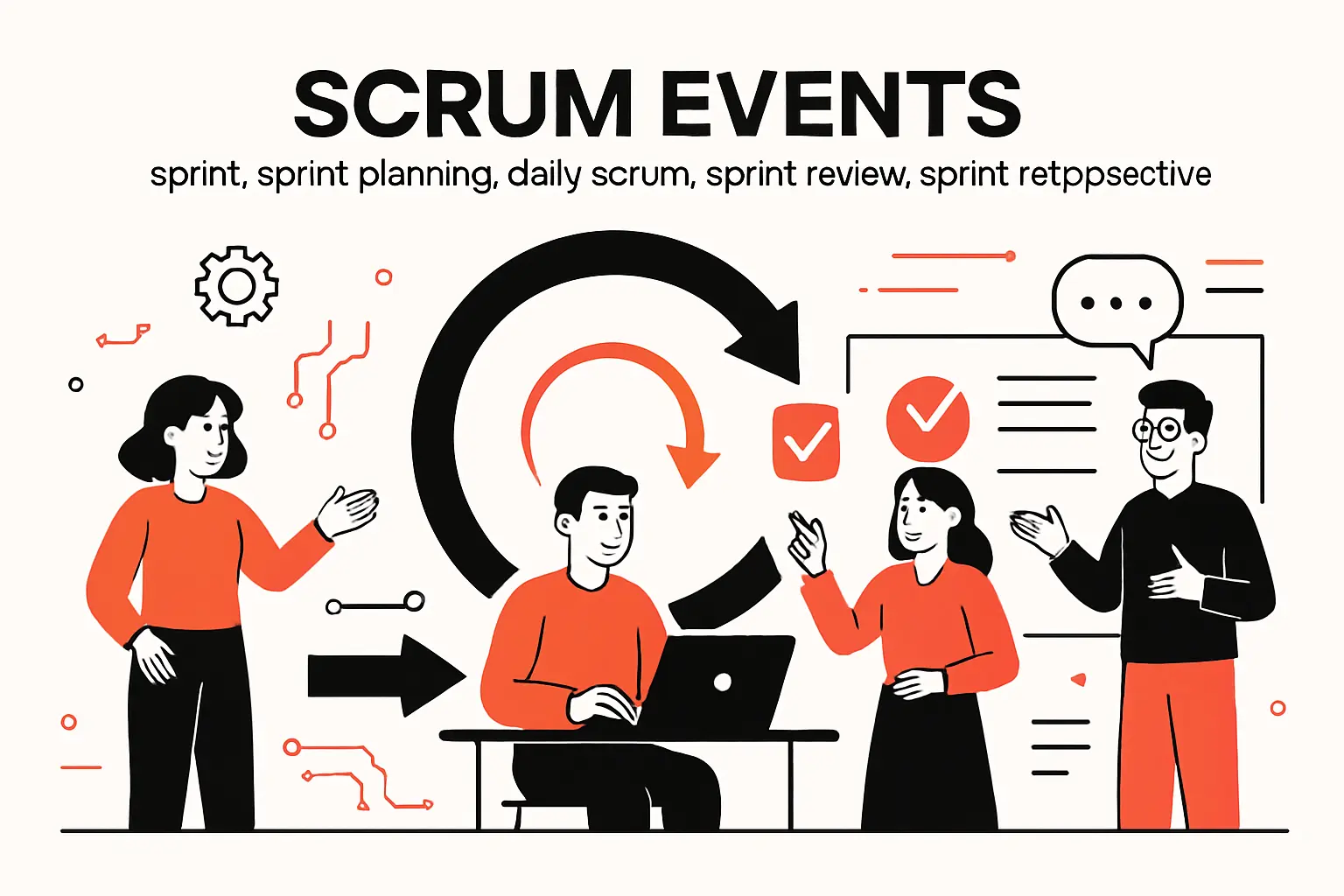
Scrum’s events are structured conversations designed to harvest evidence and refocus effort. Markets are embracing blended ways of working, with hybrid approaches posting a +57% increase according to a widely cited project management study. In that reality, Scrum events become stabilizers: they protect learning time, anchor stakeholder engagement, and force regular inspection of both product and process.
1. Sprint planning: decide what can be done and how to do it
We approach sprint planning as a set of decisions rather than a ceremony. First, align on the sprint goal—the change we intend to achieve for a user or system. Second, select backlog items that, when integrated, deliver that change. Third, shape a technical plan that preserves quality and reduces risk. We encourage developers to outline the tests, integration steps, and data signals that will prove the goal. If the plan looks busy but doesn’t converge on a coherent capability, we thin the selection until it does.
Role clarity in planning
The PO owns “why” and “what”; developers own “how”; the Scrum Master owns the conditions for a good decision—time, focus, and clarity. Planning ends with a confident forecast and the courage to adjust when evidence arrives.
2. Daily Scrum: 15-minute inspect-and-adapt planning for the next 24 hours
This is a quick team recalibration, not a status ritual. We center the conversation on the sprint goal: what moved the goal forward, what blocked it, and what the day’s plan should be to keep momentum. When delivery work is fully visible—through a board that reflects reality—the Daily Scrum becomes an incisive replanning session. Our own teams rotate facilitation and occasionally run “silent dailies” using comments on the board to reduce meeting fatigue while preserving alignment.
Anti-fragility in micro
When something cracks—a brittle test suite, a flaky environment—we treat the Daily Scrum as a place to make the invisible visible and to decide whether to slow down to fix the underlying cause. That bias for root-cause attention keeps the system from accumulating quiet liabilities.
3. Sprint review: demonstrate the increment to stakeholders
The sprint review is a learning forum, not a show-and-tell. We aim to simulate real use and capture qualitative reactions alongside any telemetry we have. Stakeholders come to see constraints as design inputs, not complaints, and to help prioritize the next experiment. We bring the product roadmap into the conversation to show how new learning affects the bigger arc. The most valuable reviews often surface what not to build next.
Steering with evidence
We encourage stakeholders to propose alternative hypotheses—what else might solve the problem—and then commit to validating one of them during the next cycle. Over time, this makes prioritization a shared act of sense-making, not a negotiation over features.
4. Sprint retrospective: identify improvements for the next sprint
Retrospectives are the heartbeat of continuous improvement. We alternate formats to avoid stale conversations: sometimes focus on flow, sometimes on quality, sometimes on decision latency. We ask teams to pick one or two actionable improvements and to encode them into their working agreement or Definition of Done so changes survive the calendar. The meta-goal is to cultivate psychological safety and intellectual honesty; the rest follows.
From talk to change
A retrospective without a visible experiment in the next sprint is a missed opportunity. We track these experiments just like product work, with owners and expected signals, and we celebrate when a small change pays off—because it reinforces the habit of adaptation.
Sprints in depth: goals, length, cadence, and execution

Scrum compresses strategy into short, repeatable learning cycles. Done well, sprints reduce waste and create momentum. Agile transformations that prioritize disciplined operating models can deliver material performance gains—analyses of agile initiatives describe improvements on the order of 20 to 30 percent through better alignment, shorter decision paths, and the removal of low‑value work. The sprint is where those gains happen in practice.
1. Sprint duration: one to four weeks within a one-month maximum
We choose sprint length based on risk and learning cadence. Shorter cycles accentuate fast feedback and reduce inventory of half-done work; slightly longer cycles can help when integration or stakeholder availability would otherwise dominate the calendar. The right test is simple: can the team reliably produce a usable increment and learn something important about the product in that timebox? If not, the duration is wrong—or the slice of work is too large.
Cadence as a contract
Once we set a cadence, we defend it. That reliability builds stakeholder trust and gives the team a predictable rhythm for discovery, delivery, and improvement. Changing length is a strategic decision, not a reaction to pressure.
2. Sprint goal sets the theme and defines success
A good sprint goal tells a user story: “Enable customers to do X they couldn’t do yesterday” or “Prove whether Y actually matters.” It creates freedom for developers to adjust the tasks while keeping eyes on the outcome. We push for goals that close a learning loop—about desirability, feasibility, or viability—so the increment answers a real question and the roadmap evolves accordingly.
Outcome beats output
When the goal is clear, it becomes easier to split work intelligently. We cut through the tangle of tasks by asking, “What’s the smallest capability that still unlocks the intended behavior?” That question keeps complexity in check and pulls quality conversations forward.
3. Sprint backlog emerges during planning and can adapt as needed
Great sprint backlogs behave like living models of the plan. We expect them to evolve as tests reveal problems, as integration highlights edge cases, and as stakeholders surface fresh context. The key is to make changes intentional, anchored to the sprint goal. If we must drop or swap an item, we say so explicitly and capture why. These small acts of transparency prevent scope creep from eroding trust.
Adaptation without chaos
We maintain a visible “parking lot” for items that don’t belong in the current sprint but shouldn’t be lost. That keeps focus intact while honoring useful discoveries. It’s how teams stay nimble without becoming noisy.
4. Use Jira boards and backlogs to plan, run, and track sprints
Tools like Jira can either clarify or confuse. We configure boards to mirror the team’s real flow and Definition of Done—no vanity columns. Backlogs reflect outcome themes, not departmental silos. We connect work items to product goals and attach the evidence that matters: test runs, logs, designs, and acceptance notes. Our favorite move: make dashboards for stakeholders that show progress via outcomes delivered and learning achieved, rather than via raw counts of tickets closed.
Tooling as a catalyst
When the tool speaks the team’s language, meetings shrink and decisions speed up. We treat the configuration itself as an artifact—versioned, reviewed, and continually improved—so it serves the process instead of the other way around.
5. Manage capacity and velocity to set realistic forecasts
Capacity and velocity exist to create shared realism, not to score the team. We calibrate velocity over multiple sprints, resisting the urge to use it as a target. Capacity planning is a conversation about constraints—people, skills, dependencies, environments—and we capture those constraints explicitly in our forecast. This removes the drama from planning and keeps focus on the sprint goal rather than on point totals.
Forecasting with humility
Forecasts improve when teams inspect the variance between plan and reality and ask what drove it—under-specified work items, brittle tests, unseen cross-team dependencies. We reduce variance by refining earlier, integrating more often, and right-sizing slices of work. Over time, predictability emerges from better habits, not from pushing harder.
Agile vs Scrum: how they relate and differ
In our practice, we explain Scrum as a way to make agile principles tangible. The broader market continues to emphasize adaptability, as large analyst forecasts and venture trends have shown in recent cycles, and that context reinforces Scrum’s focus on empirical learning over detailed prediction. It’s helpful to consider agile the mindset and Scrum the operating pattern—one gives you direction, the other gives you rails.
1. what is scrum vs agile: framework versus philosophy
Agile is a set of values and principles that prize individuals and interactions, working software, customer collaboration, and response to change. Scrum is a framework that codifies those principles into specific roles, artifacts, and events. We find it useful to treat agile as the compass (which way to travel) and Scrum as the trail map (how to travel), recognizing that the terrain still requires judgment. When teams confuse the two, they either practice “process without principles” or “principles without practice.” Neither performs under pressure.
Compass and map working together
We coach leaders to articulate agile values in their own words and then to let Scrum provide the scaffolding. That pairing allows teams to preserve autonomy without losing alignment, and to maintain quality without stifling discovery.
2. Scrum provides structure and timeboxes; agile emphasizes values and principles
Scrum gives you timeboxes and touchpoints that create predictable moments for decision-making. Agile tells you the kind of decisions to privilege—customer value over internal convenience, adaptability over rigid plans. In organizations that have drifted into ceremony-for-ceremony’s-sake, we strip back to essentials: keep the events, keep the artifacts, and reconnect them to outcomes, not outputs. We’ve watched morale rebound when teams feel their process is helping them learn again.
The trap of cargo-cult agile
Adopting labels without behaviors creates cynicism. We counter that by measuring what the process is supposed to improve—lead time to learning, quality of increments, stakeholder clarity—and then tuning events and artifacts to move those needles.
3. Scrum alongside Kanban and hybrid approaches
Scrum and Kanban aren’t rivals; they’re complementary. When inbound work is highly variable and service-like—support flows, platform enablement, or integration requests—Kanban’s pull-based flow and explicit policies shine. When the work is goal-driven and discovery-heavy, Scrum’s timeboxed bets perform well. Hybrid approaches combine them: a Scrum team for product evolution, a Kanban lane for operational flow. Large organizations often benefit from a portfolio-level view that harmonizes both, so local optimizations don’t create global friction. Executive teams appreciate that hybridity reduces the false choice between “move fast” and “be reliable.”
TechTide Solutions: custom Scrum implementations tailored to customer needs
We build Scrum implementations that fit the business, not the other way around. Our discovery work often starts by mapping strategy to outcomes and measuring how work currently flows. Findings are usually unsurprising yet potent: too many handoffs, too little clarity, and not enough integration. Leadership trends reinforce the shift toward product-centric operating models, and the same executive survey that elevated the CIO’s role stresses the need to align tech strategy with business value. We translate that into concrete practices, tools, and coaching that make value visible and attainable.
1. Discovery and backlog shaping aligned to business outcomes
We begin with outcomes and constraints. Together with product leaders, we define the product’s “north stars,” the risks that matter most, and the system capabilities that unlock progress. Then we shape a backlog that tells a story from the user’s perspective. Discovery continues alongside delivery: we test assumptions with customers, instrument the product to observe behavior, and fold learning back into priorities. In regulated spaces, we pull compliance into discovery so obligations become requirements in plain language rather than late-stage surprises.
A client vignette
A payments client needed a new merchant onboarding flow while migrating away from legacy contracts. We co-created a backlog structured around the merchant journey—data collection, verification, activation—and identified integration risks early. By focusing on a crisp sprint goal each cycle, the team released usable slices while proving feasibility of tricky components. When a dependency stalled, we adjusted scope to deliver a smaller capability that still moved the metric that mattered. Stakeholders saw steady movement in the right direction and stayed engaged.
2. Iterative delivery focused on sprint goals and a clear definition of done
In delivery, we act as stewards of both speed and safety. We keep sprint goals outcome-oriented and protect them from scope creep. The Definition of Done acts as our quality contract; we evolve it as the product matures. Coaching developers to integrate daily and to instrument features for behavior signals means the team gets evidence while it still matters. Product managers gain confidence to prune or persevere because the increment is more than code—it’s a hypothesis tested.
Quality-first without slowing down
For an industrial IoT platform, we introduced feature toggles and an observability toolkit. That allowed a cautious rollout of edge-device updates while capturing field telemetry. The DoD incorporated the telemetry hooks and rollback plans so that every increment was safe enough for selective exposure and honest enough to teach us something.
3. Enablement and coaching for teams with tooling setup and workflows
Scrum succeeds when teams own it. Our enablement work ranges from configuring boards to reflect real flow, to designing dashboards that tell a story stakeholders can trust, to running hands-on workshops for backlog refinement and test design. We cultivate internal champions—Scrum Masters who can coach, Product Owners who can narrate value, and developers who can shape technical strategy. As the organization learns, we help leaders scale the patterns that work without fossilizing them into bureaucracy.
Making it stick
We pair metrics with meaning. Instead of obsessing over velocity, we look at predictability of completing sprint goals, the clarity of increments, and the speed with which evidence changes decisions. Those lead indicators keep Scrum from becoming a compliance exercise and turn it into a compounding advantage.
Conclusion: key takeaways on what is scrum
Scrum remains one of the most effective ways to operationalize agile values when the work is complex and the stakes are high. The market climate keeps rewarding teams that learn quickly and execute reliably, and the research we cited earlier reinforces that disciplined, outcome-oriented practices correlate with stronger business performance. Scrum gives you a vocabulary and a cadence for that discipline without drowning you in ceremony.
1. Scrum turns agile principles into concrete roles, artifacts, and events
Scrum is intentionally small: three roles, a handful of artifacts, a few events. But the effects are large when teams use them to gather evidence and make better decisions. Roles clarify accountability, artifacts preserve intent and quality, and events create moments to inspect and adapt. Together they form a sociotechnical loop that turns uncertainty into knowledge.
2. Short, time-boxed sprints drive learning, transparency, and adaptation
Cadence creates focus; small increments create momentum. When teams treat each sprint as a chance to answer a product question and improve a delivery habit, learning compounds. Organizations then benefit twice: from the product capability delivered and from the process wisdom gained.
3. Success depends on clear accountabilities, quality increments, and continuous improvement
Scrum works when people do the human work it asks of them: speak plainly about value, make work visible, invite feedback early, and improve the system in small, steady steps. That’s how teams earn trust, protect quality, and build products customers choose. If you want a sounding board on applying these ideas to your context, we’d love to run a short discovery session with your leaders and team—shall we map your outcomes and build your first two sprints together?