
At Techtide Solutions, we’ve watched “agent” become one of those slippery words that means everything and nothing—until something breaks in production. Somewhere between a prompt and a product, teams discover that a clever demo isn’t the same thing as a reliable system, especially when the workflow needs to pause for approvals, recover from failures, stream progress to users, and preserve context across sessions.
Against that backdrop, the business case has become hard to ignore: McKinsey estimates gen AI could add $2.6 trillion to $4.4 trillion in economic benefits annually when applied across industries, which explains why leadership teams keep asking for “agents” even when engineering teams quietly worry about reliability.
So our goal in this piece is frank and practical: we want to explain what LangGraph is, where it fits, and why its “graph-first” approach is often the missing engineering layer between a promising LLM prototype and a stable agentic workflow you can trust.
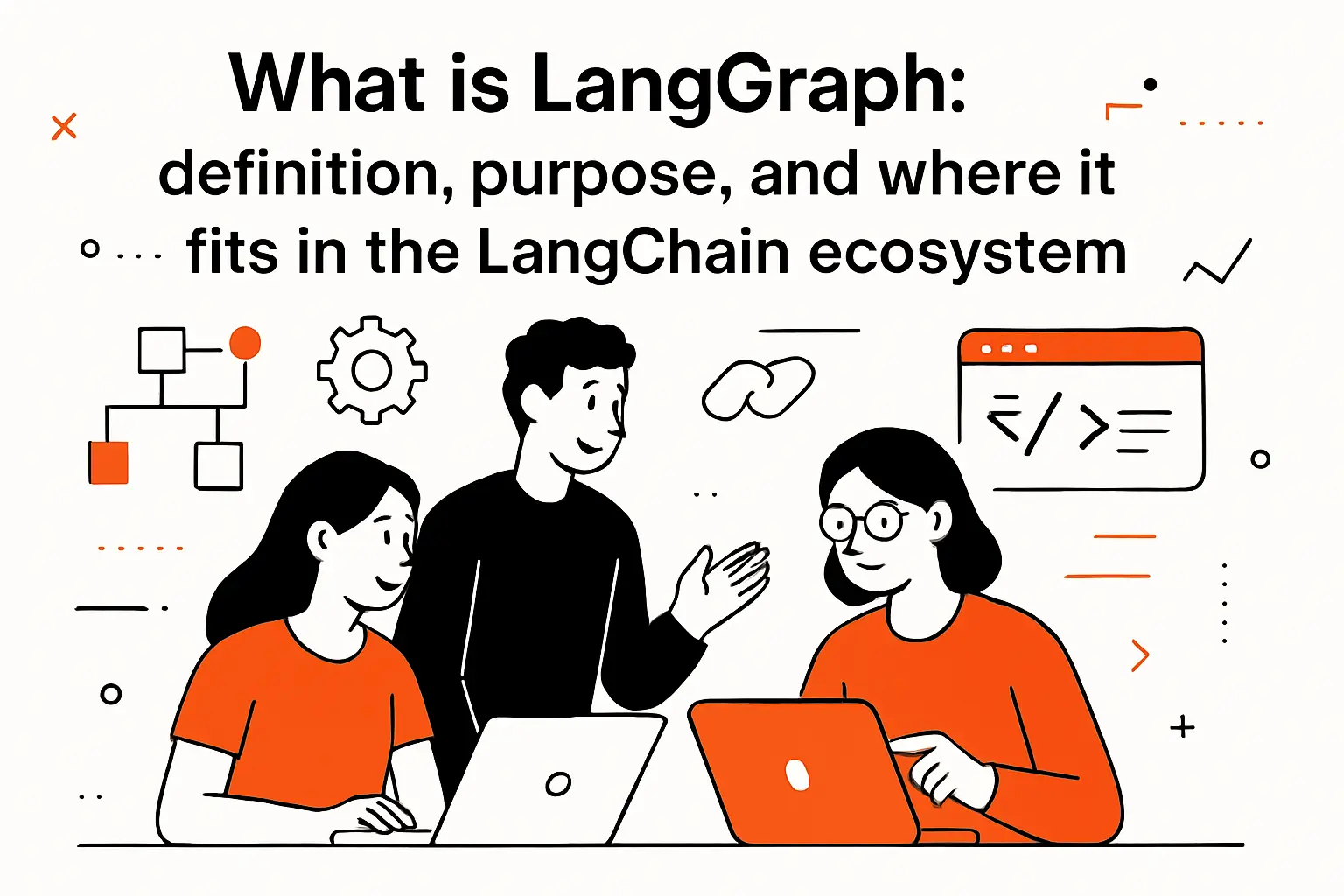
What is LangGraph: definition, purpose, and where it fits in the LangChain ecosystem
1. A low-level orchestration framework and runtime for long-running, stateful agents
In our experience, the real shift with LangGraph is that it treats an “agent” less like a magical model loop and more like a long program with explicit state, resumability, and observable steps. That sounds obvious to software engineers, yet plenty of agent implementations still resemble a recursive prompt stitched to tool calls, with no durable notion of “where we are” when something times out or a human needs to intervene.
LangGraph positions itself as durable execution infrastructure: you design a workflow that can save progress, pause, and resume without redoing completed work, which is exactly what we need when LLM calls fail, users approve actions asynchronously, or a workflow spans hours instead of seconds.
From a delivery standpoint, we think of it as a runtime that makes agent behavior “legible.” Instead of hoping the model does the right thing, we define a controllable process in which the model participates—sometimes as the decision-maker, sometimes as a sub-step, and sometimes as a contributor whose output we review before anything risky happens.
2. Graph-based control flow to coordinate multi-actor LLM applications
Graph-based control flow matters because LLM applications rarely stay linear once they touch the real world. A production assistant might classify intent, retrieve context, draft an answer, call tools, wait for user clarification, route to a specialist, and retry with a different strategy when the first attempt fails.
LangGraph’s core promise is that you can express those dynamics as a graph—nodes and edges—rather than burying them in nested conditionals or ad hoc loops. The LangChain team describes edges (including conditional edges) as the mechanism to decide “where do we go next,” and compilation turns that definition into an executable runtime you can invoke and stream like other LangChain-style components graph.compile().
In other words, LangGraph is not just a visualization gimmick. Practically speaking, graphs give product, engineering, and safety stakeholders a shared package they can reason about: which steps exist, which steps can repeat, where humans can intervene, and where state persists.
3. Quick answer to “what is langgraph” in one sentence
LangGraph is a framework for building stateful, long-running LLM workflows as explicit graphs, enabling you to control, resume, observe, and safely steer them in production.
LangGraph building blocks: stateful graphs, nodes, edges, and cycles
1. State as a centralized “memory bank” for transparency and debugging
State is where LangGraph starts to feel like “software engineering for agents” rather than “prompt engineering with extra steps.” Instead of passing hidden variables through a chain, a LangGraph application revolves around a shared state object that nodes read and update.
Conceptually, this is powerful because state becomes the audit trail of what the workflow believes so far: the user’s request, retrieved context, intermediate decisions, tool outputs, and any approvals or flags. The official persistence documentation explains that checkpoints snapshot state and store it in threads, enabling human-in-the-loop patterns, memory, time travel, and fault tolerance through that persisted state history saved to a thread.
Operationally, we treat state as a contract. When a client asks “why did it do that,” a well-structured state makes the answer inspectable instead of speculative, which is the difference between “AI vibes” and a debuggable system.
2. Nodes as units of work: LLM calls, tool calls, and custom logic
Nodes are where work happens: an LLM call, a retrieval step, a tool execution, a policy check, a validation transform, or a human approval pause. Because nodes are ordinary functions (or runnable-like objects), we can integrate existing business logic rather than rewriting everything into prompts.
In our builds, we often split nodes into “decision nodes” and “action nodes.” A decision node might ask the model which tool to use or whether the user’s request is allowed; an action node might call a CRM API, run a database query, or format a response for a UI. This separation keeps the model from becoming the place where business logic accidentally lives.
Even when an LLM is inside a node, the node boundary still matters: it’s a clean point to log inputs/outputs, validate structure, enforce schemas, and attach safety checks that do not depend on the model cooperating.
3. Edges as execution routing: fixed transitions and conditional branching
Edges are the “control plane.” Fixed edges express invariants (after retrieval, we always synthesize), while conditional edges express decisions (if confidence is low, ask a clarifying question; if tool output is missing, retry; if approval is required, interrupt).
The Graph API guide shows conditional branching via add_conditional_edges, where a function looks at state and returns the next node (or nodes) to execute.
From a reliability lens, conditional edges are also where we pin down “allowed transitions.” Instead of letting a model invent the next action, we force the workflow to choose among known routes, which is a subtle but meaningful guardrail.
4. Cyclical graphs for iterative agent runtimes, reflection, and retries
Cycles are the honest admission that many workflows aren’t DAGs. A tool-using assistant is inherently iterative: call the model, decide to use a tool, execute it, feed results back, then either conclude or loop again.
In practice, cycles let us implement reflection patterns (revise a draft after critique), retry patterns (fallback to a different retriever strategy), and progressive disclosure (ask a user follow-up questions before executing a risky operation). Unlike a “while True” loop buried in a function, a cycle in a graph stays visible and instrumentable.
When we review an agent design with a client’s security or compliance team, a cyclical graph is easier to discuss than an opaque loop: everyone can see what repeats, where it exits, and where humans can step in.
LangGraph vs LangChain: choosing between chains and graphs
1. Chains and DAG-style flows for linear pipelines vs cyclical, dynamic workflows
Chains shine when the workflow is mostly linear: extract, retrieve, summarize, format. Graphs shine when the workflow needs to branch, pause, loop, or coordinate multiple actors.
LangChain’s general “runnable” abstraction emphasizes composable execution and streaming APIs, which is great for building pipelines and reusable components invoke and stream.
From our perspective, LangGraph becomes the better fit the moment you hear yourself say: “Unless…” or “But sometimes…” or “We need an approval step…” because those are branching and interruption requirements, not mere composition.
2. Implicit state passing vs explicit state management for fine-grained control
Implicit state passing is comfortable until you need to debug a partial failure or reason about what exactly was known at a specific point in the run. Graphs push you toward explicit state updates, which can feel more verbose, yet it buys clarity.
With explicit state, we can define what is allowed to persist, what should be ephemeral, and what must be redacted before it ever reaches an LLM call. That last point matters in regulated environments: the ability to structure state and apply transformations is often more important than the choice of model.
Operationally, explicit state also enables better replay and postmortems, because “what happened” is represented as a state history, not a collection of logs that may or may not align.
3. How LangChain and LangGraph can be used together in the same project
We rarely treat LangChain and LangGraph as an either/or decision. A common pattern in our deployments is to use LangChain components inside nodes—prompt templates, retrievers, tool wrappers—while LangGraph governs the overall workflow.
The LangGraph overview explicitly recommends LangChain agents as a higher-level abstraction for teams getting started, while positioning LangGraph as focused on orchestration capabilities like durable execution and human-in-the-loop higher-level abstraction.
In concrete architecture terms, LangChain is often our “library of building blocks,” while LangGraph is the “workflow operating system” that decides how and when those blocks run.
When should you use LangGraph: control, guardrails, and human steering
1. Control vs freedom: designing predictable processes without losing LLM power
Every team building with LLMs eventually confronts a philosophical fork: do we want the model to be “free,” or do we want the system to be reliable? LangGraph is what we reach for when we want the model’s strengths—language understanding, flexible reasoning—without surrendering process control.
Predictability doesn’t mean making the model dumb. Instead, it means containing the model’s discretion inside well-defined steps: classify, decide among approved actions, propose a draft, and request approval before a side effect.
When stakeholders demand “no surprises,” graphs become a shared agreement: the workflow can only do what the graph allows, and every allowed transition is a deliberate product decision.
2. Best-fit scenarios: multi-step reasoning, persistent state, and deterministic plus AI workflows
Multi-step reasoning is only half the story; the other half is multi-step accountability. If an assistant drafts a customer email, pulls account history, suggests a credit adjustment, and prepares an internal ticket, the organization needs to know which step produced which output.
Persistent state is particularly valuable in workflows that span sessions. In customer support, for example, a conversation might pause overnight, resume the next day, and still need the prior context plus a clean record of what actions were proposed versus executed.
Deterministic-plus-AI workflows are where we see the most traction: deterministic rules handle the non-negotiables (permissions, audit logging, schema validation), while the model handles the ambiguous parts (intent interpretation, summarization, natural-language drafting).
3. Human-in-the-loop interventions for review, approval, and safe execution
Human-in-the-loop is not a concession; it’s a feature. Plenty of business processes already have approvals, reviews, and sign-offs, and agentic systems should fit that reality rather than pretending autonomy is always desirable.
LangGraph supports interrupts that pause execution, persist state, and wait indefinitely until resumed, enabling review-and-approve patterns for high-stakes actions pause graph execution.
In our implementations, we often use interrupts in two places: before side effects (sending an email, updating a record) and after uncertainty (low confidence classification, conflicting tool results). That structure keeps the model helpful while keeping the organization safe.
4. Why not just write regular Python: state, visualization, logging and traces, and built-in abstractions
Regular Python can absolutely orchestrate an agent loop, and we’ve done it. The issue is that “we can” is not the same as “we should,” especially when the workflow needs to survive failures, provide replay, and expose internal state to non-engineers.
LangGraph bakes in persistence concepts—threads, checkpoints, resumability—that we would otherwise re-implement, test, and maintain ourselves. The persistence layer is not just storage; it’s the foundation that makes time travel, human-in-the-loop, and fault tolerance practical checkpoints saved at every super-step.
Visualization and collaboration matter as much as code when agents become business-critical. A graph is a communication artifact, and our teams have found that it reduces ambiguity during design reviews, incident response, and compliance sign-off.
Capabilities that make LangGraph production-ready
1. Durable execution and checkpointing to persist through failures and resume work
Durable execution is one of those features that feels “enterprise” until you ship without it and discover your agent can’t recover from a transient outage. A tool call times out, a model provider throttles, or a deployment restarts mid-run; without checkpointing, you either lose progress or rebuild complicated custom recovery logic.
LangGraph defines durable execution as saving progress at key points so a workflow can pause and later resume exactly where it left off, which is especially useful for long-running tasks and human-in-the-loop scenarios resume without reprocessing previous steps.
From a systems standpoint, we also appreciate the emphasis on determinism and idempotency. When the runtime can replay from a checkpoint, your code must not accidentally duplicate side effects, so the design nudges teams toward safer engineering patterns.
2. Comprehensive memory: short-term working memory and long-term context across sessions
“Memory” in LLM apps is frequently misunderstood as “stuff we shove back into the prompt.” In production, memory is a more careful discipline: what should persist, what should expire, what must be attributed, and what cannot be stored at all.
LangGraph’s memory story is tightly coupled to persistence, and the docs also point to long-term memory tooling via LangMem, which frames memory as something you manage intentionally rather than accidentally accruing in a chat history.
In our architecture reviews, we push for a “two-lane” approach: a small working memory for the current task and a curated long-term store for stable user preferences or organizational context, both governed by clear retention and privacy rules.
3. First-class streaming for real-time UX and visibility into intermediate steps
Streaming is not just a UI nicety; it is a trust mechanism. Users accept latency when they can see progress: “Searching…,” “Calling tool…,” “Drafting response…,” and “Waiting for approval…”.
LangGraph exposes multiple streaming modes, including state values, updates (deltas), token-level message streams, and debug-style traces stream modes.
For product teams, that capability changes the design space. Instead of a single opaque spinner, we can build agent experiences that feel like collaborative work, where the system shows its intermediate reasoning artifacts and invites correction before it commits to an action.
4. Time travel and state inspection to roll back, correct course, and debug complex runs
Time travel is the feature that makes skeptics turn into believers—especially the engineers on call when something goes wrong. Debugging non-deterministic behavior is notoriously difficult if you can’t reconstruct the precise state that led to a decision.
LangGraph’s time travel functionality lets you resume execution from a prior checkpoint, replaying the same state or modifying it to explore alternatives, and it does so by working with checkpoint history and state updates resume execution from a prior checkpoint.
In our incident-response playbooks, we treat time travel as a practical debugging primitive: capture the thread state from production, replay locally, adjust a routing decision or tool output, and verify the fix without guessing.
5. Studio and observability tooling for visualization, collaboration, and tracing
Observability is where agent projects either mature or stall. Without tracing, teams can’t reliably answer basic questions: Which node ran? What did the tool return? Why did the workflow branch? What did the model see?
LangSmith Studio is described as a visual interface that connects to a locally running agent to show prompts, tool calls, results, and final output so teams can inspect intermediate states and iterate without extra deployment work visualize what’s happening inside your agent.
From Techtide Solutions’ standpoint, Studio also changes collaboration dynamics. Product managers can reproduce a problematic run, reviewers can see where an approval would have helped, and engineers can pinpoint which node needs stronger schema enforcement.
Getting started with LangGraph: install, define state, and compile your first StateGraph
1. Installation and a minimal hello-world graph from START to END
Installation is straightforward, and we like that LangGraph doesn’t force a heavyweight project template. A minimal Python install often begins with a single package command, followed by a tiny graph that moves from START to END through one node.
Below is the smallest “hello world” style shape we typically use to verify an environment, wiring, and basic invocation:
from langgraph.graph import StateGraph, MessagesState, START, ENDdef mock_llm(state: MessagesState): return {"messages": [{"role": "ai", "content": "hello world"}]}builder = StateGraph(MessagesState)builder.add_node("mock_llm", mock_llm)builder.add_edge(START, "mock_llm")builder.add_edge("mock_llm", END)graph = builder.compile()result = graph.invoke({"messages": [{"role": "user", "content": "hi"}]})From there, we usually add streaming and persistence early, because agent UX and reliability are easiest to design when the primitives exist from day one.
2. Step-by-step chatbot workflow: define state schema, build nodes, connect edges, and run
A practical chatbot graph benefits from explicit state beyond “messages.” In a customer-support context, we often track a user profile, a routing decision, and a retrieval bundle separately so we can audit exactly what influenced the final reply.
State schema
Rather than treating everything as a blob, we define a schema-like structure (TypedDict, dataclass, or a model) so node contracts stay crisp. That approach also helps prevent accidental leakage of sensitive fields into prompts.
Nodes
Common nodes include an intent classifier, a retrieval step, a response drafter, and a final “safety and formatting” step. In real deployments, we keep the final step deterministic: it enforces tone, redacts secrets, and validates the output structure regardless of what the model produced.
Edges
Edges connect the flow: classify → retrieve → draft → finalize. Once the baseline works, we add conditional routing for escalations (handoff to a human) or clarifications (ask a follow-up question instead of guessing).
During implementation, we recommend running with streaming enabled even in local testing, because intermediate visibility quickly reveals whether the graph is doing “useful work” or just looping.
3. Conditional edges for routing decisions and branching logic at runtime
Conditional edges are the backbone of “agentic” behavior without chaos. A routing function reads state and chooses the next node from a small, approved set, which keeps the workflow safe while still adaptive.
In practice, we often route based on: tool availability, required permissions, user tier, confidence in retrieval, and whether an approval is mandatory. A clean routing function is also a great place to implement policy: if a request touches billing, route through a review node; if a request is low risk, proceed automatically.
When the routing decision is model-assisted, we still keep the output constrained—typically a finite set of labels—so the graph doesn’t devolve into “the model decides everything.”
4. Beginner pitfalls: state updates, conditional edge mapping keys, and avoiding dead-end nodes
Most beginner mistakes we see are not “LLM mistakes”; they are workflow mistakes. A node returns an update that doesn’t match the state schema, a conditional route returns a value that doesn’t map to a destination, or an edge accidentally creates a dead-end node that never reaches END.
From a debugging standpoint, we advise teams to adopt a few habits early:
- Prefer explicit state keys so missing updates fail loudly rather than silently.
- Keep routing outputs constrained to known labels to prevent unmapped branches.
- Design every branch to converge or exit so workflows cannot strand users mid-run.
- Introduce persistence early so partial failures can be resumed instead of restarted.
Once these basics are in place, the rest becomes an engineering conversation about correctness and UX, not a fragile dance around unpredictable runtime behavior.
Real-world applications and architecture patterns with LangGraph
1. Chatbots and assistants with multi-turn context, personalization, and coherent conversations
Chatbots are the obvious use case, yet “obvious” doesn’t mean “easy.” Multi-turn coherence requires more than message history; it demands intentional state design: what the user asked, what we answered, what we promised to do, and what we actually did.
In our customer-assistant builds, the graph often separates conversational intent from operational action. A user might ask, “Can you check on my order?” and the assistant should respond conversationally while also performing an operational lookup, then merging results back into a coherent reply.
Personalization is where teams get tempted to overstuff prompts. Instead, we prefer a curated profile object in state, refreshed deterministically (and auditable), which yields a system that is both more stable and easier to govern.
2. Autonomous agents for task execution, system monitoring, and tool-driven workflows
Autonomous agents become compelling when there is real work to do: triaging alerts, enriching tickets, generating drafts, scheduling follow-ups, or monitoring operational signals. The key is that “autonomy” should be scoped, not absolute.
In system monitoring, for instance, an agent might summarize a noisy alert, fetch logs, propose a likely root cause, and prepare a remediation plan. Even then, we usually keep the final action behind an approval node, because automation without accountability is how incidents become outages.
Tool-driven workflows also benefit from explicit retry and fallback routes. If one API is down, the graph can route to an alternate data source or gracefully degrade to a user-facing explanation rather than failing silently.
3. Multi-agent systems: specialized agents, routing, parallelism, and coordinated collaboration
Multi-agent is where graphs really earn their keep. A single “generalist” model can do many things, but production systems often need specialists: a retrieval specialist, a policy specialist, a formatter, a tool executor, and an escalation coordinator.
In our designs, the coordinator is typically a routing node that delegates to specialist nodes, then merges their contributions into state. Coordination isn’t just delegation; it includes conflict resolution when agents disagree, and it includes termination logic so the system knows when it is “done.”
Parallelism can be valuable when multiple data sources are needed. A graph can fan out to fetch context from different systems, then converge into a synthesis node that assembles a final answer with clear provenance.
4. Workflow automation, recommendation systems, and adaptive learning experiences powered by persistent state
Workflow automation is often the highest ROI category because it connects directly to existing business processes: approvals, ticketing, document generation, and customer follow-ups. A graph becomes the automation blueprint, while the model fills in the human-language gaps.
Recommendation systems can also benefit from statefulness, particularly when recommendations are not one-shot. As user preferences evolve during a session, the system can update state incrementally and adapt recommendations without losing the trail of how it arrived at a suggestion.
Adaptive learning experiences are another strong fit. A tutoring workflow can track misconceptions, propose exercises, wait for user input, and branch based on performance, all while keeping the “teaching plan” explicit and reviewable.
TechTide Solutions: Custom LangGraph agent development tailored to your customers
1. Discovery and workflow design: translating customer needs into reliable graph control flows
Discovery is where most agent projects quietly succeed or fail. Before we write code, we map the workflow like a product: what the user wants, what the business allows, what must be audited, and what failure modes are unacceptable.
At Techtide Solutions, we translate those answers into a graph design that is deliberately “boring” in the right places: deterministic gates for permissions, explicit approval points for side effects, and predictable exit conditions so the system never feels trapped in a loop.
During workshops, we also push stakeholders to specify what “done” means. Without a crisp definition of completion, agents tend to wander, and wandering is expensive both computationally and operationally.
2. Implementation and integration: LLMs, tools, RAG, and existing product systems in one solution
Implementation is where theory meets systems integration. An agent that can’t call the right tools, retrieve the right context, or respect the right permissions is not an agent; it’s a chatbot with ambition.
In our builds, we integrate RAG as a first-class node rather than a hidden side effect. The retrieval step becomes auditable, cacheable, and testable, while the synthesis step becomes a controlled transformation from evidence to answer.
Tool integrations are handled with the same care we’d give any production integration: retries, timeouts, circuit breakers, and careful data shaping so the model sees only what it needs. When an API returns messy data, a deterministic normalization node often does more for reliability than any prompt tweak.
3. Deployment and iteration: persistence, streaming UX, monitoring, and continuous improvement
Deployment is not the finish line; it’s when the real work begins. Once users interact with an agent, edge cases multiply, and observability becomes the difference between steady improvement and chaotic regression.
In production rollouts, we prioritize persistence and streaming early so the UX feels responsive and runs can be resumed instead of restarted. Monitoring then focuses on the workflow’s health: where it branches, where it fails, where it asks for help, and where humans override its decisions.
Continuous improvement becomes a disciplined loop: observe traces, identify failure nodes, tighten schemas, refine routing logic, and only then revisit prompts. Over time, the graph evolves into a stable operational asset rather than an experiment that must be constantly babysat.
Conclusion: Key takeaways on what is langgraph and how to adopt it successfully

1. When LangGraph is the right choice vs simpler orchestration approaches
LangGraph is the right choice when your LLM application needs to behave like a system, not a stunt: it must pause for human input, recover from failures, loop intentionally, and expose intermediate state for debugging and governance. Simpler orchestration is fine for linear pipelines, but it tends to fray once workflows become conditional and long-running.
From our point of view, the deciding question is not “Do we want an agent?” but “Do we want a controllable process where an LLM participates?” If the answer is yes, graphs are usually the cleanest abstraction.
2. How to start small with one workflow and grow into multi-agent systems
Starting small is not a platitude; it is a practical survival strategy. A single workflow—support triage, internal knowledge assistant, incident summarization—can validate the architecture, the data boundaries, and the observability stack before you multiply complexity.
As confidence grows, we extend the graph rather than replacing it: add an approval node, add a fallback retriever route, add a specialist agent node, then introduce coordination patterns. Done carefully, the system grows like a city with zoning laws, not like a settlement that expands wherever it can.
3. Focus areas for production success: state, persistence, guardrails, and observability
State design is the quiet foundation: if state is sloppy, everything else becomes guesswork. Persistence turns workflows into resumable programs rather than disposable requests, while guardrails ensure that model outputs cannot bypass policy or safety requirements.
Observability is where trust is built and maintained. When you can trace why a workflow branched, inspect what it knew at the moment of a decision, and replay a run to verify a fix, you stop arguing about whether the model is “smart” and start improving the system like engineers.
If you’re evaluating LangGraph right now, our suggestion is to pick a single workflow that matters to the business, model it as a graph with explicit state and a human checkpoint, and then ask a hard question: does this feel like something you can operate confidently six months from now?