
At Techtide Solutions, we meet artificial intelligence in the wild every day: inside customer service transcripts, sensor logs from factory lines, emails that need triage, documents that need summarizing, and software backlogs that need pruning. The reason the topic matters to every executive is simple: the technology has shifted from demo to durable capability. As a barometer, independent research estimates that the global value at stake from generative AI alone could reach $2.6 trillion–$4.4 trillion annually, signaling a structural shift in how work will be done across sectors. In the pages that follow, we define AI in plain language, unpack how it works, trace its main types, and translate the hype into concrete use cases, benefits, risks, and a pragmatic path to value.
What is artificial intelligence: definition, scope, and core ideas
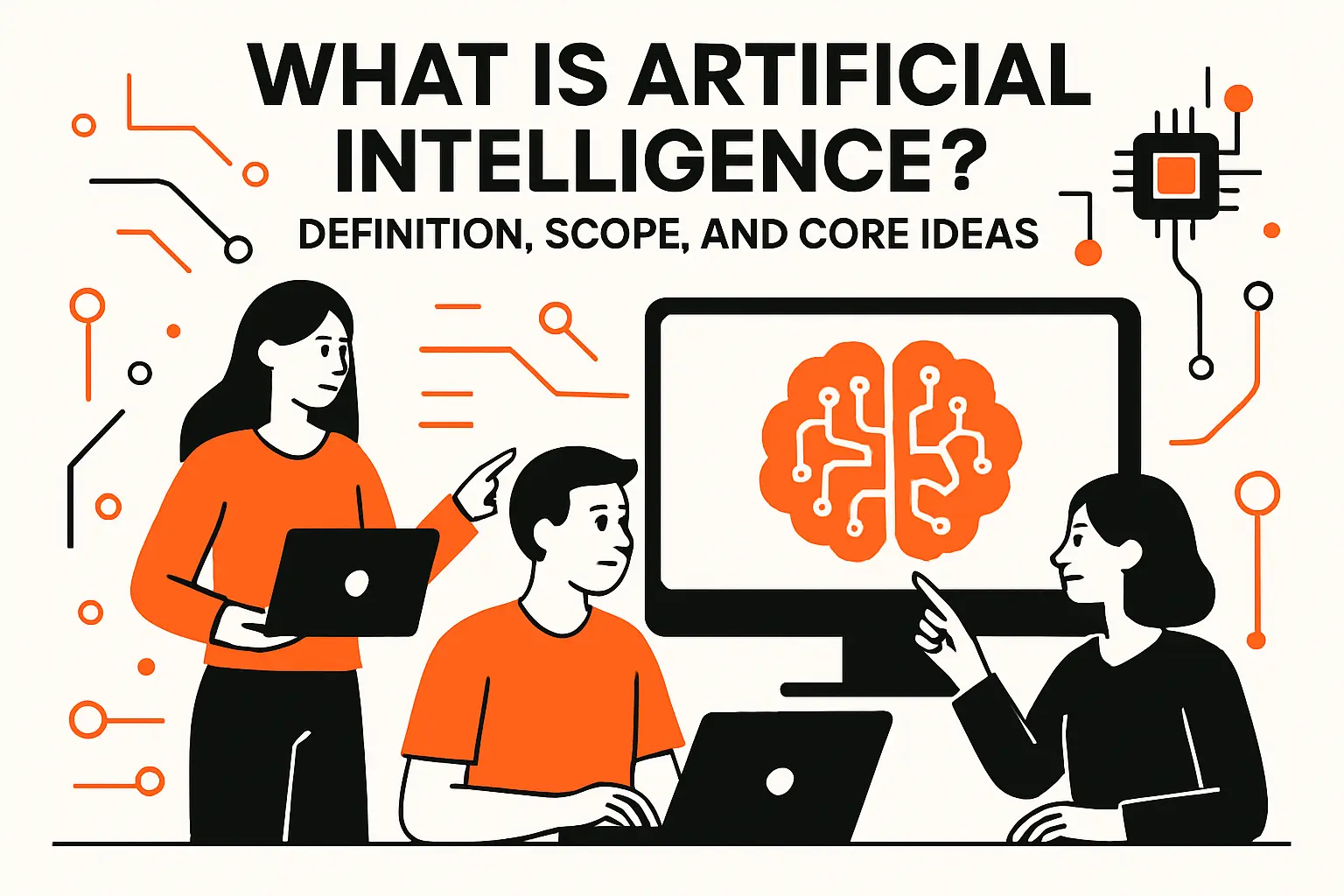
AI isn’t a single product so much as a toolbox for building systems that perceive, learn, and decide. The size of that toolbox and the appetite for using it are both expanding: enterprise and consumer spending tied to AI is forecast to total $1.5 trillion in 2025, a clear signal that AI capabilities are moving from labs into operating budgets and product roadmaps. In our client work, we see this shift when a pilot model stops living in a sandbox and starts feeding real workflows—claims adjudication, pricing adjustments, route planning, product descriptions—where the stakes are practical and measurable.
1. Plain-language definition and goals of AI
We describe AI to our clients like this: AI is the disciplined craft of giving machines useful competence. Not consciousness or human creativity, but competence within a defined scope. It maps inputs—text, images, tabular signals—to outputs: predictions, plans, actions, with dependable consistency. The goals of AI follow naturally from that description. Compress time to insight, reduce toil, and surface patterns humans miss. Improve decisions under uncertainty, and build systems that adapt as conditions change.
Notice the emphasis on scope. AI that excels in retail recommendations falters in pathology labs without retraining, governance, and setting-specific validation. Right-size ambition. Choose problems where wrong answers cost little, guardrails are feasible, and tight feedback loops exist. Design for recoverability, not perfection. Shift culture from building a brain to assembling a team. Combine small models with deterministic components that cooperate. Each tackles a well-bounded task. That mindset reduces fragility and improves maintainability.
2. AI vs machine learning vs deep learning
It helps to imagine AI as a family tree. At the trunk is AI—any method that enables machines to act intelligently, including rules and search. On one branch sits machine learning, where models learn patterns from data rather than relying solely on hard-coded rules. Deep learning is a smaller branch within ML. It uses multi-layer neural networks for perception and generation. Systems can hear intent in audio and detect anomalies in logs. They can also write code from natural-language prompts.
Where do large language models fit? They are deep learning systems trained on broad text (and increasingly multimodal) corpora to predict the next token. Despite their name, they are not encyclopedias; they are probability engines with emergent abilities. On our projects, we pair models with retrieval, rules, and domain models to anchor generation in curated data and explicit policies. Ungrounded fluency becomes grounded performance. For stakeholders, we sketch concentric circles: deep learning inside machine learning inside AI. Within that deep-learning ring, foundation models are powerful—just not the only instrument.
3. Core components of AI: data, algorithms, computing power
Every successful AI system is a braid of three strands: data, algorithms, and compute. Data gives the model its world; algorithms shape how it learns; compute sets the tempo of experimentation. Businesses often over-index on algorithms because they are tangible and newsworthy, but we see the best returns from disciplined data work: canonicalizing entities, de-duplicating records, instrumenting pipelines with data lineage, and encoding subject-matter knowledge as schemas, constraints, and evaluations. Good data confers advantage because it is hard to copy and improves with use.
Algorithm choice should be boringly pragmatic. For structured problems, gradient-boosted trees remain formidable. For unstructured content, transformer-based architectures dominate, but we still prefer lightweight, task-specific models when latency, transparency, or cost demand it. On compute, opportunity cost rules the day: the fastest feasible training run is the one that gets you to a reliable decision sooner, not merely the one that achieves a marginal benchmark gain. Capacity planning ought to include not just training but inference footprints, observability, and the energy and cooling implications of sustained workload.
4. Basic functions of AI: learning, reasoning and decision-making, problem-solving, perception
Learning is the adjustment of model parameters to fit patterns; reasoning is the ability to chain steps toward a conclusion; decision-making is choosing an action under constraints; problem-solving is decomposing a goal into tractable subgoals; perception is extracting meaning from raw signals. In practice these functions interleave. A fraud model perceives strange patterns in transaction streams, reasons over graph relationships, and decides to escalate or allow. A supply-chain planner perceives stock-outs in telemetry, solves a constrained optimization problem, and recommends a replenishment plan.
We aim for layered competence: perception models feed symbolic planners; learned policies are constrained by explicit rules; and every decision has a place to send “I’m not sure” cases for human review. That last mile—admitting uncertainty—is where many AI efforts go awry. We design for escalation paths from day one and ensure that the interface tells operators why a recommendation was made and how to override it, not as a bolt-on but as part of the operating model.
How artificial intelligence works: data, models, and training
Under the hood, AI systems are less magic and more meticulous engineering: collect the right data, choose and train an appropriate model, validate it against reality, deploy with guardrails, and monitor like a mission-critical system. Market dynamics mirror this behind-the-scenes work: spending specifically tied to generative AI capabilities is projected to reach $644 billion in 2025, much of it devoted to model infrastructure, tuned applications, and AI-enabled devices—a reminder that capability at scale lives in the plumbing as much as in the model weights.
1. Data-driven learning and pattern recognition
Data is the model’s habitat. High-signal, representative data improves sample efficiency and lowers the risk of spurious correlations. When we stand up a new AI initiative, we start with a data audit: What decisions generate or require this data? Who owns quality? What is the time-to-freshness? Which labels are ground truth and which are proxies? We map the data-generating process, not just the datasets, because models inherit the biases, omissions, and incentives of the workflows that create their training examples.
Pattern recognition is only as trustworthy as the patterns you allow in. We invest early in deduplication, outlier analysis, and leakage tests to prevent future signals in training data. Next, we design evaluations that mirror reality. Temporal cross-validation handles drift. Group-sliced checks catch performance cliffs across subpopulations. Stress tests simulate adversaries and distribution shifts. These techniques look like overhead until the day they save a launch from a costly misstep.
Feature engineering and representation
Even in the age of foundation models, thoughtful representation pays dividends. Structured data needs calendar effects, cohort indicators, and graph embeddings that capture relationships among customers, suppliers, and devices. Text benefits from domain-tuned embeddings with metadata provenance, so retrieval can cite sources and honor access controls. Images and signals demand pipelines that preserve calibration and unit semantics end to end, because normalization errors often masquerade as “model issues.”
Data governance as engineering
Governance gains teeth when it is enforced in code. We implement declarative data contracts, automated lineage capture, and approval workflows that bind data access to business purpose. That way, the compliance story is not a separate binder; it is a living system that can show who did what to which data and why. The upshot is faster audits, clearer accountability, and a foundation for responsible AI that scales.
2. Machine learning paradigms: supervised, unsupervised, semi-supervised, reinforcement
Supervised learning maps inputs to labeled outputs and is the workhorse for classification, scoring, and forecasting. Unsupervised learning discovers structure without labels; we use it for segmentation, anomaly detection, and dimensionality reduction to improve retrieval and visualization. Semi-supervised and weak supervision approaches help when labels are scarce or expensive by bootstrapping from heuristics or small gold sets. Reinforcement learning shines when you can enumerate actions, observe outcomes, and shape a reward signal; in the enterprise, we find it most tractable in simulated or constrained domains such as routing, pricing, or automated testing of UI flows.
In practice, we blend paradigms. A modern recommendation system might learn embeddings from unsupervised objectives, fine-tune on supervised click or purchase events, and then adjust rankings via reinforcement signals that optimize for long-term satisfaction rather than short-term clicks. The glue is careful evaluation: counterfactual tests for causal uplift, interleaving experiments for ranking, and post-deployment guardrails that detect regressions before customers do.
Active learning and human-in-the-loop
Labeling is expensive; disagreement is priceless. We design labeling workflows to surface the cases humans find tricky, not the easy ones models already ace. Active learning loops that sample for uncertainty or diversity can multiply the value of every labeled example. Pair that with annotation guidelines written in the language of decisions, not data science, and your model’s learning curve steepens for the right reasons.
3. Neural networks and deep learning architectures
Neural networks learn layered representations. Convolutional networks capture locality and translation invariance and remain strong in vision; recurrent and sequence models capture order, though attention-based transformers now dominate many sequence tasks. Architectural flourishes—residual connections, normalization, positional encodings—exist to ease optimization and preserve information flow. The most important design choice is often the simplest: do we need a generalist model or a specialist? In many enterprise problems, a compact, domain-tuned model beats a larger generalist on cost, latency, and control.
Training deep models is an exercise in managing trade-offs. Optimizers, learning schedules, regularization, data augmentation, and loss shaping all interact. We rarely chase leaderboard minutiae; we focus on robustness under perturbation, calibration of confidence, and predictable behavior when the model encounters inputs outside its appetite. That is why we invest in test harnesses with adversarial and synthetic cases, monitor embedding drift, and design rollouts with canaries and kill switches. Reliability is a property of the socio-technical system, not just the model file.
Self-supervision and transfer
Self-supervised learning on unlabeled data produces representations you can reuse. We routinely pretrain on in-domain corpora and then fine-tune for specific tasks with modest labeled sets. This approach reduces time to value and mitigates the brittleness you see when you try to coax a general model to behave like a specialist without giving it the vocabulary or examples of that specialty.
4. Generative AI and foundation models including large language models
Foundation models changed the developer ergonomics of AI: capability comes prepackaged, and adaptation proceeds through prompting, fine-tuning, or retrieval. We treat these models as universal function approximators with personality: useful, fast learners, but prone to confabulation and sensitive to context. Our blueprint uses retrieval-augmented generation to ground answers in enterprise data, tool use to execute actions with auditable trails, and policy enforcement at the middleware layer so that compliance is a property of the system, not a skill the model must magically discover.
Fine-tuning and feedback learning turn a fluent system into a reliable colleague. We incorporate supervised fine-tuning on curated examples, preference optimization to align with organizational voice and tone, and structured outputs that downstream systems can parse deterministically. The most transformative capability isn’t eloquence; it is the ability to decompose tasks, call tools, consult knowledge sources, and explain decisions in a way operators can understand and govern.
Evaluation and safeguards
We assess generative systems along multiple axes: helpfulness, harmlessness, honesty, faithfulness to sources, and operational metrics like latency and throughput. Red-teaming uncovers jailbreaks and prompt injection pathways; watermarking and content provenance help downstream teams separate synthetic from human-authored content; and privacy-preserving techniques like selective redaction and per-record access control keep sensitive data from leaking beyond its intended context. None of these measures make a system perfect; together they make it governable.
Types and taxonomies of AI
Taxonomies help decision-makers cut through buzzwords and align ambitions with capabilities. What matters in practice is matching the type of intelligence to the job to be done: pattern recognition for perception, reasoning for planning, interactivity for dialogue, and embodiment for real-world manipulation. Adoption is widening in step with this clarity—one industry survey found that 29% have deployed GenAI, with many others piloting embedded features in their existing software. We read those signals as an invitation to prioritize targeted wins over abstract debates about definitions.
1. Stages of AI development: reactive machines, limited memory, theory of mind, self-aware
These stages are best viewed as conceptual lenses rather than a strict timeline. Reactive systems respond to current inputs without internal state; think of a content filter or a simple recommender. Limited-memory systems incorporate recent context; chat assistants and anomaly detectors fall here. “Theory of mind” refers to systems that model other agents’ beliefs or intentions; some research models approximate this via planning and recursive reasoning, though the results remain brittle. “Self-aware” is speculative; today’s systems display no subjective experience, only behavior that sometimes mimics it. For the enterprise, the most meaningful demarcation is between tools that only predict and tools that can plan, call external functions, and explain themselves well enough to be audited.
We coach product teams to resist anthropomorphic metaphors. They make for exciting demos and confusing roadmaps. If we instead talk in terms of capabilities and constraints—what context the system remembers, how it updates its beliefs, when it escalates—we end up with products that customers trust and teams can iterate safely.
2. Narrow weak AI vs strong AI artificial general intelligence and superintelligence
Narrow AI excels at bounded tasks: classifying defects, ranking leads, extracting clauses from contracts, generating a product description that follows brand voice. Artificial general intelligence is the idea of a system that can flexibly learn and perform across the full range of human cognitive work. Whether and when such a system emerges is an open research question; what matters in the boardroom is that narrow systems are already impactful. We design for ensembles of narrow systems that collectively feel broad. That lets us deliver value now, with clear interfaces, while keeping an eye on research that might relax constraints later.
Philosophical debates about superintelligence are valuable, but our clients hire us to shift cash flows, not metaphysics. Still, existential discussions nudge us toward stronger guardrails, tooling that records model intent and action sequences, and architectures where a human maintains meaningful oversight. We can act responsibly today without pretending to know the endpoint of the field’s trajectory.
3. Common subfields and techniques: natural language processing, computer vision, robotics, expert systems
Natural language processing turns text into structure and structure back into narrative. We use it to mine customer feedback, triage service tickets, summarize medical notes, and harmonize product catalogs. Computer vision makes pixels actionable, enabling quality assurance on the line, visual search in e-commerce, and inspection in insurance claims. Robotics integrates perception, planning, and control; the business win often lies not in humanoid form factors but in collaborative systems that automate specific steps of messy physical workflows. Expert systems—rules and knowledge graphs—are back in style as complements that temper the freewheeling nature of generative models. When we combine learned models with symbolic systems, the result is not just accuracy; it is legibility.
A pattern we rely on is hybridization: embed domain logic and policies alongside learned components. In underwriting, a learned risk score sits alongside eligibility rules and regulatory constraints; in healthcare, clinical guidelines temper model suggestions; in manufacturing, physics-based simulators produce synthetic data for training and safety cases. This is less glamorous than a frontier benchmark, but it is how you ship systems that work.
Applications and use cases of AI today
Applications succeed when they’re rooted in clear business objectives and trustworthy data. While attention often fixates on headline models, the enterprise growth story is broader: investment in AI companies building infrastructure and applications reached $100.4B in 2024, signaling a maturing stack from silicon to software that companies can assemble rather than invent from scratch. In our practice, the projects that last are those that pair business KPIs with a crisp definition of where AI is allowed to act and how it proves its work.
1. Everyday and business uses: chatbots and virtual assistants, personalized recommendations, fraud detection
Conversational interfaces have become an on-ramp for enterprise AI. When we deploy chat assistants for customer service, we integrate them with identity systems, knowledge bases, and case management tools, and we prime them to admit when they don’t know and to escalate. The difference between a toy and a teammate is less about the model and more about connectors, context, and accountability. The same goes for internal assistants that draft emails, summarize threads, and propose next actions; they are only as good as their grounding in the company’s corpus and policies.
Personalization remains a workhorse. Retailers and media platforms that already ran classic recommenders are now supplementing rankings with generative explainers—bite-sized reasons that a suggestion fits a user’s situation. We time-box creativity with templates and constrain outputs to the catalog and policy: experimentation inside an envelope. Fraud detection continues to benefit from graph models that capture relationships among entities; linking generative systems to those graphs helps investigators narrate a case, not just flag it. In all of these, we build feedback loops so humans can correct and contribute, turning tacit expertise into training signals.
Grounded generation and retrieval
Retrieval-augmented generation is our default for enterprise chat and search. We index curated content in a vector store, enrich it with metadata, and route queries to specialized retrievers. The generative layer then composes an answer that cites sources and reflects entitlements. The result is less “creative writing” and more a useful librarian that knows what it knows and tells you where it learned it.
2. Industry examples: health care, finance, autonomous vehicles, predictive maintenance
Health care shows the power of combining modalities. Clinicians want triage that respects context, summarization that preserves nuance, and decision support that cites protocols. We design systems that keep humans in control and capture rationales. In medicine, provenance isn’t academic; it’s the backbone of trust. Finance teams demand explainability and audit trails. Here, we hybridize statistical models with rules and watch for drift. Shadow deployments support slow, regulator-friendly rollouts. In mobility and robotics, we emphasize simulation-to-real transfer and redundancy. Perception stacks should fuse signals; planners must degrade gracefully. Test suites stress rare edge cases before release. For industrial maintenance, we correlate sensor streams with maintenance logs and procurement timelines. Then we generate prioritized work orders, not dashboards. In the field, action beats insight.
Across industries, the winning pattern combines perception, prediction, and decision into a forward loop. Build narrow agents that talk to systems of record and propose actions with reasons. Ask for permission when confidence drops. Our field teams see modest improvements compounding when recurring workflows shed friction. Benefits amplify on processes crossing organizational boundaries.
3. AI agents and agentic AI: autonomous goal-driven systems
Agentic systems attempt to plan and act in pursuit of goals, often by calling tools, collaborating with other agents, and updating beliefs. The promise is enticing: dynamic workflows, proactive tasking, and adaptive behavior that feels closer to how humans coordinate. The pitfalls are real: goal misspecification, tool misuse, feedback loops, and brittle plans when conditions shift. Start with assistive autonomy: agents propose, humans dispose. Advance only where domains are bounded and guardrails are easy to enforce.
We’ve seen success with logistics agents that slot and re-slot inventory as conditions change. In finance operations, agents reconcile transactions and initiate follow-ups with documented rationales. For developer tooling, they triage issues and propose pull requests that pass tests and policies. The difference between hype and help is systemic thinking. Define the agent’s contract and give it a grammar for calling tools. Record chain-of-thought as structured plans, not raw free text. Require the agent to show its work.
Benefits and challenges of AI adoption
The business case for AI is straightforward—save time, reduce errors, improve decisions—but the implementation is anything but. Adoption patterns are uneven, driven by varying levels of data readiness, governance maturity, and executive sponsorship. A snapshot of momentum in one critical corporate function comes from a recent Deloitte study noting that 86% of corporate and private equity leaders report using generative AI in their dealmaking workflows, underscoring how quickly advanced capabilities can spread once they fit the contours of a high-value process.
1. Key benefits: automation, data insights, improved decisions, fewer errors, 24/7 availability, reduced risk
We orient AI programs around three value pillars. First is acceleration: compressing the time from question to answer, from request to fulfillment. Even when an AI assistant is imperfect, shaving minutes off each interaction across thousands of interactions shifts capacity in ways people feel. Second is elevation: surfacing patterns that would have remained submerged—cross-sell propensity in unstructured notes, root causes that only emerge when you correlate operational and support data, dependencies among vendors that expose concentration risk. Third is assurance: reducing variance and capturing institutional knowledge so quality does not hinge on a few experts being online.
Round-the-clock availability is where AI feels unreasonably effective. A well-governed system never gets tired, never fakes understanding when it lacks context, and never forgets to log what it did. That last point matters: if you design the system to produce structured rationales and attach them to actions, you win twice—operators trust the system more, and auditors find a clear trail. Over time, risk falls because you move from ad hoc heroics to repeatable, measured practice.
From insight to action
We caution against “insight theater.” Dashboards proliferate; decisions don’t move. We wire models directly to the levers of the business: pricing engines, campaign systems, route planners, robotic work cells, service triage. And we instrument the loop to learn from outcomes. The culture shift is as important as the code: empower teams to act on model recommendations and to override them with explanations when the model falls short. That human feedback becomes training data, and your system gets better where it matters most.
2. Key risks and harms: data poisoning and bias, cybersecurity, privacy and copyright, environmental impacts, misinformation
Every AI capability introduces new attack surfaces. Data poisoning is a quiet threat: sneak tainted examples into training corpora or retrieval indexes, and you can nudge outputs in subtle ways. We mitigate this with provenance tracking, content validation at ingestion, and anomaly detection on embedding space. Bias is more than a fairness report; it is lived in downstream decisions. We prefer to frame it in terms leaders recognize: what harms are plausible, what populations are affected, what interventions reduce them, and how will we know they worked?
Security is the other flank. Prompt injection, tool exfiltration, and jailbreaks are not theoretical—they are the new phishing. We compartmentalize capabilities, require explicit tool invocation with argument validation, and treat the LLM as an untrusted component in a zero-trust architecture. On privacy and copyright, we design for data minimization and purpose limitation. Retrieval systems must respect entitlements; prompts and outputs must avoid leaking sensitive details beyond intended recipients; and training and fine-tuning data governance needs to encode what is allowed, not just what is possible.
Environmental impact is often discussed in terms of training runs, but operational workloads dominate in many enterprise deployments. Efficiency is therefore an ethical and economic imperative: distillation to smaller models where feasible, caching and reuse of intermediate results, and scheduling workloads to align with greener energy windows when your platform allows it. On misinformation, we subscribe to provenance from the start—source citation, content credentials, and moderation policies that are tailored to the risks of your domain.
Risk-aware development playbook
We’ve institutionalized a few practices: a risk register that evolves with the system; pre-mortems that ask “How might this fail, and who gets hurt?”; kill switches and safe modes for rapid rollback; and red-team exercises before major launches. These practices don’t slow you down; they make it safe to go faster because you’ve rehearsed recovery.
3. Responsible AI and governance: transparency, accountability, privacy and compliance
Responsible AI is a management system, not a manifesto. We anchor it in clear roles—data owners, model stewards, risk partners—and auditable processes that show how requirements become tests, and tests become gates. Transparency shows up as model cards and decision logs written in language non-technical stakeholders can use; accountability ties every model to a business KPI and a clear escalation path; privacy is embedded in the stack via data contracts that encode purpose, access patterns that enforce least privilege, and telemetry that proves compliance in operation—not just on paper.
Compliance is easier when it is continuous. We script validations into CI/CD, maintain golden datasets for regression testing, and track model changes like code with versioning and approvals. When regulators ask for evidence, we can show the history of a decision-making system with the same rigor we apply to financial systems. That level of discipline is a competitive advantage disguised as governance.
TechTide Solutions: building custom AI solutions that match your needs
We exist to make AI useful, safe, and economically sound for your business. That means understanding your goals, translating them into solvable problems, and assembling a stack that leverages proven components where possible and custom models where necessary. The demand for skilled partners is rising alongside the services market itself, which analysts expect to reach $516 billion in 2029—a sign that organizations are looking for help not just with models, but with the end-to-end engineering and governance that make those models pay off.
1. Discovery and solution design tailored to your business goals
We begin with discovery that respects constraints: strategy, data reality, risk appetite, regulation, and human workflows. Facilitators sit with operators and subject-matter experts to map decision points and pain points. Architects translate those findings into candidate use cases ranked by value, feasibility, and risk. A good discovery produces a shortlist, not a wish list. Each item carries measurable outcomes, defined guardrails, and a plan for human–machine collaboration.
From there, we prototype quickly but soberly. We test the smallest thing that could prove or disprove the case, often with synthetic data and simulated interfaces. The metric is not “Wow, that demo was cool,” but “Does this change the decision or the outcome we care about?” If it does, we progress to a full design: data flows, model choices, retrieval strategy, tool integrations, user experience, and governance. If it doesn’t, we harvest what we learned and try the next item on the shortlist. Value is a function of velocity and focus.
Architecture blueprints you can run
Our reference architectures favor modularity: ingestion and curation pipelines; a feature and embedding layer with lineage; retrieval and policy middleware; model-serving with canary and shadow routes; and an observability stack that tracks quality, drift, usage, and cost. We make conservative technology choices, preferring interfaces and standards that minimize lock-in and maximize portability across cloud and on-prem environments.
2. End-to-end implementation: data pipelines, model selection, and cloud-native deployment
Implementation is where ambition meets lineage and latency. We build data pipelines that validate at the edge, annotate with provenance, and split PII handling from downstream modeling cleanly. For model selection, we benchmark candidates against business-relevant datasets and test harnesses, not just public leaderboards. We are agnostic about model sources: hosted foundation models for general language capability, open models for cost or control, classical ML when structure and speed dominate, and proprietary fine-tunes when domain nuance matters.
Deployment adheres to cloud-native principles: containerized services, infrastructure as code, declarative configurations, and automated rollouts with blue-green or canary strategies. We wire in feature stores and embedding indices as first-class citizens and design our retrieval layers to respect access boundaries. Tool use is explicit and logged; actions taken by an agent are deterministic and reversible where possible. We prioritize graceful degradation paths so that if any component fails, the system falls back to safe behavior rather than silence or hallucination.
Human-centered UX
Interfaces make or break adoption. We design copilots that are not just helpful but coachable, with controls that let operators adjust tone, depth, and verbosity; toggles to show or hide chain-of-thought summaries; and buttons to escalate, re-route, or file feedback. We treat explanation as a product feature: links to sources, highlights that connect recommendation to evidence, and callbacks that capture the operator’s correction as training data.
3. MLOps, security, and responsible AI governance across the lifecycle
MLOps turns clever models into reliable systems. Our pipelines include automated data checks, reproducible training runs, evaluation suites keyed to business criteria, and model registries with approval gates. Once deployed, we monitor for performance drift, usage anomalies, and cost blowouts; we run regular A/B tests to validate that changes improve outcomes, not just metrics. When a model misbehaves, our feedback systems route examples to the teams that can fix the root cause—data, features, or model logic.
Security and governance are woven throughout. Secrets are scoped; prompts and retrieved content are treated as untrusted inputs; outputs are scanned for sensitive content before they leave the system. Our compliance posture is documented as code: data contracts, policy checks in CI/CD, and audit logs that map every model version to the decisions it touched. Responsible AI lives in three questions we answer continuously: What can this system do? What is it allowed to do? What did it actually do?
Runbooks for the real world
Production incidents will happen. We write runbooks that teach operators how to diagnose and respond: how to roll back a model, how to disable a tool, how to switch retrieval to a read-only mirror if a source system goes down. We rehearse these scenarios. The benefit isn’t just resilience; it’s confidence. Teams embrace AI faster when they know how to steer it under pressure.
Conclusion: what is artificial intelligence and where it’s heading
AI is not a destination; it is a capability every organization will assemble, refine, and govern across many products and processes. Investment, tooling, and talent are accumulating across the stack, and high-value workflows are migrating from manual triage to assistive autonomy. In our vantage point across industries, the winners won’t necessarily be those who train the largest models, but those who combine narrow, reliable systems; clean, well-governed data; and ruthless alignment with business outcomes. Surveys and forecasts point in the same direction: adoption is broadening, infrastructure is maturing, and the focus is shifting from proof-of-concept heroics to durable value at scale.
1. AGI remains theoretical while narrow and generative AI deliver value today
We can respect the research frontier without waiting for it. General intelligence remains a scientific question; business value is a design problem we can solve now. The pattern we advocate is to assemble task-focused systems that act as dependable colleagues, not oracles. Give them tools and boundaries, let them explain themselves, and make it easy for humans to correct and contribute. Over time, you can widen the scope as confidence and controls grow.
In our experience, the most effective executive posture combines optimism with operational skepticism. Fund use cases with rich feedback loops and measurable payoffs. Politely starve those that can’t explain how they’ll learn from outcomes. That posture turns hype into a head start. Your teams practice the disciplines—data stewardship, evaluation, governance—that compound across every AI initiative.
2. Emerging directions: multimodal models, agentic AI, and retrieval-augmented systems
Three directions will shape near-term adoption. Multimodal models will unify text, images, audio, and tabular signals. That unity makes richer systems easier to build. Picture a field service bot that sees a broken part and reads a maintenance manual in one breath. Agentic systems orchestrate complex workflows by breaking goals into steps and calling tools. Safe versions default to assistive behavior. They become autonomous only within constrained domains. Retrieval-augmented systems turn existing data estates into on-demand expertise. Content credentials and policy engines keep generation grounded and compliant.
These are not science projects anymore; they are engineering choices. The bets you place should be governed by your data assets, your risk tolerance, and your customer promises. We find that the best starting point is where your organization already knows the business well and can judge the AI’s work quickly. That is where the learning flywheel spins fastest.
3. Next steps: prioritize high-impact use cases and data readiness
Begin with a portfolio workshop. Inventory decision points across your value chain. Map pain to potential, then rank candidates by value, feasibility, and risk. In parallel, invest in unglamorous foundations: data contracts, lineage, labeling guidelines, and an evaluation harness defining “good.” When a use case clears those gates, prototype with retrieval and assistive agents before you consider deeper custom training. Finally, establish a governance rhythm with regular reviews, pre-mortems, and kill switches so your AI can evolve safely as it scales.
We built Techtide Solutions to help leaders do exactly that—turn AI into a disciplined capability rather than an experiment. If you had to pick one workflow where AI could shift outcomes for your customers or your teams this quarter, which would it be?