
Inside most organizations, “SSL” is the word people reach for when they mean “that thing that makes the padlock show up.” In our experience at TechTide Solutions, that shorthand isn’t just harmless nostalgia—it’s the root of a lot of operational confusion: mismatched expectations about what HTTPS actually guarantees, brittle certificate renewal processes, and security postures that look modern on the surface while hiding legacy assumptions underneath.
Across the software economy, transport security is no longer a feature you tack on at the end; it’s a prerequisite for doing business. Gartner’s cloud forecast is a decent proxy for how much of the world’s data now lives behind APIs and identity layers, with worldwide public cloud end-user spending projected to total $723.4 billion in 2025, and in that environment, plaintext traffic is basically a self-inflicted outage waiting to happen.
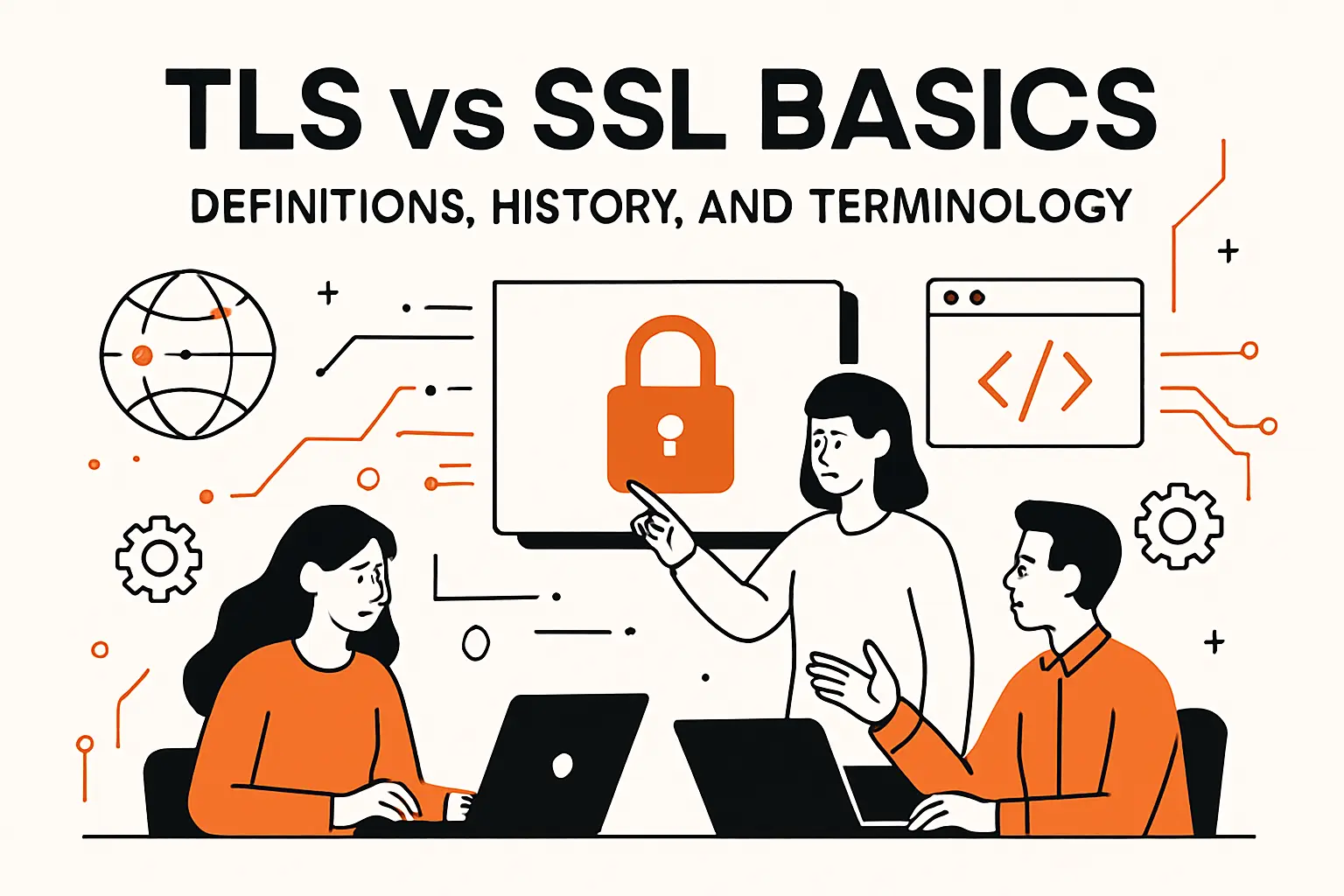
TLS vs SSL basics: definitions, history, and terminology
From the trenches, we’ve watched two patterns repeat. One pattern is technical: teams upgrade an app, but the TLS edge still defaults to “whatever the load balancer shipped with.” Another pattern is organizational: someone assumes “we have an SSL certificate” equals “we’re secure.” Both are understandable, and both are fixable—once we separate protocol, certificate, browser signals, and operational hygiene into the right mental boxes.
Over the rest of this guide, we’ll walk through those boxes with a practitioner’s lens. Along the way, we’ll be opinionated about what matters in production, because security that can’t survive real deployments isn’t security—it’s theatre.
1. What SSL is and what it was designed to do
Engineers created SSL (Secure Sockets Layer) to solve a concrete early-web problem: how can a browser talk to a server over an untrusted network without anyone on the path reading or modifying the traffic? SSL didn’t try to “make a website safe in every sense.” Instead, it created a protected tunnel for the connection so eavesdroppers couldn’t steal credentials, payment details, or session identifiers.
Conceptually, SSL introduced a pattern that still defines modern secure transport: prove identity (at least of the server), negotiate encryption parameters, and then use fast symmetric cryptography for the bulk of application traffic. Even when the details have changed dramatically, that shape—authenticate, agree, encrypt—remains the backbone.
In practical business terms, SSL was the first mainstream “trust handshake” for the web. Once companies could rely on a standardized mechanism for confidentiality and authenticity, online commerce and account-based services became viable at scale, not just for technically sophisticated users willing to accept risk.
2. What TLS is and why it replaced SSL
TLS (Transport Layer Security) is the successor to SSL, standardized and evolved to address cryptographic weaknesses, implementation pitfalls, and the reality that the internet is adversarial by default. SSL grew out of a vendor-driven ecosystem. TLS moved the protocol into a standards process, where the community could treat interoperability and long-term maintenance as first-class concerns.
Operationally, TLS replaced SSL because “mostly secure” doesn’t age well. As cryptanalysis improves and attacks become commoditized, yesterday’s safe defaults become today’s liability. That shift isn’t theoretical; it shows up in incident reports, compliance obligations, and the cost of emergency upgrades when browsers or payment processors refuse legacy protocols.
At TechTide Solutions, we think of TLS as an evolving contract between applications and the network: the contract must continue to hold even when the network is hostile, the client is diverse, and the certificate ecosystem changes underneath you. TLS exists because the contract needs active maintenance, not a one-time install.
3. Why SSL is still used as a label for TLS connections
Language lags behind engineering. People still say “SSL certificate” in procurement, ticketing systems, and vendor pages because the phrase feels familiar, it’s easy to search, and product UX has baked it in for decades. Even when the negotiated protocol on the wire is TLS, the surrounding ecosystem often keeps the old label as a convenience.
Another reason the label persists is that certificates outlived the original protocol branding. Organizations don’t buy “a TLS implementation”; they obtain certificates, configure servers, and satisfy a browser trust model. Since that trust model was historically introduced under the SSL banner, the term stuck.
Our viewpoint is simple: treat “SSL” as legacy terminology, not as a technical statement. When someone says “SSL,” ask the question that actually matters: “Which TLS versions and cipher suites do we enable, and how do we manage the certificate lifecycle?”
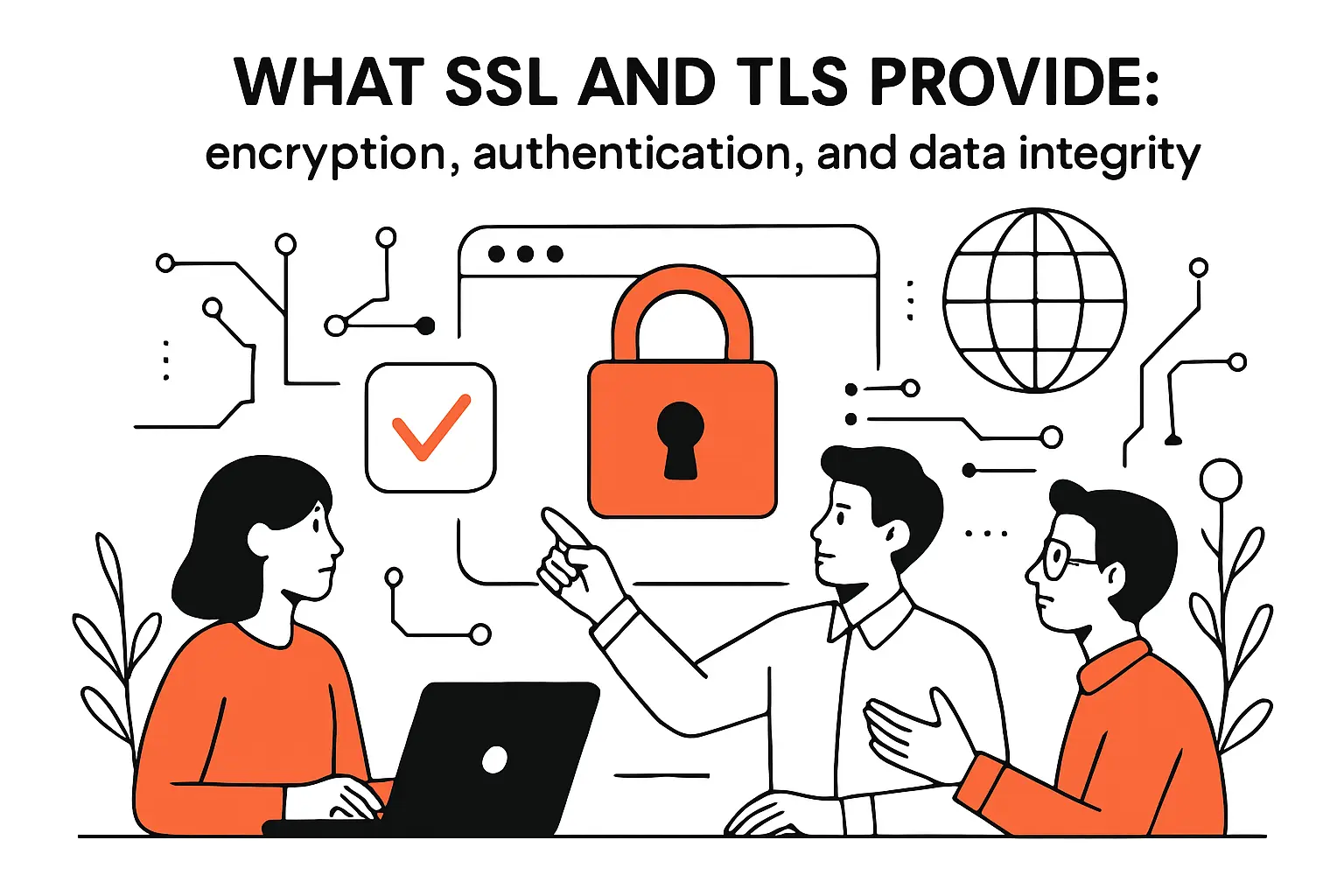
What SSL and TLS provide: encryption, authentication, and data integrity
1. Confidentiality through encrypted data in transit
Confidentiality is the property most people intuitively associate with HTTPS: outsiders shouldn’t be able to read the payload moving between client and server. In practice, confidentiality protects login credentials, session tokens, personal data, and business-sensitive API responses from passive interception on Wi‑Fi, corporate networks, ISPs, or compromised routing paths.
Technically, TLS achieves this by negotiating shared secrets and then encrypting application data using symmetric cryptography. Symmetric encryption is fast enough for high-traffic services, which is why we can secure everything from static assets to streaming API responses without turning performance into a tax.
From a business lens, confidentiality prevents “quiet data loss”—the kind of leak that never trips an alert because nothing was hacked in the classic sense. When plaintext traffic exists, an attacker doesn’t need to break in; they just need to listen.
2. Authentication to establish trust between client and server
Authentication is the underappreciated half of transport security. Encryption without identity just means you might be encrypting traffic to the wrong party. TLS typically authenticates the server to the client by proving that the server holds the private key corresponding to a publicly trusted certificate for the domain name the client intended to reach.
Trust, here, is delegated. Browsers and operating systems ship with trust stores, and certificate authorities (CAs) act as the entities that validate and sign identities. The result is a chain of trust where “this certificate is acceptable” depends on policy decisions far outside your app code, which is why certificate governance matters as much as cryptography.
On internal systems, stronger patterns are available. Client certificates (mutual TLS) can authenticate machines or workloads, which is often cleaner than shared API keys when we’re securing service-to-service calls across microservices or partner networks.
3. Integrity checks to detect tampering during transmission
Integrity is the reason we call TLS a defense against active attackers, not just snoops. Without integrity, an intermediary can flip bits, inject scripts, or alter API parameters while the request is in flight. TLS addresses this by using message authentication mechanisms that detect modification and cause the connection to fail rather than accept corrupted data.
In practical web terms, integrity prevents the classic “injected JavaScript on public Wi‑Fi” scenario. For APIs, integrity blocks parameter tampering, response rewriting, and downgrade games that try to coerce clients into weaker settings. Put differently: TLS aims to ensure the bytes you receive are the bytes the other side intended to send.
At TechTide Solutions, we treat integrity as the difference between “encrypted” and “safe enough to build on.” If we can’t trust the path, we design the connection so the path can’t silently change meaning.
How the TLS handshake works end to end
1. Certificate based identity verification during connection setup
The handshake is where identity gets established. Before any meaningful application data flows, the client and server exchange messages that let the client validate the server certificate: domain name match, chain to a trusted root, acceptable validity window, and policy compliance (like key usage and signature constraints).
What we look for in real deployments
In production, teams rarely hit failures because “TLS is broken.” They usually trip over overlooked details instead: they forget intermediate certs, issue a cert for the wrong hostname, or configure SNI wrong so a reverse proxy presents the wrong certificate. Those issues feel mundane, yet they’re exactly what causes browser warnings and failed API calls.
Why the user experience is part of the security model
Browsers translate certificate validation into user-facing signals, but the protocol itself is strict: when identity checks fail, clients are supposed to distrust the connection. That strictness is what turns certificate management into an operational discipline rather than a one-time setup.
2. Asymmetric cryptography for secure key exchange
Asymmetric cryptography shows up in the handshake because it solves the “how do we agree on secrets over an open channel?” problem. The handshake uses public-key techniques so that even if an attacker records the entire negotiation, they can’t feasibly compute the negotiated session secrets.
Modern TLS deployments typically rely on ephemeral key agreement mechanisms to establish shared secrets, which is a big deal for incident containment. If a server key were compromised later, past captured traffic should remain protected—assuming the configuration actually uses forward secrecy-capable key exchange.
In our work, asymmetric crypto is also where compatibility battles happen. Legacy clients might only support older key exchange modes, while modern clients prefer safer, faster groups. The handshake is the negotiation table, and your server configuration decides who gets a seat.
3. Session keys and symmetric encryption after the handshake
Once the handshake completes, the connection switches into “bulk transport” mode: symmetric encryption and integrity protection for application data. This is where TLS becomes efficient, because symmetric primitives are far less computationally expensive than public-key operations.
Session keys are also where performance and resilience features enter the picture. Resumption mechanisms can reduce repeated handshake costs, and modern stacks can reuse negotiated parameters safely to improve latency without weakening security—if configured properly and aligned with client behavior.
From a business perspective, this phase is why “TLS is slow” is usually a dated complaint. The cost center is often not encryption itself, but misconfigured stacks, lack of hardware acceleration, or avoidable connection churn caused by application patterns.
Protocol versions and deprecations you must know

1. SSL version history and why SSL is deprecated
SSL is deprecated because the protocol family accumulated structural weaknesses and unsafe defaults that can’t be papered over with configuration tweaks alone. Over time, the security community found practical attacks against older negotiation behaviors, legacy cipher modes, and downgrade mechanisms that allowed attackers to steer connections into weaker states.
In operational terms, “deprecated” means the ecosystem will eventually stop tolerating it. Browsers remove support, CDNs disable it, and compliance frameworks treat it as unacceptable for sensitive workloads. That removal is not a moral judgment; it’s the natural outcome of protocols that can no longer meet their security goals under modern threat models.
Our stance is blunt: if anything in your environment still requires SSL-era behavior, you don’t have an SSL problem—you have a dependency-management problem. The fix is to modernize the dependency, not to keep the protocol on life support.
2. TLS evolution from TLS 1.0 through TLS 1.3
TLS has evolved in a direction we strongly approve of: fewer legacy branches, safer cryptographic primitives, and less negotiation complexity that attackers can exploit. The arc from earlier TLS versions to the current generation reflects hard lessons learned in production, where “optional” security features often become “never enabled,” and complexity becomes a vulnerability multiplier.
Standards work matters here, because the strongest ideas still fail if they can’t be implemented consistently. The document titled The Transport Layer Security (TLS) Protocol Version 1.3 captures the modern philosophy: simplify, remove fragile legacy pieces, and improve both security and latency characteristics.
From our perspective, TLS evolution is a reminder that security is a moving target. A protocol version isn’t “good” forever; it’s good relative to what attackers can do today and what implementations get wrong in practice.
3. Why older TLS versions are deprecated and why TLS 1.2 or later is commonly required
Engineers have deprecated older TLS versions because those versions allow cipher-suite combos and handshake behaviors that no longer hold up at internet scale. Even if a server tries to lock things down, real clients and intermediaries can still open doors to downgrade or cross-protocol tricks through the remaining protocol surface area.
Regulatory and standards guidance also drives the baseline forward. Many teams use NIST SP 800-52 Rev. 2 as a reference point when defining acceptable TLS configurations, and we see the same “modern-only” expectations mirrored in payment ecosystems, enterprise browsers, and zero trust initiatives.
Practically, “commonly required” translates into vendor policy. If an upstream provider drops support for older versions, your integrations fail—sometimes without a graceful fallback—so the business impact can be immediate.
4. How known SSL weaknesses and real world attacks accelerated the move to TLS
Security history has a way of turning academic concerns into budget line items. Once attackers could exploit high-profile weaknesses at scale, teams stopped asking “should we upgrade?” and started asking “why did anyone leave this enabled?” That shift came from more than protocol math—attackers also leaned on fragile real-world implementations and automated exploitation until it became cheap and repeatable.
At TechTide Solutions, we’ve repeatedly seen attacks function as forcing mechanisms. A single well-publicized vulnerability can cause browsers, CDNs, and SaaS providers to tighten defaults within months, which then forces downstream organizations to modernize faster than their normal change-control cycle.
In our view, the most important lesson is cultural: treat transport security like a living system. When teams bake “we’ll revisit TLS later” into their roadmap, later arrives as an emergency.
tls vs ssl technical differences that impact security and performance
1. Handshake differences: fewer steps, fewer legacy options, faster negotiation
Handshake design has direct consequences for both security and latency. Fewer optional branches means fewer opportunities for downgrade attacks and fewer weird edge cases between libraries. Modern TLS handshakes also aim to reduce network round trips, which matters for mobile connections, global users, and API traffic that fans out across multiple services.
From an engineering standpoint, simplifying negotiation is a security win because it reduces the “choose-your-own-adventure” feel of legacy cipher suite selection. When we harden a stack, we want to eliminate ambiguity: clients should either negotiate a modern set of parameters or fail clearly.
On performance, the biggest gains often come from removing outdated compatibility modes. In our deployments, the best latency improvements aren’t magic—they’re the result of choosing a modern baseline and enforcing it consistently across edge, service mesh, and downstream dependencies.
2. Alert messages: encrypted alerts and the close notify behavior
Alert messages are the protocol’s way of saying “something went wrong” or “we’re done here.” In older designs, alerts could leak information useful for attackers, especially when combined with padding oracles and error-based probing. Modern TLS aims to reduce that leakage by protecting more of the control-plane conversation.
“Close notify” is one of those details that sounds pedantic until it isn’t. Clean connection shutdown reduces ambiguity about truncation attacks and half-closed connections where an attacker might try to splice streams or cause applications to accept incomplete data as complete.
In production systems, we treat alert behavior as a debugging signal and a security signal. Clear alerts help operations teams fix misconfigurations quickly, while encrypted or less-informative alerts reduce what an attacker can learn by poking at your edge.
3. Message authentication changes: MD5 based approaches vs HMAC based approaches
Message authentication is where the protocol proves that ciphertext hasn’t been manipulated. Earlier approaches relied on constructions that, over time, proved to be brittle in the face of practical cryptanalysis and implementation quirks. Modern designs lean on stronger, better-understood authentication mechanisms and avoid legacy hash dependencies that have a long history of collision concerns.
From a “why businesses should care” standpoint, this is about predictability. If a protocol depends on primitives that the security community is actively deprecating, you’re building a system that will require disruptive upgrades. Stronger message authentication means fewer emergency migrations and fewer “why did this suddenly break in Chrome?” fire drills.
Our operational bias is to remove weak options entirely rather than keeping them for compatibility. Compatibility is expensive, and the bill tends to arrive during incidents.
4. Cipher suites and key exchange improvements: forward secrecy and modern cryptography
Cipher suites are the menu of what’s possible, and old menus are dangerous because they keep bad food on the table. Over time, engineers have pushed TLS configs toward safer defaults. They favor ephemeral key exchanges for forward secrecy. They rely on AEAD ciphers that combine confidentiality and integrity cleanly. And they also tighten negotiation rules so clients and servers can’t “agree” on something weak by accident.
Forward secrecy is one of those features that changes the economics of compromise. If an attacker records traffic today and steals a server key tomorrow, forward secrecy aims to prevent retroactive decryption. For organizations handling sensitive personal data, proprietary analytics, or regulated records, that property can meaningfully reduce breach blast radius.
In our builds, we prefer configurations that are boring in the best way: modern primitives, minimal negotiation surface, and tested interoperability with the actual clients the business serves—not hypothetical legacy devices we no longer support.
HTTPS and the browser padlock: what it does and does not mean
1. HTTP vs HTTPS: HTTPS uses SSL TLS to secure otherwise insecure HTTP traffic
HTTP is a plaintext application protocol, and plaintext protocols assume a friendly network that does not exist. HTTPS is just HTTP running inside a TLS-protected connection. TLS adds confidentiality, integrity, and authentication to traffic that attackers could otherwise intercept or modify.
In other words, HTTPS doesn’t replace HTTP; it wraps it. That framing helps teams see why “we redirected to HTTPS” matters, but doesn’t finish the job. If the first contact happens over plaintext, an attacker can tamper with the redirect unless you also use protections like HSTS.
At TechTide Solutions, we consider HTTPS the minimum viable transport posture for any internet-facing application, including marketing sites. Once integrity is missing, content injection becomes a supply-chain risk, not just a privacy risk.
2. What users can learn from the lock icon and certificate details
The lock icon is a coarse signal: it primarily tells users the browser successfully negotiated TLS and validated a certificate chain for the domain they visited. That’s meaningful, because it blocks trivial impersonation and passive snooping, but it isn’t a stamp of “this business is trustworthy” in the broader sense.
Certificate details can still be useful in investigations. For example, support teams can confirm the certificate’s subject names, issuer, and validity window when diagnosing “works on my machine” reports or regional interception issues. Security teams can use those details to detect misissued certificates or unexpected intermediates.
Still, most users won’t inspect certificate fields. Because of that, we design systems where security doesn’t depend on user vigilance, and we treat the padlock as a baseline, not a competitive advantage.
3. Why HTTPS does not automatically mean a website is fully secure
HTTPS can secure transport while the application remains vulnerable. A site can have flawless TLS and still ship insecure session management, XSS, CSRF, broken access control, leaked secrets in client code, or vulnerable dependencies. Transport security prevents certain classes of network-layer attacks; it doesn’t validate business logic or application correctness.
Phishing is the classic example. Attackers can obtain valid certificates for lookalike domains and serve convincing pages over HTTPS. In that scenario, the padlock confirms encryption to the attacker’s server, not legitimacy of the underlying entity.
Our rule of thumb is: TLS is necessary for trust, but trust requires more than TLS. Secure software is layered, and each layer has a different failure mode.
4. Browser warnings and SEO signals that encourage HTTPS adoption
Browsers have steadily increased the friction for plaintext experiences, because even a single insecure navigation can expose users. Google’s security team notes that HTTPS adoption climbed dramatically and reached the 95-99% range around 2020, which is precisely why modern browsers can be more aggressive about warning on the remaining insecure edges.
Search ecosystems also nudge the web in the same direction. Google has publicly framed HTTPS as a ranking signal, and while we don’t treat SEO as a security control, those incentives matter because they influence executive priorities and migration budgets.
From our perspective, the combined pressure of browser UX and platform policy creates a practical mandate: HTTPS isn’t just “best practice,” it’s table stakes for visibility, user trust, and interoperability.
Certificates in practice: validation levels, lifecycle, and operational best practices

1. SSL certificate and TLS certificate naming: certificates vs protocols
Certificates and protocols sit at different layers, and confusing them causes expensive mistakes. TLS is the protocol that negotiates secure communication. A certificate is the artifact most often used to prove identity during that negotiation. Calling it an “SSL certificate” does not tie it to SSL. It is simply industry shorthand for a certificate used in TLS.
When we work with stakeholders, we separate these conversations on purpose. One asks what certificate is needed and how it will be validated and renewed. Another asks which protocol versions and cipher suites are allowed. A third asks what the application assumes about transport security. Each has different owners and different failure modes.
In operations, this clarity helps teams create clean runbooks. Certificate expiry is a lifecycle problem; weak cipher suites are a configuration problem; mixed content is an app integration problem.
2. What a certificate contains and why certificate authorities matter
A certificate is a signed statement binding an identity, such as a domain name, to a public key. It follows rules set by the issuing CA and enforced by client trust stores. Certificates also include metadata that limits usage, such as key purposes, validity periods, and issuer chains. Clients must build and verify those chains correctly.
CAs matter because browser trust is only as strong as the weakest trusted issuance and validation behavior. Even when your organization does everything right, a misissued certificate elsewhere can enable impersonation until revocation. That is why ecosystem governance and transparency mechanisms exist.
At TechTide Solutions, we treat CA selection as a risk decision, not just a procurement decision. The cheapest certificate isn’t necessarily the lowest total cost if tooling, automation support, and incident response posture are weak.
3. Validation levels: domain validation, organization validation, extended validation
Validation levels answer one question: what did the CA verify before issuing the certificate? Domain validation proves domain control, while organization validation adds verification of the requester’s legal identity.
Extended validation aimed to show stronger identity signals, though modern browsers emphasize it far less today. For most systems, the real security value comes from encryption and correct domain binding, not validation badges.
In sensitive contexts, OV or EV can still help when legal entity verification reduces fraud risk. Our recommendation is simple: choose the level by threat model, then focus hard on renewals, monitoring, and deployment.
4. Renewals, automation, and monitoring for continuous TLS coverage
Certificate renewal is where “we use HTTPS” turns into a discipline. Manual renewals don’t fail because people are incompetent; they fail because humans are a poor scheduler under competing priorities. Automation is the only scalable response, especially as fleets grow and as certificate lifetimes shorten.
The industry is explicitly pushing in that direction. The CA/B Forum has adopted a schedule that reduces maximum public TLS certificate validity from 398 days to 47 days, and that kind of shift changes the economics: monitoring and renewal automation become core infrastructure, not nice-to-have tasks.
In our deployments, we like layered safeguards: automated issuance, proactive expiry alerts, and synthetic checks that validate the served certificate chain from the same vantage points your users have. When certificates fail, they often fail publicly and immediately, so detection has to be boringly reliable.
5. Common TLS use cases beyond websites: email, VPN, VoIP, DevOps, IoT, internal services, databases
Websites are only the visible slice of TLS. Email encryption relies on TLS for server-to-server and client-to-server links. VPNs frequently use TLS-based control channels. VoIP signaling and modern collaboration tools also depend on transport security to prevent call hijacking or metadata leakage.
DevOps is a major hotspot. CI pipelines distribute artifacts, sign images, and connect to registries and cluster APIs. Those paths are exactly what attackers love to target. For IoT and internal services, TLS often decides whether network access equals data access. A stronger model requires every connection to prove its identity.
A concrete real-world example we point to is payments infrastructure: Stripe states that All API requests must be made over HTTPS, and that kind of vendor mandate is increasingly common because upstream providers can’t afford to inherit your transport risk.
6. Encrypted traffic visibility: TLS decryption approaches and SSL TLS threat vectors
Encrypted traffic creates a tension between visibility and privacy. Enterprises sometimes use TLS interception to inspect traffic for malware, exfiltration, or policy violations. That approach can work, but it is not free. It introduces new trust anchors and new failure modes. In some cases, it can also break modern protections like certificate pinning or forward secrecy expectations in mobile apps.
Threat actors also hide in encrypted channels. Malware can use TLS to blend into normal traffic. Phishing pages can be served over HTTPS. Attackers can abuse misconfigurations, weak client validation, or certificate issuance gaps to look legitimate long enough to do damage.
Our view is that visibility should be engineered with restraint. When interception is required, scope decryption narrowly and govern it tightly. Meanwhile, use alternative telemetry such as endpoint signals, DNS analytics, and application auditing. That preserves stronger transport guarantees across the environment.
TechTide Solutions: building secure custom software with modern TLS
1. Custom web and mobile app development with HTTPS and TLS built in
In our delivery process, TLS is not a launch checklist item; it’s part of the architecture. That means we design every environment—development, staging, production—so that HTTPS is normal, not special. When developers only see TLS in production, they tend to build accidental assumptions: hardcoded HTTP callbacks, mixed content dependencies, and insecure local testing workarounds that later leak into releases.
For web applications, we treat the edge as a policy enforcement point. There we define redirect strategies, strict transport headers, secure cookie flags, and sane timeouts. On mobile, we watch certificate validation behavior inside SDKs very closely. After all, “works on Wi-Fi” does not guarantee safety on hostile networks.
Just as importantly, we connect TLS posture to business requirements. If an app handles regulated data, we align transport configuration with compliance expectations early so that audits don’t become last-minute archaeology.
2. Integrating certificate management, renewals, and secure service to service communication
Operational excellence with TLS usually comes down to automation and identity. For internet-facing endpoints, that means automated certificate issuance and renewal integrated into infrastructure-as-code and deployment pipelines. For internal traffic, that often means moving from “shared secrets everywhere” toward short-lived credentials and workload identity, frequently implemented with mutual TLS across services.
In microservice environments, we like to make the secure path the easy path. Service meshes, identity-aware proxies, and centralized certificate managers can help, but only if the organization also commits to a clean trust model: which services are allowed to talk, how identities are issued, and what happens during rotation.
When a certificate expires, the failure is rarely isolated. Because modern systems are interconnected, one failed handshake can cascade into retries, queue backlogs, and user-visible outages. That reality is why we design monitoring that catches certificate and chain problems before customers do.
3. Modernizing legacy deployments from SSL era assumptions to TLS 1.2 and TLS 1.3 ready configurations
Legacy modernization is where the “SSL vs TLS” confusion becomes expensive. Older stacks often assume long-lived certificates, permissive cipher negotiation, and backward compatibility with clients that no longer exist in meaningful numbers. Meanwhile, modern browsers and enterprise policies increasingly assume hardened defaults, shorter lifecycles, and predictable negotiation behavior.
Practically, our modernization approach is incremental but firm. First, we inventory every TLS termination point—CDNs, load balancers, app servers, service meshes, database proxies, and outbound clients. Next, we establish a target profile that matches your client population and regulatory needs, then roll it out with telemetry so we can see which legacy clients break and why.
For configuration guidance, we frequently lean on resources like the Mozilla SSL Configuration Generator and the Transport Layer Security Cheat Sheet, not because they are magic, but because consistent, community-reviewed baselines reduce the odds that a team “invents” insecure defaults under deadline pressure.
Conclusion: choosing TLS and implementing it correctly
1. Default to TLS for modern secure communication and treat SSL as legacy terminology
SSL is a label that refuses to die. The protocol reality is simpler: modern secure transport is TLS. In daily work, using SSL as a vague stand-in for encryption leads to fragile configurations and surprise outages. Instead, use sharper vocabulary.
Name the protocol TLS, the artifact a certificate, and the behavior HTTPS. Once those terms are distinct, ownership becomes clearer. Security governs policy, platform manages lifecycle, and application teams avoid plaintext assumptions.
Most importantly, align the choice of TLS settings with an explicit threat model. If the business can’t articulate what it fears, it will struggle to justify the tradeoffs that real hardening requires.
2. Pair strong protocol configuration with sound certificate practices and automation
TLS configuration and certificate management are inseparable in production. Strong ciphers cannot save you from an expired certificate. Likewise, automated renewal cannot save you from legacy negotiation paths attackers can exploit. The winning pattern is a hardened baseline plus an automated lifecycle. It should be backed by monitoring that treats trust failures as urgent incidents.
From an engineering side, this means repeatable configuration across environments and consistent termination points. It also requires a clear plan for internal encryption, especially for east to west traffic. Operationally, rotation should be routine, not a panic event.
In our experience, strong organizations do not avoid problems entirely. Instead, they detect issues earlier, recover faster, and avoid turning maintenance into public outages.
3. Continuously review TLS settings as browsers, servers, and standards evolve
TLS is not something you set once and forget. Client behavior changes, browser requirements tighten, CA policies evolve, and new attacks redefine what feels safe. Because of that, we recommend scheduled TLS reviews. Validate what is enabled, verify what is negotiated, and test on the same networks and devices.
Healthy organizations also build feedback loops into delivery. When vendors drop older protocols or certificate lifetimes shrink, the response should already be automated. That posture turns ecosystem change into routine work instead of disruption. A simple question reveals the truth: when did your team last validate TLS end to end? And could you reproduce that validation on demand?