
At TechTide Solutions, we treat social media strategy like product engineering: define outcomes, design the system, instrument everything, and keep shipping improvements. Brands that “just post” are essentially deploying untested code into production—hoping the market will QA it for free.
Market overview: worldwide social media advertising spend is projected to reach US$276.72bn in 2025, which is a polite way of saying the feed is now one of the most competitive storefronts in business.
Still, throwing budget at the problem rarely fixes the foundation. Sustainable growth comes from an end-to-end plan: goals, measurement, content design, platform fit, community operations, and the technical plumbing that turns attention into revenue.
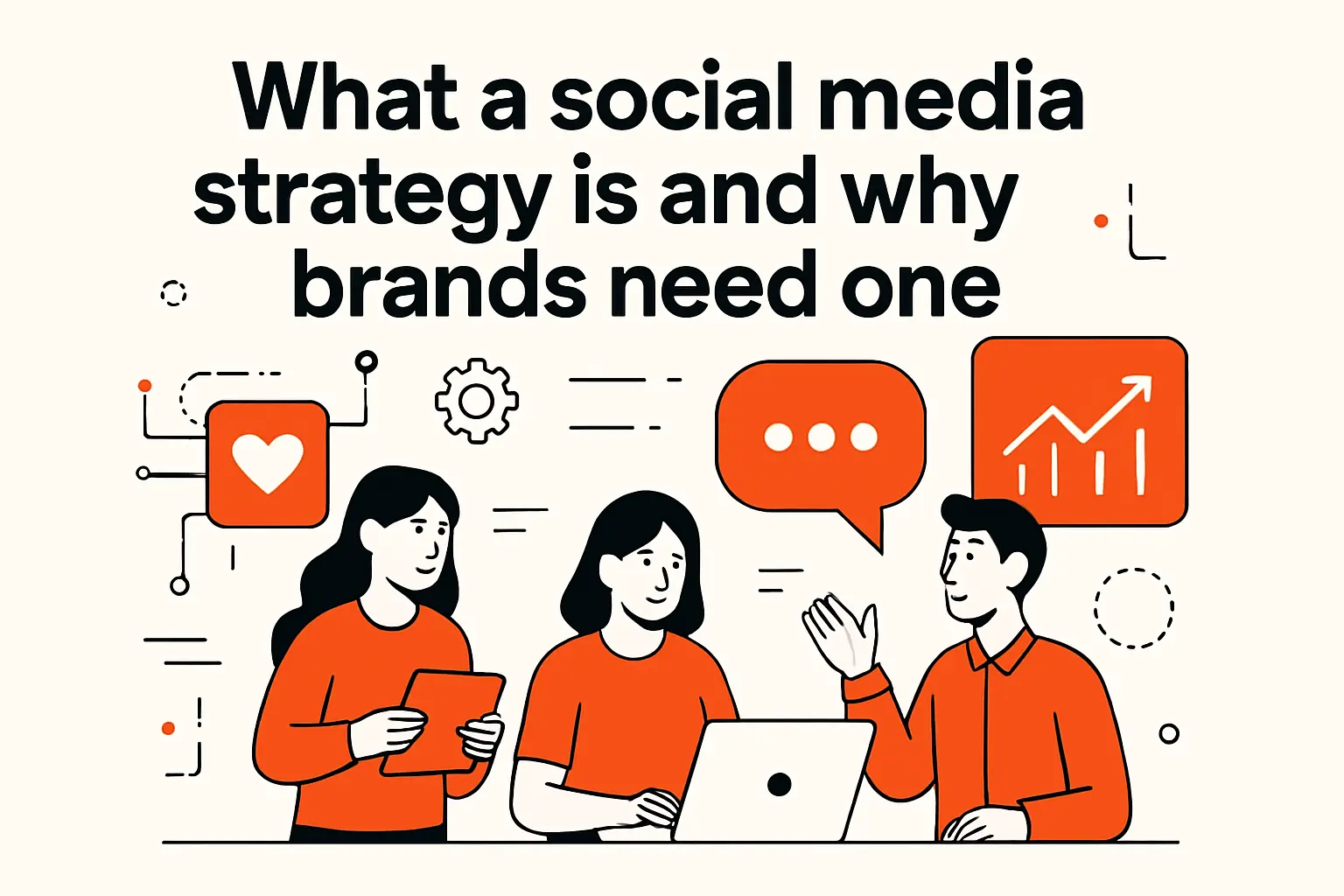
What a social media strategy is and why brands need one
1. Define social media marketing and the role of strategy in creating business impact
Social media marketing is the craft of earning attention, shaping perception, and driving action through platform-native content, community interaction, and paid distribution. Strategy is what turns that craft into business impact: it’s the set of choices that makes your social presence coherent, repeatable, and measurable instead of accidental.
From our perspective, the most useful mental model is “social as a system.” Inputs include creative, offers, community prompts, influencer partnerships, and ad spend. Outputs include reach, engagement, click-through behavior, leads, purchases, retention signals, and customer feedback. Between those two sits the messy reality: platform algorithms, shifting cultural context, and competitors who copy anything that works.
Without strategy, teams default to reactive posting, and reactive posting tends to chase short-term visibility while quietly eroding long-term brand meaning. With strategy, social becomes a business asset: a channel with a clear role, governance, and feedback loops that inform product, sales, and support.
2. Align social efforts with broader objectives, campaigns, and measurable outcomes
Alignment is where social stops being “the marketing team’s side quest” and becomes a lever the whole company can pull. If your broader objective is pipeline, social should not be evaluated like a billboard. Conversely, if your objective is brand preference, you should not force every post to behave like a checkout page.
In practical terms, alignment means every meaningful social initiative answers three questions: what business outcome does this support, what customer behavior must change for that outcome to happen, and how will we observe that change? The last question is the difference between a plan and a wish.
We like to map social deliverables directly to campaign architecture. A product launch, for example, isn’t “a launch post.” It’s a sequence: awareness assets that seed the problem, consideration assets that explain the approach, proof assets that reduce risk, and conversion assets that make action feel easy. When social is planned as a sequence, measurement becomes cleaner and creative iteration becomes more deliberate.
3. Build trust through two-way engagement, not just broadcasting promotions
Broadcasting is easy; trust is earned in the replies, the direct messages, and the uncomfortable moments when customers point out friction. Brands often underestimate how public customer experience has become. A slow response, a scripted answer, or a defensive tone can undo the work of an entire content calendar.
Two-way engagement is not a “nice to have,” because social platforms train users to treat brands like participants in a shared space. When that expectation is met, customers volunteer context you can’t buy: what confused them, what alternatives they considered, and what made them hesitate.
Consider how certain consumer brands have built reputations by sounding human rather than corporate. We’re not suggesting every brand should be playful; we are suggesting every brand should be present. Presence is operational: response guidelines, escalation paths, and a culture that values conversation as data, not distraction.
4. Stay adaptable as trends, algorithms, and audience behaviors change quickly
Social strategy is not a binder on a shelf; it is a living system under constant environmental pressure. Algorithms change what gets distribution, audiences shift platforms, and content formats rise and fall at an uncomfortable pace.
Adaptability, in our view, is less about chasing trends and more about building an experimentation discipline. When the feed changes, the teams that win already have a testing cadence, a way to tag creative hypotheses, and a reporting rhythm that makes tradeoffs explicit.
Just as importantly, adaptability requires modular content design. If your storytelling only works in one format on one platform, you’ve built a brittle system. If your narrative can be expressed as a short video, a carousel, a founder post, and a community prompt, you’ve built an asset that survives the next algorithm update.
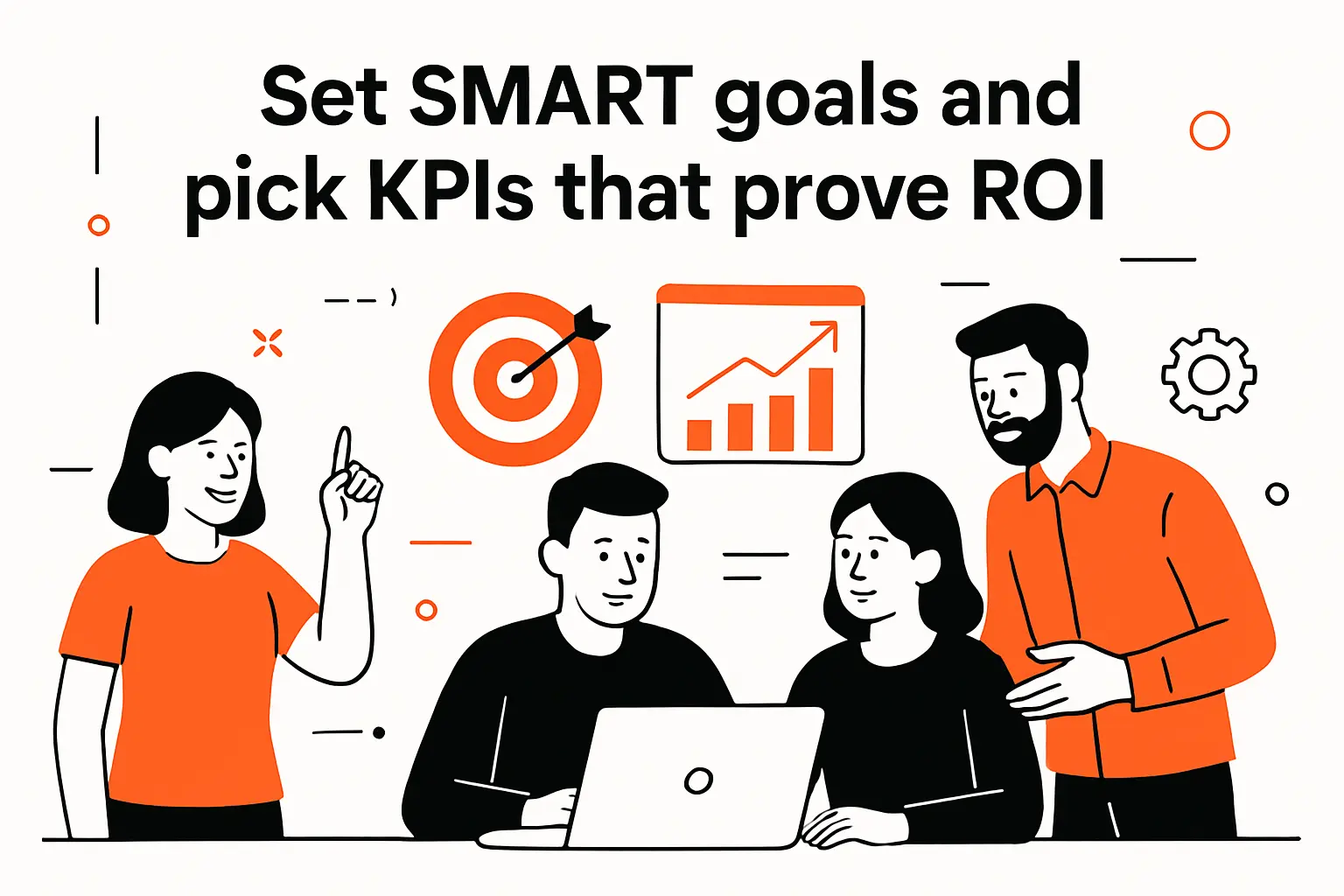
Set SMART goals and pick KPIs that prove ROI
1. Start with 1–3 priorities and tie them to the customer journey
Focus is the most underrated growth tactic in social. When a brand tries to optimize for everything at once—awareness, engagement, lead generation, recruiting, customer service, and community—it typically ends up optimizing for nothing. Strategy starts by choosing a small set of priorities and explicitly assigning social a job to do in the customer journey.
At TechTide Solutions, we like to frame those priorities as journey outcomes: “more qualified discovery,” “faster movement from consideration to trust,” or “better retention signals through community.” Each phrase points to observable behaviors rather than vague aspirations.
Once priorities are selected, every major content decision becomes easier: which stories to tell, which formats to emphasize, which calls-to-action to include, and which comments deserve a deeper response. Clarity reduces internal debate, which is crucial because social rewards speed and consistency more than perfect consensus.
2. Translate goals into KPIs for awareness, engagement, and conversions
SMART goals live or die by their measurement design. The trick is to translate “what we want” into “what we can observe,” and to make sure the observation is tied to business value.
For awareness, we tend to focus on distribution quality rather than raw reach. Frequency patterns, audience relevance signals, and share-of-voice in your niche are usually more informative than a single viral spike. Engagement KPIs should reflect intent: saves, shares, meaningful comments, and qualified profile visits often correlate with downstream performance better than low-effort reactions.
For conversions, measurement quickly becomes technical. A clean KPI definition might require event tracking on landing pages, consistent campaign tagging, and a reliable way to distinguish organic behavior from paid behavior. When those foundations are missing, teams end up arguing about numbers instead of improving outcomes.
3. Use data-driven metrics over vanity metrics to demonstrate value
Vanity metrics are seductive because they are immediate and visible. Data-driven metrics are harder because they require instrumentation, governance, and sometimes uncomfortable conclusions. Yet the leadership question is always the same: “What did this do for the business?”
We recommend building a measurement ladder. At the top sit business outcomes: revenue influence, pipeline quality, retention indicators, support cost deflection, or brand preference. Beneath that sit behavioral leading indicators: sign-ups, demo requests, add-to-cart actions, email subscriptions, or repeat site visits. At the bottom sit platform-native signals that predict behavior: saves, rewatches, comment depth, and click intent.
When teams connect those layers, reporting becomes persuasive. Instead of claiming “engagement improved,” you can explain how content changes increased qualified site behavior and improved downstream conversion rates, while also identifying which segments responded best.
4. Define success criteria early to support reporting and stakeholder buy-in
Success criteria are not a reporting artifact; they are a decision tool. Defined early, they protect the team from moving goalposts and help stakeholders understand what tradeoffs they are accepting. A brand that wants premium positioning, for example, may accept slower follower growth in exchange for higher-quality engagement and better sales conversations.
Operationally, we like to document success criteria as a short “measurement contract” shared across marketing, sales, and leadership. It includes KPI definitions, attribution assumptions, and what decisions the report is meant to enable. Without that last part, teams produce dashboards that look impressive but change nothing.
One more reality check matters here: the broader marketing ecosystem is increasingly digital. Gartner has reported that 61.1% of total marketing spend is attributed to digital channels, and that reality intensifies the demand for clear, defensible ROI narratives.
Know your audience deeply: research, personas, and segmentation
1. Document demographics, behaviors, motivations, and content preferences
Audience work fails when it stops at demographics. Demographics help with media buying, but behavior and motivation are what shape creative performance. The best audience documentation reads less like a census and more like a set of decision triggers: what people want to accomplish, what risks they fear, what language they use to describe the problem, and what proof makes them believe.
In our work, we push for “content preference clarity.” Some audiences want fast, skimmable takeaways; others want depth and credibility. Certain communities respond to behind-the-scenes process; others respond to results and status signaling. When content preferences are known, production becomes more efficient because the team is not reinventing the style every week.
We also recommend documenting the “objection library” up front. Objections show up in comments, competitor comparisons, and quiet drop-offs in conversion funnels. When you write them down early, you can design content that resolves them before the audience has to ask.
2. Use platform analytics, social listening, surveys, and site analytics to validate assumptions
Assumptions are unavoidable; untested assumptions are optional. Validation is where audience research becomes trustworthy enough to base spend on. Platform analytics can reveal which topics retain attention, which formats drive saves, and which posts create meaningful profile actions.
Social listening adds a different layer: it captures how people talk when you are not in the room. That language is gold for copywriting and positioning, because it reflects real framing rather than internal brand jargon. Surveys and interviews then help you test the “why” behind the behavior. Meanwhile, site analytics closes the loop by showing what happens after social sends traffic: which pages get exits, which CTAs convert, and which segments behave differently.
For brands operating in the United States, platform reach still concentrates heavily. Pew Research Center reports that 84% say they ever use YouTube and 71% report using Facebook, which matters because “platform preference” often isn’t philosophical—it’s simply where the audience already spends time.
3. Create buyer personas to guide messaging, formats, and channel decisions
Personas are useful when they drive choices, not when they decorate slide decks. A strong persona includes three things: context (what situation triggers the search for a solution), criteria (what they evaluate and how they choose), and constraints (budget, time, compliance, internal politics, or risk tolerance).
From there, we tie persona needs directly to content formats. An operational leader might need checklists, implementation notes, and proof of reliability. A senior decision-maker may need a narrative about strategic advantage and risk reduction. A practitioner might need templates and examples they can copy into their workflow today.
Channel decisions also become clearer through personas. Some personas want thought leadership and credibility signals; others want community validation and peer discussion. When you pick channels based on persona behavior, you stop trying to force every platform to do the same job.
4. Segment audiences to personalize content, ads, and community engagement
Segmentation is how you scale relevance. Without it, messaging becomes generic; with it, you can tailor creative, offers, and community routines to what each group actually values. Segmentation can be based on lifecycle stage, intent signals, content interests, or even the language a person uses in comments and messages.
In paid social, segmentation improves efficiency because you can align creative to the exact objection the audience is wrestling with. In organic social, segmentation shows up as content series: recurring themes that speak to specific needs while still reinforcing a consistent brand identity.
Community engagement benefits as well. A brand that recognizes different audience clusters can respond in ways that feel surprisingly personal at scale: directing a beginner to foundational resources while offering an advanced user deeper implementation details.
Choose the right platforms and optimize profiles for social search

1. Select channels based on where target audiences are active and how they use each platform
Platform selection is a business decision disguised as a creative decision. Each platform has a different attention economy: different content half-lives, different discovery mechanics, and different social norms about what “good” looks like.
Rather than asking, “Should we be on every platform?” we ask, “Where do we have the right to win?” That depends on audience presence, but also on your ability to produce the content the platform rewards. A brand may have a strong audience on a channel but lack the operational capacity to publish consistently in the formats that actually get distribution.
From a risk standpoint, concentration can also be dangerous. When one channel becomes the only growth engine, algorithm shifts become business shocks. A resilient strategy chooses a primary channel for momentum and secondary channels for stability and audience capture.
2. Match content formats to platform strengths such as short-form video, community, or thought leadership
Format fit is often the hidden reason “social isn’t working.” A brand might publish excellent insights in a format the platform doesn’t distribute. Another brand might publish mediocre insights in a highly native format and outperform simply because the algorithm knows what to do with it.
Short-form video rewards strong hooks, rapid clarity, and visual proof. Community-first platforms reward conversation design: prompts, opinions with nuance, and posts that invite people to share lived experience. Professional thought leadership rewards specificity: lessons learned, frameworks, and the credibility that comes from showing your work.
In our experience, the highest-performing brands treat formats like containers for the same strategic story. The “what we believe” stays consistent; the expression shifts to match how people consume on each platform.
3. Optimize bios and profiles with keywords and consistent brand identity for discoverability
Social search is no longer a side feature; it’s a primary discovery behavior for many audiences. That makes profile optimization a practical growth lever. A good profile answers: who you help, what outcome you deliver, what you publish, and where to go next.
Keyword clarity matters because platforms increasingly index bios, captions, and even on-screen text. Consistent brand identity matters because recognition compounds over time; if your visuals and voice change every week, you reset audience learning.
We also recommend treating pinned content like a landing page. Pin the posts that explain your core value, show proof, and set expectations about what people will get if they follow you. That small detail can turn a fleeting profile visit into a long-term audience relationship.
4. Reduce risk from impersonation by monitoring for copycats and considering verification where available
Impersonation risk is an operational problem, not just a branding annoyance. Copycat accounts can confuse customers, siphon traffic, and create support incidents that damage trust. Monitoring should be routine: search for lookalike names, track reused creative, and watch for suspicious engagement patterns around your brand keywords.
Verification, where it makes sense and where platforms offer it, can help reduce confusion. Even more important is building recognizable brand signals: consistent handles, consistent naming conventions, and a clear “official links” practice so customers always know where to go.
When the worst happens—a phishing attempt or a fake promotion—response speed matters. A prepared playbook, internal escalation path, and templated public statement often make the difference between a contained incident and a reputational mess.
Design a content strategy with pillars, brand voice, and high-performing formats
1. Build content pillars and themes that map to goals and audience needs
Content pillars are the architecture underneath your calendar. Without pillars, teams brainstorm forever and still feel inconsistent. With pillars, you can publish frequently while staying coherent, because each post fits into a deliberate set of themes tied to audience needs and business goals.
We like pillars that combine “what we know” and “what the audience cares about.” For a software brand, that might include education (how the problem works), proof (what results look like), perspective (what we believe and why), and process (how we implement reliably). For a local business, pillars might be community stories, behind-the-scenes craft, customer outcomes, and timely offers.
Importantly, pillars should be measurable. If a pillar never produces meaningful engagement or downstream behavior, it may be emotionally satisfying but strategically expensive.
2. Balance promotional content with original, authentic storytelling and value-led posts
Promotion is necessary; constant promotion is corrosive. Audiences do not follow brands to be sold to nonstop. They follow for entertainment, education, identity alignment, or community belonging—and the sales come as a side effect of sustained trust.
Value-led posts can be tactical (tips, checklists, teardown analyses) or narrative (customer stories, founder lessons, behind-the-scenes tradeoffs). Authenticity here is not about oversharing; it’s about being specific enough that people recognize reality. Generic content reads like it was generated by committee, and committees rarely go viral for the right reasons.
A healthy mix also protects performance. When every post is an offer, creative fatigue sets in quickly. When storytelling and proof are part of the rhythm, promotional posts feel like a natural next step rather than an interruption.
3. Prioritize short-form and interactive video, plus formats that keep audiences engaged on-platform
Platforms want users to stay on-platform; your content strategy should respect that incentive structure. Formats that retain attention—video, carousels, native Q&A prompts, and community-driven threads—tend to be rewarded because they improve session depth.
Interactivity is a force multiplier because it turns passive consumption into participation. Polls, comment prompts, stitch-friendly opinions, and audience challenges create a feedback loop: the audience gives you language, objections, and ideas; you respond with content; the audience feels seen; the algorithm notices engagement depth.
From a production standpoint, we recommend building a repeatable system: a way to turn a single insight into multiple platform-native assets. When the system is repeatable, the team spends less time reinventing and more time improving quality.
4. Scale credibility with influencer collaborations and user-generated content
Influencer work and user-generated content are both credibility engines, but they operate differently. Influencers provide borrowed trust and distribution; user-generated content provides social proof and relatability. Both work best when the collaboration is designed as a product, not a one-off post.
In our experience, the strongest collaborations start with clear creative constraints: what must be true, what cannot be claimed, and what “authentic” looks like for the creator’s audience. Brands that over-script collaborations often get content that feels stiff; brands that under-brief risk off-message content that creates compliance and support headaches.
UGC systems deserve tooling. Rights management, content collection workflows, and searchable libraries turn “random customer posts” into an asset pipeline that can power organic content, paid creative testing, and landing page proof.
Plan and publish: calendars, cadence, and community management
1. Create a content calendar that connects posts to campaigns, key dates, and objectives
A content calendar is not just a scheduling tool; it’s a strategy artifact. It makes your intent visible: what you’re prioritizing, what story you’re telling, and how you’re balancing education, proof, and promotion.
We recommend connecting calendar entries to objectives and hypotheses. Instead of “post about feature,” write “reduce hesitation by showing implementation workflow,” then choose a format that can actually prove it. When objectives are explicit, post-mortems become productive rather than personal.
Campaign integration matters too. Social posts should not feel like isolated events; they should be coordinated with email, website updates, sales enablement, and support readiness. Nothing hurts conversion like a social post that drives interest to a landing page that doesn’t match the promise.
2. Set posting frequency and timing by platform, then adjust as performance data accumulates
Cadence should be designed, not guessed. Different platforms reward different rhythms, and different audiences have different tolerance for frequency. Early on, consistency matters more than optimization; later, optimization compounds.
Performance data should drive iteration, but only after you’ve collected enough signal to avoid overreacting. A single underperforming post might be creative, timing, or topic fit; a repeated pattern across multiple posts is a strategy insight.
Seasonality and business cycles also matter. The best cadence is one your team can sustain through vacations, launches, and surprise priorities. A strategy that requires heroic effort eventually collapses into silence, and silence is its own algorithmic penalty.
3. Build an engagement strategy with response guidelines, proactive prompts, and community-building routines
Community management is where strategy becomes human. Response guidelines protect brand voice under pressure, but they should not turn your team into robots. The goal is to be consistent in principles while still sounding like a real person.
Proactive prompts are a simple way to build routines: weekly questions, recurring themes, or community challenges that invite participation. Those routines create expectation, and expectation creates habit. Once habit exists, content performance becomes less volatile because your audience is trained to show up.
Escalation paths matter as well. Some comments are simple; others touch billing, safety, legal concerns, or public criticism. A clear internal workflow ensures fast, accurate responses without forcing the social team to improvise policy in real time.
4. Clarify resources, budget, and workflow for planning, publishing, approvals, and reporting
Many social strategies fail not because the ideas are wrong, but because the operating model is missing. Who writes, who designs, who edits, who approves, and who reports? What happens when a post needs legal review? Who monitors comments on weekends? Which stakeholders get visibility, and at what level of detail?
At TechTide Solutions, we recommend documenting the workflow like an engineering team documents a release process. That means defined states (draft, review, approved, scheduled, published), clear ownership, and explicit service levels for feedback so content does not die in approval limbo.
Budget planning should also include the hidden costs: creative tooling, production time, community moderation, and analytics infrastructure. When leadership only funds ad spend, the strategy becomes lopsided and performance becomes fragile.
Measure, learn, and stay ahead: competitive analysis and evolving tactics
1. Run competitive analysis to benchmark, spot content gaps, and identify differentiation opportunities
Competitive analysis is not about copying; it’s about context. You need to know what the audience is already seeing so you can decide whether to differentiate, counter-position, or outperform with better execution.
We recommend analyzing competitors across three lenses: positioning (what they claim and how they frame the problem), content mechanics (formats, hooks, editing style, cadence), and community dynamics (what comments reveal about audience needs). The comment section is often where the real competitive intelligence lives, because it exposes confusion and unmet expectations.
Differentiation then becomes concrete. Instead of saying “we’re better,” you can say “we’re for teams that want reliability,” or “we’re for people who want a simpler workflow,” and back it up with proof content that competitors aren’t producing.
2. Share reporting insights across teams so social data informs broader business decisions
Social reporting should not live only inside marketing. Product teams can learn what features confuse users. Sales teams can learn what objections appear repeatedly. Support teams can spot early warning signals when sentiment shifts. Leadership can see how messaging resonates before investing heavily in larger campaigns.
To make that sharing useful, reports should answer: what happened, why we think it happened, what we changed, and what we’ll do next. Dashboards alone rarely change decisions; interpretation does.
A useful practice is to include a “voice of customer” section in reporting: recurring phrases, repeated objections, and surprising requests. Those qualitative signals often explain quantitative movement better than any chart.
3. Use a test-and-learn loop: experiment with formats, captions, CTAs, timing, and paid creative
Test-and-learn is the engine of adaptability. The key is to test one variable at a time where possible and to document hypotheses so the team learns even when a test “fails.” Failure with clarity is still progress.
In organic content, tests can explore hook styles, narrative structures, and topic framing. In paid social, tests can explore audience segmentation, creative variants, and landing page alignment. We also recommend testing “proof density”: how quickly you show evidence versus how long you build story before presenting results.
When the loop is consistent, strategy becomes cumulative. Each month builds on prior learning rather than starting over with a new brainstorm and the same old uncertainty.
4. Adopt modern tactics like cross-platform repurposing, social SEO, zero-click content, and AI-enabled automation
Modern tactics are less about hacks and more about respecting how people behave. Cross-platform repurposing acknowledges that attention is fragmented, while social SEO acknowledges that discovery often starts inside apps. Zero-click content acknowledges that many users prefer to learn without leaving the feed, which means value must often be delivered without an immediate click.
Automation, when used responsibly, improves consistency. It can help with scheduling, tagging, routing messages, and generating first drafts for internal review. Still, automation should not replace judgment. A brand’s voice and community trust are not assembly-line outputs; they are relationships.
Our stance is pragmatic: use AI to speed up mechanical tasks, then reinvest human effort into insight, creativity, and nuanced engagement where brands actually win.
TechTide Solutions: Building custom tools to power your social media strategy
1. Custom analytics dashboards and KPI reporting tailored to your goals and stakeholders
Off-the-shelf dashboards often fail because they are built for generic reporting, not your strategy. At TechTide Solutions, we build analytics layers that match how leadership thinks: business outcomes first, then the leading indicators that explain movement.
Technically, that usually means integrating platform APIs, ad platform reporting, website analytics, and customer relationship data into a single modeled dataset. From there, we design KPI definitions that reflect your funnel reality, not someone else’s template. Role-based views matter too: a content lead needs creative performance diagnostics, while an executive needs clarity on impact and direction.
We also like dashboards that include “decision notes.” Numbers without context invite debates; numbers paired with hypotheses and next actions create momentum.
2. Workflow automation for planning, approvals, scheduling, community management, and integrations
Workflow is where strategy becomes sustainable. Many teams are one sick day away from chaos because the process lives in someone’s head. Our approach is to engineer workflows that reduce cognitive load: structured briefs, clear approval paths, and automated notifications that keep work moving.
Integrations are often the hidden win. When a community message contains a sales signal, the system should route it appropriately. When a comment reveals a support incident, the system should capture it with context. And when a post is published, the system should tag it for reporting automatically so attribution isn’t an afterthought.
Done well, workflow automation doesn’t make a brand feel automated. Instead, it gives the team more time to sound human, because they aren’t drowning in coordination overhead.
3. Web and mobile development for community, UGC collection, campaign experiences, and scalable customer touchpoints
Social platforms are powerful, but brands still need owned experiences: landing pages that convert, community hubs that deepen loyalty, and campaign microsites that capture demand cleanly. We build web and mobile experiences that connect social attention to business outcomes without breaking the narrative.
UGC collection is a great example. A simple customer prompt can generate great content, but without a secure intake flow, rights capture, moderation tooling, and a searchable library, the value leaks away. Our development work often includes submission forms, consent workflows, moderation queues, and asset tagging so the content can be reused safely across marketing and product.
Campaign experiences also benefit from engineering rigor: fast performance, accessibility, clean analytics instrumentation, and reliable integrations. When those basics are right, creative campaigns stop being fragile stunts and start becoming scalable growth plays.
Conclusion: Make your social media strategy a living, measurable system
1. Review performance on a regular cadence and refine what you publish, where, and why
Strategy becomes real when it survives contact with reality. A regular review cadence turns social into a learning machine: publish, measure, interpret, adjust. Without that cadence, teams either chase random trends or cling to habits long after performance has faded.
In our work, we also emphasize separating signal from noise. One post does not define a strategy; patterns do. When you review consistently, you start to see what your audience actually rewards and what your business actually benefits from.
2. Document wins, repeatable playbooks, and lessons learned to improve consistency over time
Documentation sounds unglamorous, yet it’s how performance compounds. When a hook style works, write it down. When a narrative structure consistently earns meaningful comments, turn it into a template. And when an offer framing reduces friction, codify it.
Playbooks also protect teams during change. People leave roles, platforms evolve, and priorities shift. A documented system keeps the brand consistent even as the humans operating it rotate.
One caution we’ve learned the hard way: document the “why,” not only the “what.” If the team understands why a tactic worked, they can adapt it as formats and algorithms change.
3. Keep evolving as platforms, algorithms, and audience expectations continue to shift
Audience expectations are rising, not falling. Personalization is a good example: McKinsey has found that 71% of consumers expect companies to deliver personalized interactions, and 76% get frustrated when this doesn’t happen, which means generic social content increasingly feels like wasted time to the people you want to reach.
Experience gaps matter too. Deloitte has reported that 80% of business-to-consumer leaders think their online experiences are impressive, but only 42% of surveyed consumers agree, and social media is often where that gap becomes visible first—through comments, complaints, and quiet skepticism.
So the next step is straightforward, even if it isn’t easy: pick your strategy inputs, instrument your outcomes, and build the operational discipline to iterate. If we at TechTide Solutions could leave you with one question, it would be this: what would change in your business if your social media stopped being a posting habit and became an engineered growth system?