
Cloud momentum keeps compounding: end‑user spending on public cloud services is projected to reach $723.4 billion in 2025, which squares with what we see daily as organizations modernize storage, analytics, and AI pipelines atop object storage. At TechTide Solutions, we’ve learned that the humble S3 bucket is the pivot point of that modernization: get the bucket’s architecture, security, and lifecycle design right, and everything upstream and downstream moves faster, safer, and cheaper; get it wrong, and every team—from data science to compliance—pays an invisible tax. In this guide, we share how we think about S3 the way practitioners do: hands on the console, code in the repo, governance in lockstep, and cost under control.
What an S3 bucket is and how Amazon S3 works
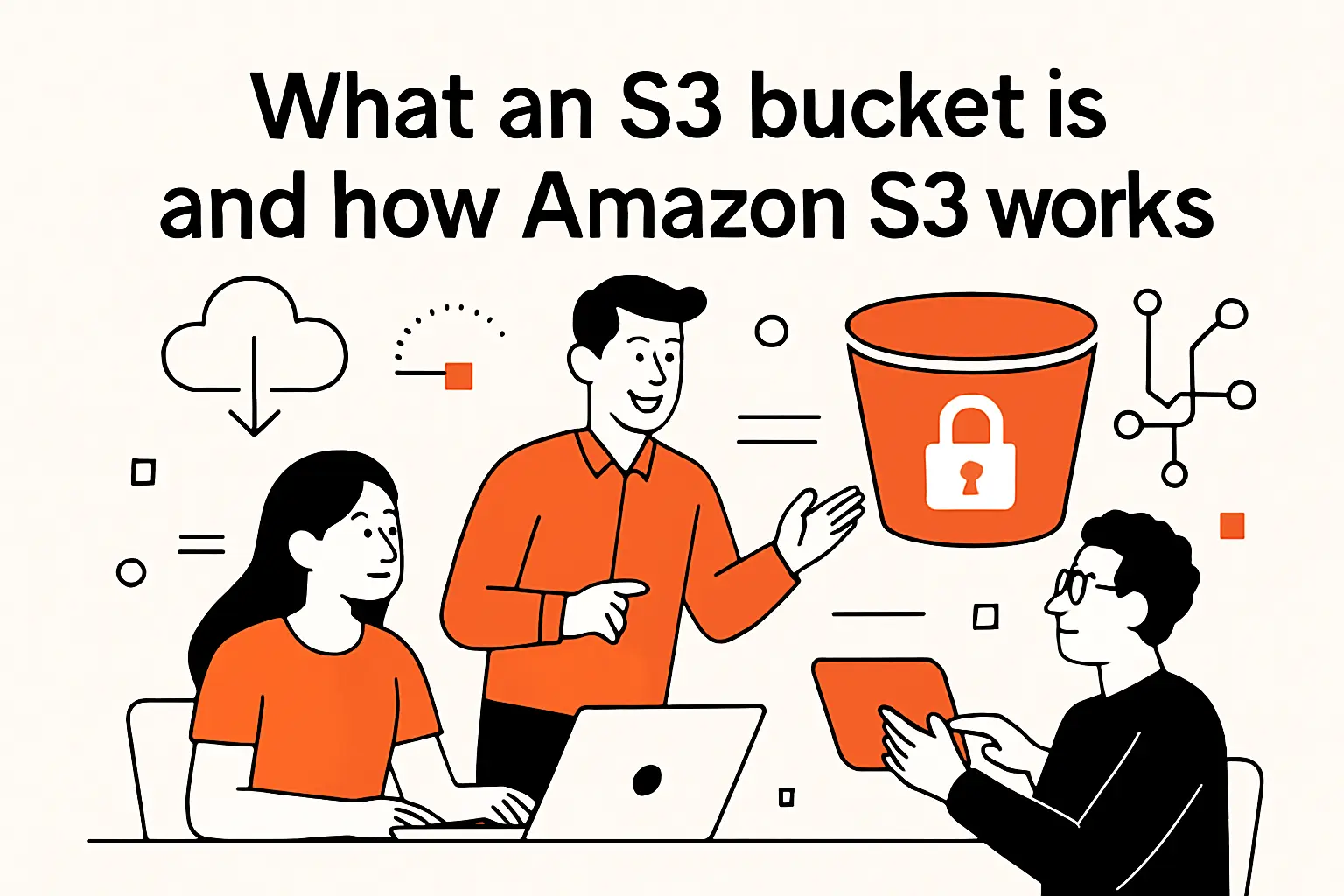
Data gravity is very real: the total volume of data created and consumed worldwide is forecast to reach 182 zettabytes in 2025, and that reality explains why S3 is the default landing zone for modern applications. When we design with S3, we start by modeling the bucket as a product: it has customers, SLAs, threat models, change cadences, and a roadmap. That framing keeps us from treating S3 as “just storage,” and it ensures that naming, partitioning, and security guardrails are deliberate rather than accidental by‑products of urgent launches.
1. S3 bucket as the container for objects in Amazon S3
An S3 bucket is a globally unique namespace anchored to a Region that stores objects and associated metadata. At first glance, it feels like a simple container. In practice, it is a policy boundary, a lifecycle boundary, and a performance boundary. We frequently see teams underestimate how many stakeholders a single bucket serves—ingestion jobs, end‑user apps, BI tools, ML pipelines, backup workflows, and compliance controllers may all converge on the same repository. That’s why we favor a “one purpose, one bucket” mindset for critical domains, combined with access points and replication to tailor consumption without creating brittle silos. Treat the bucket like a product with clear ownership and service boundaries, and you’ll avoid the slow creep into ad hoc permissions and naming chaos.
2. Objects and keys inside an S3 bucket
Objects are the payload—data plus system and user metadata—addressed by keys that behave like full paths even though S3 is flat beneath the covers. We obsess over key design because it drives everything from cost and caching to access controls. Good keys capture natural partitions (domain, partitioning trait, data class) while leaving room for growth and late‑arriving attributes. We like keys that enable clean lifecycle filters and access‑point prefixes: that lets the same bucket hold raw, refined, and published datasets without commingling access or retention policies. If you ever plan to query with Athena or Spark, align keys with partition columns to avoid wasteful scans; if you expect heavy random reads, lean into object granularity that matches typical read sizes rather than packing overly large blobs that force needless bandwidth. Metadata matters too: object tags and system metadata can become your cheapest index when used judiciously.
3. Common S3 bucket use cases across data lakes, websites, mobile apps, backup, archive, IoT, and analytics
We rarely ship a workload that doesn’t touch S3. Data lakes land raw events for later normalization; static sites publish artifacts behind a CDN; mobile apps offload media; backups target low‑cost classes; archives comply with retention mandates; IoT gateways trickle telemetry for down‑the‑line enrichment; analytics engines hydrate tables or snapshots from durable objects. The trick is mapping each use case to the right bucket patterns: separate landing buckets for ingestion, staging buckets for transformations, curated buckets for consumption, and publishing buckets for products like dashboards or ML features. That layered approach lets lifecycle rules enforce cold‑path economics while maintaining hot‑path agility. It also keeps your governance story legible: auditors love a tidy bucket topology with purposeful names and predictable policies.
4. Static website hosting with an S3 bucket
We often use S3 for static web apps and documentation hubs. The winning setup pairs a website bucket with a CDN distribution and origin access controls so the bucket itself remains private. That model gives you security by default, resilient caching, and the ability to rewrite routes for single‑page apps without exposing the origin. We’ve shipped this pattern for developer portals, marketing microsites, and knowledge bases. Over time, we’ve learned to bake in edge‑side redirects, immutable build hashes for cache‑busting, and a separate bucket for logs. That last piece pays dividends when debugging edge behavior, and it keeps your content bucket lean.
5. REST API and SDKs for S3 bucket operations
While most teams use the console for early experiments, production flows depend on the S3 API and SDKs. We rely on the object operations you’d expect—PUT, GET, HEAD, LIST, DELETE—and also on features like multipart upload, server‑side encryption headers, and presigned URLs for controlled access. A helpful mental model is that S3 is an HTTP‑native object store: latency profiles and error semantics differ from block or file systems, so client behavior should favor idempotency, retries with backoff, and parallelization for throughput. When teams push heavy ingest, we encourage them to pipeline uploads and to monitor client‑side metrics—latency distributions, error rates, and concurrency—so they can dial the knobs before hitting long tails.
6. Creating and managing S3 bucket basics
Our default checklist is simple but strict: create the bucket in the Region closest to data producers or consumers; tag it with owner, data classification, and lifecycle intent; enable default encryption; turn on versioning unless there is a strong reason not to; keep Block Public Access on; and decide up front whether replication, object lock, and inventory reports are in scope. We also codify every bucket with infrastructure as code. That removes drift, makes policy reviews surgical, and allows repeatable environments for dev, test, and prod. Last, we schedule periodic policy “table reads” with security and data owners to track how exceptions accumulate—because they inevitably do.
Core S3 bucket types and when to use them
The shape of your bucket should follow the shape of your workload: AI and analytics are stretching infrastructure in new directions, and private AI companies alone raised $100.4B in 2024, which is why we’re opinionated about matching S3 bucket types to latency, durability, and concurrency needs. We think of three AWS‑defined bucket families—general purpose, directory, and table—plus an emerging pattern we call “vector buckets” for embedding‑centric AI systems.
1. General purpose buckets for most workloads
This is the classic S3 bucket most teams know. It favors regional resilience, balanced latency, and universal compatibility with services across the platform. We put general purpose at the center of data lakes, content repositories, and application artifacts because it gives you flexibility without artificial constraints. The key to sustainable usage here is policy hygiene: lean on access points per persona or application, use prefix‑based scoping, and keep lifecycle transitions aligned to business stages—landing, staging, curated, published—rather than to infrastructure happenstance. In our experience, that division lets platform teams raise the floor on security and cost without slowing delivery.
2. Directory buckets with S3 Express One Zone for low‑latency access
Directory buckets bring hierarchical, directory‑like semantics and very low latency by placing data in a single Availability Zone. In practice we use them as a “hot tier” for workloads that hammer small objects or metadata: ML feature lookups during model serving, ephemeral build artifacts in CI, or micro‑batch ingestion that can’t tolerate extra network hops. Because the data lives in one Zone, architectural discipline matters: replicate to a regional bucket for protection, and treat the directory bucket as a cache or staging area rather than the long‑term source of truth. When teams do that, they get a responsive working set without compromising durability goals elsewhere.
3. Table buckets optimized for S3 Tables and Apache Iceberg
Table buckets pair with S3 Tables to provide table‑oriented abstractions (think schema, partitions, snapshots) atop open formats like Apache Iceberg. We reach for them when multiple engines—Athena, Spark, Flink, even homegrown services—need synchronized views and transactional guarantees. This is especially helpful when data engineers must handle late‑arriving facts, schema evolution, or compaction without disturbing readers. The by‑product is better governance: lineage and snapshots make change review and data quality checks auditable. We’ve also found that steady table hygiene (manifest pruning, compaction, partition tuning) prevents cost spikes and keeps interactive queries snappy.
4. Vector buckets for machine learning vector embeddings
“Vector buckets” are not an official AWS type; they’re a pattern we use to back vector search and retrieval‑augmented generation systems with S3 at the core. Raw embeddings, metadata, and chunked documents live as objects; an external index (OpenSearch Serverless, a managed vector database, or a bespoke service) stores the math; and event hooks keep the index in lockstep with the bucket. We like this design because S3 gives you durability, economics, and a simple recovery story, while the index handles nearest neighbors. When we build it this way, we can swap index engines over time without rehydrating the corpus, and we keep compliance happy because the canonical content never leaves the governed boundary.
S3 bucket storage classes and lifecycle optimization
Cost and value are two sides of the same coin: thoughtful storage class choices and lifecycle policies are how you compound savings over months and years, while funding the analytics and AI that create new value. The prize is sizable; cloud adoption has the potential to generate $3 trillion in EBITDA by 2030, and storage discipline is a dependable contributor to that outcome. In our FinOps playbooks, lifecycle design sits next to rightsizing compute and eliminating idle spend because it’s predictable, safe, and measurable.
1. Selecting storage classes including S3 Standard, Standard‑IA, One Zone‑IA, Glacier classes, and S3 Express One Zone
We choose a storage class by asking three simple questions: how quickly do you need the data to start loading, how often will you use it, and how well does it need to keep working if one location has a problem? S3 Standard is usually best for active data that people use often. Standard-IA and One Zone-IA are better for data that is read only sometimes but still needs to be available.
Glacier is for long-term storage or data that must be kept for legal or business reasons. S3 Express One Zone is for workloads that need extremely fast response times. The biggest mistake we see is using one storage class for everything. A better approach is to match the storage class to each stage of the data’s life: hot when it first arrives, cooler after it is published, and cold when it is no longer the main version, then automate those moves.
2. S3 Intelligent‑Tiering for changing access patterns
Intelligent‑Tiering shines when you can’t predict access. We deploy it on workloads with spiky or seasonal reads, or on datasets that many teams explore sporadically. It quietly shifts objects between tiers as access ebbs and flows, which saves money without governance meetings or code changes. Before flipping it on, we tag datasets by sensitivity and business owner; that way, if someone tries to use a cold tier for a mission‑critical dashboard, we can have a quick conversation about trade‑offs and alternatives.
3. Lifecycle policies to transition or expire objects
Lifecycle rules help control storage costs automatically and also act as a safety net. We usually use rules based on tags instead of one default rule for the whole bucket, because tags show what each file is meant for. This lets you move logs to a cheaper storage class after their analysis period ends, delete temporary files after publishing, and keep main snapshots for as long as the business needs them. We also turn on cleanup for unfinished multipart uploads and older file versions when it makes sense. The result is storage that mostly cleans itself, so teams can spend less money and less time managing it and focus on more important work.
4. Object Lock for write‑once‑read‑many compliance
When files must not be changed or deleted, we trust Object Lock. It needs file versioning turned on and supports control modes for rules and compliance, with set time periods for keeping data and legal holds when needed. We use it for archive data with strict rules, important system settings, and logs that clearly show if someone tried to change them. Before we turn it on, we plan the unlock process in advance: who can ask for a change, who can approve it, and how special cases will be recorded. That planning helps prevent urgent problems later and shows auditors that the team handled things carefully.
5. S3 Replication between buckets and across Regions
Replication helps solve three different needs: moving data across separate accounts or separate customer environments, keeping data closer to the region where it will be used, and protecting business operations if something goes wrong. We write replication rules like code so they are clear, limited to only the access needed, and easy to find later. When encryption keys are involved, we line up KMS policies across accounts and Regions so the target side can unlock the data without creating unsafe gaps. For data that has legal or contract limits, we make replication optional and write down the reasons for allowing it. That helps prevent problems during compliance reviews.
S3 bucket access control and data protection essentials
Security debt is the cost you can’t see until something breaks. The global average cost of a data breach climbed to $4.88 million in 2024, and while that figure spans more than storage, S3 misconfigurations often show up as root causes. Our bias is to make the secure path the easy path: defaults that are strict, policies that are readable, and automation that eliminates manual steps where humans might err.
1. S3 Block Public Access default‑on safeguards
Block Public Access is the seatbelt you should never unbuckle. We treat it as permanent for data buckets and rely on a CDN with private origins when public delivery is required. This keeps public exposure centralized and auditable while letting the bucket’s policy remain simple and restrictive. In client engagements, we’ve remediated more than a few “temporary” public grants that lingered far beyond a launch; keeping BPA on is how you prevent those time bombs.
2. IAM and bucket policies for least‑privilege access
Good policies read like prose: who can do what, on which prefixes, under which conditions. We favor role‑based access with short‑lived credentials and conditions on principals, VPC endpoints, and required encryption. Instead of piling exceptions into a single bucket policy, we use access points to carve the namespace per consumer. That avoids the “one mega‑policy” trap where nobody understands the effective permissions. And because reviews are inevitable, we keep policies modular so changes are traceable.
3. S3 Object Ownership and guidance on ACLs
ACLs solved early multi‑tenant patterns but they’re now generally more trouble than they’re worth. We enable bucket owner enforced object ownership so the bucket owner owns new objects regardless of who writes them. That choice simplifies billing, security analysis, and deletions. If legacy workflows still depend on ACLs, we isolate them and put a retirement date on the pattern, moving writers to role assumptions and access points as soon as they’re ready.
4. Amazon S3 access points to manage shared datasets at scale
Access points let you present a shared dataset to many consumers, each with its own alias, prefix restrictions, and network controls. We use them to avoid explosion of buckets just to get per‑team isolation, and to route traffic through VPC endpoints without touching the bucket’s base policy. It’s also where we express data ownership: a producer access point for writes, consumer access points for reads, and admin access points for lifecycle automation. That pattern keeps intent crisp while staying friendly to auditors.
5. Access Analyzer for S3 to validate bucket policies
Humans write policies; analyzers catch edge cases. We run Access Analyzer as a guardrail in CI and as a periodic job that flags external or cross‑account access we didn’t expect. When it discovers a finding, our playbooks categorize it fast: intentional, acceptable with justification, or drift in need of rollback. That discipline prevents “we meant to lock that down next sprint” from becoming “we’re investigating an incident.”
6. Server‑side encryption options for S3 bucket data
Encryption at rest is table stakes; key management is where design lives. We default to managed server‑side encryption and promote customer‑managed keys when data sensitivity, access transparency, or jurisdictional requirements demand it. For cross‑account patterns, we align key policies with role assumptions and access points to avoid implicit trust. At the application layer, we adopt envelope encryption and client‑side cryptography for workloads that need end‑to‑end control. The end result is consistent posture without choking developer velocity.
Monitoring, analytics, and event‑driven processing in S3
Event‑rich architectures are the norm now: the number of connected devices worldwide is forecast to rise to over 31 billion in 2030, and those streams land most naturally in object storage for durability and downstream fan‑out. Our monitoring stance is pragmatic: the signal you need tomorrow is the log you capture today, so wire it up early and make reports part of the product, not an afterthought.
1. CloudWatch metrics and CloudTrail auditing for S3 buckets
CloudWatch and CloudTrail help us watch what is happening in S3. We turn on request metrics and detailed file activity logs when the data is sensitive or when many changes are happening, then send the most important signals to monitoring screens. These include access failures that jump after a policy update, error rates that suggest a new problem in the client app, and sudden spikes in file reads that look like someone pulling data without permission. We also track business results—files published, records handled, and file lists created—so data leaders can see progress without digging through raw system data. Good monitoring across both technical activity and business results helps teams notice problems when things start to move in the wrong direction.
2. Server access logging for detailed request records
Server access logs are old‑school, but when you need them, nothing else will do. We capture them to a dedicated log bucket, apply lifecycle rules to keep costs down, and query them with Athena during investigations. The most common win is documenting access patterns to justify lifecycle transitions or access‑point scopes. We’ve also used them to debunk assumptions—like a dataset that “nobody uses” until the access logs prove otherwise.
3. Storage Lens, Storage Class Analysis, and Inventory reports
Storage Lens gives you a broad view of your storage, Storage Class Analysis shows which data is rarely used, and Inventory lists give you a clear file list for everything else. Together, they help turn guesswork into action. We use Storage Lens across all accounts to spot unusual patterns and trends, then set up alerts when growth speeds up in unexpected path groups. Inventory supports later checks, such as making sure nothing is missing, confirming encryption is turned on, and running malware scans. The goal is not only better visibility. It is also a growing list of practical cost-saving and risk-lowering tasks.
4. Event notifications and S3 Object Lambda for on‑the‑fly processing
S3 can do more than just store files when you connect it to event alerts, queues, or functions. We use file upload events to start tools that add missing data, check files, or reduce file size. We use file delete events to clean up related indexes, and we use failure queues so we can see and review jobs that did not work. When users need changed versions of data without saving extra copies, S3 Object Lambda can help. It can hide sensitive fields for one-time viewers, change image formats when someone reads a file, or create custom file lists when needed. The result is less extra code, faster feedback, and fewer extra copies of data to manage.
Performance, scale, and consistency characteristics

S3 underpins a massive portion of infrastructure: the IaaS market alone reached $140 billion in 2023, and that context informs how we design for scale and latency. In our practice, we focus on predictable consistency, parallelism for throughput, smart client behavior, and network placement that favors the shortest path. That combination lets applications hit their marks without exotic tuning.
1. Strong read‑after‑write consistency for PUT and DELETE operations
S3 provides strong read‑after‑write consistency for key object operations, which simplifies application logic compared to earlier object stores that favored eventual consistency. We still build idempotency and retries into clients, because networks are messy and failures cluster, but the storage semantics let readers see what writers just committed and respect deletes without extra choreography. That alone removes a class of cache invalidation and race conditions that used to haunt distributed systems.
2. High durability and availability design of Amazon S3
Under the hood, S3 spreads data across facilities in a Region and verifies integrity constantly. As builders, we interpret that design as a promise: you don’t micromanage replicas within a Region. Instead, you make an explicit choice about cross‑Region replication for disaster recovery or data residency, and you let the service handle intra‑Region resilience. In return, you get a durability profile that allows you to lean on S3 for everything from machine images and container layers to ML features and audit logs.
3. Elastic scalability to exabytes and high request throughput
Modern S3 no longer requires handcrafted prefix sharding to scale request rates. Even so, we write clients that parallelize uploads and downloads, align object sizes to typical read patterns, and use range requests when appropriate. Where latency matters, we bring compute to the data—through VPC endpoints, co‑located analytics services, or temporary working sets in directory buckets—so applications don’t spend their lives traversing long network paths. In most cases, those choices deliver noticeable improvements without touching a single line of storage back‑end code.
4. Accelerated data transfers with S3 Transfer Acceleration
Global teams and mobile contributors often push content from distant networks. Transfer Acceleration shortens the long haul by routing uploads and downloads over optimized edges. We choose it sparingly because it introduces a distinct endpoint and a different cost profile, but for distributed field teams, far‑flung cameras, or edge data collection, it is sometimes the only practical way to keep ingest windows short. As ever, we start with measurement: if latency profiles show long tails from remote clients, acceleration becomes a knob worth turning.
How TechTide Solutions helps you build with your S3 bucket

Independent research underscores both the expanding value of cloud programs and the rising expectations around resilience and governance, and our role is translating that macro story into the bucket‑level designs, policies, and automations your teams can trust. We operate as builders and stewards: opinionated where experience is decisive, collaborative where context rules, and accountable for the outcomes—security posture, developer velocity, and cost curves.
1. Custom S3 bucket architecture and integration tailored to your workloads
We start with discovery: data domains, access patterns, regulatory constraints, and downstream consumers. From there, we draft a bucket topology that encodes intent—landing, staging, curated, and published flows; access points per consumer; replication where locality or continuity demands it; and lifecycle policies that reflect how the business actually uses data. Integration is where architecture becomes real: log pipelines that reveal behavior, schema and partitioning that empower query engines, and CI/CD hooks that keep infrastructure definitions honest across environments. We also document the “owner’s manual” for each bucket: who owns it, who can change it, and how requests get triaged. That clarity is what keeps month three as clean as day one.
Our view on data products
We advocate treating curated S3 namespaces as data products with SLAs and consumer contracts. That lens shifts the conversation from “Where’s the file?” to “What’s the interface, and what guarantees come with it?” It also motivates tooling like table buckets with established schemas, manifest pipelines for bulk readers, and catalog entries that make discovery and governance straightforward.
2. Security‑by‑design for S3 bucket access, encryption, and governance
Security cannot be a bolt‑on. We build bucket policies, access points, key policies, and detection in one motion so the secure path is the paved path. For sensitive datasets, we add client‑side encryption and tokenization; for broad distribution, we shift delivery to CDNs with private origins; for multi‑account programs, we standardize roles and guardrails so new teams inherit good patterns by default. Beyond controls, we wire early warnings—analyzer findings become tickets, drift triggers pull requests, and exception registers stay visible. That combination keeps intent intact as teams change and projects evolve.
Threat modeling that sticks
Our threat models live with the code. We list realistic attack paths—over‑permissive access points, public policies, weak key governance—and map them to controls we can verify. Then we automate the checks. This creates a feedback loop where architecture choices get validated continuously rather than only at audits.
3. Data lifecycle and cost optimization using storage classes and policies
Lifecycle optimization is a habit, not a one‑time exercise. We align storage classes to data value, not just age; we introduce Intelligent‑Tiering where access is unpredictable; and we archive confidently once downstream consumers decouple from historical raw. Our teams also operationalize reporting so finance sees savings and data owners see trade‑offs. When stakeholders share the same view, you get durable agreements: what stays hot, what cools when, and how long archives live. That predictability lets product teams plan and finance teams trust the curve.
Conclusion and next steps for your S3 bucket strategy

Market signals point the same direction: cloud programs are compounding in value, while stakeholders demand stronger governance and clearer cost accountability. The S3 buckets you define today are the substrate for your next experiments in analytics, ML, and application modernization. In our experience, the organizations that win treat buckets as long‑lived products with owners, policies, and roadmaps—not as incidental implementation details.
1. Align S3 bucket design with data types, access patterns, and bucket types
Start with the workload and work backward. If latency rules, consider directory buckets as a hot working set; if table semantics and multi‑engine access dominate, design around table buckets and open formats; if versatility and service integrations matter most, general purpose buckets are your anchor. For AI retrieval patterns, a vector bucket architecture offers durability and agility in one move. Pair those choices with keys that encode natural partitions and intent.
2. Establish governance with access controls, monitoring, and analytics
Make the secure path easy. Keep Block Public Access on, adopt least‑privilege roles, use access points to scope consumers, and let analyzers watch your back. Then instrument buckets like products: metrics, logs, inventory, and fleet‑level lenses that convert observations into a backlog of fixes and improvements. When governance and observability ship together, teams move faster with less risk.
3. Plan ongoing cost optimization with lifecycle rules and intelligent tiering
Tie storage classes and lifecycle rules to business stages so savings happen automatically. Use Intelligent‑Tiering when access is unpredictable, and archive confidently once consumers decouple from historical raw. Revisit these choices periodically as products evolve and new teams begin to consume the same datasets. When you’re ready, we can map your current buckets to an optimized topology, wire the guardrails, and leave you with dashboards that make progress—and savings—visible. Shall we sketch that blueprint together and turn your S3 buckets into the platform your next wave of products deserves?