

Brand protection is no longer a legal checkbox. It is an operating system for trust. Market overview: Gartner projects information security end-user spending at $213 billion, and that budget also funds brand defense work. Our view at TechTide Solutions is blunt. A brand is an attack surface. It also is a promise customers test every day. When we design software, we treat that promise like infrastructure. We harden it, monitor it and recover it fast when it gets hit.
In practice, “protecting the brand” blends law, security, and customer experience. A trademark filing can help. A watch service can help. A clean incident workflow helps even more. The tricky part is timing. The cheapest fix is early differentiation. The most expensive fix is public confusion at scale. The goal of this guide is to keep your team in the cheap zone. We will also show how custom software turns brand defense into repeatable work.
1. What it means to protect your brand in 2025
Brand protection now spans board risk, growth, and security. Market overview: Brand Finance values the Global five-hundred total brand value at $9.5 trillion, which signals how much money rides on names and symbols. For founders, that is both inspiring and sobering. A name can be an asset. It can also be a liability if it misleads. Our stance is simple. A protected brand is a controlled customer experience. Control comes from clarity, ownership, and fast response.
1. Brand protection basics: reputation, customer trust, and market value
Reputation is not a vibe. It is accumulated evidence. Customers collect that evidence from support emails, invoices, checkout flows, and shipping updates. They also collect it from rumors. Attackers exploit that. A convincing fake page can siphon money and goodwill in one stroke.
Trust is also technical. Email authentication, domain hygiene, and secure redirects shape what users believe. So does design consistency. A brand system that is crisp and repeatable becomes harder to imitate. A messy system invites copycats. We have seen this pattern in SaaS onboarding flows. Small inconsistencies create big doubt.
Market value is the downstream effect. Investors like defensible assets. Partners like reduced risk. Customers like fewer surprises. For that reason, we treat brand protection as a cross-functional program. Legal cannot do it alone. Security cannot do it alone. Product cannot do it alone.
2. What counts as intellectual property in your branding
Branding creates multiple IP layers. The name and logo are the obvious layer. Taglines, product names, and even distinctive UI patterns can matter. Packaging, sound cues, and mascots also matter. The key is distinctiveness. The more “source-identifying” the element feels, the more protectable it tends to be.
We also think about “data exhaust” as brand-adjacent property. Your email templates, knowledge base articles, and release notes are content. They are also trust signals. Copycats often steal them first. That theft is a reputational problem even before it becomes a legal problem.
In software, the boundary gets subtle. Functional behavior is usually not protected as a brand. Yet visual arrangements can be. Marketing screenshots can be. Product videos can be. When we help clients catalog assets, we map each asset to a protection path. That mapping prevents confusion during a takedown rush.
3. How copycats and confusion can damage revenue and credibility
Copycats rarely try to win on quality. They try to win on confusion. Confusion is expensive because it hits conversion and support at the same time. A customer who gets tricked will contact you. They will also warn others. In B2B, that warning travels through procurement and compliance teams. One bad story can stall a deal quietly.
Confusion also pollutes analytics. Fake ads distort attribution. Impersonation domains soak up branded search traffic. Scam support numbers divert calls. Even app store clones can distort review sentiment. We treat these as incident types, not one-off annoyances.
From our seat, the most corrosive effect is “trust drift.” Customers stop believing your official channels. They hesitate on payment pages. They second-guess support replies. That hesitation reduces lifetime value without a clear dashboard alert. Brand defense work, done well, restores that invisible confidence.
2. Build a distinctive brand foundation before filing anything
Distinctiveness is the cheapest security control you will ever deploy. Market overview: WIPO estimates 11.63 million trademark applications were filed worldwide, which means your proposed name faces real crowding. We push teams to treat naming like architecture. A good structure prevents later rework. A weak structure makes every future move harder. Filing early helps, but filing poorly locks in weakness. We prefer a deliberate foundation first.
1. Choose a unique mark and avoid overly descriptive names
Descriptive names feel safe at first. They also blend in. A name that describes the product can be hard to protect. It can also be easy to copy “legally.” Copycats can swap a syllable and keep the meaning. Customers still get confused. Search engines still mix results.
Our heuristic is practical. If a competitor could use the same words honestly, it is a weak brand core. Stronger marks are suggestive, fanciful, or arbitrary in context. They invite curiosity. They also give legal teams stronger arguments. In user testing, unique marks are easier to recall. They also create cleaner verbal shorthand inside teams.
When clients arrive with a descriptive name, we do not scold them. We look for a path. Sometimes the answer is a distinctive house mark plus descriptive product lines. Sometimes the answer is a coined word that still feels pronounceable. The goal is customer clarity with legal leverage.
2. Reduce similarity risks by designing for differentiation
Similarity risk is not only legal. It is also perceptual. People skim. They do not litigate. That means you must design for fast recognition. Color systems, typography, icon style, and voice all matter. Attackers can copy any single element. Copying the full system is harder.
We like to run a “distance test.” We place your brand next to nearby competitors in the same channel. Then we ask a simple question. Would a rushed buyer confuse them on a small screen? If the answer is yes, we improve the system. Small improvements compound over time.
Design also affects enforcement. A consistent logo makes reverse image searches easier. A consistent UI style makes screenshots more persuasive in takedown reports. Even consistent file naming helps your own team. When we build internal brand asset portals, we enforce consistency as a workflow, not a memo.
3. Make your brand harder to copy by linking it to a clear source
The most copy-resistant brands feel “anchored.” They point back to a clear origin. That origin can be a founder story. It can be a signature product quality. It can be a distinctive support experience. In software, it can be a reliable status page tone and cadence. These anchors create a pattern customers notice.
We also harden the anchor technically. Verified social profiles reduce impersonation impact. Domain-based email authentication reduces spoofing. Consistent in-app messaging reduces scam success. A secure customer portal reduces payment diversion. None of these replaces trademarks. They reinforce them.
During incidents, the anchor is how you recover. If customers know where “real” updates appear, they stop trusting random posts. We advise clients to establish official channels early. Then we integrate those channels into product UX. The result is credibility that persists under pressure.
3. Secure legal ownership with the right IP protections to protect your brand

Legal ownership turns a brand story into an enforceable right. Market overview: WIPO reports 88.2 million active trademark registrations worldwide, and that volume shapes how crowded many categories feel. We approach ownership like layered defense. Trademarks cover source identifiers. Copyright covers creative expression. Design rights can cover visual features. Each tool has strengths. Each tool has gaps. A smart mix closes gaps without overspending.
1. Trademarks: names, logos, slogans, and other distinctive brand identifiers
Trademarks protect signs that identify source. Names and logos are the workhorses. Slogans can qualify too. Even distinctive packaging, in some jurisdictions, can be protected as trade dress. The keyword is “distinctive.” If the mark points to you, it belongs here.
For software companies, we often see confusion about what a trademark is not. It is not a patent. It does not protect how your code works and also does not stop others from building similar features. Instead, it stops others from using confusingly similar identifiers. That scope is narrower than many founders assume. Yet it is powerful in marketplaces and platform enforcement.
We also care about how marks show up in real user flows. Login pages, billing portals, and support channels all display marks. Those contexts influence specimens and evidence. When we build marketing sites, we also preserve audit-ready proof. Screenshots, deployment logs, and asset hashes support later disputes.
2. Design registration for unique packaging and product design elements
Design protection is about appearance. That can include product shapes, ornamental features, and distinctive packaging. In consumer goods, it can be the box and label system. In hardware, it can be the device form. And software, some jurisdictions limit design rights, but UI visuals may be eligible in certain contexts.
We see design protection shine when counterfeits look “close enough.” A logo swap might avoid trademark filters. A copied shape still triggers consumer recognition. That is where design rights add leverage. They also help customs and platform teams understand what “fake” looks like.
From an engineering lens, design rights benefit from disciplined asset management. High-quality design files matter. Version history matters. Clear dates of creation matter. We help clients store those assets with access control and immutable logs. The goal is simple evidence that holds up under scrutiny.
3. Copyright for marketing materials, photos, artwork, and other creative assets
Copyright protects original expression. That includes copywriting, photos, videos, illustrations, and many design assets. It can also cover website layouts and app graphics, depending on jurisdiction. It typically does not protect ideas and protects the specific creative form.
Copyright becomes a practical enforcement tool online. Many platforms have clear workflows for reporting copied content. A stolen product photo is easier to prove than “brand confusion.” That makes copyright a fast lever. We treat it as an incident response pathway. It often buys time while trademark issues get evaluated.
Operationally, we advise clients to keep clean chains of authorship. Contractor agreements should clarify ownership. Asset libraries should record creators and licenses. Marketing teams should avoid “mystery images” pulled from the web. A brand defense program fails when your own rights are unclear. Clean inputs create strong outputs during enforcement.
4. Trademark infringement 101: prevent conflicts and protect your brand early
Infringement is the daily friction point between brand strategy and market reality. Market overview: the OECD estimates counterfeit and pirated goods trade reached USD 464 billion, and that scale feeds impersonation behavior online. We think of infringement as a spectrum. Some actors are malicious, careless and legacy conflicts from similar naming. Your job is to reduce exposure before launch. Then you respond quickly when issues appear.
1. What trademark infringement is and why it happens
Trademark infringement centers on likely consumer confusion. The confusion can be about affiliation, sponsorship, or origin. It does not require identical marks and identical goods either. Real cases often involve lookalike names in adjacent categories.
Why does it happen? Sometimes it is intentional free riding, parallel thinking in crowded markets and also a reseller stretching the brand too far. In software, we also see “affiliate drift.” Partners build landing pages that imply official status. That can trigger liability and reputational harm.
Our view is pragmatic. You cannot litigate your way into clarity. You must design and operate for clarity. That includes consistent naming conventions. It includes partner guidelines. It includes enforcement thresholds. When we help clients define policy, we write decision trees that teams can follow under stress.
2. Common violations to watch for: logos, slogans, packaging, names, and deceptive websites
Most violations cluster around distribution channels. Search ads can misuse brand terms. Social accounts can mimic your handle. Marketplaces can list lookalike goods under your name. Support scams can publish fake phone numbers. Deceptive websites can clone your layout and harvest credentials.
We also watch for technical tells. Newly registered domains can mirror your brand with a generic suffix. TLS certificates can appear for a confusing hostname. Email headers can show spoof attempts against your executives. These indicators are actionable. They point to takedown targets and user warnings.
Real-world examples are instructive. Luxury brands fight counterfeits because customers cannot verify authenticity quickly. Software brands fight fake installers because users just want to “download the update.” Attackers thrive where friction is high. Reduce friction for the legitimate path. Increase friction for the fake path.
3. Pre-launch clearance steps: screening searches and professional legal guidance
Pre-launch clearance is unglamorous. It also saves budgets. We like staged screening. Start with basic search and app store checks. Then expand into trademark database screening. Next, assess domain availability and social handle availability. Finally, involve counsel for deeper similarity analysis and filing strategy.
From our side, we add technical reconnaissance. We check whether similar domains are already used for phishing, similar brand terms appear in scam forums. And we also check whether ad networks already show confusing matches. These checks are not legal clearance. They are operational reality checks.
Professional legal guidance matters because trademark law is jurisdictional and nuanced. Internal teams often miss classes, specimens, and use requirements. We encourage clients to treat counsel as part of product launch. The best time to involve them is before design assets harden. Early alignment avoids painful rebrands later.
5. Register smart and stay cost-effective with your trademark strategy
Cost-effective trademark work is about focus. Market overview: Gartner found only 20% of legal matters stay within budget when sent to outside counsel, which pushes teams toward tighter scope and better process. We apply the same discipline to trademarks. Register what you will defend. Defend what you can monitor. Expand when the business proves demand. A lean strategy also keeps filings aligned with real product roadmaps.
1. Register core marks first: start with your primary brand
Start with the mark that customers already use. That is usually the company name or flagship product. Registering a dozen side projects can feel proactive. It often becomes waste. Core marks deserve early priority because they attract early abuse. They also become the basis for platform enforcement.
We also advise registering “house mark” patterns early. If your company brand will cover multiple offerings, it should be strong and clean. Product names can evolve. The house mark should be stable. That stability reduces future renaming cost. It also makes marketing more coherent.
In our experience, the best trademark portfolios feel boring. They map to revenue and customer recognition, avoid speculative filings and also integrate with internal asset management. When a new feature launches, teams know whether the name is protected or provisional. That clarity prevents accidental overpromising in marketing copy.
2. Prioritize your wordmark for flexibility as visuals evolve
Logos change. Wordmarks are steadier. A wordmark can cover many visual identities over time. That flexibility helps during rebrands, acquisitions, and product redesigns. It also helps when different teams create new design variants. A wordmark anchors them.
We think of wordmarks as the API of brand identity. They are the stable interface. Logos are the implementation detail. That framing helps technical teams understand why wordmarks matter. It also helps executives resist premature logo fights. You can refresh visuals without losing legal continuity.
That said, visuals still matter for enforcement. Platform reviewers often act faster on clear logo matches. Our suggestion is to treat the logo as a strong secondary layer. Register it when it stabilizes. Then keep a controlled library of approved logo variants. That library helps your own teams avoid accidental drift.
3. File strategically: goods and services descriptions, key classes, renewals, and expansion planning
Filing strategy lives in the details. The goods and services description is where many filings become fragile. If it is too narrow, it fails to cover growth. If it is too broad, it invites rejection and conflict. The best descriptions match what you actually deliver. They also reflect near-term roadmap realities.
We recommend aligning trademark scope with product architecture. If your offering is a platform, cover the platform nature. If you ship downloadable tools, cover that distribution model. And if you sell services, cover the service motion. Counsel will guide the legal phrasing. Your job is to provide precise technical truth.
Renewals and expansion should be planned like maintenance windows. Put reminders into the same systems you trust for uptime. We integrate trademark milestones into internal calendars and ticketing workflows. That removes the “who owns this” ambiguity. Strategic filings are not just legal events. They are operations.
6. Protect your brand online: domains, takedowns, and always-on monitoring
Online brand defense is where law meets incident response. Market overview: Gartner predicts 17% of total cyberattacks will involve generative AI, and that raises the realism of impersonation content. Our stance is clear. You cannot rely on customers to spot fakes. You must reduce opportunities for deception. That means owning the obvious domains. It also means watching for the non-obvious ones. Then you respond with speed and documentation.
1. Claim your domain and variations to reduce impersonation and cybersquatting
Domains are the front door of trust. Own the primary domain early. Then secure common misspellings and plausible variations. Attackers often register lookalikes that differ by one character. They also exploit internationalized characters that resemble Latin letters. Those “homograph” tricks fool even careful users.
We also recommend controlling DNS settings like a security asset. Use registrar locks. Use strong access controls. Limit who can change records. Document change procedures. A compromised domain is not a marketing problem. It is a company-wide incident.
From our engineering perspective, domain strategy includes redirects and subdomains. Avoid redirect chains that can be hijacked. Avoid orphaned subdomains pointing at decommissioned services. Monitor for dangling DNS records. Those leftovers become takeover opportunities. In brand defense, housekeeping is a weapon.
2. Use monitoring systems and alerts to spot misuse, counterfeits, and infringement
Monitoring works when it is systematic. Set alerts for new domains that include your mark. Watch certificate transparency logs for suspicious hostnames. Track social handles that mimic your naming pattern. Monitor marketplaces for listings that reuse your photos or product names. Then feed the findings into a triage queue.
We also use content similarity techniques. Perceptual hashing detects near-duplicate images. Text fingerprinting detects copied paragraphs. Logo detection models flag likely matches across noisy screenshots. These tools are not perfect. They are still valuable because they reduce manual scanning load.
Alert fatigue is the enemy. So we tune rules. We assign severity based on channel, audience reach, and payment risk. We enrich alerts with WHOIS history and hosting fingerprints. Better context reduces wasted effort. Our preferred outcome is predictable cadence. Monitoring becomes boring. That is when it is working.
3. Respond fast: cease-and-desist letters, platform removals, and DMCA takedown workflows
Response speed shapes damage. A fast takedown prevents a scam from “going viral.” A slow response gives attackers feedback and confidence. We recommend prebuilt playbooks. The playbooks define who drafts notices. They also define who approves them. They define evidence standards too.
Cease-and-desist letters can work well for non-malicious conflicts. Platform removals work better for impersonation and scams. DMCA notices work well for copied creative assets. Each path requires different proof. So we store proof templates. We also keep a chain of custody for screenshots and headers.
We also track outcomes like a product funnel. Each incident has a status. Each status has an owner. Escalation paths are documented. Recurring targets become watchlist entries. In mature programs, enforcement becomes a loop. Detect, validate, act, verify, and learn. That loop protects reputation at scale.
7. TechTide Solutions: Custom software solutions that help protect your brand
Custom software turns brand defense from heroic effort into repeatable operations. Market overview: McKinsey estimates generative AI could add $4.4 trillion annually in value, and we see brand protection teams using that leverage through automation. Our work sits at that intersection. We build systems that collect signals, workflows that guide decisions and also integrations that speed enforcement. The result is fewer surprises and faster recovery.
1. Requirements-first discovery to build around customer needs and real workflows
Brand protection fails when tools ignore human workflows. So we start with discovery. We map roles, approvals, and evidence needs. We ask where incidents arrive today and what “done” means for each incident type. Then we design around that reality.
In our projects, discovery includes legal, security, marketing, and support. Each group sees different symptoms. Legal sees rights and risk. Security sees abuse patterns. Marketing sees customer confusion. Support sees angry tickets. The system must serve all those perspectives without creating friction.
We also define data boundaries early. What data is sensitive? What must be retained? And what can be shared with external counsel? Clear answers reduce future rework. In short, we treat discovery like threat modeling. The goal is to prevent predictable failure modes before code exists.
2. Custom development for brand protection features, integrations, and automation
Most brand defense programs rely on scattered tools. Alerts live in inboxes. Evidence lives in shared drives. Approvals live in chat threads. That fragmentation slows response. Custom development can unify those pieces. A single intake portal can normalize reports. A single queue can route work. And a single case record can store evidence.
Integrations are where value compounds. We connect domain monitoring feeds into ticketing systems. We connect social platform reports into case dashboards and connect marketplace complaints into audit logs. And we also integrate with identity systems for access control. Each integration reduces manual copy-paste errors.
Automation should be careful. We do not auto-send legal notices blindly. We do automate data gathering, evidence packaging and also reminder cadences and SLA timers. That balance preserves judgment while reducing toil. It is how small teams defend large brands.
3. Secure delivery, iteration, and ongoing improvements as needs evolve
Brand defense software is security-adjacent. So we build it like security software. We design for least privilege, log every meaningful action and also protect evidence from tampering. We also secure integrations, because they can become backdoors. A brand defense portal should never become a new risk.
Iteration matters because attackers adapt. New scam formats appear. Platform rules change. Internal stakeholders change too. So we ship in increments. We measure triage time and closure time. We collect user feedback from legal and support teams. Then we refine workflows and screens.
We also plan for continuity. Documentation must survive staff turnover. Runbooks must be accessible during incidents. System health must be observable. When the defense system goes down, response slows. That is unacceptable. So we treat uptime as part of reputation readiness.
8. Conclusion: a repeatable checklist to protect your brand long-term
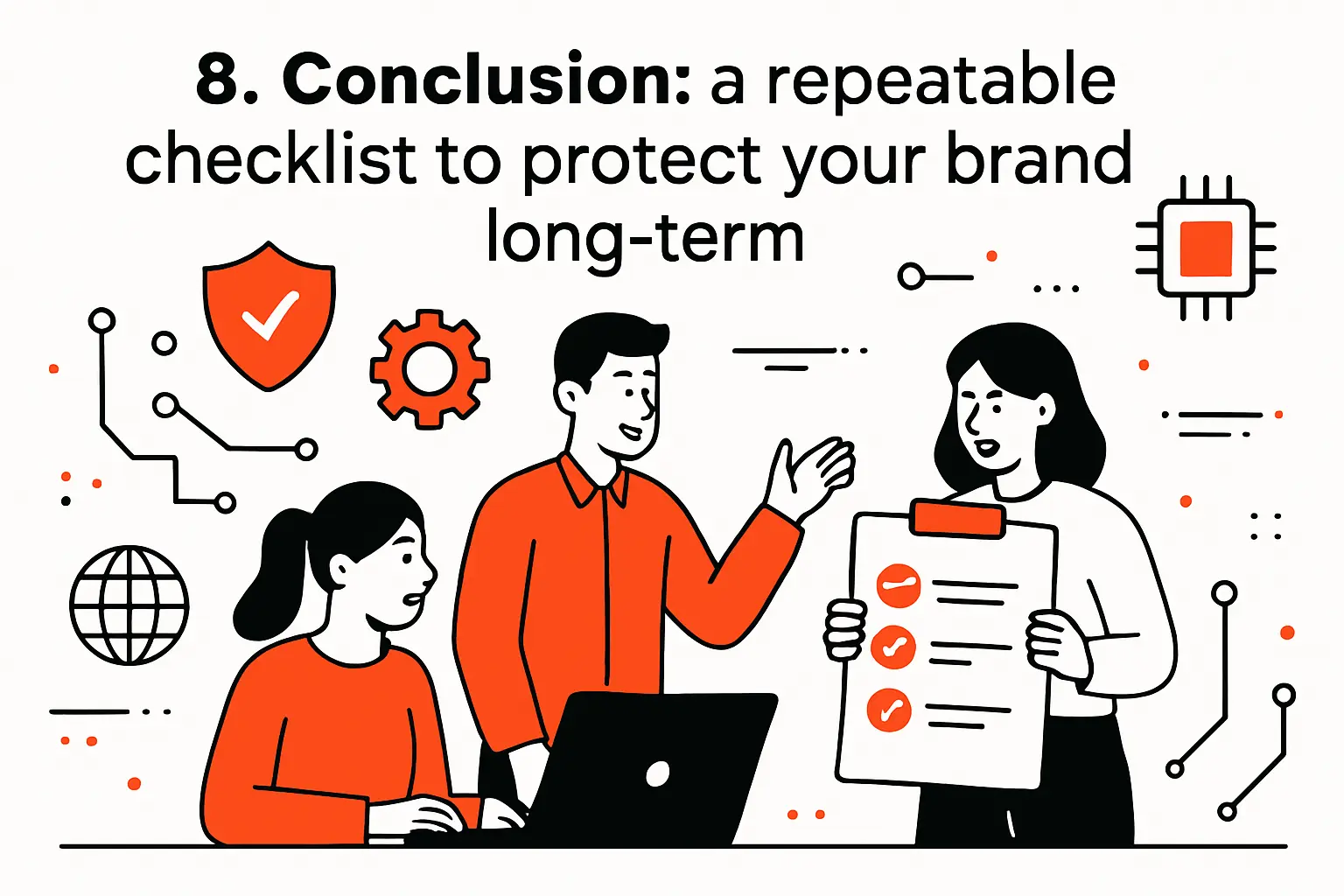
Long-term brand protection is less about one big action. It is about a durable rhythm. Market overview: PwC reports 93% of business executives agree trust improves the bottom line, and we see that link in every incident we help clients navigate. The checklist below is the rhythm we recommend. It blends legal clarity, online defense, and customer communication. It also scales from early startups to mature enterprises. The key is consistency over heroics.
1. Combine legal protection, online enforcement, and reputation readiness into one operating rhythm
Legal ownership and clarity
- Document what marks you use, where you use them, and who approves changes.
- Align trademark scope with real offerings and realistic expansion plans.
- Centralize contracts and licenses for creative assets to avoid ownership disputes.
Online prevention and monitoring
- Control domains, subdomains, and redirects with disciplined access and change review.
- Deploy email authentication and consistent official channels for customer guidance.
- Run monitoring that feeds a triage queue, not a cluttered inbox.
Enforcement and incident response
- Define evidence standards for each incident type and store proof in one case record.
- Prewrite playbooks for takedowns, platform reports, and counsel escalation steps.
- Close the loop with verification, customer messaging, and policy updates.
Reputation readiness
- Train support teams to recognize impersonation patterns and respond with calm clarity.
- Keep a public-facing “how to verify us” page and link it inside product surfaces.
- Review incidents regularly and fund the controls that actually reduce repeat abuse.
At TechTide Solutions, we treat this rhythm as a product. A brand deserves operational discipline. A trademark file alone cannot deliver that discipline. Monitoring alone cannot deliver it either. The win comes from connecting rights, signals, and response into one system. If you want a next step, start by mapping your current incident flow end to end. Then ask one hard question. Where does confusion enter, and how fast can we remove it?