
In Techtide Solutions day-to-day delivery work, we treat “framework choice” as a business decision disguised as a technical one. The moment an LLM workflow touches revenue, compliance, or customer trust, orchestration stops being a developer convenience and becomes operational infrastructure. Market overview: McKinsey estimates generative AI could add the equivalent of \$2.6 trillion to \$4.4 trillion annually across use cases, which is exactly why teams are investing in orchestration patterns that don’t crumble under real-world ambiguity.
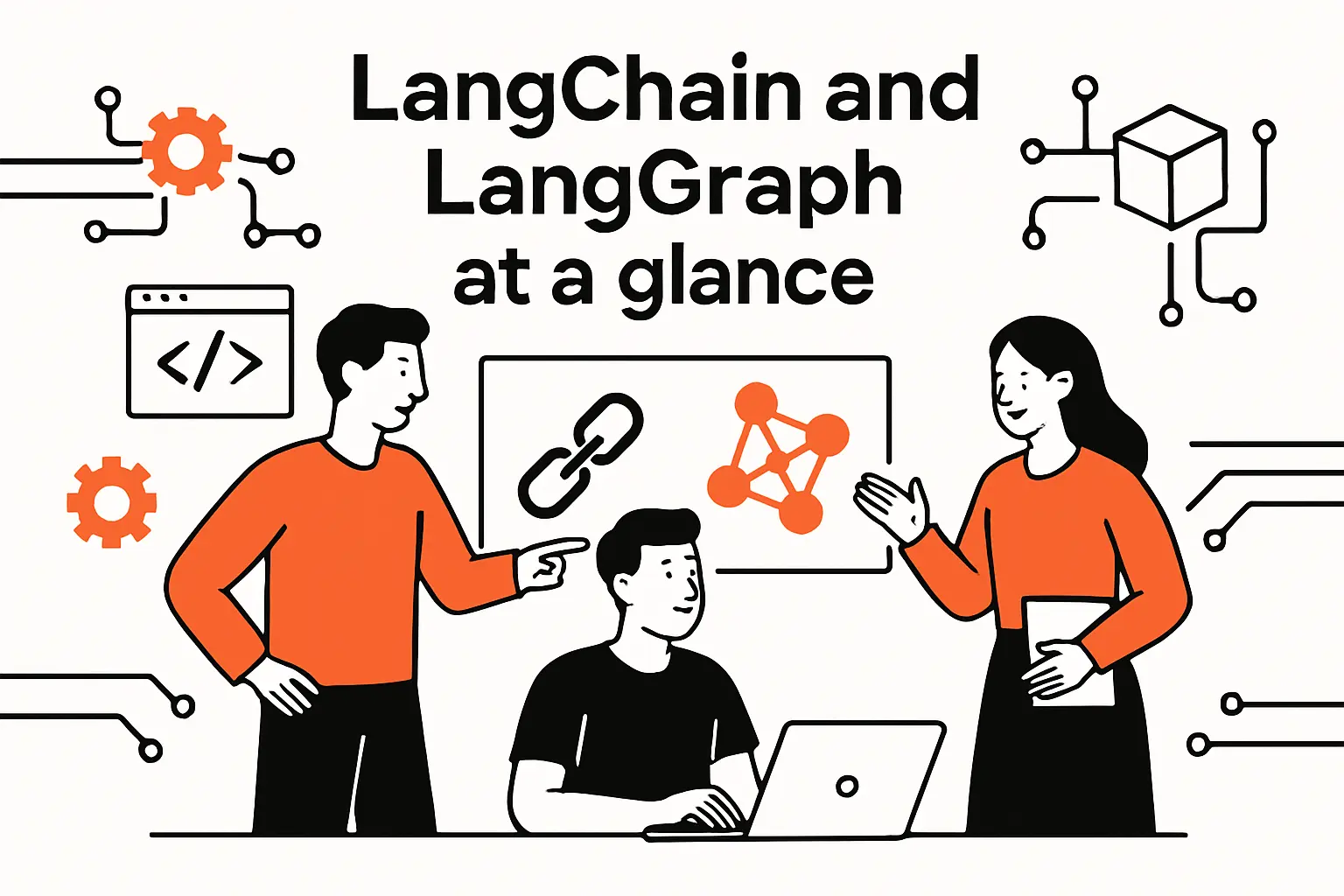
LangChain and LangGraph at a glance
1. LangChain as a modular toolkit for building LLM applications
LangChain, in our view, is best understood as a composable toolbox that turns “one-off prompt scripts” into maintainable systems. Instead of hardwiring everything into a single function, we can assemble prompts, models, parsers, retrievers, and tool calls into a workflow that remains readable under change. The real magic is not that LangChain can call an LLM; it’s that LangChain standardizes the seams between components, so teams can swap a retriever, adjust a prompt, or add guardrails without rewriting the whole app.
From a delivery standpoint, that modularity maps cleanly onto how product teams evolve requirements: first a prototype, then basic grounding, then tool access, then safety and observability. In practice, we’ve used LangChain to power internal knowledge assistants, ticket triage helpers, and “draft-first” writing copilots where the workflow is mostly sequential and the goal is to ship quickly without painting ourselves into a corner.
2. LangGraph as an approach for stateful, nonlinear, multi-agent workflows
LangGraph is where we go when the workflow stops being a straight line and starts behaving like operations: loops, backtracking, branching, and conditional escalation. Conceptually, it treats an LLM application as a graph of nodes (work steps) connected by edges (transitions), with a shared state that gets updated as the system moves. That sounds abstract until you build a “real assistant” that must ask clarifying questions, decide whether to search or act, wait for approval, then resume later without forgetting what happened.
In our builds, LangGraph shines when we need an agentic control loop that can recover from partial failure. Rather than hoping a single prompt gets everything right, we structure the work: plan, execute, verify, repair, and only then respond. The result is less “chatbot theater” and more workflow automation with audit-friendly state and explicit control flow.
3. How both fit within the broader LangChain ecosystem
We don’t treat LangChain and LangGraph as mutually exclusive; we treat them as layers. LangChain provides the parts bin—models, prompt templates, retrievers, output parsers, tool abstractions, and standardized interfaces. LangGraph provides the orchestration fabric when those parts must cooperate in a long-lived, stateful process.
Across real client systems, we often end up with a hybrid: “LangChain inside nodes, LangGraph around the nodes.” That combination lets us keep node logic straightforward (a retrieval step, a summarization step, a policy check step) while letting the graph manage the messy realities: retries, human review, branching decisions, and resumable execution.
Our strongest opinion here is simple: use the smallest orchestration model that matches the product’s behavior. If the assistant behaves like a pipeline, we build a pipeline. If it behaves like a living process, we give it a graph and state.
Langgraph vs langchain comparison: workflow structure and execution model
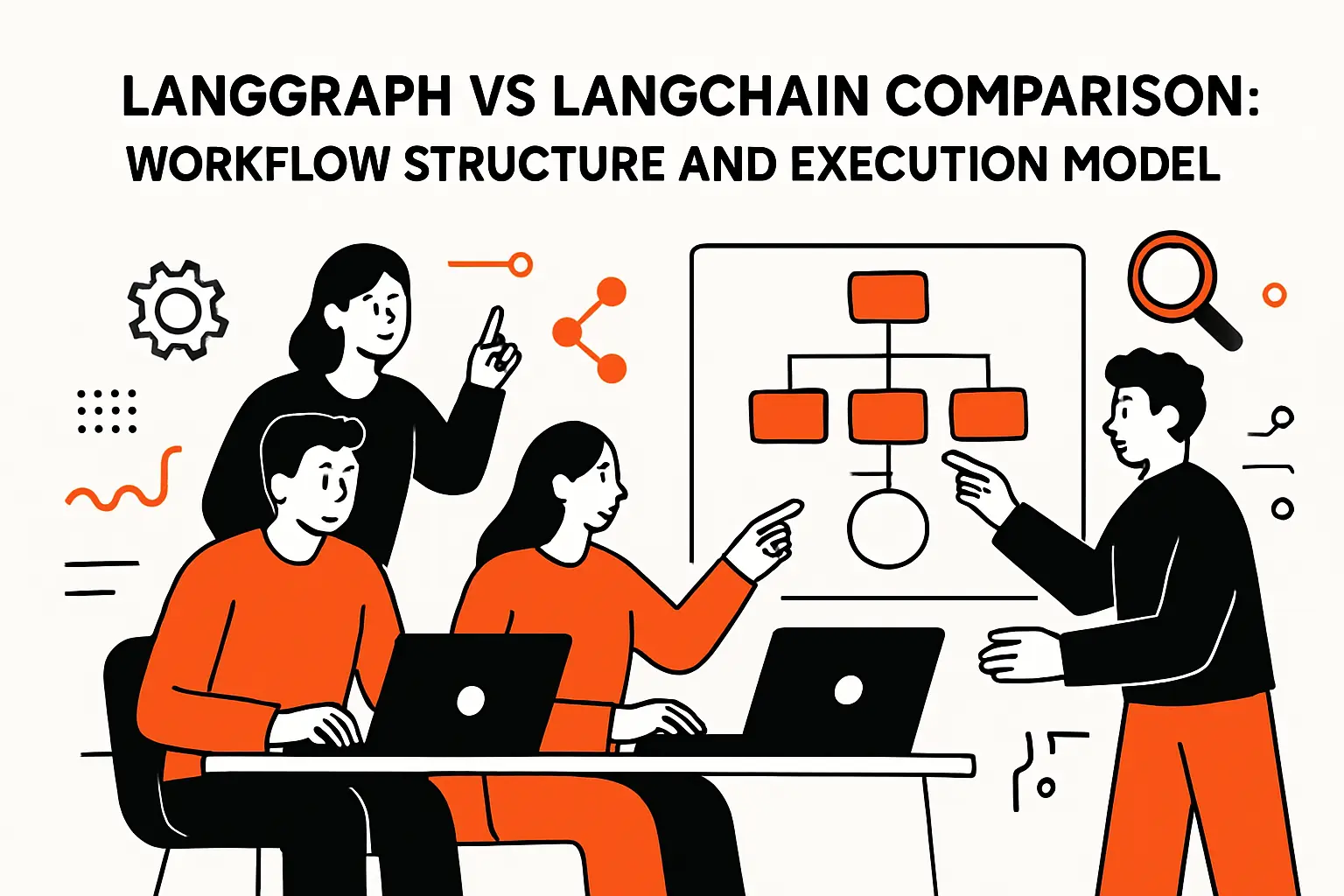
Every LLM app is an execution model choice. Under pressure, teams often choose by vibes—until the first production incident forces clarity. For us, the core question is whether your workflow is predictably step-by-step or inherently cyclical and decision-heavy.
1. LangChain chains and DAG-style pipelines for predictable, step-by-step flows
LangChain workflows tend to read like a recipe: take input, enrich it, call a model, parse output, optionally retrieve context, then return an answer. That structure is a feature when product requirements emphasize predictability and speed. A chain is easier to test because the boundaries are obvious: we can unit test retrieval, snapshot prompt formatting, and validate parsing independently.
In client work, we’ve used chain-style pipelines for “document-grounded Q&A” where the user asks a question, we retrieve relevant passages, we generate an answer, and we attach citations. Another reliable fit is batch processing: summarize incoming notes, classify intent, generate a draft response, then hand off to a human operator.
When the workflow is stable, the operational story is also simpler: fewer moving parts, fewer state transitions, and fewer “why did it do that?” moments. That simplicity pays dividends in on-call rotations and stakeholder trust.
2. LangGraph nodes and edges for cycles, branching, and dynamic routing
LangGraph starts paying for itself when “one pass” is not enough. If the system must decide which tools to call, ask follow-up questions, or revise its plan after partial results, the graph model becomes more natural than a chain with increasingly tangled conditional logic.
From our perspective, graphs also force honesty: you must declare the possible states and transitions. That declaration is a gift in production because it makes behavior auditable. Instead of burying routing decisions inside prompts (“If you need more info, ask a question”), we express routing as a first-class design element. Operationally, that gives us deterministic hooks for safety checks, policy enforcement, and human approvals.
We’ve seen this matter in procurement assistants (“request quote,” “validate vendor,” “check contract policy,” “ask for missing fields”) and in incident response copilots that must iterate: gather signals, propose hypothesis, run checks, then revise the hypothesis based on results.
3. When “retrieve → summarize → answer” fits better than a graph loop
Not every problem deserves a graph. In fact, one of our recurring consulting moments is telling a team, gently, that their “agent” is just a pipeline—and that’s fine. If the workflow is essentially “retrieve → summarize → answer,” a chain-based approach often yields faster delivery and fewer surprises.
In those cases, adding loops can create accidental complexity. A graph loop may keep re-retrieving, re-summarizing, and amplifying noise, especially when the underlying data is messy. Meanwhile, a simple chain can be paired with practical guardrails: a confidence rubric, a refusal policy, and a “show your sources” requirement.
Our rule of thumb: if the user experience is meant to feel instantaneous and the system is not expected to negotiate goals with the user, default to a pipeline. If the assistant must collaborate, deliberate, and adapt, upgrade to a graph.
State management and memory: implicit vs explicit
State is where LLM apps either become software or remain demos. Once you need multi-turn conversations, asynchronous work, or recovery after failure, you have to decide what “the system knows” and where that knowledge lives.
1. LangChain memory components for passing context through workflows
LangChain’s memory patterns are pragmatic: store conversation history, summarize older messages, or retrieve relevant prior turns. For many chat-style assistants, that approach is enough. Instead of modeling a full application state, you pass context along and let each step do its job.
In our builds, memory is most effective when it stays narrow. A customer support assistant might retain user preferences, recent troubleshooting steps, and product identifiers, while leaving everything else to retrieval from a knowledge base. That prevents “context bloat,” reduces prompt fragility, and keeps the system grounded in source-of-truth data rather than its own prior outputs.
Done well, memory is less about hoarding tokens and more about shaping continuity: preserving constraints, tracking decisions, and keeping a consistent voice. When we treat memory as a product feature, we also treat it as a privacy surface, with explicit retention rules and data minimization baked into the design.
2. LangGraph centralized state objects updated at each node
LangGraph pushes you toward explicit state. Instead of sprinkling memory across components, you define a shared state object that nodes read and update. That design is powerful because it clarifies what is mutable and what is derived. Rather than “the model remembers,” the application remembers, and the model operates as a transformation step within that system.
In practice, a centralized state lets us do things chains struggle with: track tool outputs separately from user messages, preserve intermediate artifacts, store policy decisions, and record why a routing choice was made. That separation is crucial for debugging. If an agent makes a bad call, we can inspect the state and see whether retrieval was weak, the plan was flawed, or a tool returned stale data.
From an engineering management perspective, explicit state also improves collaboration. Product, security, and engineering can agree on what’s allowed to persist, what must be redacted, and what must be auditable.
3. Persistence and checkpointing for long-running or multi-session applications
Long-running assistants break the illusion that “a conversation is a request.” Once users expect the assistant to pause, wait for approvals, or continue later, you need persistence. In the graph model, checkpointing becomes a core capability: the system can save a thread’s state, resume after an interruption, and keep the workflow coherent across sessions.
We see persistence matter most in operational workflows: compliance reviews, financial approvals, customer escalations, and onboarding flows where missing information is the norm rather than the exception. For those apps, persistence is not just convenience; it’s correctness. Without it, the assistant either forgets decisions or re-derives them inconsistently.
Our strongest stance is that persistence must be designed alongside governance. If you can resume a workflow, you can also replay mistakes unless the system records intent, approvals, and policy checks in a way that can be reviewed later.
Control flow, reliability, and production-oriented capabilities
Reliability is not a feature you bolt on after the demo. It’s a property of the control flow you choose. When we audit failing LLM applications, the root cause is often a missing control decision: no verification step, no fallback path, no human override.
1. Conditional logic and routing as first-class design elements
Routing is where orchestration frameworks reveal their philosophy. In chain-first designs, routing can become an accumulation of “if statements” and prompt instructions. In graph-first designs, routing becomes architecture: explicit transitions that can be tested, reviewed, and reasoned about.
From our software point of view, the best routing logic combines symbolic signals and model judgment. For example, we might use deterministic checks to decide whether sensitive tools are allowed, then let the model choose among safe options. Another pattern we like is “route by evidence”: if retrieval confidence is low, route to clarification; if evidence is strong, route to answering; if the user intent is action-oriented, route to a tool execution plan.
Business stakeholders love this approach because it makes behavior legible. When a system can explain which path it took and why, trust grows—and trust is the currency that determines whether an assistant becomes a product or a toy.
2. Retries, error handling, and node-level control for resilient agents
Production reality is messy: tools time out, downstream APIs fail, data sources return partial results, and LLM outputs occasionally drift. Graph-style orchestration gives us a clean place to apply resilience patterns at the node level: retry a flaky call, branch into a fallback tool, or escalate to a human review step.
Importantly, resilience is not only about infrastructure. It’s also about cognition under uncertainty. A resilient agent can admit it lacks enough information, ask for clarification, or choose a safe degraded mode rather than improvising. When we design these systems, we treat “I don’t know” as a feature with pathways, not as an embarrassment.
The broader industry is learning this the hard way. Gartner predicts Over 40% of agentic AI projects will be canceled by the end of 2027, and we read that as a warning against overconfident orchestration with weak failure modes.
3. Human-in-the-loop steps and streaming output for real-time experiences
Human-in-the-loop is not an admission of defeat; it’s a production pattern. In regulated industries and high-stakes operations, a human checkpoint can be the difference between safe automation and a liability. Graph-based designs make these checkpoints easier to implement because pausing and resuming is part of the model, not an afterthought.
Meanwhile, streaming output changes user perception. A system that streams intermediate progress feels alive and accountable, especially when it narrates what it’s doing: “searching policy,” “drafting response,” “waiting for approval.” That narration also creates an interaction surface where users can correct course early, before a wrong assumption becomes a wrong action.
At Techtide Solutions, we encourage teams to treat human review as a configurable layer. Some workflows always require approval; others only require it when risk signals trigger. The key is having an orchestration model that supports both without becoming tangled.
Developer experience: complexity, learning curve, and debugging
Developer experience is not just “how fast can we write code.” It’s “how fast can we understand failures,” “how safely can we change behavior,” and “how confidently can we ship improvements without regressions.”
1. Speed to prototype: minimal setup vs upfront graph design
LangChain is often the fastest path from idea to working prototype. The cognitive overhead is low: you stitch together building blocks and get something running. For many teams, that speed matters because the real unknown is product-market fit, not orchestration theory.
LangGraph usually asks for more upfront thinking. You define nodes, edges, and state, which can feel like “architecture before value.” Yet we’ve learned that the graph design phase is not wasted when the product is inherently stateful. Instead of accumulating ad hoc branching logic over weeks, you start with a model that already matches the domain.
Our internal heuristic is blunt: if we anticipate lots of branching and retries, we reach for LangGraph earlier. If the path to value is a straight line, we start with LangChain and reserve the right to evolve.
2. Visualization and tracing: graph views, studio tooling, and run observability
Observability is where LLM apps become debuggable systems rather than mystical black boxes. For chain-first workflows, step-by-step traces help us pinpoint where output quality drops: retrieval, prompt composition, tool output, or parsing. For graph-first workflows, visualization becomes even more valuable because it reveals which paths are taken most often and which nodes are responsible for failures.
In our projects, we instrument early. The first time a stakeholder says, “It gave a weird answer,” we want more than intuition—we want a run record showing the inputs, the decisions, and the tool calls. That record is also the foundation for evaluation: once you can observe behavior, you can score it, compare variants, and make improvements that are measurable rather than anecdotal.
From a business lens, observability is also cost control. If an agent loops unnecessarily or calls expensive tools too often, tracing makes waste visible.
3. Community, documentation maturity, and maintainability considerations
Maintainability comes down to whether future engineers can read the workflow and predict its behavior. In some organizations, a chain is easier because it mirrors the mental model of a request pipeline. In others, a graph is easier because it mirrors operational reality: conditional decisions, retries, pauses, and resumptions.
We advise teams to choose the representation that matches how they already think. If your product team talks in “steps,” chains will feel natural. If your domain experts talk in “states” and “cases,” graphs will feel natural. Another factor is organizational maturity: teams with stronger testing practices can handle more complex orchestration sooner because they can protect it with evaluation and regression tests.
Our personal viewpoint is that maintainability is rarely about the framework alone. The real difference is whether you encode decisions in prompts (hard to audit) or in control flow (easier to audit).
Where LangChain is the best fit
We still reach for LangChain constantly. Not because it is “simpler” in a dismissive way, but because many valuable LLM products are fundamentally pipeline-shaped.
1. RAG pipelines grounded in external documents and vector stores
Retrieval-augmented generation is one of the most consistently useful enterprise patterns, and LangChain’s abstractions make it approachable. For a typical RAG assistant, the workflow is stable: normalize the query, retrieve relevant chunks, optionally rerank, then generate an answer constrained by retrieved context.
In our client work, a RAG pipeline often powers internal enablement: sales playbooks, HR policy lookup, engineering runbooks, and customer support macros. The business win comes from reducing time spent searching and reducing inconsistency in answers. Because the workflow is mostly linear, LangChain’s composition model stays readable and easy to iterate on.
A practical tip we apply: we treat retrieval configuration as a product surface. Chunking strategy, metadata filtering, and citation formatting are not “just engineering.” They determine whether users trust the assistant enough to rely on it when stakes are high.
2. Sequential NLP tasks like summarization followed by question answering
Sequential NLP workflows are a natural match for chain-style orchestration. For example, we might summarize a long thread into a structured brief, then use that brief to answer questions or draft a response. Another pattern is “extract then generate”: pull entities, dates, and commitments from messy text, then generate a follow-up email that references those extracted facts.
In these flows, predictability matters more than autonomy. A chain allows us to enforce ordering, validate intermediate output, and keep scope tight. Because each step has a clear contract, we can test with representative examples and detect regressions when prompts change.
From a business standpoint, sequential workflows are also easier to govern. Audit requirements map to steps: what did we retrieve, what did we summarize, what did we answer, and what constraints did we apply.
3. Simple chatbots and FAQ assistants with limited branching
Some assistants don’t need an elaborate control loop. If the product is an FAQ bot with a small number of safe actions—search a knowledge base, ask a clarification, or hand off to a human—LangChain can be enough. The trick is resisting the temptation to over-agentify.
In our builds, the most successful simple chatbots are intentionally boring. They are grounded, transparent about uncertainty, and designed to fail gracefully. Rather than promising autonomy, they promise fast access to the right information and a consistent tone.
A subtle advantage of staying simple is organizational adoption. Teams are more willing to deploy an assistant when they can predict its behavior. Once the assistant earns trust, the business often asks for more automation—at which point we revisit whether a graph model is warranted.
Where LangGraph is the clear winner
LangGraph wins when your assistant behaves less like a function and more like a process. As soon as the product must manage evolving context, competing goals, and asynchronous checkpoints, the graph model stops being optional and starts being pragmatic.
1. Multi-agent systems coordinating through shared state
Multi-agent systems are often described theatrically, but the practical version is simple: separate responsibilities, shared state, explicit handoffs. One agent drafts, another critiques, another checks policy, another validates tool outputs. In a chain, that coordination can become fragile because each agent’s output must be piped forward in a single direction.
In LangGraph, shared state becomes the collaboration medium. Each specialist node reads what it needs, writes its contribution, and the graph decides what happens next. This structure is especially effective when you need “defense in depth” against hallucinations: a verifier node can enforce grounding, a policy node can block unsafe actions, and a human review node can intercept sensitive operations.
From a business risk perspective, that layered design is easier to justify to security and compliance stakeholders because control points are architectural rather than purely prompt-based.
2. Long-running assistants with loops, clarifying questions, and dynamic decisions
Real assistants do not always have enough information up front. They ask, they refine, and they adapt. A graph loop is ideal for that: the assistant can decide to clarify missing fields, re-run retrieval with better terms, or branch into a different tool when the first attempt fails.
In our experience, long-running assistants also need the ability to pause. A finance workflow may require approval before sending an email. A compliance workflow may require a reviewer to edit the generated rationale. A customer success workflow may require waiting for a user to provide a missing attachment. Graph-based persistence makes these interactions coherent: the assistant can stop, preserve context, and resume without re-inventing its own narrative.
When we design these loops, we explicitly cap unproductive iteration. The goal is not infinite deliberation; the goal is purposeful adaptation with clear stop conditions.
3. Automated workflows and stateful decision trees that must adapt over time
Many enterprises already have decision trees—loan workflows, claims workflows, IT change management workflows—but those trees are brittle because they require exact inputs. LLMs can make them more flexible, yet flexibility without state is chaos. LangGraph provides a way to make the decision tree adaptive while still controlled: each node can interpret unstructured input, map it into structured state updates, and route based on rules that remain auditable.
We’ve applied this idea to onboarding workflows where different roles require different checks, and to support workflows where the “next step” depends on what the customer already tried. Instead of a monolithic prompt that tries to do everything, we build a graph of small, testable decisions.
In business terms, this approach reduces rework. When the assistant remembers which checks were completed and which evidence was gathered, it avoids asking users the same questions repeatedly—one of the fastest ways to lose trust.
TechTide Solutions: building custom solutions with the right orchestration approach
We build LLM systems the way we build other software: clarify requirements, choose an execution model, instrument early, and ship in increments. Orchestration is never the goal; it’s the mechanism that lets a product behave consistently under real-world conditions.
1. Turning product requirements into tailored LangChain or LangGraph architectures
At Techtide Solutions, we begin with behavior, not libraries. A product requirement like “answer questions from internal docs” usually maps to a LangChain-led RAG pipeline. A requirement like “resolve requests end-to-end with approvals and tool calls” often maps to a LangGraph-led workflow with explicit state and human checkpoints.
Before we commit, we map decisions: where the system can branch, where it must stop, and where it must verify. That map becomes the architecture. Only then do we decide whether the implementation is best expressed as a chain, a graph, or a hybrid.
Design principle we repeat
When a decision affects safety, cost, or compliance, we prefer encoding it in control flow rather than burying it in a prompt. That choice is not ideological; it is maintainability under pressure.
2. Prototype-to-production delivery for langgraph vs langchain comparison outcomes
Prototypes are supposed to be optimistic. Production systems are supposed to be honest. Our delivery approach bridges the two by making evaluation and observability part of the build, not an afterthought. During prototyping, we focus on user value: does it answer the right questions, does it reduce time spent, does it fit into existing workflows?
As we harden toward production, we tighten contracts. Inputs get validated, outputs get structured, tool calls get permissioned, and failure modes get explicit. If the assistant needs loops and resumability, we make that a first-class part of the architecture early, so we don’t retrofit state after the product has already shipped to users.
From our experience, the “framework decision” is rarely permanent. What matters is designing in a way that allows evolution: starting simple, then adding graph orchestration only when behavior demands it.
3. Integrations and scalable deployment for real-time, stateful agent experiences
Orchestration frameworks don’t live in a vacuum. They must integrate with identity, permissions, data stores, business systems, and monitoring. When we deploy assistants, we treat them as services with clear boundaries: an API surface, a state store, an audit trail, and a policy layer.
In real deployments, scalability often hinges on non-LLM concerns: caching retrieval, limiting tool calls, handling concurrency, and managing secrets. Stateful agents add another layer: we must ensure that state persistence aligns with privacy requirements and that resumption semantics are correct even when infrastructure changes beneath us.
What “real-time” actually means in production
Streaming output, incremental tool progress, and responsive UI patterns can make complex workflows feel lightweight. That user experience is not cosmetic; it reduces abandonment and increases trust because the system looks like it is doing work rather than stalling silently.
Conclusion: how to choose between LangChain, LangGraph, and complementary tools
Framework choice is not about picking a winner. The durable strategy is choosing an orchestration model that matches product behavior, then surrounding it with the practices that make LLM systems safe: observability, evaluation, and governance.
1. A decision checklist based on workflow complexity, state needs, and control flow
We end with a checklist we actually use when scoping builds:
- Choose LangChain when the workflow is mostly linear, the steps are predictable, and the biggest risks are prompt quality and retrieval quality.
- Adopt LangGraph when the workflow needs loops, conditional branching, resumable execution, or explicit shared state that multiple steps must update safely.
- Prefer explicit control flow when approvals, policy checks, or risk gating are required, because prompts alone are hard to audit and easy to accidentally weaken.
- Plan for persistence when the assistant must pause, wait, or continue later, since stateless chat patterns won’t deliver consistent outcomes in long-lived processes.
Underneath all of this sits a business reality: the more autonomy you want, the more you must invest in control, visibility, and evaluation.
2. When to combine LangChain components inside LangGraph nodes
The hybrid approach is often the sweet spot. LangChain components remain excellent building blocks for node logic: retrieval, summarization, classification, structured extraction, and tool wrappers. LangGraph then orchestrates those nodes when the product needs dynamic behavior.
In our experience, this combination minimizes risk. Node logic stays small and testable, while the graph manages the messy parts: retries, routing, human approval, and resumability. Another advantage is team velocity: developers familiar with chain-style composition can contribute to node implementation without having to own the entire orchestration layer.
Practically speaking, this is how we avoid “agent sprawl.” Instead of one mega-agent that tries to do everything, we build a set of disciplined capabilities and orchestrate them with a control model that matches the domain.
3. Production readiness strategy: layering observability and evaluation alongside orchestration
Production readiness is a posture, not a milestone. We recommend layering three things regardless of which framework you pick: tracing for debuggability, evaluation for regression protection, and policy controls for safe tool use. Without that triad, teams end up shipping blind, then learning from incidents instead of learning from tests.
From our perspective, the biggest leap in maturity is moving from “the assistant seems good” to “we can prove it behaves well under representative scenarios.” That proof requires recorded runs, curated datasets, and feedback loops that turn real usage into measurable improvements.
If you’re choosing between LangChain and LangGraph right now, the next step we’d suggest is to write down your workflow’s failure modes and ask a blunt question: do we need a pipeline that runs, or a process that can recover, pause, and adapt?