
At TechTide Solutions, we’ve learned (sometimes the hard way) that raw generation is rarely the product—execution is. A model can draft a persuasive answer, yet the business value shows up only when that answer becomes an action. A ticket updated, an order verified, a risk flagged, a workflow unblocked. In our view, the agent wave is not hype. Gartner forecasts worldwide GenAI spending to reach $644 billion in 2025, and budgets that large tend to demand accountability, not demos.
Why LangChain and why now: turning LLM outputs into useful actions

1. Composable building blocks for chaining generation to tools, data, and decisions
Practically speaking, LangChain’s core promise is the ability to combine pieces easily: small units you can reason about, test, and reuse. Instead of treating “the prompt” as a magic spell, we build pipelines that clearly separate responsibilities—context assembly, calling tools, well-organized output, and cleanup after the main work. Because each step is explicit, teams can discuss failure modes with the same clarity they bring to any large, multi-part system. Timeouts, retries, safe-to-run-more-than-once behavior, and easy review and tracking.
Consider an internal “quote-to-cash” assistant. One chain extracts commercial terms from a draft order form, another tool call checks the customer record in a CRM, and a final step generates a risk summary for legal review. When those pieces are modular, governance becomes feasible: legal can own the policy layer, finance can own the reconciliation logic, and engineering can own the orchestration without everyone stepping on each other’s toes.
2. Modular architecture that lets you swap components and tailor behavior to each workflow
In the early days of LLM adoption, many teams shipped a single prompt and a single model and hoped for the best. Reality looks different: vendors change pricing, latency fluctuates, and capability jumps arrive on irregular schedules. From our perspective, the winning architecture is the one that assumes churn and builds seams on purpose. Seams where you can swap a model, replace a retriever, change a parser, or tighten a policy without rewriting the entire application.
LangChain encourages that separation through an parts mindset: models, tools, data fetchers, storage systems, and output formats. Instead of tying your product logic to one provider’s quirks, you can treat the model as something the system relies on with a stable interface. Meanwhile, prompt templates patterns become files or assets you can version and review like code, which matters when a compliance team asks, “What exactly are we telling the system to do?”
We also like modularity for a less glamorous reason: incident response. When a customer reports a bad answer, it’s invaluable to isolate whether the issue came from retrieval (wrong context), generation (bad reasoning), or tool calls (incorrect state). A monolithic “chat endpoint” makes that diagnosis feel like fortune-telling; a modular pipeline turns it into engineering.
3. From toy demos to real applications by adding reasoning, memory, and action
Most toy demos fail in production for the same reason prototypes fail in any discipline: they ignore operational constraints. LLM systems add their own twists non determinism, prompt injection risk, and subtle reliability gaps where a plausible sentence can quietly become an incorrect decision. To move from “cool” to “trusted,” we focus on three capabilities: Policy-bounded reasoning, privacy-bounded memory, and permission-bounded action.
Reasoning becomes useful when we anchor it to explicit steps—retrieve relevant context, call the billing tool, validate against business rules, and write a structured response. Memory becomes helpful when we design it intentionally rather than letting it emerge accidentally: session continuity for a single interaction, plus carefully curated long-term memory that stores only what should persist. Action becomes safe when tool access is explicit and scoped, with human review where the blast radius is large.
That’s why we often treat “agent” as an architectural style rather than a feature. A reliable agent isn’t just a chat loop. It’s a governed workflow that can think, remember, and act without improvising beyond its authority.
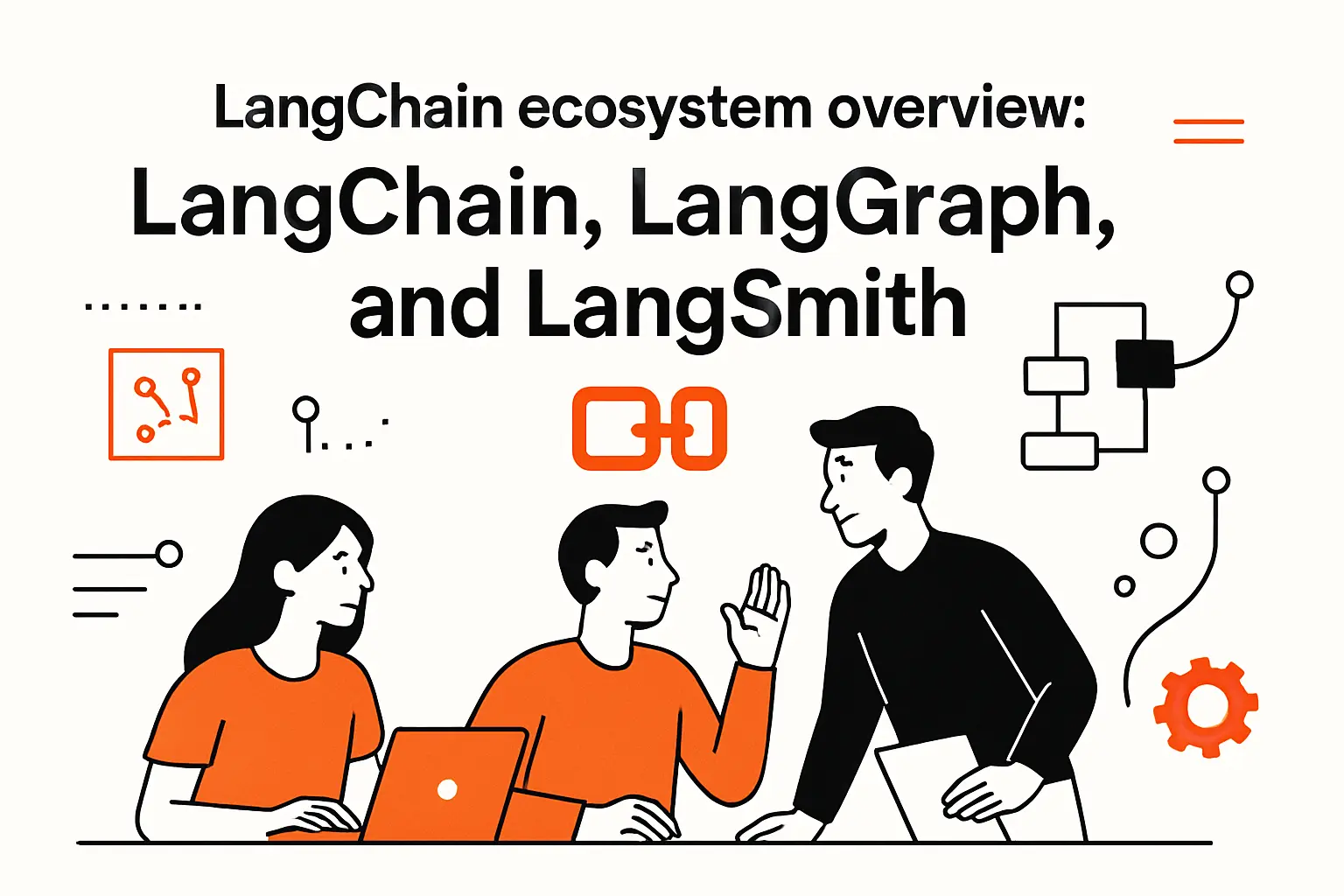
LangChain ecosystem overview: LangChain, LangGraph, and LangSmith
1. LangChain for shipping quickly with a pre-built agent architecture and model integrations
LangChain shines when a team needs momentum without locking itself into a brittle abstraction. The project’s own overview frames it as the path to pre-built agent architecture and model integrations, and we find that phrasing accurate in the trenches. You get a productive starting point, then you refine toward your domain’s constraints.
Speed matters, but speed alone is not the goal. What we want is fast feedback on the real risks. Hallucination under stress, tool misuse, retrieval gaps, and the weird ways user input can jailbreak a naive prompt. LangChain helps you get to that feedback quickly because you can assemble a first pass from known building blocks, instrument it, then iterate.
From an engineering management angle, the value is also social: when primitives are standardized, teams can share patterns. A “retrieval + answer synthesis” pattern in support can be reused in sales enablement, while the security team can apply the same redaction approach to traces across products.
2. LangGraph for building custom agents with low-level control and stateful workflows
Some workflows are too important—or too complex—to accept a black-box agent loop. LangGraph is compelling precisely because it leans into orchestration: graphs, state, and explicit edges rather than implicit “magic.” The docs emphasize durable execution, streaming, human-in-the-loop, and we interpret those as production concerns dressed in developer-friendly language.
Durability is not an academic feature. Long-running tasks fail in the real world: browser automation hits a login challenge, a third-party API rate-limits you, or a database transaction conflicts. A stateful graph lets you persist progress, resume safely, and insert checkpoints where you can require approval before the workflow continues.
Control also improves testability. When each node has a crisp contract—inputs, outputs, state mutations—you can unit test the “business brain” separately from the LLM calls. That separation is how we keep agentic systems from becoming the new version of untestable legacy code.
3. LangSmith for the agent engineering lifecycle: observability, evaluation, and deployment
LLM systems are harder to debug than traditional code because the same input can yield different outputs and different tool choices. Observability, then, is not optional—it’s the price of admission. LangSmith’s documentation highlights that Each request generates a trace, and that simple idea changes how teams operate: instead of guessing what happened, you inspect the exact chain of events.
Tracing becomes even more valuable when you treat prompts, tool calls, retrieval results, and parsers as first-class steps. When a workflow misbehaves, the question isn’t “Why did the model do that?” but “Which upstream step made that behavior likely?” A trace answers that in minutes, not days.
In our builds, we pair observability with evaluation. The moment a product becomes customer-facing, you need regression tests that reflect user reality: ambiguous questions, messy documents, adversarial inputs, and edge cases your product team can’t predict in a meeting.
4. Common application archetypes: copilots, enterprise GPT, customer support, research, code generation, AI search
Similar patterns show up across many industries, even if people use different words. A copilot usually means help built directly into a product, using knowledge of that domain, while an enterprise GPT usually means a controlled entry point to a company’s internal knowledge and tools. Customer support assistants rely on searching past information and ticket details, research agents rely on web browsing and combining information, and code generation systems rely on well-organized outputs and awareness of the codebase.
Instead of starting with “agent vs. RAG,” we start by thinking about how much effort it takes for the user to interact. If the user is already working inside a task—such as reviewing a claim or handling a security alert—an in-product copilot can reduce the need to switch between tools. If the user’s main need is finding information, like “Where is the policy for this?”, then AI search and RAG are usually the right starting point.
Across these archetypes, reliability comes from the same fundamentals: scoping permissions, grounding responses in evidence, and turning “helpful text” into “verifiable steps.” When those fundamentals are ignored, the archetype doesn’t matter; the product becomes a confident liar.
5. LangGraph case studies across industries: browser automation, copilots, research and summarization, data extraction, customer support, code generation, internal search
We see LangGraph-style orchestration pay off when workflows have branching logic and partial failure is expected. Browser automation is a prime example: the agent must navigate pages, detect errors, retry safely, and stop when it hits uncertainty. A graph-based approach helps because you can model decision points explicitly: “If login fails, request human input,” or “If the page changes, capture a screenshot and halt.”
Copilots benefit differently: the graph becomes a policy engine. A node can enforce that certain actions are “read-only,” another node can require customer confirmation before sending an email, and a final node can write an auditable record. Internal search systems also fit well because retrieval is rarely a single step; hybrid strategies, reranking, and evidence grouping often outperform naive vector search.
Data extraction is where we get the most blunt. If a business process depends on extracted fields, then extraction must be treated like parsing, not creative writing. Graph nodes that validate schemas, request clarifications, and route to fallback extraction can convert a fragile demo into something you can stake revenue on.
6. Customer-story snapshots: Klarna, City of Hope, Trellix, C.H. Robinson, AppFolio, Podium, Vizient, Vodafone, Dun & Bradstreet
Real adoption is messy, so we read customer stories less for bragging rights and more for failure patterns and mitigation strategies. The Customer Stories catalog is useful precisely because it spans different risk profiles: fintech, healthcare, cybersecurity, logistics, SaaS operations, and telecom. That breadth matters, since the shape of “reliability” changes with the domain.
From a fintech story, we typically learn about escalation handling and tool permissions. Healthcare, we look for how teams constrain outputs, preserve privacy, and handle clinical ambiguity. And cybersecurity, we watch how teams extract structure from noisy logs without turning every false positive into a fire drill.
Across these snapshots, the consistent lesson is that “agent” is not the finish line. The finish line is an integrated workflow that a domain expert trusts enough to use on a busy day.
Top langchain use cases for summarization and document analysis
1. Summarizing short text with clear prompts and lightweight chains
Short-text summarization looks trivial until you deploy it. A “quick summary” feature in a support console can accidentally rewrite a customer’s intent, omit a key constraint, or introduce a tone that escalates conflict. For short inputs, we usually avoid heavy machinery and instead build a lightweight chain with a crisp definition of “good”: include the user’s goal, include constraints, include next actions, avoid speculation.
Prompt design matters, yet we’ve found that the biggest win is a stable output contract. If a summary is meant to feed a downstream system—like a ticket classification step—then it should be structured. If the summary is meant for a human, then it should be consistent in format so humans can skim it.
In practice, we often pair summarization with a “confidence and gaps” section. Even when we don’t show it to the end user, it helps support agents detect when the model is guessing rather than summarizing.
2. Summarizing longer text with chunking strategies and map-reduce style approaches
Long-document summarization is where naive approaches fail loudly. When a document exceeds a model’s comfortable context window, the model tends to either ignore the middle or invent connective tissue. Chunking fixes the mechanics, but it introduces a new problem: local summaries can drift away from global meaning.
Map-reduce style summarization works well when each chunk yields a consistent intermediate artifact—key points, obligations, risks, and definitions—followed by a synthesis step that merges and de-duplicates. Hierarchical approaches can also help: produce section-level summaries, then a document-level summary, then a task-specific view like “risks for procurement” or “clauses for legal.”
From our perspective, the most important design choice is not the chunk size; it’s the merge logic. A merge step that explicitly reconciles contradictions and flags missing sections is often the difference between “polished” and “reliable.”
3. Context-aware summarization that adapts prompts to document type and metadata
Summarizing a contract like a blog post is a category error. Different document types encode meaning differently: contracts hide obligations in defined terms, incident reports hide causality in timelines, and medical notes hide uncertainty in careful phrasing. Context-aware summarization starts by routing the document through a classifier or heuristic based on metadata, then selecting a prompt and output format tailored to that type.
In our builds, metadata is not an afterthought; it’s a control surface. Department, region, document label, and workflow stage can all adjust how the summarizer behaves. A procurement draft might require emphasis on renewal clauses, while a privacy addendum might require emphasis on data transfer and retention language.
When the workflow is sensitive, we also add “quote-first” behavior: the system extracts relevant passages verbatim, then summarizes them. That approach reduces hallucination risk because the model is anchored to text that a reviewer can verify quickly.
4. Voice-to-insight summarization: transcribe calls, chunk dialogue turns, and extract objections
Voice-to-insight systems are summarization projects disguised as pipelines. A call must be transcribed, speakers separated, turns chunked, and then meaning extracted in a way that maps to business action: objections, commitments, risk signals, and follow-ups. Even when transcription is good, messy conversation creates its own pitfalls—interruptions, sarcasm, and context that lives across multiple turns.
We like a layered approach. First, produce a clean conversational record with timestamps and speaker tags. Next, extract structured items: customer goals, objections, competitor mentions, and promised next steps. Finally, produce role-specific summaries: an account executive wants objections and commitments, while a product manager wants feature gaps and recurring friction.
Because these summaries often influence revenue decisions, we treat them as decision support, not truth. A good system highlights evidence snippets and invites the user to confirm, rather than pretending it heard everything perfectly.
Question answering over private data with RAG pipelines
1. End-to-end “docs to answers” flow: splitting, storage, retrieval, and grounded responses
RAG is best understood as disciplined context management. Instead of asking a model to “know” your company, you retrieve relevant internal documents at runtime and ask the model to answer using that evidence. The LangChain RAG material that walks through the Indexing portion of the pipeline reflects the same engineering truth we’ve found: most failures are indexing failures, not generation failures.
Splitting is not purely technical; it’s semantic. A policy document split in the wrong places loses meaning, and a knowledge base chunk that mixes unrelated topics poisons retrieval. Storage design matters as well: documents need metadata for filtering, tenancy isolation, and retention rules. Retrieval must be observable, because a wrong answer often begins with wrong context.
Grounded responses are the payoff. When the model cites specific passages—internally for auditing, or externally for transparency—teams can trust the system more quickly, and debugging becomes a matter of tracing evidence rather than debating phrasing.
2. Embedding and retrieval with vector stores for private PDFs and proprietary knowledge bases
Embedding-based retrieval is powerful, but it’s not magic. We treat embeddings as an approximate index over meaning, then compensate for approximation with metadata filters, reranking, and guardrails. Private PDFs add complexity: OCR artifacts, tables, and scanned signatures can confuse splitters and degrade embedding quality unless you normalize the text carefully.
From a security standpoint, tenancy boundaries matter. A “single vector store for everyone” is often the easiest prototype and the fastest way to create a compliance headache. In production, we design retrieval around identity and policy: which user can access which corpus, which documents are restricted, and how access is audited.
Operationally, retrieval quality improves when you measure it. We instrument “did the answer cite the right doc?” and “did retrieval return the expected section?” then feed failures back into indexing rules and chunking strategies.
3. Follow-up memory to support clarifying questions in multi-turn document Q&A
Document Q&A fails when users ask ambiguous questions and the system pretends they weren’t ambiguous. A strong agent asks clarifying questions, but to do that well it must remember what has already been discussed, what the user’s role is, and what the document context is. Follow-up memory turns Q&A into a conversation where the system can refine its retrieval strategy over time.
We often implement “question rewriting” as a first-class step: take the user’s follow-up, combine it with the conversation context, and produce a stand-alone query for retrieval. That approach prevents the retriever from seeing “What about that clause?” without knowing what “that” refers to.
In regulated contexts, we also design memory to be selective. The agent should remember intent and references, while avoiding storage of sensitive personal data unless the product explicitly requires it and governance allows it.
4. Enterprise RAG patterns: hybrid retrieval, iterative refinement, evidence synthesis, and self-correction
Enterprise RAG is rarely “vector search and done.” Hybrid retrieval combines semantic search with keyword search to catch both meaning and exact terms, which matters for policy language and product codes. Iterative refinement—retrieve, draft, detect gaps, retrieve again—often produces better answers than a single retrieval pass, especially when the initial query is vague.
Evidence synthesis is the underrated step. When multiple documents disagree, a good agent surfaces the conflict and suggests resolution paths, such as “policy updated later” or “region-specific rule.” Self-correction is also essential: the agent should be able to detect when its answer lacks evidence and then either retrieve again or ask a clarifying question.
Prompt injection is the shadow problem in RAG. Any pipeline that feeds retrieved text directly into a model without boundary-setting can be manipulated, so we treat retrieved content as untrusted input and apply strict instruction hierarchy in prompts and system design.
Conversational agents, chatbots, and copilots with memory

1. Chatbots that remember: session continuity and long-term memory with vector stores
Users don’t want to repeat themselves, and businesses don’t want agents that forget customer context midstream. Session continuity is the minimum: remember the conversation so the user can say “That one” and be understood. Long-term memory is trickier: it can personalize experiences, yet it can also store the wrong thing forever if you treat every message as truth.
Our pattern is “short-term by default, long-term by design.” A support assistant should remember a user’s open tickets and product plan, but it should not permanently store emotional venting or personal details unless there is a clear customer benefit and a compliant retention policy.
Vector-store-backed memory can work well when memory is treated as retrieval, not as a transcript. Instead of dumping a full history into the context, the agent retrieves relevant prior facts, which reduces noise and improves consistency.
2. Memory module options for multi-turn context: buffer, summary, retriever-backed, and custom memory
Different memory strategies solve different problems. A buffer is simple and faithful, but it grows and becomes noisy. A summary compresses context, yet compression can delete nuance and introduce subtle distortions. Retriever-backed memory scales better, but it depends on good embeddings and careful metadata design.
Custom memory is where serious products differentiate. We often split memory into lanes: “user profile facts,” “current task state,” “recent conversation,” and “external system state.” That design allows you to apply different retention rules and different privacy controls to each lane.
In our experience, the biggest mistake is treating memory as an LLM convenience rather than a product surface. Memory is user trust made concrete; if it’s wrong, the agent feels uncanny, and if it’s invasive, the agent feels unsafe.
3. Customer support assistants designed for faster resolution and better context persistence
Support assistants succeed when they reduce time-to-resolution without eroding correctness. The core loop usually includes: retrieve relevant knowledge base content, pull ticket history, summarize the situation, propose next steps, and optionally draft a customer reply. Done well, the assistant becomes a “case acceleration layer” rather than a replacement for human judgment.
We like to integrate with ticketing systems so the agent can read the current state and write back structured updates: tags, priority suggestions, and internal notes. When an action is risky—issuing a refund, closing an account, changing a subscription—we gate it behind explicit approval and log every step for auditability.
Context persistence is not just memory; it’s workflow continuity. A good assistant knows what has already been tried, which troubleshooting steps were completed, and what constraints apply, so it doesn’t send the customer in circles.
4. E-commerce product assistants that ask clarifying questions and match intent to specs
E-commerce assistants often fail by answering too quickly. A user who asks “Will this fit?” might mean fit in a room, fit on a device, fit a body type, or fit a compatibility matrix. Clarifying questions are not friction; they are precision tools that reduce returns and increase trust.
Product assistants work best when they’re grounded in structured catalog data: specs, variants, availability, shipping constraints, and policies. In our builds, the assistant retrieves product facts, then uses tool calls to validate inventory or shipping timelines, and finally generates recommendations with explicit trade-offs.
Intent matching also benefits from conversation state. If the user has already said “I need it for outdoor use,” that constraint should steer all later recommendations, and the assistant should be able to restate it back to the user as a confirmation of understanding.
Agents that act: tool routing, research automation, and database workflows
1. Automating research tasks by chaining search, summarization, storage, and reporting
Research automation is one of the cleanest ways to make LLMs immediately useful. A good research agent doesn’t just browse and paraphrase; it collects sources, extracts claims, records evidence, and produces a report that a human can verify. Tool routing matters here because “search,” “open page,” “summarize,” and “write memo” are different actions with different failure modes.
At TechTide Solutions, we design research agents with a bias toward traceability. The output should not only answer a question but also show how the agent got there: what it looked up, which sources it used, and what uncertainty remains. That design turns research from a black box into a repeatable workflow.
When the domain is sensitive—security advisories, legal changes, vendor risk—we also insert a “skeptic node” that checks for contradictions, outdated pages, and claims that lack evidence, then prompts the user for a decision on whether to proceed.
2. Multi-step workflows for team productivity: summarize, create tasks, and schedule via APIs
Team productivity agents are seductive because they feel like magic: “read this thread, create tasks, schedule a meeting.” Under the hood, though, the system must handle messy details: deduplicate tasks, assign owners, respect permissions, and avoid creating calendar chaos. Tool calls are where these agents either become useful coworkers or dangerous interns.
We prefer a “proposal then commit” pattern. The agent drafts tasks and calendar suggestions, then the user approves before anything is written to external systems. That pattern reduces risk and improves user trust, because the agent behaves like a collaborator rather than an autopilot.
Idempotency is another practical concern. If a workflow retries due to a timeout, it should not create duplicate tasks, so we design tool calls with stable identifiers and careful retry behavior.
3. Text-to-SQL style workflows: select tables and columns, construct queries, execute, and explain results
Text-to-SQL is powerful when it’s treated as a constrained workflow instead of a free-form query generator. The agent should first inspect available schemas, then select relevant tables and columns, then generate a query under strict safety rules, and only then execute. After execution, the system must explain results in business language and expose assumptions.
From a governance standpoint, read-only access is the default. Even when business users ask for “fix the data,” the agent should escalate to a controlled workflow rather than improvising a write query. Parameterization and validation matter as well, because the easiest way to create an incident is to let a model generate a destructive query with confidence.
In practice, this pattern becomes a self-service analytics layer. When it’s implemented with proper observability and permissions, it can reduce the burden on data teams while keeping security teams comfortable.
4. Structured extraction and output parsing with schemas for reliable downstream automation
Downstream automation demands structure. If an agent extracts invoice fields, incident attributes, or procurement clauses, those outputs must conform to a schema so that validation is deterministic. We’re partial to schema-first design: define the output contract, enforce it with parsing and retries, and treat any non-conforming output as a recoverable failure.
LangChain’s ecosystem has long pushed toward structured interaction with tools and outputs, and the idea of structured tools fits neatly into this worldview. When a tool expects typed inputs, the agent’s behavior becomes less ambiguous, and error handling becomes more like traditional programming.
Schema enforcement also improves safety. If the model is only allowed to output specific fields, it has fewer opportunities to smuggle in unsafe instructions, irrelevant content, or accidental data leakage.
Shipping reliable agents at scale: evaluation, observability, and enterprise deployment patterns

1. Evaluation workflows for non-deterministic outputs: automated QA grading and quality checks
Evaluation is how we keep agent systems honest over time. Because outputs vary, you can’t rely solely on “it worked once” testing. Instead, you need suites of scenarios that reflect production reality: ambiguous user requests, messy documents, adversarial phrasing, and edge cases that trigger tool failures.
We typically combine automated checks with human review. Automated grading can validate schema compliance, detect missing citations, and measure retrieval relevance. Human review can assess whether the answer is actually helpful and whether the agent’s tone and risk posture match the brand.
When evaluation is treated as an ongoing process—run on every prompt change, model swap, or retrieval tweak—agents stop being fragile. Without evaluation, every improvement is a gamble, and teams quietly revert to manual work when the system surprises them.
2. LangSmith tracing, monitoring, and alerting for debugging multi-step agent execution
Tracing is the difference between debugging and guessing. In multi-step agent systems, a single user request can trigger retrieval, reranking, tool calls, parsing, and final synthesis. Without traces, you only see the final answer and you miss the causal chain that produced it.
LangSmith-style observability also enables operations work, not just developer work. Monitoring can reveal spikes in tool failures, rising latency in retrieval, or prompt changes that correlate with degraded output quality. Alerting can then route the right signal to the right team: infra for timeouts, data for retrieval drift, and product for UX issues.
From our standpoint, good tracing becomes a product advantage. Teams that can diagnose and fix agent failures quickly ship features with more confidence, and confidence compounds.
3. Cost intelligence and performance optimization for token-heavy chains and tool calls
Cost control is reliability control wearing a different hat. Token-heavy chains and frequent tool calls can quietly inflate spend, and unpredictable costs often trigger panic-driven cutbacks that harm product quality. A disciplined system measures where tokens are used, where retrieval adds noise, and where outputs can be shortened without losing meaning.
We like to optimize by changing the workflow before changing the model. Better chunking reduces irrelevant context, caching reduces repeated calls, and structured outputs reduce verbose explanations. Latency improves through parallelism where safe, and through early exits when confidence is low.
When cost is visible at the chain level, product decisions become rational. Instead of saying “LLMs are expensive,” teams can say “this step adds little value” and redesign it with intent.
4. Enterprise integration patterns: Kubernetes-native deployment, security and compliance, audit trails, and OpenTelemetry tracing
Security boundaries as product features
Enterprise deployment is not just “run it in a cluster.” Security teams want clear boundaries: which services can call the model, which tools the agent can invoke, and how secrets are managed. We build agents with explicit permission maps so a support agent cannot suddenly access payroll data, and so a research agent cannot write to customer records.
Audit trails that answer uncomfortable questions
Auditability is where agent systems prove they belong in serious environments. A useful audit trail records user intent, retrieved evidence, tool calls, and final actions. When an executive asks, “Why did this happen?” the team should be able to answer with trace-backed facts rather than a vague description of “the model decided.”
Operational observability that fits existing stacks
In mature organizations, observability already exists, and agent systems must plug into it. Kubernetes-native deployment patterns help with scaling and isolation, while OpenTelemetry-style tracing helps align LLM steps with the rest of the platform’s telemetry. The goal is not to create a new monitoring silo; it’s to make agent workflows first-class citizens in the production runtime.
5. Real-time data integration and processing: event-driven architectures, streaming ingestion, and AI-assisted data quality enforcement
Many of the highest-value agent workflows are event-driven. A fraud signal, a support escalation, or a shipping delay arrives as a stream, and the agent must react quickly with context. Streaming ingestion changes the architecture: retrieval must be fresh, state must be updated continuously, and tool calls must be safe under concurrency.
We also see agents improving data quality when they’re used as “semantic validators.” Instead of only checking whether a field is present, a system can check whether a record makes sense given surrounding context, then route suspicious cases to review. That doesn’t replace traditional validation; it augments it with language understanding.
When real-time workflows are designed with explicit state, clear permissions, and robust tracing, agents become less like chatbots and more like operational software—software that happens to speak natural language.
TechTide Solutions: building custom LangChain solutions tailored to your customers

1. Use-case discovery and architecture planning for high-impact langchain use cases
Our work usually starts with a simple question: “Where does language touch money?” Sometimes that’s support resolution, sometimes it’s sales enablement, and sometimes it’s compliance review. We map the workflow, identify high-friction steps, and then decide whether the right solution is summarization, RAG, or an agent that can take controlled actions.
Rather than promising a general-purpose assistant, we aim for narrow wins with clear metrics. A single workflow that reliably saves time is more valuable than a broad assistant that occasionally invents facts. Architecture planning then follows naturally: what data is needed, what tools are safe, what observability is required, and what governance constraints must be respected.
When the discovery phase is done well, the build phase becomes straightforward. When discovery is skipped, teams ship a chat UI and then wonder why it doesn’t change outcomes.
2. Custom software development: web apps, APIs, and agent workflows integrated with your data sources and tools
Shipping an agent is still software engineering. The system needs APIs, authentication, role-based access control, data connectors, and integration with the tools your team already uses. We build the surrounding product: admin controls, prompt and policy management, evaluation harnesses, and interfaces that encourage safe usage patterns.
Integration is where differentiation happens. An agent that can read a knowledge base is helpful; an agent that can also create a ticket, attach evidence, notify the right team, and update the customer record becomes operational. That difference is why we treat tools and workflows as the real product surface, with the LLM as an engine inside the machine.
Because customers rarely have clean data, we also invest in ingestion and normalization. Retrieval quality, in our experience, is a stronger predictor of success than model cleverness.
3. Production hardening: evaluation, monitoring, security, and scalable deployment for reliable agent behavior
Hardening is where teams either earn trust or lose it. We implement evaluation suites that reflect your domain, set up observability that surfaces failure modes, and add safety layers that constrain what the agent can do. Deployment patterns then ensure the system scales predictably and remains operable under load.
Monitoring is not just uptime. We watch for drift in retrieval quality, increases in tool-call failure rates, and signs that users are prompting the system into unsafe territory. Security controls include strict permissioning, redaction where needed, and audit trails that stand up to scrutiny.
From our viewpoint, production hardening is not “extra.” It is the difference between a pilot and a platform that your business can confidently build on.
Conclusion: how to prioritize langchain use cases for real business outcomes

1. Start with a narrow workflow, validate with evaluation, then expand into agents and multi-step automation
Successful adoption usually begins small. Pick a workflow with clear boundaries, instrument it heavily, and measure whether it truly saves time or reduces errors. After the system is stable, expand into adjacent steps—more tools, richer memory, deeper retrieval, and eventually more agentic autonomy where it is justified.
As we’ve seen across clients, the biggest risk is trying to do everything at once. Broad assistants feel impressive, yet they often fail in subtle ways that erode trust. Narrow workflows, on the other hand, earn trust through repetition: the same task, done well, day after day.
If a team treats evaluation as part of the product, iteration becomes safe. Without evaluation, iteration becomes roulette.
2. Choose the right level of abstraction: LangChain for speed, LangGraph for control, LangSmith for reliability
Different layers solve different problems. LangChain helps teams ship quickly with useful abstractions and integrations. LangGraph helps teams model stateful workflows with explicit control and safe failure handling. LangSmith helps teams observe, evaluate, and improve systems once they’re exposed to real users.
In our practice, the best teams mix these layers deliberately. A simple workflow might stay in a chain, while a high-stakes workflow becomes a graph with checkpoints and approvals. Observability and evaluation then sit across the stack, because reliability is not a feature you bolt on later.
Choosing the right abstraction is ultimately a business decision: speed matters until correctness matters more, and then control becomes the differentiator.
3. Design for grounded answers and operational excellence from day one: retrieval quality, observability, and governance
Grounding is the antidote to confident nonsense. Retrieval quality determines whether your agent has the right evidence, observability determines whether you can debug and improve it, and governance determines whether it behaves safely within your organization’s rules. Together, those pillars turn LLM capability into business reliability.
At TechTide Solutions, we think of agent systems as a new kind of application: language-native, tool-driven, and trace-first. The teams that win will be the ones who treat these systems like real software—with tests, telemetry, and security—not like a novelty UI.
What narrow, high-leverage workflow in your organization is begging to be turned into a governed agent, and who should own its evaluation from the very beginning?