


At TechTide Solutions, we treat “vibe coding” as the newest layer in a long tradition of making software more expressive: we moved from punch cards to compilers, from frameworks to scaffolding tools, and now from manual syntax to AI-guided intent. The difference is that vibe coding can feel like magic—until it doesn’t, and then it feels like chaos.
Market overview: Gartner forecasts worldwide GenAI spending to reach $644 billion in 2025, which helps explain why product teams are pressuring engineering orgs to move from “experiments” to “shipping” faster than ever. From our vantage point, the real opportunity isn’t replacing programming; it’s compressing the distance between a business idea and a running, testable application. That compression is only valuable when it’s paired with ownership, debugging literacy, and a security mindset—because real apps have real users, and real users create real edge cases.
What Vibe Coding Is and What It Is Not?

1. Vibe coding defined: generating functional code from natural-language prompts
Vibe coding is the practice of turning natural-language intent into working code by collaborating with an AI system that can generate, modify, and explain software. Instead of starting with a blank file and writing every line, we start with a description of the outcome and then steer the model toward a runnable implementation.
Conceptually, vibe coding is closer to directing than typing. A beginner can say, “Build a simple inventory tracker with login and a dashboard,” and the AI can scaffold routes, data models, and UI components. That doesn’t mean the beginner suddenly “knows software engineering,” but it does mean the beginner can create something concrete to critique, test, and refine.
What We Mean by “Functional”
In our shop, “functional” doesn’t mean “looks good in a screenshot.” It means the code runs, handles unhappy paths, persists data in a predictable way, and fails loudly when something goes wrong. If the AI output can’t survive a refresh, a slow network, or a malformed input, it’s a demo—not an app.
2. Pure vibe coding vs responsible AI-assisted development ownership
Pure vibe coding is when we accept AI output as-is and keep prompting until the app “seems fine.” Responsible AI-assisted development is when we treat the AI as a powerful accelerator while we remain accountable for architecture, correctness, security, and long-term maintenance.
Ownership is the dividing line. When an app breaks in production, “the model wrote it” is not a root-cause analysis. A team still needs code review discipline, basic observability, a rollback plan, and the habit of writing tests around the behavior that matters to the business.
A Realistic Rule of Thumb
Early prototypes can tolerate messy internals, because their job is to validate the idea. Anything that touches money, identity, or sensitive data deserves a slower, more deliberate build path with human review and explicit threat modeling.
3. Vibe coding vs traditional programming: shifting from typing syntax to guiding outcomes
Traditional programming emphasizes syntax fluency and incremental construction: define a function, compile, fix errors, repeat. Vibe coding shifts effort toward specifying outcomes, constraints, and acceptance criteria in a way the AI can use to generate coherent changes.
Practically, the “new hard part” becomes communication. If we can describe what success looks like—inputs, outputs, edge cases, performance expectations—the AI can often fill in the mechanical steps. When our description is fuzzy, the AI will still produce code, but it will encode assumptions we didn’t intend.
The core vibe coding loop: describe, generate, run and refine
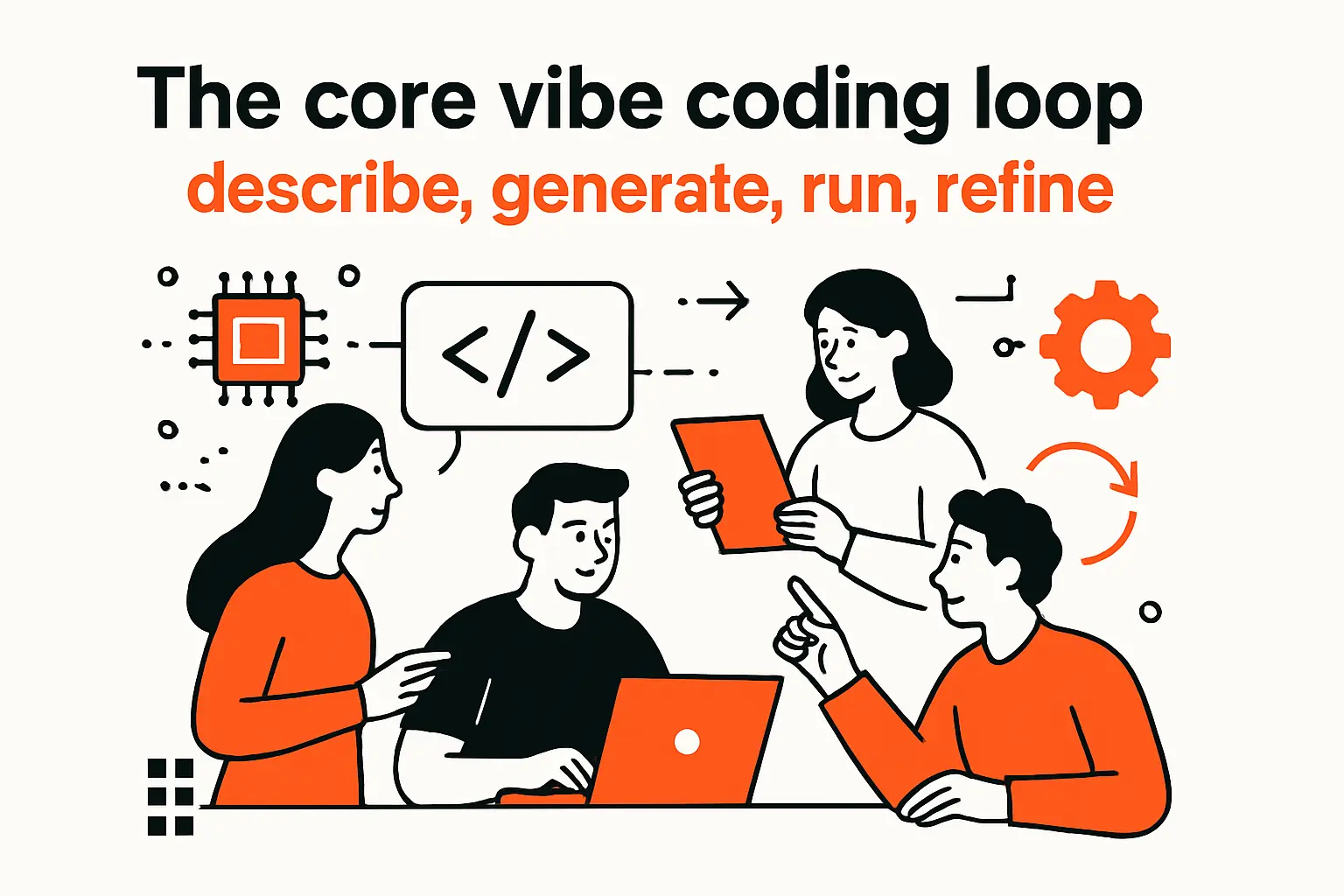
1. The code-level workflow: goal, generation, execution, feedback, repeat
The smallest vibe coding loop is brutally simple: define a goal, generate code, run it, observe what happens, and refine. The loop feels fast because AI can produce a lot of code quickly, but speed only helps if we keep the loop tight and reality-based.
Execution is the truth serum. Running the code turns vague disagreements into specific symptoms: a failing build, a missing environment variable, a broken API call, or a UI state bug. Once we have symptoms, we can prompt with concrete evidence—error logs, stack traces, failing test output—rather than vibes alone.
Prompts We Actually Trust
- “Here is the error output; explain the likely cause and propose the smallest fix.”
- “Make no other changes besides addressing this failing test and keeping behavior identical elsewhere.”
- “List the assumptions you’re making about the runtime environment and dependencies.”
2. The application lifecycle: ideation through testing and validation
Vibe coding doesn’t remove the software lifecycle; it compresses it. We still move through ideation, UX definition, data modeling, implementation, testing, and validation—except we can iterate on a working artifact much earlier.
In business terms, earlier artifacts change the conversation. Stakeholders stop debating hypotheticals and start reacting to a live flow: “This dashboard is confusing,” “That export needs filters,” “We can’t store customer notes like that.” Those reactions are gold, because they surface requirements nobody remembered to mention.
Validation Beats Elegance
Our bias is to validate workflows before polishing internals. An ugly but accurate prototype can de-risk a product direction, while a beautiful architecture that solves the wrong problem is an expensive distraction.
3. Why domain knowledge and clear context improve AI-generated results
AI systems generate plausible code, not guaranteed-correct code. Domain knowledge provides the guardrails that separate “plausible” from “usable,” especially in regulated industries, complex workflows, or legacy-heavy environments.
Context also reduces hidden mismatches. A model can build “a scheduling app,” but a dental clinic’s scheduling needs are different from a field-service team’s dispatch needs. When we include constraints—appointment duration rules, cancellation policies, staff roles, audit logs—the generated design becomes meaningfully closer to the real world.
The Hidden Cost of Missing Context
When context is thin, teams pay later in rework: schema changes, refactors, security patches, and UI rewrites. Clear context upfront is not “extra documentation”; it’s a way to keep the AI from optimizing for the wrong success definition.
Start with a product mindset before you prompt

1. Vibe coder mindset: agency, curiosity, and courage to iterate through failure
Vibe coding rewards agency. Instead of waiting for permission to begin, we can draft a prototype, test assumptions, and invite feedback early—while still treating the output as disposable until it proves value.
Curiosity matters because AI output is a negotiation. If something breaks, the fastest path is to ask “why did it do that?” and “what did it assume?” rather than treating the model like a vending machine. Courage matters because failure is part of the loop: prototypes fail, prompts fail, deployments fail, and that’s normal.
Reframing Failure as Signal
A failed run is often better than a successful-looking mock, because it reveals a missing dependency, an unclear requirement, or an architectural mismatch. In our teams, we celebrate fast failures that come with clear learnings.
2. Define the problem and features first: PRD-style requirements and success criteria
Before we write prompts, we write a tiny PRD-style brief. The goal isn’t bureaucracy; it’s clarity. A short doc can capture the user persona, the job-to-be-done, key screens, data entities, and what “done” means in observable behavior.
Good success criteria are testable. “Make it user friendly” is vague, while “a user can sign up, create a project, add tasks, and export a CSV without errors” creates a checklist the AI can implement and we can verify.
A Minimal PRD Template We Use
- Problem statement and who feels the pain.
- Core user journeys written as plain-language steps.
- Out-of-scope list to prevent feature creep.
- Nonfunctional constraints: performance, privacy, compliance, deployment target.
3. Use wireframes, sketches, and examples to make the intended UX unambiguous
UX ambiguity is where vibe coding goes off the rails. If we don’t specify layout and interaction patterns, the AI will invent them, and we’ll spend cycles “negotiating UI” instead of building product value.
Sketches help because they constrain the solution space. Even a rough wireframe clarifies hierarchy: what’s primary, what’s secondary, what should be visible without scrolling, and what belongs behind a modal. Example-driven prompts are even better: describing a known pattern—like “a Kanban board similar to Trello”—anchors expectations.
Artifacts That Improve AI Output
- A screenshot of a UI style you like, annotated with what to copy and what to avoid.
- A sample dataset that reflects real messiness: missing fields, long strings, unusual characters.
- Error copy guidelines so failures don’t feel like system crashes.
How to start vibe coding by choosing the right tool for your goal

1. Browser-first tools for fast prototyping and minimal setup
Browser-first vibe coding tools shine when we need speed, not ceremony. They reduce setup friction—no local environment wrangling, fewer dependency traps, and faster feedback loops for beginners who just want a working demo.
For stakeholder alignment, browser-first tools are a gift: we can share a link, gather feedback, and iterate without asking someone to clone a repo. In our experience, that immediacy is often the difference between “interesting idea” and “approved pilot.”
Where Browser-First Breaks Down
Complex integrations, strict network policies, or heavy compute needs can strain browser-only environments. When an app needs custom infrastructure, advanced testing, or deep refactoring, a desktop workflow tends to win.
2. Desktop editors and IDE copilots for deeper control and existing codebases
Desktop editors become essential when we’re working inside an existing codebase with established conventions. Copilots in an IDE can help us refactor safely, generate tests near the code, and keep changes small enough for real code review.
Legacy realities also matter: enterprise apps often require internal SDKs, private packages, and network access that browser sandboxes can’t provide. In those cases, local tooling is not optional; it’s the price of admission.
Control Is a Feature
Deeper control means we can enforce architecture: shared libraries, lint rules, CI checks, and release pipelines. That control is what turns “AI-generated code” into “software we can maintain.”
3. Matching the tool to the job: quick prototypes vs production-ready full-stack builds
A prototype tool should optimize for speed of iteration and clarity of feedback. A production toolchain should optimize for correctness, repeatability, and governance. Confusing those goals leads to disappointment, usually right when leadership expects a demo to become a product.
Our recommendation is to start with the smallest environment that can validate the idea, then “graduate” to a production path once usage is real. Graduation means introducing proper auth, secure secrets management, structured logging, monitoring, and a testing strategy that covers the riskiest behaviors.
A Simple Decision Filter
- If the app is a pitch: choose the fastest loop.
- If the app handles identity or payments: choose the most controllable workflow.
- If the app must live for years: choose tools that support refactors, not just generation.
Vibe coding with Google AI Studio, Firebase Studio, and Gemini Code Assist
1. Google AI Studio: write a single prompt, iterate in a live preview, deploy to Cloud Run
Google AI Studio’s Build mode is a strong example of what vibe coding looks like when the tool treats “running software” as the default artifact. In particular, it can create a web app with a live preview, which turns prompt edits into immediate UX feedback instead of abstract code review.
From a business perspective, that live preview is a meeting accelerator. Product owners can react to real flows, while engineers can inspect the generated structure and decide what’s worth keeping. Once the app is close enough, deployment options help convert a prototype into something shareable for pilot users.
How We Prompt for Better Build Outputs
- Describe user roles and permissions, not just pages.
- Specify data boundaries: what must stay client-side versus server-side.
- Ask for a “readme-style” explanation of the architecture and trade-offs.
2. Firebase Studio: refine an app blueprint, generate a prototype, publish a full application
Firebase Studio’s App Prototyping agent leans into a blueprint-first workflow. Instead of jumping straight into code, we can describe the app and let the system generate an app blueprint, code, and a web preview, which encourages beginners to validate requirements before getting lost in implementation detail.
In practice, that blueprint acts like a lightweight contract between the builder and the AI: features, style guidelines, and major components are visible up front. As the prototype evolves, the right move is to keep asking: “Does this still match the blueprint?” If not, the fix is often to revise the blueprint, not to pile on patches.
Why Blueprinting Matters to Businesses
Blueprints create a paper trail of intent. When teams hand off a prototype, the blueprint becomes a shared language for scope, which reduces “telephone game” drift between stakeholders and implementers.
3. Gemini Code Assist: generate code in-file, refactor with prompts, and generate tests
Gemini Code Assist is most valuable once we’re living in real code. Inline suggestions can speed up the mechanical work, while smart actions make it easier to modernize legacy functions without rewriting entire modules at once.
Testing is where this class of tool can punch above its weight. Having an IDE option to Generate unit tests nudges teams toward safer iteration, especially when vibe-coded changes need guardrails before they land in a shared branch.
Our Refactoring Pattern
- Isolate a function behind an interface boundary.
- Generate tests that describe existing behavior.
- Refactor internals while keeping tests green.
Replit vibe coding 101: from idea to MVP with Replit Agent

1. Crafting an effective initial prompt: goal, key technologies, and data sources
An initial prompt should read like a project kickoff, not a wish. We aim to include the product goal, the key user journeys, and constraints like the desired stack, hosting assumptions, and any external APIs or datasets the app must use.
Data sources deserve special care. If an app depends on a third-party API, we instruct the agent to stub it first, then integrate once the UI and data model are stable. That approach prevents the whole build from being blocked by authentication friction or API misunderstandings.
Prompt Ingredients We Don’t Skip
- User roles and permissions model.
- Data entities and relationships, described in plain language.
- Edge cases like empty states, failed requests, and retries.
2. Attaching a mockup and approving the Agent plan before code generation
When an agent is capable of sweeping changes, planning becomes a safety feature. Replit’s flow of moving from planning to execution is clearer when we explicitly review the task list and select Start building only after the plan matches the product intent.
Mockups reduce back-and-forth. A simple layout reference—nav placement, card style, form fields—helps the agent converge quickly, and it gives us a concrete basis for rejecting changes that drift. From our experience, “approve the plan” is the moment to catch scope creep before it becomes code.
How We Review an Agent Plan
- Check that tasks are sequenced from foundation to polish.
- Confirm the data model exists before the UI depends on it.
- Verify security steps are not postponed until the end.
3. Agent scaffolding: environment setup, full-stack code generation, and checkpoints
Agent-driven scaffolding feels powerful because it handles the busywork: project structure, dependency installation, initial routes, and basic CRUD. That convenience is exactly why we insist on checkpoints and rollback literacy—because an agent can also produce fast, confident mistakes.
Replit’s checkpointing model is unusually relevant for vibe coding because checkpoints capture your complete project state, which turns experimentation into a reversible process. Once reversibility is real, we can iterate more boldly without fearing we’ll brick the environment.
Our Checkpoint Habit
After a major refactor or dependency change, we pause and manually run the critical journeys before asking for the next feature. That pause keeps failures close to their cause, which is the fastest debugging posture.
Refine, debug, and ship: turning AI prototypes into reliable apps
1. Fast mode refinements: targeted edits for styling, features, and UX polish
Refinement works best when requests are small and testable. Rather than saying “make it better,” we ask for narrow changes: improve spacing in a specific component, add a validation message to a specific form, or change a table to a card layout for mobile readability.
Targeted edits also protect stability. When an AI changes too much at once, it becomes hard to tell which change caused the new bug. Keeping edits scoped makes the diff reviewable, even for beginners, and it keeps the feedback loop honest.
Polish Requests That Stay Safe
- “Update only CSS and do not change API calls.”
- “Keep the same UI layout; add loading and empty states.”
- “Do not introduce new dependencies for this change.”
2. Debugging via DevTools: use console and network signals as prompt-ready feedback
DevTools turns “it’s broken” into actionable evidence. Console errors reveal missing imports, runtime exceptions, and misconfigured environment variables. Network traces show failing requests, incorrect endpoints, CORS issues, and auth problems like silent redirects.
Once evidence exists, prompts become sharper. Instead of asking the AI to “fix auth,” we paste the failing request details, the status code behavior, and the exact call stack location. That specificity changes the model’s output from speculative rewrites to focused repairs.
Security Is Part of Debugging
Broken access control is a common failure mode in rushed prototypes, and OWASP reports a max incidence rate of 55.97% for that category, which is a reminder that “it works” is not the same as “it’s safe.”
3. Publishing and iteration: configuration review, secrets handling, public URLs, and republishing
Shipping is where vibe coding becomes real software engineering. Configuration review matters because small mistakes—wrong environment variables, permissive CORS, debug mode left on—can undermine an otherwise solid prototype. Secrets handling matters because prototypes often start with keys pasted into client code, which is a short path to accidental exposure.
Republishing should be a habit, not a ceremony. A reliable deployment flow lets us ship a change, validate it with real users, and iterate without destabilizing the system. In Firebase Studio, for example, there is an explicit path to Deploy to Cloud Run, which encourages teams to treat deployment as part of building rather than an afterthought.
What We Check Before a Public Link Goes Out
- Confirm secrets are server-side and rotated if exposed.
- Verify auth flows across logout, expired sessions, and revoked access.
- Review logging to avoid leaking sensitive payloads.
TechTide Solutions: custom software development support for vibe coding projects
1. Turning vibe-coded prototypes into production web apps and mobile-ready experiences
At TechTide Solutions, we often enter after a prototype exists and the business wants it to survive reality: actual users, real load, and the messy diversity of devices and networks. That transition requires more than “cleaning up code”; it requires choosing which parts of the prototype are trustworthy enough to keep.
Mobile-ready experiences frequently expose hidden architectural flaws. A UI that feels fine on desktop can become unusable on a phone, while a data-fetching approach that seems fast on Wi‑Fi can feel sluggish on cellular. Our approach is to preserve the validated workflow while reworking the brittle pieces behind it.
What “Production” Means to Us
Production is observable, secure, and maintainable. It has clear error handling, consistent data contracts, predictable deployments, and a roadmap for upgrades as dependencies evolve.
2. Building custom solutions around your needs: APIs, databases, authentication, and payments
AI-generated apps tend to start with a happy-path backend: a few endpoints, a simple database schema, and minimal authorization. Business reality usually demands more: role-based access, audit trails, rate limits, and reliable integrations with external systems like CRMs, ERPs, and analytics platforms.
Payments deserve special rigor, because they combine security, compliance, and user trust. Stripe’s documentation is explicit that the Payment Intents API tracks a payment from creation through checkout, and that lifecycle framing matches how we design payment flows: resilient state machines, not fragile “submit once and hope” forms.
Integration Work We Commonly Add
- API gateways and request validation to protect downstream services.
- Database migrations and indexing strategies aligned to query patterns.
- Authentication flows with least-privilege permissions and clear session handling.
3. Making the code reliable: reviews, testing strategy, and maintainable architecture
Reliability is where many vibe-coded apps stall, because generation is not the same as engineering. Code review turns AI output into team-owned logic. Testing strategy turns “it worked yesterday” into confidence that it still works after the next change.
Architecture is the long game. If the app is a one-off internal tool, we can keep things simple; if it’s a customer-facing product, we need a structure that welcomes change: clear boundaries, modular services, stable contracts, and a deployment pipeline that makes safe iteration routine.
How We Make AI Output Maintainable
- Normalize patterns across the codebase so future prompts don’t create competing styles.
- Introduce linters and formatting early to reduce “diff noise.”
- Document the domain model so new contributors can reason about business rules.
Conclusion: what to do next after you learn how to start vibe coding

1. Iterate in small chunks: build, test early, and refine continuously
Small chunks are the antidote to AI-driven chaos. When we iterate in tiny slices, each change is easier to verify, easier to roll back, and easier to understand. That rhythm also keeps prompts grounded in evidence rather than aspiration.
Early testing doesn’t require perfection. A simple checklist of core journeys—sign in, create a record, edit it, delete it, recover from a failed request—will uncover most structural problems quickly. Once those journeys are stable, polish work becomes a multiplier instead of a gamble.
Next-Step Practice Loop
- Pick a single user journey and make it work end-to-end.
- Add one edge case that would embarrass you in front of a real user.
- Write a small test or scripted check that prevents regression.
2. Know the limits: security, hidden bugs, and when to bring in a human reviewer
AI can generate code that looks confident while hiding subtle defects: race conditions, authorization gaps, missing input validation, and brittle assumptions about client state. Those defects don’t always show up in happy-path demos, which is why human review remains essential for anything high-stakes.
Security is not a feature we “add later.” The right moment to address it is when the data model and permissions model are being designed, because retrofitting authorization into a tangled prototype is one of the most expensive refactors teams attempt.
When We Insist on Human Review
- Anything involving money movement, identity, or regulated data.
- Anything that exposes public endpoints to the internet.
- Anything that could materially harm users if it behaves incorrectly.
3. Plan beyond Day 0: upgrades, refactors, and long-term maintenance as the app grows
Shipping an app is the beginning of maintenance, not the end of development. Dependencies change, APIs deprecate, and security expectations evolve. Without a plan for upgrades and refactors, even a successful prototype can become a fragile liability.
Long-term maintenance is also a product strategy question. If the app proves valuable, it will attract more users and more demands, which means the architecture must evolve. The most sustainable posture is to treat vibe coding as an accelerator for learning, then invest in the engineering practices that keep the app healthy as it matures.
As a next step, we recommend choosing one real user workflow to validate this week and writing down the exact “success looks like” behavior before you prompt—what workflow will we put in front of users first to earn the right to build the next feature?