
At Techtide Solutions, we’ve watched “chatbots” evolve from novelty widgets into operational systems that sit on top of real business knowledge: contracts, policies, runbooks, tickets, product docs, and incident timelines. That shift is exactly why Retrieval-Augmented Generation (RAG) matters. A modern organization rarely needs a model that can merely speak well; it needs a model that can answer correctly, show its work, and stay aligned with fast-moving internal truth.
Market overview: Gartner expects worldwide generative AI spending to reach $644 billion in 2025, which is our polite way of saying that leadership teams are already budgeting for AI outcomes—and your architecture will be judged like any other production system.
Instead of treating RAG as a buzzword, we treat it as an engineering discipline: data pipelines, indexing strategies, retrieval quality, prompt contracts, evaluation harnesses, and deployment ergonomics. In this blueprint, we’ll walk through the pipeline we use in the real world—where PDFs are messy, data owners disagree, and latency is a product requirement rather than an academic footnote.
Why use RAG: grounding LLM answers with external knowledge
1. What a RAG system improves compared to a plain chatbot
Plain chatbots are persuasive generalists. They can summarize, rephrase, draft, and brainstorm, but they struggle with a basic enterprise expectation: “Answer based on our information, not the internet’s average.” RAG changes the contract. Rather than asking a model to “remember” your policies, we retrieve relevant passages from a curated corpus and place them in the model’s context so the answer is anchored to your approved materials.
From a systems perspective, we like RAG because it replaces brittle “prompt-only truth” with a verifiable chain: query → retrieved evidence → generated response. Operationally, that means fewer escalations, better auditability, and a clearer path to debugging. When a stakeholder says, “The assistant gave a wrong answer,” we can ask, “Did retrieval fail, did chunking distort meaning, or did the generator ignore context?” That decomposition turns finger-pointing into engineering work.
In practice, RAG also reduces the blast radius of model upgrades. If we improve the generator model, the corpus remains stable. If we revise the corpus, we can re-index without retraining a foundation model. That separability is a gift to teams that need predictable change control.
2. Common applications and use cases for RAG systems
Most of the RAG systems we build live in one of two places: customer-facing support surfaces or internal knowledge environments. Customer support RAG tends to prioritize tone, clarity, and safe refusals, while internal RAG tends to prioritize coverage, deep technical recall, and metadata-aware filtering.
Common patterns we see repeatedly include:
- Support assistants that answer “How do I…?” questions using product documentation, known issues, and release notes, while escalating to humans when the retrieved context is thin.
- Sales enablement assistants that map customer questions to approved positioning, security notes, and integration guides without inventing capabilities.
- Engineering copilots that search runbooks, incident postmortems, and architecture decision records to accelerate debugging and onboarding.
- Policy and compliance assistants that surface the right policy clause, not a plausible-sounding paraphrase, and can cite the underlying snippet for review.
Across these domains, the value isn’t “AI that sounds smart.” The value is workflow compression: fewer tab switches, faster retrieval of institutional memory, and answers that come with enough evidence for a human to trust—or challenge—the result.
3. How retrieval grounding can reduce hallucinations and keep answers current
Hallucinations thrive in a vacuum. When a model is forced to answer without relevant context, it will often “complete the pattern” with something that reads well but is factually wrong. Retrieval grounding fights that by narrowing the model’s attention to specific passages that match the user’s intent.
Conceptually, this approach aligns with how retrieval-augmented generation was framed in the research literature, where models combine parametric knowledge with an external memory that can be updated independently—an idea that traces back to work that introduced retrieval-augmented generation for knowledge-intensive tasks. We don’t need to re-litigate the academic framing to benefit from the practical implication: when knowledge changes, you re-index instead of praying a model’s internal weights “somehow learned it.”
Currentness is equally important. Teams ship new features, legal language evolves, and security policies tighten. RAG gives us a clean update path: ingest new sources, rebuild or incrementally update indexes, and let retrieval surface fresh content immediately. That’s the difference between “AI as a static artifact” and “AI as a living interface to governed data.”
how to build rag: the core pipeline from indexing to retrieval and generation
1. Indexing phase vs retrieval-and-generation phase
We separate RAG into two phases because they behave like two different products. The indexing phase is offline-ish: you load documents, clean them, chunk them, embed them, and store the vectors (plus metadata) into a searchable index. The retrieval-and-generation phase is online: a user asks a question, you retrieve relevant chunks, you construct context, and the generator produces an answer.
That split is not merely conceptual. It affects cost, latency, and failure modes. Indexing can tolerate heavier compute and can run on schedules or event triggers. Online retrieval must respond quickly and predictably, which pushes us toward caching, smaller retrieval windows, and careful prompt budgets.
When teams blur these phases, they often end up with “RAG that feels slow and flaky.” Our rule of thumb is simple: treat indexing like data engineering, treat retrieval like search engineering, and treat generation like application logic with guardrails.
2. Retriever and generator roles in a RAG architecture
The retriever’s job is to find candidate evidence. The generator’s job is to synthesize an answer that respects that evidence. We like to keep that boundary explicit because each component has different tuning knobs and different measurement strategies.
Retrievers can be dense (vector similarity), sparse (keyword-style), or hybrid. Generators can be large hosted models, local models, or domain-tuned models. The key is that the generator should never be forced to “remember” everything; it should be rewarded for reading context carefully and punished (via evaluation and product design) when it invents facts.
When we implement RAG with frameworks, we lean on standardized component interfaces so we can swap implementations without rewriting the whole system. For example, the idea of a retriever as an interface that takes a query and returns documents is formalized in tooling like LangChain, which explicitly defines a retriever as an abstraction for returning relevant documents. Even if you never use LangChain, that mental model is worth stealing.
3. Query, retrieval, contextualization, and generation as a repeatable loop
Teams often describe RAG as a linear pipeline, but we design it as a loop. A user asks a question. We retrieve. We generate. Then we decide whether the answer is “good enough,” whether to retrieve more, or whether to ask a clarification question.
In production, that loop becomes a set of policies:
- When retrieval confidence is low, we ask a clarifying question instead of bluffing.
- When evidence is conflicting, we surface the conflict and cite the competing snippets rather than choosing a side silently.
- When the question implies a time dependency, we bias toward the newest sources via metadata filters and recency-weighted ranking.
From our perspective, the loop is the core product behavior. Users don’t experience “embedding models” or “vector stores.” They experience whether the assistant knows when it doesn’t know—and whether it can recover gracefully.
Pick your build approach and tooling: from-scratch learning to scalable frameworks
1. Build from scratch to understand the pieces, then use libraries to scale
For teams new to RAG, building a small prototype from scratch is the fastest way to learn what can go wrong. Implement a minimal loader, a simple splitter, embeddings, a vector index, and a prompt template. Watch it fail. Then you’ll know what the frameworks are actually buying you.
After that learning loop, we usually migrate to libraries because production RAG is rarely about cleverness; it’s about reliability. Libraries provide standardized document objects, consistent retriever interfaces, and utilities for splitting, metadata handling, and callbacks. The trick is to use libraries as scaffolding, not as magic. If the team can’t explain why a chunk was retrieved, it’s not “done,” even if the demo works.
In our own projects, we aim for “frameworks around a clear core,” meaning the architecture can survive if we rip out a library later.
2. Local-first RAG with Ollama for embeddings and chat models
Local-first RAG is not just for hobbyists. Regulated industries and privacy-sensitive teams often prefer a development workflow where documents never leave a controlled machine or network segment. That’s where local model runners help: you can iterate quickly, validate data flows, and make security teams less nervous.
Ollama has become a practical option for this workflow, especially because it supports both chat-style inference and embeddings in a simple local API. In particular, the ability to generate embeddings locally via an embeddings endpoint makes it easy to run a full RAG loop without depending on external services during early development.
Local-first does come with trade-offs. Model quality may be lower than the best hosted options, and hardware constraints become part of product design. Still, we like local-first for two reasons: it shortens iteration cycles, and it forces teams to confront the reality of their data (formats, duplication, missing metadata) before they spend money on scale.
3. Framework-based RAG with LangChain components and retriever interfaces
Framework-based RAG is attractive because it turns many “glue problems” into configuration: loaders, splitters, vector store integrations, retriever wrappers, and chain orchestration. The benefit is speed, but the cost is opacity if the team treats it as a black box.
We find the most useful LangChain concepts are not the chains themselves, but the components and interfaces: documents, loaders, splitters, retrievers, and runnables. For example, when you adopt a shared loader abstraction—where loaders convert various sources into a standard document shape—you can expand ingestion sources without rewriting downstream logic. That design is captured in the notion of document loaders as standardized adapters that load document objects through a consistent interface.
From a business perspective, this modularity matters. It keeps your RAG project from being “one engineer’s special script” and turns it into a system you can maintain, test, and extend.
Data preparation and ingestion: building a reliable knowledge corpus
1. Sourcing domain-relevant data and keeping datasets up to date
RAG quality is overwhelmingly a data problem. The model can only ground itself in what you provide, so the corpus must reflect the organization’s real operating knowledge. That usually means combining officially curated content (policies, handbooks, documentation) with operational exhaust (tickets, runbooks, incident notes), then deciding what’s allowed into the assistant’s “brain.”
Governance matters here. Our ingestion plans typically start with ownership: who can publish, who can revise, who can deprecate, and who must approve. Without that clarity, RAG becomes a mirror of organizational confusion, where contradictory documents compete in retrieval and the model tries to reconcile them with overly confident prose.
Keeping data fresh is less about “daily re-indexing” and more about event-driven updates tied to existing systems of record. When a policy repository merges a change, the ingestion pipeline should know. When a product doc site publishes a new page, indexing should follow. In short, we treat ingestion as a first-class integration, not an afterthought.
2. Structuring, preprocessing, cleaning, and deduplicating documents
Teams underestimate how much retrieval quality depends on boring preprocessing. A corpus with duplicated pages, boilerplate nav text, and repeated footers can drown the retriever in noise. Meanwhile, inconsistent titles or missing source metadata makes it hard to apply filters and impossible to build trustworthy citations.
Our cleaning steps tend to include:
- Removing boilerplate text that repeats across pages, such as headers, footers, and cookie banners.
- Normalizing whitespace, line breaks, and encoding artifacts introduced by PDF extraction or web scraping.
- Deduplicating near-identical content so retrieval doesn’t return the same paragraph in different wrappers.
- Attaching metadata like source, authoring system, document type, and access scope so the retriever can enforce boundaries.
Because RAG is ultimately a search problem, we borrow a search engineer’s mindset: index what you want to retrieve, strip what you never want to see, and preserve the provenance that helps humans validate the answer.
3. Loading content in practice: files, unstructured text sources, and datasets
Real corpora arrive in every shape: Markdown in Git, HTML in a docs site, PDFs from procurement, exported ticket threads, and spreadsheets that pretend to be databases. The ingestion strategy must be flexible without becoming a maintenance nightmare.
In many projects, we build a layered loader system. First, source connectors pull raw artifacts (files, exports, scraped pages). Next, parsers extract text and structure. Finally, a normalization stage produces a consistent internal document representation that downstream chunking and embedding can rely on.
During this phase, we focus on one question: “If a human asked for evidence, could we point to a stable source location?” If the answer is no, the loader is incomplete—even if the demo works.
Document loading patterns: text, web content, and PDF ingestion pitfalls
1. LangChain loading approaches for unstructured sources
Unstructured sources are a polite way of describing “the stuff that breaks naive parsers.” Web pages contain navigation noise, PDFs hide text behind layout quirks, and exported tickets include signatures and quoted threads. A practical loader system needs multiple strategies and a fallback plan.
LangChain’s loader ecosystem is useful here, not because it magically fixes parsing, but because it encourages a consistent “documents in, documents out” workflow. For teams working with messy content, integrations like Unstructured-backed loaders can accelerate early experiments. In particular, the idea of an Unstructured-based loader that parses files into a standardized document format is reflected in LangChain’s integration guidance on the UnstructuredLoader for multiple file types.
From our side, we still insist on validation. A loader that returns “some documents” is not enough; we need to know whether it extracted meaningful text, preserved headings, and carried through source metadata.
2. PDF parsing and ingestion checks to prevent empty vector indexes
PDFs are the most common source of “RAG looks like it works, but retrieval returns garbage.” The failure mode is often silent: the pipeline runs, embeddings get created, and the index fills up—except the extracted text is empty or mostly whitespace, so the vector store is full of meaningless vectors.
To avoid this, we treat PDF ingestion like a mini ETL job with explicit checks. We verify that extracted text crosses a minimum meaningful threshold, that page-level extraction is not returning repeated boilerplate, and that tables or columns are not being flattened into nonsense. When the corpus contains scanned PDFs, OCR becomes mandatory—and we then validate that OCR quality is adequate for retrieval, not just “technically produced text.”
Even when using helper integrations, we still evaluate parsing quality. LangChain’s Unstructured PDF integration is a reasonable starting point, and the fact that it integrates an UnstructuredPDFLoader to parse PDF documents into Document objects can speed up experimentation. Production readiness, however, comes from the checks you wrap around it.
3. Validation checkpoints: confirm documents loaded, chunks created, and items stored
RAG pipelines fail quietly unless you force them to be loud. We build checkpoints at every stage: loading, normalization, chunking, embedding, and persistence. Those checkpoints let us answer questions like “Did we ingest the right sources?” and “Did we accidentally drop half the corpus because of an encoding issue?”
Our favorite validation pattern is to sample artifacts and make them inspectable by humans. A simple internal dashboard that shows raw text extraction, chunk boundaries, and stored metadata will catch issues faster than any unit test you write in isolation.
Beyond visibility, we recommend adding invariant checks. If the loader yields unusually short content, if chunk counts drop unexpectedly, or if embeddings fail intermittently, the pipeline should halt and alert rather than producing a deceptively “successful” index that undermines user trust later.
Chunking and text splitting: making content retrievable and model-friendly
1. Why chunking matters for embeddings, search granularity, and context limits
Chunking is where RAG systems quietly win or lose. If chunks are too large, retrieval becomes vague and the generator gets flooded with irrelevant content. If chunks are too small, you lose context, and answers become brittle because key details are split across boundaries.
In our experience, chunking also shapes the “feel” of the assistant. Good chunking produces answers that quote the right clause, capture the right exception, and carry the right definition. Poor chunking produces answers that are technically grounded but practically useless, because the evidence is missing the part a human would care about.
We design chunking around semantics. Paragraph boundaries, headings, and section structures are often better split points than raw character counts. At the same time, chunking must respect the generator’s context constraints and the retriever’s ability to find meaning in partial text. That tension is the craft.
2. Chunk size and chunk overlap tuning for better recall
Overlap is insurance against boundary loss. When important context straddles a split point, overlap preserves continuity so retrieval can still surface a coherent passage. Yet overlap also increases index size and can lead to redundant retrieval results if not managed carefully.
Rather than chasing a universal “best chunk size,” we tune for the dominant query shapes. Policy questions tend to need longer contiguous passages because definitions and exceptions appear together. Troubleshooting questions often benefit from smaller, procedure-focused chunks. Documentation queries vary based on whether users ask “what is this?” or “how do I do this?”
During tuning, we run retrieval-only tests before involving the generator. If retrieval cannot consistently surface the right evidence, prompt tweaks will not save you. That discipline is how we keep RAG work grounded in measurable improvements rather than vibes.
3. When to use simple sentence chunks vs structured splitters
Sentence-based splitting can work for short, well-edited text, but it often fails for enterprise artifacts that contain lists, tables, code blocks, and nested headings. Structured splitters, especially those that try to respect natural text hierarchy, tend to produce more coherent retrieval units.
LangChain’s RecursiveCharacterTextSplitter is a widely used example of a splitter that attempts to preserve structure by splitting on larger separators first and only becoming more granular when necessary. That general approach is described in LangChain’s guidance on the recommended recursive splitting strategy for generic text, and we’ve found the underlying idea helpful even when implementing our own splitters.
For code-heavy corpora, we often use specialized strategies: splitting by file, class, function, or docstring boundaries, then attaching metadata that preserves repository paths and module context. The guiding principle stays the same: chunks should be meaningful evidence, not arbitrary slices.
Embeddings and vector stores: building the searchable index
1. Embedding model selection and consistency for documents and queries
Embeddings are the representational backbone of dense retrieval. If the embedding model doesn’t match your domain language—product names, acronyms, internal shorthand—semantic similarity may fail in subtle ways. That failure often looks like “retrieval returns something adjacent but not correct,” which then cascades into plausible but wrong answers.
Consistency is non-negotiable: the same embedding model used for indexing must be used for querying, and the same preprocessing steps must apply in both directions. We also pay attention to tokenization quirks, casing normalization, and how we handle code blocks versus prose, because those details affect how the vector space is shaped.
For multilingual or regionally mixed corpora, we prioritize embedding models that handle cross-lingual similarity well, then validate with targeted queries in each language variant. The goal is not theoretical elegance; it’s practical recall under real user phrasing.
2. Vector store options from in-memory prototypes to production databases
Vector storage choices are architecture choices. For prototyping, an in-memory index can be enough to validate chunking and retrieval behavior. For production, you need persistence, concurrency control, monitoring hooks, and integration with the rest of your data stack.
Two options we frequently evaluate are:
- FAISS for fast similarity search in a self-managed environment, especially when the team wants direct control over indexing and retrieval behavior and appreciates that it is a library for efficient similarity search and clustering of dense vectors.
- Postgres with pgvector when teams want to keep embeddings close to relational metadata, benefit from familiar operational patterns, and value that you can store vectors in Postgres for vector similarity search alongside application data.
In enterprise systems, the “best” vector store is usually the one you can operate confidently. Latency matters, but so does incident response, backup strategy, access control, and the ability to explain the system to the next engineer who inherits it.
3. Similarity metrics and approximate nearest neighbor search basics
Similarity is not a single thing. Cosine similarity, dot product, and Euclidean distance each imply different geometry, and the “right” choice depends on how embeddings are produced and normalized. We tend to keep things simple: match the metric to the embedding model’s expectations, then validate with retrieval tests rather than guessing.
Approximate nearest neighbor (ANN) indexing is the usual answer when corpora grow and latency budgets tighten. The business implication is straightforward: if retrieval latency spikes, the assistant feels slow, users abandon it, and stakeholders declare the project a failure regardless of model quality. ANN lets you trade a controlled amount of recall for predictable speed.
Still, approximation requires discipline. We validate recall on a test set, monitor drift as the corpus grows, and periodically rebuild indexes when ingestion patterns change. Search engineering habits apply here more than “AI hype” instincts ever will.
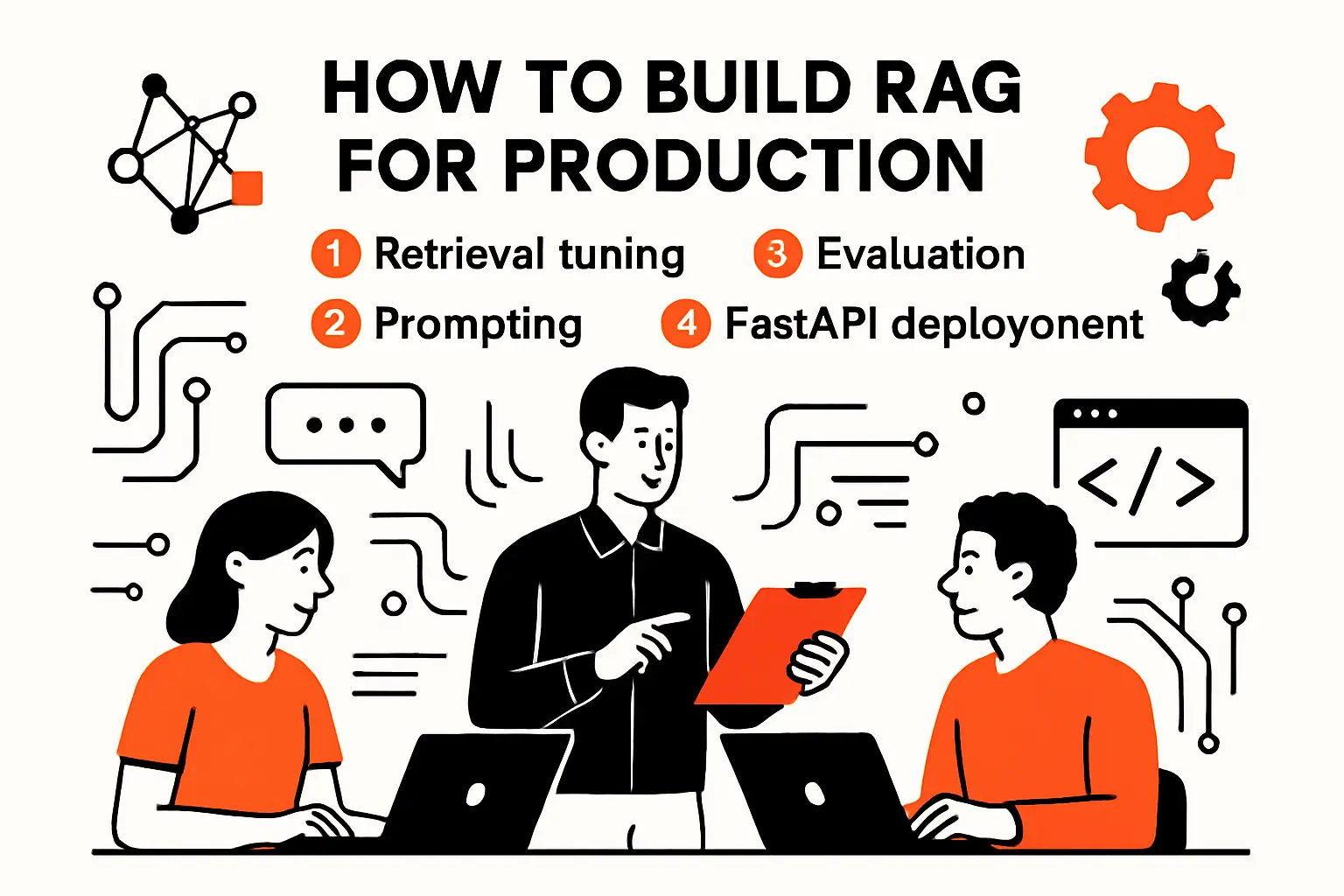
how to build rag for production: retrieval tuning, prompting, evaluation, and FastAPI deployment
1. Retriever configuration: similarity search, top-k selection, and retrieval parameters
Retriever configuration is where RAG stops being a toy. The first tuning step is deciding how many chunks to retrieve and how to balance relevance with coverage. Too few results and you miss critical evidence; too many and you dilute the context, increasing the chance the generator latches onto the wrong passage.
We also tune retrieval with filters and constraints. Metadata filters prevent cross-tenant leakage, enforce document visibility rules, and keep answers aligned with the user’s role. Query-time constraints—like preferring specific document types for specific intents—often outperform raw similarity tweaks because they encode business logic directly.
When a team complains about hallucinations, we usually start here. In many cases, the model is not “making things up” so much as it is answering based on weak evidence. Strengthen retrieval, and generation improves without touching the model.
2. Improving relevance with reranking and iterative query refinement
Dense retrieval is good at finding “roughly related” content. Reranking is how we sharpen that into “the right evidence.” In production, we often add a second-stage reranker that examines candidates more carefully and reorders them based on deeper relevance signals.
Query refinement is the other lever. User questions are frequently underspecified, overloaded with pronouns, or phrased as symptoms rather than topics. We handle this by rewriting queries into a search-friendly form, expanding acronyms, and extracting key entities before retrieval.
In our builds, we treat refinement as a controlled transformation, not as freeform generation. The refined query should be inspectable and testable. Otherwise, you’ve replaced one opaque model step with another opaque model step, and debugging becomes a guessing game.
3. Prompt construction: “use only context” instructions and context assembly patterns
Prompting in RAG is less about clever phrasing and more about contracts. We write prompts that explicitly define roles: “You are a grounded assistant,” “Use the provided context,” “If context is insufficient, say so,” and “Cite the relevant snippet.”
Context assembly is equally important. We prefer to include document titles, source identifiers, and section headers alongside chunk text, because that structure helps the generator interpret the evidence. In policy-heavy domains, we often preserve clause numbering and definitions, because those details matter for correct interpretation even when users don’t ask for them explicitly.
From a product standpoint, citations are not just trust theater. They change user behavior. People ask better questions when they can see where an answer came from, and stakeholders are more willing to adopt the system when it looks auditable rather than magical.
4. Orchestration choices: RAG agents with tools vs single-pass RAG chains
Single-pass RAG chains are straightforward: retrieve once, answer once. Agents introduce tool use and iteration: retrieve, check, refine, retrieve again, then answer. Each approach has a place.
We lean toward single-pass designs when latency and predictability matter most, such as customer support flows where users expect quick answers and the corpus is well-curated. Agents become valuable when tasks are multi-step, when users ask compound questions, or when the system must pull from multiple sources like a ticket system plus a docs site plus a policy repository.
Operationally, agents increase complexity. More model calls mean more cost, more failure modes, and more tracing requirements. Our stance is pragmatic: earn the right to use agents by demonstrating that single-pass retrieval cannot meet the product needs.
5. Evaluation and optimization: precision, recall, F1, iterative refinement, and fine-tuning
Evaluation is where most RAG projects either mature or stall. Without a test set, teams “improve” the system by chasing anecdotes, and every stakeholder ends up with a different definition of success.
We build evaluation around two layers:
- Retrieval evaluation, where we check whether the system surfaces the right evidence for a query.
- Answer evaluation, where we assess whether the response is correct, complete, and faithful to the retrieved context.
On the optimization side, we prioritize fixes in a specific order: data quality, chunking strategy, retrieval tuning, reranking, prompt contracts, and only then model fine-tuning. Fine-tuning can help, but it’s rarely the first bottleneck. In many projects, the “model problem” turns out to be a corpus problem wearing a trench coat.
6. Serving RAG as an API: FastAPI, async processing, and request handling considerations
Serving RAG means serving a pipeline, not a single model call. We need to handle ingestion updates, retrieval queries, prompt assembly, model inference, and response formatting—all under a latency budget and with clear error behavior.
FastAPI is a common choice for this layer because it’s ergonomic for building typed request/response APIs and integrates cleanly with Python-based retrieval stacks. We frequently lean on FastAPI’s request modeling features, especially the ability to declare request bodies with Pydantic models for validation and schema generation, because that reduces ambiguity between client and server.
Async processing is also part of the story. Retrieval and model calls are often I/O-bound, and the service should remain responsive under concurrent load. Background workflows matter too: ingestion, re-indexing, and long-running enrichment should not block user requests, which is why we sometimes rely on patterns where you can run background tasks after returning a response for lightweight post-response work while heavier jobs move to dedicated workers.
TechTide Solutions: building custom RAG solutions tailored to customer needs
1. Custom RAG architecture design aligned to your users, data, and constraints
At Techtide Solutions, we start RAG design with user intent, not with a vector database. Different users ask different questions, tolerate different latency, and require different safety boundaries. A support agent wants quick, helpful answers with clear escalation. A compliance analyst wants evidence-first responses and conservative refusal behavior. An engineer wants deep recall and precise technical snippets.
Constraints shape architecture. Data residency requirements might push you toward local-first or private VPC deployments. Strict access controls might require per-document ACL enforcement at retrieval time. High-variability corpora might require hybrid search and strong metadata hygiene. We treat these as first-class requirements, not as later “hardening.”
Our design deliverable is usually a blueprint that maps sources → ingestion → chunking → embedding → storage → retrieval → prompting → evaluation → serving, with explicit ownership and operational responsibilities at each stage.
2. End-to-end implementation: ingestion pipelines, retrieval logic, and app integration
Implementation is where theory meets the stubborn reality of enterprise content. We build ingestion pipelines that can handle mixed formats, preserve provenance, and support incremental updates. Retrieval logic is then tuned against real user queries, not synthetic examples, with clear instrumentation so teams can see what was retrieved and why.
Integration is often the difference between “a RAG demo” and “a RAG product.” We embed RAG into existing workflows: support ticket tools, internal portals, documentation sites, or chat surfaces where teams already work. Along the way, we build the connective tissue: authentication, authorization, logging, caching, rate limits, and domain-specific UX patterns like “show sources,” “open the referenced doc,” and “report this answer.”
Because we’re a software development company, we treat RAG like application engineering with an AI component—not like an AI experiment that hopes to become a product someday.
3. Operational readiness: deployment, monitoring, iteration loops, and roadmap planning
Operational readiness is where many RAG systems quietly fail. The initial build works, then the corpus drifts, users discover edge cases, and nobody owns the feedback loop. We prevent that by planning for monitoring and iteration from day one.
Monitoring includes retrieval diagnostics (what was retrieved, how often “no good evidence” occurs), latency breakdowns (retrieval vs generation), and user feedback signals (thumbs down, escalations, “viewed sources”). Iteration loops connect those signals back into corpus improvements, chunking adjustments, prompt contract updates, and evaluation set expansion.
Roadmap planning matters because RAG maturity happens in phases. Early stages focus on “make it answer correctly.” Later stages focus on access control depth, multi-source orchestration, personalization, and compliance readiness. We prefer to ship value early, then harden in disciplined increments.
Conclusion: turning a basic RAG into a robust system
1. Minimum viable RAG checklist from corpus to retrieval-grounded answers
A minimum viable RAG system is not “an LLM with a vector store.” It’s a complete loop that is testable and governable. When we sanity-check an MVP, we look for the following:
- A clearly defined corpus with known owners and update paths.
- Reliable loaders that preserve provenance and produce meaningful extracted text.
- A chunking strategy that matches dominant query shapes and preserves semantic units.
- Embedding consistency between indexing and querying, with documented preprocessing steps.
- A vector index with metadata that supports filtering and traceability.
- A prompt contract that forces grounded answers and supports safe refusal.
- An evaluation harness that separates retrieval failures from generation failures.
- A deployment surface that supports observability, access control, and iteration.
Without those pieces, you can still demo RAG, but you can’t responsibly ship it.
2. When to extend beyond basic retrieve-then-generate with advanced RAG patterns
Basic retrieve-then-generate is often enough to create real business value. Still, certain signals tell us it’s time to evolve: users ask multi-hop questions, evidence is distributed across systems, or the corpus is too noisy for naive retrieval.
At that point, we consider advanced patterns like hybrid retrieval, reranking, query planning, structured citations, and multi-step orchestration. Sometimes we add “answer verification” passes that check whether the generated response is supported by retrieved snippets. Other times we redesign the corpus itself, converting unstructured blobs into more structured knowledge objects that are easier to retrieve reliably.
Next step: if you already have a corpus and a basic prototype, what would happen if you built a small evaluation set from real user questions and forced your system to earn trust in measurable ways—before you scale it across the organization?