
At Techtide Solutions, we’ve watched the “agent” conversation shift from novelty demos to board-level urgency, and the shift is not subtle. Market overview: Gartner forecasts worldwide GenAI spending to reach $644 billion in 2025, and McKinsey found 65% of respondents say their organizations are regularly using gen AI in at least one business function, which is why “make it real” is replacing “let’s explore.”
In our day-to-day delivery work, that pressure shows up as a familiar pattern: leaders want automation, teams want safety, and customers want consistency. Because LLMs are probabilistic, every production agent has to earn trust the hard way—through constraints, observability, repeatable evaluation, and tooling that turns fuzzy reasoning into auditable workflows.
Below, we lay out how we approach LangChain-based agents as a product engineering problem rather than a prompt-writing contest. Our goal is practical: ship an MVP quickly, prove value with measurable outcomes, then harden the system until it behaves like software your business can rely on.
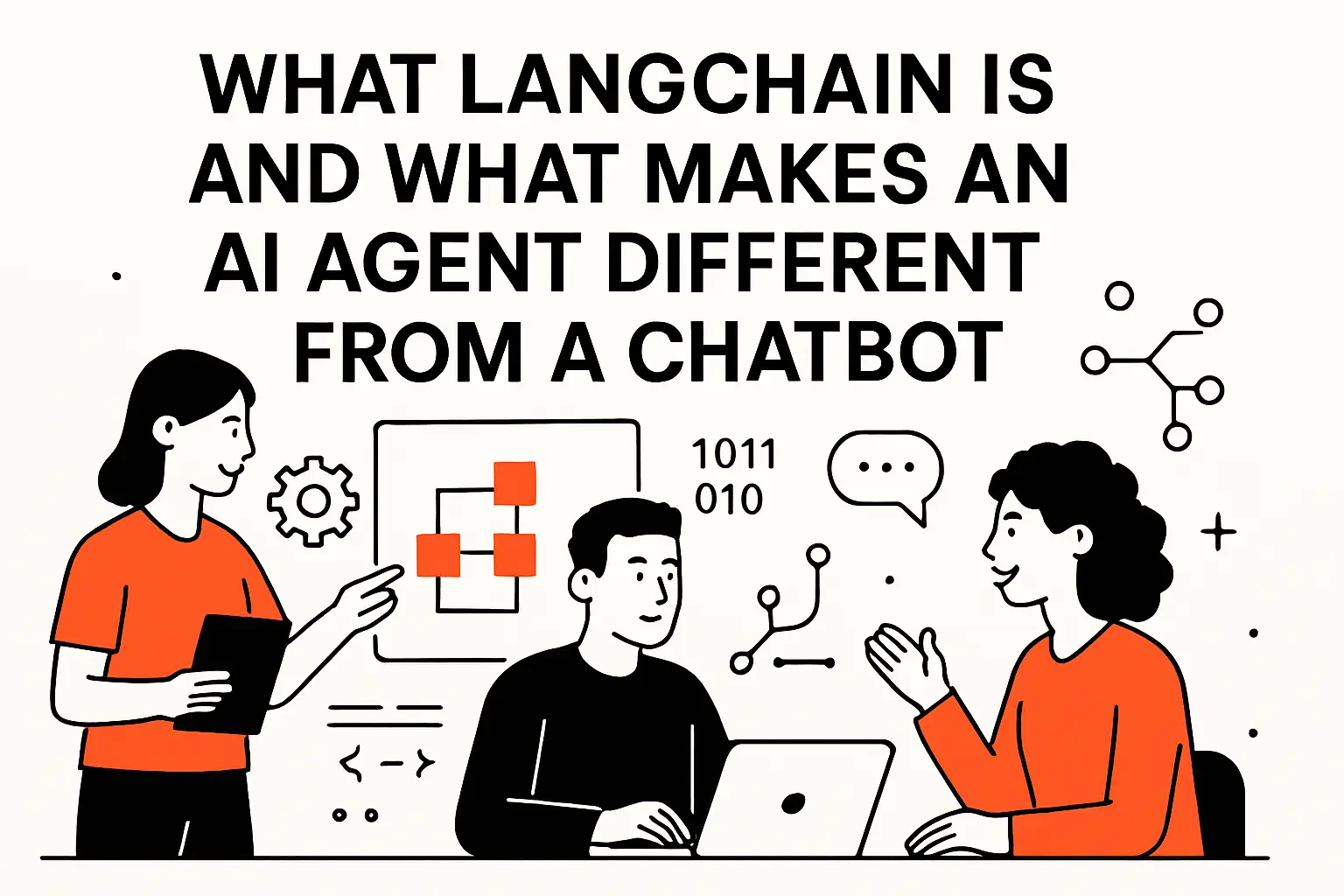
What LangChain is and what makes an AI agent different from a chatbot
1. LangChain as the bridge between an LLM and your tools, data sources, and business logic
In a typical business app, we write code that directly calls APIs, queries databases, and updates records; the flow is explicit and deterministic. With LangChain, we still do all of that engineering, but we add an orchestration layer that lets an LLM participate in the flow—especially where language understanding, fuzzy matching, ambiguity resolution, or judgment calls matter.
From our perspective, LangChain is most valuable when it “wraps” existing capabilities you already trust: CRMs, ticketing systems, data warehouses, internal services, and permissioned action endpoints. Instead of treating the model as a magic brain, we treat it as a decisioning component that must operate inside the boundaries of your product logic.
What We Mean by “Bridge” in Production
Practically speaking, the bridge is a set of interfaces: prompts that define role and policy, tool schemas that define allowed actions, and runtime guards that enforce limits. Under the hood, that structure is what keeps an agent from improvising its way into an incident report.
2. Tool calling basics: functions the model can invoke to take action and fetch data
Tool calling is the moment an agent stops being a “nice answer generator” and becomes an actor in your system. During an agent run, the model can decide it needs more information or needs to perform an operation, and it emits a structured request that your application interprets as a function call.
When we design tools for clients, we treat them like product APIs: narrow scope, explicit contracts, and predictable failure modes. For LangChain specifically, we like the framing that Tools extend what agents can do—letting them fetch real-time data, execute code, query external databases, and take actions in the world because it keeps teams honest about the real work: engineering the “do” part, not just the “say” part.
Why Tool Calling Changes the Engineering Game
Operationally, tool calls introduce side effects, which means you need idempotency, audit logs, and permissioning. Architecturally, tool calls force you to define what “allowed behavior” looks like—an exercise most teams skip until something breaks.
3. Common agent outcomes: answering questions, automating tasks, and handling multi-step workflows
In production, we typically see three classes of outcomes. First, “answering” outcomes: the agent synthesizes a response grounded in internal docs, policies, or customer context. Second, “doing” outcomes: the agent files a ticket, drafts a customer reply, updates a CRM field, or triggers a workflow. Third, “orchestrating” outcomes: the agent performs a sequence of steps—collecting details, validating constraints, calling tools, and producing a final artifact.
Real-world examples tend to look unglamorous, which is exactly why they’re valuable. An operations agent that reads inbound vendor emails, extracts structured fields, cross-checks a procurement system, and queues approvals can create compounding leverage. A support agent that gathers logs, runs a diagnostic tool, and proposes a next action reduces escalations while keeping humans in control of customer commitments.
Our Rule of Thumb for “Agentic” Value
Whenever a workflow involves messy language, incomplete information, and branching decisions, we consider an agent. When the workflow is purely mechanical, we reach for traditional code first.
4. When not to use an agent: cases where traditional software is faster, cheaper, and more reliable
Not every business problem deserves an LLM in the loop, and we’ve learned that saying “no” early is a competitive advantage. If the task is stable, rule-based, and already well modeled—think tax calculations, inventory reconciliation, or deterministic routing—traditional software will usually be faster, cheaper, and easier to verify.
Risk also matters. In regulated environments, an agent that can trigger irreversible actions (payments, account closures, compliance filings) must be wrapped in constraints so tight that you may effectively be rebuilding a standard workflow system anyway. In those cases, we often start with deterministic orchestration and selectively insert LLM components only where they add measurable value.
The Hidden Cost: Debugging Probabilistic Systems
Even a “good” agent can fail in weird ways when prompts change, models update, or upstream data shifts. Because of that, we reserve agentic autonomy for places where the business payoff justifies the operational complexity.
LangChain Academy roadmap: foundational to production-ready agent capabilities
1. Module 1 Create Agent essentials: foundational models, tools, and short-term memory
In our experience, the early phase of agent development succeeds or fails based on fundamentals: how you bind tools, how you format prompts, and how you manage short-term memory in a way that doesn’t balloon cost or inject irrelevant context. That’s why we like the Academy framing of “essentials”—it pushes teams to build competence in the primitives before chasing flashy multi-agent architectures.
From a product standpoint, the most important shift is recognizing that “memory” is not a magical brain. Instead, memory is a deliberate mechanism for selecting which prior facts should be reintroduced, in what format, and with what authority.
What We Look for Before Moving On
Before we add complexity, we want evidence that the agent can follow instructions, call tools correctly, and recover when a tool fails. Without that, every advanced feature just amplifies chaos.
2. Multimodal messages: designing agents that can work beyond plain text
Multimodal inputs are where agents start to feel like products rather than chatboxes. In practical terms, this means handling PDFs, screenshots, error logs, images of receipts, or UI captures from customers who don’t know what they’re looking at. When a user can drop “what I see” into the conversation, your agent can diagnose, classify, and route far more effectively.
Design-wise, multimodality forces clarity: you must decide what the agent is allowed to infer from an image, what it must verify via tools, and what it should hand off to a human. In support environments, for example, an image might be used for rough triage, while the final decision still requires a tool call that retrieves authoritative account state.
Multimodal Pitfall: Overconfidence
Images can trick models into confident nonsense. Because of that, we treat multimodal perception as a suggestion generator, then confirm critical facts via systems of record.
3. Module 2 Advanced Agent concepts: Model Context Protocol, context and state, multi-agent systems
Advanced agent work is fundamentally about state: what the agent believes, what it has done, what it is allowed to do next, and what evidence supports each decision. That’s also where Model Context Protocol discussions tend to land for us—not as a buzzword, but as a way to reason about structured context boundaries across tools, services, and runtime environments.
Multi-agent systems can help when responsibilities need separation. For instance, we may split a “planner” role from an “executor” role so that tool usage is constrained and auditable. Another pattern we like is having a specialist agent for retrieval and citation while a separate agent focuses on user communication style and tone alignment.
We Prefer Specialization Over Huge Tool Menus
When an agent has too many tools, it tends to thrash. Smaller toolsets with clearer roles usually outperform a single omnipotent agent in production.
4. Module 3 Production-Ready Agent practices: middleware, long conversations, human-in-the-loop, dynamic agents
Production readiness is not a single feature; it’s a posture. Middleware matters because it’s where policy enforcement lives: rate limits, content filtering, tool authorization, tenant isolation, and audit logging. Long conversations matter because users treat agents like ongoing collaborators, which means your system must handle drift, stale assumptions, and context bloat.
Human-in-the-loop is the safety valve we reach for repeatedly, especially in customer-facing products. The goal is not to slow the system down; it’s to place humans at decision points that carry business risk, while letting the agent handle the repetitive work that burns team capacity.
Dynamic Agents Need Stronger Guardrails, Not More Freedom
As agents become more adaptive, the quality of your constraints becomes the difference between a scalable system and an expensive liability.
How to build AI agents with LangChain: Step 1 define the agent’s job with concrete examples
1. Choose a realistic task you could teach a smart intern
We like the “smart intern” test because it forces you to define the job in operational terms. An intern can do surprisingly complex work, but only if you give them context, boundaries, and an escalation path. Agents are the same: they need a crisp role, clear inputs, and a defined output artifact.
Instead of starting with “build an agent for customer support,” we start with something like: “Given an inbound ticket and account metadata, propose the next best action and draft a reply, using the knowledge base and recent incidents.” That framing naturally reveals what data you need and what tools must exist.
Good Tasks Have a Concrete Deliverable
A draft email, a filled-out form, a prioritized list of actions, or an internal ticket update is easier to test than a vague “helpfulness” goal.
2. Create 5–10 examples to validate scope and define performance benchmarks
Examples are your early-warning system. A small set of realistic scenarios exposes ambiguity, missing data, and policy conflicts long before you write orchestration code. Better still, examples become your initial benchmark set, which helps you detect regressions as prompts evolve.
From our side, we try to capture cases that represent normal operations, edge cases, and failure modes. For a billing agent, that might include confusing invoices, partial refunds, disputed charges, and policy exceptions. For an IT agent, we include tickets with missing logs, contradictory user descriptions, and known recurring incidents.
We Treat Examples as Product Requirements
If stakeholders can’t agree on what “good” looks like in example form, the agent will become a debate machine rather than a productivity tool.
3. Define success criteria early: what “good output” looks like for real users
Success criteria are where agent projects become business projects. A good criterion ties directly to user value: fewer escalations, faster turnaround, higher first-contact resolution, better internal documentation, or less time spent on repetitive triage. Once those criteria exist, the team can stop arguing about vibes and start measuring outcomes.
We also define failure criteria. A support agent that invents policy is unacceptable. A finance agent that changes a field without a tool-verified reason is unacceptable. A legal summarization agent that omits key obligations is unacceptable. Naming those explicitly helps everyone understand what must be constrained.
Quality Is a Contract, Not a Hope
Agents feel magical early on, but production success comes from turning “pretty good” behavior into repeatable, testable guarantees.
4. Scope red flags: vague requirements, missing APIs/data, or using agents where fixed logic works better
Scope red flags show up fast once you start writing examples. If the agent needs data that lives in a spreadsheet nobody owns, you don’t have an agent problem—you have a data governance problem. If the agent needs to take actions in a system without an API, you may need integration engineering before you can automate anything safely.
Another red flag is using an agent to patch a broken process. If the SOP is unclear or inconsistent, an agent will merely “average” the confusion, producing outputs that look plausible while hiding underlying operational debt.
We Push for Process Clarity Before Automation
An agent can accelerate a good process, but it can also accelerate a bad one straight into customer-visible failure.
Step 2 design a Standard Operating Procedure that the agent can follow
1. Write a step-by-step SOP for how a human would complete the task
An SOP is your best defense against accidental autonomy. By writing down how a skilled human completes the task, you force the organization to externalize tacit knowledge: where to look, what to verify, how to decide, and when to escalate. That written artifact becomes the backbone of your agent prompt and the blueprint for tool design.
In our delivery practice, we encourage teams to write SOPs in plain language first, then refine them into “agent-friendly” structure. Clarity beats cleverness here, because ambiguity becomes runtime variance.
What an SOP Should Contain
Decision points, required checks, “never do” rules, and evidence expectations are more valuable than long prose explanations.
2. Identify decisions, tool needs, and data dependencies surfaced by the SOP
Once the SOP exists, the missing pieces become obvious. If a step says “confirm customer entitlement,” you need a tool that can fetch entitlements. If a step says “check for known incident,” you need an incident lookup tool or a RAG knowledge base. And if a step says “update the ticket,” you need a safe write operation with auditability.
At Techtide Solutions, we like to label each SOP step as one of three types: deterministic (code), judgment-heavy (LLM), or retrieval-heavy (RAG/tool). That classification keeps the system modular and prevents the LLM from being used as a hammer for every nail.
Dependencies Are Not Just Data
Rate limits, permissions, and human approvals are dependencies too. Mature agent designs treat them as first-class constraints.
3. Translate the SOP into an agent flow: triggers, inputs, intermediate steps, and outputs
A flow is where the agent becomes a system. The trigger might be “new Zendesk ticket,” “Slack command,” or “webhook from internal service.” Inputs might include ticket text, customer metadata, and relevant policy docs. Intermediate steps might include classification, retrieval, tool calls, and validation checks. Outputs might include a draft response, an updated record, and an internal explanation trace.
Flow design also clarifies where humans should be inserted. For example, we often require approval before any external customer message is sent, while allowing the agent to autonomously gather diagnostics and prepare drafts.
We Prefer Explicit States Over Implicit Memory
When state is explicit, you can debug it, persist it, and audit it. When state is implicit, you can only hope the model remembered correctly.
Step 3 build an MVP with a single strong prompt before adding automation
1. Start from the SOP: outline the agent’s architecture and where LLM reasoning is essential
Before we wire up tool calls, we try to prove the core reasoning loop with a single prompt. That means feeding the agent the relevant context as plain text (for now), then asking it to produce the exact output artifact we want. This is where we learn whether the task is even “LLM-shaped.”
Architecturally, we separate concerns early: instruction layer (policy and SOP), context layer (retrieved facts and user input), and output layer (structured response). Keeping those layers distinct makes later automation far less painful.
We Avoid Premature Orchestration
Tooling cannot rescue a weak task definition. Strong prompts emerge from tight scopes, not from clever frameworks.
2. Focus on one high-leverage reasoning task first: classification or decision-making
In many business agents, the first win is classification: “What kind of ticket is this?” or “Which workflow should run?” That decision can unlock automation while keeping risk contained, because classification can be reviewed and corrected easily. Decision-making tasks also work well: “Given these constraints, which next action is safest?”
From our experience, high-leverage reasoning is usually about mapping messy language into structured intent. Once intent is structured, the rest of the pipeline can often be deterministic.
Start Where Humans Spend Cognitive Energy
If your team is mostly copy-pasting, automation should target templating first. If your team is mostly diagnosing, automation should target triage and evidence gathering.
3. Use hand-fed context and your Step 1 examples to validate the prompt reliably
Hand-feeding context is not a shortcut; it’s a scientific method. By controlling what the model sees, we can isolate whether failures come from missing data, unclear instructions, or model limitations. This phase is also where we refine the output format, tighten the tone, and enforce the “no invention” rules.
As reliability improves, we gradually replace hand-fed context with automated retrieval or tool calls. That staged approach prevents teams from debugging too many moving parts at once.
We Treat Prompting Like Interface Design
The prompt is an API contract between your product and a probabilistic component. Clear contracts reduce surprising behavior.
4. Prompt iteration workflow: versions, scenario testing, and performance tracking with LangSmith
Prompt iteration without tracking is how teams accidentally regress. We want versioned prompts, repeatable scenario tests, and a way to compare outputs over time. For that, we lean on the idea that LangSmith can test application code pre-release and while it runs in production, because it matches how we treat any other critical system: ship changes with evidence.
In practice, we capture traces from real usage, add them to evaluation datasets, and rerun them when prompts or tools change. Over time, that creates a feedback loop where production teaches the agent how to behave more consistently.
Observability Is Not Optional
If you cannot trace which tools were called, what data was retrieved, and why the agent chose an action, you cannot operate the system safely at scale.
Step 4 connect and orchestrate real data with tool-calling agents in Python
1. Project setup: dependencies, virtual environments, and API keys via a .env file
Once the MVP prompt behaves, we connect it to reality. A clean project setup keeps experimentation from turning into dependency soup. In Python, we standardize on isolated environments, explicit dependency management, and configuration that never leaks secrets into source control.
From a security standpoint, we treat API keys and credentials as production-grade assets even during prototyping. A .env file can work locally, while secret managers handle cloud deployments later; the key is keeping the configuration interface consistent as you move toward production.
Our Setup Bias
Repeatability beats cleverness. If a new developer can’t run the agent reliably, production hardening will be slow and error-prone.
2. Building tools that agents can call: search, scrape, and save operations as callable functions
Tools should mirror what your business already trusts. In a customer support agent, that typically means read-only tools first: fetch customer profile, fetch recent orders, search knowledge base, retrieve incident status. After read paths are stable, we introduce write tools carefully: add internal note, tag ticket, draft reply, request approval.
Design-wise, we build tool wrappers that behave like stable application services. Inputs are explicit, outputs are structured, and side effects are never hidden. That approach aligns with the LangChain framing that tools are callable functions with defined schemas, and it keeps the agent from becoming a free-form script runner.
Tool Scoping Keeps You Safe
If an agent can “save anything anywhere,” it eventually will. Narrow tools reduce blast radius and improve testability.
3. Tool design patterns: clean inputs/outputs, performance limits, and robust error handling
In production, tool design is where latency and reliability live. We aim for small payloads, predictable response times, and clear error semantics. When a tool fails, the agent should receive a structured error it can reason about, not a stack trace it will paraphrase into nonsense.
We also build in “guard patterns” around tools. Authentication and authorization happen before the tool executes. Validation rejects malformed inputs. Logging captures requests and outcomes for audit. Retries are handled carefully to avoid duplicating side effects.
Performance Is a Feature
An agent that takes too long feels broken, even when it is technically correct. Fast tools make agentic workflows feel natural to end users.
4. Agent construction patterns: system prompts, agent scratchpad, and executing runs with an AgentExecutor
Once tools exist, we wire them into an agent loop that can plan, act, and respond. At a conceptual level, Workflows have predetermined code paths and are designed to operate in a certain order; agents are dynamic and define their own processes and tool usage, and that difference matters when you decide how much autonomy to allow.
In LangChain-style tool calling agents, the “scratchpad” concept is crucial because it gives the model a place to see prior tool calls and their results. For that reason, the agent prompt often must have an agent_scratchpad key so the runtime can pass intermediate steps back to the model consistently.
Execution Is Its Own Component
We treat orchestration as separate from reasoning. That separation is how we add timeouts, cancellation, audit hooks, and human approvals without rewriting the agent’s core prompt.
5. Structured outputs for reliability: defining schemas with Pydantic and parsing agent responses
Free-form text is friendly for demos and hostile for production. When an agent’s output becomes an input to downstream systems, we want structure: explicit fields, allowed values, and validation. Pydantic-style schemas give us a contract that can be checked automatically, which reduces silent failures and “kind of correct” outputs.
From our viewpoint, structured output design is also a UX decision. A support agent response might include a customer-facing draft, an internal-only reasoning summary, and a list of tool evidence references. Once that structure exists, product teams can build clean interfaces, approvals, and analytics around the agent’s behavior.
Validation Creates Leverage
When outputs are validated, failures become actionable. When outputs are unstructured, failures become subjective debates.
Build RAG agents with LangChain: indexing, retrieval, and agentic search strategies
1. Indexing pipeline: load documents, split into chunks, and store embeddings in a vector store
RAG begins long before the first user question. The indexing pipeline determines what the agent can know and how reliably it can find it. In practice, we load documents from sources like wikis, PDFs, tickets, runbooks, and product specs, then split them into chunks that preserve meaning while remaining searchable.
From an engineering standpoint, the key is provenance. We want each chunk to carry metadata: source, timestamp, access control context, and document hierarchy. That metadata is what lets the product show “where the answer came from” and what lets your security model remain enforceable.
Chunking Is Not Just Text Splitting
Good chunks map to business concepts: policies, procedures, troubleshooting steps, and definitions. Bad chunks map to random page breaks.
2. Retrieval and generation loop: retrieve relevant splits with a retriever, then generate with grounded context
The classic RAG loop is retrieve-then-generate. A user asks something, your retriever pulls the most relevant document chunks, and the model answers using that context. In production, we add more discipline: we instruct the model to cite retrieved sources, to avoid claims not supported by context, and to ask clarifying questions when retrieval is weak.
We also tune retrieval strategies by use case. For policy questions, precision matters more than breadth. For troubleshooting, breadth can matter because multiple weak signals may combine into a correct diagnosis. Those are product decisions, not just embedding decisions.
Grounding Is a Behavioral Constraint
RAG is not only about adding knowledge; it’s about constraining what the model is allowed to confidently assert.
3. RAG agents: wrap vector search as a tool and let the LLM decide when and how to search
Agentic RAG treats retrieval like one tool among many. The agent decides when it needs knowledge, how to phrase a search query, and whether to refine the query after seeing results. This can feel dramatically more capable, especially when the user’s request is vague or when the agent needs to gather context before it can even decide what to ask for.
In our implementations, we pair RAG tools with “evidence rules.” The agent must surface the retrieved excerpts it relied on, and it must explain which parts of the user request were answered by which evidence. That pattern makes trust-building possible, especially for internal copilots used by customer-facing teams.
Agentic Search Needs Guardrails
If the agent can search broadly, it may surface irrelevant or sensitive information. Access control and query constraints are part of RAG design, not an afterthought.
4. RAG chains: always retrieve first, then answer in a single LLM pass for lower latency
RAG chains are the “boring” option that often wins. By always retrieving first, then answering in a single generation pass, you get predictable behavior, lower latency, and easier evaluation. For FAQ-style experiences, policy lookups, and internal documentation assistants, this is frequently the right baseline.
From a product perspective, chains also simplify UI. Users see one response with citations, and the system remains easy to debug because the decision path is fixed. When teams are early in production adoption, we often recommend starting here before escalating to agentic retrieval.
Predictability Buys You Time
Many organizations need a reliable system today more than they need a clever system tomorrow. Chains are a pragmatic starting point.
5. Trade-offs: flexibility and contextual tool calls versus control, predictability, and inference cost
Agents are flexible, but that flexibility is not free. More steps mean more tool calls, more model invocations, and more surface area for errors. Meanwhile, chains are more controllable but can fail when the user’s request requires branching logic or iterative clarification.
At Techtide Solutions, we frame this as an engineering trade: do you want the system to be adaptive in the moment, or do you want it to be measurable and repeatable at scale? Most mature products land on a hybrid: deterministic scaffolding with agentic components where uncertainty is unavoidable.
Cost Is Not Just Compute
Operational cost includes debugging time, incident response, and stakeholder trust. A slightly less capable system can still be the better business choice.
6. Going beyond basics: deeper control with LangGraph, plus next steps like streaming, memory, and structured responses
When agent behavior needs tighter control, we reach for graph-based orchestration. In that world, you explicitly model states, transitions, and checkpoints, which makes it easier to implement approvals, retries, and fallbacks. If you want to go deeper on that path, it matters that LangGraph is an MIT-licensed open-source library, because open primitives give teams room to customize without locking into a black box.
Streaming is another practical upgrade. Users don’t just want answers; they want to see progress—especially when the agent is fetching data or waiting on tools. Memory strategies also evolve here: short-term conversational context, long-term user preferences, and task-state persistence all need different storage and retrieval approaches.
Our Next-Step Pattern
Once the MVP is stable, we add structured outputs and explicit state management before we broaden the agent’s scope. That sequencing keeps complexity from compounding too early.
TechTide Solutions: custom agent and RAG development tailored to your product and customers
1. Custom AI agent design: translating business SOPs into reliable LangChain-based workflows
Our strongest projects begin with operational truth: how work actually happens inside your team. We translate SOPs into agent behaviors, tool contracts, and safety constraints that match your business reality rather than a generic “assistant” persona.
In delivery, we focus on the parts that are easy to underestimate: stakeholder alignment on outputs, tool permission modeling, and failure-path design. Those are the ingredients that turn a prototype into something your frontline teams will actually adopt.
We Build for Adoption, Not Demos
An agent that impresses engineers but confuses users is a product failure. We optimize for workflows that feel natural inside existing tools and processes.
2. End-to-end implementation: tool integrations, RAG pipelines, and production-ready web app backends
End-to-end means more than “the model runs.” We implement tool integrations that connect to your systems of record, build RAG pipelines with provenance and access control, and deliver backend services that can be deployed, monitored, and scaled. In practice, this often includes designing APIs that separate agent orchestration from business logic so the system remains maintainable.
We also build with lifecycle in mind. Prompts change, policies change, and knowledge bases evolve. A production agent must be designed for iteration, with a clear path to add tests, retrain retrieval indexes, and roll out updates safely.
Integration Quality Determines User Trust
If tools return inconsistent data, the agent will look unreliable no matter how good the model is. Tight integrations make the whole experience feel credible.
3. Operational readiness: testing strategy, observability, and deployment patterns aligned to customer needs
Operational readiness is the phase most teams skip, then regret. We build evaluation harnesses, tracing, error reporting, and audit logs so you can understand what the agent did and why. On top of that, we design deployment patterns that match your environment: internal-only copilots, customer-facing assistants, or hybrid systems with staged approvals.
From our viewpoint, an agent is a living system. The job is not to “finish” it; the job is to make it safe to evolve it.
Reliability Is an Operating Model
Once an agent touches real customers or real money, you need release discipline, rollbacks, and monitoring just like any other critical service.
Conclusion: test, deploy, and iterate your LangChain agents into production-ready systems
1. Testing and iteration: manual validation on examples, automated runs, and clear success metrics
Testing starts manually, because early on you’re still learning what “correct” means. As soon as the output format stabilizes, we move toward automated runs over the example set, then expand those tests as real-world traces accumulate. Clear success metrics keep the team grounded in business value rather than subjective preference.
Over time, the testing strategy becomes your safety net for change. Prompt edits, tool upgrades, and retrieval tuning all become routine when you can prove they improved the system rather than merely changing it.
We Measure What Users Feel
Latency, correctness, and consistency are not abstract engineering metrics; they map directly to whether teams trust the agent enough to use it daily.
2. Observability and debugging: tracing multi-step runs with LangSmith to improve reliability and cost
Multi-step agents require “flight recorders.” Tracing lets you see tool calls, intermediate decisions, and the exact context the model used. With that visibility, failures become diagnosable: a retrieval miss, a malformed tool schema, an unclear instruction, or an authorization block.
Cost control also improves with observability. When you can see which steps are expensive and which are redundant, you can simplify flows, cache results, or replace agentic behavior with deterministic logic where it makes sense.
Debugging Agents Is Debugging Systems
The model is only one component. Most production failures come from orchestration edges: missing data, tool flakiness, and unclear policies encoded in prompts.
3. Deployment path: serve agents via FastAPI endpoints and promote to cloud hosting with repeatable releases
Deployment is where an agent becomes a product capability. We typically package the agent behind a service boundary (often a FastAPI layer), define request/response contracts, and integrate authentication and tenant isolation. Once that boundary exists, the agent can evolve independently while the product remains stable.
Repeatable releases matter more than the hosting choice itself. Whether you deploy to a managed container platform or a more traditional VM environment, disciplined rollouts and rollbacks are what keep agent updates from becoming customer incidents.
Production Means Operational Ownership
If nobody owns on-call response, monitoring, and release gates, the “agent” will quietly become an unmanaged risk surface.
4. Scaling up safely: expand scope gradually, add integrations carefully, and keep humans in the loop when needed
Scaling is not just about handling more requests; it’s about handling more responsibility. As scope expands, integrations multiply, and the agent’s decisions carry more business impact. Gradual expansion lets you learn where the system fails without turning early users into unwilling beta testers.
Human-in-the-loop is the scaling lever many teams resist, then embrace. Approval queues, confidence thresholds, and escalation workflows are not admissions of failure; they are how you safely unlock automation while protecting customers and brand trust.
Our Suggested Next Step
If you already have a workflow in mind, the most productive move is to write the SOP and assemble a small example set, then ask: which parts are deterministic, which parts need retrieval, and which parts truly need agentic judgment?