
At Techtide Solutions, we’ve learned the hard way that “backend development” is rarely about business logic alone. Infrastructure decisions, deployment choreography, observability plumbing, and permission models tend to sprawl until a simple feature request feels like a mini-migration. Meanwhile, executives still expect the backend to be the quiet, reliable engine that never interrupts customer experience.
Against that backdrop, Darklang is interesting not because it adds yet another syntax to the world, but because it reframes the backend as a productized runtime with an opinionated workflow. In our view, that’s the only credible way to fight accidental complexity at scale: not by telling teams to be disciplined, but by removing entire categories of decisions that discipline must repeatedly defend.
Market forces also push in this direction. Public cloud spend keeps rising, and the gravity of managed services makes “operational overhead” a board-level cost center rather than an engineering footnote. Gartner’s forecast of $675.4 billion in 2024 is one reason we see more companies asking a pragmatic question: if we’re already paying for platforms, why not demand platforms that collapse the distance between code and running software?
In this article, we’ll walk through what Darklang is trying to solve, how its “deployless” worldview actually works, where the language design choices matter in practice, and why the open-source reboot changes the risk calculus for real teams. Along the way, we’ll offer the Techtide Solutions take: what we’d pilot, what we’d avoid, and what we’d want proven before betting a revenue-critical service on it.
What the dark programming language Darklang is trying to solve

1. Serverless backends with a focus on minimizing infrastructure and deployment work
Most teams we work with don’t struggle to write endpoints; they struggle to keep endpoints alive. The moment a backend grows beyond a toy, it collects “shadow requirements”: secrets rotation, log retention, rollback strategy, schema migrations, background jobs, queue tuning, and the perennial question of how to debug a production-only edge case without turning the system into a science project.
Darklang’s core promise is to compress that surface area so backend work feels closer to writing code than running a small data center. From our perspective, that promise is less about serverless branding and more about removing the need to constantly translate intent (a feature) into infrastructure artifacts (pipelines, manifests, images, and environment matrices). Put differently, Darklang is trying to make deployment and operations “boring by default” rather than “possible with enough YAML.”
In practical terms, the problem being solved is latency between decision and feedback. When deploys become ceremonies, teams batch changes; when changes batch, risk rises; when risk rises, approvals multiply; and the loop slows again. Darklang’s thesis is that a platform can break that cycle by turning the backend into a continuously running, continuously updating substrate where the default action is shipping.
2. An integrated approach: language, editor, and infrastructure designed as one system
We tend to think of programming languages, editors, and infrastructure as separate markets. Darklang challenges that separation by treating them as one product boundary: the language semantics inform what the runtime can guarantee, and the runtime guarantees inform what tooling can safely automate.
From an engineering leadership standpoint, integration is not automatically good; it is a trade. Still, integration can unlock capabilities that are hard to bolt on later, especially around safe refactors, trace-driven debugging, and preventing entire classes of production failure. If you control the runtime, you can standardize observability. If you control the language, you can standardize error handling. And f you control the editor and packaging workflow, you can standardize how changes move from idea to execution.
At Techtide Solutions, we’ve built internal “platform layers” for clients that approximate this integration—shared libraries, paved-road templates, golden CI pipelines, standardized telemetry. Darklang’s provocative stance is that teams shouldn’t have to assemble that scaffolding themselves, because assembling it is the accidental complexity.
3. Darklang vs Dart vs the esoteric language Dark: avoiding name confusion
Brand collisions matter more than engineers like to admit. “Dark” is an overloaded name in the programming world, and “Dart” is a separate, widely known language with its own ecosystem and community expectations. Darklang’s identity sits awkwardly in that search-space, especially for teams who do quick due diligence by skimming documentation and GitHub activity before committing to a deeper read.
In our client conversations, we’ve seen name confusion slow evaluation because stakeholders assume the language is either related to mobile tooling (because of Dart) or is experimental art (because of “Dark” as an esoteric curiosity). Darklang is neither. It is best understood as a backend-centric system that uses a language as the entry point into a managed runtime and workflow.
Practically, the way we handle this internally is to describe it as “Darklang, the deployless backend platform,” not “Dark.” That wording forces the conversation onto operational outcomes rather than syntax trivia, which is where the real differentiation lives.
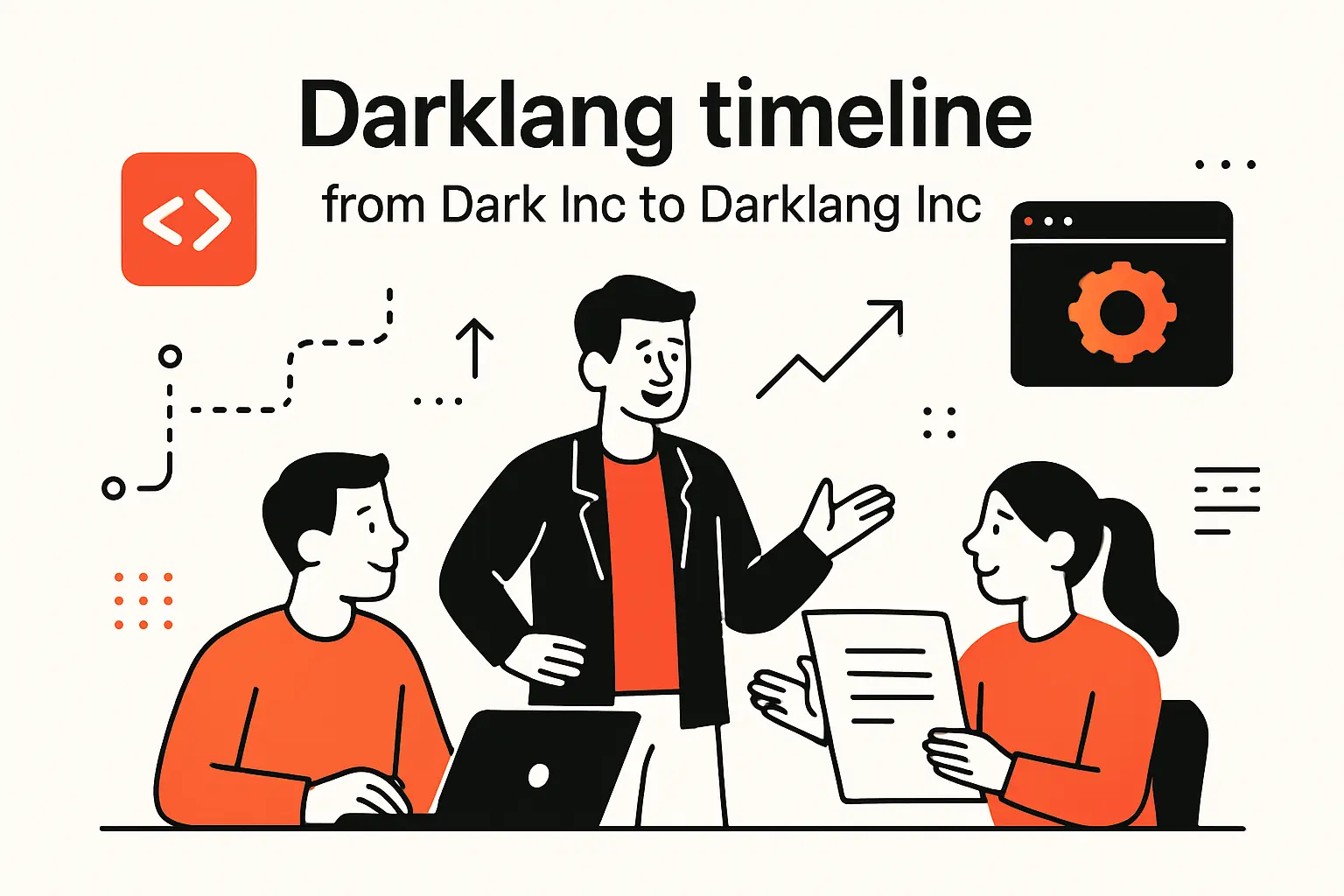
Darklang timeline: from Dark Inc to Darklang Inc
1. 2017 founding and the 2019 emergence into broader public visibility
Every platform story has a “why now” moment, and Darklang’s early arc is a familiar one: a small team tries to bend reality so that building backends stops feeling like a tax on product velocity. The public unveiling phase matters because it is where an idea collides with real workloads, real developer habits, and real expectations about reliability.
From our perspective, the most instructive part of this era is not the hype cycle; it’s the decision to center “deployless” as the differentiator. Many tools promise speed. Few tools are willing to claim that shipping should be the default and that the platform should absorb the complexity that makes shipping scary.
In client terms, the relevant question is simple: did the platform emerge because it could meaningfully reduce time-to-change for production systems, or because it was a clever demo? Darklang’s history suggests the team optimized for the former, even when it meant carrying a heavy product and infrastructure burden.
2. Darklang-Classic: the hosted platform era and “deployless” positioning
Darklang-Classic is the era that made “deployless” concrete. Instead of asking developers to install toolchains, wire up CI, provision databases, and then prove the system works, the platform positioned itself as the place where code and runtime meet immediately.
In our experience, hosted-only eras usually teach two lessons. First, hosted control makes it easier to deliver magical UX because you can assume the runtime shape. Second, hosted control concentrates risk because the vendor becomes a single point of failure in both business continuity and operational transparency.
The interesting nuance is that “deployless” is not just about removing a deploy button. It’s about changing how teams think. When deploys are not an event, engineers start designing small changes. When changes stay small, reviews improve. And when reviews improve, reliability becomes a habit rather than a hero moment.
3. June 16, 2025: Dark Inc runs out of money and assets move to Darklang Inc
Vendor transitions are where platform bets get tested. When a company changes hands, users learn whether they were buying a product with a community—or renting access to a runway. Darklang’s shift into a new steward matters because it reframes the system from “hosted service with a language” into “language and tooling with multiple possible execution contexts.”
From a risk-management standpoint, this is the moment that makes many enterprise conversations possible. Procurement teams don’t love vendor lock-in, but they can tolerate it if continuity plans exist. Engineering teams don’t love black boxes, but they can accept them if observability and exit strategies are credible.
At Techtide Solutions, we read this transition as a forcing function: either the platform becomes inspectable and contributable, or it becomes an increasingly fragile niche. The fact that the story continued is, in itself, a signal that the community and maintainers believe the core ideas are worth preserving.
Just code: the Darklang philosophy for removing accidental complexity
1. “No cruft” development: removing build systems, packaging steps, and environment setup
We sympathize with the “no cruft” rallying cry because we’ve watched teams burn weeks not on features, but on alignment: aligning local machines, aligning build pipelines, aligning dependency graphs, and aligning environment variables across a growing set of services. Those steps are sometimes necessary, yet they are rarely the reason a business wins.
Darklang’s philosophy aims at the repetitive friction points: build orchestration, packaging rituals, and the endless drift between “works on my machine” and “works in production.” In an integrated system, the platform can eliminate entire categories of setup because the runtime assumptions are standardized and the iteration loop is intentionally short.
For our clients, the business value shows up as reduced cycle time and fewer cross-team handoffs. A feature team that can implement, validate, and ship without waiting on a separate platform team is not just faster; it also tends to be more accountable for outcomes because it owns the whole loop.
2. Reducing DevOps surface area: fewer moving parts across deploy, infra, and data layers
DevOps is not the enemy; unbounded DevOps is. Once infrastructure becomes an open-ended design space, every team invents a new way to log, deploy, shard, cache, and queue. Eventually, reliability depends on a handful of specialists who are stretched thin and constantly context-switching.
Darklang’s bet is that backends can be safer when there are fewer levers to misconfigure. If a runtime provides primitives for endpoints, background execution, and persistence, then operational concerns become properties of the platform rather than bespoke code in every repo. That’s attractive for teams who want to focus on domain logic while still meeting uptime expectations.
At Techtide Solutions, we frame this as “reducing the blast radius of creativity.” Creativity belongs in product behavior, not in reinventing deployment mechanics. A platform that narrows infrastructure choice can feel constraining, yet constraint is often what makes an org scale without drowning in variance.
3. Tradeoffs raised by the community: simplicity vs outsourcing complexity to the platform
Skepticism is healthy here. When a platform removes choices, it also takes on responsibilities. If you outsource operational complexity to a platform, you are trusting its defaults, its roadmap, and its incident response posture. That trust can be warranted, but it must be examined.
One recurring tradeoff is transparency. Traditional stacks expose everything—sometimes too much—so teams can always “drop down a layer.” Integrated platforms often hide layers to reduce cognitive load, which is great until you hit the edge case where you need that hidden detail. Another tension is portability. A system that is delightful because it is cohesive can be difficult to replicate elsewhere without losing the magic.
Our stance is pragmatic: simplicity is worth it when the platform earns it through reliability, clear boundaries, and credible escape hatches. When those conditions aren’t met, the simplicity becomes a marketing veneer over a hard dependency.
Deployless development workflow: continuous delivery by default
1. Continuous delivery model: frequent, low-risk updates pushed rapidly
“Continuous delivery” is easy to praise and hard to live. Tooling can make shipping fast, but culture determines whether teams keep changes small, write meaningful tests, and prioritize observability. Darklang’s workflow tries to change the economics: when deployment overhead approaches zero, the incentive to batch changes weakens.
In our delivery work, we’ve seen the highest reliability come from teams that ship in small increments and treat rollback as routine rather than an emergency act. A deployless model supports that behavior by removing the “big red button” feeling. Instead of planning deployments, teams plan slices of value.
Operationally, the key is not speed for its own sake. The real win is lower variance: fewer late-night releases, fewer coordination meetings, and fewer “freeze windows” that delay customer value. For businesses, that translates into predictable iteration and faster response to market feedback.
2. Deployment redesign: eliminating common steps like containers, long builds, and handoffs
Most deployment pipelines are a museum of historical compromises. Containers solved dependency drift, yet they also introduced image scanning, registry management, base-image churn, and runtime security constraints. Build steps catch errors early, yet they also lengthen feedback loops and create separation between code and runtime behavior.
Darklang’s redesign is to treat deployment as an implementation detail rather than a developer task. In an integrated runtime, the platform can interpret or otherwise execute code directly, manage versioning, and provide safety rails that reduce the need for heavyweight handoffs.
For a typical organization, the business implication is significant. When product teams can deliver without negotiating with multiple gates, the org’s bottleneck shifts from “release mechanics” to “decision quality.” That’s where leadership actually wants the bottleneck to be, because decision quality is a competitive lever, while release mechanics are just overhead.
3. Built-in primitives: HTTP endpoints, background workers, scheduled jobs, datastores, and internal tools
In most stacks, primitives arrive as a patchwork: a web framework for endpoints, a queue system for workers, a scheduler for cron-like jobs, a database driver for persistence, and a separate low-code tool for internal admin panels. Each piece is reasonable alone. Together, they create integration seams where complexity breeds.
Darklang’s model is to expose these primitives as first-class concepts so developers write business logic against stable interfaces rather than wiring. From a systems point of view, that can be a powerful way to enforce consistent observability and consistent failure modes. When the platform knows what an endpoint is, it can trace it. When the platform knows what a worker is, it can replay it.
In our practice, the internal-tools angle is especially compelling. Many businesses end up building “shadow apps” for customer support, finance operations, and incident response. A platform that treats those as legitimate backends—not afterthought scripts—can reduce operational toil and improve data integrity across departments.
Language design in Darklang: functional, typed, and pragmatic
1. Functional programming with Records and Enums as core modeling tools
Language design is only interesting when it changes system behavior. Darklang’s functional lean matters because it pushes teams toward explicit data flow. In a backend context, explicit data flow is not academic; it’s what makes debugging and change review feasible when services interact in complex ways.
Records and enums as core modeling tools encourage a style of code where domain states are enumerated rather than implied. In our client work, that translates into fewer “mystery states” in production, because the code must acknowledge the possibilities. When business logic evolves—new subscription states, new fulfillment pathways, new account flags—explicit modeling reduces the chance that old assumptions silently persist.
Records As Contracts Between Teams
Cross-team interfaces are where bugs hide. A record type can act like a contract that forces conversations early: what fields exist, which ones are optional, and what transitions are valid. In a platform that emphasizes rapid iteration, having those contracts be easy to evolve without chaos becomes a strategic advantage.
2. Option and Result types: replacing nulls and exceptions with explicit error handling
Backends fail in boring ways: missing data, invalid input, downstream timeouts, permissions mismatches. Traditional languages often encode those failures via nulls and exceptions, which are convenient until they become invisible control flow. At scale, invisible control flow is a tax on every code review and every on-call shift.
Option and Result types, when used consistently, make failure explicit and therefore composable. From a business standpoint, the benefit is not philosophical purity; it’s reliability. Teams can reason about what happens when a dependency is unavailable. Product managers can get clearer answers about edge cases. Support teams can be given tooling that distinguishes “not found” from “could not load,” which changes how issues are triaged.
At Techtide Solutions, we generally prefer explicit error modeling even in ecosystems that don’t enforce it, because it produces calmer incident response. Darklang’s alignment with that principle is one reason we consider it a serious attempt at reducing accidental complexity, not just a language novelty.
3. Runtime and data model choices: garbage collection and Unicode-first text handling
Runtime choices matter because they shape what kinds of mistakes are cheap. Garbage collection is a trade: you give up some low-level control in exchange for faster development and fewer memory management bugs. For many business backends, that’s the right trade, especially when the primary constraint is developer time and operational clarity rather than micro-optimizing memory layout.
Unicode-first text handling is similarly practical. Real businesses ingest messy customer input: names, addresses, product metadata, and free-form support messages. Text bugs are often not spectacular; they are subtle data-quality issues that surface as billing mismatches or failed exports. A runtime that treats text as a first-class, human-facing concept reduces the chance that teams accidentally corrupt customer data while “just parsing strings.”
Our view is that these choices align with Darklang’s broader posture: optimize for building correct systems quickly, then provide platform-level levers for performance and scale rather than expecting every team to become runtime experts.
Tooling and iteration loop: CLI workflows, packages, and editor support
1. Run shared functions directly: calling package items from the command line
CLI workflows sound mundane, yet they are where many organizations either accelerate or stall. When teams can share executable utilities as easily as they share code snippets, operational maturity improves. The same logic that powers an endpoint can also power a diagnostic script, a data backfill, or a customer-support automation tool.
Darklang’s “run a shared function” framing is compelling because it treats reuse as a distribution problem, not merely a code-organization problem. In traditional ecosystems, sharing utilities means packaging, versioning, and dependency negotiation. In a tighter platform model, reuse can become more granular and less ceremony-heavy.
For businesses, that translates into fewer one-off scripts that nobody owns. Instead, internal automation can be reviewed, versioned, and operated with the same seriousness as product code, which is exactly where auditability and compliance pressure tends to push mature organizations anyway.
2. Gradual static typing for prototyping, plus stronger checking for confidence later
Teams often fall into a false dichotomy: either move fast with dynamic code and pay later, or move slower with strict typing and pay upfront. Gradual typing attempts to break that trap by letting teams explore while still converging on rigor as a system hardens.
In our experience, the real advantage is psychological as much as technical. Prototyping stays fluid, which keeps momentum. Later, stronger checking becomes a tool for refactoring rather than a barrier to starting. That aligns well with how product work actually happens: uncertainty early, consolidation later.
When this works, onboarding improves too. New engineers can make small changes with confidence because the system provides guardrails. Meanwhile, senior engineers spend less time explaining “tribal knowledge” about implicit assumptions, because the types document intent.
3. Editor compatibility: VSCode extension and LSP support beyond a single proprietary editor
Tooling adoption is often decided by what developers already use. Proprietary editors can enable deep integration, yet they also impose workflow change, which is a hidden cost that rarely appears in ROI spreadsheets. Editor compatibility is therefore a strategic choice, not a convenience feature.
By leaning on LSP and mainstream editor support, Darklang reduces one of the biggest barriers to trial. Developers can keep familiar navigation, familiar keybindings, and familiar review habits. For organizations, that means the cost of evaluation is closer to “pilot a new runtime” rather than “retrain the team.”
At Techtide Solutions, we treat this as a prerequisite for serious enterprise consideration. Platform magic is only useful if teams can actually reach it without abandoning the ergonomic tools that keep them productive day-to-day.
Safety, immutability, and the open-source ecosystem of the dark programming language
1. Immutability as “secret sauce”: enabling safer execution, easier review, and replayable behavior
Immutability is one of those concepts that feels like a language preference until you tie it to operational outcomes. In a mutable world, debugging means reconstructing a timeline of state changes that may not be observable. In an immutable world, state transitions are explicit, and replay becomes a realistic technique rather than a heroic reconstruction.
For businesses, safety often means predictability. When code is easier to review and behavior is easier to replay, teams spend less time arguing about what happened and more time fixing what matters. That reduces incident duration and lowers the cost of compliance evidence, because the system’s behavior can be explained more cleanly.
Our perspective is that immutability pairs naturally with a deployless model. If change is frequent, then each change must be easy to reason about. Immutability is one way to make that reasoning tractable even as the system evolves rapidly.
2. Permissions and static analysis: understanding what code can do before running it
Supply-chain risk and “run this script” anxiety are now mainstream problems. When teams adopt AI-assisted coding or rapidly pull in third-party code, the question becomes less “does it work” and more “is it safe to run.” Permission models and static analysis are an attempt to give developers a preview of capability rather than a post-incident surprise.
In a platform where code is meant to be shared and executed easily, this becomes crucial. Without guardrails, the convenience turns into a security incident waiting to happen. With guardrails, convenience can be scaled into organizations that have real compliance obligations.
At Techtide Solutions, we like security controls that are legible. The best permission systems are the ones developers can understand quickly and product owners can sign off on without needing a translator. When the platform makes capability visible, teams can align faster and ship with fewer hidden risks.
3. Open source under Apache 2.0: dark-next vs Darklang-Classic and how contributions are organized
Open source changes the trust model. Source availability alone can be reassuring, yet it still leaves governance ambiguous. A genuinely open repo with clear contribution pathways is different: it allows external scrutiny, encourages community fixes, and reduces the existential fear that a platform disappears overnight.
The split between the newer direction (often discussed as “dark-next”) and the legacy hosted era matters because it clarifies what the community is actually building toward. For teams evaluating the platform, this is a key diligence question: are we adopting the actively evolving path, or are we adopting a legacy product that is being kept alive while the real future happens elsewhere?
We also pay attention to operational realism. The hosted system has nontrivial ongoing costs, and the maintainers have been transparent that it can cost ~$2600/month to run, which underscores why open source and portability are not just philosophical choices—they are survival strategies for a platform with infrastructure gravity.
TechTide Solutions: custom software development tailored to your customers

1. Discovery and solution design: translating business needs into clear technical requirements
At Techtide Solutions, we start where many engineering conversations end: what outcome must be true for the business to call the project a win? Requirements gathering is not a checklist exercise for us; it’s a risk-reduction strategy. Clear requirements prevent rework, but they also prevent architecture from drifting into “whatever the last engineer preferred.”
During discovery, we map business processes into system boundaries: what needs to be real-time, what can be eventual, what must be auditable, and what can be optimized later. Darklang-style thinking often shows up here even when we are not using Darklang, because the same principle applies: reduce moving parts until each part has an obvious reason to exist.
Our deliverable is not just a spec. The goal is a decision record that explains tradeoffs in plain language so product, engineering, and operations can stay aligned long after the kickoff meeting is forgotten.
2. Custom implementation: web apps, mobile apps, and backend services built to fit existing workflows
Implementation is where theory meets constraints: legacy systems, compliance requirements, and the messy reality of customer data. We build web applications, mobile applications, and backend services with an eye toward integration first, because the most common cause of project pain is not new code—it’s how new code collides with existing workflows.
For backends, we emphasize a few patterns that mirror Darklang’s ethos even in conventional stacks. Explicit data models beat implicit ones. Observable workflows beat hidden background magic. Small deployable units beat monolithic releases. When clients want to accelerate safely, these patterns do more than any single framework choice.
In practice, we often deliver a “thin waist” API that stabilizes the business domain while allowing frontends and internal tools to iterate independently. That approach reduces coordination tax and keeps customer-facing changes from being blocked by internal system churn.
3. Long-term success: integrations, modernization, testing, and ongoing support for evolving requirements
Software is never finished; it just gets deployed. Long-term success is therefore about whether a system can accept change without constant heroics. We support integrations, modernization efforts, automated testing strategies, and ongoing maintenance that keeps systems adaptable as customer expectations evolve.
From our viewpoint, the biggest long-term cost is not compute—it’s uncertainty. When nobody knows how a system behaves under stress, every change becomes a gamble. That’s why we invest heavily in observability, meaningful test suites, and operational runbooks that match how the business actually uses the product.
When clients ask whether a newer platform approach is worth it, we frame the decision around organizational maturity. If a team lacks platform depth and needs to ship reliable internal automation fast, a more integrated runtime can be a force multiplier. If a team already has excellent platform engineering, the question becomes whether the integration adds leverage or just adds dependency.
Conclusion: evaluating Darklang for real projects
1. Where Darklang can fit well: fast backend services, automation, and simplified operational overhead
Darklang fits best where speed and operational simplicity are strategic, not just nice-to-have. Internal automation is a strong candidate because businesses often tolerate too much manual work in support, finance operations, and data hygiene simply because building tools feels expensive. A deployless workflow can make those tools cheaper to create and safer to evolve.
Customer-facing backends can also benefit, especially when the service is straightforward: webhook handlers, integrations, notification pipelines, and glue code that connects systems reliably. In those contexts, the value is not exotic performance. The value is reducing failure modes and making iteration routine.
At Techtide Solutions, we also see potential for “thin backends” that sit in front of more complex systems, providing a consistent API and enforcing business rules while pushing heavy lifting into specialized services. That layering can let teams adopt Darklang incrementally without rewriting their entire platform story.
2. Where to be cautious: enterprise readiness, transparency expectations, and platform-dependence concerns
Caution is warranted anywhere the platform becomes a critical dependency without a clear operational story. Enterprises care about audit trails, disaster recovery, incident response, and predictable upgrade paths. Any emerging ecosystem must prove that it can meet those expectations without relying on informal knowledge or a small set of maintainers.
Transparency is another issue. Integrated platforms can hide complexity so well that teams lose the ability to diagnose problems independently. For regulated industries, that can be unacceptable. For high-scale systems, it can be dangerous. A mature evaluation should therefore ask: what happens when something goes wrong, and who can fix it under pressure?
Platform dependence is the final reality check. Even with open source, the “platform shape” can be opinionated in ways that make migration costly. Our recommendation is to treat Darklang as a deliberate bet: make it where it buys you leverage, and isolate it where it might become hard to replace.
3. Next steps for teams: prototype scope, validate workflow assumptions, and track the open-source roadmap
A smart next step is a bounded prototype that exercises the workflow rather than the syntax. Pick a service that has real integrations, background execution, and operational needs, then validate whether the deployless loop actually changes your team’s behavior. Success should be measured in cycle time, debugging clarity, and operational calm—not in how quickly someone can learn the language.
During that prototype, we suggest documenting assumptions explicitly. Identify what your team expects about observability, rollback, secrets handling, and data evolution. Compare those expectations to what the platform provides out of the box, then decide whether the gap is acceptable or risky.
Finally, keep a close watch on the open-source roadmap and community signals. The question we’d leave you with at Techtide Solutions is this: if your backend platform disappeared tomorrow, would you be stuck—or would you have a path to keep shipping?