


At TechTide Solutions, we treat customer segmentation as the place where strategy stops being aspirational and starts being operational. Segments are the “interfaces” between messy human behavior and the systems that have to respond in real time—pricing engines, lifecycle messaging, sales outreach, support triage, onboarding, and even roadmap planning.
Market context matters because segmentation is rarely a standalone data-science exercise; it rides on modern data stacks, identity resolution, and scalable compute. In that light, Gartner’s forecast that worldwide end-user spending on public cloud services will total $723.4 billion in 2025 is not just a cloud headline—it’s a signal that the infrastructure for data-heavy personalization and clustering is no longer exotic, it’s becoming default.
Customer segmentation fundamentals: definition, goals, and common segmentation bases
Throughout this outline, we’ll stay practical: what to cluster, how to prepare the data, how to pick algorithms, how to validate whether clusters are real, and how to turn the result into actions that a marketing manager, a product lead, and a support director can all use without squinting at a scatter plot.

1. What customer segmentation is and how it supports personalization
Customer segmentation groups similar customers so teams can serve them differently on purpose. Instead of treating everyone like one average, it creates a few behavioral archetypes for clearer decisions.
Those segments shape what to show, recommend, offer, delay, or stop doing entirely. In personalization work, segments also give experimentation and automation something stable to hold onto. Rather than writing brittle rules, we define a segment and let the model update membership as behavior shifts. As a result, downstream systems stay simpler and make fewer mistakes.
Actionable vs. Academic Segments
Actionable segments have clear levers attached: a message, a UI variant, a pricing bundle, or a support workflow. Academic segments may look elegant but fail the “Monday morning test”—if a team can’t change what it does because of the segment label, the segmentation is just reporting with extra steps.
2. Four common segmentation bases: geographic, demographic, behavioral, psychological
Segmentation “bases” are the lenses we use to decide what similarity even means. Geographic segmentation often helps when logistics, seasonality, or regulation changes the customer experience. Demographic segmentation can help when life stage or household structure strongly shapes demand. Still, in many digital products, it is a weak proxy for intent.
Behavioral segmentation is usually where machine learning shines most. It relies on observed actions such as purchases, engagement, feature adoption, and response to offers. Psychological segmentation tries to capture attitudes and motivations. In practice, teams often infer it from behavior and sometimes from surveys. That is why ML driven clustering can bridge what customers say and what customers do.
Where Teams Commonly Go Wrong
One recurring anti-pattern we see is mixing bases without deciding the business question first. A segment defined by geography plus engagement plus inferred motivation can be powerful, but only if the team knows which lever it intends to pull—otherwise the segment becomes too complicated to explain and too unstable to deploy.
3. Examples of segmentation signals: age, location, time on site, time since last app open
Signals are measurable inputs that shape future clusters. Demographic signals, like age bands, work best when tied to compliance, eligibility, or distinct product needs. Geographic signals matter more in retail, delivery, travel, and healthcare because local context changes what good service looks like.
Meanwhile, behavioral signals often outperform everything else in digital products. They reflect intent while it is happening. Time on site can separate casual browsers from deep evaluators. Likewise, time since the last app open often warns that a user habit is weakening. Used carefully, these signals can trigger retention actions before churn becomes a postmortem.
Business impact: advantages of customer segmentation for growth and customer experience
1. Budgeting efficiency by prioritizing high-potential customer groups
Budget efficiency is the first visible win because segmentation forces prioritization. Instead of spreading spend evenly, teams can focus on the segments where marginal investment moves the needle—high lifetime value, high propensity to upgrade, or high referral behavior—and reduce waste where the probability of conversion is structurally low.
Across the engagements we’ve led, the biggest budgeting unlock comes from separating “expensive to acquire” from “expensive to retain.” When those are mixed, marketing teams overpay for acquisition while product teams overbuild onboarding; once they’re separated, spend can follow the real constraint in each segment’s journey.
Real-World Pattern: Paid Search vs. Product-Led Growth
In a SaaS motion, one segment might reliably convert after a hands-on demo, while another succeeds through self-serve onboarding and community content. Segment-aware budgeting prevents the common mistake of forcing every customer through the most expensive channel simply because it’s the easiest to measure.
2. Product design and promotions informed by segment needs and engagement
Product teams benefit when segmentation is framed as “different jobs to be done” rather than “different people.” A single feature can be essential to one segment and irrelevant to another, which changes how we prioritize roadmap work, how we message releases, and how we measure success after shipping.
Promotions become more honest when aligned with segment friction. If a segment hesitates because of setup complexity, a discount is a bandage; if the blocker is uncertain value, a guided trial experience is better. Put bluntly, segments tell us whether we should change the offer, change the product, or change the story.
3. Marketing personalization and improved customer satisfaction across segments
Personalization works when we stop guessing and start matching messages to demonstrated intent. McKinsey’s research observation that personalization most often drives 10 to 15 percent revenue lift resonates with what we see in practice: the compounding effect comes from getting many small interactions right, not from finding one “magic” campaign.
Customer satisfaction improves for a surprisingly simple reason: relevance reduces cognitive load. When a segment receives fewer, better-timed, and more context-aware touchpoints, customers feel understood rather than targeted—and teams get cleaner feedback signals because users are reacting to the product, not to noise.
Why customer segmentation using machine learning beats manual segmentation

1. Faster pattern discovery across large customer datasets and reduced manual effort
Manual segmentation is usually constrained by imagination and spreadsheet ergonomics. Analysts can only test a handful of rules before fatigue sets in, and those rules often reflect internal assumptions more than customer reality.
Machine learning clustering accelerates discovery because it can explore multi-dimensional similarity without us deciding the weights in advance. Instead of arguing whether “usage frequency” matters more than “support tickets,” we let the model surface natural groupings—then we interpret, validate, and refine based on business meaning.
When Manual Segmentation Still Wins
Regulated eligibility, contractual tiers, and legal boundaries often require rule-based segmentation. Even then, ML can operate inside the constraints by clustering within each allowed tier, which keeps compliance intact while improving personalization.
2. Model retraining and scalability as customer behavior and data change over time
Customer behavior drifts because products evolve, competitors change expectations, and seasons rewrite demand. A static rule set decays quietly: it still runs, it still produces labels, and it still misleads teams—often for months.
With ML-driven segmentation, retraining becomes a deliberate operational loop. By rebuilding clusters on a cadence (or triggering recalculation when key distributions shift), we keep segments aligned with current reality, and we can detect when “a new kind of customer” has emerged rather than forcing them into a legacy bucket.
3. Use cases and guiding questions: valuable customers, churn risk, pain points, satisfaction drivers
Segmentation is most powerful when paired with a question the business actually cares about. In B2C, the guiding question might be “who is likely to become a repeat buyer?” while in B2B it might be “which accounts expand without heavy support?”
From our perspective at TechTide Solutions, a good segmentation initiative typically clusters behavior first, then overlays outcomes second. That order matters because it prevents circular logic: if we cluster on churn labels, we don’t learn behavior patterns—we just recreate the churn definition in a new costume.
Practical Guiding Questions We Use
- Which customers generate value without generating operational burden?
- Which behaviors precede frustration, abandonment, or support escalation?
- Which onboarding paths correlate with long-term retention and trust?
- Which segment definitions can be activated across channels without heroic data work?
Customer data for segmentation: dataset types, feature examples, and initial checks
1. Transaction-level purchase data and item-level patterns for clustering
Transaction-level data is a classic foundation because it captures willingness to pay and repeat intent. Purchase recency, purchase frequency, basket composition, discount sensitivity, and return behavior can all become features that separate “deal seekers” from “brand loyalists” without us stereotyping customers.
Item-level patterns add texture that totals can’t provide. A customer who repeatedly buys replacement parts behaves differently from one who buys bundles for new projects, even if their total spend looks similar; clustering on product categories, replenishment cycles, and co-purchase affinities often reveals segments that map cleanly to merchandising strategies.
Example: Retail vs. Subscription Signals
In retail, basket diversity can indicate exploration or gifting behavior. In subscription products, the analogous signal is feature diversity—how broadly a customer adopts the product’s surface area rather than how much they pay.
2. Demographic and behavioral attributes commonly used for customer segmentation
Demographics become useful when they capture constraints: a student budget, a small-business compliance need, or a household decision-making dynamic. Behavioral attributes, on the other hand, capture motion: onboarding completion, feature adoption, session timing, channel preference, and responsiveness to lifecycle messaging.
In many modern stacks, behavioral data is far richer than it used to be. Product analytics events, CRM interactions, support transcripts, and even documentation search logs can feed segmentation—provided we unify identity and define features in a way that respects privacy boundaries.
3. Initial dataset checks: shape review, missing values, unique-value scans, irrelevant columns
Before clustering, a dataset audit saves more time than any clever algorithm choice. A quick check of missingness, uniqueness, and obviously irrelevant columns often reveals that a “customer dataset” is really a patchwork of incompatible grains—transactions mixed with users, users mixed with devices, and devices mixed with anonymous sessions.
Data quality is not a moral virtue; it is an economic reality. Gartner notes that poor data quality costs organizations at least $12.9 million a year on average, and segmentation projects are especially sensitive because clustering will happily treat data errors as patterns unless we stop it.
Checks We Consider Non-Negotiable
- Column meaning: confirm every field’s definition, unit, and source system.
- Grain consistency: ensure each row represents the same entity across the table.
- Leakage risk: remove outcome fields that would trivialize interpretation.
- Identifier sanity: validate keys, joins, and deduplication logic before feature work.
Data preprocessing and feature engineering for clustering-ready inputs
1. Handling missing values and simplifying date fields into day, month, year
Missing values are not just a nuisance; they carry meaning. A missing demographic field might indicate an incomplete profile, while a missing purchase history might indicate a new customer or a data integration gap, and those two cases should not be treated the same way.
Date fields often need simplification because raw timestamps rarely cluster well. By extracting calendar components (and, more importantly, derived behavioral features like time since last action and typical engagement window), we convert time into a stable signal that can separate “weekday work users” from “weekend explorers” without hardcoding assumptions.
Imputation Is a Product Decision
In our delivery work, we align imputation choices with how the business interprets unknowns. Treating “unknown” as its own category is sometimes more honest than filling in a guessed value that implies certainty we don’t have.
2. Encoding categorical variables: label encoding, binary mapping, ordinal encoding, one-hot encoding
Clustering algorithms generally expect numbers, but customers rarely behave in purely numeric ways. Categorical encoding is the bridge: we convert plan types, acquisition channels, device families, and region groupings into a numerical representation that preserves meaning without accidentally imposing fake order.
Encoding choice depends on what “distance” should mean. Ordinal encoding can be appropriate when categories have a natural rank (for example, support tier levels), while one-hot encoding is often safer for nominal categories because it prevents the model from treating category codes as a spectrum.
Common Pitfall: Exploding Cardinality
High-cardinality categories like “referrer URL” or “campaign name” can create sparse, noisy feature spaces. In those cases, we typically aggregate, hash, or extract higher-level concepts rather than feeding the raw category list into clustering.
3. Standardization with StandardScaler for distance-based customer segmentation using machine learning
Distance-based clustering is sensitive to scale because a feature with a wider numeric range can dominate similarity calculations. If “lifetime spend” varies widely while “sessions per week” stays relatively tight, the algorithm may cluster almost entirely on spend unless we standardize.
For that reason, we routinely standardize continuous variables in clustering pipelines, leaning on the behavior described in scikit-learn’s documentation that Standardize features by removing the mean and scaling to unit variance so that multiple behavioral dimensions can contribute rather than letting one metric drown out the others.
Exploratory analysis and visualization to reveal segmentation patterns
1. Category distributions to understand the customer base before clustering
Exploration starts with humility: we want to know what we’re about to cluster before we cluster it. Category distributions expose imbalances (a dominant plan type, a single acquisition channel, or a narrow region footprint) that can bias clusters and produce segments that merely mirror the dataset’s collection method.
Distribution review also helps with storytelling. When segments are later presented to business teams, having a baseline picture of the whole population makes it easier to explain why a segment is distinct rather than just “the loudest group in the room.”
2. Correlation heatmaps to identify strong relationships and reduce redundancy
Redundant features can distort clustering by counting the same behavior twice. If two variables are tightly correlated—say, “sessions” and “active days”—the algorithm may overweight that behavioral axis, and clusters may appear more separable than they truly are.
Correlation analysis is not only about removing fields; it’s also about designing features that capture different aspects of value. When we see strong correlations, we often replace raw metrics with more meaningful ratios or normalized indicators that better reflect customer strategy rather than customer scale.
3. Low-dimensional visualization with t-SNE to preview separable clusters
Visualization helps us sanity-check whether clusters might exist, but it should not be treated as proof. We use t-SNE as a lens to project complex behavior into a human-readable map, then we ask whether the “islands” align with interpretable customer stories or are just artifacts of parameter choices.
In practice, we rely on the same conceptual framing in scikit-learn’s documentation that t-SNE is a tool to visualize high-dimensional data, which is exactly how we treat it: a preview mechanism that guides feature work and algorithm choice rather than a final validation step.
Building customer segments with K-means clustering in Python
1. K-means workflow: fit, fit_predict, labels, and centroids for segment assignment
K-means remains popular because it is conceptually straightforward: it assigns customers to the nearest centroid, then updates centroids based on assigned members, repeating until the solution stabilizes. In operational terms, that makes it easy to deploy because the “segment definition” becomes a set of centroids that can be stored, versioned, and used to label new customers.
From a machine-learning standpoint, we like K-means when we expect compact, roughly spherical clusters in feature space and when interpretability matters. Scikit-learn’s clustering documentation captures the core idea well: minimizing a criterion known as the inertia or within-cluster sum-of-squares, which is useful as long as we remember it encodes assumptions about cluster shape.
Practical Note on Feature Choice
When K-means performs poorly, feature design is often the real culprit. Better behavioral features usually beat algorithm hopping, especially in customer analytics where data is noisy and identities are imperfect.
2. Adding cluster labels back to the dataset for segment-level analysis
Once labels exist, the segmentation becomes a living dataset rather than a one-off model output. By joining labels back to the customer table, we can compute per-segment profiles: typical behaviors, dominant channels, feature adoption patterns, and support load characteristics.
Operationally, this is the moment segmentation becomes useful to non-technical teams. A segment label can flow into CRM fields, marketing audiences, in-app messaging systems, and support routing rules—provided we define ownership and create a governance path for what happens when a segment definition changes.
3. Other clustering options for customer segmentation using machine learning: DBSCAN, agglomerative, BIRCH, EM, mean-shift
K-means is not a universal hammer. Density-based methods such as DBSCAN can be better when clusters have irregular shapes and when we want the model to treat sparse regions as noise rather than forcing every customer into a segment. Hierarchical approaches (including agglomerative clustering) can be valuable when we want a tree of segments, enabling executives to view the customer base at different levels of granularity.
Model choice should follow the activation plan. If the business needs a stable set of reusable segment definitions for campaigns and dashboards, centroid-based methods can be operationally clean; if the goal is anomaly discovery or niche-group detection, density and mixture approaches often surface more nuance.
Choosing the optimal number of clusters and validating segmentation quality
1. Elbow method and inertia: selecting K where improvement levels off
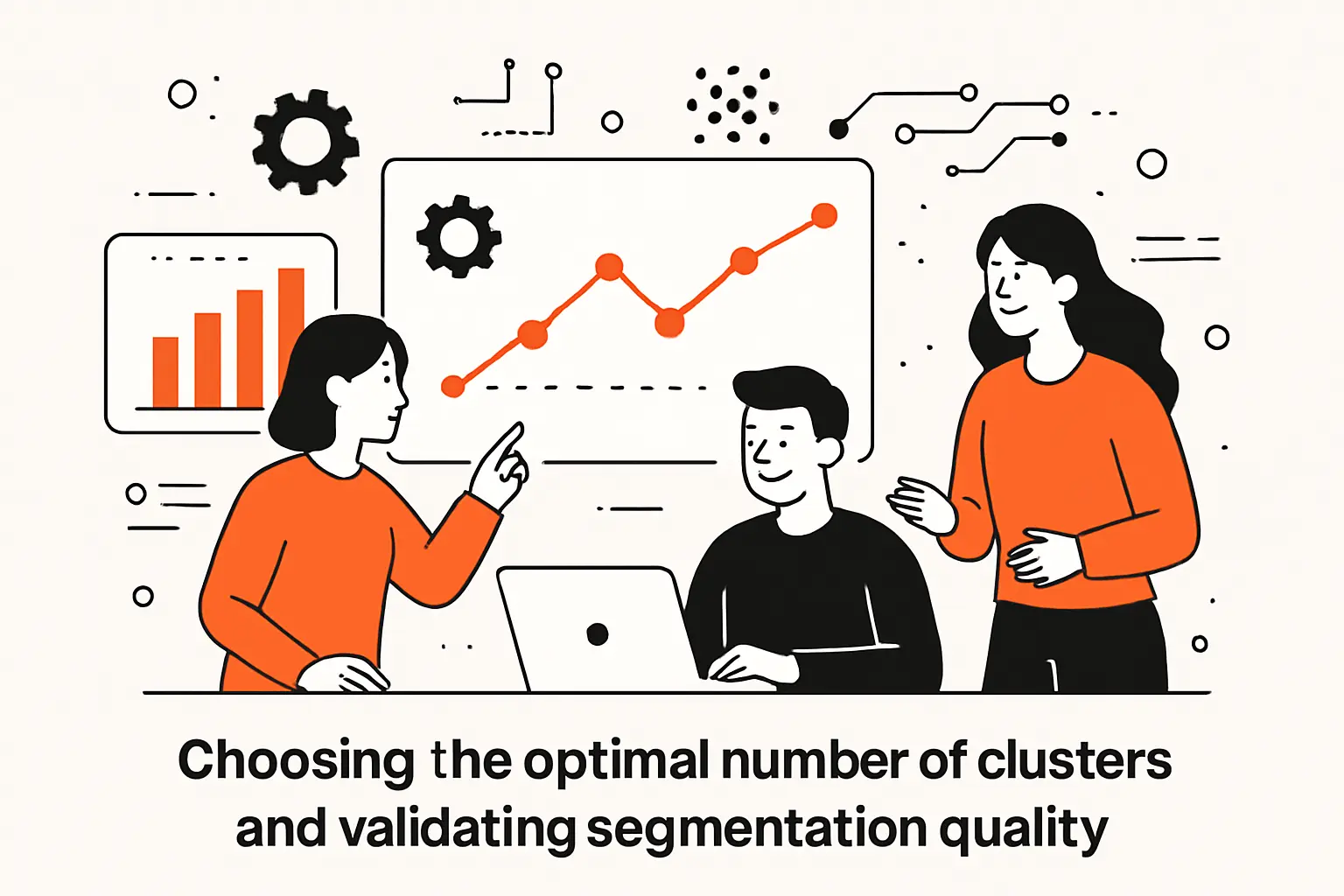
The elbow method is a pragmatic heuristic: as we increase the number of clusters, within-cluster dispersion typically decreases, but the incremental improvement eventually becomes marginal. That “bend” is often a reasonable compromise between overfitting (too many tiny clusters) and oversimplification (too few broad segments).
In delivery settings, we treat the elbow as a conversation starter rather than a verdict. A mathematically neat elbow that produces segments nobody can name is less valuable than a slightly “worse” solution that maps cleanly to activation levers and measurable outcomes.
2. Average silhouette method and gap statistic as complementary selection tools
Silhouette analysis helps evaluate whether customers are closer to their own cluster than to neighboring clusters, which is a useful way to test separation without relying on a single objective. The method traces back to the classic paper Silhouettes: A graphical aid to the interpretation and validation of cluster analysis, and we still find it relevant because it links quantitative structure to qualitative interpretability.
Gap statistic approaches selection by comparing clustering structure against a reference distribution, which can temper our tendency to see clusters where none exist. When we need that extra rigor, we lean on the formulation introduced in Estimating the Number of Clusters in a Data Set Via the Gap Statistic, especially in cases where marketing teams are eager to “find five segments” before we’ve proven the data actually supports it.
3. Balancing quantitative signals with interpretability and actionable segment profiles
A segmentation model can score well and still fail the business. Interpretability matters because segments must be explained, trusted, and acted on; if frontline teams can’t describe a segment in plain language, it won’t survive contact with real workflows.
Actionability also depends on stability and reach. A segment that flips membership constantly will create inconsistent experiences, while a segment that contains too few customers may not justify operational complexity; the best practice is to define what “good” means in business terms first, then choose the cluster configuration that satisfies it.
TechTide Solutions: building custom customer segmentation using machine learning solutions

1. Designing end-to-end segmentation systems from business goals to production workflows
At TechTide Solutions, we build segmentation as a system, not a notebook. Business goals come first: retention improvement, cross-sell expansion, onboarding acceleration, or support deflection, and those goals dictate what data we prioritize, what features we engineer, and how we validate whether the segments are creating lift.
From an engineering standpoint, we focus on repeatability: versioned feature definitions, reproducible training runs, and a clear contract for how segments are computed and served. That discipline prevents the common failure mode where a segmentation “works” once, then becomes impossible to refresh without the original analyst’s laptop and tribal memory.
What “Production-Ready” Means to Us
Production-ready segmentation includes monitoring for drift, logging of segment assignment changes, and an explicit rollback plan. When segments drive pricing, messaging, or support priority, operational guardrails are not optional.
2. Developing customer data pipelines and integrations for reliable model inputs
Reliable segmentation depends on reliable identity, and identity is usually the hardest part. Customer events arrive from web analytics, mobile SDKs, POS systems, CRMs, support platforms, billing systems, and data warehouses, and each source has its own keys, latencies, and quirks.
In our implementations, we typically design a pipeline that formalizes the customer “golden record,” then derives feature tables on a schedule that matches business cadence. By separating ingestion, identity resolution, feature computation, and model training, we make it possible for teams to evolve one layer without breaking everything downstream.
3. Delivering tailored web apps and dashboards to activate segments across teams
Segments only create value when they are activated where decisions happen. That might mean a dashboard that shows segment health and movement, a CRM view that surfaces segment-specific talking points for sales, or an experimentation console that lets marketers launch campaigns by segment without filing a ticket.
In our experience, the highest adoption comes from building tools that answer the questions teams already ask. Instead of forcing stakeholders to learn clustering jargon, we translate segments into practical views: “who is likely to need onboarding help,” “who is primed for upsell,” and “who is drifting away,” then we wire those insights into the daily workflow.
Conclusion: turning customer segments into personalization and continuous improvement
1. Using segment insights to drive targeted campaigns, rewards, and product decisions
Segments become powerful when they shape concrete decisions: which campaign to run, which reward to offer, which feature to simplify, and which support path to prioritize. By treating segments as a shared language across marketing, product, sales, and support, organizations reduce internal debate and increase the speed of iteration.
From our perspective, the best segment activations are the ones that feel obvious in hindsight. When a segment label explains a pattern teams have sensed but couldn’t prove, buy-in accelerates—and the segmentation stops being “the data team’s project” and becomes an operating model.
2. Applying segmentation models to new data and refreshing segments over time
Segment assignment should be treated as a service: new customers and new events arrive continuously, and the business needs updated labels without manual intervention. Whether the system runs in batch or near-real-time, the key is to keep feature computation consistent so that a label assigned today means the same thing it meant last week.
Refresh cadence depends on volatility. High-velocity consumer apps may need frequent refresh, while slower B2B cycles can tolerate longer intervals; either way, we advocate for explicit schedules, monitoring, and clear communication so downstream teams know when segment definitions have changed.
3. Next-step enhancements: validate clusters, try alternative algorithms, add variables, analyze segment movement
Improvement rarely comes from swapping algorithms at random; it comes from tightening the feedback loop between segments and outcomes. By validating clusters with business-side experiments, adding variables that capture intent more directly, and analyzing how customers move between segments over time, segmentation evolves from categorization into a true learning system.
As a next step, we recommend choosing one activation pathway—campaign targeting, onboarding flows, or support routing—and building a minimal end-to-end loop that can be measured and refined. Which workflow in your organization would benefit most if the customer base suddenly became legible, not just measurable?