
At TechTide Solutions, we treat AI coding models the way we treat cloud providers, databases, and frontend frameworks: as engineering leverage, not identity. The practical question is rarely “Which model is best?” and almost always “Which model reduces risk while increasing throughput for this specific job-to-be-done?”
Market momentum is real, and it is not subtle: Gartner forecasts worldwide GenAI spending to reach $644 billion in 2025, which means leadership teams will keep asking engineering to “use the tools” whether the workflow is mature or not.
So our goal here is not to crown a winner. Instead, we will build a developer-first framework, walk through realistic coding tasks, and show how to combine Claude, ChatGPT, and Gemini into a repeatable workflow that survives production constraints, code review, and long-term maintenance.
1) What “best for coding” actually means: a developer-first decision framework
1. Defining success: correctness, maintainability, readability, and speed-to-MVP
Correctness is the obvious metric, but in professional software delivery it is only the entry ticket. A model that produces “working” code that is brittle, overfit to the prompt, or hard to reason about can quietly increase total cost of ownership, especially once multiple engineers inherit the output.
Maintainability is where AI assistance either shines or collapses. In our day-to-day builds, the difference between “a function that passes today’s test” and “a module that survives six months of product changes” usually comes down to separation of concerns, coherent naming, predictable side effects, and a sensible error-handling story.
Readability is not aesthetic fluff; it is operational safety. When a bug hits at 2 a.m., the team needs code that makes intent obvious, not code that hides intent behind cleverness. Speed-to-MVP still matters, yet we view it as a constrained optimization problem: move fast while leaving a trail of structure that makes iteration safer tomorrow.
2. Choosing by task type: greenfield builds, refactors, debugging, UI work, and learning
Greenfield builds reward models that can scaffold quickly, propose workable architecture, and generate coherent boilerplate without tripping over basic details. In that mode, we care about breadth: routes, state, persistence, validation, and deployment considerations showing up early rather than as painful retrofits.
Refactors are a different sport. For refactoring, the “best” model is the one that respects constraints: keeping public APIs stable, preserving behavior, and improving structure without introducing novel bugs. A good refactor assistant also narrates trade-offs, because the right answer depends on performance, readability, and team norms.
Debugging asks for disciplined reasoning: reproduce the issue, isolate the failing assumption, and propose the smallest safe patch first. UI work rewards taste plus rigor: responsive layout, accessible interactions, and a sane HTML/CSS structure. Learning and onboarding demand teaching clarity, where the model becomes a patient pair-programmer rather than a code vending machine.
3. When “tool balance” beats “single-model loyalty”
Single-model loyalty is emotionally convenient and operationally risky. Different models tend to have different failure modes: one may confidently hallucinate APIs, another may over-cautiously hedge, and a third may optimize for verbosity rather than precision.
Tool balance is how we reduce correlated errors. In practice, that means using one model to generate a first draft, another to critique it like a senior reviewer, and a third to rewrite for clarity or simplify architecture. The key is not “ask three models the same thing”; the key is to assign different roles so their outputs are complementary.
Inside TechTide Solutions, we often treat models as layers: draft, review, and verify. The “verify” layer can include a different model, but it also includes tests, lint rules, static analysis, and human review. A model that helps you write tests and shrink ambiguity can be more valuable than a model that simply types faster.
2) claude vs chatgpt vs gemini for coding: strengths and trade-offs at a glance

1. ChatGPT: well-balanced, strong at getting to a correct answer and generating brand-new code
ChatGPT tends to be a strong generalist when the prompt is well-specified. For greenfield code generation, it often produces coherent scaffolding quickly: a basic API, a simple UI, a data model, and “glue code” that makes the demo work end-to-end.
From our perspective, the biggest practical upside is momentum. When product stakeholders want to see something tangible, ChatGPT is frequently good at producing an initial “walking skeleton” that engineers can then harden. Another advantage is its ability to switch between implementation and explanation without losing the thread, which helps when a team is half-building and half-learning.
Trade-offs show up when prompts are underspecified or when hidden constraints matter. In those situations, ChatGPT can optimistically fill in blanks with plausible-sounding assumptions. A disciplined workflow fixes that by forcing explicit constraints: supported environments, libraries already in use, style rules, security requirements, and what must not change.
2. Claude: strongest for writing style, collaboration-style feedback, and handling large code contexts
Claude often behaves like a careful collaborator rather than a fast code generator. When we ask for feedback on an approach, or when we want a “review letter” on an architecture decision, Claude’s tone and structure can be unusually useful for real teams.
Large-context work is where Claude tends to feel most “senior.” When a prompt includes many files, long error logs, or a messy migration plan, it often stays oriented and produces advice that reads like a thoughtful technical lead: identify risks, propose sequencing, suggest guardrails, and surface edge cases.
The downside of that deliberative posture is that you may need to push it toward decisiveness. On some tasks, Claude can generate multiple viable pathways and ask good questions, yet engineering sometimes needs a concrete patch right now. Our pattern is to let Claude critique and structure, then use another model (or a second Claude pass) to produce the final diffs with sharper constraints.
3. Gemini: strong for context-heavy deep work and cost-effective builds, with trade-offs in conversational smoothness
Gemini can be compelling when the work is broad and context-heavy: analyzing requirements, connecting product constraints to technical options, or synthesizing multiple sources of information into a plan. In that mode, it can function like a research analyst plus systems thinker, which is surprisingly valuable for engineering managers.
Cost-effective builds are not just about per-token pricing; they are about iteration economics. If a model helps you converge faster (fewer cycles of “oops, that assumption was wrong”), the effective cost drops even if the sticker price is not the lowest. Gemini can shine when it keeps the “big picture” intact and prevents thrash.
Conversational smoothness is where some teams feel friction. When a model’s answers are less “hand-holdy,” it can still be right, but the experience may require more careful prompting. At TechTide Solutions, we treat that as a solvable interface problem: better prompt templates, stricter acceptance criteria, and a habit of requesting structured outputs.
3) Head-to-head coding builds: what happens when you ask for complete apps and games

1. One-shot builds: “Create a full-featured Tetris” and what “feature complete” looks like
A one-shot “full-featured Tetris” prompt is a stress test because “feature complete” is ambiguous. In our internal evaluations, the best results come from prompts that define gameplay loop, controls, scoring, speed progression, pause/restart behavior, and basic polish like sound toggles and mobile input strategy.
ChatGPT often excels at getting something playable quickly, especially when you specify the tech stack (Canvas, React, Godot script, or plain JS). Claude frequently improves the “human layer”: clearer comments, better-named functions, and more coherent separation between game state, rendering, and input handling. Gemini tends to be valuable when you ask for a plan first, then request incremental implementation steps with checkpoints.
Across all models, the most common failure mode is hidden complexity: collision detection edge cases, rotation rules, and timing loops that behave differently across browsers. Our pragmatic definition of “feature complete” is not “it compiles”; it is “it behaves correctly under weird input,” and that requires tests, assertions, and a willingness to instrument the game loop.
2. Iterative builds: pushing toward a playable “2D Mario” level through back-and-forth
Iterative builds reveal something one-shot builds hide: whether the model can maintain continuity over time. A “2D Mario level” request quickly becomes a systems problem: camera behavior, collision layers, physics tuning, enemy AI, collectibles, and level scripting.
In a back-and-forth workflow, Claude is often strong at keeping a clean narrative of what changed and why. ChatGPT can be excellent at producing concrete code patches on demand, especially when you paste failing snippets and specify the exact behavior you want. Gemini can be effective when the iteration includes design constraints like performance budgets, asset pipelines, or modular level definitions.
Our real-world takeaway is simple: the model matters less than the iteration protocol. When we ask for a plan, then demand a minimal implementation, then request tests, then request refactors, the output quality rises across the board. Conversely, when prompts stay fuzzy, every model will eventually disappoint.
3. Cost vs quality: paying for top results versus optimizing for budget
Cost decisions should follow risk decisions. If a feature is core to revenue, compliance, or customer trust, “cheap” iterations can be expensive when they ship defects or security gaps. On the other hand, if you are prototyping an internal tool, a faster-and-cheaper model may be rational as long as you have guardrails.
At TechTide Solutions, we separate “generation cost” from “verification cost.” Code that looks correct but is hard to validate can create a hidden tax: engineering time spent reading, testing, and reworking. A slightly higher-quality first draft can reduce that downstream tax more than most teams expect.
Budget optimization becomes safer when you modularize tasks. One model can generate UI scaffolding, another can review for security and edge cases, and a third can rewrite documentation. This mix-and-match approach often beats an all-in bet on a single premium tier.
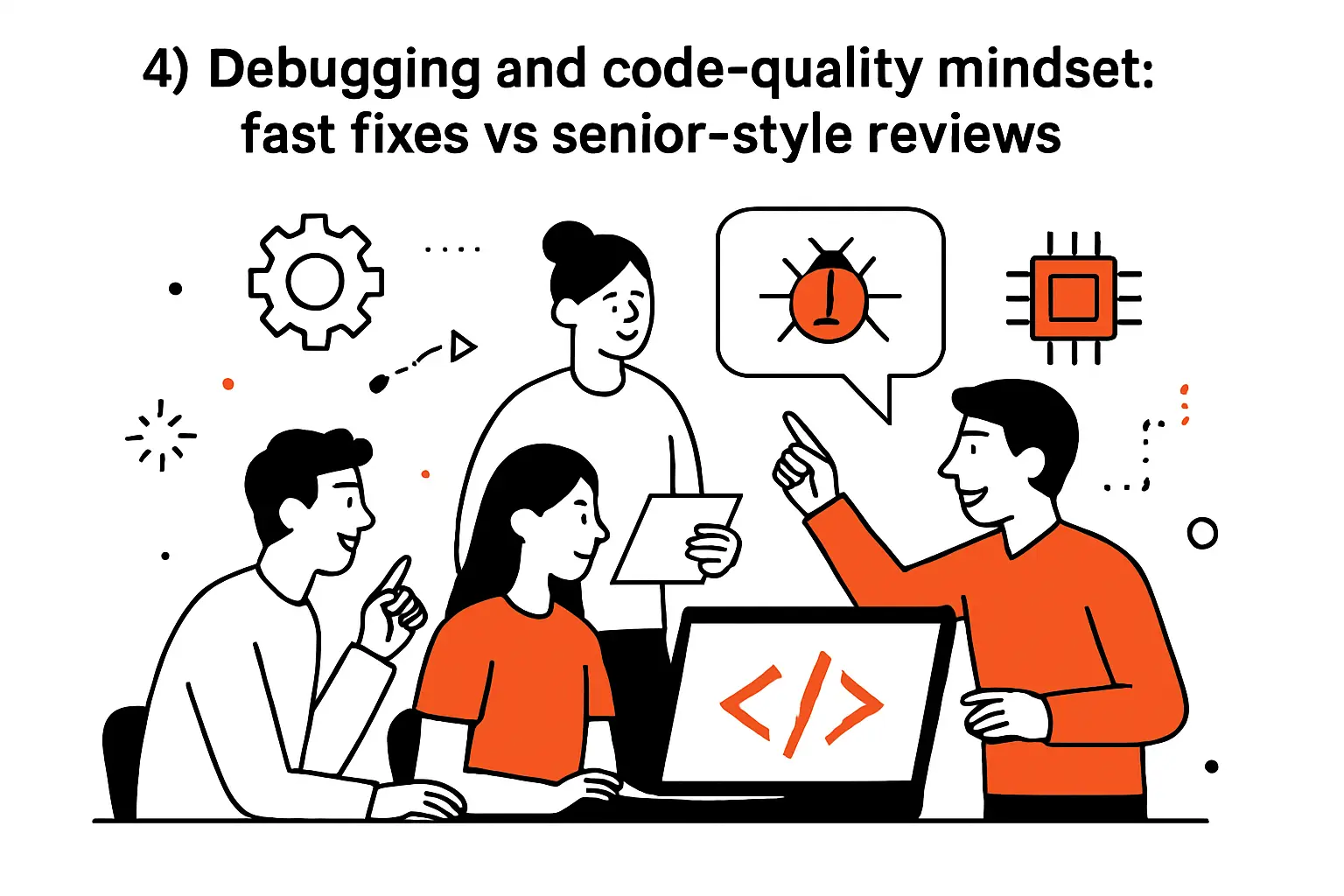
4) Debugging and code-quality mindset: fast fixes vs senior-style reviews
1. Bug fixing in practice: correcting a broken JavaScript BMI calculator
A broken JavaScript BMI calculator is deceptively educational because it usually fails in boring ways: string inputs not parsed to numbers, division order mistakes, rounding inconsistencies, and DOM selectors that silently return null. The fastest model is the one that immediately asks for the failing snippet and the expected outputs for a few test cases.
ChatGPT often jumps straight into a corrected implementation, which can be great when the bug is obvious. Claude tends to respond like a reviewer: it will point out input validation, error messaging, and how to prevent NaN from leaking into the UI. Gemini, when prompted carefully, can be helpful at mapping the bug to root cause and then proposing a fix plus a lightweight test harness.
In production debugging, our rule is “patch small, then improve.” We accept a minimal fix only if it is paired with at least one safeguard: a unit test, a runtime assertion, or a clear validation step. Models can do that work, but we have to ask for it explicitly.
2. Explanation quality: operator precedence clarity versus deeper “code review” enhancements
Operator precedence is where explanations often get shallow. A weaker answer says “add parentheses” and moves on; a stronger answer explains why the wrong order happens, how JavaScript coercion can complicate it, and how to write code that makes intent unambiguous.
Claude is frequently strong at this “teaching plus reviewing” blend: it clarifies the root concept and then suggests cleaner patterns, such as extracting intermediate variables with names that communicate meaning. ChatGPT can do the same, but it may need a nudge to slow down and explain rather than sprint to the final code. Gemini can produce solid conceptual explanations when the prompt demands a structured breakdown.
Inside teams, explanation quality is not academic; it affects onboarding and reduces repeated bugs. When a model teaches well, it helps junior developers internalize principles rather than cargo-culting patches. That is a quiet productivity multiplier.
3. Speed vs craftsmanship: “fix exactly what you asked” compared to “improve what you didn’t ask”
“Fix exactly what you asked” is what you want when the blast radius is unknown. A minimal patch reduces the chance of introducing new defects. ChatGPT tends to be good at this mode if you specify constraints like “no refactor,” “keep the function signature,” and “change as little as possible.”
“Improve what you didn’t ask” is what you want when code quality is the real bottleneck. Claude often leans this way by default, offering refactors, naming improvements, and edge-case handling. Gemini can also do it well when you request an explicit review checklist (security, performance, readability, accessibility) and then ask for prioritized recommendations.
Craftsmanship is a business decision, not a moral one. When a system is customer-facing, long-lived, or regulated, we bias toward review-style outputs. When a prototype needs to validate demand, we bias toward speed and accept some mess, as long as the mess is quarantined.
5) Frontend and UI work: recreating designs, responsiveness, and accessibility

1. UI replication task: building a centered login form with HTML and CSS only
A centered login form sounds trivial until you add real requirements: consistent spacing, clear focus states, visible error messaging, and a layout that still looks intentional on narrow screens. In this task, a model’s CSS instincts matter as much as raw code generation.
ChatGPT typically produces workable HTML/CSS quickly and is good at “give me another variant” iteration. Claude often writes cleaner markup and is more likely to include thoughtful microcopy and comments explaining layout decisions. Gemini can do well when you provide a design description (spacing, type scale, color intent) and request a structured CSS approach (variables, utility classes, or component-scoped styles).
For UI replication, we judge output by how easy it is to evolve. A login screen is rarely just a login screen; it becomes part of a design system. Models that keep the structure semantic and the CSS modular reduce future rework.
2. Desktop-first output vs mobile-friendly layout and accessibility considerations
Desktop-first output is a common default because it is easier to “make it pretty” on a wide canvas. Mobile-friendly layout demands more discipline: flexible widths, sensible line lengths, and spacing that adapts without breaking. A model that remembers to avoid fixed pixel widths saves time immediately.
Accessibility is the sharper edge. Labels must be connected to inputs, focus outlines must remain visible, error messages should be announced to assistive tech, and color contrast must be sufficient. Claude is often the most consistent at reminding teams of these concerns, while ChatGPT tends to deliver them when the prompt asks explicitly for accessibility requirements. Gemini can be strong when you request a checklist-driven output and ask it to self-audit.
From a business standpoint, accessibility is not only compliance; it is reach and trust. In customer-facing products, inaccessible UI is a funnel leak. AI can help here, but only if we make accessibility part of “definition of done,” not a last-minute patch.
3. “Make it look good” workflows: when aesthetics and structure matter as much as correctness
“Make it look good” is where many AI workflows fail because the request is subjective. Our workaround is to translate taste into constraints: spacing scale, border radius style, shadow philosophy, type hierarchy, and component density. Once those are explicit, models can iterate usefully.
ChatGPT is often strong at generating multiple stylistic variants fast, which is valuable during discovery. Claude shines when we ask for a critique of the UI’s clarity, such as “what feels off and why,” and then request a revised implementation. Gemini tends to be helpful when you want to align the UI with brand or product strategy, especially if the prompt includes persona and context.
Aesthetics still need engineering structure. Clean CSS organization, predictable class names, and minimal specificity wars matter more than a pretty screenshot. When the model produces tidy structure, designers and developers can collaborate without constantly fighting the codebase.
6) Explaining code and working with large contexts: learning, onboarding, and codebase navigation
1. Teaching-style assistance: line-by-line explanation and commenting for complex snippets like debounce
Debounce is a classic “looks simple, hides complexity” snippet. A helpful model does not just annotate lines; it explains timing behavior, closure capture, and what changes if the function is used in React, in a DOM event handler, or in a server context.
Claude often produces the best teaching artifact: a narrative explanation, a commented version of the code, and a set of “gotchas” that match how developers actually break debounce in real code. ChatGPT is strong when you ask for examples that contrast debounce and throttle, or when you request a version with TypeScript typing and tests. Gemini can do well when the prompt asks for a conceptual model first and implementation second.
Onboarding benefits from this style of help because it compresses tribal knowledge into something repeatable. In our team workflows, we sometimes treat AI-generated explanations as living documentation that must survive code review just like code does.
2. Long-context coding workflows: analyzing large codebases and many files in a single prompt
Large-context workflows are where AI starts to feel like a “search plus reasoning” layer over a repository. When we paste multiple files or describe a subsystem, the model can detect inconsistent naming, duplicated logic, and boundary violations between modules.
Claude’s reputation for handling large contexts tends to show up here, especially when you ask it to build a dependency map, propose refactor seams, or identify “high-churn” modules that deserve isolation. ChatGPT is effective when you request concrete patches for a specific bug across multiple files, particularly if you constrain it to the existing architectural style. Gemini can be strong when the task is to interpret a complex system and then propose an incremental migration plan rather than a rewrite.
Even so, context is not comprehension. Models can miss implicit contracts that are not written down, such as “this endpoint must remain backward compatible for a partner integration.” Our practice is to treat long-context outputs as hypotheses that must be validated by tests, runtime behavior, and human domain knowledge.
3. Deep research for engineers: synthesizing market and strategy context into actionable technical direction
Engineering choices are increasingly shaped by strategy: build vs buy, platform risk, compliance exposure, and time-to-value. In that environment, deep research is not “nice to have”; it is how teams avoid building the wrong thing very efficiently.
McKinsey’s research estimates generative AI could add the equivalent of $2.6 trillion to $4.4 trillion annually across the use cases it analyzed, which is a strong signal that software engineering leaders will be pressured to operationalize AI assistance rather than treat it as an experiment.
In our work, “actionable technical direction” means turning that pressure into architecture and governance: which workloads are safe for AI acceleration, how to handle sensitive data, and how to design a workflow where models help without silently changing system behavior. Claude, ChatGPT, and Gemini can all assist with strategy synthesis, yet the true differentiator is whether the team converts insight into standards, templates, and review rituals.
7) Reasoning, reliability, and guardrails: reducing mistakes before they ship
1. Logical and common-sense reasoning patterns: handling trick prompts and flawed assumptions
Trick prompts in coding are rarely puzzles; they are flawed assumptions. A model might be asked to “optimize” a function that is already I/O bound, or to “secure” a system without any threat model. Strong reasoning shows up as clarifying questions and boundary setting.
ChatGPT can be excellent at quickly enumerating assumptions and then offering options, especially when you ask it to propose tests that would falsify those assumptions. Claude often does well at spotting ambiguity and articulating what it cannot know from the prompt alone. Gemini can be effective when the prompt demands a structured reasoning trail, such as “list constraints, list unknowns, propose safe defaults, then generate code.”
Common sense also includes product sense. If the model suggests adding a complex dependency for a small UI problem, that is a smell. We actively instruct models to prefer the simplest viable solution that matches the team’s stack and operational realities.
2. Practicality vs “theoretical maximization”: spotting solutions that aren’t rooted in reality
Theoretical maximization sounds like “use perfect patterns everywhere,” but reality is messier: deadlines exist, teams have skill constraints, and existing systems create gravitational pull. A model that ignores that context will propose solutions that look impressive and fail in implementation.
Practicality looks like incrementalism. Instead of recommending a rewrite, the model proposes a migration seam. Instead of inventing a new architecture, it suggests a minimal boundary plus tests. Claude tends to be good at “practical review” style guidance, while ChatGPT tends to be good at producing the concrete steps of an incremental plan. Gemini can be strong at keeping the overall strategy coherent across phases.
At TechTide Solutions, we push models to behave like staff engineers: optimize for outcomes, reduce risk, and leave the codebase better than you found it. Any output that cannot be code reviewed, tested, and owned is not a solution; it is a liability in disguise.
3. Trust, uncertainty, and verification habits: when models admit they don’t know and when to fact-check
Trust is the heart of AI-assisted development, and the data reflects the tension. Stack Overflow’s AI page reports that 51% of professional developers use AI tools daily, which tells us the workflow is becoming normal even when teams are still figuring out guardrails.
Distrust is rising at the same time: Stack Overflow’s press release notes 46% of developers said they don’t trust the accuracy of the output from AI tools, and that is the sober reminder that “adoption” is not the same as “reliability.”
Verification habits are the missing bridge. In our workflow, a model must earn trust through reproducibility: tests that pass, error cases that are handled, and uncertainty that is stated plainly. When the model hedges, we treat that as useful signal rather than weakness, because it tells us where to look more closely before shipping.
8) How TechTide Solutions helps teams build custom software with AI-assisted development

1. Turning ideas into custom web and mobile apps: discovery, prototyping, and rapid iteration
Discovery is where AI can accelerate clarity, not just code. In early engagements, we translate fuzzy business goals into user journeys, acceptance criteria, and a prioritized backlog that engineering can actually execute.
Prototyping benefits from models that generate fast scaffolding, copy variants, and UI layouts. ChatGPT is often useful for producing working demos quickly, while Claude can improve the narrative around trade-offs and help shape requirements into constraints. Gemini can help synthesize stakeholder input into a coherent plan that avoids building features nobody will use.
Rapid iteration becomes safer when prototypes are built as “throwaway with discipline.” We intentionally keep boundaries clear: what is demo code, what is reusable, and what must be production-grade. AI assistance is powerful here, yet we treat it as acceleration for engineering judgment, not a replacement for it.
2. Building production-grade solutions: architecture, security, testing, and maintainable code ownership
Production-grade software is where most AI hype quietly dies. The hard parts are not generating code; the hard parts are architecture decisions, secure defaults, observability, test coverage, and the mundane work of making systems operable.
Security requires threat modeling, secrets handling, dependency hygiene, and careful logging. Testing requires designing for testability, not bolting tests on afterward. Maintainable code ownership requires clear module boundaries, documentation, and a code review culture that treats AI-generated diffs like any other diff: it must be explained and justified.
In our delivery practice, we use models as assistants within a disciplined pipeline. Humans own design decisions, model outputs are treated as drafts, and verification is enforced through tooling. That is how AI becomes a reliable contributor rather than a chaotic source of regressions.
3. Integrating AI into engineering workflows: model selection, prompt standards, code review, and automation
Integration is where most teams need help, because “using AI” is not a strategy. A workable strategy defines which tasks are allowed, what data can be included in prompts, and what verification steps are mandatory before merge.
Prompt standards sound bureaucratic until you see the impact. When prompts consistently specify constraints (runtime, frameworks, style rules, error handling, test expectations), output quality becomes more predictable. Code review also changes: reviewers learn to spot model-shaped risks, such as overly confident assumptions, suspicious library calls, or missing edge cases.
Automation ties it together. We help teams add guardrails like pre-commit hooks, linting, formatting, unit tests, and CI checks that enforce a baseline of quality regardless of whether a human or a model wrote the code. For many organizations, that operational layer is the difference between “AI toy” and “AI advantage.”
9) Conclusion: choosing your best coding model and building a repeatable workflow

1. Best model by job-to-be-done: new code, debugging, UI polish, long-context analysis, and multimodal inputs
For new code, we focus on models that can set up code quickly while following clear constraints. For fixing bugs, we focus on models that ask for steps to repeat the problem, suggest small fixes, and then recommend tests. And for UI polish, we look for models with good CSS instincts and awareness of ease of use for everyone.
Long-context analysis is its own category: it rewards models that can keep many moving parts in mind without losing correctness. Multimodal inputs matter when the work includes screenshots, diagrams, or design references, and in that scenario we choose the model that best translates non-code inputs into implementable structure.
The honest answer is that “best” changes by task. Teams that pick a single default model for every situation often end up blaming the model for problems that are really workflow problems.
2. Using more than one model: handoffs that improve correctness, clarity, and practicality
Multi-model workflows work when the handoff is intentional. One model drafts, another critiques, and a third focuses on readability and maintainability. That division of labor reduces blind spots and makes quality less dependent on a single tool’s personality.
In our practice, we also separate creative generation from verification. Drafting benefits from speed and breadth, while verification benefits from skepticism and structure. Claude often plays the “reviewer” role well, ChatGPT often plays the “builder” role well, and Gemini often plays the “planner/synthesizer” role well, yet teams should validate those roles against their own tasks and constraints.
Handoffs get even stronger when tests are the lingua franca. Instead of debating whether the model is right, we ask it to encode expectations as tests. Once tests exist, any model that can satisfy them becomes useful.
3. Final shipping checklist: prompt constraints, compliance, testing, and verification before deployment
Before deployment, we want prompts to have constraints, not vibes: target environment, libraries allowed, performance expectations, security requirements, and what must not change. Compliance and privacy rules must also be explicit, especially for sensitive domains where data handling is regulated.
Testing is non-negotiable. Unit tests, integration tests, and smoke tests turn AI-generated code from “maybe correct” into “demonstrably correct for known cases.” Verification then becomes a habit: run the suite, review the diff, check logs, and validate edge cases that the model might not anticipate.
Next step suggestion: pick a real feature your team is about to build, assign ChatGPT, Claude, and Gemini distinct roles in a single workflow, and measure which combination reduces rework the most—what would it look like to treat model choice as an engineering experiment rather than a belief?