
We at TechTide Solutions see CI/CD not as a buzzword but as the backbone of modern software delivery. The strategic context is straightforward: enterprise software spending is enormous, with global outlays reaching 1tr USD, so even small improvements in delivery discipline compound into meaningful business impact. In this guide, we’ll move from first principles to field‑tested practices, weaving in our lived experience building and operating pipelines for teams ranging from fintechs to industrial manufacturers. Our aim is pragmatic clarity: what CI/CD is, how it works end‑to‑end, where it pays off, and how to implement it without painting yourself into a corner.
What are CI/CD pipelines?
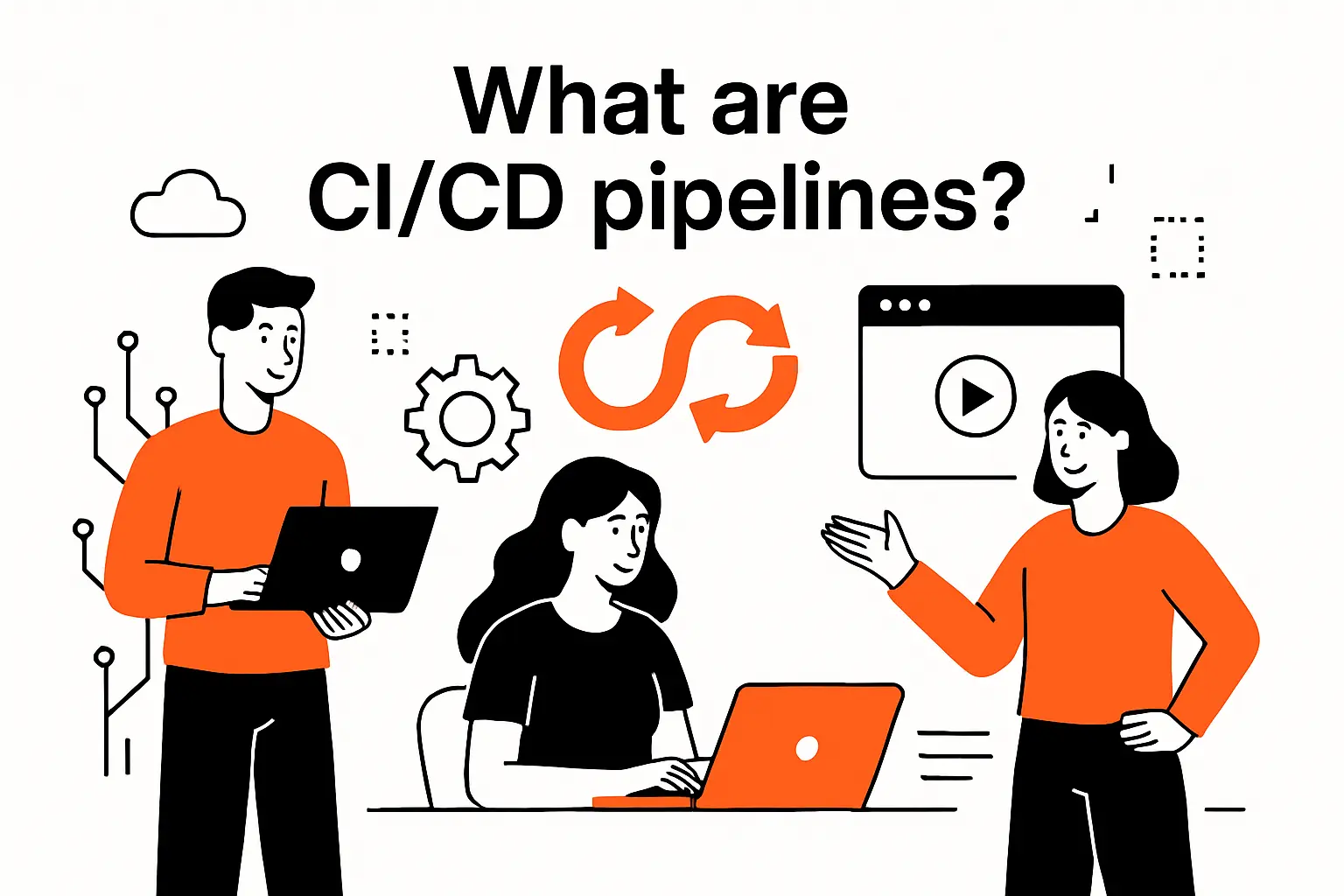
As platform engineering becomes a mainstream way to deliver consistent developer experiences and paved roads, predictions show this motion is accelerating, with adoption expected to be widespread—one analysis forecasts that by 2026, 80% of software engineering organizations will establish platform teams, and CI/CD pipelines sit at the core of those platforms. In our practice, pipelines are the living expression of how code becomes customer value—codified as workflows that developers and operators can trust. When designed well, they’re boring in the best possible way: predictable, observable, and relentlessly automated.
1. Definition and purpose of CI/CD pipelines
We define a CI/CD pipeline as the orchestrated set of automated steps that takes a code change from a developer’s branch to a production system in a safe, repeatable manner. Continuous integration’s role is to integrate and validate changes early; continuous delivery hardens and stages artifacts for release; continuous deployment pushes those artifacts to users based on policy. The purpose is twofold: risk reduction and flow. The less human ceremony between a commit and a production rollout, the fewer places error can hide—and the faster feedback travels from users to developers.
In practical terms, a pipeline is a contract. It captures expectations about what “done” means—linting, build reproducibility, test quality, security posture, and deployment mechanics. Teams fail when that contract lives inside people’s heads or chat logs. They succeed when the contract is codified as pipeline‑as‑code and enforced consistently across services.
2. CI/CD pipelines vs CI/CD practices
Practices are the habits—trunk‑based development, peer reviews, feature flags, test‑first design, and runbooks. Pipelines are the embodiment of those habits in a system. You can have a shiny tool with a poor practice culture and still struggle. Conversely, healthy practices can limp along on basic tooling but will plateau. We’ve watched teams unlock far more value by clarifying a few practices (for example, “every change must be deployable and reversible”) than by adding yet another orchestration widget. A good sanity check: can we explain our pipeline to a new engineer in a single whiteboard session? If not, we’ve probably encoded accidental complexity.
3. How CI/CD pipelines relate to DevOps
DevOps is the organizational philosophy—shared ownership, continuous improvement, and tight feedback loops. CI/CD is the technical implementation that makes DevOps tangible. Without CI/CD, DevOps can degrade into slogans; without DevOps, CI/CD turns into fragile script farms. The pipeline is where cultural agreements become guardrails. For example, “you build it, you run it” translates into approvals that are owned by service teams, not a central queue; “shift left” becomes mandatory static analysis and unit tests; “shift right” becomes proactive telemetry and automated rollbacks. In our experience, the healthiest organizations treat the pipeline as a product, with a roadmap, service level objectives, and a dedicated platform team that listens to developer users.
Stages in a CI/CD pipeline
Automation is being rethought in the era of AI and platform teams; recent research highlights that a 25% increase in AI adoption correlates with improvements in aspects of development work, reinforcing why the classic build–test–deliver–deploy progression must now incorporate intelligent gates, policy checks, and reproducible provenance. The four stages below form a system: strengthening one stage often reveals constraints in another, which is why we advocate improving them as a value stream rather than as isolated tasks.
1. Build
The build stage turns source into artifacts. Our north star is hermetic, reproducible builds. That means pinned dependency graphs, isolated build environments, and a cryptographic chain of custody. We favor approaches like containerized build runners and “distroless” bases to avoid drag from environment drift. Build caching is another workhorse: remote caches accelerate feedback while retaining determinism, provided you treat cache invalidation as a first‑class concern. For polyglot monorepos, we like graph‑aware build tools that understand incremental compilation and can surface dependency impact quickly.
Practical patterns
- Generate a software bill of materials (SBOM) at build time and attach it to the artifact as non‑repudiable metadata. We’ve used SBOMs to accelerate incident response when a supply‑chain advisory hits.
- Sign artifacts and attest build steps. With signing plus attestations, you can prove exactly which source and which toolchain produced the bits you’re about to deploy.
- Guard the ephemeral build environment. Short‑lived credentials, ephemeral runners, and workload identity by default remove a surprising amount of risk.
2. Test
Testing is a sieve, not a moat. Unit tests catch logic defects early; contract tests ensure services agree on APIs; integration tests exercise workflows; smoke tests validate deployability. We champion a layered “test pyramid” with targeted stress beyond happy paths—timeouts, retries, transient dependency failure—because production rarely fails politely. Flaky tests are a tax; your pipeline must detect, quarantine, and surface them with evidence. We’ve had success with probabilistic test selection that leans on change impact analysis to run the most relevant tests first, then fills the budget with the rest.
Practical patterns
- Spin up ephemeral environments per change when integration risk is high; wire them with production‑like dependencies via service virtualization to keep cost and flakiness under control.
- Instrument tests with trace IDs and send spans to observability backends; correlating test failures with runtime traces shortens triage dramatically.
- Shift‑left security tests without drowning signal in noise. We integrate static analysis, secrets detection, and configuration linting, and require issues to be triaged just like functional defects.
3. Deliver
Delivery is about creating a deployable, policy‑approved artifact and placing it in a promotion system. This is where provenance, compliance, and risk posture are codified. We promote artifacts through environments via immutable tags and attestations, not by rebuilding. Policy‑as‑code engines make approvals auditable: for example, enforcing that an image has a current SBOM, a vulnerability budget below a defined threshold, and a signed provenance statement. Feature flags belong here too; delivery should enable progressive exposure without redeploying code.
Practical patterns
- Use a single artifact for all environments. If an artifact differs between staging and production, you’re testing a hypothesis with different ingredients.
- Treat change windows as policy, not calendar invites. Your policy engine can encode maintenance windows and customer commitments cleanly.
- Record a narrative of every promotion. Textbook forensics require knowing what moved, why, and who authorized it.
4. Deploy
Deployment is the translation from “ready” to “running.” Progressive delivery (canary, blue‑green, or rolling) reduces blast radius and increases confidence. We typically tie rollout steps to health signals that reflect user experience, not only infrastructure vitals—think error budgets and user‑journey SLOs rather than raw CPU spikes. Rollback paths must be as engineered as the rollout, including reversible schema changes and data compatibility plans. Post‑deploy verifications—synthetic checks, log diffing, and anomaly detection—close the loop before full exposure.
Practical patterns
- Define “production readiness” as code: runbooks, alert routing, dashboards, autoscaling policies, and chaos experiments are prerequisites at deploy time.
- Gate rollouts on SLO health. If your error budget is exhausted, the safest deployment is often no deployment.
- Codify instant rollbacks. Human‑driven rollbacks are too slow when users are hurting; automation should make the safe thing the fast thing.
Continuous integration vs continuous delivery vs continuous deployment
The strategic payoff of investing in these capabilities shows up in outperformance: top‑quartile software organizations grow revenue markedly faster, with a strong study finding outcomes that are four to five times faster when developer velocity is high. That’s not magic; it’s the compounding effect of faster feedback, cleaner codebases, and smoother release trains. We advise leaders to pick the right ambition—CI, CD, or continuous deployment—based on their risk tolerance, regulatory constraints, and product cadence.
1. Continuous integration in CI/CD pipelines
Continuous integration is the discipline of integrating small changes into trunk frequently, with automated validation at each merge. Technically, that means short‑lived branches, pre‑merge checks, and immediate feedback. Organizationally, it means a culture where engineers expect an always‑green mainline and treat broken builds as emergencies. The biggest anti‑pattern we encounter is “integration theater”: developers merge rarely, rely on rebasing large branches, and smooth over conflicts locally. CI thrives when teams slice changes small, lean on pair reviews, and accept that tests are part of the development act, not a post hoc chore.
2. Continuous delivery in CI/CD pipelines
Continuous delivery assures that every change is releasable. You might not deploy every change, but you could. That subtle difference matters: it moves scrutiny earlier, in delivery gates, where it’s cheaper to fix. We find CD easiest to adopt when teams embrace feature flags and decouple release from deploy. It’s a relief valve—ops teams don’t have to carry the burden of “everything goes live immediately,” and product can orchestrate launches thoughtfully, decoupled from infrastructure cadence.
3. Continuous deployment in CI/CD pipelines
Continuous deployment is the apex: every change that passes the pipeline deploys automatically. It demands high confidence in tests, bulletproof rollbacks, and comfort with progressive exposure. Domains with strict regulatory oversight may consider continuous deployment per service or per feature, using flags and segmented audiences. We’ve led clients to continuous deployment for stateless services first, then extended the pattern cautiously to stateful components with double‑writing, background migrations, and shadow traffic to reduce risk.
4. Continuous delivery versus continuous deployment
CD and continuous release mainly differ in who decides when a change goes live. In CD, a person—usually from product or operations—chooses the release time. In continuous release, rules and automation make that decision. The trade-off is control versus speed. Our usual advice is to start with CD so you can strengthen testing and rollout steps, then move lower-risk services to continuous release once you know you can roll changes back safely and monitor them well. The right choice depends on the product. For example, an internal reporting service may release updates all the time, while a customer-facing billing system may still need human approval.
Benefits of CI/CD pipelines
The business case has hardened, not least because adjacent investment areas are scaling; for example, the DevSecOps tools segment reached $5.9 billion in 2023, reflecting how security, reliability, and delivery are increasingly intertwined. We see benefits across cost, quality, collaboration, resilience, and developer experience—each reinforcing the others when pipelines are productized and supported by a platform team.
1. Reduced deployment time and lower costs
Automation turns toil into code. That saves engineer time directly and reduces the tail risks that lead to costly firefighting. But the biggest savings are often less visible: fewer handoffs, less context switching, and a cleaner operational posture. We recommend tracking deployment lead time and rework as qualitative signals first, then layering in bench‑marked metrics once teams trust the pipeline. Cost control also improves when ephemeral environments, execution caches, and selective testing reduce unnecessary compute consumption.
2. Early error detection and higher code quality
Short feedback loops catch defects when they are cheap. We’ve seen pipeline‑driven behavior changes like writing smaller pull requests, adding property‑based tests, and baking observability into features. Together, these shift failure modes from production to pre‑release. The key is to treat red pipelines as learning opportunities, not blame assignments. Retrospectives that examine systemic causes—flaky tests, slow environments, ambiguous coding standards—are where quality climbs sustainably.
3. Continuous feedback loops and collaboration
CI/CD collapses the distance between code and customer. Developers learn what users experience; ops gains context on why changes exist; product sees delivery health as it evolves. We lean on chat‑ops integrations to keep this loop conversational—deployments announce themselves, tests summarize results, and feature flags report adoption. Good pipelines make collaboration ambient: the right information shows up where people already work.
4. Reliability, rollbacks, and less downtime
Reliability is engineered, not wished into existence. Progressive delivery and automated rollback give teams the courage to ship continuously without betting the business on each change. We advocate attaching SLOs to services and using them as gates; if user journeys degrade, the pipeline applies brakes automatically. This discipline reduces mean time to recovery not by heroic on‑call responses but by preventing bad rollouts from ever going fully live.
5. Faster releases and improved developer experience
Developer experience is a leading indicator for business outcomes. The easier it is to go from idea to production, the more experiments you can run, and the better your odds of discovering value. Developers interpret your pipeline as a contract: if it’s slow or flaky, they will route around it. If it’s reliable and self‑service, they will lean in. We’ve helped teams turn skeptical engineers into advocates simply by shaving friction from onboarding and making golden paths visible in a central portal.
Best practices and tooling for CI/CD pipelines
Non‑functional concerns now shape tooling choices. Sustainability is climbing into engineering backlogs, with expectations that by 2027, 30% of large global enterprises will encode software sustainability into non‑functional requirements—one more reason to favor ephemeral resources, smarter test selection, and efficient builds. In our experience, strong practice beats shiny tools, but the right platform choices do remove entire classes of failure. Below are the patterns we standardize.
1. Single source repository and trunk-based frequent check-ins
Favor a single canonical repository per product boundary and trunk‑based development with small, frequent merges. A single repo or a carefully designed monorepo makes cross‑cutting changes discoverable and improves refactoring. Trunk‑based habits reduce merge hell and reward incrementalism. We pair this with code owners and automated reviews to keep quality consistent without bottlenecks.
Watch‑outs
- Monorepos can become monoliths if build graphs are not explicit. Invest in code indexing, dependency hygiene, and tooling that can isolate incremental changes.
- Long‑lived branches are the enemy of continuous integration. If a branch must persist, ring‑fence it with extra checks.
2. Automated builds and self-testing builds
Every commit should be buildable and testable by robots. Self‑testing builds turn “it compiles on my machine” into a museum exhibit. We embed static checks, unit tests, and artifact signing right in the build job. When a failure happens, the job should yield useful diagnostics—logs, traces, and pointers to the offending lines—so that engineers can act immediately.
Watch‑outs
- Beware of over‑eager parallelization that starves caches and thrashes I/O. Speed measured in seconds can sabotage speed measured in throughput.
- Prevent signature sprawl by centralizing signing keys and rotating them via a well‑audited process.
3. Stable testing environments and maximum visibility
Tests are only as good as their environments. Standardize container images for testing, seed data deterministically, and make test flakiness visible in dashboards. We route test telemetry to the same observability stack used in production to collapse mental models. Developers debug faster when the signals look familiar across environments.
Watch‑outs
- Over‑mocking creates illusions of safety. Keep a pragmatic balance between speed and fidelity using contract tests and selective integration suites.
- “Heisenbugs” often hide in test data. Build utilities to generate realistic data sets and rotate them regularly.
4. Predictable releases at any time
Predictability gives teams the freedom to move fast. Define one standard release process for each platform, such as Kubernetes, serverless, or VM-based systems, build it into a promotion workflow, and give teams confidence that a release at any hour will follow the same steps. That process should include rollback options, gradual rollout patterns, and checks based on system health. When developers can release with confidence, release timing becomes a business choice, not a technical limit.
5. Jenkins and other popular CI/CD tools
Tools do not guarantee results, but they shape how teams work. Jenkins is still a flexible choice for organizations that want detailed control and lots of plugin options. GitHub Actions works well because it is close to the GitHub ecosystem. GitLab CI/CD brings code, pipelines, and security scanning together in one place. CircleCI and Azure DevOps fit teams that want managed runners and stronger enterprise controls. Our view is simple: choose pipeline definitions in code, strong secret handling, built-in support for containers, and direct connections to code review, issue tracking, and package storage. Above all, the tool should stay out of the way and help developers move faster instead of slowing them down.
6. Cloud CI/CD stacks and integrated platforms like GitLab
Integrated platforms reduce mental overhead by combining source control, package management, pipeline runs, and security scanning. We recommend them for organizations that want faster results and more consistent control. The trade-off is flexibility: unusual cases sometimes need custom runners or custom stages. A practical middle ground is to use the integrated platform as the main foundation, then connect extra tools through clear interfaces.
7. Containers and Kubernetes management in pipelines
Containers make it easier to run software in different environments, and orchestration tools make systems more reliable. CI/CD should treat container image creation as part of the build process, not as a strange release detail, and it should check that images meet runtime rules before promotion. In Kubernetes, define deployment files in code by using templates or configuration-driven approaches, enforce admission rules, and use gradual rollout tools for safer releases. Monitoring should support this too: add labels for service, version, and rollout wave so the pipeline can understand impact in real time.
8. Kubernetes-native pipelines with Tekton and OpenShift
Tekton runs pipelines as Kubernetes resources, which makes sense for teams that want to standardize on the cluster as the control center. Tasks and pipelines become tracked objects with versions. Parallel work and isolation are handled by the scheduler, and secrets use existing cluster features. OpenShift’s Pipelines and GitOps options package these ideas for enterprise use, with built-in defaults, safety controls, and RBAC models that fit tightly controlled environments. We have used Tekton in cases where workload identity, isolation between tenants, and cluster-wide policy are essential.
Security and compliance in CI/CD pipelines
Security posture is shifting as AI‑centric tools attract extraordinary capital, with AI’s share rising to 37% of venture funding; this amplifies attention on software supply chains and model artifacts moving through pipelines. For us, the objective is defense‑in‑depth without developer drag: embed checks, prove provenance, and make the secure path the easy path.
1. Built-in security checks and policy gates in pipelines
Security works when it’s automatic. Bake scanning for code, containers, infrastructure‑as‑code, and secrets into the default template. Use policy‑as‑code to gate promotions: for example, block artifacts that contain critical vulnerabilities without accepted mitigations or lack signed attestations. We like lightweight dashboards that tie security findings to the exact commits and owners who can remediate them, so issues do not wander.
2. DevSecOps with shift-left and shift-right testing
Shift‑left finds problems earlier; shift‑right proves resilience. We run threat modeling alongside design reviews and place security unit tests in the same harness as functional ones. On the run‑time side, we deploy canaries with security toggles, inject fault scenarios, and monitor behavioral baselines. Together, they harden the system against both predictable and novel attacks.
3. Secure code, outside libraries, and file integrity
Supply chain security is a basic requirement. Using outside libraries is hard to avoid, so teams need to make that risk visible: keep an approved list of libraries, lock version numbers, and scan them regularly. File integrity depends on keeping a clear and trusted path from source code to the live system: use repeatable builds, sign build files, and check those signatures before release. When a new security warning appears, SBOMs and source records help you answer the most important question quickly and with confidence: “Are we affected?”
4. Access control and infrastructure setup
Giving people only the access they truly need, and using login details that expire quickly, helps limit damage when something goes wrong. We set up role access automatically through identity providers and rotate secrets without manual work. For infrastructure, we define settings in code, review them the same way we review software, and check them for security issues. It is also important to watch for settings that slowly change over time, because even a safe setup can quietly become unsafe. We also support emergency access processes that can be tracked clearly and expire on their own.
5. Compliance and quality assurance embedded in CI/CD
Regulatory frameworks can become leverage rather than drag if they’re codified. Map controls to pipeline stages, auto‑collect evidence, and generate audit‑ready reports from the pipeline’s event stream. Quality management dovetails here: acceptance criteria can be encoded as tests and policy checks, removing ambiguity between product, engineering, and the audit function. The end state is continuous compliance, where audits read like a transcript of what the pipeline enforced.
TechTide Solutions: building custom CI/CD pipelines tailored to your needs
In our client work, we see the same lesson repeat: outcomes improve when the pipeline is treated as a product with users, roadmaps, and service levels. Independent research consistently links strong developer velocity to superior business performance, and the mindset behind that research matches what we practice—tooling that reduces cognitive load, processes that reward small, safe changes, and platform teams that operate like product teams. We bring those patterns to bear and adapt them to your constraints.
1. Assessment and pipeline design aligned with your stack and goals
We start by mapping your value stream—from idea intake to customer impact—and identifying the slow spots. Then we assemble a design tailored to your reality: the code hosting you use, your packaging and deployment targets, your security posture, and the skills of your teams. We propose a reference architecture, select tools that fit your ecosystem, and define a migration plan that keeps day‑to‑day work flowing. The output is not a slide deck; it’s a pipeline backlog prioritized by ROI and risk reduction.
What this looks like in practice
- Discovery sessions with product, platform, and security leaders to align goals and constraints.
- Repository and build graph analysis to right‑size monorepo or multi‑repo strategies.
- Proofs of value on one or two services to validate the pipeline pattern before scaling.
2. Implementation using modern toolchains and cloud-native practices
Implementation is where contracts meet code. We codify pipeline templates, stand up shared runners, integrate signing and provenance, and connect observability end‑to‑end. For containerized workloads, we implement declarative deployments, progressive delivery controllers, and admission policies that encode your standards. For serverless and data platforms, we wire in schema migration controls, data‑quality checks, and lineage tracking so that changes remain understandable. Throughout, we partner with your platform team to make the paved road obvious and attractive.
What this looks like in practice
- Reusable templates that standardize builds, tests, and deployment per runtime while allowing service‑level overrides.
- Artifact registries with signing and SBOMs, and promotion workflows that move artifacts—not rebuilds—across environments.
- Policy‑as‑code gates for security, compliance, and SLO health, enforced automatically and explained clearly to developers.
3. Enablement, monitoring, and continuous optimization
New pipelines change daily work; enablement is how we turn change into adoption. We run hands‑on labs, pair on early migrations, and instrument the pipeline itself to detect friction. Dashboards show where time goes in builds, which tests flake most often, and where approvals pile up. We then iteratively remove pain: parallelize what makes sense, cache intelligently, and prune tooling that adds little value. The long‑term goal is autonomy: platform teams that can evolve the pipeline without us and product teams that trust the path to production.
What this looks like in practice
- Developer‑focused documentation and golden paths that answer “how do I…” questions quickly.
- Metrics and traces for the pipeline itself, so performance regressions are caught like any other incident.
- Regular design reviews where developers propose improvements and platform teams evolve templates accordingly.
Conclusion: getting started with CI/CD pipelines
CI/CD is less a destination than a discipline. Industry momentum tells us the platform approach will continue to mature and spread, and pipelines will remain its core interface. The winners won’t simply buy tools; they will invest in paved roads that make the right thing feel natural, and they will measure progress in working software and user outcomes.
1. Start small and automate the highest-impact steps
Begin where feedback is slowest or risk is highest. That might be test flakiness, manual promotions, or error‑prone deployment scripts. Automate the narrowest slice that reduces pain for one team, validate the pattern, and then scale horizontally. Success looks like developers asking to migrate, not being told.
2. Measure outcomes and iterate on your pipeline
Measure what matters: lead time for changes, deployment frequency, change failure rate, and time to restore are reliable north stars when used as learning tools, not whip‑cracks. Instrument the pipeline and your services so improvements are visible. Then iterate. Pipelines that stagnate become obstacles; pipelines that learn become competitive edges.
3. Choose delivery or deployment based on risk tolerance and business needs
Fit the ambition to the domain. For some services, continuous deployment will feel liberating; for others, continuous delivery with deliberate launches will feel prudent. Whatever path you pick, engineer reversibility and observe everything. If you’d like a working session to map your value stream and sketch a pragmatic first step, we would be glad to facilitate—what would a one‑service pilot look like in your environment?