
We’re Techtide Solutions, and our day job is making cloud bills read like business narratives rather than inscrutable CSVs. The macro backdrop explains why that matters: public cloud spend is accelerating toward $723.4 billion in 2025, and without crisp cost allocation, growth turns into fog. In the pages that follow, we map out how AWS cost allocation tags become the connective tissue between engineering activity and financial accountability, and how we’ve seen them transform showback and chargeback from quarterly drama into weekly habit.
What are aws cost allocation tags and why they matter
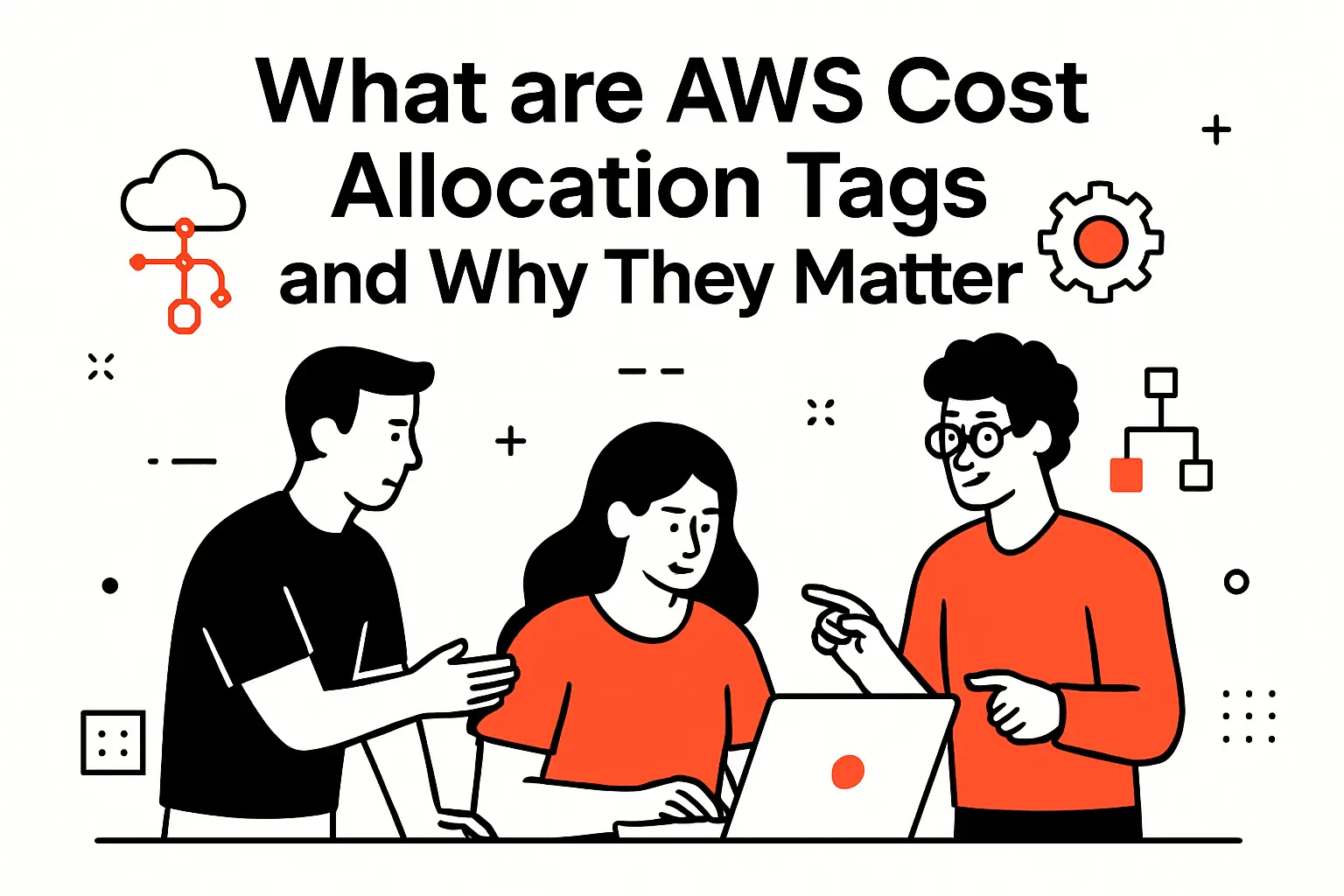
From our vantage point, tagging isn’t housekeeping—it’s instrumentation. The stakes are clearest when you consider AWS’s scale: according to Gartner, AWS led IaaS with 37.7% market share in 2024, which means a large fraction of cloud infrastructure decisions ultimately surface on AWS bills. In that context, tags are less a feature and more a financial language that turns resources into business constructs—products, teams, environments, and applications—that people can reason about.
1. Two types: AWS-generated and user-defined tags
In practice, we think of tags as the simplest reliable ontology you’ll ever design. AWS gives you two families. User-defined tags are yours to invent and control; they express your business taxonomy (product, team, cost-center, app, environment, data-classification). AWS-generated tags are created by AWS or partner services to capture provenance and lifecycle metadata—common examples track who created a resource or which pipeline minted it. Together, the pair forms a tight loop: your business language meets AWS’s operational breadcrumbs.
Design lens we use
We ask three questions before proposing any tag schema. First, what do you need to allocate today (teams, products, SKUs) versus what you might need next quarter (programs, shared platforms)? Second, which entities require roll-up (product to portfolio, team to business unit) and which require cross-cutting overlays (security tier, data domain)? Third, which tags require governance, and which can remain ad hoc? Saying “application” is easy; deciding which applications should exist across hundreds of microservices is not.
Example from the trenches
A digital publisher came to us with divergent schemas across studios. We converged on a lean, opinionated set—App, Product, Team, Environment, CostCenter, DataDomain—then kept optional flags for special programs. The biggest win wasn’t the tags themselves; it was the conversations they forced about what the business actually wanted to measure.
2. Where tagged cost data appears in Cost Explorer and cost allocation reports
Once you activate cost allocation tags at the payer level, your tags become first-class dimensions in Cost Explorer (filter/group), Budgets (alerts and guardrails), and the Cost and Usage Report (CUR) for detailed analytics. We prefer starting exploratory analysis in Cost Explorer to validate coverage and outliers, then graduating to CUR-backed dashboards where you can model amortization, custom allocation, and showback/chargeback logic with the precision your finance partners expect.
Why this matters operationally
Tag visibility changes behavior. Engineers can see their slice of spend by product or environment and stop treating cloud costs as a shared mystery. Finance gets line-of-sight to project spend without waiting on month-end allocations. Tagging becomes the shared Rosetta Stone across groups that historically spoke past each other—platform, product, security, and FP&A.
3. Tag keys and values fundamentals including user and aws prefixes
In billing views, AWS normalizes tag keys into prefixed columns so you can distinguish ownership. User-defined keys carry a user: prefix, while AWS-generated keys carry an aws: prefix. That means user:CostCenter and aws:createdBy can happily coexist in the same dataset, and you can reason about both business intent and operational provenance. We advise lowercase keys, delimiters instead of whitespace, and singular nouns—product, not products. Being boring here pays compounding dividends.
Beyond the basics
Think about synonyms and near-duplicates (“owner” vs “appOwner”), and choose one canonical key. Consider whether certain values should be human-readable or IDs resolvable in a directory (e.g., cost center codes). If tags are inputs to access control (ABAC), fold that into your design early: the same tag that powers cost reporting can gate production change.
How to activate aws cost allocation tags
Activation is where taxonomy becomes telemetry. It’s also where process friction appears—especially in multi-account, multi-team environments—so we tie activation to business outcomes. The macro on “why now” is compelling: McKinsey estimates cloud adoption could unlock $3 trillion in EBITDA by 2030, and capturing a fair share of that requires the telemetry and guardrails that tags enable.
1. Activate tag keys in the Billing and Cost Management console or via API
Activation happens in one of two ways: through the Billing and Cost Management console (payer account) or programmatically via the AWS Billing API. We treat console activation as the bootstrap step, and API activation as the ongoing control plane. In mature organizations, we wire activation into a pipeline that reacts whenever a new, approved tag key appears in the tagging dictionary—think “submit change, get activation.” That avoids the all-too-common trap where good tags exist in resource land but never graduate into the billing plane.
Guardrails we recommend
Centralize the tagging dictionary and publish it like a product—schema, allowed values, lifecycle, and a clear intake process for new keys. Mirror those rules in code via policy engines and test them in pre-deploy checks. Don’t rely on heroic manual activation.
2. Up to 24 hours for tag keys to appear and activate
We plan activation windows as asynchronous events. In practice, that means sequencing work: apply tags, trigger activation, validate coverage next day, and only then flip reporting filters or budgets that assume those tags exist. Treat it as propagation, not a synchronous API success.
Playbook tip
When we onboard a new product line, we stage dashboards against a shadow dataset until tag activation completes. That prevents early dashboards from “teaching the wrong lesson” when values haven’t populated yet.
3. The awsApplication tag is auto-activated and excluded from quotas
If you use AWS Service Catalog AppRegistry to define applications, the awsApplication tag offers a ready-made path to application-level cost analytics because AWS auto-activates it for cost allocation and exempts it from cost allocation tag quotas. We’ve used this to bootstrap application reporting quickly, even while broader tagging is still rolling out. It’s not a substitute for a full schema, but it’s a pragmatic accelerant.
How we position it
We tell product leaders, “If you can delineate applications cleanly in AppRegistry, we can give you per-app cost curves fast.” Then, as engineering standardizes on the fuller schema, we merge those views into a richer Cost Category.
Choosing a cost allocation model for your organization
Cost allocation is a choice about what you want people to see and optimize. We’ve learned that the “right model” reflects operating cadence and internal economics—not a template. The upside is real: Deloitte estimates that adopting FinOps tools and practices could save US$21 billion in 2025, and a clear allocation model is the prerequisite for those savings to stick.
1. Account-based model for clear per-account visibility
We start here when teams and products map cleanly to accounts. The benefits are immediate: clean isolation, simpler IAM scoping, independent budgets, and a default mapping from account to “owner.” It also pairs neatly with AWS Organizations: organizational units mirror business structure, guardrails apply at the right scope, and you can reason about spend per OU.
When account-based falls short
Shared platforms (data, developer experience, observability) and cross-cutting programs don’t fit neatly into accounts. That’s where we introduce tag-based overlays and Cost Categories to split shared charges equitably. We also caution teams not to equate “separate account” with “free allocation”—data transfer, inter-service chatter, and shared commitments still need governance.
2. Business unit or team-based grouping with Cost Categories
Cost Categories let you define business-facing lenses across line items, regardless of the underlying account or tag quirks. We use them to create durable, executive-friendly views—by BU, product family, program, or customer segment—without forcing underlying engineering structures to contort. Inherited rules (e.g., derive the category value from a tag) help keep the model dynamic as teams deploy new services.
Split-charge rules are the secret sauce
Shared services and platform teams often carry “gravity costs” that aren’t fair to assign in whole. Split-charge rules apportion those costs across consumers, and they can be proportional (to usage), fixed (for subscription-like fees), or even (for seed funding). We co-create these rules with finance so teams know the rules of the game before the bill arrives.
3. Tag-based allocation for granular workload and application tracking
Tags are how you measure the work you actually do—launch that experiment, scale that campaign, train that model. The job is to keep the tag dictionary close to how you run the business. In growth-mode organizations, we bias toward an “application first” view that rolls up to product and BU. In platform-rich organizations, we add overlays that distinguish platform from product to prevent platform teams from looking artificially expensive.
Reality check
Granularity without governance becomes noise. We cap the set of keys that feed allocation and route “nice-to-have” metadata to logs or observability tags instead. The goal is fewer, more trustworthy dimensions—so analyses converge rather than proliferate.
4. Control access to Cost Categories using tags
We routinely use tag-based access controls on Cost Categories to keep autonomy and guardrails in balance. The pattern: tag the Cost Category definition by owner or business unit, then apply IAM policies so leaders can manage their own categories without stepping on others. This mirrors how we treat product backlogs and roadmaps—local control, global coherence.
Governance pattern
Assign a curator for each Cost Category (e.g., FP&A partner for a BU). Changes land via pull request with automated checks for rule complexity, catch-all coverage, and collision with other Cost Categories. Over time, that creates a living catalogue of business lenses anyone can discover and trust.
Reporting and monitoring with activated tags
Good allocation is useful only if it’s visible where decisions happen. The AI investment wave is pushing cost observability closer to day-to-day dev loops; one signal is that AI funding hit $100.4B in 2024, and with it, the appetite for precise cost attribution of GPU-heavy workloads. Our stance: put tagged cost views next to the dashboards teams already watch, and wire budgets into the same feedback loops as latency and error budgets.
1. Use Cost Explorer and Budgets to filter and group by tags
We treat Cost Explorer as the “tactile” interface for stakeholders. Product managers can group by application or environment; engineers can filter by service plus tag to chase anomalies; finance can export monthly views filtered by Cost Category. Budgets then turn those slices into guardrails: periodic budgets for runway, AI-training-specific budgets for experiments, and alert-only budgets for watchful waiting scenarios. The principle is consistent—make the right view one click away, and make the consequences of drift visible without ceremony.
Patterns that work
For AI training, we give teams a GPU-focused view that groups by app and workload phase (train, tune, infer) with clear boundaries on when and how capacity reservations kick in. For SaaS products, we group by customer tier or plan via tags to keep COGS conversations connected to packaging.
2. CUR includes a separate column for each activated tag key
CUR is the source of truth for allocation analytics. Each activated key shows up as a distinct field, making it trivial to pivot, enrich, and feed allocation models. We build our dashboards on top of this dataset to preserve fidelity: amortization, credits, refunds, and commitment coverage are explicit, not hand-waved. The result is that engineering, finance, and leadership all see the same substrate—no “your numbers vs. my numbers.”
Dashboards we ship
A standard pack we deploy includes: a product margin lens (by product and environment), a platform recovery lens (apportion shared services via split-charge rules), and a commitment coverage lens (so teams learn to line up purchase timing with release cadence). Because everything rides on tag columns, the same code works in new orgs once the tagging dictionary is aligned.
3. Treat unallocatable spend such as RI and Savings Plans in analysis
Commitments are where many allocations go sideways. We make three moves: amortize commitment costs across beneficiaries (so a mid-month purchase doesn’t distort one team’s story), exclude commitment discounts when calculating baseline usage (so teams see “true load” versus “discounted bill”), and model shared pools explicitly (so platforms don’t turn into dumping grounds for everyone else’s efficiency). Tagging doesn’t solve commitments on its own; a repeatable allocation algorithm does.
Quality-of-service nuance
When platform teams offer shared compute, we tie RI/SP coverage targets to SLOs. If the platform promises a floor of throughput for a tier, the allocation engine accounts for that reservation before distributing excess benefits based on actual usage.
4. Cost allocation reports reconcile with Bills page totals
We encourage teams to validate that allocation views aggregate to billing totals at month end. That check builds trust and helps catch data drift. When reconciliation works, leaders stop screenshotting line items and start acting on trends. Over months, that equips everyone—from engineering managers to budget owners—to have the same conversation with shared facts.
Our checklist
Before we call a tagging rollout “done,” we verify: coverage above threshold for required keys, reconciliation with billing totals, stable Cost Category rules, and alerts behaving as expected. Then we set cadence—reviews, hygiene sprints, and stakeholder demos—so the system stays healthy.
Tagging design and governance best practices

We think about tagging as a product with customers across the org. That perspective helps small, consistent practices compound. It’s also pragmatic when markets keep accelerating; for example, IaaS revenue growth clocked 16.2% in 2023, so your tagging model must evolve as the portfolio does. Treat governance as enablement, not gatekeeping.
1. Consistent naming conventions lowercase and no whitespace
We standardize on lowercase keys, delimiters (hyphen or underscore), and human-readable values with clear dictionaries. Whitespace in keys breeds invisible inconsistency; varied casing turns one product into many. Naming is policy-as-UX: make the right thing the easy thing, and everything downstream—search, filters, joins—gets cleaner.
Our “boring but right” defaults
Keys: product, app, team, environment, costcenter, datadomain. Values: single source of truth in a registry (directory for cost centers, service catalog for apps). When in doubt, choose the value users would type in a search box.
2. Programmatic tagging in pipelines and enforcement with tag policies
We push tagging upstream, as code: IaC templates stamp required keys; CI checks validate schema; policy engines block deploys that violate rules; drift detection auto-remediates where feasible. Tag Policies set allowed values and heredity rules across accounts, and Config rules surface exceptions. The philosophy is simple—people shouldn’t have to remember rules the platform can enforce for them.
Engineering patterns
We lean on CDK/CloudFormation hooks to inject tags consistently, use OPA or similar policy-as-code for pre-merge checks, and wire an exception path for legitimate edge cases. We also pre-bake tags into reusable components (e.g., a “GPU training stack” module adds the right schema) so teams opt into good behavior by default.
3. Bulk updates with Tag Editor and periodic hygiene reviews
Tag hygiene is choreography: find gaps, correct them at scale, and keep the gaps from reopening. Tag Editor and service-specific consoles let ops teams backfill or refactor values; periodic reviews close the loop. We tie hygiene to business cadence—before major launches, at fiscal boundaries, after reorganizations—so allocation views stay aligned with how the company actually works now, not last year.
A play we run after acquisitions
We map the acquired entity’s schema, propose a translation to your canonical keys, and create temporary Cost Categories to preserve their reporting while we transition tags. That lets stakeholders keep steering while we migrate.
4. Do not include sensitive information in tags
Tags travel widely—in logs, exports, and sometimes third-party tools—so we treat them as public within the org. No secrets, no customer PII, no regulated data. When tags also drive ABAC, resist the temptation to encode policy in values (e.g., “finance-sensitive-high”). Use dedicated policy tags or attributes instead. Simpler tags reduce risk and make escalations easier when you rotate tools or vendors.
Limitations and pitfalls to avoid
Even the best tagging regimes have edges. Concentration among hyperscalers means your allocation model must withstand rapid service launches and price-plan churn; the “big three” already capture more than 60 percent, which keeps competitive dynamics—and your unit economics—in motion. The antidote is to keep allocation rules explicit, testable, and change-friendly.
1. Tags are not retrospective and require activation by the management account
Historically, tags only affected future billing data once activated at the payer account. Today, AWS offers a backfill capability that can apply current activation status retroactively for up to twelve months. We still advise designing as if tags are forward-looking: treat backfill as a safety net, not an excuse to postpone activation.
Risk management
When policies or structures change mid-quarter, use backfill intentionally to keep reports coherent across the boundary. Then capture the change in your tagging dictionary so future quarters don’t require the same surgery.
2. Inconsistent casing or spelling splits cost views
It’s the most common source of silent data skew: app=checkout versus App=Checkout creates parallel universes in your reports. We prevent this by codifying values in catalogs and making picker UIs the default (not free-text boxes). Where free text is unavoidable, run nightly normalization that flags anomalies for review rather than silently “fixing” them.
Downstream effect
Inconsistency breeds false narratives. A product appears to trend down not because it’s efficient, but because half of its resources drifted into a near-duplicate tag value. Good naming avoids bad strategy.
3. Not every resource or cost is taggable plan for shared and untaggable costs
Certain charges won’t carry tags directly, and some services don’t propagate tags the way you expect. We handle this through Cost Categories, split-charge rules, and consistent allocation algorithms based on usage signals and ownership metadata. The design principle: no “mystery meat” lines in the bill; every dollar has an intentional home.
Commitments and credits
Credits, refunds, support, and marketplace fees deserve explicit treatment too. We document these cases in the allocation playbook so no one is surprised at month end when totals don’t line up with “usage-only” views.
How TechTide Solutions helps you build with aws cost allocation tags
Our differentiation is equal parts empathy and engineering. We’ve sat with platform teams during incident retros, with finance during budget season, and with product leaders mid-launch week. We translate those pressures into a tagging architecture that stays useful under load. The same macro forces that drove the growth we cited earlier also drive a need for clean telemetry—so we ship playbooks that survive org change, tool change, and market change.
1. Custom tagging strategies and automation tailored to your teams
We co-create the tagging dictionary with your engineering and finance partners, wire enforcement into pipelines, and stand up an automated activation flow. That includes linting in repos, policy checks in CI, and drift detection in production. We iterate in small increments: pilot with one product, expand to the platform, then roll out broadly once the muscle memory sets.
Deliverables you can touch
Working IaC examples with embedded tags, a shared tagging dictionary repo, CI policies with actionable error messages, and a “new tag intake” process linked to activation. We bias toward artifacts teams can keep evolving after we leave.
2. CUR-powered dashboards and allocation rules aligned to your cost model
We build dashboards on CUR so every view ties back to authoritative data. The allocation engine encodes your business rules—split-charge methods, platform recovery, commitment amortization—and runs nightly. When product leaders ask “what changed and why,” the answer is in the same system that produces invoices and compliance reports.
Alignment with finance
We socialize the allocation playbook with FP&A early. That reduces rework and transforms end-of-month reviews into collaborative tuning sessions rather than forensic exercises.
3. Ongoing governance through tag policies reviews and FinOps enablement
We schedule lightweight reviews, update the dictionary as the business evolves, and teach teams how to spot and fix coverage gaps. Governance isn’t a once-and-done meeting; it’s a cadence. The goal is cultural: engineers owning their unit economics with the same pride they bring to latency, availability, and security.
Human layer
We run enablement sessions focused on reading cost data like product telemetry—what stories tags can tell, how to debug anomalies, and how to propose changes to allocation rules when org structures shift.
Conclusion: put cost allocation tags to work across accounts and teams

Tags aren’t the point—decisions are. The growth vectors we cited earlier will keep stress-testing your unit economics; a well-governed tagging system turns stress into signal. Start with a simple schema that reflects how your business tracks value, activate it with discipline, and make the resulting views part of everyday work for engineers and budget owners alike.
1. Combine accounts tags and Cost Categories for showback and chargeback
We’ve seen the best results when teams layer these constructs: accounts for isolation and autonomy, tags for semantic richness, and Cost Categories for durable business-facing views. That combination gives leaders clarity without forcing architecture around the org chart.
Action you can take this week
Document the three most important lenses you wish existed—by product, by team, by program—and verify whether tags and Cost Categories can deliver them today. The gap between wish and reality is your roadmap.
2. Start simple and iterate as reporting needs evolve
You don’t need the perfect schema to begin. Launch with a minimal viable set of keys, wire activation and hygiene into your operating rhythm, and add only when you feel pain. The measure of success isn’t the number of tags; it’s how quickly teams can answer “what changed and why.”
Our closing viewpoint
Tagging is a living system. Treat it with the same humility and curiosity you bring to product development, and it will keep paying dividends as your portfolio grows and your business model evolves.
3. Enable reporting tools and validate tag coverage continuously
Make coverage and reconciliation explicit goals. Set up dashboards that spotlight untagged or uncategorized spend and fold fixes into your weekly rhythm. Train leaders to read cost as operational telemetry, and the reduction in surprises will feel like oxygen.
What’s your next step?
If you want a partner to co-design the schema, automate activation, and stand up allocation dashboards your executives can trust, we’re ready to pair up—shall we schedule a short working session to align on your first three lenses?