
As product-centric ways of working become the operating system of modern software, industry signals point in one direction: agile, product-aligned teams are no longer the exception. A widely cited analyst survey found that 85 percent of organizations have adopted or plan to adopt a product-centric application delivery model, and in our work at Techtide Solutions we have watched time-boxed sprints become the cadence that turns strategy into shipped software. Sprints give shape to uncertainty, throttle work-in-progress to sustainable levels, and build the habit of continuous learning—practices that matter more when the ground shifts underfoot.
We write this guide in the first person because we have lived with sprint cycles through gnarly replatforms, greenfield product launches, and regulated migrations. We will define the agile sprint cycle, walk stage-by-stage through the ceremonies and artifacts, tackle planning with a practitioner’s eye, and share how we implement the cycle with clients. Along the way, we will connect sprints to engineering flow, organizational design, and risk management—because sprint mechanics only sing when they harmonize with the business.
What Is the Agile Sprint Cycle?
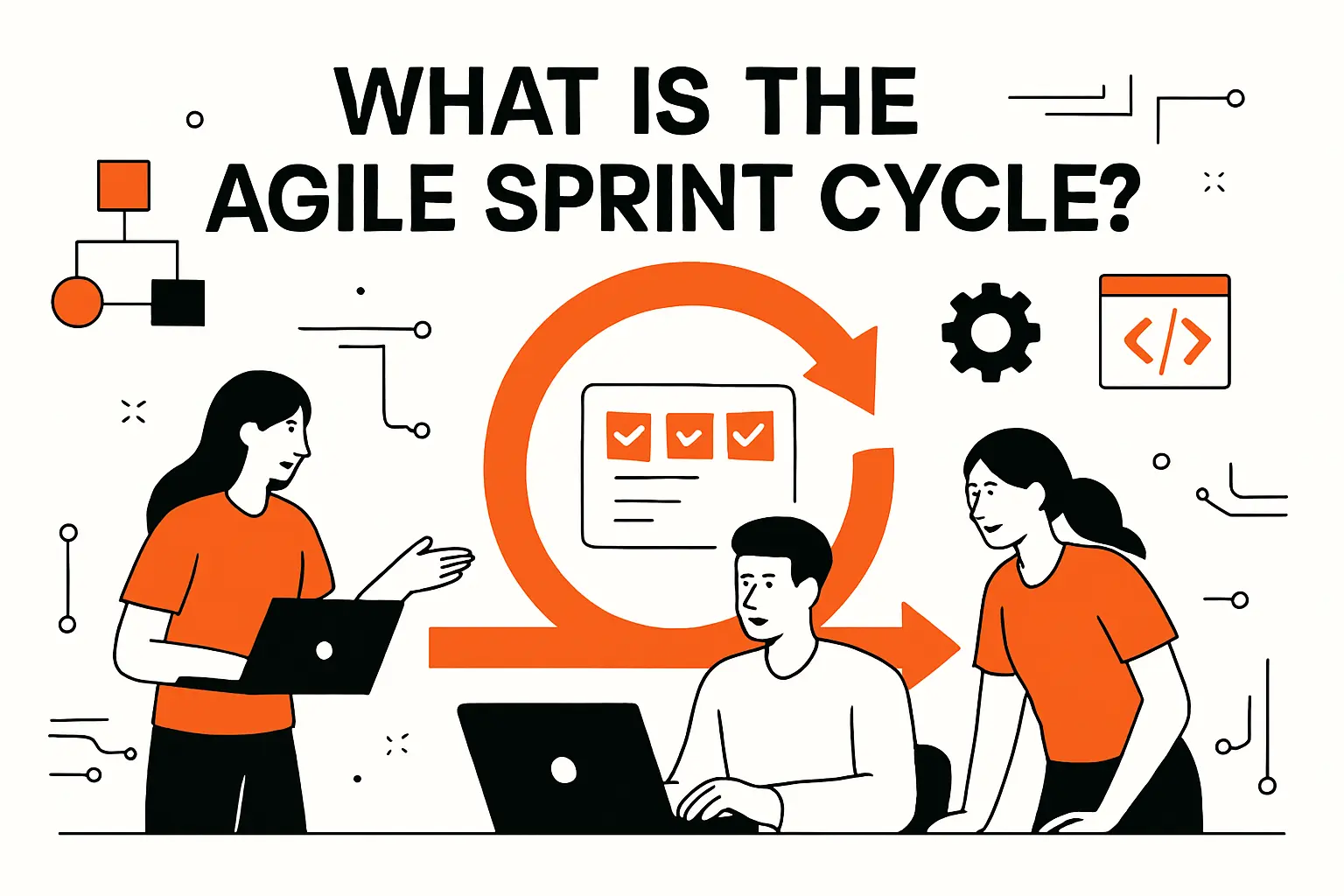
Executives care about sprints for outcomes, not rituals. In our experience, the strongest argument for disciplined sprinting is the linkage between software excellence and business performance: in a large cross-industry study, top-quartile developer velocity correlated with revenue growth that was four to five times faster than the bottom quartile. That kind of gap isn’t won by heroics; it’s earned by repeatable cycles—sprint goals, small batches, feedback, and learning—that reduce waste and amplify value. We see the sprint cycle as the smallest loop where strategy meets code and customers.
1. Time-Boxed Iterations Lasting One to Four Weeks
A sprint is a fixed-length window—short enough to force focus, long enough to deliver something meaningful. We favor shorter sprints when uncertainty is high (new domains, new teams, untested architecture) and slightly longer sprints when work is predictable (mature products, steady-state operations). The point of the timebox is not speed for its own sake; it’s to constrain WIP so that we finish work, integrate continuously, and surface risk early. Without a timebox, scope expands to fill the calendar and decision latency creeps in unnoticed.
We often describe a sprint as a “budget” measured in team capacity rather than dollars. The budget resets at a predictable cadence, and the team chooses the highest-value work that fits within it. The discipline of the timebox suppresses local optimizations—perfect code in the corner nobody uses—and rewards moving the product forward slice by slice. That pressure also stabilizes expectations: stakeholders learn to think in iterations (“What can we see next sprint?”) instead of lobbing long lists over the fence.
Why the Timebox Works
- It curbs multitasking by making “finish” the primary currency of progress.
- It amplifies feedback, which shrinks the gap between plan and reality.
- It reduces decision fatigue by creating a natural moment to revisit priorities.
- It limits the blast radius of mistakes; the next correction is always close at hand.
2. Agile Versus Scrum and Where Sprints Fit
Agile is a philosophy—values and principles that favor people, collaboration, and adapting to change. Scrum is a framework that operationalizes agility with defined roles, artifacts, and events. Sprints belong to Scrum, but the idea of time-boxed, iterative delivery transcends frameworks. Kanban teams, for example, may implement “cadence” without formal sprints; XP emphasizes small increments, tests, and continuous integration. We choose the form that best matches the system of work, but the heartbeat—bounded intervals, clear goals, working increments—remains our north star.
When we meet a team that says, “We do Scrum, but…,” the “but” often masks a mismatch between ceremonies and constraints. The antidote is to start from first principles: What decision cycle do stakeholders need? What batch size unlocks feedback without thrashing? How will we ensure done really means done? With those answers, we select practices deliberately rather than cargo-culting rituals. The sprint cycle is a means, not a talisman.
3. From Sprint Planning to Daily Scrum, Review, and Retrospective
In Scrum, the sprint cycle has four anchor events: planning (deciding why and what), the daily scrum (coordinating how), the review (showing what changed), and the retrospective (learning how to improve). We lean on these events because they divide the work of product-making into distinct conversations: strategy and selection, execution and flow, value demonstration, and system improvement. When teams blur those conversations—turning a review into status reporting or a retro into a venting session—the cycle loses its edge.
We also encourage teams to right-size the ceremonies. If a product owner shows up prepared, the planning meeting shifts from aimless estimation to purposeful slicing and risk management. If developers come to the daily scrum with impediments named and small changes merged, the meeting becomes a trigger for swarming rather than a stand-up comedy routine. If stakeholders engage in the sprint review with honest reactions, we get product decisions, not applause. And if the retro produces one change we actually try next sprint, we accumulate real improvements.
4. Sprint Goal and a Usable Increment at the End
The sprint goal is the story of the iteration: a concise rationale that orients trade-offs. It helps us choose the minimum slice that validates a hypothesis, makes a user flow coherent, or derisks a dependency. Without a goal, we ship fragments. With a goal, we ship a small, coherent increment that a stakeholder can use, critique, or measure. That increment should be integrated, tested, documented where needed, and ready to release. Anything less invites debt and undermines trust.
We have seen this difference play out palpably. In a healthcare scheduling product, the team’s early sprints scattered effort across UI scaffolding, API exploration, and data modeling. Nothing was releasable. We reframed the sprint goal to “book a single appointment end-to-end for a narrow cohort.” That lens cut scope to essentials—patient lookup, slot selection, confirmation—and produced a usable increment. The next sprint widened the cohort and refined edge cases. Momentum replaced busyness.
Essential Stages in the Agile Sprint Cycle

Organizations are revisiting how work gets funded and executed because inflexible processes choke agility at the source. One survey of technology leaders reported that 56 percent expect to implement Agile, DevOps, or similar flexible delivery models to improve responsiveness—an aspiration that turns real only when the sprint stages are practiced with intent. The stages below are not paperwork; they are lenses for value, flow, learning, and renewal.
1. Product Backlog Refinement
Refinement is where ideas become options: we clarify intent, shrink work into slices a sprint can digest, and expose ambiguity early enough to act. We do not try to perfect stories; we aim to make the next slice buildable, testable, and demonstrably valuable. The product owner curates, but refinement is a team sport. Developers surface constraints, testers propose acceptance criteria, designers challenge feasibility, and security engineers raise compliance flags. When refinement is healthy, planning becomes selection, not surgery.
Practical Slicing Heuristics We Use
- Smallest valuable outcome: Define the thinnest slice that changes user behavior or validates a risk, not the smallest coding task.
- Vertical over horizontal: Deliver a thread from UI to data to deployment so feedback is end-to-end.
- One path, not all paths: Ship the common path first, tackle exceptions after we see usage.
- Just-enough fidelity: Replace big “BRDs” with crisp acceptance criteria and a working example.
- Dependency surfacing: Mark stories with external dependencies so we can sequence intelligently.
- Operational definition: Consider logging, metrics, and runbooks part of the slice, not a later chore.
Refinement is also our moment to challenge priorities. A backlog that never has items removed is a museum, not a plan. We routinely ask: If this item never ships, who would notice? The product owner’s “no” is as valuable as the team’s “done.”
2. Sprint Planning
Planning answers two questions: why this sprint matters and what we believe we can finish. We treat it as a negotiation between aspiration and capacity. The product owner presents intent; the team examines feasibility and risk; together we commit to a coherent slice of value. Good planning is the art of saying “not now” to work that dilutes the goal. Great planning leaves the team energized because the path is clear and the stakes are understood. We go deeper on planning later in this guide, including setting capacity and hardening the definition of done.
Signals You Planned Well
- The sprint goal fits on one line and makes trade-offs obvious.
- Each selected item has crisp acceptance criteria and visible risks.
- Capacity reflects reality—holidays, production support, and meetings are accounted for.
- The team can visualize a path to “done” that includes testing, security, and deployment.
3. Implementation and Daily Standups
During the sprint, the team implements the selected work and meets briefly each day to synchronize. We steer away from status recitals and toward flow: What impediments threaten the goal? Where can we swarm to unblock the riskiest piece? Which change should integrate today so downstream work is unblocked tomorrow? We love to see small pull requests merged often and automated tests flagging regressions immediately. That rhythm enables collaboration across disciplines without waiting for handoffs.
Remote and Hybrid Patterns That Work
- Asynchronous check-in before the standup, so the live meeting is about decisions, not data.
- Shared sprint board with explicit WIP limits to signal where help is needed.
- “Walking the board” instead of “going around the room,” to focus on flow, not individuals.
- Spot-swarming on the highest-risk card directly after the standup with the smallest useful group.
4. Sprint Review
The review is a conversation with stakeholders about outcomes, not a theater production. We demo working software, yes, but we frame it in the language of the sprint goal: the user journey we enabled, the behavior we observed, the risk we derisked. We prefer narrated journeys over slide decks and encourage real users to click through the increment or test drive an API. The most valuable reviews end with a decision—ship, iterate, or pivot—not just applause.
Designing for Candor
- Invite the right voices: real users, support, sales engineers, compliance, SRE—whoever will live with the increment.
- Show the ugly bits: edge cases, learning moments, and refactorings that matter for future scope.
- Instrumented demos: bring a handful of metrics to ground the conversation in facts.
- Capture decisions in the backlog immediately while context is fresh.
5. Sprint Retrospective
If the review is about the product, the retrospective is about the system that builds it. We view retros as the sprint’s engine of compounding returns. One small improvement adopted consistently beats many clever ideas forgotten by next week. Psychological safety is the keystone; without it, we get silence or blame instead of analysis. We use data to anchor discussion—cycle time scatterplots, defect escape rates, flaky test counts—and rotate facilitation so the format doesn’t stale. The retro ends not with a wall of sticky notes but with one or two changes the team agrees to try, with a clear owner.
Retros That Change Behavior
- Explicitly connect retro actions to observed pain (e.g., long code reviews, pager fatigue).
- Timebox experiments: try a WIP limit or pairing rotation for a sprint, then inspect.
- Make improvements visible on the board so they compete fairly with feature work.
- Close the loop next retro: did the change help, hurt, or require refinement?
6. Handle Unfinished Work by Returning It to the Product Backlog
Not all plans survive contact with reality. When a story isn’t done, we return the remaining work to the product backlog rather than carrying it as “almost finished” debt. We then decide whether to re-slice it (common), defer it (sometimes wise), or bring it forward intact (rare). This practice protects the sanctity of “done” and keeps velocity honest. It also forces a product conversation: if finishing the slice no longer advances the goal, maybe the world changed and our plan should too.
Antipattern Watch
- Stretching the timebox to “finish” undermines predictability and normalizes overcommitment.
- Counting half-done work as complete erodes trust and pollutes metrics.
- Auto-carrying leftovers without re-slicing transfers yesterday’s assumptions into tomorrow’s plan.
Sprint Planning: Goals, Inputs, and Steps
Sprint planning is where product intent meets the team’s real capacity for change. We treat it as a lightweight operating review of value, risk, and feasibility, not a guessing game about dates. The motivation is practical: agile transformations that treat planning as a sharp instrument to increase speed, clarity, and dedication have demonstrated improvements on key operational metrics in the range of 30 to 50 percent; planning is where those gains begin. In our practice, strong planning feels calm and decisive because everyone knows why the sprint exists and what “done” will mean.
1. Define a Clear Sprint Goal
The sprint goal is the filter for everything else. We write it in plain language tied to a product outcome: “Enable first-time users to complete onboarding without live support,” or “Migrate customer invoices for a single region to the new ledger.” When trade-offs arise mid-sprint—as they inevitably do—the goal tells us which scope to protect and which to trim. A strong goal also reveals hidden dependencies; if we can’t phrase the goal cleanly, we are probably mixing concerns.
Patterns for Strong Goals
- Outcome first: describe the change in user behavior or system capability, not the tasks.
- Hypothesis-aware: a goal can validate a bet (“If we shorten the flow, completion rises”).
- Scope-bounded: name a segment, market, or flow to keep the slice coherent.
- Testable: align acceptance criteria to observable evidence that the goal was met.
We sometimes pair the sprint goal with a lightweight “north star metric” for that iteration—not to turn the sprint into a KPI factory, but to align on what evidence would satisfy us that the outcome happened.
2. Understand Team Capacity and Velocity
Capacity is how many hands we have available; velocity is how much “done” we have historically produced per sprint. Velocity helps calibrate expectations, but treating it like a target corrupts it. We avoid performance theater by grounding capacity in reality—planned leave, support duties, onboarding—and using velocity as a forecast, not a commitment. The real magic is in flow: small, uniform slices reduce variance, which makes forecasts more stable. In other words, slicing well today makes next sprint’s velocity more informative.
Capacity Practices That Survive Reality
- Publish the capacity assumptions in the planning doc so surprises are visible.
- Reserve a small buffer for the unknown in unpredictable domains.
- Protect time for platform health and technical debt to avoid false economy.
- Avoid gaming: if the team inflates estimates to “hit velocity,” switch to throughput-style measures.
3. Select and Break Down Prioritized Backlog Items
Selection is where product strategy becomes the next slice of work. We weight items by both value and risk—shipping a small learning slice early often beats a large “obvious” feature later. Once selected, we break stories into testable steps and map dependencies explicitly. We also think about organization design here: if a single item requires three teams to coordinate, we either re-slice to reduce handoffs or identify pairing opportunities across teams to keep the batch small. Planning reveals structure; it doesn’t just follow it.
Breaking Work Without Breaking Flow
- Define acceptance criteria with the tester in the room; they will spot ambiguity immediately.
- Design for feature toggles, not branches that live forever.
- Capture operational work (alerts, dashboards, runbooks) as part of the story, not chores later.
- For external dependencies, lock in an integration spike early rather than gambling on the final week.
4. Clarify the Definition of Done
Done means releasable. Our definition of done typically includes code merged and reviewed, tests passing at multiple levels, security checks clean, documentation updated where needed, and monitoring in place. We also treat “operational readiness” as part of done: a feature that can’t be supported in production isn’t done, it’s a liability. When teams negotiate the DoD consciously, quality stops being a moral stance and becomes a shared contract.
Shift-Left Compliance
- Automate security and compliance checks in the pipeline so surprises don’t appear at release.
- Keep living checklists (e.g., data handling, audit trails) tied to stories, not static wiki pages.
- Make “docs-as-code” part of the repo; reviews catch knowledge gaps as naturally as code smells.
5. Timebox the Planning Meeting and Keep a Consistent Cadence
Planning should be long enough to agree on the goal, confirm capacity, slice the work, and surface risks—but no longer. Preparation is what shrinks planning: if refinement is effective and artifacts are up to date, planning moves briskly. Cadence matters too; a predictable rhythm creates a planning muscle. We start on time, finish when the goal and plan are real, and leave with a crisp understanding of what not to do this sprint.
Cadence as a Competitive Advantage
- Plan at the same point in the week to align with stakeholder availability and release trains.
- Use a consistent agenda so new team members ramp quickly.
- Assign explicit roles in planning (facilitator, scribe) to keep conversations focused.
Key Roles and Artifacts in the Agile Sprint Cycle
As organizations lean into product-centric operating models, the clarity of roles and the integrity of artifacts determine whether sprints are engines of value or ritualized status updates. In our practice, we design the system around the flow of decisions: what the product owner decides, what developers decide, what the Scrum Master enables, and how artifacts encode those decisions so the team can move without waiting for meetings.
1. Scrum Roles Product Owner, Scrum Master, Developers
Product Owner. The PO owns outcomes, not tasks. Their job is to link strategy to the next slice of value, continuously refine the backlog, and make call-after-call about what matters. Strong POs tell stakeholders the truth about trade-offs and tell teams the truth about constraints. Weak POs try to please everyone and deliver little of consequence.
Scrum Master. The Scrum Master is a designer of flow: they remove impediments, tune ceremonies, and coach the team toward transparency and continuous improvement. We value Scrum Masters who are systems thinkers—curious about how structure shapes behavior—more than ceremony police.
Developers. In Scrum, “developers” encompasses the cross-functional team—engineers, testers, designers, analysts—who turn ideas into increments. The hallmark of mature teams is shared ownership: testers propose architecture-friendly acceptance criteria, designers consider testability, engineers think about onboarding copy. The best teams swap “my part” for “our increment.”
Role Antipatterns We Guard Against
- PO as ticket taker: backlog filled by stakeholder demands with no product narrative.
- Scrum Master as meeting scheduler: rituals happen, but flow stays broken.
- Developers as function silos: work bounces between roles instead of moving as a slice.
2. Artifacts Product Backlog, Sprint Backlog, Increment
Product Backlog. A living, ordered list of options, not a graveyard. It expresses strategy in slices and includes evidence of learning—what we tried, what we saw, what we’ll do next. We prune it often.
Sprint Backlog. The subset of items selected to meet the sprint goal, broken into tasks when that helps coordination. We keep it transparent and small enough to manage, with WIP limits to make bottlenecks obvious.
Increment. The usable output of the sprint: integrated, tested, instrumented, and ready to release. We view “increment” as a proof of learning as much as a bundle of code; that mindset keeps us close to outcomes.
Making Artifacts Decision-Ready
- Keep acceptance criteria and test notes adjacent to code in the repo so the artifact is alive.
- Connect backlog items to metrics dashboards so reviews are grounded in evidence.
- Automate traceability where compliance demands it, but don’t let paperwork replace proof.
3. Definition of Done and Done Increment
We codify “done” because ambiguity kills flow. In our DoD, done includes technical completeness and operational readiness. We underwrite quality with lightweight, automated checks and a small set of human reviews that catch what tools miss—usability fit, edge-case thinking, security nuances. The payoff is twofold: fewer regressions and faster reviews because the team trusts the baseline.
Evolving “Done” Without Stalling
- Change the DoD deliberately in retros—and only then—so criteria don’t drift mid-sprint.
- Measure the cost of new checks and remove those that no longer buy signal.
- Pair on tricky reviews (security, performance) rather than elongating queues.
4. Stakeholders and Business Input
Sprints thrive when stakeholders are co-authors. We set expectations that reviews are decision forums, not showcases; that roadmap shifts will flow through refinement; and that experiments are welcomed when evidence demands them. We also make operational partners—support, sales engineering, finance—part of the conversation so the increment is viable beyond code. When stakeholders see their concerns resolved in the increment, trust compounds.
Patterns for Healthy Stakeholder Engagement
- Timebox feedback windows and capture decisions in the backlog, not email threads.
- Bring a narrative (user journey, demo data) that makes the goal tangible to non-developers.
- Use “preview environments” so stakeholders touch the increment, not just watch it.
Benefits of the Agile Sprint Cycle
Measured well, the sprint cycle produces business results that go beyond faster delivery. Research on enterprise agility has associated highly successful transformations with a likelihood of being top-quartile performers that is three times higher, a pattern we recognize when sprints are coupled with clear strategy and robust engineering practices. Sprints are not a silver bullet, but they create the conditions for learning, focus, and quality to pay back.
1. Predictability and Focus Through Timeboxing
Timeboxing turns the slippery notion of “progress” into a repeatable rhythm. Predictability does not mean rigidity; it means stakeholders can expect meaningful change at a regular cadence. The team benefits too: focus improves because we commit to less and finish more. In economic terms, sprints reduce option cost by forcing us to decide which options to exercise now and which to defer. The reduced WIP carries less context-switching overhead, and the cognitive load on individuals drops.
We have repeatedly seen this in platform modernization. Without sprints, teams tried to plan months ahead and got trapped in analysis. With sprints, we framed the work as a sequence of thin migrations—one service, one data pathway, then one customer cohort—so we could measure, learn, and adjust. Predictability came not from grand precision but from small bets chained together.
2. Faster Feedback and Higher Customer Satisfaction
The sprint review tightens the loop between building and listening. We prioritize working software over status reporting, then ask for reactions from real users and operators. When product decisions are made steadily at the end of each sprint, we avoid the sunk-cost fallacy that lures teams into polishing features customers don’t want. A culture of short feedback cycles doesn’t just optimize UX; it changes what the business funds next. In this sense, sprints are a governance tool as much as a delivery tool.
Consider a B2B SaaS pricing overhaul we delivered. Instead of attempting every pricing scenario at once, we implemented a minimal self-serve path for a targeted plan. Early feedback exposed a key insight: customers valued transparency on discounts more than additional price tiers. That discovery reshaped the roadmap and avoided months of marginal work. The sprint cadence made that learning inevitable rather than accidental.
3. Transparency, Collaboration, and Productivity
When the backlog is real, the board reflects flow, and the increment is always shippable, teams can collaborate without micromanagement. Visibility breeds autonomy. Developers self-select tasks where their skills fit best, testers pair early on acceptance criteria, designers and engineers coordinate on limiting rework, and SREs advise on operational readiness before deployment. Productivity gains show up not primarily as individuals working faster, but as the system eliminating friction—fewer handoffs, shorter queues, and smaller batches.
One of our favorite transparency practices is to treat the repo as the source of truth. If an outsider can navigate the codebase to find the latest docs, acceptance criteria, and feature toggles, the team is probably healthy. If key knowledge lives in private slides or someone’s head, sprint reviews will feel polished while the engine sputters underneath.
4. Risk Mitigation and Quality Assurance
Sprints shrink risk exposure by limiting the size of each bet and increasing the frequency of course corrections. A small increment with test coverage and monitoring will fail in narrow, observable ways; a large release fails broadly and opaquely. Short cycles also reveal flaky tests, brittle integrations, and scaling limits sooner, when the cost to fix is lower. We like to see teams use a “risk register light” embedded in the backlog: capture a risk with the slice it affects, decide whether to mitigate now or later, and review the risks in planning.
Regulated contexts underscore this value. In a financial services migration, auditors initially demanded heavyweight documentation phases. We showed them how a sprint cadence with integrated controls—automated policy checks, immutable logs, and peer-reviewed changes—produced stronger evidence than gated sign-offs. The outcome: fewer delays, better traceability, and a happier compliance team.
5. Adaptability Through Iterative Releases
Sprints train the organization to respond, not react. When every iteration ends with a decision, strategic pivots are cheaper because we can steer at the next boundary. This is particularly powerful for infrastructure and platform teams, where internal customers have competing needs. By sequencing increments as experiments (“Will this cache remove the hot path?” “Does this API design reduce downstream coupling?”), platform bets become testable, not religious.
Adaptability compounds over time. As teams build muscle memory for small, coherent increments, the portfolio-level program can sequence multiple teams’ sprints to minimize cross-team blocking. We have orchestrated complex launches by mapping dependencies across teams and aligning sprint goals like gears. The work looks intricate, but the mechanics are simple: smaller pieces, visible flow, and deliberate synchronization points.
How TechTide Solutions Builds Custom Solutions With the Agile Sprint Cycle

At Techtide Solutions, we adopt the sprint cycle as the baseline and tune it to the domain—consumer apps, fintech platforms, healthcare systems, or internal tools. We enter with humility, because context beats dogma, and we hold ourselves to the standard that an increment should speak for itself. Our aim is straightforward: sprint by sprint, convert strategy into software that customers will use and the business can trust.
1. Customer Discovery and Sprint Goal Alignment
We begin with discovery sessions that surface the job-to-be-done, constraints, and immediate risks. From there, we articulate an inaugural sprint goal that forces a thin, end-to-end slice. If the product is new, our first sprint typically targets a single journey that can be put in front of a handful of users quickly. If we are modernizing, the first sprint aims to move a small but representative flow through the new path, instrumented for comparability. We prefer to nudge stakeholders away from “phase one equals everything we want” toward “first slice equals the smallest meaningful step.”
Discovery also clarifies cross-team boundaries. Where multiple teams are involved, we map integration points and decide whether to embed representatives or run explicit swarms to tackle the riskiest handoffs. This is where sprint goals save us: they expose when a team can truly deliver an outcome independently versus when the organization needs to address structural coupling.
2. Incremental Delivery With Reviews and Stakeholder Feedback
We treat sprint reviews as product decisions, not ceremonies. Each review includes an explicit ask: ship, iterate, or pivot. For executives, we translate the sprint goal into the business question being tested. For users, we design demos that invite honest reactions, including awkward corners. For operational partners, we show observability, rollback plans, and support scripts so they can engage early. The sprint cadence becomes the steering wheel for the roadmap: evidence-in, next bets-out.
One client—a multinational retailer—engaged us to rework a promotions engine that had accreted complexity over years. We reframed the initiative as a series of sprint goals around customer segments and campaign types rather than a monolithic rewrite. Early sprints delivered a functional path for a limited set of promotions in a pilot region, which exposed data modeling assumptions we adjusted before scaling. Because each increment was usable and measurable, stakeholders backed the sequencing even when it deviated from initial plans.
3. Continuous Improvement Via Retrospectives and Definition of Done
We hold retrospectives with our clients present when appropriate; nothing builds trust like improving the system together. We also institutionalize a client-specific definition of done early and evolve it intentionally. For regulated industries, we integrate controls into the pipeline (static analysis, dependency checks, data-handling verifications) and keep auditors in the loop so the evidence we produce is what they need. On platform engagements, we tie “done” to SLOs and load-test thresholds so performance does not trail functionality by months.
We favor incremental improvements over sweeping rewrites of process. In one engagement, we noticed code reviews were lagging, adding days to cycle time. Rather than launching a “review revolution,” we piloted pairing on complex changes and a rotation for “review lead” each sprint. Cycle times shrank, reviewers learned from each other, and the change stuck because it was small and demonstrably useful.
4. Transparent Tracking Through Backlogs and Daily Standups
Our clients see what we see. We maintain a single product backlog with crisp acceptance criteria, keep sprint boards with explicit WIP limits, and rely on the repo for living documentation—README, ADRs, and test notes side by side with code. Daily, we conduct concise standups that walk the board, not the people. Impediments are named, owners are clear, and the highest-risk item receives attention first. This transparency is not performative; it reduces status work, increases autonomy, and keeps the conversation anchored in the increment.
We also expose engineering health. Flaky tests, build times, incident follow-ups, and error budgets are part of the narrative at reviews and retros. By placing engineering signals alongside product outcomes, we avoid the false dichotomy between speed and quality. Stakeholders quickly learn that dependable delivery is the compound interest of good engineering practices executed in sprints.
Conclusion: Make the Agile Sprint Cycle Work for Your Team
The sprint cycle is a deceptively simple idea: pick a small goal, do the work in a fixed window, show the increment, and learn. Its power comes from the culture it nurtures—clarity, candor, flow—and from the way it aligns from strategy to code to customer. In our experience, the teams that benefit most from sprints are those that treat the cycle as a living system to be tuned, not a doctrine to be obeyed.
1. Choose a Consistent Sprint Length and Cadence
Pick a cadence your team can sustain, then protect it. Resist the temptation to elongate a sprint to “fit” more; instead, cut scope or re-slice. Keep ceremonies on the calendar even when it’s tempting to skip them during crunches. The consistency will create focus for the team and reliable expectations for stakeholders. Above all, let the sprint goal determine what stays and what slips. That clarity is worth more than squeezing in one more card.
2. Measure Outcomes With Sprint Goals and Velocity
Use velocity as a forecast, not a scoreboard, and pair it with outcome measures tied to sprint goals. When you see variation, investigate the system: batch size, WIP, review bottlenecks, test stability. Celebrate finished increments that move the product forward, not point tallies. If you need a single guiding question for measurement, use this: what evidence from this sprint tells us we created real, releasable value?
3. Iterate on Process After Every Retrospective
Treat retrospectives as the sprint’s R&D for how you work. Choose one change per sprint, make it explicit, and inspect the impact next time. Over months, this small habit transforms how teams communicate, integrate, and decide. If you want a practical next step, ask your team this: what is the smallest experiment we can try next sprint to make flow more visible or “done” more trustworthy? We would love to compare notes on what you pick and how it goes—shall we start with your next sprint goal?