
Across the last few years, we at TechTide Solutions have watched retrieval-augmented generation shift from a clever demo pattern into a core enterprise architecture. Market gravity is unmistakable: Gartner forecasts worldwide GenAI spending to reach $644 billion in 2025, and that scale forces us to treat RAG like production infrastructure rather than a prompt trick.
Advanced Rag Architecture: From Naive Pipelines to Production Systems

From a software engineering standpoint, “advanced RAG” means designing the whole lifecycle: ingestion that preserves meaning, retrieval that is measurable and debuggable, and generation that is explicitly constrained. Put differently, we stop asking “Can the model answer?” and start asking “Can the system keep answering correctly after the next data refresh, schema change, or user behavior shift?”
1. Core RAG phases: ingestion, retrieval, and generation working as one pipeline
In theory, RAG is a simple story: we ingest documents, retrieve relevant context, and generate an answer. In production, those phases are inseparable. Ingestion decisions silently define the ceiling of retrieval quality, while retrieval decisions define the floor of generation quality.
At TechTide Solutions, we model RAG as a pipeline with contracts. Ingestion must guarantee stable identifiers, trustworthy metadata, and reproducible chunk boundaries. Retrieval must provide not only passages but also an evidence trail we can log, replay, and evaluate. Generation must treat retrieved context as a constraint, not as “helpful background.” That systems view aligns with the foundational framing that Retrieval-Augmented Generation combines parametric and non-parametric memory to support grounded language generation, but we go further: we explicitly design for operations, drift, and auditability.
Engineering principle: isolate blame
When an answer is wrong, we want to know whether ingestion lost content, retrieval missed it, or generation ignored it. That sounds obvious, yet many teams ship a single black-box “RAG chain” and discover too late that debugging becomes guesswork.
2. RAG architecture variants: naive RAG, modular RAG, and advanced RAG
Naive RAG typically looks like this: chunk documents, embed them, run vector similarity search, dump the top results into a prompt, and hope. Modular RAG evolves by separating components: a document processing service, an indexing layer, an API-driven retriever, and a prompt-orchestrated generator. Advanced RAG keeps that modularity but adds deliberate feedback loops: query transformation, hybrid retrieval, reranking, compression, citations, and evaluation harnesses wired into CI and production monitoring.
From our perspective, the architectural leap is not “more AI”; it is more software discipline. Advanced RAG is basically search engineering plus LLM orchestration, with the added constraint that the generator is probabilistic and can be confidently wrong. That last detail changes everything: we need guardrails that treat “unknown” as a valid output, and we need observability that surfaces when context was missing versus when the model drifted off-script.
A pragmatic mental model
We often describe advanced RAG to stakeholders as: “Search finds evidence; the model writes the memo.” Once teams accept that separation, budgets and responsibilities become clearer.
3. Why basic RAG breaks in practice: duplicates, missing identifiers, and long-query failure modes
Basic RAG breaks for mundane reasons long before it breaks for exotic model reasons. Duplicate content is a classic culprit: the same policy PDF exported quarterly, the same FAQ mirrored across intranet pages, or the same Jira ticket summarized in multiple postmortems. Retrieval then over-samples redundancy, and the generator sees many near-identical snippets, which can amplify a single outdated clause.
Missing identifiers are even more damaging. If a chunk cannot be traced back to a document version, an owner, and a timestamp, “grounding” becomes theater. Long queries introduce a different failure mode: users paste whole emails, incident timelines, or multi-part requests. Without preprocessing, retrieval embeddings can collapse into “topic soup,” yielding vaguely related context that feels plausible but is not actionable. Finally, long contexts trigger the lost-in-the-middle effect that makes long contexts unreliable without careful context management, which is why simply increasing the context window rarely fixes production accuracy.
Ingestion and indexing foundations for advanced rag

If we had to bet on one place where most RAG projects succeed or fail, we would bet on ingestion. Retrieval can only retrieve what you actually indexed, and “indexed” means more than embeddings. It means structure, provenance, and maintainability.
1. Content preprocessing and extraction: cleaning text, handling tables, and preserving metadata
Extraction is the moment where meaning can be irreversibly lost. PDFs flatten layout; HTML collapses navigation into noise; slide decks mix speaker notes, headers, and decorative text. Rather than “just OCR it,” we treat each content type as a parsing problem with quality gates.
For tables, we prefer preserving row and column semantics instead of dumping them as whitespace. In enterprise settings, tables often hold the only authoritative truth: pricing tiers, support matrices, compliance checklists, and incident timelines. Metadata is equally critical. We capture source URI, document title, section headings, timestamps, owners, confidentiality labels, and domain-specific fields like product line or region. With that metadata in place, downstream retrieval can become more precise, and generation can cite sources in a way that feels contractual rather than decorative.
Real-world example: policy search
When we build RAG for internal policy assistants, the difference between “HR policy” and “HR policy for contractors” is often a metadata filter, not an embedding nuance. Without that filterability, correct answers become non-deterministic.
2. Chunking strategies: character, recursive, token, semantic chunking, and proposition chunking
Chunking is not a purely mechanical step; it encodes your theory of how meaning is retrieved. Character-based chunking is fast but blind to structure. Recursive strategies respect headings and paragraphs, which often align with how humans cite. Token-based chunking matches model constraints but can split ideas in awkward places.
Semantic chunking goes further: it tries to split where topic shifts, which reduces mixed-context chunks that confuse retrieval. Proposition chunking is an extreme form: we break text into minimal, self-contained claims that can be assembled like evidence tiles. In our own builds, we choose chunking based on the question patterns we expect. For troubleshooting assistants, smaller chunks win because users ask pointed questions and need precise steps. For narrative tasks like summarizing meeting notes, larger parent chunks help because coherence matters more than pinpoint recall.
Our rule of thumb: chunk for citations
If a chunk cannot be comfortably cited as a unit of evidence, it is usually too big, too mixed, or too anonymous.
3. Index design and maintenance: vector indexes, hierarchical indexes, hybrid indexes, and update strategies
A production index is a living system, not a one-time artifact. Vector indexes excel at semantic similarity, but they can be brittle when users expect exact matches for part numbers, ticket IDs, or clause references. Hierarchical indexes give us a way to retrieve at multiple granularities: small chunks for matching, larger parents for readable context. Hybrid indexes combine sparse keyword signals with dense vectors, which is often the difference between “find the right doc” and “find a thematically similar doc.”
Maintenance matters just as much as design. We implement incremental updates, deletion workflows, and backfills as first-class operations. In regulated environments, we also track retention and legal holds. A subtle production issue we see repeatedly is embedding drift: when teams change embedding models without re-embedding the corpus, similarity scores become meaningless. Advanced RAG treats re-indexing as a planned migration with rollback, not as a late-night scramble.
Query understanding and query transformation techniques

Users do not speak “retrieval.” They speak in goals, frustrations, shorthand, and context that exists only in their heads. Query understanding is where we translate human intent into retrievable intent—without rewriting the user’s meaning.
1. Query rewriting and step-back prompting to align user intent with retrievable context
Query rewriting is not about making queries longer; it is about making them index-aligned. In many systems, users ask for an outcome (“Why did the deployment fail?”) while the corpus is organized by artifacts (“CI logs,” “runbooks,” “incident notes”). A rewriting layer can expand acronyms, add missing product names inferred from session context, and convert conversational prompts into search-friendly statements.
Step-back prompting adds a different flavor: instead of immediately retrieving against the user’s exact phrasing, we ask the model to abstract the question into a higher-level retrieval plan. We have found it especially useful when users ask for guidance that spans multiple docs. Conceptually, this matches the idea that step-back prompting encourages abstraction before attempting detailed reasoning. In RAG, that abstraction becomes a retrieval scaffold: the system searches for principles, definitions, and canonical procedures before it searches for edge-case exceptions.
Where rewriting goes wrong
Over-aggressive rewriting can smuggle in assumptions. To counter that, we log both the original and rewritten query, and we treat rewriting as a reversible transformation rather than a replacement.
2. HyDE hypothetical document embeddings and hypothetical question indexing for better retrieval symmetry
Dense retrieval often fails when the query and the document “talk past each other.” Users ask in symptoms; documents answer in diagnoses. HyDE is a clever symmetry hack: generate a hypothetical answer document from the query, embed that hypothetical text, and retrieve using the resulting embedding. Practically, that means retrieval is guided by the shape of an answer rather than the shape of a question. The core idea aligns with HyDE using a hypothetical document to create a retrieval-oriented embedding that improves zero-shot dense retrieval.
In production, we like HyDE most for messy corpora: scattered wikis, partially migrated docs, and inconsistent writing styles. Hypothetical question indexing is the complementary ingestion-side move: pre-generate plausible questions for chunks and store those as additional retrieval keys. When we combine both, we often see a reduction in “near-miss” retrieval, where the correct doc is present but never surfaces because the query vocabulary doesn’t match the author’s vocabulary.
A caution from the field
HyDE can overfit to the model’s own priors. For sensitive domains, we keep the hypothetical text out of the final prompt and use it strictly as a retrieval instrument.
3. Decomposition and routing: subqueries, query routers, and dispatching across multiple stores
Some questions are not single questions. They are bundles: “Compare the latest SLA with the previous one and tell me what changed for enterprise customers.” That request spans retrieval for “latest,” retrieval for “previous,” and retrieval scoped to “enterprise.” Decomposition turns one conversational ask into multiple targeted subqueries with explicit scopes.
Routing then decides which store should answer which subquery. In our implementations, we commonly separate: a policy store, an engineering runbook store, a ticket store, and a metrics glossary store. Each has different chunking, metadata, and ranking behavior. A query router can use lightweight classification, user role, or explicit user intent to dispatch correctly. Done well, routing improves both quality and cost because we avoid searching everything for every question. Done poorly, routing becomes a silent failure mode, so we build “router fallbacks” that widen the search when confidence is low.
Retrieval strategies that improve recall and precision
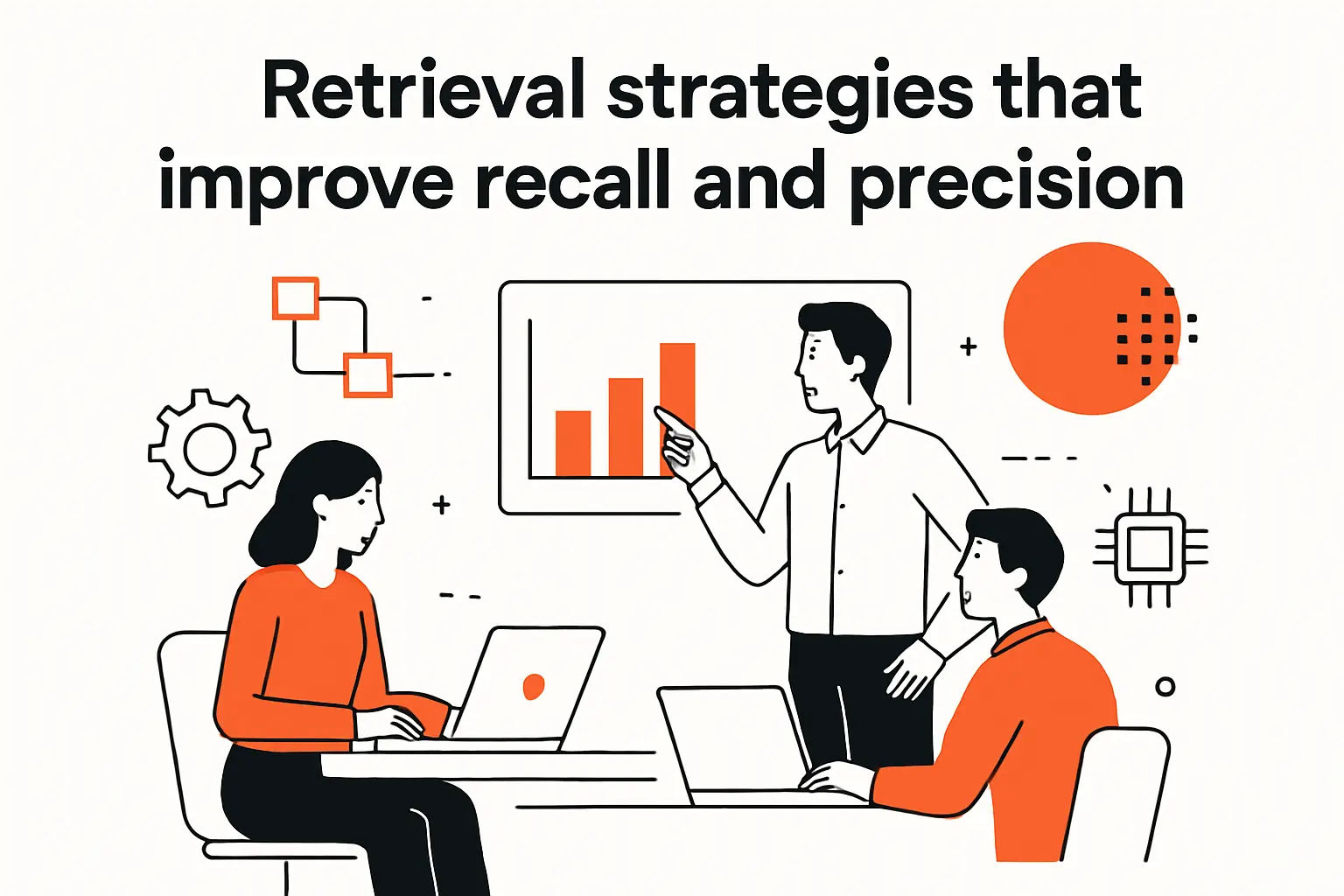
Retrieval is the heart of RAG, and it is also where many teams underestimate classic information retrieval wisdom. Dense vectors are powerful, yet enterprise truth often hides behind exact terms, structured filters, and cross-document relationships.
1. Hybrid retrieval: combining keyword and dense vector search with reciprocal rank fusion
Hybrid retrieval is the workhorse of robust RAG. Keyword search captures exact identifiers and rare terms; dense search captures paraphrases and conceptual similarity. The question is how to merge them without over-tuning fragile weights.
Reciprocal rank fusion is a pragmatic answer: rather than normalizing incomparable scores, we fuse ranked lists in a way that rewards agreement near the top. That approach is grounded in the retrieval literature, including the finding that reciprocal rank fusion is a robust way to merge heterogeneous retriever results. In production, we like RRF because it is easy to reason about, easy to log, and resistant to distribution shifts. When a corpus changes, score calibration can break; rank fusion tends to degrade more gracefully.
What hybrid fixes immediately
Hybrid retrieval often resolves the classic “ticket ID problem,” where a user expects an exact match but dense retrieval returns “similar incidents” instead of the incident.
2. Metadata-aware retrieval: self-query retrieval and multi-faceted filtering for scoped answers
Enterprise questions almost always carry implicit filters: region, product, customer segment, timeframe, confidentiality tier, or document type. If we ignore that structure and rely only on semantic similarity, we force the generator to “guess the scope,” which is how hallucinations masquerade as confidence.
Metadata-aware retrieval makes scope explicit. Self-query retrieval uses an LLM to translate natural language into structured filters, then runs retrieval with those filters applied. We treat it like a semantic parser with guardrails: allowed fields, allowed operators, and strict validation. Multi-faceted filtering also supports UX patterns we find invaluable: letting users refine by source, by owner, or by recency, and letting auditors replay the exact filter context that produced an answer.
Business impact we see repeatedly
When filters are reliable, stakeholders stop arguing about “the model’s opinion” and start discussing “which policy version the answer came from,” which is the conversation we want.
3. Graph retrieval and GraphRAG: using entities and relationships to support multi-hop questions
Some questions require stitching facts across documents: “Which services depend on this database, and which runbooks mention the failover?” Dense retrieval can fetch related passages, but it does not naturally model dependency chains. Graph retrieval does.
GraphRAG is a family of techniques that build or leverage a graph of entities and relationships—services, systems, teams, documents, customers—and then retrieve subgraphs as context. We see it as a way to turn “search” into “traversal,” which is essential for multi-hop questions. The framing aligns with GraphRAG organizing retrieval around entities and relationships for multi-hop questions and complex reasoning. In practice, we use graphs in several ways: to expand context through adjacency, to summarize communities of related nodes, and to enforce constraints (for example, only retrieve runbooks linked to the service named in the incident).
A sober warning
Graphs can amplify extraction errors. If entity resolution is sloppy, traversal becomes a confidence multiplier for the wrong neighborhood, so we treat graph quality as an index quality problem, not as a visualization problem.
Post-retrieval optimization and context management

Retrieval gives candidates; post-retrieval decides what the model actually sees. In our experience, this layer is where advanced RAG earns its keep: it reduces noise, improves grounding, and controls cost without sacrificing recall.
1. Reranking pipelines: cross-encoder rerankers and dedicated reranking services
Vector similarity is a coarse instrument. Rerankers refine the shortlist by scoring query-document pairs with a heavier model that can read more carefully. Cross-encoders are a common reranking choice because they jointly attend to query and passage text, capturing nuance that bi-encoder embeddings often miss.
From a systems angle, reranking is also a product decision: do we want a library call inside an API, or a dedicated reranking service with independent scaling, caching, and observability? We usually prefer the service model for larger organizations because reranking load patterns differ from embedding load patterns. Another advantage is experimentation velocity: swapping rerankers becomes a deployable change, not a refactor across multiple apps. Most importantly, reranking gives us a lever to improve precision without constraining ingestion, which is helpful when the content team cannot change how documents are authored.
Reranking’s hidden benefit
When we log reranker scores alongside retrieval scores, debugging becomes dramatically easier because we can see whether “good docs were fetched but demoted” versus “good docs were never fetched.”
2. Prompt compression and contextual compression to reduce token cost and fight lost-in-the-middle
Long context windows tempt teams into dumping more text into the prompt. That strategy is expensive and often counterproductive. Contextual compression takes retrieved passages and extracts only the parts relevant to the query, which reduces distraction and improves the odds that key evidence survives the model’s attention bottleneck.
We view compression as a retrieval-adjacent step, not a generation step. The goal is not to “rewrite the documents,” but to create an evidence packet: minimal, faithful, and easy to cite. Prompt compression then structures that packet: grouping by source, labeling sections, and adding lightweight scaffolding like “definitions” or “procedures.” The net effect is fewer tokens and stronger grounding, especially under the lost-in-the-middle behavior we mentioned earlier.
Compression failure mode
Over-compression can erase qualifiers. To prevent that, we preserve citations back to the original chunk and allow the system to expand context on demand when uncertainty is detected.
3. Reducing noise and redundancy: deduplication, contextual window expansion, and hierarchical context supply
Noise often looks like relevance until you measure it. Redundancy is particularly toxic: multiple copies of the same clause, multiple excerpts of the same changelog, or multiple near-identical incident summaries. Deduplication can happen at several layers: during ingestion via content hashing, during retrieval via similarity clustering, and during context assembly via “only keep the best representative of a duplicate group.”
Contextual window expansion is the opposite move: when a chunk is relevant but incomplete, we expand around it (parent section, neighboring paragraphs) so the generator sees the conditions and exceptions. Hierarchical context supply combines both ideas: we retrieve small for matching, then supply larger for answering. In our builds, this is one of the most reliable ways to reduce hallucinations without punishing recall, because it keeps prompts readable while still preserving the document’s logical structure.
Generation and response synthesis patterns for grounded outputs
Generation is where users feel the system. It is also where teams get hurt if they treat an LLM like a deterministic template engine. Our approach is to make generation behave like a controlled interface over retrieved evidence.
1. Grounded prompting: answering strictly from retrieved context and handling unknowns
Grounded prompting is a philosophy enforced by mechanics. We instruct the model to answer only using retrieved context, to quote or paraphrase carefully, and to say it does not know when evidence is missing. In other words, we treat the model like a junior analyst who must cite their sources.
Operationally, we implement this through prompt structure (clear separation of instructions, context, and question), refusal behavior (explicit allowance to say “not found”), and response formatting (bullets for steps, short paragraphs for rationale, and an evidence section when appropriate). For business users, “unknown” is not a failure; it is risk containment. In regulated workflows, a cautious answer that requests clarification is often more valuable than a fluent guess that creates compliance exposure.
Our opinionated stance
If the context is weak, we would rather retrieve again than generate harder. Most production incidents we investigate come from systems that do the opposite.
2. Reference citations and post-completion checks: fact checking and policy checks on generated answers
Citations are not decoration; they are the user interface for trust. When answers include references back to specific documents or sections, stakeholders can verify quickly, and disagreements become resolvable. We therefore treat citation generation as part of response synthesis, not as an afterthought.
Post-completion checks add another layer. After the model drafts an answer, we run automated validations: does each factual claim appear in the evidence packet, does the answer contradict a retrieved clause, does it include disallowed content, and does it leak sensitive data? For high-stakes deployments, we also run a secondary model as a critic focused on faithfulness and security. Interestingly, recent research highlights limits of naive similarity-based hallucination detection, and the Semantic Illusion paper argues embedding-based detectors can miss semantically plausible hallucinations, which is why we prefer multi-signal checks rather than a single “hallucination score.”
Policy checks are not optional
Whenever an assistant can see internal docs, it becomes a new data exfiltration surface. We design with that assumption, not against it.
3. Robustness and adaptation: fine-tuning, natural language inference filtering, and iterative refinement
Robustness means the system keeps working when the world changes. Fine-tuning can help in narrow ways: aligning tone, improving tool use, or teaching domain vocabulary. Still, fine-tuning does not replace retrieval quality, and it can even mask retrieval issues by making the model “sound right” more often.
Natural language inference filtering can be useful as an evidence validator: does a passage entail a claim, contradict it, or neither? We use that logic cautiously and treat it as a heuristic, especially given the limits discussed in recent work. Iterative refinement is our more reliable pattern: generate a draft, evaluate it against retrieved evidence, retrieve again if gaps are found, and regenerate with the missing context. That approach is conceptually aligned with Chain-of-Retrieval Augmented Generation retrieving and reasoning step by step for complex queries, even if we implement it with pragmatic orchestration rather than a monolithic model.
Evaluation, safeguards, and production-readiness for advanced rag systems

Production-readiness is not a checklist item; it is a discipline. Without evaluation and safeguards, RAG systems tend to drift into “feels good” territory, where demos look impressive but reliability collapses under real usage.
1. Assessment pipelines and golden datasets for repeatable quality measurement
We evaluate advanced RAG at multiple layers: retrieval quality, citation faithfulness, answer completeness, and user satisfaction. Golden datasets are essential because they turn vague debates into measurable regressions. In our practice, a golden set includes representative queries, expected sources, acceptable answer patterns, and negative tests where the correct behavior is to refuse or ask for clarification.
Automated evaluation frameworks help scale this work. For reference-free scoring, we have found it useful that RAGAS provides reference-free evaluation metrics for RAG pipelines across retrieval and generation dimensions. Even then, we do not outsource judgment entirely to automated metrics. Human review remains vital for nuanced failures like misleading omissions, overconfident phrasing, or subtle policy violations.
A testing habit that pays dividends
Every bug we fix becomes a new test case. Over time, that turns production incidents into a compounding reliability asset.
2. Responsible AI safeguards: harms assessment, jailbreak resistance, and red-teaming workflows
Responsible AI in RAG is not abstract ethics; it is concrete risk management. Harms assessment asks: what can go wrong for users, customers, employees, and the business if the system answers incorrectly, leaks data, or can be manipulated?
We align safeguards with established frameworks, and NIST’s Generative AI Profile provides a structured way to manage GenAI risks across the system lifecycle. On the security side, we operationalize prompt-injection defenses, tool authorization boundaries, and content filtering informed by OWASP Top Ten for LLM Applications framing prompt injection and sensitive information disclosure as core threats. Red-teaming then becomes a repeatable workflow: simulate malicious inputs, measure failure modes, and verify mitigations with regression tests.
Where teams get complacent
Many organizations lock down the model but forget the data plane. In RAG, the corpus and the retrieval filters are part of the security perimeter.
3. Operating at scale: latency and cost trade-offs, monitoring, and multimodal retrieval considerations
Operating at scale is where architecture meets economics. Latency budgets force trade-offs: deeper reranking improves precision but adds compute; more retrieval calls improve recall but add cost. We typically address this with adaptive pipelines that “spend” more compute only when the query complexity demands it.
Monitoring is the unsung hero. We log queries, rewritten queries, retrieved document identifiers, ranking decisions, compression outputs, and final citations. Drift detection matters too: when new documents enter the corpus, retrieval distributions change, and yesterday’s evaluation results may no longer represent today’s behavior. Multimodal retrieval adds another dimension. If users ask questions about diagrams, screenshots, or scanned PDFs, the pipeline must support image-aware extraction and indexing, along with the governance controls that accompany richer data types.
TechTide Solutions: building custom advanced rag systems tailored to customer needs

At TechTide Solutions, we do not treat RAG as a product you “install.” We treat it as an engineered capability that must match a customer’s data reality, operational constraints, and risk tolerance. The most effective systems feel boring in the best way: predictable, traceable, and maintainable.
1. Solution discovery and architecture design mapped to your data, users, and workflows
Discovery starts with uncomfortable questions. What decisions will users make based on these answers? Which data sources are authoritative, and which are merely convenient? How often does content change, and who owns correctness?
From there, we design the architecture around workflows rather than around model features. A customer support copilot needs tight integration with ticketing systems, customer context boundaries, and “show your work” citations. An engineering incident assistant needs log-aware retrieval, runbook hierarchy, and clear escalation paths when evidence is missing. In both cases, we define success criteria early and translate them into evaluation harnesses so that progress is measurable rather than anecdotal.
Our design bias
We prefer starting with a smaller, high-trust corpus and expanding coverage over time, instead of indexing everything and hoping the retriever sorts it out.
2. Custom implementation across web apps, internal tools, and enterprise integrations
Implementation is where RAG becomes real software: authentication, authorization, audit logs, rate limits, caching, and fallbacks. We integrate advanced RAG into web applications, chat interfaces, internal portals, and workflow tools so that the assistant is present where work happens rather than living in a separate demo environment.
Enterprise integrations often determine adoption more than model choice. If the assistant cannot respect document permissions, users will not trust it. If it cannot write back to systems of record safely, it will remain a read-only toy. We also build for operational resilience: retries for retrieval backends, graceful degradation when rerankers time out, and clear user messaging when the system is uncertain.
Integration pattern we like
Instead of giving an assistant broad tool access, we expose narrowly scoped actions with explicit inputs and explicit audit trails.
3. Optimization and scaling: evaluation-driven iteration, performance tuning, and long-term maintainability
Optimization is a loop, not a phase. After initial launch, we iterate based on evaluation results, user feedback, and observed failure modes. Some improvements are data-side: better metadata, fewer duplicates, cleaner extraction. Other improvements are retrieval-side: hybrid fusion, better routing, improved reranking. Generation-side improvements usually focus on grounded prompting, better citations, and safer refusals.
Maintainability is the quiet requirement that decides whether a RAG system survives. We document schemas, version indexes, and treat prompt templates like code. We also put dashboards in place that track answer quality signals over time, because “it worked last quarter” is not an operational strategy. When customers expect the assistant to become a durable internal capability, we build with clear ownership boundaries and upgrade paths so the system can evolve without constant reinvention.
Conclusion: an implementation roadmap for advanced rag
Advanced RAG is not a single technique; it is an architecture with layered defenses. When we build it thoughtfully, we get something rare in applied AI: a system that can explain itself, improve systematically, and earn trust over time.
1. Start with strong ingestion and chunking, then add reranking, hybrid retrieval, and query transformations
Early wins come from fundamentals. Solid extraction, metadata preservation, and chunking that respects document structure give you a corpus that can actually be searched. Next, hybrid retrieval and reranking improve precision in ways users notice immediately, especially for exact-term queries mixed with conceptual questions.
Once retrieval is reliable, query transformations become a force multiplier. Rewriting, decomposition, and symmetry tricks like hypothetical embeddings help align messy user intent with your index reality. Throughout this phase, we recommend wiring evaluation into development so each improvement is measurable, and each regression is caught before users do.
2. Expand to GraphRAG, agentic workflows, and richer response synthesis when complexity demands it
As question complexity grows, graph retrieval and multi-step retrieval workflows become worth the added engineering cost. Richer response synthesis then helps the system communicate uncertainty, cite evidence cleanly, and provide action-oriented outputs instead of generic prose.
From here, the next step is usually organizational rather than technical: deciding who owns corpus quality, who owns evaluation standards, and how the assistant’s answers are governed as internal knowledge changes. If we at TechTide Solutions were sitting with your team tomorrow, which part of your pipeline would you harden first: the data you ingest, the way you retrieve, or the way you prove your answers are grounded?