
As cloud-centric delivery becomes the default, product teams are under pressure to ship value faster without sacrificing quality; in practical terms, that pressure is rising alongside overall cloud investment, with public cloud end‑user spending forecast to reach $723.4 billion in 2025, a reminder that our systems, processes, and team habits must keep pace with the platforms we now build on. At TechTide Solutions, we read this as an invitation: use the 12 Agile Principles to connect strategy, design, and engineering into a humane, adaptive way of working that turns market turbulence into a tailwind.
The 12 Agile Principles at a Glance
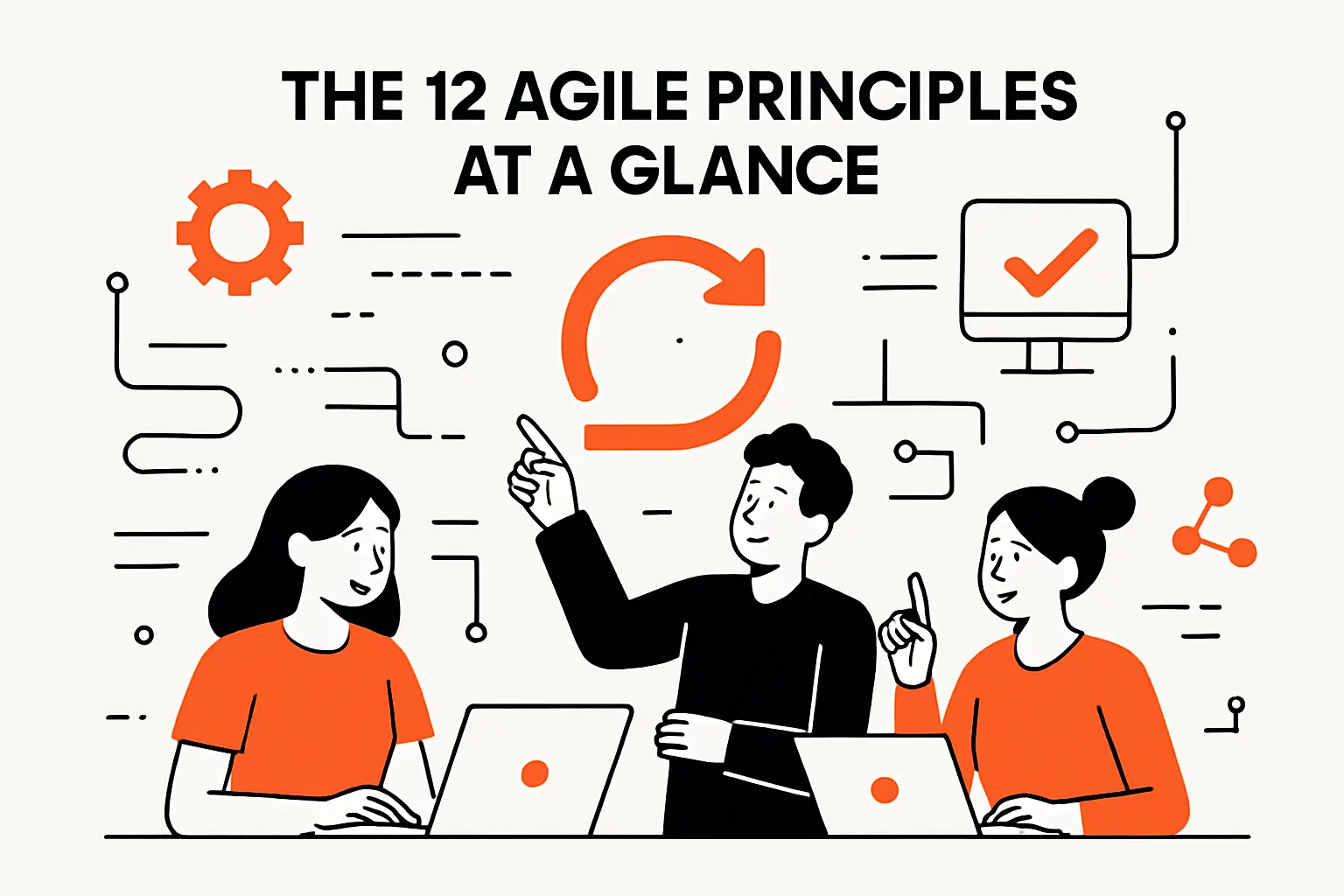
Principles translate values into everyday posture. We teach teams to treat the 12 not as a checklist but as a set of tensions to balance: speed with quality, autonomy with alignment, simplicity with thoroughness. The emphasis on sustainability is not accidental; it is echoed in workforce research showing a persistent gap between leaders’ intentions and employees’ lived experience, exemplified by findings where 89% of executives say their organization is advancing human sustainability in some capacity, even as worker sentiment lags. The same theme runs through agile practice: outcomes improve when we make the work itself sustainable.
1. Satisfy Customers Through Early, Continuous Delivery of Value
Early and continuous delivery requires two commitments: slicing value thin and shortening the idea‑to‑learning loop. Our pattern is to frame features as hypotheses, not promises, then ship controlled live tests that reduce uncertainty. In an ecommerce refactor, we released a just‑good‑enough search improvement to a small audience and watched click‑to‑add behavior over a short window. The change landed; only then did we harden the design. Notice the discipline: customers see progress early, but we avoid over‑investing until proven. That posture satisfies customers because it treats their time and attention as the ultimate budget.
How we slice
We look for “end‑to‑end, edge‑to‑edge” slices: a path from a user gesture through services to storage and back to a visible result, deployed safely via toggles. Slices beat layers because partial systems invite guesswork; real value emerges only when a user can do something new or do something they already do, but faster and with less friction.
2. Welcome Requirement Changes, Even Late, to Serve Customer Advantage
Welcoming change is not heroic; it’s architectural. Teams that fear change often carry brittle tech or brittle agreements. We invest in seams—clear API contracts, small deployable units, and observability that makes regressions obvious—so that late insights aren’t catastrophic. We also clarify option value with stakeholders: a pivot opportunity later is worth more than a spec “locked” earlier if it raises our odds of a hit. In practice that means a living backlog that retires items when evidence no longer supports them, and a culture that celebrates what we didn’t build.
Guardrails
Say yes to change that improves outcomes; say no to change that relitigates settled principles or disrupts foundational coherence. When options multiply, we timebox evaluation, spike the riskiest path, and recommit to the simplest approach that meets the goal.
3. Deliver Working Increments Frequently With Shorter Timeboxes
Frequency creates focus. Short timeboxes force us to decompose work into coherent slices and to keep integration pain low. The operational trick is to maintain a steady heart rate: predictable, small releases; tight feedback loops; quick detection and rollback when needed. We’ve found that stakeholders start making better decisions once they trust the cadence, because the next chance to learn is always around the corner.
Antipattern to avoid
“Demo theater” where teams polish slides but delay integration. We counter that by requiring a tracer bullet—a thread of working code in production, gated by toggles—for every initiative before we invest in breadth.
4. Ensure Daily Collaboration Between Business and Developers
Nothing aligns incentives like joint ownership of outcomes. We pair product managers and technical leads in a shared channel and habitually pull in customer success, design, and analytics. Every week we expect at least one real customer voice in the conversation, even if it’s just a curated clip. Over time, business and engineering stop translating and start co‑creating—debates shift from “can we build it?” to “should we build it, and what’s the smallest test that proves it?”
Remote‑first nuance
Distributed teams can be more collaborative than colocated ones when they treat video calls as workshops, not broadcasts. We keep cameras on for interest‑based alignment (problem framing, prioritization) and async for status. It’s not about more meetings; it’s about better ones.
5. Build Around Motivated People With Support and Trust
Motivation is a function of meaning, mastery, and autonomy. We aim for explicit outcomes and guardrails—what matters, what is out of bounds—and leave room for teams to choose approaches. Trust compounds when teams keep promises about the small things: they respond to incidents without blame, they own quality, they surface risks early. Leaders earn trust by removing systemic friction: cutting external approvals, unblocking access to data, and funding technical debt deliberately rather than treating it as shadow work.
Signals you’re getting it right
Teams proactively propose simplifications. Engineers volunteer for customer calls. Product managers bring evidence, not opinions. Designers offer options framed by trade‑offs, not mandates. The invisible glue is psychological safety paired with consequence for outcomes.
6. Use Face-to-Face Conversation as the Most Effective Communication
In a post‑office world, “face‑to‑face” means high‑bandwidth, low‑latency interaction. We prefer short, camera‑on working sessions for architecture or product decisions, then move decisions into writing for permanence. Emojis and reactions are signal, not fluff—if an architectural note gets silence, we treat it as a risk. And we record short context clips instead of holding live status briefings, so people can consume asynchronously and use synchronous time for thorny topics.
Hybrid rituals
Anchor days for team formation and complex design, with clear meeting hygiene: agenda upfront, artifact open, decision captured, owner assigned. When we finish a session, the artifact is the memory, not the meeting.
7. Use the Working Product as the Primary Progress Measure
Story counts and burn‑down charts tell you what people typed, not what customers felt. We make the working product the dashboard: key flows instrumented, error budgets explicit, adoption curves visible. Progress becomes an experience: can a real user complete the newly enabled path, and do they come back? Stakeholders start asking better questions when the demo is live, not a slide—“Can we toggle this to a different segment?” becomes the new “When will it be done?”
Metric hygiene
We avoid vanity metrics that always go up and prefer measures with tension: flow efficiency balanced by defect escape, feature adoption balanced by support contacts. The goal is not to “win the number” but to learn faster than competitors.
8. Maintain a Sustainable, Constant Delivery Pace
Sustainability means capacity planning that respects human limits and system constraints. We cap work‑in‑progress, leave headroom for unplanned work, and schedule time for learning and refactoring. The paradox is that calm teams ship more; frantic teams ship less of what matters. When the calendar fills with heroics, we pause and renegotiate scope rather than extracting one more promise from exhausted people.
What to watch
Spikes in after‑hours commits, creeping lead times, or recurring incident themes are early indicators that pace is slipping from sustainable to brittle. Treat those signals like production smoke and respond with systemic fixes, not pep talks.
9. Pursue Technical Excellence and Good Design to Boost Agility
Technical excellence is not polish; it’s speed insurance. We invest in automated tests where they pay for themselves, keep branches short‑lived to avoid merge hell, and create paved roads—reusable patterns and scaffolding that help teams do the right thing by default. Design partners with engineering early to clarify intent, reduce rework, and expose the simplest viable experience for the next slice. Excellence shows up as fewer surprises, faster learning, and easier change.
Debt done right
We carry debt the way CFOs carry leverage: deliberately, transparently, and with a plan. When a quick hack unlocks a timely bet, we record it, quantify its drag, and schedule the cleanup before it compounds.
10. Keep It Simple by Avoiding Unnecessary Work
Simplicity is ruthless prioritization. It requires saying no to good ideas that dilute focus. We prune backlogs aggressively and insist that each item name the outcome and the smallest meaningful step toward it. We also look for deletion candidates—features we can turn off because few use them. Every line of code, every ops policy, every report is a maintenance liability; simplicity pays dividends in cognitive load and defect rates.
Decision checkpoint
Before starting work, ask: What will we not do because we are doing this? What would make this decision obviously wrong? When will we check? If those answers are vague, the work is not simple enough yet.
11. Rely on Self-Organizing Teams for the Best Designs and Requirements
Self‑organization is not leader abdication; it’s leader discipline. Leaders set a clear north, establish guardrails, and then let teams configure themselves. We find the best designs emerge when teams own the end‑to‑end slice—designers, engineers, and product managers shaping the solution together, loosely coupled to other teams through contracts and governance that focuses on outcomes, not rituals. The result is faster local decisions and fewer systemic collisions.
Enabling constraints
We use constraints to spur creativity: capacity limits, standard interfaces, simple design tokens. Within those boundaries, teams have room to innovate. The constraint is the canvas.
12. Reflect Regularly and Adjust Behavior to Improve
Learning is the continuous act of closing gaps between intent and outcome. We run short, blameless retros that produce one or two actionable experiments, not laundry lists. Each experiment has an owner and a review date. When something works, we socialize the pattern; when it doesn’t, we capture the lesson and try again. Improvement becomes a habit, not an event.
Retros that matter
Invite a customer success colleague, a designer from another team, or an SRE to one retro each cycle—fresh eyes, richer learning. Keep the scope tight: one slice, one outcome, one story. The only measure of a great retro is changed behavior visible in the product and the calendar.
Agile Values That Ground the 12 Agile Principles
Values are the load-bearing walls of agile practice. When we audit struggling programs, we almost always find that the problem precedes any framework: teams have misplaced their confidence in tools or templates and lost sight of the behaviors that produce outcomes. Industry studies back the payoff from getting the fundamentals right, with research showing that agility can improve operational performance by 30 to 50 percent, provided the underlying ways of working truly change. We treat these values not as slogans but as daily choices—who we talk to, what we show, how we decide.
1. People and Interactions Over Processes and Tools
We often tell clients that their architecture diagrams lie less than their slide decks, but their side conversations tell the truth. The first agile value reminds us that the bottleneck isn’t usually Jira, it’s the misalignment between the humans using it. On a retail platform replatforming we led, executives initially insisted on a “tooling overhaul” to fix cycle time. Demos looked polished; outcomes lagged. When we mapped the invisible work—handoffs, approvals, impromptu Slack decisions—two interventions delivered outsized gains: clear decision rights and a daily five‑minute cross‑functional stand‑down focused purely on blockers. Tools mattered later; first, we needed the right conversations.
What we’ve learned: instrument interactions, not just workflows. We use lightweight social contracts—team charters, explicit norms for async responses, a roster of product/domain “explainers”—to surface the interpersonal load that slows delivery. When cross‑team dependencies spark friction, we convene short, focused alignment sessions instead of “status meetings,” and we leave with a written decision and a single DRI. Our experience is that a modest investment in human rhythm outperforms elaborate process templates.
Practice tip
Before buying a new tool, run an “interaction retro.” Ask: Where do decisions actually get made, and by whom? What conversations do we avoid? Which updates are performative? Fix that. Tools work best when they amplify healthy interactions, not compensate for missing ones.
2. Working Product Over Comprehensive Documentation
Documentation is not the villain; detached documentation is. We keep a bias toward artifacts that prove value in the customer’s hands: feature flags, trunk-based increments behind toggles, and “thin slice” demos that connect a user event to a business outcome. In a fintech modernization, teams wrote fewer specs and more executable contracts, plus short Architecture Decision Records (ADRs) attached to pull requests. The paradox is that our documentation became both lighter and more authoritative because it lived where decisions lived—next to code, tests, and telemetry.
What this looks like
We ship “narrated increments”: a small change to production, toggled to a limited audience, accompanied by a minute‑long screen capture explaining what we changed and why. Product managers attach that clip to the story. Engineers add an ADR link to the diff. Customer success leaders comment inline with what they’re hearing. The working product becomes the meeting, and the narrative becomes the searchable memory.
3. Customer Collaboration Over Contract Negotiation
Contracts don’t vanish in agile—they shrink in scope and grow in learning. We’ve replaced adversarial “requirements sign‑off” with collaborative “risk sign‑on”: we jointly list the top uncertainties and how we will test them early. On a healthcare intake project, we shifted from volume‑based milestones to outcome‑based reviews with patient advocates in the room. The legal contract still reflected obligations, but the day‑to‑day momentum came from a cadence of discovery interviews, usability sessions, and delivery demos that made contracts feel like guardrails, not handcuffs.
Pro move
Put the riskiest assumption in the first release, not the safest. We deliberately schedule a “learning slice” up front—something small but representative enough to validate fit. If the assumption proves wrong, the contract specifies how we pivot without blame.
4. Responding to Change Over Following a Plan
Plans are hypotheses. Agile doesn’t reject planning; it resizes it to the uncertainty in front of us. We advocate “rolling‑wave” roadmaps: a crisp near‑term plan, a hazy mid‑term option set, and aspirational long‑term bets. In practice this looks like outcomes that are stable, options that are revisited often, and commitments that only harden when signals (from customers or telemetry) warrant it. The operating principle is simple: no plan survives first contact with a real user. A plan that changes with purpose is a plan doing its job.
Signals to watch
When issue trackers become the conversation and product dashboards become wallpaper, change will be resisted. Flip the ratio: start with outcomes, then work backward to slices. Use qualitative signals—call snippets, session replays—beside quantitative telemetry so that shifts in tone or confusion show up before churn does.
Putting the 12 Agile Principles Into Practice Day to Day
Turning principles into muscle memory means designing defaults: structures and habits that make the right behavior easy. We see this day‑to‑day enablement as a core executive responsibility, and it aligns with market realities in which platforms evolve quickly and teams must absorb change without drama. Analysts forecast sustained growth and modernization across the cloud stack, and operational research underscores that agility pays off when it shapes everyday work, not just big‑bang transformations. In our engagements, the teams that thrive are the ones that treat practice as product: iterated, instrumented, and improved with feedback.
1. Start With Customer Outcomes and Value-Centric Backlogs
We teach teams to write outcomes before items: a clear change in user behavior or business result, backed by how we’ll observe it. Only then do we propose slices that could plausibly cause that change. On a B2B analytics tool, our backlog shifted from internal feature names to customer journeys—how quickly a user got from a question to a confident answer—and the backlog pruned itself. Stakeholders rediscovered that what customers pay for is not functionality; it’s progress against their own goals.
Tools we use
Story mapping to visualize end‑to‑end journeys, opportunity solution trees to keep options visible, and hypothesis statements that make learning explicit. These artifacts channel creative energy toward outcomes instead of output.
2. Plan in Short Cycles and Reduce Batch Size
Small batches reduce risk and accelerate learning. We frame planning as a choice among slices, not a commitment to complete everything in a fixed span. We schedule integration earlier than comfort suggests, add just enough scaffolding for observability, and resist the urge to perfect internal APIs until we see the usage patterns. Planning becomes a conversation about option value rather than a race to fill every hour.
Executive habit
Leaders can help by funding options, not monoliths. Allocate budget in tranches tied to evidence, not promises, and celebrate scope subtraction as a sign of focus, not failure.
3. Use Daily Collaboration and Lightweight Face-to-Face Touchpoints
We favor brief, high‑bandwidth touchpoints: a short product‑engineering sync to clarify intent, a quick design walkthrough anchored on a prototype, a rapid huddle when telemetry flags regression. These conversations prevent the slow bleed of misalignment that cannot be fixed by a longer status meeting. Our rule of thumb: if a thread produces more heat than light, jump to a call; if a call settles the matter, write down the decision where future readers will find it.
Remote‑first hacks
Use shared canvases for live co‑editing, prepare short context videos instead of long meetings, and rely on “silent starts” where people read and react before discussion. Attention is a scarce resource; spend it on design, not recitation.
4. Define Done and Demonstrate Working Increments Frequently
“Done” must include the invisible work customers still feel: observability, security hygiene, rollback readiness, and support notes. We keep achievement criteria visible and enforce that each increment demonstrates value in a realistic environment. Demos stop being theater when the audience can try the thing, not just watch it.
Definition of Done checklist
Thin vertical slice deployed safely; toggles for rollout; alerting in place; ADR captured; support notes drafted; one paragraph “why” to aid future maintainers. We revise this list as we learn.
5. Protect a Sustainable Pace to Prevent Burnout
A sustainable pace is strategically conservative and operationally brave: conservative in capacity planning, brave in re‑scoping when reality intrudes. We plan slack for inevitable surprises and negotiate scope publicly when trade‑offs appear. Leaders normalize taking breathers after major pushes; managers measure team health alongside throughput. The unglamorous truth is that steady tempo beats adrenaline for any horizon that matters.
Team ritual
Every week, we ask one question: “If we keep working the way we worked, will we still be proud and energized next month?” If the answer wavers, we intervene with changes to scope or process before fatigue becomes failure.
6. Invest in Technical Excellence and Ongoing Refactoring
Good design shortens debates and lowers change cost. We earmark time for refactoring not as an indulgence but as risk management. Where data and services have drifted into accidental complexity, we nudge toward modular boundaries. We also write tests where they maximize signal: at integration points and stable contracts. This is not zealotry; it’s pragmatism aimed at reducing rework and making it safe to move fast.
Enabling patterns
Paved roads for common tasks, example repos to accelerate the first slice, and internal guides showing “the TechTide way” for logging, metrics, tracing, and deployment. Consistency creates speed without killing autonomy.
7. Practice Simplicity Through Ruthless Prioritization
We keep a “value kill list” of features and rituals we’re willing to stop doing. If something no longer advances the core outcome, we retire it. Simplicity also shows up in our data diet: fewer dashboards, better chosen; fewer alerts, more meaningful. The discipline to remove is as creative as the urge to add, and it requires the same leadership attention.
Questions that cut
What problem dies if we solve this? What would make us delete this feature with a smile? Who will notice if we remove this meeting? The answers sharpen focus.
8. Empower Self-Organizing, Cross-Functional Teams
Cross‑functional teams shrink the distance from idea to outcome. We onboard security, compliance, and data partners early as collaborators, not gatekeepers, and give teams budget and policy guardrails that let them make sensible local decisions. With that autonomy comes visibility: teams share outcomes, not activity, and invite scrutiny of trade‑offs. Autonomy without transparency is chaos; transparency without autonomy is theater. We want neither.
Operating model note
When product teams own their services and experience end‑to‑end, shared functions evolve from ticket‑taking to consulting. That shift is cultural as much as structural; it thrives on trust and shared language.
9. Run Frequent Retrospectives and Customer Feedback Loops
We treat retros and feedback sessions as instruments, not rituals. They measure the gap between our model of the world and reality. We ask customers to narrate their tasks while we watch quietly, we test changes with small cohorts before broad rollout, and we compare what we expected to happen with what actually happened. The learnings go back into the backlog and the operating model: sometimes a product tweak, sometimes a process change, sometimes a governance adjustment.
Make it safe
Blame kills learning. We normalize mistakes and focus on system fixes: clearer contracts, more guardrails, better defaults. The fastest learner usually wins, not the busiest worker.
Applying the 12 Agile Principles Beyond Software and Across Teams
Agility is a whole‑enterprise sport. In our experience, the biggest unlock happens when marketing, HR, finance, and operations bring the same principles to their work, turning “IT projects” into “business products.” Analysts who study enterprise transformations note that the organizations that internalize agile behaviors across functions tend to adapt faster when strategy, technology, or regulation moves. That broader adoption elevates engineering from service provider to peer in value creation, and it gives non‑technical teams a way to manage uncertainty without paralysis.
1. Extend Agile to Marketing, HR, Operations, and Other Functions
Marketing: treat campaigns as experiments. Build a lean hypothesis, test a narrow segment, observe behavior, iterate. Replace big‑batch launches with rolling learning. HR: frame policies as products with customers (candidates and employees), outcomes (time‑to‑hire, retention drivers), and feedback loops (pulse surveys and onboarding telemetry). Operations: import service reliability practices—error budgets, blameless postmortems, small releases—to make process changes safer and more repeatable. The cross‑functional bonus is shared vocabulary: “slice,” “toggle,” “rollback,” “guardrail,” “definition of done.”
Case in point
We helped a marketing team pivot from quarterly blasts to a steady drumbeat of small, targeted offers. Creative, data science, and product met weekly to inspect results and plan the next test. Costs went down; learning went up; sales attributed fewer wins to luck and more to design.
2. Align Engineering and Business With Shared Visibility and Goals
Shared dashboards that mix product outcomes, reliability signals, and business KPIs shift the conversation from “why aren’t you building my feature?” to “what is moving the goal?” We align on a few outcome themes at the company level and let teams pick their contributions, with the understanding that plans change as we learn. When leaders ask about status, we show working software and customer behavior, not just progress bars. The question isn’t “Are we on schedule?” but “Is this still the best option?”
Artifacts that help
Company outcome map; product scorecards that show adoption, satisfaction, and stability; and a change review that prioritizes learning speed and safety over ceremony. Transparency enables autonomy; autonomy earns trust.
3. Make Remote Work Face-to-Face With Effective Video Collaboration
Distributed work becomes human when we use real‑time video for decisions and async updates for everything else. We favor short working sessions, high‑quality audio, and shared canvases. Then we encourage participants to sketch, narrate, and decide in the moment. We also document decisions in places that survive turnover—decision logs, ADRs, and short context videos. The payoff is a team that feels close even when far apart because their default is to show, not tell.
Ritual upgrades
Replace long status calls with brief context recordings. Use chat threads to prepare, then video to decide. Finish with a clear decision and owner. People remember decisions they helped make; they forget slides they watched passively.
4. Center Metrics on Customer Value and Working Increments
We discourage output‑only dashboards in favor of value‑centric ones. A healthy view blends outcome (what changed for customers), flow (how work moved), and quality (how reliably it runs). For non‑software teams, “working increment” might be a live campaign, an updated policy, or a revised onboarding; the test is whether a real user can try the change and feel the difference. We make trade‑offs visible and honest: sometimes we choose speed over completeness, sometimes vice versa, but never without saying so out loud.
Beware metric theater
If the numbers move but the product does not feel better, the metrics are lying or we are measuring the wrong thing. Curate a tight set of measures with tension so they cannot all be gamed at once.
5. Adapt Governance and Planning Cadences to Embrace Change
Governance that expects certainty creates fiction. We help PMOs evolve from project checkpointing to product enablement: funding durable teams, reviewing outcomes instead of deliverables, and periodically rebalancing the portfolio as evidence accumulates. Reviews become conversations about risk, options, and the next best slice of learning. When governance encourages adaptive planning, teams stop hiding reality and start improving it.
Policy shift
Grant teams decision rights within guardrails: architectural standards, security policies, spending limits. Ask for outcomes and options; retire the illusion that long documents reduce uncertainty. What reduces uncertainty is learning.
Common Challenges and Pitfalls When Adopting the 12 Agile Principles
Agile fails quietly when it is adopted as theater rather than transformation. We see predictable traps: tool‑first rollouts, big‑batch commitments disguised as plans, ceremonies that crowd out work, and metrics that reward movement over meaning. People‑centric research consistently finds dissonance between leadership narratives and worker experience, a reminder that sustainable change depends on how work feels, not just what leaders say. Our remediation approach is hands‑on: shrink the scope, restore feedback, and make outcomes visible.
1. Treating Agile as Tools Over People and Interactions
Buying a suite of tools without changing behaviors is a morale‑draining detour. We look for telltale signs: dashboards with no decisions attached, tickets that read like legal contracts, meetings that transmit status without resolving uncertainty. The fix is social before technical: establish decision rights, shorten feedback loops, and let tools support those choices. The moment you hear “We can’t do that in the tool,” treat it as a design smell, not a policy.
Countermeasure
Run a “day in the life” study and ruthlessly remove rituals that don’t change decisions. Reduce the number of boards and status fields until people can breathe. Complexity is easy; clarity is hard—and more valuable.
2. Overplanning Up Front and Resisting Change
Front‑loading certainty creates brittle promises. Teams over‑specify early, then face awkward renegotiations when reality intrudes. We advocate smaller commitments that buy option value: agree on outcomes and constraints, invest in the first slice that tests the riskiest assumption, and plan discovery as an explicit workstream. Plans should be easy to change precisely because we created them to be changed.
Smarter planning
Think of plans as scaffolding: they support construction, then get removed. Leave placeholders for future unknowns, and signal to stakeholders that options will be revisited rather than defended.
3. Skipping Demos, Customer Feedback, and Retrospectives
When schedules get tight, the first things cut are usually the only things that reveal truth. Without demos, we drift into self‑deception, and if without customer feedback, we build for imaginary users. Without retros, we forget why pain recurs. Our remedy is to make these loops small and habitual. A short demo recorded to share broadly beats a long meeting with a narrow audience. A quick customer call beats an internal debate. A fifteen‑minute retro with one experiment beats a long lament with none.
Leadership’s role
Leaders should attend demos occasionally and ask only outcome‑oriented questions. Their presence signals that learning is prized and that scope can change when evidence warrants it.
4. Using Vanity Metrics Instead of Working Product Indicators
If a metric never causes a decision, it is decoration. We help teams emphasize measures tied to experience: task completion rates, adoption curves, support contacts, error budgets. We discourage the overuse of activity metrics as performance proxies and instead ask, “What would a customer notice if this metric improved?” If the answer is unclear, the metric is likely unhelpful.
Metric refactor
Curate a balanced scorecard with a few lagging outcomes and a few leading indicators. Make trade‑offs explicit—speed and quality in tension—so discussions remain honest.
5. Pushing an Unsustainable Pace That Leads to Burnout
Unsustainable pace first looks like heroics and ends as turnover. We watch for quiet signals—missed learning time, eroded code reviews, perfunctory demos—and we intervene. The right move is often to remove work, not add people. Calm isn’t complacency; it’s the discipline to trade scope for focus and protect the capacity to keep promises next month.
Systemic fixes
Normalize recovery time after heavy pushes, and fund refactoring and automation work that prevents the next crunch. Burnout is not a character flaw; it’s a design flaw in the system of work.
6. Scaling Practices Without Preserving Principle Intent
Copy‑pasting frameworks across a company often creates ritual without result. We scale patterns when they’ve proven effective locally and we adjust them to context. The intent—continuous delivery of value, short feedback loops, empowered teams—must survive translation. If ceremonies multiply while autonomy shrinks, scaling has gone off the rails. Scale should reduce coordination tax, not inflate it.
Scaling sanity check
Ask three questions: Are teams closer to their customers? Is change cost lower? Are decisions made nearer to where knowledge lives? If not, scaling is theater, not enablement.
How TechTide Solutions Helps Users Build Custom Solutions According to Customer Needs
We practice what we coach. Our model blends product strategy, design, and engineering under a single outcomes banner, with a delivery rhythm that treats learning as a first‑class citizen. We built this approach after watching the market’s rapid shift toward cloud‑native platforms and after seeing, time and again, that the teams who embed agile habits into their daily work learn faster and perform better. Our engagements are structured to earn trust quickly, reduce risk through thin slices, and align stakeholders around working increments and clear narratives.
1. Agile Discovery to Clarify Customer Needs and Outcomes
We start with discovery that has teeth. We inventory assumptions, segment customers by jobs‑to‑be‑done, and define outcomes as behaviors we can observe. Product and design lead with interviews and prototypes; engineering participates early to shape feasible options. The goal is to reduce uncertainty enough to justify the first slice, not to document every corner of the solution. When discovery is continuous instead of a one‑off phase, delivery inherits clarity rather than ambiguity.
Artifacts we favor
Assumption maps with test plans, customer‑journey story maps, and outcome‑oriented charters. These live artifacts keep purpose in view when inevitable distractions appear.
2. Short Iterations, Frequent Releases, and Transparent Demos
We run a cadence that anyone can set their watch by: small increments, safe rollouts, and regular demos. Stakeholders know when to expect progress and how to influence the next step because the product itself is the agenda. Transparency builds trust, and trust unlocks latitude to simplify scope without fear. Our teams feel the difference: less anxiety, more momentum.
Playbook moves
Feature flags that decouple deployment from release, observability wired in from the first slice, and demo playlists that stakeholders can watch on their own time. We keep the theater out and the signal in.
3. Cross-Functional Collaboration From Day One
We organize around outcomes, not functions. Security, data, and compliance are partners from the start. We use enabling constraints—approved scaffolds, patterns, and interfaces—to make it easy to do the right thing. This approach reduces later rework and fosters a culture where teams ask for help early because they don’t fear being graded; they expect to be supported.
Fusion in practice
On a data‑heavy initiative, we paired data engineering with product and design to shape privacy‑preserving user flows from the outset. The “hard” conversations happened early, not as last‑minute blockers. The product shipped faster and with less drama because quality was built in, not inspected in.
4. Built-In Quality, Technical Excellence, and Thoughtful Design
Our definition of quality spans experience, reliability, and changeability. Designers and engineers collaborate on experience prototypes and resilience scenarios. We prioritize paved roads for common tasks, ensuring that teams spend time on unique challenges instead of reinventing plumbing. Technical excellence, to us, is the capability to change direction with confidence because the foundation is sound.
Quality patterns
Contract tests at boundaries, resilient messaging for cross‑service communication, and progressive rollout patterns for safe experimentation. Design contributes by simplifying flows and clarifying the “happy path,” which lowers support burden and cognitive load.
5. Continuous Improvement Guided by the 12 Agile Principles
We embed improvement as a habit. Our retros produce small experiments with owners and review dates. We publish internal patterns and anti‑patterns so teams can share learning across engagements without being forced into one‑size‑fits‑all methods. The principles give us language and direction; telemetry and customer feedback tell us whether we’re actually improving. This loop—principles to practice to learning—keeps our delivery muscles strong.
What clients see
Clearer decisions, calmer delivery, fewer surprises, and a product that earns its keep early. The end state is not a ceremony calendar; it’s a team that knows how to learn.
Conclusion and Next Steps With the 12 Agile Principles
The principles endure because they are about how humans solve problems together. Markets will continue to evolve quickly, tools will keep multiplying, and platforms will deepen; the organizations that turn agility into a way of working—anchored in values, expressed through principles, and visible in habits—will shape that future instead of reacting to it. For us at TechTide Solutions, the throughline is simple: treat learning as the product, and value will follow.
1. Lead With Values, Guided by the 12 Agile Principles
Start with values and teach your leaders to model them. When people and interactions come first, the rest of the system can be tuned with less friction. The 12 principles give you a shared grammar for what good looks like; use them to align across functions, not just within engineering.
2. Start Small, Learn Fast, and Iterate
Pick one product area, one outcome, one slice. Make learning visible and safe. Use working increments to convince skeptics and retire non‑essentials. If your first attempt feels modest, you’re probably doing it right—agility grows by compounding small wins, not announcing large programs.
3. Make Feedback, Quality, and Sustainability Nonnegotiable
Nonnegotiables define culture. Enforce demo discipline, protect sustainable pace, and fund technical excellence. Then ask the question we ask ourselves at the end of every engagement: what is the smallest, safest experiment you can run this month that, if it works, would change how your team delivers? If you want a sounding board for that next experiment, we’re ready to help.