


At Techtide Solutions, we do not treat backlink strategy as a numbers game. We treat it as reputation engineering for search, discovery, and revenue. A durable backlink program emerges when the right pages earn trust from the right audiences, on the right sites, for the right reasons.
The landscape is shifting fast: Gartner projected that search volume will drop 25% by 2026, and McKinsey found that 50% of consumers intentionally seek out AI-powered search engines. We read that as a clear signal that authority now has to travel across classic search and AI-assisted discovery alike, which is why we keep returning to examples such as Cloudflare Radar and State of the Octoverse; both show how data-rich, genuinely useful assets can become reference points instead of disposable content.
Foundations of a Strong Backlink Strategy
1. Backlinks and how they work
Practically, a backlink is a link from another site to yours, but we think of it as more than a pointer because links help Google judge relevance and discover new pages. In business terms, that means a backlink can help a page get found, help a topic get associated with your brand, and help a buyer trust that your content deserves attention. Placement matters, surrounding copy matters, and the destination URL matters just as much as the site sending the link.
2. Why backlinks matter for SEO and AI visibility
Backlinks still matter because PageRank remains part of Google’s core ranking systems, and Google’s AI guidance says pages must already qualify for Google Search snippets before they can surface as supporting links in AI experiences. We take that combination seriously: if links strengthen discovery, topical prominence, and page credibility, they still influence who gets surfaced, who gets cited, and who gets clicked when users shift from blue links to answer engines. That business upside matters even more because the same Google guidance also indicates AI-overview clicks tend to be higher quality.
3. Quality, relevance, and context over raw volume
Volume alone is a vanity metric. We would rather earn one editorial link from a highly relevant industry publication than collect a stack of sidebar placements from pages nobody reads. Context is the multiplier here: a link surrounded by explanatory text on an evergreen page carries far more business value than a lonely URL dropped into a generic directory. Whenever we evaluate opportunity, we ask whether the page is topically close, editorially credible, and likely to stay live for a long time.
4. Branded backlinks, targeted backlinks, and link diversity
We separate backlink types on purpose. Branded backlinks reinforce who you are in the market; targeted backlinks push authority toward priority commercial or informational pages; and diversified backlinks keep your profile from looking narrow, manufactured, or overly dependent on one channel. A healthy profile usually mixes media mentions, partner pages, industry associations, research citations, podcasts, review platforms, and niche community references.
Recommended reading: How to Get Backlinks in 2026: Proven Ways to Earn High-Quality Links
Set Goals and Benchmarks for Your Backlink Strategy
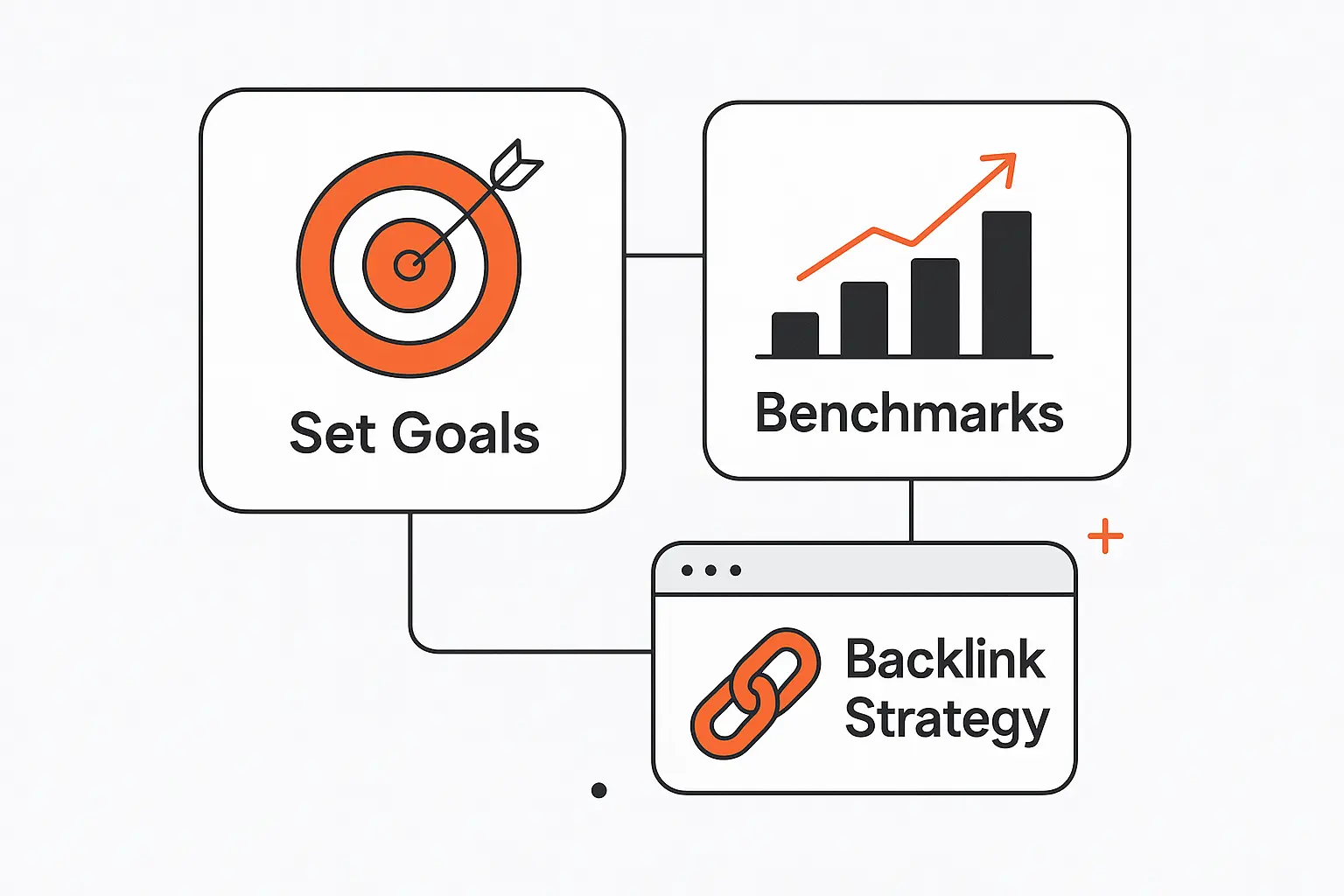
1. Brand authority and visibility goals
Before outreach starts, we define what authority should do for the business. Sometimes the goal is broader brand visibility across category conversations. In other cases, the priority is earning citations on pages that influence a buying committee, a hiring audience, or a local service area. Our benchmark set usually includes referral traffic quality, branded search lift, earned mentions on trusted sites, and whether the brand begins showing up more often in conversational search and AI answers.
2. Keyword support for priority pages
Keyword support works best when we map links to specific pages rather than dumping everything onto the homepage. Product pages, comparison pages, category hubs, service landing pages, and deep guides each need their own supporting references. That page-level discipline matters because a strong domain cannot fully compensate for a weak or under-cited URL. We therefore choose assets based on what query set they need to support and what type of publisher could credibly cite them.
3. Competitive gaps, timelines, and realistic expectations
Competitive gap analysis should be page against page, not logo against logo. If a rival’s pricing guide has links from analysts, communities, and product roundups while yours has none, the gap is obvious and actionable. Timelines, however, need realism: quick wins can show movement early, but authority usually compounds over quarters as links get crawled, pages get re-evaluated, and new content earns secondary mentions. We set expectations around momentum, not miracles.
Recommended reading: How Does a Search Engine Work
Quick Win Link Building Tactics
1. Reclaim unlinked brand mentions
Unlinked brand mentions are our favorite fast start because the publisher has already decided you are worth mentioning. The ask is simple: if the reference would be more useful to readers with a direct source, could they add the appropriate page? This tactic works especially well when the mention refers to original data, a quote from your team, a proprietary framework, or a product page that helps a reader verify the point immediately.
2. Fix broken backlinks to your site
Broken backlinks are silent authority leaks. When Google notes that migrations often surface a spike in Not found errors, we hear a practical warning: every high-value dead URL should be redirected cleanly or replaced before it keeps bleeding trust and referral traffic. We routinely audit historical campaigns, media placements, retired resources, and renamed service pages to make sure the authority still lands on a live, relevant destination instead of a dead end.
3. Replace dead competitor links with better resources
Dead competitor links create opportunity when you bring a clearly better replacement. The workflow is straightforward: find a cited resource that vanished, rebuild the topic with fresher information, and contact sites that still point at the broken page. Editors say yes when the suggestion improves their page, not when it merely helps your SEO. For that reason, we only run this play when our replacement is genuinely more current, more complete, or more useful.
4. Turn partnerships, testimonials, and member listings into links
Many companies sit on easy links they never ask for. Vendor partner pages, accelerator directories, chamber memberships, customer testimonials, certification pages, and community listings often already have a place where a link belongs naturally. We like these opportunities because they are usually relevant, defensible, and fast to secure. More importantly, they create a cleaner authority graph around the real relationships your business already has.
Recommended reading: SEO On Site Off Site: Differences, Ranking Factors, and a Balanced Strategy
Scalable Outreach and Placement Opportunities
1. Resource pages and curated link lists
Resource pages still work when the page is curated with actual editorial judgment. We look for librarians of the web: associations, universities, nonprofits, specialized blogs, or vendor ecosystems that maintain useful lists over time. A strong pitch is brief and specific, explaining what gap your asset fills and why their audience would reach for it. Generic blasts fail because they sound like blasts.
2. Media requests, expert quotes, and PR mentions
Media requests and expert quote opportunities reward speed, clarity, and evidence. Instead of pitching your brand, answer the reporter’s exact question with a concise viewpoint, a usable proof point, and a page worth citing if the story needs sourcing. Even when the first mention comes without a link, the relationship can lead to future coverage or a polite follow-up correction. We keep subject-matter experts, bios, and supporting references ready before the request appears.
3. Podcast appearances and guest posts
Podcasts and guest posts are strongest when audience overlap is real. We pursue them for borrowed trust, not just borrowed domain signals. That means the topic should align with your expertise, the host or editor should have genuine standards, and the linked destination should advance the conversation rather than interrupt it. A thoughtful appearance can send referral traffic, branded search demand, and link opportunities well beyond the first publication.
4. Competitor backlink replication where your content fits
Competitor backlink replication only works when your content belongs in the same context. We cluster competitor links by pattern, including resource lists, founder interviews, partner pages, statistics roundups, tools, local citations, and expert commentary, then decide which patterns we can credibly match. Copying the footprint without matching the substance is how teams waste months. Replication should be selective, ethical, and anchored to fit.
Recommended reading: How to Increase Website Traffic with SEO Content Promotion and Analytics
Content Driven Backlink Strategy That Attracts Natural Links
1. Surveys and audience insights
Surveys give you something the web cannot quote until you publish it. Even modest research can become link-worthy when the question is timely, the sample is relevant, and the write-up explains the method clearly. We prefer fewer questions and better analysis over bloated reports that nobody finishes. Once the data is live, the asset can feed media pitches, sales enablement, webinars, social content, and future benchmark updates.
2. Original research, benchmarks, and data driven assets
Original research scales link acquisition because it turns your site into a primary source. Benchmarks, market maps, usage studies, annual reports, calculators, and transparent datasets are particularly strong because they solve citation needs repeatedly. When we want proof, we look at examples already trusted by the market: Cloudflare Radar publishes internet trend data, and GitHub’s annual Octoverse package frames major shifts in software development. The lesson for businesses is simple: if you can become the place others must reference, outreach gets easier and natural links rise over time.
3. Newsjacking and timely commentary
Newsjacking works when you add interpretation, not noise. Product launches, algorithm changes, security incidents, regulatory updates, and funding shifts all create short windows where journalists and operators need a smart explanation quickly. We publish fast, but we refuse thin rewrites. The goal is to give the market the first useful angle or the clearest practical response, because that is what attracts mentions that keep paying after the headline cycle passes.
4. Comprehensive guides and useful tools
Comprehensive guides and useful tools remain the backbone of sustainable link earning. A sharp tutorial, an ROI calculator, a checklist, a template library, or a decision matrix gives people a reason to bookmark you instead of skim you. Our strongest linkable assets usually combine depth with utility: a guide to explain the problem, a downloadable artifact to apply it, and a simple tool to operationalize it. That combination earns both editorial links and recurring direct traffic.
Recommended reading: SEO Affiliate Marketing: A 2026 Playbook for Ranking, Trust, and Revenue
Qualify Every Link Opportunity Before Outreach
1. Relevant topics, authoritative domains, and evergreen pages
Before outreach, we qualify the page, not just the domain. Topic match comes first, followed by editorial quality, organic relevance, update history, indexability, and whether the page is likely to remain useful after the next redesign. Evergreen pages usually outperform ephemeral ones because they keep collecting readers and citations. Authority, in our view, is less about prestige theater and more about persistent relevance.
2. Natural anchor text, positive context, and reader value
Anchor text should sound like a human wrote it for another human. The Google link guidance discussed earlier stresses descriptive, concise, relevant anchors, and we agree completely. Natural brand phrases, product names, problem-led descriptors, and sentence-level context do more long-term work than forced exact-match keywords. We also care about sentiment and placement: a link in a positive, explanatory context is worth far more than a nominal mention buried in a grudging aside.
3. Spam checks, toxicity signals, and low quality filters
We do not confuse every odd backlink with a crisis, but we do filter aggressively. Google’s Search Essentials warns that manipulative behavior can push a site down or out of Google Search, yet Google’s own disavow guidance also says most sites do not need the disavow tool. That is the balance we like: reject obvious spam, parasite pages, and irrelevant placements early, but reserve deep cleanup work for real legacy abuse, manual-action scenarios, or links you genuinely cannot remove.
Track and Improve Your Link Profile
1. Google Search Console checks and backlink audits
Our audit loop starts in Search Console, but we never mistake it for a full backlink database. That same Google help documentation described earlier makes clear the Links report is only a sample, which is why we pair it with our own crawl data, redirect checks, and historical campaign records. Still, the report is directionally powerful when you review top-linked pages, top linking sites, and anchor trends against your current priorities. Ultimately, we want to know whether the pages that matter most are attracting the references they actually deserve.
2. Referring domains, anchor text, and broken page monitoring
Backlink reporting only becomes useful when it connects to performance. Google’s Performance report exposes clicks, impressions, CTR, and average position, so we watch those page-level signals alongside new referring domains, anchor trends, and referral traffic quality. Because the same Google AI guidance folds AI-feature traffic into ordinary Search Console web reporting, this view also helps us see whether authority work is influencing visibility beyond classic ten-blue-links behavior. In practice, we want to know not just who linked, but what changed after the link landed.
3. Ongoing timelines, testing, and iteration
Iteration is where mature backlink programs separate themselves. Microsoft has now introduced reporting that shows how often your content is cited in generative answers, which tells us the industry is moving toward measurable AI citation visibility, not just traditional rankings. We therefore review outreach conversion, asset performance, citation frequency, page freshness, and redirect health on a standing cadence. If a tactic earns links but not meaningful discovery or business outcomes, we rework the asset instead of simply sending more emails.
Mistakes That Weaken Link Building Results
1. Exact match overuse and unnatural link patterns
Exact-match anchor abuse is still one of the easiest ways to make a link profile look engineered. When the same commercial phrase shows up again and again across unrelated sites, the pattern explains itself. We prefer a far broader mix of brand anchors, partial-match descriptors, naked references where appropriate, and sentence-level context. Natural language gives your profile room to breathe and gives editors a reason to say yes without feeling manipulated.
2. Reciprocal link schemes and paid backlinks
Reciprocal exchanges and paid backlinks usually look efficient right up until they do not. Google is explicit that paid placements should use the sponsored attribute, which is a useful line for businesses because it separates legitimate sponsorship from covert ranking manipulation. If two companies genuinely reference each other for reader value, fine. When the entire arrangement exists only to pass authority, we want no part of it.
3. Spammy sources, link farms, and low relevance placements
Spammy sources, link farms, and irrelevant placements do not just fail to help; they pollute decision-making. Bing has warned that link schemes can get a site removed from Bing’s index. Even before penalties become visible, low-quality placements consume outreach time, muddy your reports, and create a false sense of progress. We would rather defend a smaller portfolio of trusted links than explain a large portfolio of indefensible ones.
FAQ About Backlink Strategy
1. What goes into a backlink strategy?
A real backlink strategy includes business goals, page priorities, content assets, prospect qualification, outreach workflows, anchor-text discipline, and measurement. In our work, the strategy matters more than the tactic because the same outreach method can succeed or fail depending on the page, the audience, and the story behind the asset. That is why we plan around link intent, not just link acquisition.
2. What does a backlink look like in practice?
In practice, a backlink might be an industry publication citing your benchmark report, a partner page linking to your integration guide, or a podcast show note sending listeners to a relevant landing page. The best examples feel natural inside the article or resource page where they appear. Good backlinks rarely look forced because they are there to help the reader do something useful next.
3. Do backlinks still matter for SEO in 2026?
Yes, they still matter. Google’s ranking systems still use link analysis, and both Google and Microsoft now make it obvious that the open web remains the substrate for search discovery, supporting links, and AI citations. Beyond rankings, strong backlinks also improve referral trust, brand recall, and the odds that your best pages become the ones other people reference.
4. How many backlinks are enough to compete?
No fixed number guarantees competitiveness. Instead, we compare your page-level authority, topical fit, and citation quality against the pages already winning the query class you care about. In some verticals, a handful of excellent editorial links can move the needle. In others, you need a deeper portfolio spread across analysts, media, communities, and partner ecosystems.
5. How long does a backlink strategy take to show results?
Usually, the first signs appear from quick wins such as mention reclamation, broken-link recovery, and existing relationship outreach. Longer compounding gains come from research assets, sustained digital PR, and pages that continue attracting citations after the initial campaign. We advise clients to watch for momentum across months, then judge true authority lift over a longer operating cycle.
6. Is buying backlinks worth the risk?
Rarely, if ever, from a serious business perspective. Once money becomes the hidden reason a link exists, you introduce compliance risk, cleanup cost, reporting distortion, and reputational drag. Long-term authority is almost always cheaper to build than to repair. For us, the better question is not how to buy a link, but how to create something worth citing without coercion.
Conclusion: Build a Backlink Strategy Around Value, Relevance, and Consistency
At Techtide Solutions, we see backlink strategy as a discipline that sits at the intersection of brand, content, search, PR, and product expertise. In our view, the teams that win are not the ones that chase the biggest spreadsheet; they are the ones that publish better assets, qualify better opportunities, protect link equity more carefully, and measure outcomes more honestly. If you want the next step, start by auditing your highest-value pages, reclaiming every broken reference you can find, and asking one blunt question: what on our site would a respected editor genuinely want to cite today?

