


At TechTide Solutions, we treat payment platform choice as an architectural decision, not a checkbox on a startup to-do list. The market itself makes that clear: McKinsey says U.S. payment-processing revenue through ISVs has grown at 20 percent a year for the last five years and is projected to reach $16 billion in 2025, while Statista projects U.S. digital commerce transaction value at US$1.16tn in 2025. That growth is exactly why small business owners can no longer afford to think only about taking cards; they need to think about workflows, devices, software ownership, fraud posture, and future expansion.
Meanwhile, the market split is visible in real deployments. Birch Coffee is expanding on Square as its commerce foundation, while Shopify and DoorDash use Stripe Connect to embed and orchestrate payments at platform scale. Those are very different operating realities, and that is our central point in this comparison: Square and Stripe are both excellent, but they are excellent at different kinds of business problems. When we choose well, payments become an accelerator. When we choose badly, they become a quiet source of friction for years.
Square vs Stripe at a Glance
1. All-in-One POS Ecosystem vs Custom Payment Infrastructure
We think the clearest distinction is structural. Square is strongest when a business wants payments, software, and hardware all in one, because its products are arranged to feel like a single operating environment for selling, reporting, and day-to-day management. Stripe, by contrast, fits teams that want a custom POS integration tailored to your business and a modular stack for billing, fraud, payouts, and checkout. In our experience, Square reduces decisions. Stripe increases degrees of freedom.
2. In-Person-First, Online-First, and Hybrid Selling Models
If most revenue starts at a counter, service desk, market stall, or treatment room, Square usually feels more native because its product family was built around physical selling. If most revenue starts in a browser, mobile app, or self-serve product flow, Stripe tends to feel more natural because payment logic sits comfortably inside software. For hybrid sellers, we usually decide based on where operational pain is concentrated: staff workflow and device management push us toward Square, while checkout orchestration and product-led growth push us toward Stripe.
3. Technical Resources, Customization Needs, and Future Fit
Customization is not binary here. Square gives developers Terminal API, Mobile Payments SDK, and Web Payments SDK, so it is not a closed box. Even so, the platform still nudges merchants toward Square-shaped workflows. Stripe leans harder into engineering control with an API-based integration in addition to SDKs for Android, iOS, JavaScript, and React Native, which is why we reach for it when roadmap risk includes subscriptions, marketplaces, or heavily customized checkout logic.
Recommended reading: What Are Enterprise Applications? Definition, Types, Benefits, and Examples
Square vs Stripe Pricing and Fees
1. Online Pricing and a $100 Transaction Example
For standard U.S. online card sales, Square Free publishes 3.3% + 30¢ for online or invoice payments, while Stripe lists 2.9% + 30¢ per successful transaction for domestic cards. On a $100 order, that gap is real but rarely decisive by itself. We advise small businesses to compare not only headline transaction cost, but also how often they invoice, whether they need custom checkout, and how much staff time a more integrated workflow can save every week.
2. In-Person Rates, Keyed-In Payments, and Instant Payouts
In person, Square advertises 2.6% + 15¢ per tap, while Stripe Terminal publishes 2.7% + 5¢ per successful card transaction. That means Stripe can look efficient on larger tickets, whereas Square often feels simpler operationally for owner-operated shops. Once a payment is keyed in instead of tapped, fees rise on both platforms, and Square’s instant deposit option adds a 1.75% fee per transfer. We therefore treat card-present discipline as a margin lever, not an accounting footnote.
3. Chargebacks, Hardware Costs, and Paid Add-Ons
Chargebacks are a meaningful operational difference. Square says there are no fees for dispute management services for chargebacks, whereas Stripe explains that a dispute debits your balance for the payment amount and dispute fee. Hardware and add-ons matter too: Square’s dedicated hardware starts at $59, and Stripe Billing adds 0.7% of Billing volume when recurring revenue becomes a product requirement. We usually tell founders to budget for the whole stack, not just swipe fees.
Recommended reading: CRM Reporting Guide: Essential Reports, Dashboards, Metrics, and Best Practices
POS Hardware and In-Person Selling
1. Readers, Terminals, Registers, and Mobile Devices
If we are equipping a micro-merchant, we first ask how much dedicated hardware is truly necessary. Square still appeals here because the entry point can be Get first reader free, and mobile sellers can stay very light on equipment. Stripe is lean in a different way: Tap to Pay on iPhone lets a software-led seller accept contactless cards and wallets from a compatible phone inside its own app flow. The right choice depends on whether the device is the business or merely a payment endpoint.
2. Native POS Tools vs Custom In-Person Setups
Native POS tools are where Square feels opinionated in a useful way. With Register, the system is already arranged for product catalogs, modifiers, taxes, staff permissions, and checkout flow, so a merchant can start from operations and add software later. Stripe Terminal reverses that logic. Its integration guide emphasizes server-driven integration and custom app control, which is excellent for businesses with existing software teams, but less magical for owners who simply want the register to work by Saturday morning. We see this divide constantly in discovery calls.
3. Retail, Restaurant, Service, and Pop-Up Selling Needs
Retail counters, restaurant lines, tableside service, field services, and pop-up booths do not fail in the same way. A cafe worries about throughput, a salon worries about appointments and tipping, and a pop-up worries about portability and weak connectivity. Because of that, we rarely frame Square versus Stripe as a generic POS debate. We frame it as a workflow question: do you want predefined commerce behavior with lighter rollout risk, or do you want programmable in-person payments that mirror a custom operational model?
Online Payments, Ecommerce, and Subscription Billing
1. Hosted Checkout, Payment Links, and Invoicing
For low-code selling, both platforms are more capable than many owners realize. Square Invoices lets merchants send billing via email, SMS, or a shareable link and accept common payment methods from a branded workflow. Stripe brings similar speed through Checkout, Payment Links, and invoices, and its invoicing docs highlight that teams can create and manage a Stripe-hosted invoice from the Dashboard, with no code required. We usually favor Square when sales staff own the process and Stripe when product or finance teams need deeper automation later.
2. Subscription Billing and Recurring Payment Workflows
Recurring revenue is where the platforms begin to separate more sharply. Square says merchants can build and manage subscription plans right from your Square Dashboard at no monthly cost, which is attractive for memberships, retainers, and simple replenishment. Stripe goes further when pricing logic itself becomes product strategy; its billing platform supports usage-based billing, tiered models, trials, and customer self-service. In our work, the dividing line is not whether a business has subscriptions, but whether subscription complexity is central to growth.
3. Multi-Currency Support, Local Payment Methods, and Digital Wallets
International selling is where Stripe opens a wider lead. Checkout can present prices in more than 100 currencies, and Stripe’s payment-method catalog now spans 125+ payment methods. Square is more straightforward and more domestic-first; its developer docs state that payments are processed in the currency of the seller with an exchange rate set by the card-issuing bank. For U.S.-centric merchants, that simplicity can be a feature. For cross-border ecommerce or localized checkout, it is often a ceiling.
Integrations, APIs, and Customization
1. Ecosystem Depth and Third-Party Integrations
Integrations matter because payments never live alone. Square’s 2026 partner announcement says the ecosystem now includes nearly 1,000 partners, which is meaningful for retailers, restaurants, beauty businesses, and service companies that need booking, accounting, delivery, or marketing connectors. Stripe’s app strategy is different but powerful: its Apps marketplace pitches access to more than one million Stripe users. We see Square winning more often on merchant tooling breadth, while Stripe wins when the payment stack itself must be embedded inside broader software.
2. APIs, SDKs, and Custom Checkout Control
When we need fine control over checkout, we examine how much of the flow must live inside the client experience. Square’s online payments toolkit supports teams that want to build from scratch with Square Web Payments SDK or use its hosted Checkout API. Stripe remains more composable for developer-heavy teams because Terminal and payments tooling expose deeper orchestration patterns across web, mobile, and backend services. That does not automatically make Stripe better; it makes Stripe more appropriate when the payment experience is one module inside a larger software product.
3. Scalability for Growing Businesses and Complex Payment Flows
Scalability is not just transaction volume. It is also about money movement, user onboarding, and reporting across entities. Square’s eCommerce APIs explicitly support merchants that want to keep online and in-person orders, items, and inventory in sync, which is ideal for a growing single-brand operator. Stripe pulls ahead when the business model becomes multi-party, because Connect marketplace tooling supports payouts in 118+ countries. Once we hear words like marketplace, franchise settlement, platform revenue, or split payments, our architectural bias starts shifting toward Stripe.
Ease of Use, Support, and Daily Operations
1. Fast Onboarding for Non-Technical Teams
Non-technical teams usually care about one thing first: how quickly money can move from “we should sell” to “we are selling.” Square is excellent here because merchants can sign up for Square and begin accepting payments right away, then layer on invoices, links, Tap to Pay, or a simple online store without a long implementation path. Stripe can also be fast with hosted products, but the dashboard vocabulary is closer to a payments platform than a retail control center. We often see founders understand that difference within the first demo.
2. Documentation, Support Channels, and Daily Management
Support is another area where product philosophy shows up. Stripe states that all customers receive 24×7 phone, email, and chat help, plus self-serve resources and its developer community. Square offers strong self-service and in-app support, but its messaging route connects sellers to a live advocate Monday through Friday, from 6 a.m. to 6 p.m. Pacific Time, and phone availability can vary by subscription. In practice, that makes Stripe feel more consistent for technical teams and Square feel adequate when the merchant’s needs are operationally narrower.
3. Operational Tradeoffs for Business Owners and Developers
Daily operations create hidden costs that fee tables never show. Square reduces cognitive load for owners who want one dashboard, one hardware family, and one vocabulary for staff training. Stripe often lowers long-term friction for developers who need webhooks, custom objects, and payout logic to line up with internal systems. We therefore do not ask only which platform is easier. We ask easier for whom: the person opening the shop at 7 a.m., or the engineer debugging reconciliation at 11 p.m.?
Security, Fraud Prevention, and Compliance
1. PCI Compliance and Core Payment Security
Security basics are strong on both platforms, but responsibility is distributed differently. Square says merchants who use its services for all card data handling do not need to validate PCI compliance for those transactions. Stripe is more explicit that PCI compliance is a shared responsibility between Stripe and the business. We generally prefer Square’s abstraction for traditional merchants and Stripe’s model for companies with compliance-savvy product and engineering teams.
2. Fraud Rules, Identity Verification, and Chargeback Response
Fraud tooling is not marketing fluff; it changes margins, approval rates, and support burden. Stripe says Radar is built into every account and is reducing fraud by 38% on average, while Stripe Identity can verify IDs from more than 120 countries. Square’s security stack is quieter but still meaningful, and the company says it uses machine learning to look at payments from across our ecosystem to adapt to new fraud trends. Our rule of thumb is simple: if fraud logic becomes a product feature, Stripe is usually stronger; if it is a background business safeguard, Square is often sufficient.
3. Regulated, Healthcare, and High-Risk Business Considerations
Regulated and edge-case businesses need to read the fine print before writing a line of integration code. Square explains that it doesn’t allow sellers to sell marijuana or related items, and it separately notes that certain products are prohibited from being sold via card-not-present transactions. Stripe has its own prohibited businesses framework. When we work with healthcare, wellness, or higher-risk merchants, we always start with eligibility and workflow restrictions, because the wrong assumption here can invalidate the whole platform decision.
Growth Planning and Platform Flexibility
1. Starting Simple vs Planning for Custom Expansion
A simple start is not a naive start. For many merchants, the smartest move is to launch on the platform that gets revenue flowing fastest, then revisit architecture when the business proves demand. Square often wins that first stage because its hardware, software, and payment flows are already aligned. Stripe wins the first stage when the company itself is software, because the payment layer can be designed to match the product from day one. We do not see these as rival ideologies; we see them as different ways of buying time.
2. Ecosystem Lock-In, Migration Effort, and Platform Flexibility
Lock-in is real on both sides, just in different forms. Square can pull a business deeply into its operating stack, which is wonderful when the tools fit and costly when they stop fitting. Stripe creates a different dependency: engineering teams gain enormous flexibility, but they also inherit the responsibility to maintain that flexibility. In our experience, migrations hurt most when a company mistakes initial convenience for permanent fit, or permanent flexibility for free complexity.
3. When to Revisit Your Square vs Stripe Decision
We tell clients to reopen the Square-versus-Stripe conversation when channel mix changes, when subscriptions become strategically important, when international selling enters the roadmap, or when internal software becomes mission critical. Another clear checkpoint is scale: Square itself flags merchants that process over $250,000 per year for custom pricing conversations. That is usually the moment when a business should stop asking which platform is easier and start asking which platform best matches the next two years of growth.
Square vs Stripe Use Cases by Business Type
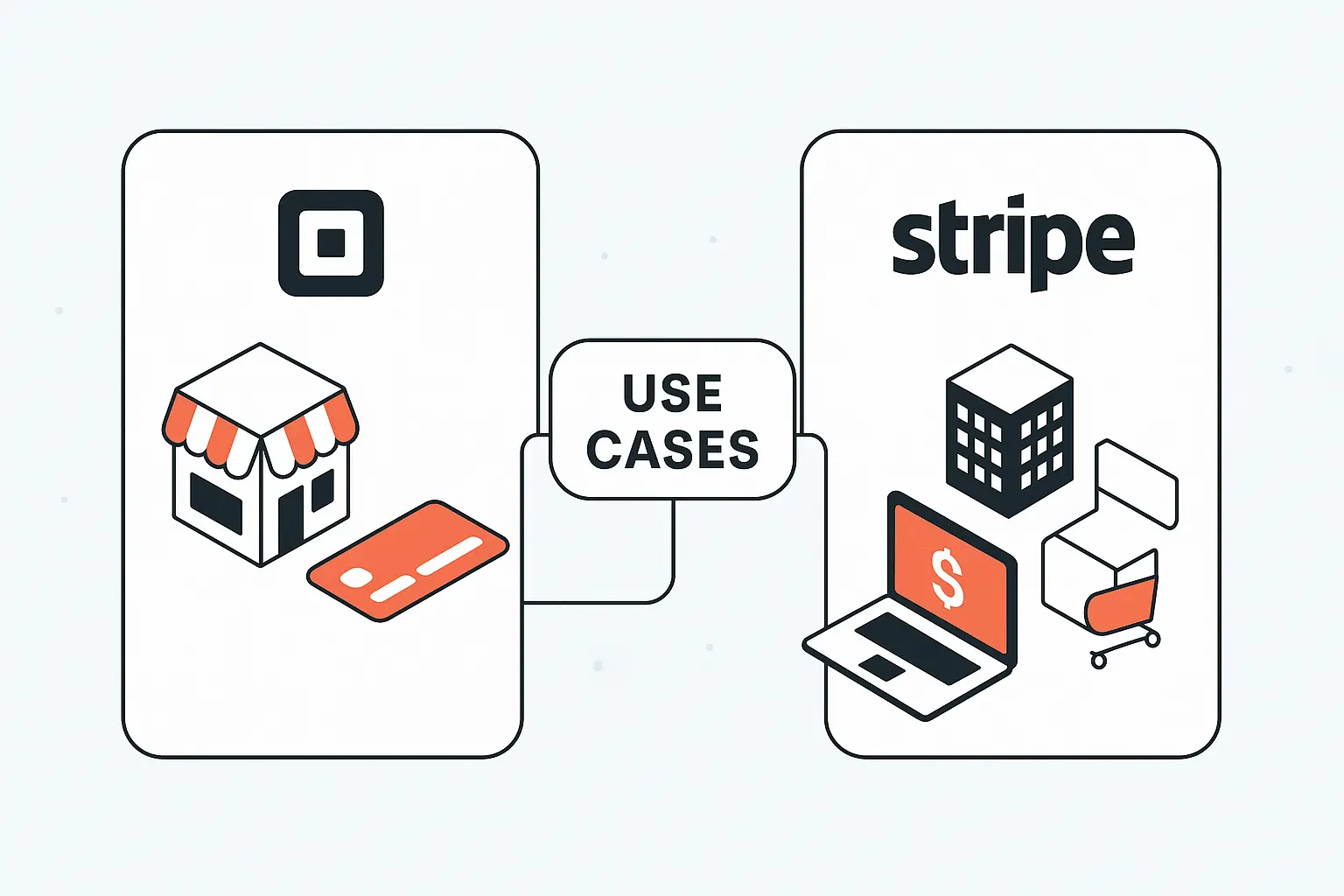
1. Small Local Businesses and Brick-and-Mortar Sellers
For neighborhood retail, coffee shops, salons, food trucks, and appointment-led businesses, we usually lean Square. The reason is not that Stripe cannot handle the payments. It can. The reason is that Square tends to solve adjacent merchant problems at the same time: device choice, staff workflows, reporting, catalog control, invoicing, and light ecommerce. When the owner is also the operator, that operational compression matters more than theoretical platform elegance.
2. Ecommerce Brands, SaaS Products, and Subscription Businesses
For ecommerce brands, SaaS companies, and subscription businesses, our bias flips toward Stripe. Those models routinely need better control over checkout components, saved payment methods, billing logic, webhook-driven back offices, and global payment options. Even when a team starts with hosted tools, the path to deeper customization is cleaner. We have found that Stripe becomes especially attractive once growth depends on product packaging, recurring revenue design, or multi-party fund flows.
3. Hybrid Sellers, Scaling Teams, and Custom Software Environments
Hybrid sellers deserve the most careful diagnosis. A restaurant with online ordering, a retailer with an app, or a service brand with field payments may look omnichannel on paper, yet the real constraint could still be staff workflow. If the heart of the system is store operations, Square often wins. If the heart of the system is custom software that happens to collect money in several places, Stripe usually wins. That distinction has saved many teams from overbuilding the wrong side of the business.
Square vs Stripe FAQ
1. Platform Fit for Different Business Models
Square is typically the better fit for owner-led local selling, countertop POS, and straightforward omnichannel commerce. Stripe is usually the better fit for software-led businesses, custom checkout, recurring billing complexity, and platform-style payments. If we had to compress the choice into one line, we would say Square is commerce-first and Stripe is infrastructure-first.
2. Fee Expectations for a $100 Stripe Payment
Under Stripe’s standard domestic online card pricing, a basic $100 web payment follows the published benchmark we referenced earlier. The effective cost rises when the payment is manually entered, involves international cards, or requires extra billing or fraud tooling. That is why we encourage founders to model their most common payment paths rather than rely on a single headline rate.
3. Key Stripe Limitations to Weigh Before Choosing
The tradeoffs are usually operational rather than functional. Stripe does not give a small local merchant the same native Square-style POS ecosystem out of the box, and some valuable capabilities live behind extra configuration or add-on pricing. We also find that Stripe asks more from developers and finance operators, which is a strength for digital businesses and a burden for teams without technical depth.
4. Ease of Setup for In-Person Sellers
For pure in-person sellers, Square is normally easier to stand up because the hardware, POS workflows, and merchant tools were designed to arrive together. Stripe can be simple for Tap to Pay or partner-led deployments, but it shines brightest when a business already has software it wants to preserve or extend. It is a better choice for flexibility than for instant retail familiarity.
5. Customization Needs vs Plug-and-Play Convenience
If you need branded, software-controlled payment experiences, Stripe is usually worth the extra design and implementation effort. If you need the shortest path to reliable selling with less configuration, Square is often the more rational choice. We recommend choosing based on the complexity you already have, not the complexity you imagine you might someday want.
How TechTide Solutions Supports Custom Payment Software Development

1. Custom Stripe Integrations for Web Apps, Mobile Apps, and Subscription Billing
At TechTide Solutions, we build Stripe integrations when the payment layer has to behave like product infrastructure. That includes web apps, native mobile apps, SaaS billing, usage metering, saved-payment flows, payout orchestration, webhook-driven reconciliation, and fraud-aware back-office tooling. We design around resilience as much as features, because payment code is only good when retries, idempotency, ledger alignment, and customer messaging all survive real-world failure states.
2. Square Solutions for POS, Ecommerce, and Omnichannel Selling
We also implement Square when the business needs fast operational lift without sacrificing future extension points. Our team can wire up POS workflows, catalog synchronization, invoicing, lightweight ecommerce, loyalty-adjacent experiences, and omnichannel reporting so that teams spend less time patching systems together. For merchants that sell in store and online, we often focus on the hard middle layer: inventory truth, order-state consistency, refunds, and staff-friendly daily procedures.
3. Platform Selection, Migration Planning, and Tailored Software Development
Most importantly, we do not force a preferred platform onto the business. We map payment flows, channel mix, compliance exposure, reporting requirements, and migration risk, then design the shortest path that still leaves room for growth. Sometimes that means staying on Square and building around it. Sometimes that means moving to Stripe in phases. In either case, we believe payment architecture should fit the business model, not the other way around.
Final Thoughts on Square vs Stripe
1. When Simplicity and Ready-Made Tools Matter Most
If simplicity, fast staff adoption, and ready-made merchant tools matter most, Square is the more convincing choice. It keeps the cognitive surface area smaller, which is often exactly what a small business needs in the first few stages of growth.
2. When Customization and Long-Term Scalability Guide the Choice
When customization, international reach, productized billing, or complex money movement matter more, Stripe is usually the stronger long-term bet. Its extra flexibility pays off when payments are woven into the software itself rather than bolted onto day-to-day operations.
3. How to Make the Final Payment Platform Decision
Our advice is to test the decision against your most common payment journey, your ugliest exception case, and your next realistic growth milestone. If you want a practical next step, map one week of transactions and ask a brutally useful question: where do we lose more time today, at the counter or in the codebase?

