


At Techtide Solutions, we think domain extensions deserve boardroom attention, not last-minute registrar clicks. Global retail e-commerce reached six trillion U.S. dollars in 2024, and Deloitte reports that customers who trust a brand are 88% more likely to buy it again; that helps explain why Wikipedia.org and Character.ai create different expectations before a visitor reads a single headline.
We have watched teams obsess over logos while treating the TLD as plumbing. That is backwards. The extension quietly shapes click confidence, geographic fit, and the cost of future expansion because it shows up in search results, browser bars, email addresses, and spoken brand mentions. A strong TLD cannot rescue thin content, but a mismatched one can blunt otherwise excellent SEO work. In our view, the smartest domain choices sit at the intersection of search strategy, branding, and operational foresight.
What Domain Extensions Are and Why They Matter for SEO
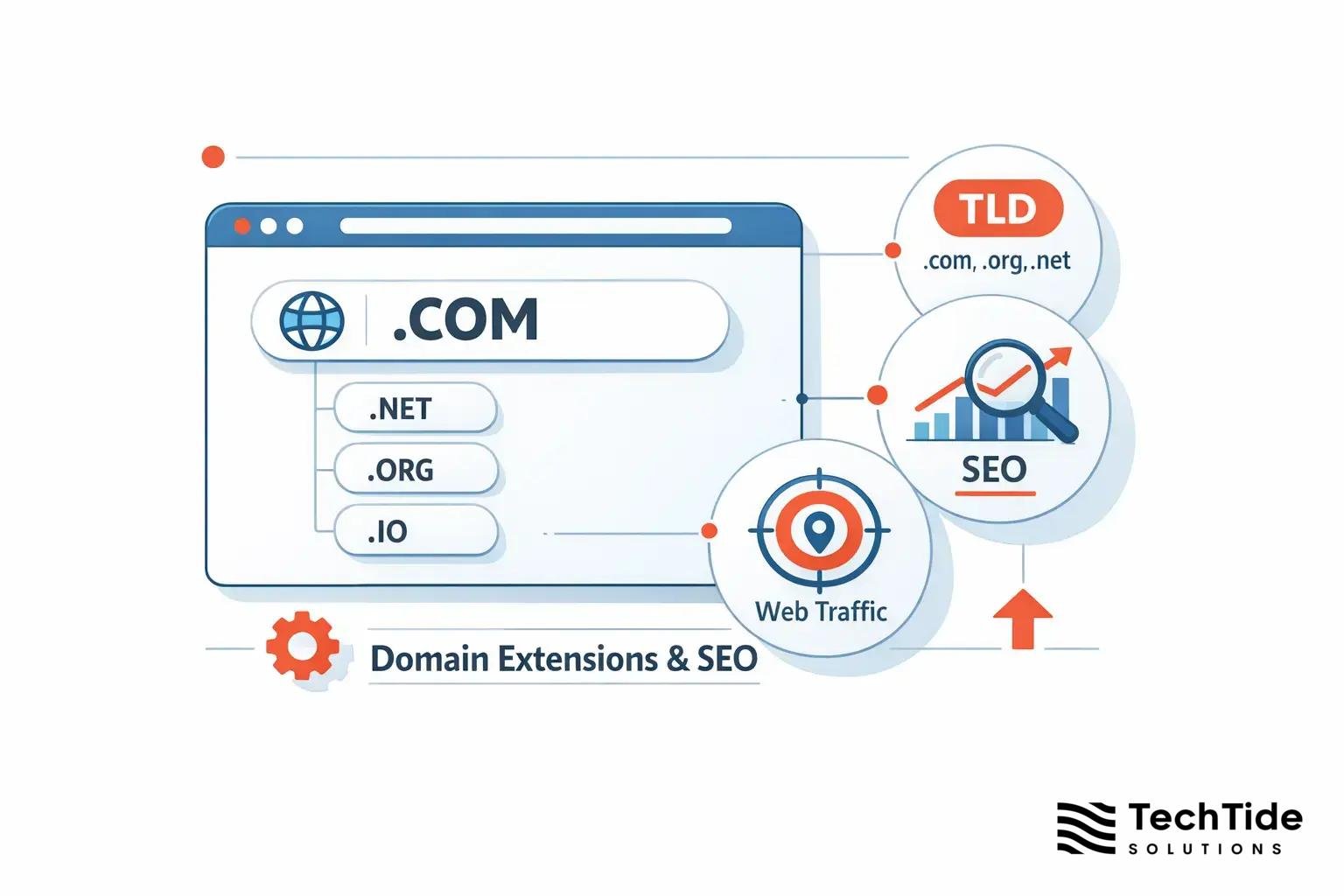
1. What a domain extension is and how top level domains work
In DNS terms, a domain extension is the last segment of a domain name. That suffix sits in the root zone, where operators manage spaces such as .com, .org, .net, .uk, or .ca. Some TLDs are generic, while others are country codes tied to national or territorial namespaces. The choice set is also much larger than many executives realize, because ICANN’s expansion added more than 1,200 new unique names to the internet. We see that abundance as both a branding opportunity and a decision trap.
2. Why domain extensions shape trust branding and search visibility
Extensions matter because users read them like brand language, not like infrastructure. A .com often feels default and commercial, a .org often feels public-minded, and a country code often feels local or limited before a page even loads. Search visibility is affected indirectly here: when the domain looks credible and memorable, people are more likely to click, remember, and later search for the brand again. We treat that as an SEO-adjacent effect with real business consequences, even though it is not a simple ranking toggle inside Google.
3. Why the best choice depends on audience market and goals
The best TLD is contextual because audience, geography, and business model change the answer. A global SaaS company usually wants a neutral domain that can travel well. A nonprofit may benefit from mission signaling. A nationally focused service business may want local familiarity first and global flexibility second. We advise clients to decide in this order: where the customer is, what the brand promises, and how expansion is likely to unfold. That sequence reduces the odds of choosing a clever domain that later becomes a strategic headache.
Recommended reading: Difference Between Domain and Hosting: A Practical Guide to Getting Your Website Online
Do Domain Extensions Affect SEO Directly or Indirectly
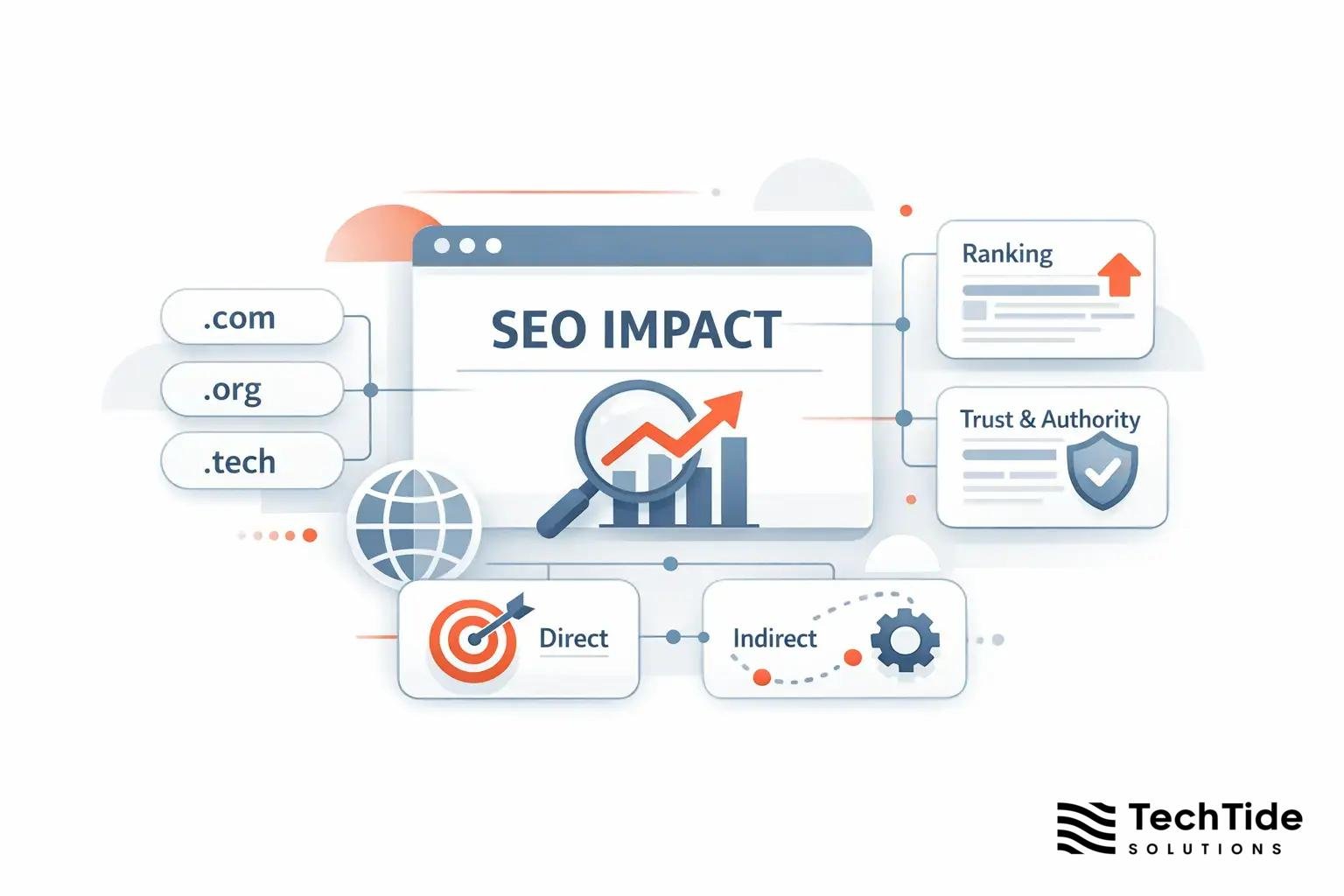
1. What Google says about top level domains and rankings
Google’s guidance is unusually direct here: keywords in a TLD do not give any advantage or disadvantage in search. That fits Google’s broader explanation that ranking systems are designed to work on the page level, while still considering some site-wide signals. So the suffix alone is rarely the star of the ranking story. What matters more is whether the domain choice helps the right pages earn trust, relevance, links, and clean geographic alignment over time.
2. How trust click through rate and memorability affect performance
Indirect effects are where domains start pulling real weight. Google says that branded queries typically lead to higher click-through rates, which tells us a memorable, trustworthy domain can reinforce the kind of search behavior brands want most: recognition-driven clicks. The nuance matters: Google also says that branded-query segmentation has no effect on how ranking works. Even so, when a better TLD improves recall in podcasts, PR coverage, email outreach, and repeat searches, it creates a compounding distribution advantage that many SEO models underprice.
3. How spam reputation can influence user behavior
We do not see a universal algorithmic penalty on unusual extensions. Yet there can be a human penalty when a namespace feels sketchy. Google defines expired-domain abuse as a domain repurposed primarily to manipulate Search rankings, and Interisle’s latest supply-chain research found new gTLDs were just 12% of the market yet nearly half of all cybercrime domains reported. Our inference is practical: if buyers and gatekeepers associate a suffix category with abuse, click confidence can drop before any dashboard tells you what happened.
Recommended reading: What Is a Custom Domain? Definition, Benefits, and How It Works
Best Domain Extensions for SEO for Global Reach
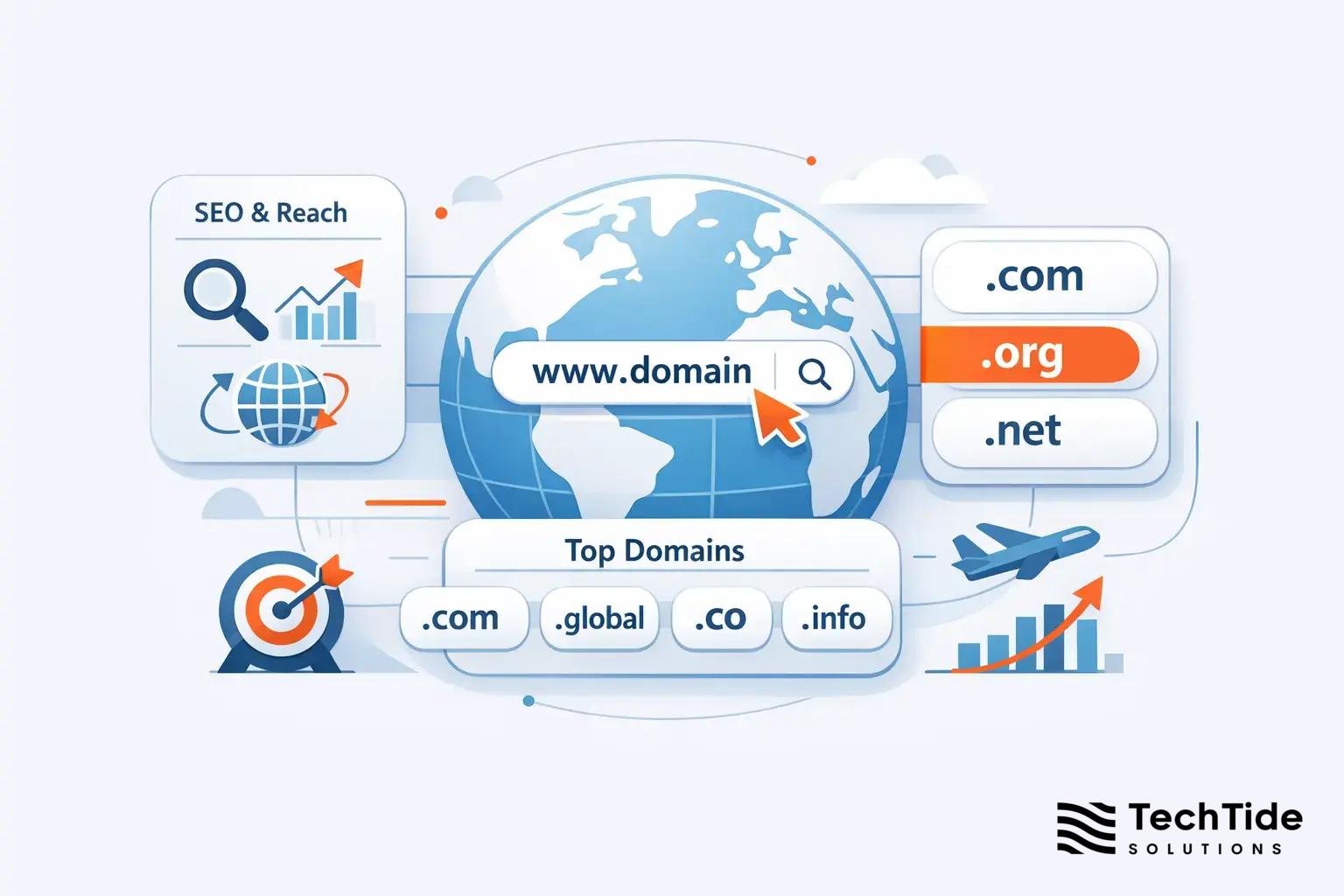
1. .com as the default choice for trust recognition and global appeal
For global reach, we still start with .com unless there is a compelling reason not to. The advantage is not mysticism; it is muscle memory. Verisign reported 161.0 million .com domain name registrations as of December 31, 2025, which helps explain why .com continues to feel like the internet’s default setting for customers, journalists, investors, and partners. When friction must be low and trust must be immediate, .com reduces explanation cost. In our work, that simplicity usually beats novelty.
2. .org for credibility authority and community focused brands
We like .org when mission is part of the product, not just part of the pitch deck. Advocacy groups, educational initiatives, open-web communities, and standards bodies often benefit because the extension carries a softer public-interest tone. That is why names such as Wikipedia.org still feel powerful, and why Mozilla.org fits a people-first internet identity so naturally. The caveat is authenticity: if the underlying business is aggressively commercial, .org can feel borrowed rather than earned.
3. .net as a flexible option for tech and web based businesses
.net is less glamorous than it once was, but we think it is still viable when the name itself is strong and the audience is digitally fluent. It carries mainstream familiarity without sounding gimmicky, which makes it useful for infrastructure companies, developer tools, and web-native brands. The example we often point to is Behance.net: the brand is memorable enough that the extension feels natural rather than second-best. If your .com is unavailable, .net can still be respectable.
Recommended reading: What Is Domain Privacy: Benefits, Eligibility, and How It Works
Best Domain Extensions for SEO for Local Markets
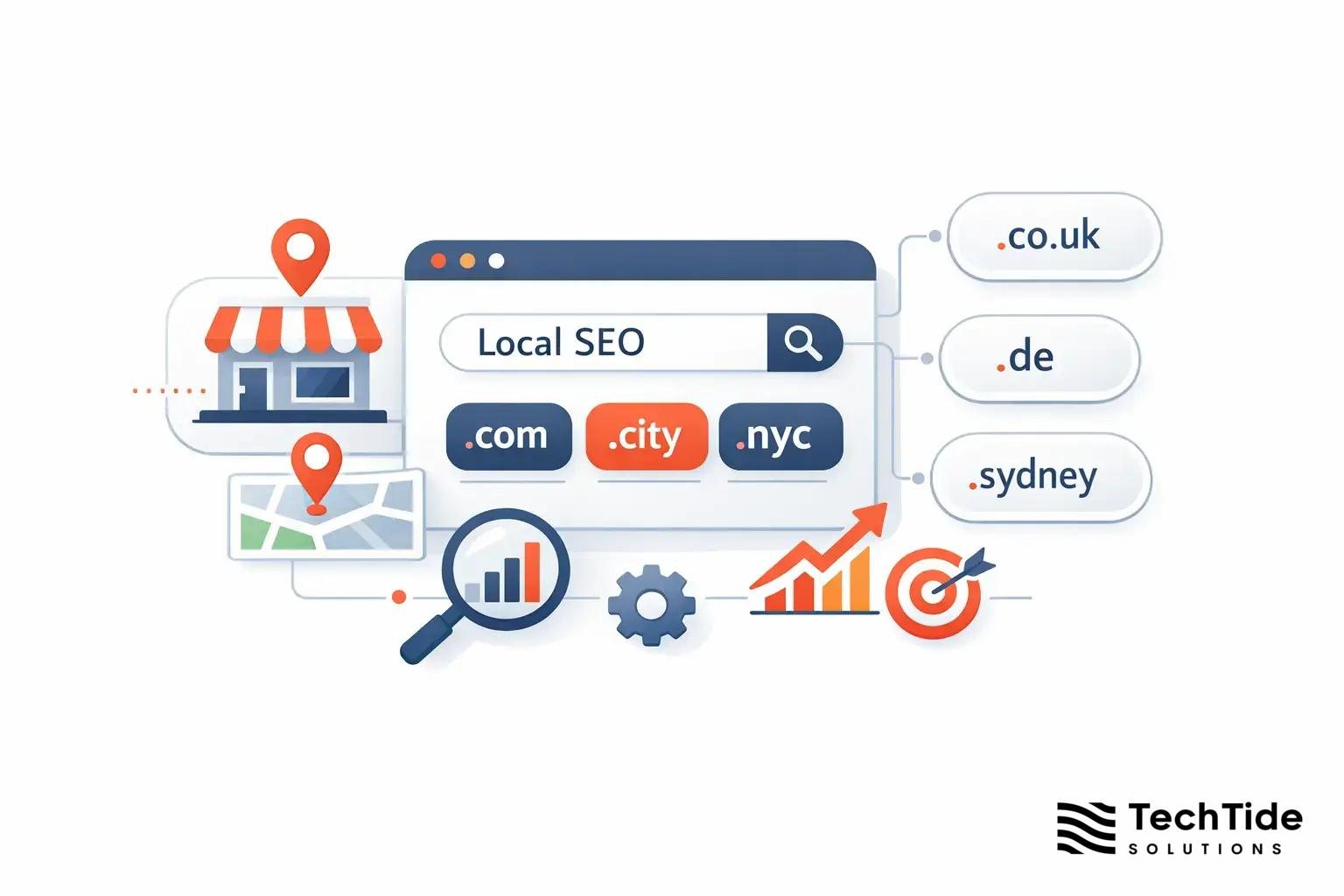
1. When .uk .ca .de .fr and .us can support local SEO
When a business truly serves one country first, local roots can be excellent. Google has long said that a country-code domain is a strong sign that a site is explicitly intended for a certain country, which is why addresses like GOV.UK and Canada.ca feel immediately local, official, and relevant. We often recommend local ccTLDs for law firms, clinics, contractors, national retailers, and public institutions whose trust equation begins with proximity.
2. How country code extensions send clear geographic signals
A local domain works best when the rest of the site also looks local. In practice, that means the language, currency, contact details, shipping logic, regional content, and local backlinks all need to reinforce the same market story. A .ca storefront written for Canadians and cited by Canadian publications sends a much stronger geographic message than a country code operating in isolation. We tell clients to think in stacks, not charms: the extension helps most when every nearby signal points in the same direction.
3. When regional domains can limit international growth
A regional root can also become a future constraint. Once a brand expands beyond one primary country, the same domain that once clarified relevance may begin to narrow perception. From Google’s international guidance and our own migration work, we treat that as an implicit tradeoff: stronger country focus can mean weaker fit elsewhere. We have seen it affect distributor outreach, hiring, media coverage, and partner confidence. If international expansion is already on the roadmap, choosing too narrowly can create unnecessary rework later.
New Domain Extensions That Can Still Perform Well
1. .co as a short modern alternative to .com
.co is attractive because it is short, modern, and visually close to .com. Technically, though, .CO is a country-code top-level domain, which is why we advise clients to separate branding appeal from registry reality. The upside is brevity. The downside is leakage, because many users still type the .com reflexively. We like .co best for startups with crisp names, disciplined branding, and a clear plan for what happens if users or backlinks drift toward the matching .com.
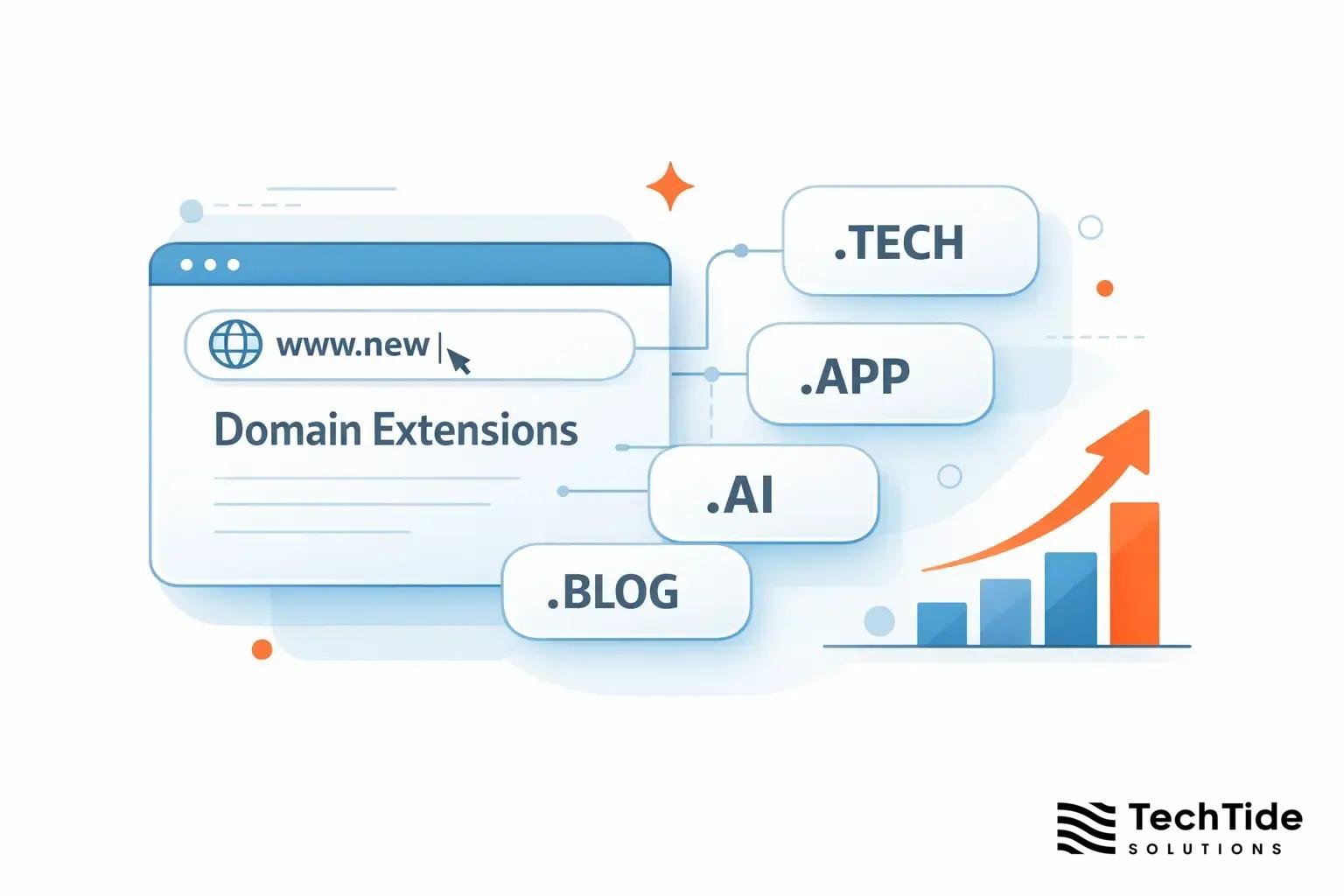
2. .io .ai and .tech for startups developers and innovation driven brands
For innovation-led brands, the key technical detail is that in Google’s current documentation, Google treats .ai, .co, and .io as generic country-code domains. That makes .io and .ai easier to defend from an SEO perspective than many founders assume. We have seen technically literate audiences accept names like Sentry.io as entirely natural, while brands such as Character.ai turn the suffix into part of the pitch. Meanwhile, .tech works well when you want an innovation cue without narrowing the story to AI.
3. .app and .store for software and ecommerce focused experiences
.app deserves special attention because it is not only semantic but technical. Google Registry requires that HTTPS is required for .app names to work in web browsers, which makes the namespace appealing for software teams that want security expectations built into the choice itself. We see that logic in products like Linear.app, where the extension feels product-native. By contrast, .store is mostly a messaging asset: it can clarify shopping intent, but it does not unlock any ranking bonus on its own.
How to Choose the Best Domain Extension for SEO and Branding
1. Match the extension to your target audience and market
We start domain workshops by asking who the site is for before asking what sounds clever. A TLD that matches the buyer’s geography and mental model usually outperforms a more creative option that requires explanation. For a regional service business, local confidence may outweigh global flexibility. For a cross-border software company, neutrality usually wins. The extension should make the intended audience feel addressed on first contact, because SEO works best when discoverability and positioning reinforce each other.
2. Choose a short memorable domain that is easy to spell
Short, pronounceable domains still beat elaborate ones in the wild. We recommend names that survive phone calls, podcasts, sales demos, conference chatter, and hurried typing on mobile. Hyphen-heavy strings, ambiguous spellings, and clever abbreviations may save money at checkout, but they create persistent friction in branded search and word-of-mouth recall. If a prospect has to ask how to spell the URL twice, the name is already underperforming. The best extension in the world cannot compensate for a domain people fail to remember.
3. Align your extension with brand identity niche and business model
The extension should harmonize with the business model. We tend to like .org for membership or mission-led institutions, .app for productized software, local ccTLDs for nationally bounded operators, and .com for companies selling trust at scale across borders. What we avoid is mismatch: a serious advisory firm on a playful novelty TLD, or a global marketplace hiding behind a narrow regional suffix. The domain should sound like the business you are trying to become, not the trend cycle you are currently chasing.
Myths Mistakes and Risks to Avoid
1. Myth that only .com can rank well
The idea that only .com can rank is simply false. Google’s guidance makes that clear, and the live web confirms it: Behance.net, Mozilla.org, Sentry.io, and Character.ai all show that strong brands can build visibility outside .com. We still prefer .com for many global commercial businesses because it reduces friction, not because search engines award it a secret crown. Mixing up user preference with algorithmic preference is one of the oldest SEO category errors we see.
2. Mistake of choosing a local extension for a global brand
Another frequent mistake is locking a would-be international brand into a local root too early. The first year may feel fine, especially if sales are concentrated in one country. Later, the same choice can complicate multilingual architecture, partner perception, press coverage, and eventually the domain move itself. Once a migration becomes necessary, you are juggling redirects, canonicals, hreflang annotations, sitemaps, and customer communication at the same time. That is avoidable pain, and we think it is far cheaper to plan around it upfront.
3. Risk of gimmicky or low trust extensions when credibility matters
When credibility matters, gimmicky or low-trust extensions can be an unnecessary handicap. That is especially true in health, finance, insurance, legal services, and cybersecurity, where buyers are already risk-sensitive. Even if Google does not demote a namespace categorically, users may hesitate when the URL feels unfamiliar or spam-adjacent. Security research on domain abuse and Deloitte’s trust findings point in the same direction: trust changes behavior. In our view, that makes sober, legible domain choices a conversion decision as much as an SEO decision.
Smart Domain Strategies Beyond the Primary TLD
1. Register multiple extensions for brand protection
One of our default recommendations is to register multiple strategic extensions around the brand. There is a security reason too: Interisle found that exact matches of a well-known brand name were used in over 200,000 cybercrime attacks. That does not mean hoarding every suffix under the sun. Rather, secure the primary commercial root, the key local-market root, and the niche or campaign TLD most likely to be copied. This protects recall, reduces impersonation risk, and gives marketing teams room to experiment without splitting the core brand.
2. Use redirects from secondary domains to your primary site
Secondary domains should usually reinforce the primary one, not compete with it. Google’s migration guidance states that 301 and other permanent redirects don’t cause a loss in PageRank, but the same guidance also recommends clean server-side redirects, updated internal links, refreshed sitemaps, corrected canonicals and hreflang, and long redirect retention. We follow that playbook closely. If a business owns the .com, .io, and local ccTLD, we normally pick one canonical home and point the rest there decisively.
3. Check availability early and secure strong alternatives
Availability work should happen earlier than most teams expect. Domain decisions spill into naming, trademarks, email rollout, analytics, Search Console setup, paid media copy, and investor materials. Once the product name is already circulating, changing course becomes expensive. Our habit is to shortlist several viable name-and-TLD combinations, then test them for memorability, geographic fit, trust, and migration risk. It is a small exercise, but it can save months of cleanup and re-explanation later.
Future Trends in Domain Extensions
1. Growth of niche and industry specific extensions
We expect niche and industry-specific extensions to keep gaining legitimate use, not because Google gives them a ranking bonus, but because ICANN’s expansion created a much broader naming canvas. The likely winners, in our view, will be the roots that communicate purpose without feeling theatrical. A precise extension can sharpen positioning in crowded software, creator, education, and commerce markets. Still, the old rule holds: the suffix should support the brand, not substitute for one.
2. Rising interest in internationalized domains
Internationalized domains are another trend worth watching. ICANN defines an IDN ccTLD as one expressed in letters other than those of the basic Latin alphabet, and Google has said it can crawl and index IDN TLDs like other domains. For brands operating in Arabic, Chinese, Cyrillic, or other non-Latin scripts, that matters. We think the strategic upside is bigger than SEO alone: native-script domains can reduce cultural distance and make a brand feel more naturally local from the first glance.
3. Why competition for memorable domains will keep increasing
Competition for memorable domains will only intensify. Even though the namespace keeps expanding, human memory does not. The best names are still short, pronounceable, credible, and adaptable across channels, so they disappear fast or command a premium. As more companies launch globally from day one, the pressure shifts from mere technical availability to strategic fit. That is why we tell clients to evaluate domains like long-lived assets rather than disposable setup tasks.
Conclusion: Which Domain Extension Is Best for SEO
1. Why .com remains the strongest choice for most global brands
If we had to choose one default answer for most international businesses, we would still pick .com. It remains the easiest option to explain, the easiest to remember, and the least likely to raise eyebrows in new markets. Our preference is rooted in user behavior and brand economics, not in a mythical ranking bonus. When a team wants maximum flexibility with minimum explanation, .com is still the cleanest bet.
2. When local or niche extensions are the better fit
Still, the right exception can be smarter than the default. Local ccTLDs are often the better fit for nationally focused operators, while .org, .app, .io, .ai, or .co can be excellent when they align with mission, product type, or audience expectations. We do not choose these as stylistic flourishes. We choose them when the suffix helps the right visitor feel, immediately, that they are in the right place.
3. Why content backlinks and user trust still matter most
Ultimately, content quality, backlinks, technical execution, and user trust matter far more than the letters to the right of the dot. Google’s own guidance keeps bringing us back to page-level relevance, people-first quality, and clean site architecture. So if you are deciding now, start with audience and credibility, pressure-test memorability, and then commit to the TLD you can support for years. The better question is not which suffix feels trendy, but which one your best customer will trust enough to click tomorrow.

