

At TechTide Solutions, we keep seeing the same pattern across industries: when software meets the real world—devices, networks, databases, operating systems, industrial controls—someone eventually asks, “Should part of this be in C?” The question sounds old-fashioned until latency, memory footprint, binary size, determinism, and hardware access stop being abstract concerns and start showing up as customer-facing failures.
Under the hood, C is less a “coding style” and more a set of trade-offs that remain relevant whenever a business needs predictable performance, broad portability, or tight integration with existing infrastructure. Market pressure makes that reality hard to ignore: McKinsey’s research on connected systems highlights how much value is riding on software that reliably touches physical environments, estimating $5.5 trillion to $12.6 trillion in value globally by 2030—and a lot of those deployments depend on C somewhere along the chain.
From our perspective, the “what is C?” conversation becomes most useful when it moves past slogans (“fast,” “low-level,” “unsafe”) and into mechanics: compilation, memory models, ABI boundaries, toolchains, and the real places C still earns its keep. Let’s walk through C the way we explain it to clients and to new engineers joining our teams—clear enough for beginners, detailed enough for practitioners.
What Is C? A Beginner-Friendly Definition of the Language
1. General-purpose programming language built for efficiency and control
In practical terms, C is a general-purpose programming language that gives us a direct, explicit way to express how data is laid out and how computation proceeds. That control shows up in small, concrete decisions: whether a value lives in a stack frame or on the heap, whether a function call is cheap enough for a hot loop, or whether a data structure can be packed to match a hardware register map.
Unlike many ecosystems, C typically compiles to native machine code with minimal runtime scaffolding, which makes it attractive when overhead must be justified rather than assumed. For teams building performance-sensitive components—compression, cryptography, real-time signal processing, packet parsing—C’s “no surprises” feel can be more valuable than syntactic comfort. Across our client work, C is often the point where a system’s theoretical architecture meets the physics of CPU caches, memory bandwidth, and I/O timing.
2. Created by Dennis Ritchie at Bell Laboratories in 1972
Historically, C emerged from systems work where portability and practicality mattered more than academic purity. Dennis Ritchie’s own account of the language’s evolution notes that the most creative period in its development occurred during 1972, and that origin story still shows in the language’s priorities: compactness, clarity of translation to machine operations, and a close relationship to operating system interfaces.
From our view of point, that lineage matters because it explains why C tends to “fit” at system boundaries. When we integrate with kernels, drivers, firmware, and long-lived libraries, the language feels less like a historical artifact and more like an engineered compromise that aged well. In other words, C wasn’t designed to be cute; it was designed to work.
3. Designed to provide relatively direct access to typical CPU and machine features
Conceptually, C sits close to the machine without forcing us to write assembly. Pointers, bitwise operators, explicit integer types, and manual memory management allow us to express work that maps naturally to what hardware actually does: addressing memory, masking bits, shifting values, and building byte-level protocols.
For businesses, that “direct access” isn’t about machismo; it’s about feasibility. When a product needs to speak a device protocol, implement a wire format, or run inside a constrained environment, C lets us control layout and lifetimes in a way that reduces guesswork. In client systems that include sensors, custom peripherals, or specialized accelerators, we repeatedly rely on C’s ability to represent memory-mapped registers, DMA buffers, and packed structures with minimal impedance mismatch.
Why Learn C: Speed, Fundamentals, and Transferable Skills
1. Why C is considered a foundational language in computer science
Academically and industrially, C is foundational because it forces an honest understanding of what software is doing. Compilation, linking, ABI boundaries, stack frames, and undefined behavior aren’t side quests in C; they’re part of the main storyline. For engineers who only learned managed runtimes, C tends to fill in the missing mental model that explains why performance cliffs and security failures happen elsewhere.
In our own hiring and mentoring, C often functions as a “systems literacy” filter. A developer doesn’t need to write C every day to benefit from thinking like a C programmer: reason about data locality, reduce allocations, avoid hidden work in tight loops, and treat interfaces as contracts with real binary consequences. When teams internalize those habits, their code improves even in languages that abstract the machine away.
2. Learning how computer memory works through C
Memory is where software meets reality, and C makes memory tangible. Variables have addresses, arrays decay to pointers, and object lifetimes become deliberate choices rather than implicit magic. That experience teaches engineers to recognize the difference between “where a value lives” and “what a value means,” which is the difference between debugging productively and flailing.
In practice, memory awareness translates into better engineering decisions: fewer copies of large data, clearer ownership, safer concurrency boundaries, and more predictable performance under load. On embedded projects, that knowledge helps teams avoid subtle crashes caused by stack exhaustion or accidental overwrites. On server projects, it helps engineers understand allocator behavior, fragmentation, and the performance cost of churn.
3. How C syntax helps you transition to other languages like C++, Java, Python, and C#
Syntactically, C is a kind of “root grammar” for a large portion of modern programming. Control flow, expression structure, operator precedence, braces, and common idioms carry forward into C++ and Java-like languages, while Python and C# programmers often find that C clarifies why certain abstractions exist in the first place.
From the way we train mixed-experience teams, the real transfer isn’t just syntax—it’s discipline. C rewards explicitness: explicit types, explicit conversions, explicit error handling, explicit resource lifetimes. Once that mindset is learned, engineers generally become more careful about APIs, more skeptical of hidden allocations, and more fluent in reading low-level documentation and system interfaces.
4. Difference between C and C++: classes and objects vs procedural structure
Structurally, C is procedural: we build programs around functions operating on data structures. C++ adds object-oriented constructs such as classes, constructors, destructors, templates, and exception mechanisms that can improve expressiveness but also increase complexity in compilation, ABI management, and runtime behavior.
In our architecture reviews, that difference becomes practical rather than philosophical. When a module needs to be portable across toolchains, stable across years of maintenance, or callable from multiple languages, C’s minimalism can be a feature. When a product benefits from rich type-level abstractions and modern generics, C++ can be a better fit—yet we still often place a C boundary around C++ internals to keep integration clean and durable.
A Short History of C: UNIX Roots to Modern ISO Standards
1. Developed to write the UNIX operating system and its early system programming role
C’s relationship with UNIX shaped the way the language feels. The standard library, file I/O model, process-oriented thinking, and “everything is a file” sensibility influenced how C programs interact with operating systems and tools. Even when we’re not working on UNIX-like platforms, many conventions in modern systems software still resemble that ecosystem.
For us, the key takeaway is that C grew up solving real systems problems: build a kernel, write utilities, create a toolchain, and make it portable enough to survive hardware diversity. That history explains why C remains popular in places where the operating system boundary is explicit—drivers, runtimes, networking stacks, and performance-critical libraries.
2. Standardization milestones: ANSI C and the ISO C standard
As C adoption grew, standardization became essential for portability, contracts, and long-term maintenance. Standardization turned “a language implemented by a few compilers” into “a language defined by a specification,” which is a crucial difference when a business depends on predictable builds across vendors, platforms, and years.
In delivery terms, standards are how we keep promises to clients. A stable language definition means a build can be reproduced, audited, and maintained across team turnover and infrastructure changes. When we choose C for a module expected to live for a long time—device firmware, a foundational library, a compatibility layer—we lean on the fact that the language has a strong standards culture and mature tooling around conformance.
3. Modern evolution of the language: C99, C11, C17, C23, and the next revision
C is not frozen; it evolves with caution. The official working group maintains a public view of revisions and milestones, and the list of major revisions— C99, C11, C17, C23—captures how the language adds features without discarding its core identity. That pace can feel slow compared with fast-moving ecosystems, yet it’s exactly what many industries want when reliability beats novelty.
From an engineering-management angle, gradual evolution reduces upgrade shock. A team can adopt newer features where they help (cleaner declarations, better library capabilities, improved diagnostics support) while keeping compatibility with conservative toolchains. When we design long-lived products, we treat “which C dialect and which compiler flags” as a business decision as much as a technical one.
How C Programs Run: Editing, Preprocessing, Compiling, Linking, Loading
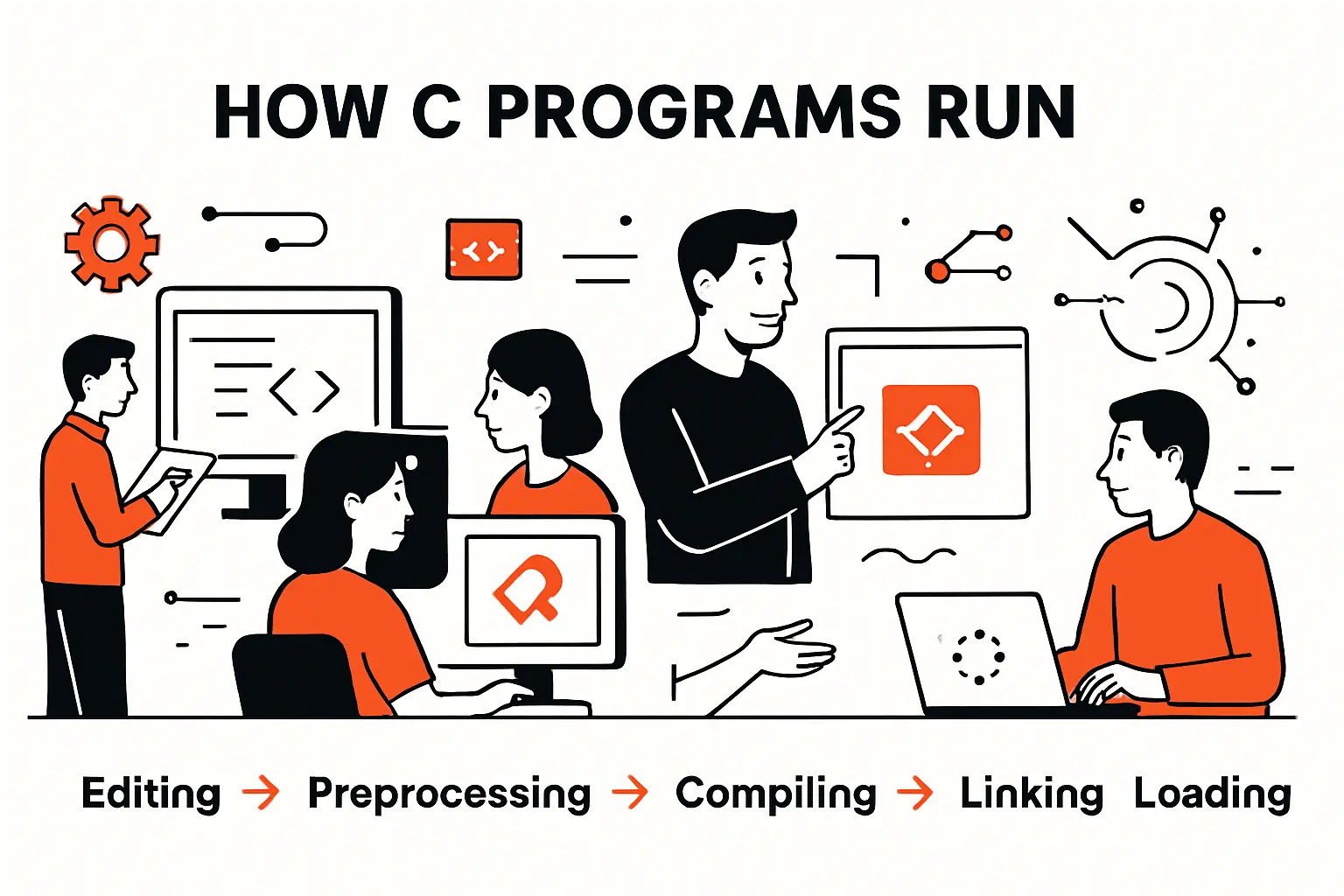
1. C as a compiled language: source code to executable machine code
C is typically compiled, meaning we write human-readable source code that a compiler translates into machine instructions for a target platform. That compilation step is not a trivial detail; it’s the reason C can be extremely fast, and it’s also why C developers think in terms of toolchains, build settings, and binary artifacts.
In our day-to-day practice, compilation is where performance and correctness decisions become concrete. Optimization settings influence inlining, vectorization, and layout decisions, while debug settings influence symbol visibility and diagnostic quality. When clients ask why a C module behaves differently across environments, the answer is often “because compilation is part of the program,” not a mere packaging step.
2. Preprocessor basics: handling directives that begin with the # character
The preprocessor runs before compilation and performs textual transformations: including headers, expanding macros, and enabling conditional compilation. That capability is powerful in cross-platform development because it allows a single codebase to adapt to different operating systems, compilers, and hardware constraints.
At the same time, the preprocessor can become a liability if abused. Over-macroized code hides control flow, complicates debugging, and makes static analysis harder. In our style guides, we try to keep macros for narrow purposes—compile-time feature selection, small invariants, and low-level helpers—while pushing most logic into functions where compilers and tools can reason about it cleanly.
3. Linking and loading: turning object files and libraries into runnable programs
After compilation, object files and libraries are linked into an executable or a shared library. Linking resolves symbol references, chooses which implementations to include, and establishes the binary interface between modules. That boundary is why C is so frequently used as an “interop language”: a stable C ABI is often the easiest meeting point for many ecosystems.
Loading is the runtime step where the operating system maps code and data into memory and starts execution. In systems work, understanding loading explains real production behavior: why an application fails to start due to missing symbols, why a plugin crashes due to ABI mismatch, or why a deployment breaks because a dynamic library changed incompatibly. When we ship C components, we treat symbol versioning and binary compatibility as first-class concerns.
4. What a C development environment typically includes: editor, compiler, and tooling
A productive C environment is a stack, not a single tool. Editors and language servers provide navigation and refactoring help, compilers provide warnings and optimization, and build systems orchestrate dependencies and reproducible builds. Debuggers, profilers, sanitizers, and static analyzers fill in the visibility that C does not provide automatically.
Inside TechTide Solutions, we think of “tooling maturity” as part of the language choice. C succeeds when the team invests in diagnostics: strict compiler warnings, automated formatting, continuous integration, and test harnesses that include dynamic analysis. Without that discipline, C’s freedom becomes an invitation to subtle defects that only appear under pressure.
C Program Structure and Core Syntax You’ll See Everywhere
1. Program skeleton: header includes, main function, and curly-brace blocks
Most C programs share a recognizable skeleton: include directives for headers, function declarations, and a main entry point. Curly braces define blocks, which control scope and lifetime for variables declared within them. That structure feels simple, yet it’s also what makes C readable across decades: the code tends to look like the machine’s steps, written down in a disciplined way.
For beginners, the smallest complete program is a useful anchor. In our onboarding, we often start with code like the following, not because “hello world” is profound, but because it shows the shape of C clearly:
#include <stdio.h>#include <stdlib.h>int main(void) { puts("Hello, C"); return EXIT_SUCCESS;}2. Core building blocks: variables, constants, and common data type categories
C’s type system looks small on the surface, but it’s rich in implications. Integers, floating-point types, characters, arrays, structs, and unions give us the vocabulary to model everything from protocol frames to file headers to in-memory indexes. Qualifiers like const add correctness constraints that matter in large codebases, especially when multiple developers touch shared modules.
From a business perspective, type choices show up as performance and reliability outcomes. A carefully designed struct layout improves cache locality and reduces copying, while a sloppy layout can create silent padding and mismatched expectations across platforms. When we build APIs meant to last, we treat type definitions as durable artifacts, versioned and reviewed like product requirements.
3. Working with output and input functions such as printf and scanf
C’s standard I/O facilities are among its most recognizable features. Functions like printf and scanf demonstrate C’s approach: powerful primitives that assume the programmer understands formatting, types, and buffer boundaries. That style can feel harsh compared with safer abstractions, but it also provides a universal baseline that exists across nearly every C environment.
In production code, we’re careful about how we use these facilities. Logging often needs predictable formatting without risking buffer misuse, and input parsing needs defensive strategies to avoid ambiguous reads and unchecked conversions. When a client system handles untrusted data, our preference is to wrap low-level I/O in domain-specific parsing functions that validate length, encoding expectations, and error conditions explicitly.
4. Operators in C: arithmetic, assignment, bitwise, logical, and conditional expressions
C operators are where the language’s “close to the machine” identity becomes obvious. Arithmetic and assignment operators do what you expect, while bitwise operators make it easy to pack flags, parse headers, and manipulate masks efficiently. Logical operators short-circuit, enabling compact guard patterns that remain common in systems code.
At TechTide Solutions, we treat operator use as a readability choice, not merely a cleverness opportunity. Dense expressions can reduce clarity and make static analysis less effective, especially around precedence rules. For critical code paths—packet parsing, authorization checks, memory bounds—we prefer explicit parentheses and small helper functions, even when the compiler could optimize the equivalent one-liner.
Memory, Pointers, and Safety: Power With Responsibility in C

1. How pointers enable direct access to memory and system-specific features
Pointers are C’s signature feature: variables that hold addresses, allowing code to reference and manipulate memory directly. That capability enables efficient data structures, zero-copy APIs, and direct interoperability with operating system interfaces. It also makes it possible to represent hardware register maps and memory-mapped buffers in a way that higher-level languages usually can’t express without special tooling.
In client engagements involving performance-critical components, pointers are how we keep overhead under control. Passing a pointer to a buffer avoids copying large arrays, and using pointer arithmetic can simplify parsing binary formats. Still, we treat pointer-centric code as “sharp,” meaning it deserves extra reviews, strong tests, and heavy diagnostic tooling because the failure modes are severe and often non-obvious.
2. Memory allocation models: static, automatic stack allocation, and dynamic heap allocation
C gives us several allocation models, and each model has different business consequences. Static storage lasts for the program’s lifetime and is predictable, automatic (stack) storage is fast and scoped, and dynamic (heap) storage supports flexible lifetimes at the cost of allocator overhead and fragmentation risks. Knowing when to use each model is a core competency in C engineering.
On embedded systems, dynamic allocation is sometimes avoided entirely because predictability beats flexibility. In server software, dynamic allocation is common, but we still aim to minimize churn in high-throughput paths by pooling, reusing buffers, and designing APIs that clarify ownership. When an organization struggles with tail latency, allocator behavior is frequently part of the story, and C makes that story visible.
3. Common pitfalls: memory leaks, dangling pointers, and memory corruption risks
With manual memory management comes a class of bugs that managed runtimes mostly avoid: leaks, double frees, use-after-free, out-of-bounds writes, and uninitialized reads. These defects are not merely theoretical; they can crash systems, corrupt data, and create security vulnerabilities. In our incident reviews, memory corruption is often the reason failures are “non-reproducible” until the team learns to use the right diagnostics.
Industry security research has repeatedly highlighted how large this risk remains at scale. Microsoft’s security engineering commentary notes that approximately 70% of security vulnerabilities they fix and assign identifiers to are due to memory safety issues, which underscores why C proficiency must include defensive practices rather than only syntax knowledge.
4. Mitigations and safer practices: restricted coding standards and compiler/tool warnings
Safe C is not an accident; it’s a process. Restricted coding standards, careful API design, and layered defenses reduce risk without giving up C’s strengths. Compiler warnings—treated as errors in disciplined builds—catch many issues early, while static analysis can identify suspicious patterns that deserve review.
Beyond compile-time checks, runtime tools change the economics of correctness. Address and undefined-behavior sanitizers can surface bugs in tests that would otherwise escape into production, and fuzzing can harden parsers and protocol handlers against hostile inputs. When we ship C components, we bake these mitigations into the delivery pipeline so safety is continuously reinforced rather than “handled later.”
Common Uses of C Today: Systems, Embedded, Compilers, and High-Performance Apps
1. Operating systems and embedded systems: why C is widely used in low-level software
Operating systems and embedded firmware remain C’s most visible domain because the language matches the problem. Device drivers, kernel subsystems, bootloaders, and RTOS components frequently need deterministic behavior and direct access to hardware details. C provides that access while staying portable enough to survive across architectures and vendor toolchains.
In product terms, embedded reliability is often a brand issue rather than a technical curiosity. A medical device that reboots, a sensor gateway that drops packets, or an industrial controller that drifts out of spec can become a customer trust problem quickly. When we build or audit firmware components, C’s transparency lets us reason about worst-case behavior, memory footprints, and failure modes without relying on opaque runtime guarantees.
2. Compilers, interpreters, and language runtimes often implemented in C
C has a long tradition as the “language behind languages.” Many runtimes, interpreters, and virtual machines include substantial C code because it’s an efficient way to implement execution engines, garbage collectors, parsers, and native extensions. Even when a runtime isn’t written entirely in C, C is commonly the stable ABI layer that the rest of the ecosystem depends on.
From our integration work, this matters because C is often the bridge between modern applications and foundational infrastructure. A Python service may rely on C extensions for performance, a database might expose a C client library for portability, and an enterprise SDK might choose C as its lowest-common-denominator interface. When performance and portability both matter, C tends to become the shared language of the stack.
3. Performance-focused domains: game engines, databases, networking, and IoT software
Whenever latency and throughput are key metrics, C remains a strong contender. Game engines use C-like approaches to manage memory and predict frame timing, databases often rely on C for careful control of buffers and storage structures, and networking software benefits from low-overhead packet processing and explicit concurrency strategies.
In IoT software, C frequently appears at the edge: firmware, gateways, protocol translation layers, and device management agents. That placement makes business sense because the edge is where constraints pile up—limited compute, intermittent connectivity, strict power budgets, and hardware-specific quirks. When a client needs consistent performance on heterogeneous devices, C-based components often provide the stable foundation that higher-level orchestration can build upon.
4. C in the web stack: historical CGI use and C-based web servers
Although web application development is dominated by higher-level languages, C still appears in the web stack in meaningful ways. Historically, CGI programs were often written in C for speed and because the interface is essentially process I/O. Today, many high-performance servers and proxies are implemented in C or C-adjacent languages, and critical libraries for TLS, compression, and networking frequently depend on C implementations.
From the business side, the web is not only about rendering pages; it’s about moving bytes safely and quickly. C tends to show up in the “plumbing” layers where resource usage matters, where protocol correctness is critical, and where mature libraries have been tested under punishing real-world traffic. When we optimize a web-facing product, improvements often come from tuning these C-based layers rather than rewriting application logic.
TechTide Solutions: Custom Software Development Powered by C

1. Tailored architecture for performance-critical and system-level components
At TechTide Solutions, we don’t treat C as a default; we treat it as a precision instrument. Architecture decisions start with constraints—latency budgets, memory limits, hardware interfaces, deployment targets—and C becomes the right choice when the system needs predictable behavior and low overhead in core paths. That typically includes modules like protocol parsers, device communication layers, compression/crypto components, or performance-sensitive data pipelines.
Rather than building monoliths in C, we often isolate C to the smallest surface area that delivers the benefit. A clean boundary—well-defined headers, stable data structures, explicit ownership rules—lets the rest of the product move quickly in higher-level languages while the C core provides speed and control. In our experience, that hybrid strategy is where C shines commercially: maximum leverage with minimal blast radius.
2. Custom integrations: connecting C modules with modern stacks, APIs, and existing platforms
Integration is where many “C projects” either succeed or stall. C can integrate widely—shared libraries, foreign function interfaces, plugin systems, and thin wrappers—but doing it well requires attention to ABI stability, memory ownership, threading assumptions, and error propagation. Those details are not glamorous, yet they determine whether a C component becomes an asset or a liability.
Across modern stacks, we frequently connect C with web services, message queues, containerized deployments, and observability pipelines. A C library might expose a small API that a Rust, Go, Python, or Java service calls, or it might sit behind an internal daemon that provides a higher-level protocol boundary. When clients inherit legacy C code, we also build adapter layers that modernize interfaces without forcing a risky rewrite.
3. End-to-end delivery: requirements, prototyping, testing, optimization, and long-term maintenance
Successful C delivery depends on process, not heroics. Requirements must include non-functional constraints like latency and footprint, prototypes must validate integration assumptions early, and testing must include both functional coverage and memory-safety diagnostics. Optimization comes after correctness, guided by profiling rather than guesswork, because “fast but wrong” is simply wrong.
Long-term maintenance is where we see the biggest ROI from disciplined C engineering. Clear coding standards, reproducible builds, automated test pipelines, and careful dependency management keep C modules stable over time. When a client needs ongoing support, we prioritize explainability: readable code, consistent patterns, and documentation that reflects the real invariants the system depends on.
Conclusion: When C Is the Right Tool and What to Do Next

C is the right tool when your product needs control over memory, timing, and system boundaries—and when your team is prepared to pair that control with discipline. For us, the deciding factor is rarely “Is C fast?” because it usually is; the deciding factor is “Does this system benefit from making low-level costs explicit?” If the answer is yes, C can deliver reliability and performance that are hard to replicate with heavier runtimes.
Before adopting C, we recommend a concrete next step: identify the specific bottleneck or system boundary that justifies lower-level work, then prototype a small, isolated C component with strict warnings, sanitizers, and clear API ownership rules. After that pilot, the decision tends to clarify itself—either the gains are tangible and repeatable, or the complexity cost outweighs the benefit.
So what’s your real constraint: raw performance, predictable latency, binary size, hardware access, portability across platforms, or long-lived maintainability—and which part of your stack would actually improve if we made that constraint explicit in C?