
Chat GPT 4 vs 5: what “better” means depends on models, modes, and routing
1. GPT-5 lineup: standard ChatGPT 5, GPT-5 Thinking, GPT-5 Pro, plus mini and nano variants
“Better” is a slippery word in applied AI, and we’ve learned (sometimes the hard way) that it usually means “better for a specific workflow under specific constraints.” From our seat at TechTide Solutions, the story of ChatGPT-4 versus ChatGPT-5 starts with product reality: GPT-5 isn’t a single monolith so much as a family and a set of behaviors that shift depending on mode, plan, and routing decisions. Market demand is already forcing that complexity into the open: Gartner expects worldwide GenAI spending to reach $644 billion in 2025, and at that scale, vendors optimize not just “smarts,” but cost, latency, safety, and UX consistency.
Under the hood, the practical lineup most teams feel looks like this: a fast default model for everyday chat, a deliberate “thinking” variant for multi-step reasoning, and a “pro” tier that spends more compute per answer when correctness is worth the wait. Alongside those, smaller “mini” and “nano” variants show up as the quiet workhorses—especially in APIs, background automation, and high-throughput classification. In other words, the GPT-5 era is less about one IQ jump and more about orchestration: selecting the right brain for the right moment without making users feel like they’re micromanaging a cockpit.
2. Automatic model routing: when the router helps, and when users feel it picks the “wrong” model
Routing is the most underappreciated part of “Chat GPT 4 vs 5,” because it changes what a user experiences even if the underlying models are excellent. In our client work, we see routing succeed when tasks are clearly separable: quick copy edits and lightweight Q&A go to the fast lane, while thorny debugging, policy interpretation, and synthesis get escalated to a reasoning lane. That separation matters operationally because it prevents teams from paying “deep thinking tax” on every trivial request, while still unlocking a higher ceiling for work that genuinely needs it.
Friction shows up in the gray zone, where the same prompt could be either shallow or deep depending on hidden context. A single sentence like “rewrite this contract clause so it’s safer” can be routine style work or a high-risk legal transformation depending on jurisdiction, intent, and what came earlier in the thread. Users experience that mismatch as the router “picking the wrong model,” even when the router is doing what it was trained to do. When that happens, we treat routing as a product surface—something to design, test, and tune—rather than a magical default that will always align with human expectations.
3. Model selection changes: concerns about rerouting existing chats and reduced user control
One subtle shift between the GPT-4 era and the GPT-5 era is psychological: people stopped thinking they were “choosing a model” and started feeling like they were “negotiating a system.” From an engineering standpoint, that’s progress—systems can adapt, self-optimize, and keep casual users out of the weeds. From a user-control standpoint, it introduces a new anxiety: “Will this same chat behave differently tomorrow?”
In practice, we’ve seen two failure modes. First, continuity breaks when a long-running thread suddenly gets rerouted and the response style, depth, or tool behavior changes midstream. Second, power users feel boxed in when the UI nudges them away from explicit selection, particularly for creative work where tone and pacing matter as much as factual accuracy. Our take at TechTide Solutions is pragmatic: systems should route by default, but professional users need stable “locks” (per-chat or per-task) so they can preserve intent, voice, and latency expectations across time.
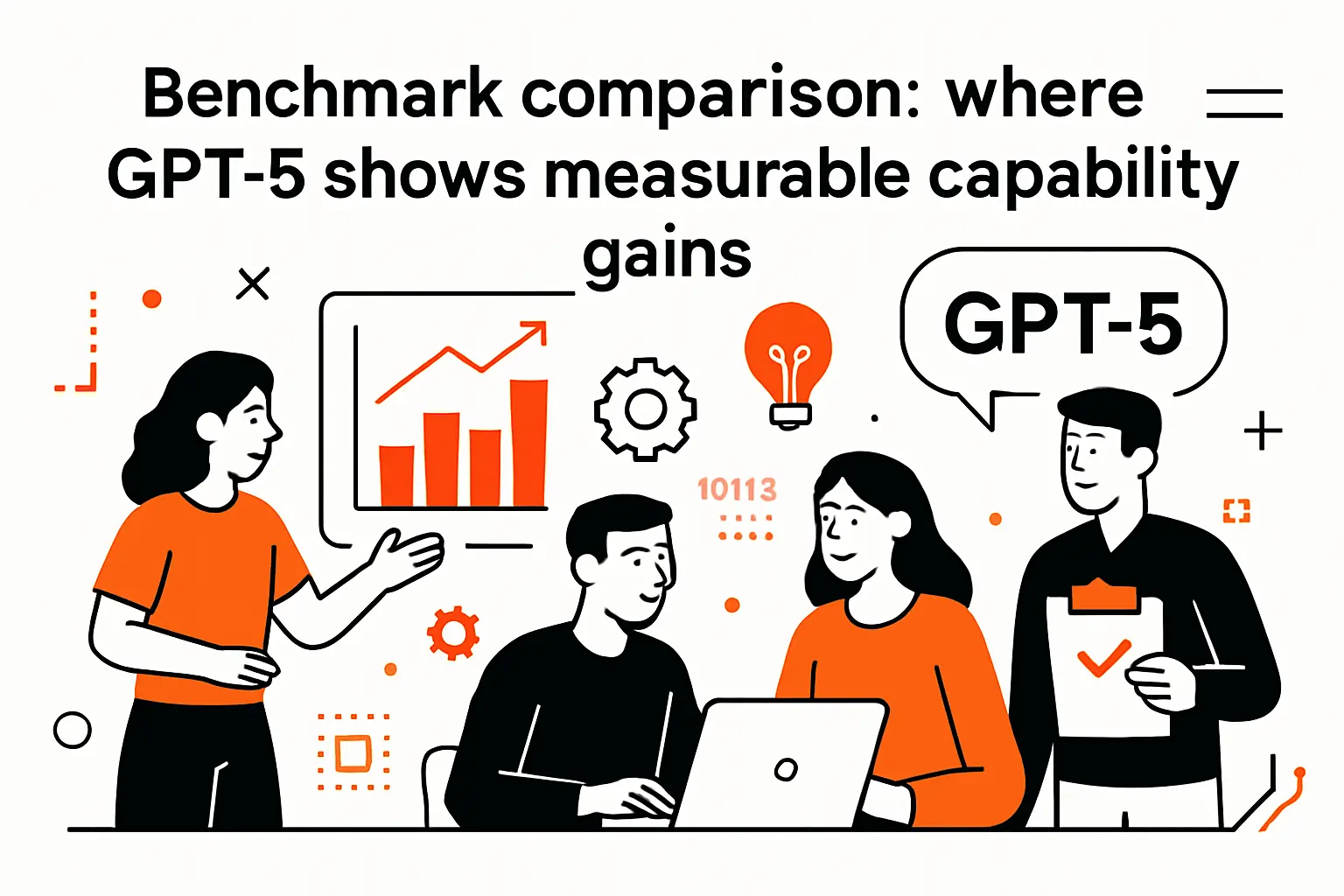
Benchmark comparison: where GPT-5 shows measurable capability gains
1. Science reasoning: GPQA Diamond improvements and fewer logic errors on high-difficulty questions
Science reasoning is where GPT-5’s improvements are easiest to explain without hand-waving, because the questions are designed to punish shallow pattern matching. GPQA Diamond is a useful proxy here: it’s not “did the model memorize trivia,” but “can it chain concepts correctly under pressure.” OpenAI’s GPT-5 Pro result of 88.4% without tools is significant less for the headline and more for what it signals: fewer silent logic slips on the kinds of questions that demand careful premise tracking.
On real projects, the value of that shift shows up when teams ask the model to do “scientific work adjacent” tasks: explaining assay results, reconciling conflicting sources in a literature review, or drafting a technical rationale for a product decision. GPT-4-family models can be brilliant in these contexts, yet they’re more likely to sound confident while missing a constraint. GPT-5’s edge, when it appears, is not just the right answer—it’s a more consistent habit of recognizing when the problem is underspecified and pushing for the missing variable before committing to a brittle conclusion.
2. Coding: SWE-bench Verified results and “real GitHub issues solved” framing
We like SWE-bench not because it’s perfect, but because it’s closer to how software fails in the real world: messy repos, implicit assumptions, and unit tests that act like tripwires. TechCrunch reports GPT-5 scoring 74.9% on SWE-bench Verified, which is meaningful if (and only if) you interpret it as “patches that compile, align with repo conventions, and pass tests often enough to matter.” For business leaders, that translates to a narrower gap between “AI wrote code” and “AI shipped a fix.”
Equally important is what “Verified” tries to fix: benchmark inflation caused by ambiguous issues or broken harnesses. OpenAI describes SWE-bench Verified as a subset of 500 samples screened to be non-problematic, and we consider that emphasis on evaluation quality a feature, not marketing. In practice, our teams use SWE-bench-style harnesses to simulate customer repos, because nothing reveals model weaknesses faster than “run tests, show diffs, explain why you changed it, and don’t break lint.” GPT-5 tends to shine when the workflow is truly agentic—multi-step investigation, patch, verify—while GPT-4-family options can still feel snappier for quick edits and conversational debugging.
3. Math and proof-style reliability: HMMT and other competition-style benchmarks with tools
Math benchmarks are notorious for turning into a game of prompt tricks, so we prefer those that reward disciplined reasoning and punish lucky guesses. In OpenAI’s developer-facing benchmark table, GPT-5 is reported at 93.3% on HMMT in a no-tools setting, which is a strong signal that the model can keep structure intact across a multi-step derivation. That matters because most business math failures aren’t “can you do algebra,” but “did you preserve constraints across three transformations and a unit conversion.”
Tool use complicates the picture in a good way. Once a model can call a calculator, run Python, or check a symbolic manipulation step, reliability becomes less about raw mental arithmetic and more about orchestration: knowing when to verify, how to sanity-check, and how to cite intermediate steps so a human can audit them. In our delivery work, we treat tool-enabled math as an engineering discipline: we log tool calls, assert invariants, and demand machine-checkable outputs (tables, schemas, proofs-by-exhaustion) instead of persuasive prose. GPT-5 is often better at that “audit mindset,” but the win only counts if the surrounding system captures those traces and enforces correctness gates.
Speed, latency, and throughput: why GPT-5 can feel slower in practice
1. Latency profile differences: time to first token, time between tokens, and user-perceived responsiveness
Latency isn’t one number; it’s a personality. Users experience “speed” as a blend of time-to-first-token, steady streaming cadence, and whether the answer arrives in useful chunks rather than one late dump. GPT-5 can feel slower than GPT-4-family models when it decides to think longer before committing, even if its final answer is better. In customer-facing products, that shift can be either delightful (“it’s careful”) or maddening (“it’s hesitating”).
From an implementation perspective, we’ve found that perceived responsiveness improves when we design for progressive disclosure. A short plan, a quick clarification question, or a partial summary while tools run can keep humans engaged without faking certainty. GPT-4-family models often “start talking” earlier, which feels fast even when the content is less precise. GPT-5’s advantage becomes clearer when the system is allowed to stream structured checkpoints—intent, constraints, next actions—so the wait buys the user something tangible.
2. GPT-5 thinking levels trade-offs: Minimal, Low, Medium default, and High reasoning effort
Reasoning controls are the hidden levers of user experience. When reasoning effort is set high, the model may produce fewer shallow mistakes, but it can also burn time on steps that don’t matter for the user’s goal. When reasoning effort is minimal, the answer comes back quickly, yet the model is more likely to skip edge cases or fail silently on multi-constraint prompts. That’s not a moral failure; it’s a trade-off you can design around.
In our builds, we map reasoning levels to business intent rather than user mood. Customer support deflection, for example, is often low-to-medium reasoning with strong retrieval, because speed and consistency matter more than inventing novel solutions. Regulatory interpretation or incident response triage, by contrast, benefits from higher reasoning effort with explicit citations, because a single misstep can cascade into a compliance or safety event. GPT-5 makes these modes easier to operationalize, but only if the product clearly communicates what mode is active and why.
3. Throughput and predictability: when provisioned throughput deployments matter for SLAs
Throughput is where “model choice” stops being a UX debate and becomes an SLA negotiation. Even a brilliant model can be a poor fit if response times swing wildly under load, because engineering teams end up overprovisioning or adding aggressive caching that degrades relevance. GPT-4-family models have historically been easier to budget for in high-concurrency scenarios, partly because they’re more predictable in “chatty” workloads.
GPT-5’s more adaptive behavior is powerful, yet it increases variance unless you pin down constraints: max tokens, tool limits, strict schemas, and fallback policies. For enterprise rollouts, we often recommend provisioned throughput or reserved capacity patterns when the application is customer-facing and contractual SLAs exist. Internally, we also like queue-aware UX: tell the user when the system is switching to a faster model for responsiveness, and offer a “run deeper” option when correctness is worth the delay. Predictability, not raw intelligence, is what keeps production systems boring—in the best possible way.
Creativity, nuance, and conversational “vibe”: reports of regression vs improvement
1. “Colder” tone and shorter outputs: affective and character voice complaints compared with GPT-4
When users complain that a model feels “colder,” they’re often describing a real product outcome: tighter alignment, fewer flourishes, and a stronger preference for directness over theatrical empathy. In some contexts—legal summaries, technical incident reports, policy drafts—that’s a feature. In other contexts—brainstorming, coaching, narrative writing—it can feel like the soul got optimized out of the room.
At TechTide Solutions, we treat tone as a deliverable, not a vibe. Character voice can be specified through templates, few-shot exemplars, and output constraints (length, rhetorical style, audience). GPT-4-family models sometimes produced more naturally “warm” prose with less prompting, which made them great for casual creative work. GPT-5 can still be creative, but it often asks us to be more explicit about the desired voice, or else it defaults to a crisp, utilitarian style that reads like a professional memo.
2. Creative contexts vs logical clarity: “imbalanced” behavior across task types
Creativity and logic are not opposites, but they compete for the same budget: attention, tokens, and the model’s internal preference for safe, defensible outputs. GPT-5 tends to privilege coherence and instruction-following, which improves technical writing but can constrain open-ended ideation. GPT-4-family options, meanwhile, may wander more, producing unexpected metaphors or lateral connections that spark new product directions.
In real work, we regularly mix modes. A product team might ask for ten campaign concepts (where novelty matters) and then request a compliance-safe rewrite (where precision matters). Our best results come from chaining: first generate wide, then narrow, then validate. In that pipeline, GPT-5 is often strongest in the narrowing and validation phases, while GPT-4-family models can still be excellent in the “wide” phase. The meta-lesson is uncomfortable but useful: “best model” is frequently a sequence, not a single selection.
3. Semantic depth and truncation: users’ perception that deeper chains end too early
Another recurring complaint is that deep reasoning chains sometimes feel prematurely cut off: the model starts strong, then compresses the final steps into a vague conclusion. That can happen for mundane reasons—length limits, safety filters, or routing decisions that switch a response profile midstream. Users interpret it as regression because GPT-4-era answers occasionally rambled longer, giving the illusion of thoroughness even when the reasoning was weaker.
Our approach is to make depth observable. Instead of asking for “a deep explanation,” we ask for explicit artifacts: assumptions list, alternative hypotheses, decision table, risk register, and a final recommendation with confidence qualifiers. Those structures force completion because the model must fill in fields, not just narrate. GPT-5 generally follows those structures more reliably, which helps mitigate the “ended too early” feeling, but only when the application design rewards completeness over eloquence.
Memory, continuity, and context handling: what changes users notice most
1. Memory behavior and control: inconsistent recall, relevance gaps, and editability expectations
Memory is where user expectations collide with system design. People want the model to remember preferences (tone, role, project details) while forgetting sensitive data, and they want that boundary to be editable. When memory works, it feels magical: fewer reminders, smoother collaboration, and less “prompt tax.” When it fails, it feels uncanny: the model recalls the wrong detail confidently or ignores the detail that actually matters.
In our experience, the best pattern is explicit memory contracts. A product should clearly separate: (a) session context (what’s in the current thread), (b) durable preferences (safe, user-approved), and (c) organizational knowledge (retrieval-based, permissioned). GPT-5’s stronger instruction-following can make these contracts easier to enforce, yet the product still needs UI affordances: view, edit, and delete memory; show what was used; and allow per-chat “do not retain” modes. Without that, users blame the model for what is often a systems problem.
2. Long-context needs: document analysis, research summarization, and long-input workflows
Long context is less about bragging rights and more about reducing human glue work. If a model can ingest a policy manual, a ticket backlog, and a design doc in one go, teams stop copy-pasting fragments and start asking end-to-end questions. That’s why plan-level context matters to real workflows, and why users notice it immediately when it changes. On ChatGPT’s plan comparison, the non-reasoning context window for some tiers reaches 128K, which is often the difference between “analyze the whole document” and “analyze this excerpt.”
Even with long context, we rarely rely on brute force alone. Retrieval-augmented generation (RAG) remains essential for freshness, governance, and cost control, especially in enterprise environments where “the latest policy” matters more than “a large prompt.” GPT-5’s advantage tends to show up in synthesis: better cross-referencing, fewer contradictions, and more disciplined summaries that preserve caveats. GPT-4-family models can still be highly effective, but they may require more chunking strategy and more careful prompting to avoid losing the thread in multi-document workflows.
3. Session continuity goals: preference retention and cross-conversation personalization
Cross-conversation continuity is the north star for many teams building AI copilots. Users don’t just want a chatbot; they want a colleague that remembers priorities, learns domain vocabulary, and stays consistent across weeks of work. That continuity is hard, because it intersects with privacy, retention policy, and security boundaries. In regulated industries, “remembering too much” can be as dangerous as “remembering too little.”
Our rule is to earn personalization through explicit signals. Instead of silently inferring preferences, we ask users to pin preferences, approve summaries, or select working styles (“concise,” “thorough,” “skeptical”). Then we store those as structured data, not as fuzzy narrative. GPT-5’s stronger compliance with structured outputs helps make that strategy viable at scale. GPT-4-family options still fit well when the goal is lightweight conversational continuity, especially in environments where you’d rather not store durable memory at all.
Safety and alignment shifts: refusals, “ethical” coaching, and reduced sycophancy
1. Everyday friction points: users noticing stronger guardrails and less willingness to “bend” answers
Safety is experienced by users as friction, especially when they’re moving fast and the model says “no” or redirects into a lecture. GPT-5-era safety tuning often feels stricter in everyday use, partly because models are expected to be deployable at massive scale across wildly different user intents. The result is predictable: some users praise the boundaries, while others feel the tool has become less flexible and more procedural.
From our standpoint, the more important question is whether the friction is targeted. A good safety system distinguishes between malicious intent and legitimate professional work, like security testing, medical summarization, or compliance policy drafting. When those legitimate workflows get blocked, teams route around the model—copying data into unmanaged tools or building shadow workflows that increase risk. So the goal is not “more refusals,” but “cleaner separations,” plus safe alternatives that still get the job done.
2. Safe completions framework: moving beyond binary refusals while limiting harmful outputs
Binary refusals are easy to implement and hard to love. In production, users rarely ask for “harm” in clear language; they ask for dual-use capability, ambiguous advice, or translations that could be misapplied. A safer and more helpful approach is to provide partial help: explain constraints, offer general guidance, propose benign alternatives, and ask clarifying questions when intent is unclear. That style reduces the feeling of being stonewalled while still limiting dangerous specificity.
In the systems we build, we design safe completion paths as first-class flows. For example, a request that resembles instructions for wrongdoing can trigger a “policy-first” response that pivots to prevention, legal compliance, or high-level educational context. Meanwhile, a request that looks like legitimate safety training can route to a constrained, auditable mode that emphasizes risk, mitigations, and citations. GPT-5 tends to be better at staying within those lanes once they’re defined, but the product architecture—classifiers, monitoring, and human escalation—is what makes the safety posture credible.
3. Trust and transparency: bias mitigation, misinformation prevention, and limitation signaling
Trust is built when the model admits what it doesn’t know, separates facts from hypotheses, and signals uncertainty in a way humans can act on. GPT-4-family models often sounded confident even when they were improvising, which created “polished misinformation” risk in high-stakes contexts. GPT-5’s improvements are most valuable when they show up as better limitation signaling: asking for missing inputs, warning when sources may be stale, and refusing to fabricate details.
Transparency also means making the system’s behavior legible. In our deployments, we expose key metadata when it matters: whether tools were used, whether retrieval was consulted, and whether the response was generated in a high-reasoning mode. When users can see those signals, they stop attributing every odd behavior to “the model getting worse” and start treating it like any other software system with modes and constraints. That shift—turning vibe-based trust into evidence-based trust—is, in our view, one of the healthiest cultural changes in AI adoption.
Cost and access: pricing tiers, ROI framing, and deployment choices
1. ChatGPT plans and features: free vs Plus vs Pro vs Team vs Enterprise capability differences
Access tiers shape user experience as much as model quality does. Free tiers tend to prioritize availability and broad access, while paid tiers usually unlock higher limits, faster responses, deeper research tools, and more consistent access to advanced reasoning. Team/Business and Enterprise layers add the enterprise-grade expectations: admin controls, shared workspaces, data governance, and procurement-friendly billing.
In practical terms, we encourage clients to decide what they’re buying: is it “a better model,” “more usage,” “higher reliability,” or “organizational controls”? Those are distinct value propositions that often get bundled into a single subscription label. A developer prototyping alone might only need a paid tier for higher limits. A regulated business, by contrast, might care less about the absolute smartest output and more about audit logs, retention controls, and predictable access for a whole department. The tier decision becomes an architecture decision once the tool is embedded in daily operations.
2. API economics: token pricing claims, token-efficiency improvements, and cost-to-quality trade-offs
On the API side, cost is where ambition meets gravity. The OpenAI API pricing table lists GPT-5.2 input at $1.750 / 1M tokens, and that single line forces a serious product conversation: how many tokens does a workflow really need, how often will users retry, and what fraction of requests should trigger deep reasoning. Put differently, cost-to-quality is rarely linear; spending twice as much does not buy twice the correctness, especially if the workflow is poorly specified or the data pipeline is noisy.
We also see teams misprice systems by ignoring “interaction cost.” A slightly weaker model that answers quickly and predictably can outperform a stronger model in total ROI if it reduces retries, back-and-forth clarifications, and human review time. Conversely, a high-reasoning model can be cheaper per outcome when mistakes are expensive—like generating a broken migration script or misclassifying a compliance ticket. The best economic model, in our experience, is to measure downstream outcomes: time saved, defects avoided, escalations reduced, and user satisfaction, then tune model choice accordingly.
3. Cost optimization patterns: routing easy tasks to smaller models and mixing models by workload
Cost optimization is mostly routing discipline. Simple extraction, formatting, language cleanup, and FAQ responses often belong on smaller models, especially when you can validate outputs with deterministic checks. Hard reasoning, multi-step planning, and tool-heavy automation belong on more capable models, ideally with guardrails and verification. Mixing models is not a compromise; it’s how you build systems that are both affordable and reliable.
At TechTide Solutions, we treat “model portfolio” the way infrastructure teams treat instance types. You wouldn’t run every job on the biggest machine, and you shouldn’t run every prompt on the highest-reasoning model. Instead, we design a router with explicit policies: when to escalate, when to fall back, and when to ask a clarifying question rather than burning tokens on a guess. Over time, that portfolio approach also de-risks vendor churn, because the product logic is built around capabilities and tests rather than a single fragile dependency.
TechTide Solutions: building custom AI solutions tailored to customer needs
1. Model selection engineering: evaluation harnesses and A/B testing for chat gpt 4 vs 5 in real tasks
We don’t pick GPT-4 versus GPT-5 by vibes; we pick by measurement. Our baseline process is an evaluation harness that mirrors production: the same documents, the same tools, the same schemas, and the same user goals. Then we A/B test across models and modes, measuring not only correctness but also time-to-success, revision count, and failure recoverability. That last metric matters because real users don’t grade answers; they abandon workflows that feel brittle.
Crucially, we test at the task level, not the prompt level. A “customer support assistant” task might include retrieval, summarization, policy constraints, escalation logic, and CRM formatting. A “coding agent” task might include repo analysis, patch generation, test execution, and PR narration. GPT-5 often wins when the task is multi-stage and tool-driven, while GPT-4-family options can remain competitive in fast, conversational loops. Once those patterns are visible in data, stakeholders stop arguing abstractly and start making informed product trade-offs.
2. Custom web and mobile apps: integrating GPT-5 thinking controls, structured outputs, and tool use
Integrating GPT-5 well is less about calling an endpoint and more about building an interaction contract. In web and mobile apps, we like to expose “depth controls” implicitly: a quick mode for chatty back-and-forth, and a deep mode for “do the whole thing” requests. Instead of telling users to select a model name, we give them an intent choice: “Draft” versus “Finalize,” “Brainstorm” versus “Decide,” “Quick answer” versus “Show your work.”
Structured outputs are the other unlock. When the model must return JSON that matches a schema, or a decision table with required columns, the entire system becomes easier to validate, cache, and monitor. Tool use then becomes safer because each tool call is logged, permissioned, and constrained. GPT-5’s strengths show up when it can coordinate tools without losing the narrative thread, but the real win for businesses is that those tool calls become auditable events—something security and compliance teams can reason about without reading every generated paragraph.
3. Production readiness: secure RAG, permissions, monitoring, observability, and cost guardrails
Production readiness is where most AI projects either mature or quietly die. Security teams want to know what data leaves the boundary, engineers want predictable latency and cost, and business owners want reliability that survives user chaos. Those concerns are not hypothetical: Netskope’s 2026 Cloud and Threat Report says the average organization sees 223 incidents per month involving GenAI data policy violations, which aligns with what we see in audits—people paste sensitive material into whatever tool is fastest unless you give them a governed alternative.
Accordingly, we build “secure-by-design” patterns: permissioned retrieval, least-privilege tool access, prompt-injection hardening, and environment-level controls that prevent data exfiltration through tools. Observability is mandatory: we track tokens, latency, tool error rates, retrieval hit quality, and user satisfaction signals. Cost guardrails matter just as much as safety guardrails, because runaway reasoning or tool loops can turn a useful feature into a financial incident. When those foundations are solid, model choice becomes flexible—you can swap GPT-4-family and GPT-5-family options without rewriting the whole product.
Conclusion: how to decide between ChatGPT-4 and ChatGPT-5 for your use case
1. Pick GPT-5 when accuracy, multistep reasoning, and agentic workflows are the priority
GPT-5 is the right bet when the work is genuinely multi-step: investigate, plan, execute, verify, and explain. Complex coding tasks, deep research synthesis, and tool-driven automation are where we most consistently see GPT-5 earn its keep. In those workflows, the difference between “plausible” and “correct” is business-critical, and the model’s ability to stay coherent across a long chain is the product.
From our perspective, GPT-5 also fits when teams are trying to build agents rather than chatbots. If the system must call tools, recover from tool errors, and maintain state across steps, the “thinking” posture becomes more than a nice-to-have. That said, we still insist on verification, because even a strong reasoning model can make a confident mistake if the data pipeline is wrong or the permissions are too broad.
2. Pick GPT-4-family options when low latency, high throughput, and conversational flow matter most
GPT-4-family models remain compelling when speed and conversational rhythm are the dominant UX requirements. Live customer chat, real-time ideation, quick rewriting, and interactive tutoring often benefit from a model that responds quickly and keeps the dialogue moving. In those contexts, a slightly weaker model that users actually enjoy using can outperform a stronger model that feels sluggish or overly formal.
In our own internal work, we still reach for GPT-4-family behavior when we’re “thinking out loud” with a product team, sketching architecture trade-offs, or iterating on copy. Faster cycles produce better outcomes, and the cost of a small reasoning error is low because humans are already in the loop. GPT-5 can still work here, but it’s not automatically the best fit unless you explicitly tune it for responsiveness and style.
3. Make the call with side-by-side testing: quality, speed, cost, and user satisfaction signals
No single benchmark will choose for you, and no single anecdote should either. The decision process we trust is side-by-side testing on your real tasks, using your real documents, your real toolchain, and your real constraints. Quality matters, but so do speed, predictability, and total cost per successful outcome, especially once you factor in retries and human review.
If we had to give one next step, it would be this: pick three high-value workflows, build a small evaluation harness, and run GPT-4-family and GPT-5-family variants against the same acceptance criteria—then let your users vote with their behavior. After all, isn’t the only definition of “better” that matters the one your customers can feel in the product?