



Adidas market share is worth tracking again because the brand delivered 13% in 2025 on a currency-neutral basis. That does not prove permanent leadership, but it usually means a brand is winning more often at retail, online, and in the minds of consumers.
Current Adidas Market Share Snapshot
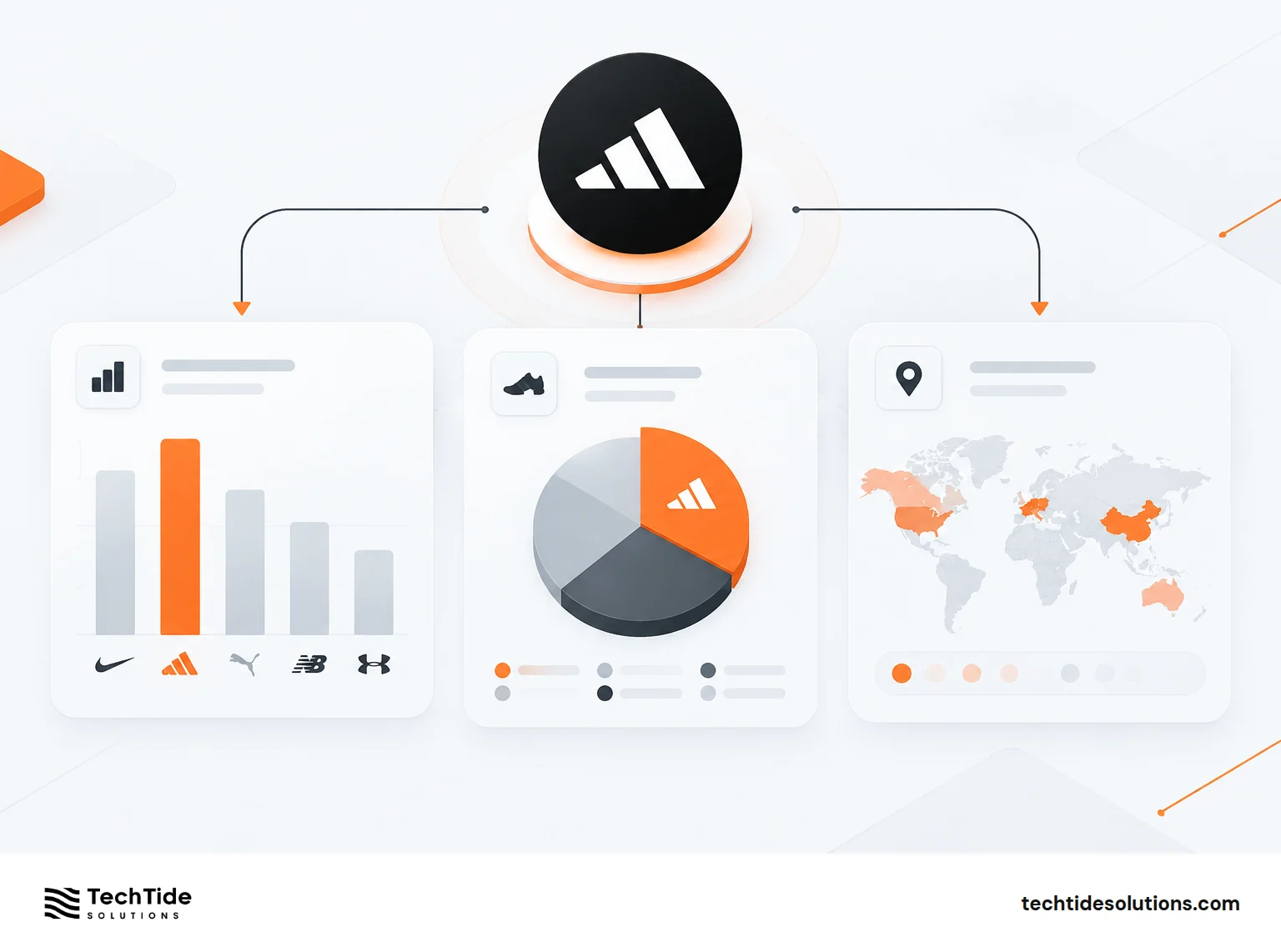
Start with one simple rule. There is no single official Adidas market share number. The answer changes depending on whether you mean company revenue, global athletic footwear, or a country-level retail market.
1. Revenue-Based Share against Nike and Other Public Peers
Nike still sets the scale benchmark. Its latest full-year filing shows $46.3 billion in FY2025 revenue. That is the clearest reminder that Adidas is still chasing a much larger rival on companywide size.
Adidas remains the clear number two among the biggest global sportswear names, posting €24,811 million in 2025 net sales. Revenue-based comparisons usually make Adidas look smaller than footwear-only comparisons because this lens includes apparel, accessories, and every market where the company operates.
2. Global Athletic Footwear Share Compared with U.S. Athletic Footwear Share
On the footwear scoreboard, the gap looks narrower. Recent Euromonitor data obtained by Reuters put Nike and Adidas at 22.9% versus 12.2% in 2025 in global sports footwear. That is still a wide lead for Nike, but it is much closer than the revenue comparison.
Public U.S. data usually come with a broader denominator. Euromonitor’s 2025 U.S. footwear report shows Nike and adidas at 16% and 6% in 2025 of total footwear retail value. That is not the same thing as pure athletic footwear, but it is one of the clearest regularly published U.S. benchmarks.
3. Why Adidas Market Share Can Look Different Depending on the Metric
Even the size of the market changes depending on who defines it. McKinsey’s 2025 sporting goods outlook says sportswear growth should soften to about 6% a year from 2024 to 2029. A faster-growing denominator can make share gains look smaller.
A separate world-market outlook cited by industry media points to 2% CAGR from 2025 to 2030 for sportswear. That spread is a good reminder that category scope, price basis, and currency treatment all change the math.
Recommended reading: Starbucks Digital Transformation: How Tech Rebuilt the Coffeehouse
Historical Trends in Adidas Market Share
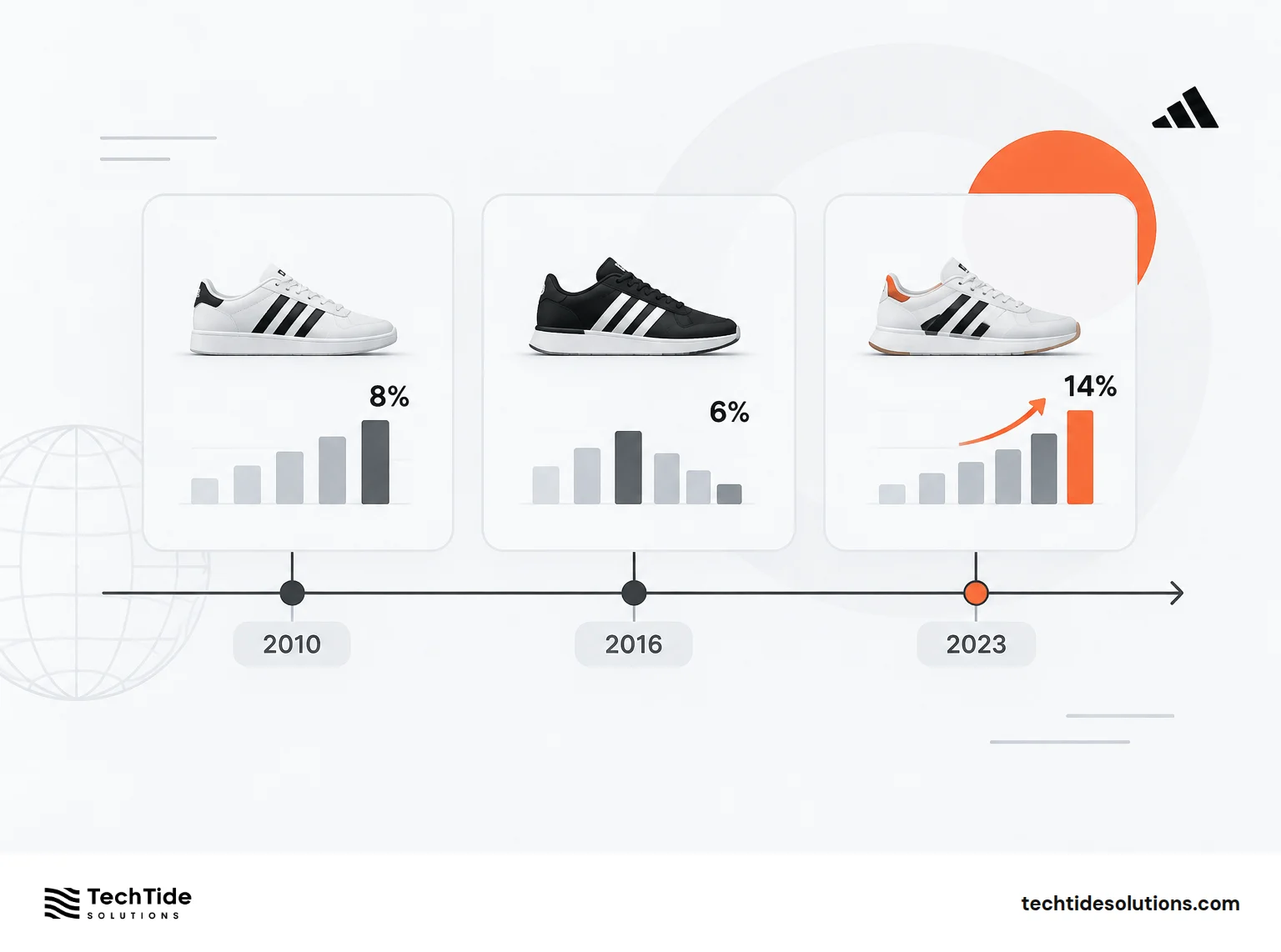
The historical picture matters, but it gets messy fast. Global footwear estimates are easier to find than a clean, up-to-date U.S. athletic-footwear time series, which is why many headlines end up mixing old and new datasets.
1. Long-Term Changes in U.S. Athletic Footwear Share
The most recent publicly visible NPD-style benchmark I could verify put adidas at 10.8% of U.S. sport footwear in 2017. That is older data, but it is still useful because newer public national athletic-footwear share lines are surprisingly scarce.
Since then, most public U.S. discussion has shifted away from clean share tables and toward rankings, sell-through, and broader footwear or sportswear reports. That makes trend reading harder than many roundup articles admit.
2. How Global Athletic Footwear Share Evolved over Time
Adidas entered 2025 from a stronger base than it had a year earlier. A trade report citing Reuters and Euromonitor put the brand at 11.7% in 2024. That helps explain why the latest move matters.
The bigger point is direction. Adidas is no longer trying to dig out of a hole. It is now trying to turn recovery into a multi-year gain cycle.
3. How Recent Revenue Growth Changes the Market Share Story
Late 2025 changed the tone. Adidas reported €6.63 billion in Q3 2025, which it described as the highest quarterly revenue in company history. Once growth gets that broad, the market share story stops looking like a one-sneaker fad.
That is the real shift. Investors now have a revenue trend they can point to, not just a few hot lifestyle franchises.
Recommended reading: Nike Digital Transformation: Real-World Case study, And Examples
How to Read Adidas Market Share Data
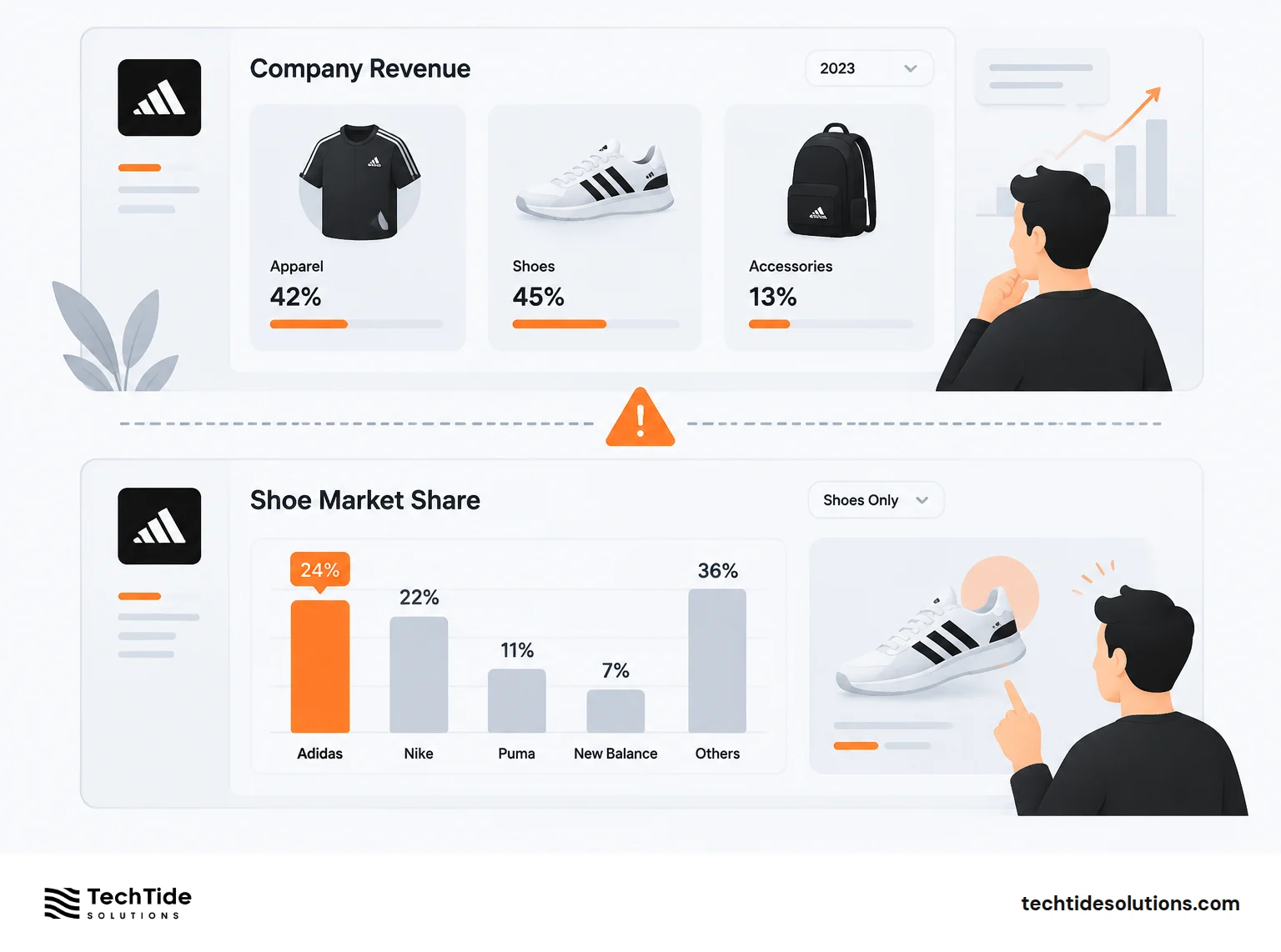
This is where many articles go off the rails. They compare public-company filings, retail share estimates, and category reports as if they all measure the same thing. They do not.
1. Companywide Revenue Share Compared with Category-Specific Share
A companywide comparison includes apparel and accessories, while category share often hinges on shoes. Adidas said 12% in 2025 for footwear revenue growth, which helps explain why footwear-specific datasets can make the brand look stronger than total company comparisons do.
That distinction matters because performance running, football, training, and classics do not all move at the same speed. One hot category can lift brand visibility long before it fully changes companywide revenue share.
2. Regional Sales Mix Compared with Overall Market Share
Adidas is still more Europe-heavy than many American readers assume. In 2025, the company said Europe made up 33% of business, North America 21%. So Adidas can gain share globally even if its U.S. position still trails its European strength.
This is why North America gets so much airtime on earnings calls. It is not the only growth market, but it is the clearest place where better execution can still move the needle.
3. Differences between Public Company Comparisons and Brand-Level Estimates
Brand-share reports and listed-company scorecards are not the same box. Euromonitor’s U.S. sportswear report says the top three brands together held only around 21% in 2025 in retail value terms. That shows how fragmented a broader apparel-plus-footwear market can be.
So a brand can look dominant in one category and merely large in another. That is normal. It is not a contradiction.
What Is Driving Adidas Market Share Gains
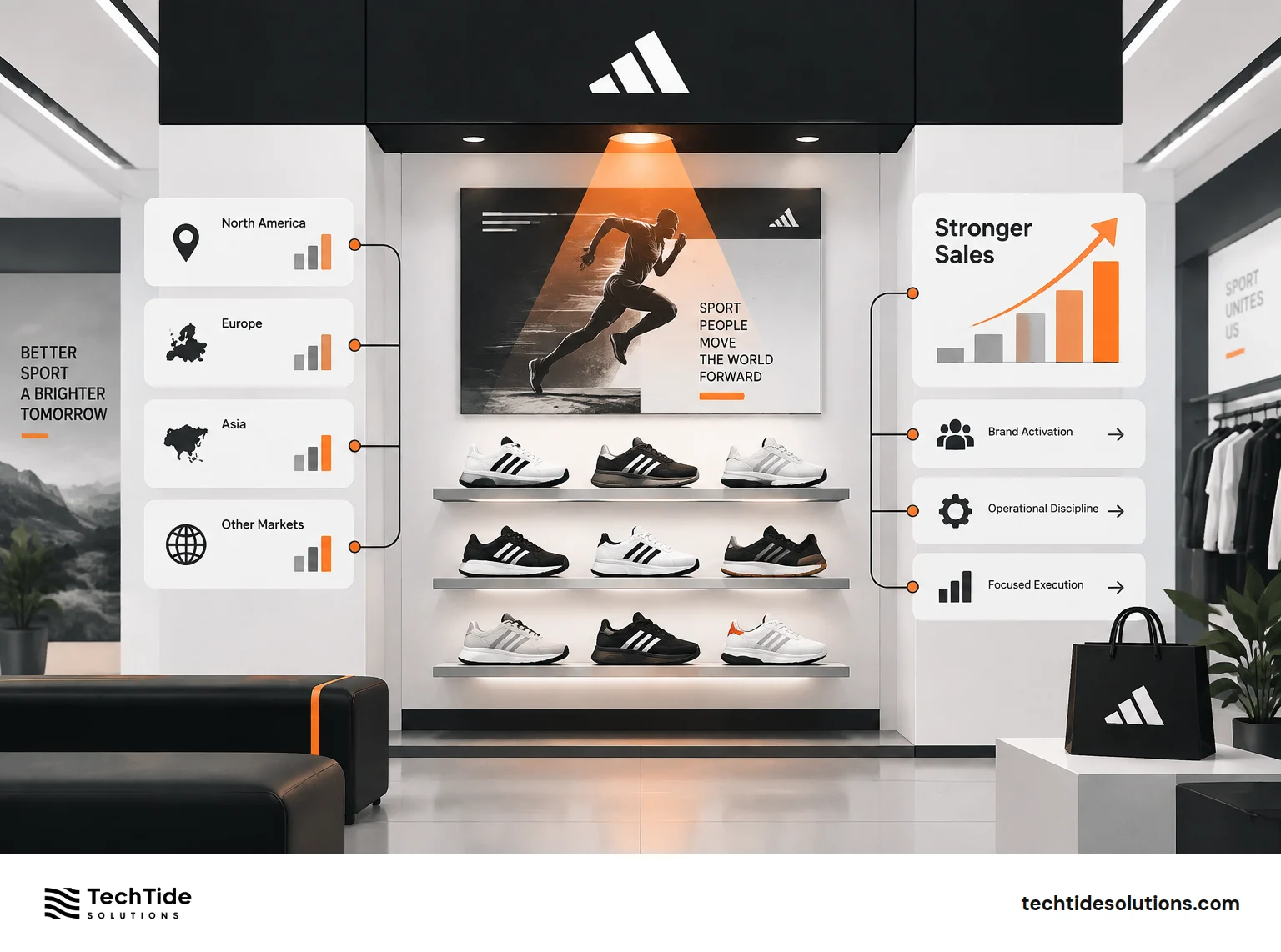
The recent upside is not magic. It comes from better product, sharper activation, and more discipline about where the brand shows up and how much it sells at full price.
1. Locally Relevant Assortments and Market Activations
North America gives a clean example. Adidas said brand sales there rose 10% on a currency-neutral basis in 2025, helped by a more locally tuned mix and cleaner marketplace execution.
That matters because U.S. shoppers are hard to win right now. Retailers want proof of demand before they bet bigger.
2. Stronger Collaborations and Cultural Relevance
Cultural heat only matters if it turns into sustained buying. Adidas’ 2025 results deck said lifestyle revenue increased 12% during 2025, which suggests the classics wave held up beyond a single breakout silhouette.
That is the better sign. Real share gains come when retailers keep buying deeper into a line after the first burst of hype fades.
3. Better Product Breadth across Performance and Lifestyle
Performance is doing more of the heavy lifting again. A results summary tied to Adidas’ 2025 release highlighted more than 35% in 2025 growth for running. That kind of move changes how athletes, specialty stores, and investors judge the brand.
When a brand wins in both classics and performance, it has more than one way to gain share. That is a much safer place to be.
Which Products Matter Most for Adidas
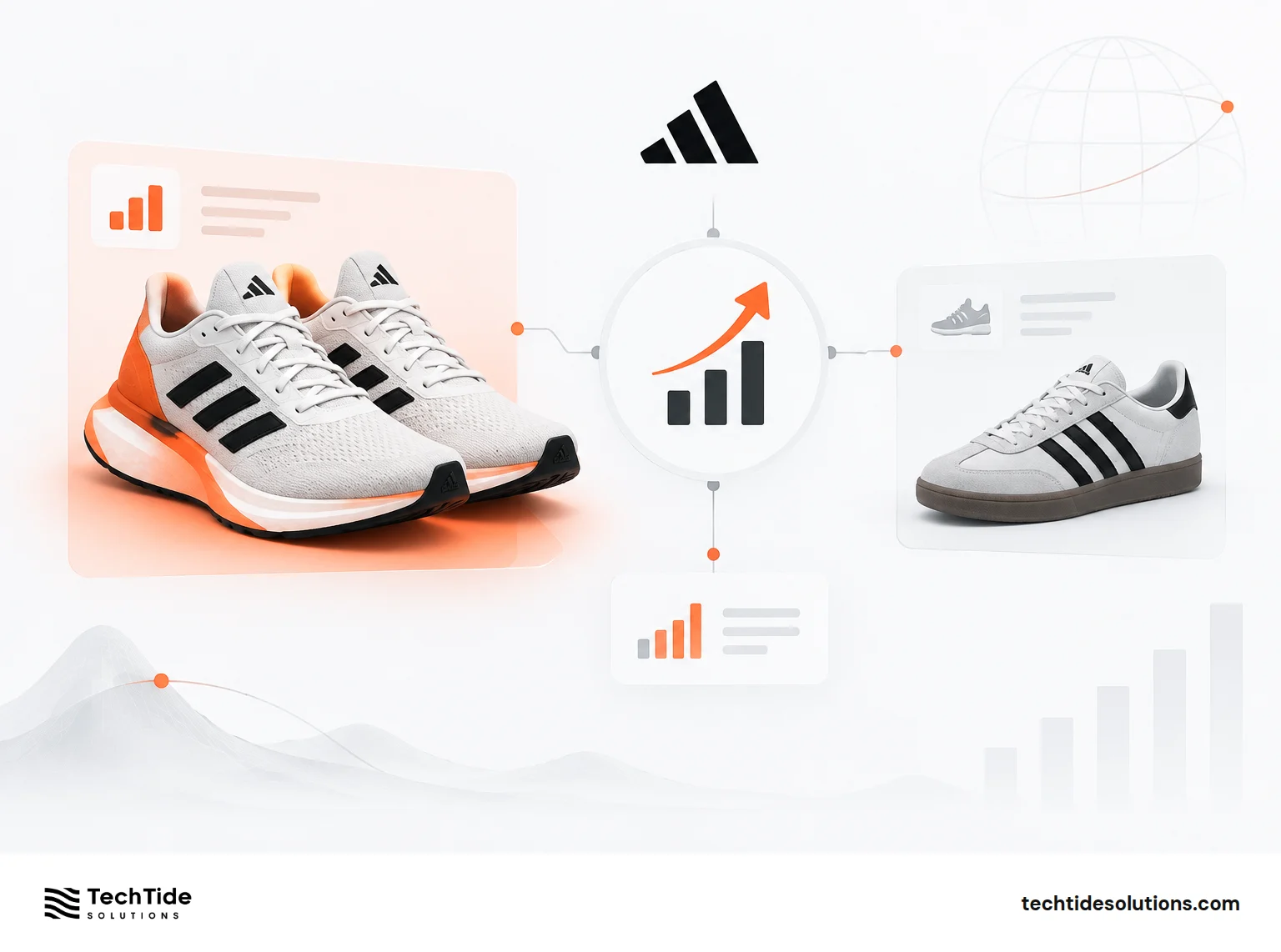
Share gains rarely come from every SKU. A few franchises usually do most of the work. For Adidas, the key mix is still performance footwear plus a lifestyle engine that keeps the brand visible every day.
1. Footwear as the Core Sales Engine
Footwear is still the main lever because it drives both athletic credibility and fashion visibility. It is also the category where Adidas can influence global footwear share most directly.
2. Performance Categories Such as Running, Football, and Training
Running, football, and training matter because they influence repeat purchase, specialty-store credibility, and event-led visibility. Adidas looks stronger here than it did a few years ago, especially in running.
3. Originals, Terrace, Retro Running, and Other Lifestyle Franchises
Originals, terrace models, and retro running keep Adidas in the conversation when shoppers are not thinking like athletes. That matters because lifestyle franchises often open the door before performance products deepen the relationship.
How Sales Channels Support Share Growth
Products get attention, but channels decide how far momentum travels. Share gains vanish quickly when brands chase too much discounting or overfill shelves.
1. Wholesale Sell-Through and Shelf Space Expansion
Wholesale still matters because it determines physical reach. Better sell-through gives retailers a reason to expand space, increase depth, and back new launches with fewer markdowns.
2. Direct-to-Consumer Growth across Stores and E-Commerce
Direct selling shows what consumers choose without a middleman. In Q1 2026, Adidas grew direct-to-consumer, e-commerce, and own retail by 22%, 25%, and 19% in Q1 2026. That is a strong signal of real demand.
3. Full-Price Selling and Gross Margin Improvement
Full-price discipline is the hidden part of the share story. It helps a brand look healthy to retailers, protects pricing power, and gives management more room to invest in marketing and product.
Regional Trends Shaping Adidas Market Share
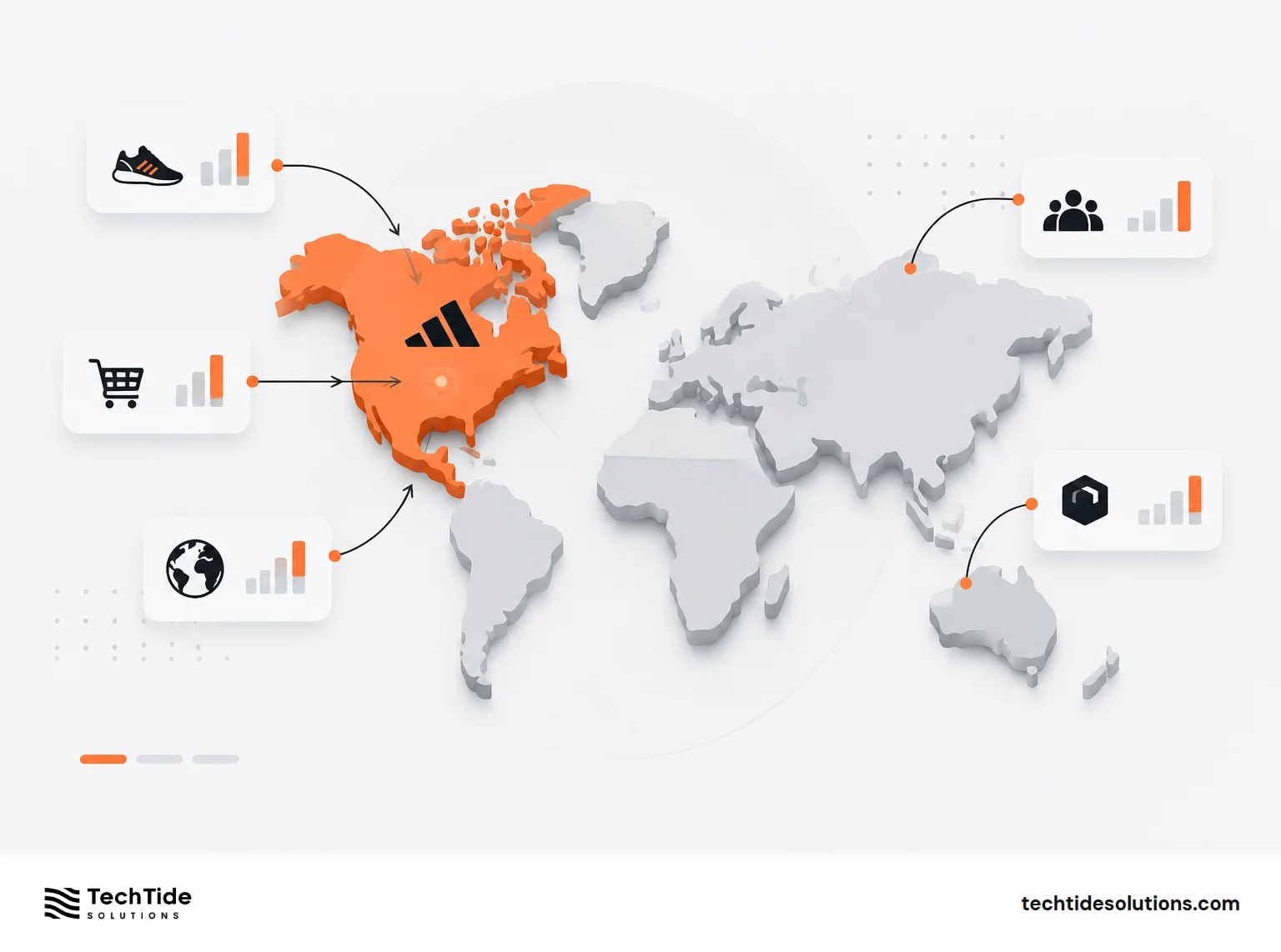
Geography matters because Adidas is not trying to win one market. It is trying to stack gains across several, with different demand patterns, currencies, and competitive pressures in each.
1. North America as a Key Share-Gain Opportunity
The U.S. market is still the swing factor. Circana said the footwear industry was basically flat at $90 billion in 2025, so taking share matters more than waiting for industry growth to do the work.
That is why Adidas keeps talking about full-price sell-through and better marketplace positioning in North America. In a flat market, clean execution matters more.
2. Greater China, Asia-Pacific, and Emerging Markets
Adidas is not leaning on America alone. Its 2025 segment data show €3,636 million and €3,510 million in Greater China and Emerging Markets, respectively. That gives the brand multiple engines for global share gains.
This mix lowers the odds that one weak market derails the whole story. It also gives Adidas more room to offset softness in harder-hit regions.
3. EMEA and Latin America Performance
Europe still gives Adidas scale, distribution depth, and home-market advantage. Latin America has also helped because demand there has often looked steadier than in the most promotion-heavy developed markets.
Adidas Compared with Nike and Other Competitors
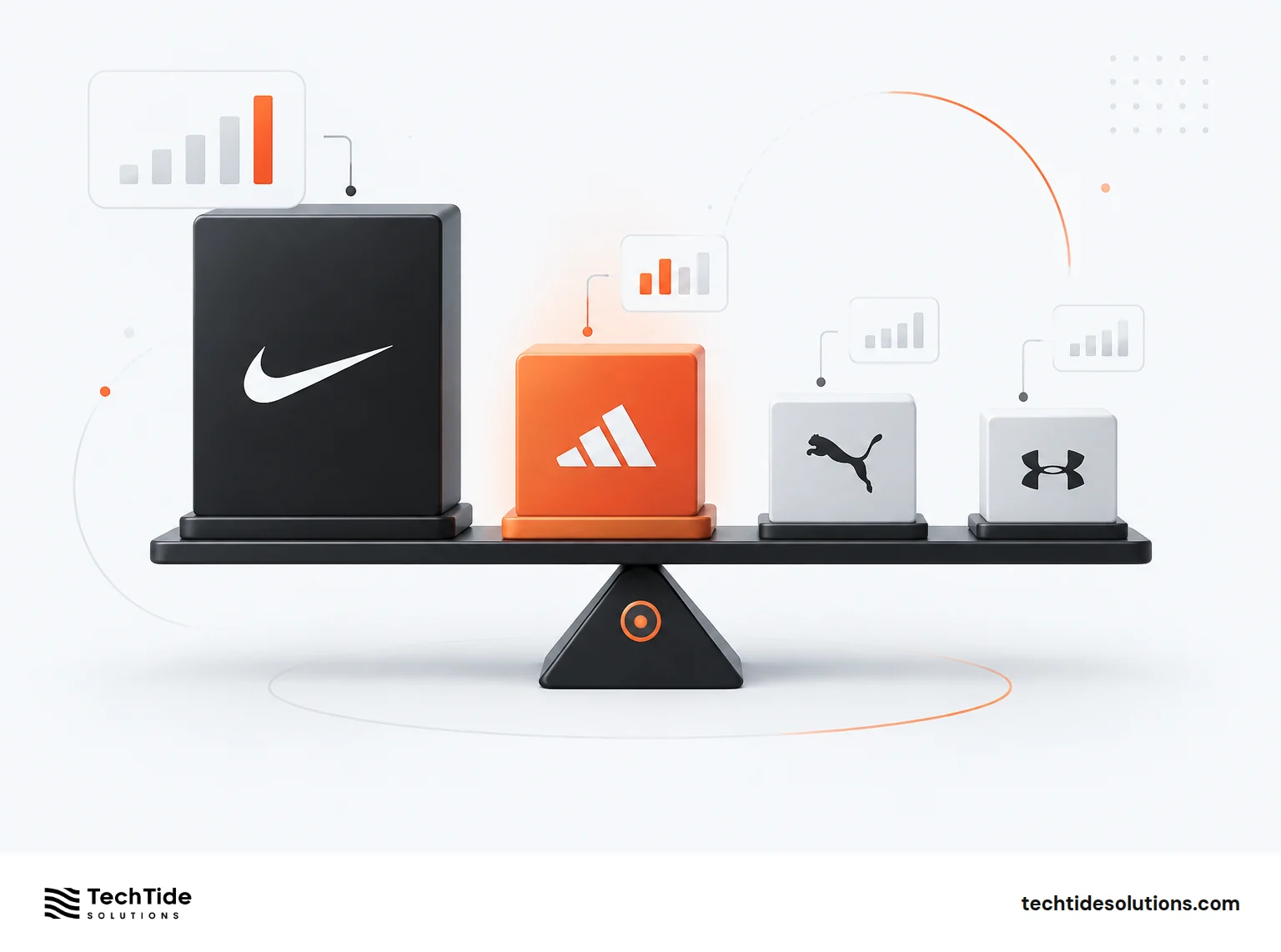
Competitor comparisons sound simple, but they hide very different business models. Nike, Adidas, Puma, ASICS, lululemon, and Under Armour are not weighted the same way across footwear, apparel, or geography.
1. Where Nike Still Leads on Revenue and Brand Scale
Nike still leads on broad revenue scale, U.S. depth, and overall distribution muscle. That matters because the biggest brand often gets the most room to reset when a product cycle goes cold.
2. How Adidas Compares with Puma, ASICS, Lululemon, and Under Armour
Puma remains much smaller on sales, finishing 2025 at €7,296.2 million. Its reset year is one reason Adidas currently looks more stable by comparison.
ASICS is also smaller in total sales, but it is the fast riser in performance. The company lists ¥810,916 million in 2025 annual sales, which is enough to make it a serious category threat even if it is not an overall scale match.
Lululemon plays a different game, but it is too large to ignore in the wider sportswear conversation, with $11.1 billion in fiscal 2025 revenue.
Under Armour is still rebuilding. Its latest annual results show $5.164 billion in fiscal 2025 net revenue as the prior-year comparison point.
3. Which Brand Looks Bigger Depends on Revenue, Brand Value, and Footwear Share
If you compare listed-company revenue, Nike is comfortably ahead. If you isolate global sports footwear, the gap narrows. If you switch to brand value, you are measuring future earnings power, not units sold. In other words, the answer depends on the scoreboard you choose.
Financial Signals Behind Adidas Market Share Momentum
Market share momentum is easier to believe when the income statement backs it up. Adidas has a much stronger case now than it did during the post-Yeezy cleanup period.
1. Record 2025 Revenue and Profit Recovery
The recovery looks far stronger when you zoom out. Adidas’ ten-year overview shows operating profit moving from €268 million in 2023 to €2,056 million in 2025. That is not just a bounce. It is a reset of the earnings base.
2. Improving Margins, Retailer Relationships, and Brand Investment
The underlying message is straightforward. Adidas is no longer relying on cleanup work alone. Better inventory quality, healthier retailer relationships, and more focused brand investment now matter just as much as the initial turnaround boost.
3. 2026 Outlook, Tariff Pressure, and Further Share-Gain Potential
Management is still guiding up. Adidas said it expects €2.3 billion despite a €400 million headwind in 2026 operating profit. That tells you the company believes share gains can outpace tariff and currency damage.
Risks That Could Limit Future Share Growth
The story is better than it was, but it is not risk free. A few pressure points could still slow the pace, especially in price-sensitive markets and more promotional channels.
1. Tariffs, Currency Pressure, and Promotional Competition
The U.S. consumer backdrop is still soft. Circana said the footwear industry grew only 1% in Q1 2026. In a market like that, tariff costs and pricing mistakes hurt faster.
2. Wholesale Caution in Europe and North America
Adidas has been openly conservative with wholesale where demand looks shaky. That protects margins, but it can also make near-term share gains look slower than the brand’s underlying sell-out trend.
3. Regional Volatility and Uneven Demand Trends
Competition is also getting better. ASICS’ Q1 2026 presentation showed ¥270.2 billion with a 22.5% margin. Adidas is improving, but rivals are not sitting still.
Adidas Market Share FAQ
Here are the short answers readers usually want after working through all the detail.
1. What Market Share Does Adidas Hold?
Globally, Adidas holds a low-teens share of sports footwear in the latest widely cited estimates. In the U.S., publicly available figures tend to come from broader footwear or sportswear datasets, which usually make the share look lower.
2. How Large Is Adidas Compared with Nike?
Adidas is clearly smaller than Nike on companywide revenue. The gap narrows when you isolate footwear, but Nike still leads by a healthy margin.
3. Does Nike Still Outsell Adidas?
Yes. On the latest full-year figures available, Nike still outsells Adidas by a wide margin at the company level.
4. Why Do Adidas Market Share Figures Vary across Reports?
Because the reports often measure different things. Some track all company revenue. Others track only footwear, only sportswear, or only one country. Channel mix and currency treatment also change the result.
5. Is North America a Major Growth Market for Adidas?
Yes. North America remains a major growth opportunity because Adidas is still less dominant there than it is in Europe, and even modest gains can have an outsized effect on the global story.
Conclusion: Where Adidas Market Share Could Go Next
The short version is this. Adidas market share looks healthier today because the brand is no longer leaning on one retro hit or one cleanup quarter. It has stronger running momentum, a broader lifestyle bench, and better financial proof behind the story.
Nike is still bigger. The U.S. market is still tough. Tariffs, currency, and promotions can still bite. But Adidas now looks like a brand with multiple ways to win, which is why the market share conversation has turned from recovery to durability.
If the company keeps balancing full-price discipline with fresh product and regional execution, Adidas should keep taking share. Maybe not in a straight line, but the direction now looks much clearer than it did two years ago.


