
Across the industries we serve at Techtide Solutions, we treat the web as a first‑class product surface because technology investment keeps pulling gravity toward digital channels; to gauge the scale, worldwide IT spending is forecast to reach $6.08 trillion in 2026, signaling that what we build in browsers and servers is increasingly central to how organizations operate and grow. We wrote this guide to demystify “what is web development” in practice—mixing standards, architectures, and the lived lessons we’ve earned shipping and scaling web platforms for clients of every shape.
What is web development: definition and scope

The web is where people live, work, and buy, and its addressable audience keeps expanding; for context, global internet users reached 5.56 billion in February 2025, so decisions made by web teams ripple through an enormous, multicultural, multi‑device landscape. When we define web development, we think beyond code to the cross‑disciplinary craft of turning business intent into reliable, secure, and humane digital experiences.
1. Definition: work involved in building and maintaining websites and web applications for the Internet and intranets
In our practice, web development is the full arc of creating and sustaining browser‑accessible products: from shaping requirements and information architecture to implementing front‑end and back‑end code, provisioning infrastructure, instrumenting observability, and running operations. It includes governance and content strategy as much as it includes npm packages, SQL schemas, and deployment pipelines. The simple definition—building and maintaining sites and web apps—hides the essential nuance: we’re not just shipping pages; we’re stewarding systems that must be adaptable, defensible, and comprehensible to both humans and machines.
Intranets deserve equal billing. Internal portals and knowledge systems often carry the heaviest workflow weight—think procurement, compliance attestations, project hubs, or AI‑augmented knowledgebases. Their audiences are smaller yet mission‑critical, and their constraints are different: strong single sign‑on, entitlements down to document sections, and auditability driving design choices. We’ve seen intranet revamps cut onboarding friction dramatically because task flows were redesigned around real jobs, not org charts. That’s web development too.
We also put accessibility and internationalization in the definition. If a page renders perfectly on our design laptops but fails screen readers or right‑to‑left scripts, it isn’t done. Likewise, if a site works only on high‑bandwidth urban fiber, it fails the real world; progressive enhancement remains a sensible default: start from resilient HTML, layer styles and interactions, and never make JavaScript a single point of failure for critical user flows.
2. Scope: from single static pages to complex web applications, e‑commerce, and social platforms
Scope stretches from simple brochure sites to sprawling marketplaces, content‑driven destinations, and enterprise portals with complex business rules. A static site can be the right answer for a brand or campaign with time‑boxed goals and a firm narrative, while a complex product suite demands design systems, domain modeling, and a service mesh. Between those poles live progressive web apps, documentation hubs with full‑text search, and dashboards blending real‑time telemetry with predictive analytics.
Real‑world examples show these shades clearly. Retailers routinely use headless commerce to decouple storefronts from transactional back ends, letting them iterate on UX without touching payment rails. Media organizations adopt component libraries so editorial teams can assemble rich packages without calling developers for every layout. Collaboration platforms lean on WebSockets or server‑sent events to keep teams in sync without polling storms. Social platforms invest in abuse mitigation pipelines embedded at the data layer, not just in moderators’ tools. Each is “web development,” but the scope and success criteria differ markedly.
We also recognize “web as integration layer.” Many of our clients run mature ERP or CRM cores; the web front‑ends become the human‑centered layer over those cores, translating procedural systems into intuitive journeys. Building that layer well demands both systems thinking and product sense: honoring the truth in legacy data while resisting the temptation to surface every field and switch.
3. Typical tasks: web engineering, design, content development, client and server‑side scripting, server and network configuration, and CMS use
Day to day, work spans disciplines. On engineering, map user stories to components, write accessible markup, structure styles with a predictable cascade, and build interactive behavior that doesn’t block rendering; on the back end, design APIs with stable contracts, model data with migrations that roll forward and backward, add queues to smooth traffic spikes, and embed observability through logs, metrics, and traces; on the platform, configure TLS, content security policies, automated certificate rotation, edge caching, and deployment strategies that minimize risk.
Design and content threads run in parallel. Visual systems express brand and prioritize clarity; UX research grounds flows in real tasks; content design sets tone, helps users make decisions, and reduces support load by answering inevitable questions in the interface. We encourage clients to treat their CMS as a long‑term newsroom, not a one‑time content dump. That means well‑defined content types, editorial workflows, and model governance—so taxonomies don’t collapse under growth.
Finally, product management, QA, and SecOps are not “adjacent functions.” They’re inside the circle. A healthy web team coordinates all of it: release cadence aligned to business rhythm, exploratory testing with strong heuristics, and security habits embedded in definition‑of‑done. When that happens, velocity and quality reinforce each other instead of trading blows.
Core technologies and web standards that explain what is web development

The modern web rides on cloud economics, and that skews the build‑vs‑buy calculus; as a snapshot, public‑cloud end‑user spend is projected at $723.4 billion in 2025, which is one reason teams lean into managed databases, serverless functions, and global CDNs while keeping critical domain logic in code. Our job is to translate standards and primitives—HTTP, URLs, media types, caches—into user value with sensible trade‑offs.
1. HTTP and the client‑server request–response model
HTTP is a simple idea with deep consequences: clients issue requests, servers respond with representations. From that flow springs the entire ecosystem: addressing with URLs, representation formats, and the cacheability and safety semantics that govern performance and correctness. Idempotency matters for reliability; if a checkout confirmation page is reloaded after a network glitch, the platform should not duplicate orders. That’s not just back‑end idempotency keys; it’s also front‑end behavior that prevents accidental resubmission.
Headers are the quiet power tools. ETags let servers validate caches without shipping bytes again; Vary avoids cache poisoning by acknowledging that content can legitimately differ by language, content type, or client hints. Accept and Content‑Type are negotiation signals; when APIs and browsers honor them well, the web becomes more flexible and less brittle. We often see substantial gains by fixing cache‑control discipline at both the CDN and origin—ensuring immutable assets are aggressively cached, while HTML receives shorter, carefully chosen directives.
State must be treated with respect. Cookies, storage APIs, and tokens enable personalization and sessions, but they also open a large security surface. Sensitive state belongs server‑side with short‑lived access and rotation; browsers should hold only the minimum needed to make UX responsive and resilient offline. That’s why progressive enhancement pairs well with service workers: use them to cache the skeleton of the app and critical data while leaving secrets and privileged computation on servers guarded by least‑privilege access.
Transport has evolved. By moving HTTP onto a UDP‑based foundation with modern congestion control and stream multiplexing, the protocol stack mitigates head‑of‑line blocking and improves recovery on lossy networks. Yet no protocol innovation absolves us from sound design: avoid waterfalls through proper preloading and module boundaries, and reduce chattiness by designing endpoints that map to user tasks rather than database tables.
Design heuristics we apply
- Prefer explicit cache lifetimes and validation over hope; measure cache hit ratios and adjust directives intentionally.
- Keep request/response bodies aligned with user journeys; if a page needs a compact summary, don’t ship entire documents and filter in the browser.
- Use content negotiation to support multiple representations cleanly; don’t create separate endpoints for trivial format switches.
- Make idempotency a requirement for any action that could be retried by clients, proxies, or background jobs.
2. HTML, CSS, and JavaScript for structure, styling, and interactivity
HTML structures meaning, CSS expresses presentation, and JavaScript choreographs interaction and state. When we start from this layered mental model, we build experiences that degrade gracefully and perform well under real‑world constraints. Semantic HTML remains a superpower: it gives screen readers high‑quality landmarks, improves search engine comprehension, and reduces the amount of script needed to glue interfaces together. That’s why we prefer native elements for buttons, inputs, and navigation before re‑inventing them with divs.
CSS has matured into a robust layout and design system toolset. Modern layout primitives let us align components responsively without grid hacks, and container‑relative styling enables component‑level ergonomics that beat brittle global breakpoints. Cascade layers help teams express design intent: utility classes can sit alongside tokens and components without turning every stylesheet into spaghetti. The outcome is fewer specificity battles and clearer team conventions.
JavaScript is the dynamo—and also the weight we must carry. We favor a discipline of sending the least code possible while still meeting UX goals. That habit leans on patterns like islands architecture, where static HTML ships quickly and interactive “islands” hydrate as needed. It also dovetails with selective prefetching guided by analytics and intent; we fetch only what’s likely to be used next, not everything that could be used. On complex apps, we split bundles by route and responsibility to minimize the time between intent and interactivity.
None of this is anti‑framework. Libraries and meta‑frameworks are invaluable for routing, data fetching, and developer ergonomics. But we temper abstraction with evidence. If a design system spans multiple properties and teams, a robust component library with clear tokens and documentation can save everyone time. If we’re building a microsite, leaning into native platform capabilities may get us to value faster than a heavyweight stack.
Accessibility and performance are features
- We test keyboard navigation and screen reader flows as first‑class acceptance criteria, not as an afterthought.
- We establish performance budgets to keep growth in check; observability tells us when business experiments threaten responsiveness.
- We instrument user timing around meaningful interactions so product teams see latency as a product metric.
3. Server‑side languages, databases, and APIs powering dynamic features
Behind the interface sits the domain. Languages and frameworks are choices—JavaScript and TypeScript runtimes, Python, Go, Java, .NET, Ruby, Rust—but domain boundaries, data models, and contracts last longer than syntax. We prefer simple, explicit modules, with business logic expressed clearly and a thin web layer to orchestrate requests and responses. For persistence, relational databases remain a superb default for transactional integrity; purpose‑built stores join the party for search, analytics, and real‑time streams. The decision is rarely either‑or; it’s often both‑and, with careful data ownership and sync design.
APIs translate domain capabilities into stable, documented contracts. Whether we choose REST with well‑used HTTP semantics or GraphQL for client‑driven querying, we define versioning and deprecation paths up front. Consistency beats novelty: traceable request IDs, predictable error shapes, honest rate‑limit headers, and strong auth. For integration‑heavy platforms we add a backend‑for‑frontend layer that adapts internal domain objects to each client’s needs without leaking internals to browsers or mobile apps.
Resilience is a discipline. We use retries with backoff where safe, circuit breakers around brittle dependencies, queues to protect upstream systems from bursts, and idempotent handlers to make replays benign. For data integrity across microservices, the transactional outbox pattern avoids dual‑write pitfalls; events flow through streams, and downstream services update their projections independently. These patterns are unglamorous compared to shiny front‑end demos, yet they’re why apps stay up when traffic, failures, or release mistakes happen.
Security joins performance at the foundation. We adopt least‑privilege for services and humans, rotate secrets automatically, sign tokens with short lifetimes, and enforce defense‑in‑depth with web application firewalls and bot protection tuned to real traffic patterns. We prefer simple, auditable controls over fragile cleverness; fewer permissions and smaller blast radii usually win.
Front‑end, back‑end, and full‑stack roles in web development

When executives ask how team structure affects outcomes, we point to the business link: high‑performing IT organizations correlate with up to 35 percent higher revenue growth, so clarifying roles is more than HR hygiene—it’s strategy. On real projects, “front‑end,” “back‑end,” and “full‑stack” are less about titles and more about how decisions flow across the stack.
1. Front‑end: UI and UX responsibilities, responsive design, and common frameworks
Front‑end engineers stand at the intersection of product and platform. Responsibilities include translating research into accessible interactions, building resilient components, and stewarding performance. Responsive design today goes beyond breakpoints; it treats the interface as a constellation of components that flex within their containers, not as a handful of rigid layouts. We make designs robust by doing as much as possible with semantics and CSS, then adding interactivity where it makes journeys smoother or safer.
Design systems are the lingua franca. Tokens capture brand and spacing; components encode behaviors; documentation teaches use and misuse. When done well, they unshackle teams. Marketing can experiment inside the rails. Product can assemble new flows without summoning a designer for every screen. Accessibility scales because patterns are reused, not reinvented.
Frameworks and build tools are force multipliers. Routing, code splitting, and data fetching conventions reduce cognitive load, but we avoid cookie‑cutter apps by treating framework defaults as starting points. If a client’s business depends heavily on content, we invest in CMS integrations and authoring ergonomics. If the business depends on velocity, we optimize local dev feedback loops and CI. The front‑end “stack” is a living conversation focused on outcomes, not fandom.
2. Back‑end: server logic, databases, APIs, performance, and security measures
Back‑end engineering is where domain logic, data accuracy, and reliability cohere. We build services around domain boundaries, not convenience boundaries, and we keep interfaces stable so front ends can move independently. Performance starts with data modeling and indexing, then flows through connection pooling, caching, and smart use of asynchronous work. A service that responds quickly is valuable; a service that responds predictably under load is durable.
Security work in the back end benefits from steady habits. Rotate keys and secrets by default; keep credentials out of images and config; insist on peer review for permission changes; and instrument audit trails that serve both security and debugging. When dealing with personally identifiable or financial data, we segregate duties and use tokenization or envelope encryption to limit exposure. We also acknowledge that security is a product concern—not a firewall—so we design consent and privacy controls users can actually understand.
APIs shape consumption. That means honest rate limits and pagination strategies that balance client needs with service protection. It means clear error taxonomies so callers can distinguish retries from bugs. And it means thinking in flows: if a consumer must call multiple endpoints to complete a common task, consider introducing an orchestration endpoint or moving some aggregation server‑side.
3. Full‑stack: integrating client and server workflows across the entire stack
Full‑stack engineers thrive where seams appear: translating product needs into vertical slices that traverse schema, API, and UI. We often assign full‑stack owners to key flows—sign‑up, checkout, booking—so a single mind can balance trade‑offs across client and server. That person shepherds contracts, coordinates with design, and watches telemetry in production to validate the bet. It’s not about heroics; it’s about continuity of intent from whiteboard to logs.
Practically, this yields better defaults. Data fetching patterns are chosen with component ergonomics in mind. Validation logic lives close to the source of truth, with shared definitions to avoid divergence. The “backend‑for‑frontend” pattern often pairs well with full‑stack ownership: a thin layer adapts domain APIs to front‑end needs without coupling browsers to internal services. Teams move faster because the friction of cross‑function handoffs drops.
We also put guardrails around full‑stack roles to protect long‑term health. Over time, unchecked vertical slicing can lead to duplicate domain logic hiding in BFFs or front‑end utilities. Our antidote is architecture reviews oriented around use cases: What’s the core capability? Where does it live? Can another team reuse it? In other words, we blend the autonomy of vertical teams with a shared map of the system.
Web development life cycle
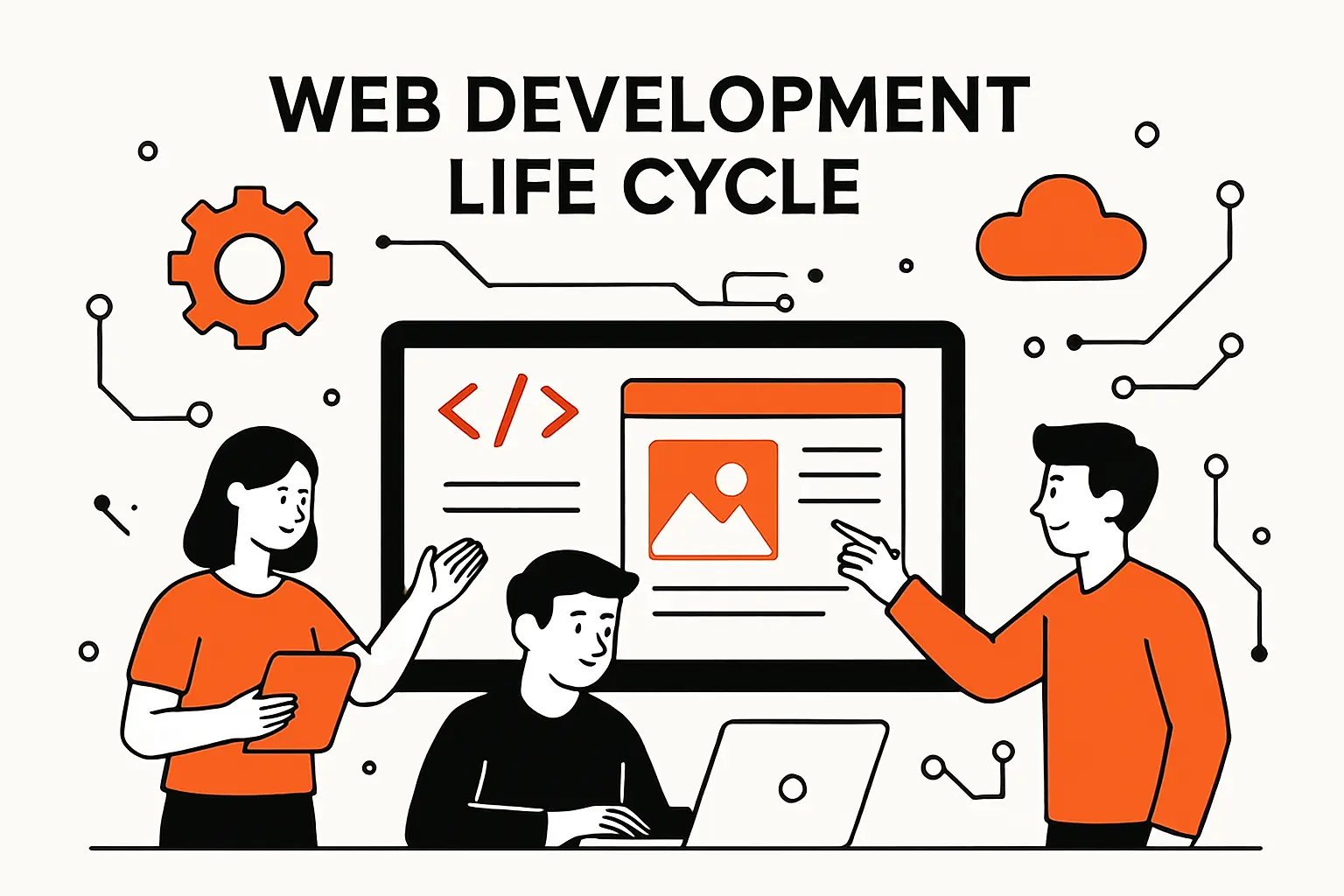
Because digital channels now command a defined slice of household budgets, it pays to treat delivery as a repeatable system; in Deloitte’s consumer wallet analysis, digital goods and services represent 2.7% of the consumer’s total wallet, which is why our teams emphasize disciplined discovery, deliberate design, and reliable operations to turn attention into trust and revenue.
1. Analysis and planning with sitemaps and wireframes
We open with discovery. That means meeting users and sponsors, mapping jobs‑to‑be‑done into journeys and sitemaps, and naming the must‑win moments. Wireframes let product, design, and engineering negotiate scope early without the gravity of visual polish. Content strategists join from day one; if we don’t know what a page has to say, layout decisions are premature. We also sketch service boundaries at this stage: what the front end owns, what belongs in the domain, and where integrations will anchor.
Non‑functional requirements sit beside features: privacy constraints, accessibility posture, performance goals, uptime targets, and observability plans. We align on decision records so trade‑offs are explicit and contextualized. If we choose a headless CMS, for example, we write down why—editorial velocity, multichannel reuse, component governance—and what we’re giving up—tight coupling between content and presentation. Future team members deserve that context.
Risk shaping is part of planning. We pull the hardest unknowns forward into technical spikes and proofs of concept. If a vendor SDK looks risky, we test it on a throwaway branch with realistic data. If an integration’s latency is uncertain, we mock it and run load tests early. These moves derisk complexity and help us order the backlog around reality, not wishful thinking.
2. Design, content creation, and development activities
Design systems, tokens, and components grow in tandem with content models. We favor a cadence where product writers and designers work “inside” the components as they solidify, using real copy and error states to reveal missing affordances. Development proceeds in vertical slices: database migrations and domain logic, then API contracts, then components and flows. We maintain traceability from user story to code to observable signals, so the team can measure whether a release moved the needle without drowning in dashboards.
Build and deploy pipelines lean on automation with human checkpoints where it counts. Feature environments enable focused stakeholder reviews; CI runs unit and integration tests; end‑to‑end checks validate happy paths and critical edge cases. We weigh server‑side rendering, static generation, and client‑side hydration based on the product’s mix of personalization, freshness needs, and content volume. One pattern we use frequently is hybrid rendering: cache‑friendly pages with small, dynamic components that fetch personalized data after first paint.
Content operations matter as much as code. Editorial workflows, translation management, asset optimization, and governance keep quality high. We encourage clients to make content a living practice—scheduled reviews, clear ownership, and tooling for A/B experimentation—because a site’s words and structure often drive conversion more than a small animation ever could.
3. Testing, launch, and ongoing maintenance and updates
Testing blends automation with human judgment. Unit tests catch contract drift; integration tests exercise happy paths and error handling; smoke tests validate core flows in production‑like environments. Exploratory testing rules out false confidence, surfacing the “unknown unknowns” that users inevitably find. We also rehearse deployment rollbacks and data restore procedures so the team can act calmly under pressure.
Launch isn’t a finish line. We monitor from day one—latency by route, error rates by feature, and user‑journey funnels—so we can respond quickly and learn deliberately. Observability must be actionable: when an alert fires, engineers need breadcrumbs to the offending service, commit, and feature flag. And security stays front‑and‑center with routine dependency updates, vulnerability scanning, and threat modeling before every significant capability lift.
Maintenance keeps platforms healthy as technology, frameworks, and browsers evolve. We budget for refactors that trim dead weight, retire paths that users no longer take, and modernize dependencies to reduce risk. We also review component inventories periodically with design to retire duplicative variants, letting the system breathe without losing consistency.
Methodologies and practices that shape effective web development
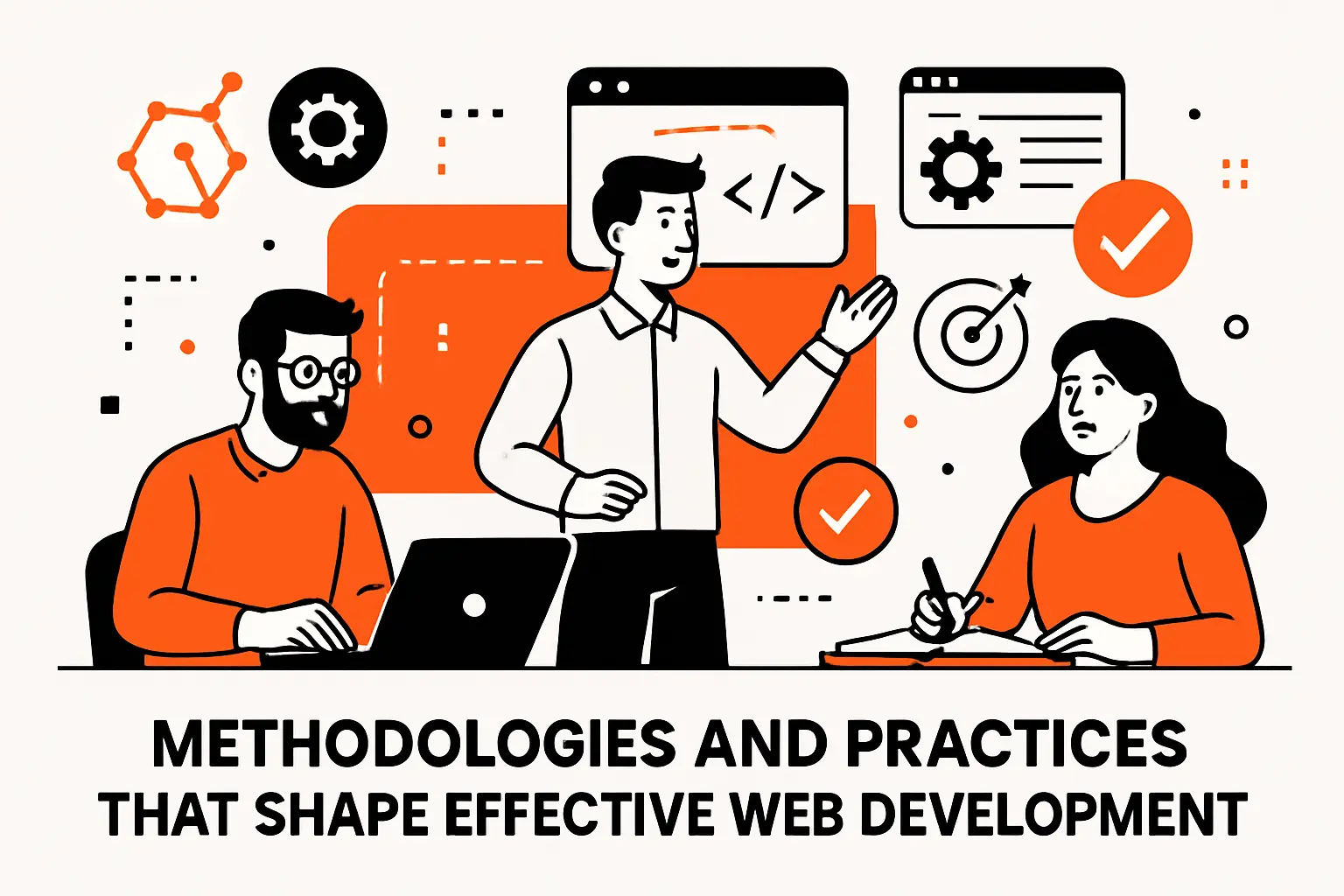
The market rewards teams that learn fast while managing risk: capital flows signal where experimentation is hottest—AI, developer tooling, and data; CBInsights reports that AI accounted for 37% of venture funding in 2024, and those dollars are already reshaping front‑end and back‑end ergonomics through smarter tooling and generated scaffolds. Methodologies give us ways to harness that energy without sacrificing reliability.
1. Traditional development methodologies used in web projects
Waterfall, stage‑gate, and the V‑model still work for projects with well‑understood requirements, firm regulatory constraints, or tightly coupled vendor dependencies. We’ll use them when the domain demands predictability above all else—think public sector portals with formal review milestones or sites that must coordinate with external certification cycles. The key is to avoid cargo‑culting: if the project’s true risk profile is in unknown user behavior or integration volatility, a linear plan will hide the danger until late in the game.
Traditional methods can coexist with iterative practices. We often hybridize: fixed milestones for compliance and security sign‑offs, with iterative delivery inside each milestone. We lay out unambiguous acceptance criteria and traceability matrices so auditors can see how requirements flowed into tests and deployments. Meanwhile, product and design keep running research sprints to ensure the features we’re certifying still solve the right problems.
Documentation is the underrated hero here. Decision logs, architecture diagrams grounded in a standard notation, and test evidence help these projects move without endless meetings. When everyone can see the system and its history, we spend less time reconciling memories and more time solving problems.
2. Agile principles and frameworks including iterative delivery, Scrum, and Kanban
Agile’s core promise—tight feedback loops—fits web work perfectly. We tune ways of working to the product. If discovery dominates, a Kanban‑first flow with explicit WIP limits keeps the team honest about capacity. If the product demands a predictable cadence of increments, we adopt Sprint rituals lightly, reserving the right to re‑shape ceremonies as data dictates. The point is not to cosplay a process but to shorten the path from idea to validated learning.
We prefer planning around outcomes and sliceable bets. That encourages vertical stories that deliver end‑to‑end value: schema, endpoint, component, UX validation. Pairing and mobbing help on ambiguous tasks; code reviews remain non‑negotiable for shared learning and safety. Feature flags separate release from deploy so we can expose functionality gradually, run A/B experiments cleanly, and recover quickly without rolling back infrastructure.
In our experience, the healthiest agile teams talk openly about trade‑offs. “Done” includes accessibility checks, performance budgets, telemetry, and basic security scans. If those are delayed, the debt is visible and scheduled, not swept under the rug. And product teams embrace “less, but better”: finishing fewer things with higher quality usually improves both user satisfaction and team morale.
3. Security practices integrated throughout the development process
Security is neither a gate at the end nor a plugin; it’s woven through habits and architecture. We begin with threat modeling that’s approachable for every role: enumerate assets, actors, and trust boundaries; imagine believable attacks; and agree on mitigations that fit the design. We embed secure defaults: strict content security policies, same‑site cookie settings, minimal scopes for tokens, and rate limits that blunt credential‑stuffing and scraping.
Supply chain vigilance is table stakes. We automate dependency checks, pin versions, and prefer minimal transitive trees over grabbing megabundles for small features. Where possible, we isolate risky dependencies behind facades so replacements are easier if a package becomes unmaintained or compromised. For CI pipelines, we keep secrets out of logs and artifacts, sign releases, and guard deploy keys like crown jewels.
Finally, we treat security as a user‑experience problem. Transparent consent, clear error messages, gentle recovery flows, and predictable session behavior make systems safer because users understand what’s happening. We partner with support teams to close the loop: the phishing email a support agent flags today may be the signal our training set needs to stop tomorrow’s campaign at the edge.
TechTide Solutions: custom web development built around your needs

Clients ask how we decide where to invest, and we point to macro signals that help prioritize platform bets; one of the clearest is that global tech spend is projected to reach $4.9 trillion in 2025, so organizations will keep funding the web foundations that actually convert attention into outcomes. Our approach blends careful discovery with architecture rigor and a delivery engine tuned for learning.
1. Discovery and requirements alignment to define goals and user needs
We start by aligning incentives and clarifying constraints. Stakeholder interviews surface competing definitions of success; user research grounds those ambitions in the reality of tasks and contexts. We run workshops to map value streams and identify where the site or app creates leverage—reducing support friction, accelerating lead qualification, enabling self‑service, or raising average order value. Then we decide what not to build; focus is the most undervalued asset in digital projects.
We capture outcomes in north‑star statements and diagnostic metrics the team can influence. Those metrics shape the roadmap, but they also shape the architecture. If freshness matters more than raw throughput, we invest in invalidation and near‑real‑time updates. If trust is paramount—say, in healthcare or finance—we invest early in consent UX, auditability, and clear explanations that meet users where they are.
Our proposals include trade‑study matrices and decision records. These artifacts aren’t bureaucracy; they are memory. When a new stakeholder arrives midstream, they can see why we chose a headless CMS over a tightly coupled template engine, or why we invested in an edge cache rather than hammering the origin. This transparency speeds onboarding and cuts re‑litigation of past decisions.
2. Architecture and technology stack selection tailored to project constraints
We build for change. That starts with modular domain boundaries and clean contracts, making it easier to swap databases, payment processors, or search engines as needs evolve. We pick stacks based on team strengths and operational realities. If the client’s team lives in the JavaScript ecosystem and values a unified mental model, we lean into that. If the domain demands strict typing or particular runtime guarantees, we choose accordingly. Architecture is not a virtue signal; it’s a portfolio of risks traded for benefits.
For content‑rich experiences, we like headless CMS setups paired with a design system. Editors get structured content with sane workflows; engineers get predictable models; and designers get components that behave. For transactional apps, we emphasize API discipline, data consistency, and observability. We keep secrets out of code and infrastructure, enforce least‑privilege at every layer, and bake in cost awareness so teams see the impact of architectural choices on the bill.
We’re pragmatic about new patterns. Server‑driven UI can simplify clients dramatically; islands architectures reduce hydration cost; edge functions bring logic closer to users. But we pilot and measure before committing broadly. Our bias is toward tools that make it easy to do the right thing and hard to do the wrong one.
3. Iterative development, testing, deployment, and ongoing support
Delivery rhythm matters. We cut vertical slices, test them in realistic environments, and release behind flags. That lets us learn with minimal blast radius and keeps stakeholders in the loop. We maintain a crisp definition of done—functionality, accessibility, performance, security, and observability—and we don’t pretend a feature is finished until those boxes are honestly checked or consciously deferred with a date to reconcile.
Post‑launch, we stay close to the product. Support agreements cover bug fixes, dependency updates, and security patches, but also experimentation and roadmap evolution. We operate a shared dashboard that product, marketing, and engineering all use, so everyone can see whether a new flow helped or hurt users. When we find friction, we fix root causes, not just symptoms: maybe a database query needs an index, but maybe the underlying model needs to better reflect the domain.
Our clients often ask for “advice beyond code,” and we’re happy to oblige. That might mean building the content playbook for an editorial team, training support agents on the nuances of new flows, or coaching internal developers on the architecture we’ve handed off. Sustainable success is collaborative.
Conclusion: what is web development in practice
Viewed from altitude, independent research houses consistently show rising internet engagement and durable investment in the digital core, and that reality makes the question “what is web development” a strategic one rather than a semantic exercise. In everyday terms, it’s the craft of translating organizational goals into dependable, respectful, and effective browser experiences that earn trust.
1. Bringing together people, process, and technology to deliver secure, performant, user‑centric web experiences
Successful web platforms emerge when engineers, designers, writers, analysts, and operators work as one team with a shared definition of success. We’ve seen teams hit their stride when they regard accessibility as a product advantage, treat performance as a feature, and keep security visible in design, not hidden in a separate checklist. The technologies will keep changing; the human habits that produce reliable outcomes are evergreen.
2. Choosing appropriate roles, stacks, and methodologies to fit project goals
No single stack or process wins universally. Some products benefit from tightly scoped teams and opinionated frameworks; others from thin clients over robust domain services. The trick is to start from business outcomes and user jobs, then let those drive choices about roles, contracts, and cadence. When role clarity, API discipline, and design systems line up, autonomy grows without fragmentation. That’s where velocity and quality reinforce each other.
3. Following a clear life cycle with continuous improvement after launch
Shipping is the start of learning. The healthiest teams watch what users actually do, fold that insight back into design and code, and keep a steady cadence of small improvements. That rhythm builds resilience and momentum. If you’re wondering what next step would create the most leverage for your web platform, we’d suggest a conversation to align on outcomes and identify the smallest, sharpest experiment that can deliver proof—shall we map that first slice together?