

At TechTide Solutions, we’ve learned that “software architecture” is one of those terms that can mean everything and nothing—until a system starts to creak under real load, real change, and real organizational pressure. Under calm conditions, teams can ship features with almost any structure. Under stress—new compliance rules, a sudden spike in traffic, an acquisition, a rewrite mandate—architecture is what determines whether progress feels like steering a ship or dragging an anchor.
Instead of treating architecture as a document, a diagram, or a job title, we treat it as a way to reason. Good architecture makes the system explainable, adaptable, and governable by people who weren’t in the room when the first commit landed. Bad architecture, by contrast, turns every change into an excavation.
What is software architecture: structures needed to reason about a system
In the sections below, we’ll define software architecture in practical terms, show why it matters to businesses, and share the structures and patterns we rely on when we design and modernize systems for long-term viability.

1. Architecture as a set of structures: elements, relationships, and properties
In our day-to-day work, architecture starts with structures—because structures are how we make a complex system thinkable. A system is not “the codebase”; it’s the elements inside it (modules, services, databases, queues), the relationships between them (calls, events, reads/writes), and the properties those relationships imply (latency, coupling, trust boundaries). Without those structures, we’re stuck debating opinions instead of testing constraints.
Practically speaking, we want to answer questions like: which parts can change independently, which parts must be deployed together, and which parts share failure modes. From that angle, an architecture diagram is not “documentation for management”; it’s a map for engineering decision-making. When a team can point to the map and say, “this dependency shouldn’t exist,” we know the architecture is doing its job.
What We Mean by “Structure” in Real Projects
Structurally, we separate concerns that change for different reasons: business rules, data access, integration edges, and operational scaffolding. That separation is not academic; it’s how we keep payment logic from being tangled with logging, or customer identity rules from being scattered across unrelated controllers. Over time, those boundaries become the difference between a safe refactor and a risky rewrite.
2. Architecture as costly, high-impact decisions and the rationale behind them
Architecture also lives in decisions—especially the costly ones we can’t easily undo. Choosing a monolith versus distributed services, deciding how identity propagates, picking a data ownership model, or adopting asynchronous messaging are not cosmetic choices. Once shipped, those decisions shape hiring, incident response, velocity, and even vendor contracts.
Equally important, we don’t treat decisions as “because the architect said so.” Rationale matters because context changes. When new constraints appear—privacy requirements, a new region, a merger—teams need to know why a decision was made so they can judge whether the assumptions still hold. Absent that rationale, engineers tend to cargo-cult the past: repeating decisions that no longer fit, simply because they are already in the system.
Trade-Off Thinking Beats “Best Practices”
In our experience, the most expensive failures come from unexamined trade-offs. A team might chase “clean architecture” while ignoring operational reality, or adopt microservices to “scale” when their true pain is poor modularity and unclear ownership. Architecture becomes durable when the decision log explains what we optimized for and what we intentionally accepted as a cost.
3. Architecture as the important stuff: focusing effort on what must stay coherent
Some parts of a system matter more than others, and architecture is how we choose where coherence is non-negotiable. Error handling, data consistency boundaries, security controls, and integration seams are rarely glamorous, yet they determine whether the system behaves predictably. By contrast, many implementation details can vary widely without threatening long-term health.
So we focus architectural attention on the “must not drift” parts: domain invariants, shared platform contracts, critical data flows, and operational guardrails. A team can experiment freely inside a module, but cross-module behavior has to stay coherent. When we see constant breakage at the seams, we treat it as an architectural smell—not merely a testing issue.
Why software architecture matters: building for change, speed, and long-term quality

1. Reducing internal cruft so new features arrive faster with fewer defects
Market overview: Gartner expects worldwide IT spending to total $6.08 trillion in 2026, and we read that as a signal that software-driven competition will keep intensifying inside nearly every industry. Under that pressure, the winners are rarely the teams who write the cleverest code; they’re the teams who can change direction quickly without breaking production.
Internal cruft—duplicate concepts, unclear boundaries, “temporary” workarounds—acts like friction. Over months, that friction shows up as longer lead times, brittle releases, and an engineering culture that becomes afraid to touch core areas. Architecture matters because it is the discipline of removing unnecessary coupling so features can land with less collateral damage.
What “Cruft” Looks Like in Production Systems
Operationally, cruft often shows up as spooky action at a distance: a pricing change breaks onboarding, or a logging tweak spikes database load. Those problems happen when responsibilities are smeared across the codebase, and when shared resources are used without clear ownership rules. Architecture creates the expectation that every dependency must earn its keep.
2. Organizing code so change stays safe and existing behavior keeps working
Safety is not just about tests, although tests help. Structurally, safety comes from isolating change so teams can reason about impact. When a bounded component owns its data and its behavior, the blast radius of a change becomes smaller and more predictable.
From a business perspective, safe change is a compounding advantage. Faster iteration means faster learning, and faster learning means better product-market fit. Conversely, when every change risks an outage, the organization starts treating improvements as dangerous, and technical debt becomes policy rather than accident.
Change Safety Is a Design Property
Modularity, explicit contracts, and dependency direction are the levers we reach for first. If a system requires engineers to memorize hidden interactions, it will fail the “new teammate test.” Architecture keeps the system legible enough that correctness does not depend on folklore.
3. Enabling early analysis, reuse, communication, and risk management
Before a team builds, architecture gives us a way to analyze risk early—without pretending we can predict everything. Latency budgets, data integrity boundaries, and security zones can be validated at the design level, long before the system is large enough to be painful to change.
Communication is another practical benefit: a shared architectural vocabulary reduces misunderstanding between product, engineering, security, and operations. Reuse becomes possible when teams standardize how they solve recurring problems, such as authentication, observability, or background processing. In mature organizations, architecture is less about control and more about accelerating alignment.
Key concepts: components, connectors, and system boundaries
1. Macroscopic system structure: components plus connectors that define interaction
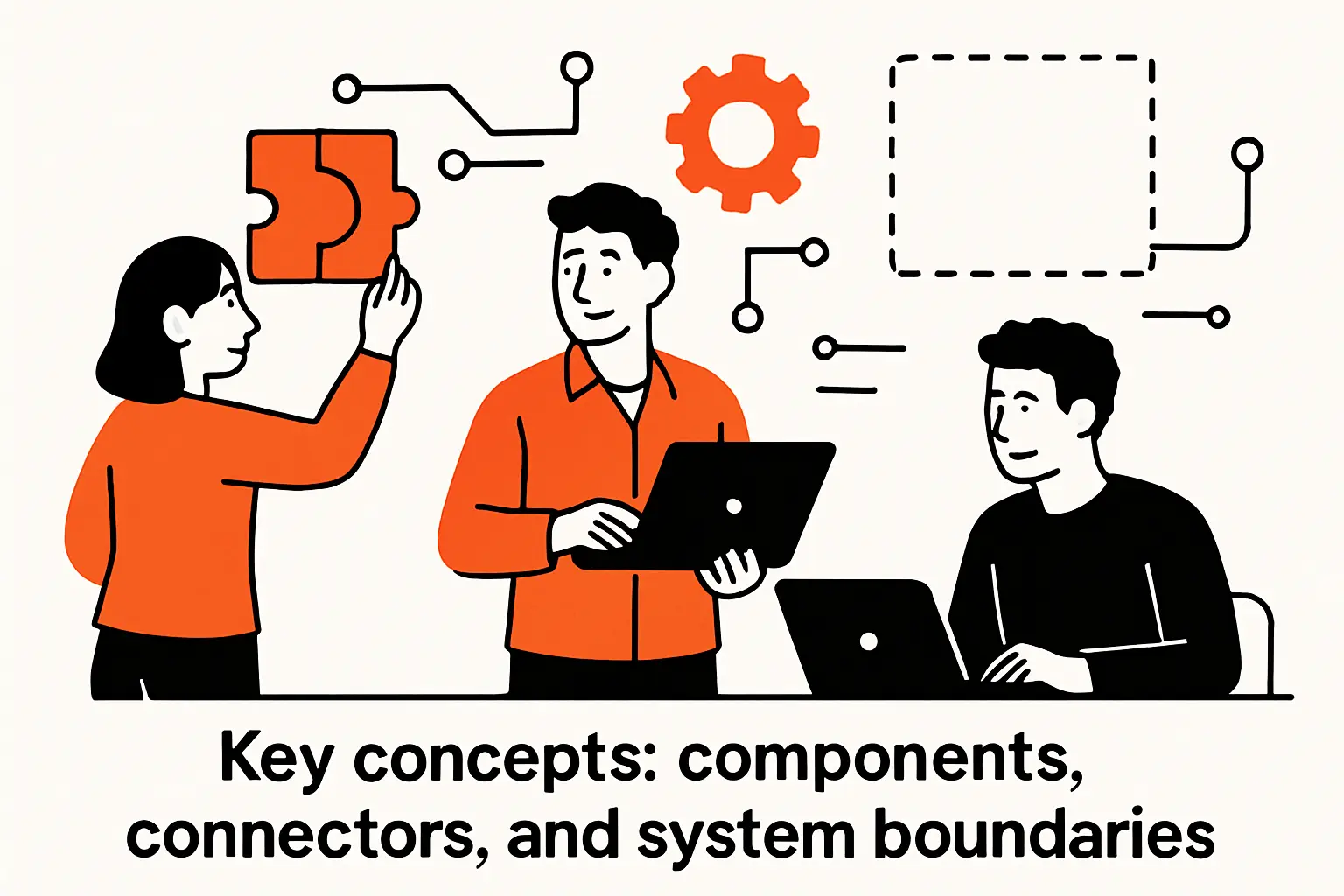
When we step back and look at a system from thirty thousand feet, the essential picture is components and connectors. Components are the “things” that do work: a billing service, a mobile app, a data pipeline, a machine learning inference endpoint, or even a shared library. Connectors are how those components interact: calls, messages, file drops, streams, shared databases, and human workflows.
Architecturally, connectors are often more dangerous than components. A service can be well-designed internally and still create chaos if the interaction style is ambiguous, inconsistent, or ungoverned. That’s why we treat connector design as first-class: we specify contract shapes, error semantics, timeouts, retry behavior, idempotency expectations, and observability hooks.
A Connector Is Also a Promise
Every integration is a promise about stability. If a connector is “whatever JSON we send today,” it will degrade into a negotiation every sprint. If a connector is a versioned, well-owned contract, teams can innovate internally without forcing synchronized releases across the organization.
2. Defining application boundaries: what counts as one system vs many systems
Boundary definition sounds philosophical until it hits a backlog. “Is this feature part of the existing system, or is it a new service?” becomes “who owns the data,” “who is on call,” “who approves changes,” and “how do we deploy safely.” For us, boundaries are an organizational tool as much as a technical one.
In practical engagements, we often start by identifying domains and capability areas: identity, catalog, checkout, content moderation, analytics, and so on. From there, we ask which capabilities must evolve independently, and which must remain tightly coordinated. A boundary that aligns with team ownership tends to survive; a boundary that exists only on a diagram tends to erode.
Where Boundaries Commonly Go Wrong
Shared databases are a frequent boundary killer. When multiple components mutate the same tables, the database becomes the real integration surface, and contracts become implicit. For that reason, we prefer boundaries that are enforceable: explicit APIs, event streams, or carefully governed shared schemas with clear stewardship.
3. Integration and communication choices: APIs, events, protocols, and data flows
Integration is where architecture becomes tangible. Synchronous APIs make request flows easy to understand, but they can couple availability and latency between services. Event-driven flows reduce direct coupling and enable better decoupling of business processes, yet they introduce complexity in ordering, deduplication, and eventual consistency.
Because of that trade-off, we avoid one-size-fits-all prescriptions. For user-facing interactions, synchronous calls can keep experiences predictable. For cross-domain workflows—order fulfillment, notifications, analytics ingestion—events are often a better fit. Either way, we insist on being explicit about data flows: what data is transmitted, what data is derived, and where the system’s source of truth lives.
Data Flow Clarity Prevents “Integration Spaghetti”
Whenever teams can’t answer “where does this value come from,” defects multiply. Architectural clarity is the habit of making those answers easy: diagrams, contracts, and naming conventions that match the business language. Once that foundation exists, integrations stop being magical and start being testable.
Architectural characteristics and non-functional requirements that drive design
1. Operational qualities: availability, performance, reliability, fault tolerance, scalability
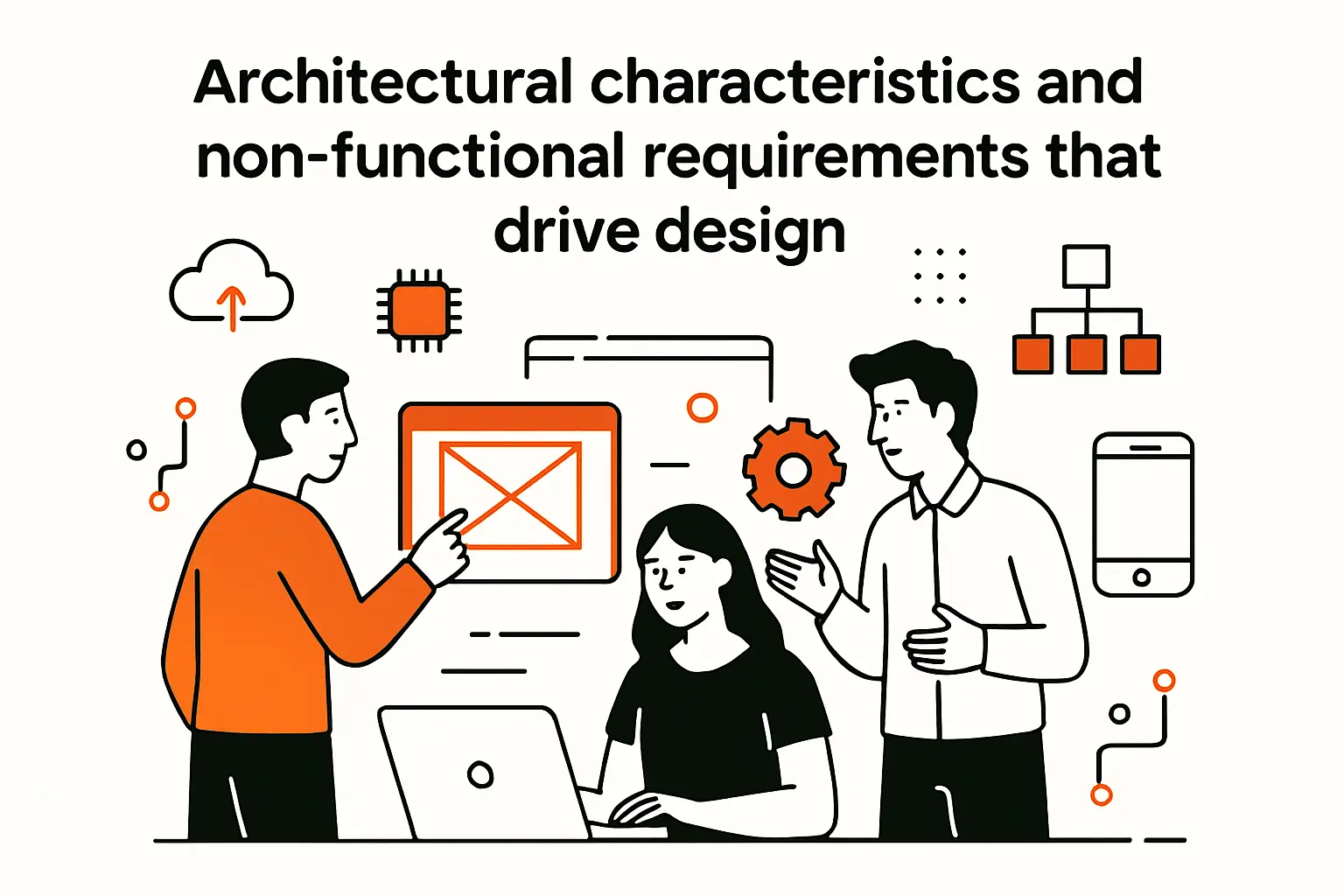
Businesses rarely buy “architecture”; they buy outcomes like uptime, responsiveness, and resilience. Those outcomes map to architectural qualities: availability (can we serve requests), performance (how fast), reliability (how correctly), fault tolerance (what happens when dependencies fail), and scalability (how behavior changes with load).
In our view, operational qualities must be designed, not hoped for. Timeouts, retries, bulkheads, circuit breakers, backpressure, and load shedding are architectural behaviors that influence how systems fail. A system that fails gracefully can still deliver value during incidents, while a system that fails catastrophically turns every dependency glitch into customer-visible downtime.
Resilience Is a Product Feature
Customer trust is earned during the worst moments, not the best ones. When a checkout flow offers a clear recovery path during partial outages, businesses keep revenue and reputations intact. Architecture is where those recovery paths are decided and encoded.
2. Cross-cutting concerns: security, privacy, usability, accessibility, feasibility
Cross-cutting concerns are the rules that apply everywhere, which is precisely why they are hard. Security is not a single feature; it’s identity boundaries, authorization logic, secret management, auditability, supply chain hygiene, and incident response readiness. Privacy is not a banner in the footer; it’s data minimization, retention strategy, consent enforcement, and access controls that match real operational workflows.
Usability and accessibility also have architectural implications. If an application cannot respond quickly or behave consistently, no amount of interface polish will save it. Feasibility is the final cross-cut: a design that assumes infinite time or infinite expertise is not architecture; it’s wishful thinking.
Security Architecture Is About Trust Boundaries
We look for where trust changes: browser to backend, backend to third party, service to database, engineer to production. Once trust boundaries are explicit, defenses can be layered appropriately. Without that map, teams tend to over-secure unimportant paths while under-securing critical ones.
3. Aligning architectural characteristics with business requirements and context changes
Architecture is a negotiation between what the business needs and what the system can sustainably deliver. A startup validating demand might prioritize speed of learning and accept some operational risk. An enterprise handling sensitive data might prioritize auditability and controlled change, even if that slows experimentation.
Context changes are where alignment gets tested. New regulations, new partners, new regions, or new pricing models can shift the architectural center of gravity. Our approach is to treat quality attributes as living constraints: revisited periodically, revalidated through incidents and delivery metrics, and refined when the business evolves.
Fitness to Context Beats Purity
Architectural purity is seductive, yet it can be a trap. A design that ignores organizational realities will erode until it becomes something else—usually in the worst possible way, through emergency changes. Alignment is the discipline of designing for the system and the people who run it.
Architecture activities across the lifecycle: analysis, synthesis, evaluation, evolution

1. Iterative core activities from initial design through ongoing system evolution
Architecture is not a phase we complete; it’s a cycle we keep running. Analysis clarifies constraints and quality attributes. Synthesis proposes structures and interaction styles. Evaluation tests those proposals against scenarios: scale events, dependency failures, compliance audits, and delivery cadence expectations.
Evolution is where the architecture proves its worth. As requirements shift, we adjust boundaries, refine contracts, and sometimes reverse earlier decisions. Rather than treating change as architectural failure, we treat change as the whole point: the system exists to respond to reality, not to preserve a diagram.
Scenario Thinking Keeps Us Honest
We like scenario-based evaluation because it avoids theoretical debates. If the system must support a high-volume import, we walk the path end to end. If a dependency fails, we simulate the failure and decide what behavior is acceptable. Architecture becomes practical when it is tested against concrete stories.
2. Balancing stakeholders through separation of concerns and architectural views
Different stakeholders need different views of the same system. Product leaders care about user journeys and business capabilities. Security teams care about threat models and trust boundaries. Operations teams care about deployment topology, incident response, and observability. Engineers care about code structure and dependency direction.
Separation of concerns is how we satisfy those needs without producing a single overloaded diagram that satisfies nobody. For that reason, we maintain multiple architectural views—each with a clear audience and purpose. A deployment view should not pretend to be a domain model, and a domain model should not pretend to be an infrastructure plan.
Communication Is a Technical Skill
When architecture is communicated poorly, teams implement different interpretations, and the system becomes incoherent. Clear views reduce rework, speed onboarding, and help non-engineering stakeholders make better trade-offs. In our experience, good architecture is inseparable from good storytelling.
3. Handling uncertainty by right-sizing components and refining structure over time
Uncertainty is unavoidable, so architecture must absorb it. Overly large components become dumping grounds, while overly small components create coordination overhead. The sweet spot depends on team maturity, operational tooling, and the cost of cross-component change.
Right-sizing is a continuous practice. Early on, we often prefer simpler shapes with strong modular boundaries and explicit seams for future extraction. As the system learns what it is—where load concentrates, where complexity lives, where teams step on each other—those seams can become service boundaries or platform interfaces. That approach avoids premature distribution while still planning for growth.
Designing for Extraction Without Forcing It
We look for “natural fault lines” in the domain: areas that have independent lifecycles and independent scaling needs. Once those lines are visible, extraction becomes a controlled project rather than a panicked rewrite. The guiding principle is reversible change whenever possible.
Documenting and governing architecture decisions
1. Architecture Decision Records: capturing context, trade-offs, and why decisions were made
We rely heavily on Architecture Decision Records because they keep the why close to the what. A decision record does not need to be long; it needs to be crisp about context, options considered, trade-offs, and consequences. When written well, it becomes a time machine for future maintainers.
Decision records also make disagreement healthier. Instead of debating opinions repeatedly, teams can revisit an existing decision and ask, “has the context changed?” That question is easier to answer than “who is right?” Over time, ADRs build an institutional memory that survives team changes and reorganizations.
What We Capture in a Strong Decision Record
- Context: what problem triggered the decision and what constraints are in play.
- Options: plausible alternatives, including the “do nothing” path.
- Consequences: what gets easier, what gets harder, and what new risks we accept.
2. Documentation views: static structure, runtime behavior, and deployment mapping
Architecture documentation becomes useful when it answers questions quickly. Static structure views show modules, services, ownership boundaries, and dependency direction. Runtime views show request paths, asynchronous flows, and failure behavior. Deployment views show where the system runs, how it scales, and where operational responsibility lives.
In our engagements, we keep documentation lightweight but living. Diagrams that are never updated become harmful, because they create false confidence. By contrast, diagrams that are embedded into delivery—reviewed in design discussions, updated during refactors, validated during incident postmortems—become a shared reality rather than a museum exhibit.
Documentation Must Match How Teams Work
If documentation requires heroics, it will decay. We prefer formats that are easy to update alongside code: simple diagram sources stored in the repository, short narrative readmes, and decision logs that tie directly to pull requests. Governance becomes easier when evidence is part of the workflow.
3. Preventing architectural drift: continuous checks, feedback, and erosion awareness
Architectural drift happens when the implemented system slowly diverges from intended constraints. Sometimes drift is healthy adaptation. Other times it is unintentional erosion: new dependencies creep in, shortcut integrations bypass contracts, and shared utilities become de facto frameworks.
Prevention is not a single gate; it’s a set of continuous checks. Code review patterns can enforce dependency direction. Automated tests can protect contract expectations. Observability can reveal unexpected coupling when one change causes performance regressions elsewhere. Most importantly, teams need a feedback culture where architectural concerns are treated as delivery concerns, not as “nice to have” cleanup.
Erosion Usually Starts with a “Quick Fix”
Under deadline pressure, teams reach for the nearest lever. Architecture stays healthy when the system offers safe levers by default—clear extension points, reliable integration mechanisms, and guardrails that make the right path the easy path. Governance is simply what keeps those levers trustworthy.
Styles vs patterns: selecting an architecture approach
1. Software architecture style vs software architecture pattern and how they differ
We draw a practical distinction between styles and patterns. A style is a system-wide organizing principle, such as layered design, microservices, or event-driven architecture. A pattern is a reusable solution to a recurring problem, such as a circuit breaker, saga-style orchestration, or a facade.
Confusion between the two leads to brittle decisions. Teams sometimes adopt a style because they liked a pattern they saw at another company, or they adopt a pattern because they think it will substitute for an overall style. In our experience, styles shape the large-scale topology, while patterns handle local problems within that topology.
Selection Starts with Constraints, Not Fashion
Different businesses face different constraints: team skill profiles, compliance regimes, operational maturity, and release requirements. Architecture becomes credible when it begins with those constraints and ends with a design that makes them manageable. Trend-chasing, by contrast, usually creates a system that is complex in the wrong places.
2. Layered architecture: horizontal layers, responsibilities, constraints, and tiers
Layered architecture remains popular because it teaches discipline. Presentation, application orchestration, domain logic, and infrastructure concerns can be separated so that changes flow in predictable directions. When implemented with care, layering makes it easier to test business rules, swap infrastructure components, and onboard new engineers.
At the same time, layers can become a performance and complexity trap if they encourage anemic domain models or encourage every request to traverse too many hops. For that reason, we treat layering as a constraint system: dependencies should point inward toward stable business concepts, and outer layers should adapt to change without forcing domain logic to contort.
Tiers Are Not the Same as Layers
We often see confusion between logical layering and physical deployment. A system can be layered within a single deployable unit, and it can also be layered across services. Keeping those concepts distinct prevents accidental coupling and avoids the assumption that “more tiers” automatically means “better architecture.”
3. Distributed approaches: microservices and event-driven architecture benefits and trade-offs
Microservices and event-driven architecture can be powerful when the organization needs independent deployability, clear ownership, and targeted scaling. Companies like Netflix and Uber have demonstrated that distributed systems can accelerate autonomous teams—when supported by strong platform capabilities, disciplined contracts, and mature operational practices.
Distribution also raises the floor for success. Observability must be consistent. Failure handling must be intentional. Data consistency becomes a design choice rather than an implicit property. When teams adopt microservices without investing in those foundations, they often get the worst of both worlds: the complexity of distribution with the coupling of a monolith.
Event-Driven Systems Demand Semantic Precision
Events are not just “messages”; they are business facts. A well-designed event stream uses stable naming, clear meaning, and explicit ownership. When events are vague or overloaded, downstream systems become tightly coupled to upstream implementation details, and change becomes dangerous again.
TechTide Solutions: turning software architecture into custom-built solutions

1. Translating business goals and quality attributes into clear architecture decisions
At TechTide Solutions, we start architecture by translating business goals into quality attributes we can design for. If a business wants faster partnerships, we look for integration flexibility and contract stability. If a business wants higher customer trust, we look for resilience and security boundaries. And if a business wants faster product iteration, we look for modularity and independent delivery lanes.
From there, we make explicit decisions rather than drifting into them. Boundaries, data ownership, integration style, and deployment strategy become choices with stated trade-offs. That clarity is what allows stakeholders to disagree productively and still move forward with confidence.
How We Turn Goals Into Engineering Constraints
Instead of asking teams to “build it scalable,” we define what scalability means in context: where load concentrates, how we measure performance, and how we respond when the system is stressed. Instead of saying “make it secure,” we define trust boundaries and enforce authorization paths. Those constraints become the backbone of the design.
2. Designing and building custom web and mobile applications with scalable architectures
Custom web and mobile products live at the intersection of user experience, backend reliability, and third-party ecosystems. For that reason, we design frontends and backends together, with explicit contracts and shared error semantics. Mobile clients, in particular, benefit from APIs that are consistent, cache-aware, and designed for partial connectivity.
On the backend, we aim for architectures that can grow without rewriting the core every quarter. Modular domain boundaries, clear service seams, and stable integration patterns help teams add features without re-litigating the fundamentals. Over time, that stability becomes the foundation for experimentation: new flows, new payment options, new analytics strategies, and new operational capabilities.
Scalability Is Also a Team Property
Technical scalability matters, yet organizational scalability is just as critical. When teams can work in parallel without stepping on each other, delivery speeds up and quality improves. Our architectural choices aim to make that parallelism safe: bounded responsibilities, well-defined contracts, and predictable deployment practices.
3. Modernizing legacy systems and reducing architectural drift as requirements evolve
Legacy modernization is rarely a single project; it’s a sequence of controlled changes. In the field, we often see systems where the original design made sense, but years of changing requirements created layered complexity. Untangling that complexity requires respecting what still works while replacing what no longer fits.
Our modernization approach favors incremental improvements: strangling risky modules behind stable interfaces, extracting capabilities where ownership is unclear, and introducing governance that prevents drift from returning. Architecture becomes the strategy that lets modernization deliver value early, rather than asking the business to wait for an all-or-nothing rewrite.
Why Modernization Is Also a Risk Strategy
CISQ estimates the cost of poor software quality in the United States has grown to $2.41 trillion, and we interpret that as more than an industry statistic—it’s a warning about what happens when systems become too hard to change safely. Modernization reduces risk by shrinking the unknowns: fewer hidden dependencies, clearer data ownership, and stronger operational controls.
Conclusion: how to apply software architecture principles in real projects

1. Start with the key quality attributes, then make and validate the trade-offs
Projects succeed when teams begin with the qualities that actually matter: responsiveness, resilience, security, maintainability, and delivery speed. Once those qualities are explicit, architecture becomes a series of trade-offs rather than an argument about taste. Validation then becomes practical: run scenarios, simulate failures, and review designs against real operational constraints.
Importantly, we avoid treating early architecture as permanent truth. Instead, we treat it as a hypothesis that must survive contact with production. When reality proves a hypothesis wrong, we adjust quickly and document what we learned.
2. Select styles and patterns that fit team boundaries, delivery needs, and operational realities
Architecture styles and patterns should match the organization’s shape. If a team lacks strong operational tooling, heavy distribution can create fragile systems. If multiple teams need autonomy, a carefully governed service boundary can reduce coordination overhead. When delivery speed is a priority, modularity and contract clarity often beat elaborate frameworks.
In our practice, the best style is the one that makes the next year of change easier. Patterns then fill in the gaps: resilience patterns for stability, integration patterns for consistency, and governance patterns for long-term coherence.
3. Document decisions, revisit them as the system changes, and keep the architecture healthy
Healthy architecture is maintained, not installed. Decision records, living diagrams, and automated guardrails keep intent aligned with implementation. Regular reviews—especially after incidents and major feature pushes—help teams notice drift before it becomes institutionalized.
So here’s our next-step suggestion: pick one critical workflow in your system, map its components and connectors, and write down the decisions that workflow depends on. Which constraints are explicit, and which ones are currently folklore—and what would happen if a new engineer had to change that workflow next week?