
At Techtide Solutions, we tend to explain IPTV the way we explain any durable piece of infrastructure: not as a buzzword, but as a chain of engineering decisions that shape business outcomes. When television moves onto IP networks, the “TV experience” stops being a closed appliance and starts behaving like software—observable, optimizable, personalizable, and, yes, breakable in new ways.
Across the media landscape, the gravity pulling video toward IP is hard to ignore. Statista projects worldwide media revenues reaching US$1.71tn in 2025, and PwC describes an entertainment-and-media industry on track to a US$3.5 trillion market by 2029, which frames why telecoms, broadcasters, and streamers keep rebuilding distribution around networks and apps rather than around a single physical pipe.
Real deployments also make the story concrete. AT&T’s U-verse, Deutsche Telekom’s MagentaTV, and many fiber providers’ “TV” products are fundamentally IPTV in practice: live linear channels delivered over IP, plus on-demand libraries, plus cloud-like controls that feel more like a platform than a channel lineup. From our vantage point, IPTV matters less because it is “new TV” and more because it is “programmable TV,” where the hard work shifts from installing coax to shipping reliable software, resilient network design, and secure content workflows.
Below, we walk through IPTV the way we build and evaluate systems: what it delivers, how it differs from cable and OTT, what happens from content source to playback, and which architectural choices decide whether users see crisp video or a spinning buffer icon.
What is IPTV and what it delivers?
1. Internet Protocol Television meaning and the role of IP based delivery
IPTV, in plain terms, is television delivered using Internet Protocol packets rather than broadcast radio-frequency channels. Instead of treating video like a one-way “signal” pushed to every household, IPTV treats video like a managed network service, with streams addressed, routed, authenticated, and measured as IP traffic.
Operationally, that IP framing changes everything. A channel becomes a stream that can be started, stopped, encrypted, moved closer to the user, or switched to a different bitrate profile based on conditions. Security becomes software-defined through conditional access and digital rights management rather than purely hardware-defined through a legacy cable box ecosystem.
From a product perspective, IP delivery also makes television composable. Recommendations, profiles, accessibility options, and device handoff stop being “nice-to-have UI flourishes” and become first-class platform features with telemetry and iteration cycles. In our work, that shift is where IPTV stops being a transport choice and becomes a business model choice.
2. Live channels, on demand video, and time shifted programming
Most IPTV services deliver three families of experiences: live linear channels, on-demand catalogs, and time-shifted playback. Live channels mimic traditional TV, but the stream is typically IP multicast or tightly managed unicast inside an operator network. On-demand behaves more like modern streaming: the user requests a title, the platform authorizes it, and the service returns a stream optimized for that device and connection.
Time-shifted programming sits between those worlds. Cloud DVR, catch-up TV, “restart from beginning,” and network-based recording are fundamentally about storing or referencing content windows, then serving them back as on-demand assets with the proper rights checks.
For viewers, the difference feels like convenience. For operators, the difference is architectural: live tends to be network-efficiency driven, while on-demand and time-shift lean on storage, caching, concurrency planning, and rights enforcement. When we design systems, we treat these as distinct workloads that happen to share the same brand name on the home screen.
3. How IPTV is commonly offered through internet service providers on managed networks
Many “classic” IPTV offerings come from internet service providers because they can run video on a managed access network. That managed model lets the provider prioritize IPTV traffic, engineer predictable last-mile behavior, and control the customer premises equipment from router to set-top box.
In a managed IPTV network, quality-of-service and admission control can be real levers rather than wishful thinking. Multicast for live TV can reduce duplicated streams across neighborhoods, and the operator can measure packet loss and jitter end-to-end with enough precision to know whether the issue lives in the home Wi‑Fi, the access loop, or the video headend.
Businesswise, bundling is the obvious motivation, but reliability is the quiet superpower. A managed IPTV product can feel “cable-like” in stability while still behaving like software in the UI and feature set, which is a combination many households implicitly want even if they never use the phrase “managed network.”
What is IPTV compared with cable satellite and OTT streaming
1. Delivery methods compared: coaxial cable RF, satellite signals, and internet protocol networks
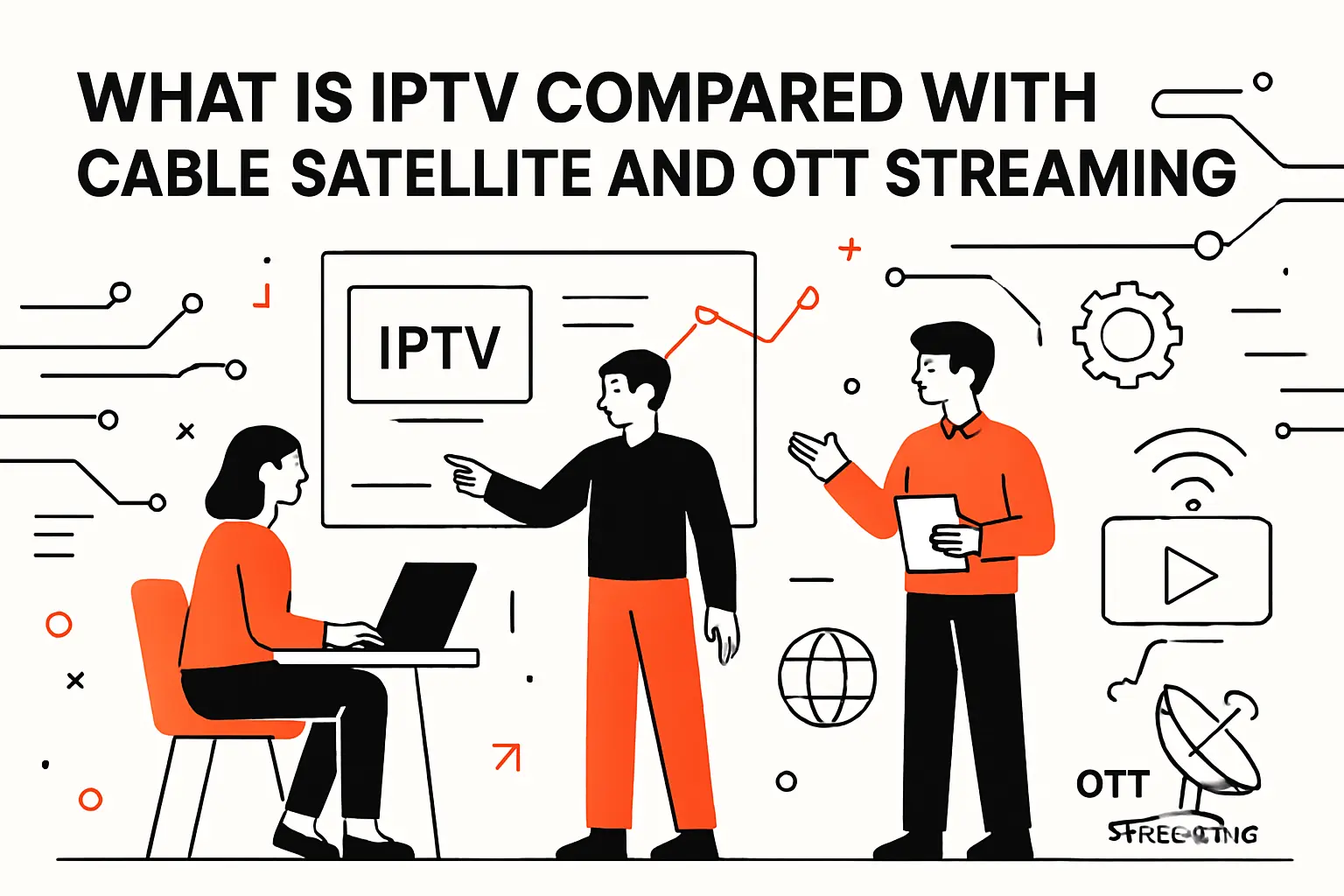
Traditional cable TV is largely built around RF channels riding over coaxial infrastructure. In that model, the network is broadcasting many channels simultaneously, and the viewer’s device tunes to one. Satellite, similarly, is a broadcast medium: a dish receives a multiplex of channels, and the set-top box selects and decrypts what the subscriber is entitled to watch.
IPTV flips the core assumption. Rather than broadcasting everything everywhere, the network delivers what the user asks for, when they ask for it, subject to entitlements. That can be unicast (one stream per household or device) or multicast (one stream shared across many homes), but either way the system is packet-based and addressable.
From an engineering standpoint, the key distinction is control. RF and satellite are optimized around spectrum and broadcast efficiency; IP systems are optimized around routing, switching, caching, and software-defined policy. When we evaluate a migration path, we look at where the organization wants its complexity to live: in physical plant and spectrum planning, or in platforms, observability, and software operations.
2. Managed IPTV networks vs OTT services on the public internet
IPTV is often confused with OTT because both can arrive “through the internet” from a user’s point of view. The difference is that IPTV commonly runs on a managed operator network, while OTT runs over the open internet, traversing many networks the service provider does not control.
That single distinction drives divergent design choices. Managed IPTV can rely on multicast, network-level QoS, and tightly controlled device certification. OTT generally leans on adaptive bitrate streaming over HTTP, CDNs, and probabilistic reliability: it is designed to survive unpredictable paths, shifting congestion, and device diversity at global scale.
In our projects, we treat IPTV and OTT as siblings, not twins. Both use IP, both can share encoding pipelines and DRM concepts, and both can reuse app code. Still, their delivery assumptions are different enough that copying an OTT approach into a managed IPTV network can waste capacity, while copying a managed-network assumption into OTT can cause brittle user experiences.
3. Reliability tradeoffs including weather impact, network congestion, and household bandwidth sharing
Reliability is where the differences become visceral. Satellite can degrade with severe weather or dish alignment problems, while cable can suffer from local plant issues, ingress noise, or neighborhood node congestion. IPTV adds its own failure modes: packet loss, jitter, buffer underruns, and home Wi‑Fi interference can turn into visible artifacts quickly.
Household bandwidth sharing is also a uniquely modern stressor. A single home network may be doing video calls, cloud backups, large game downloads, and multiple concurrent streams, and the router becomes an invisible referee. When the home uplink saturates or Wi‑Fi retransmissions spike, IPTV can suffer even if the ISP backbone is healthy.
One more layer sits above the physics: operational maturity. A provider with strong telemetry, proactive monitoring, and disciplined incident response can make IPTV feel boring—in the best way. Without that discipline, the same underlying technology becomes “flaky streaming TV,” and the market rarely forgives flakiness for long.
How IPTV works from content source to playback
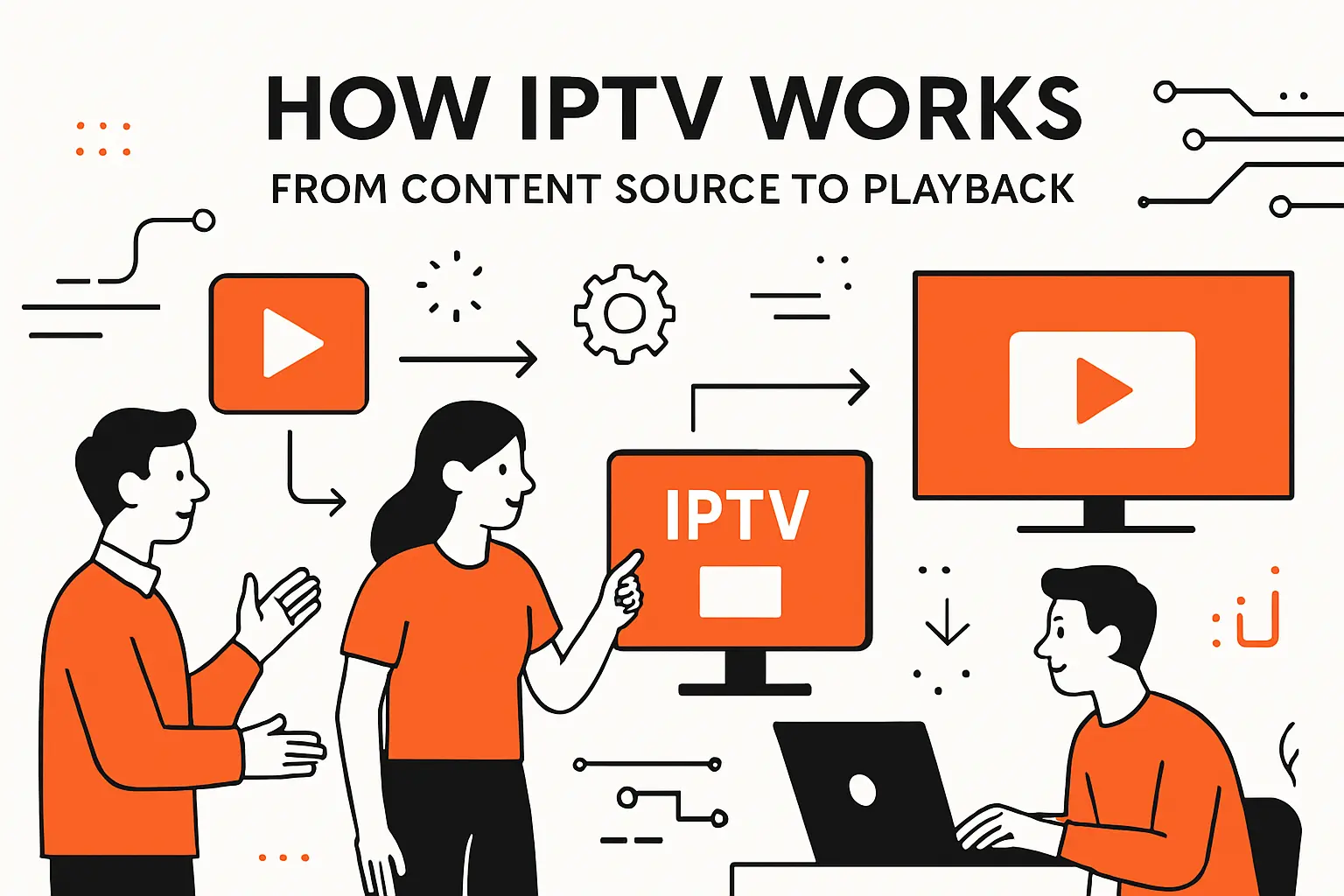
1. Content acquisition, licensing, encoding, encryption, and storage
Every IPTV stream starts with content acquisition and licensing. Rights determine where content can be shown, on which devices, at what times, and under what business rules (subscription, transactional, ad-supported, or hybrid). In practice, rights metadata is not paperwork—it is executable policy that must be enforced at playback time.
Once content is authorized for distribution, it moves through encoding and packaging. The platform typically creates multiple renditions so playback can adapt to device capability and network conditions. Encryption is applied, keys are managed, and a DRM or conditional access system is configured so only entitled users can decrypt the content.
Storage is the final foundation. Live channels may be transient, but catch-up and on-demand libraries rely on origin storage, replication, and lifecycle rules. From our perspective, the make-or-break factor is consistency: if metadata, entitlement logic, and asset availability drift out of sync, customer support costs surge and churn risk follows close behind.
2. Server infrastructure that streams video as packets to a user IP address
After assets are prepared, the streaming infrastructure takes over. A typical system includes origin servers, packagers, session managers, DRM license servers, and edge caches (whether operator-owned or CDN-provided). The user’s device requests content, the platform authenticates the session, and the stream is delivered as IP packets along a path the network can sustain.
For live IPTV on managed networks, multicast can be used so many subscribers share the same stream, reducing duplicated traffic. For on-demand, unicast is common because each user may be at a different point in playback, pausing, resuming, or seeking independently.
Capacity planning becomes a daily discipline. Popular live events create concurrency spikes, while binge-worthy episodic releases create sustained demand. Our rule of thumb is to treat “streaming” less like serving files and more like running a real-time distributed system, where tail latency, cache hit ratio, and failure domains shape user perception more than raw bandwidth alone.
3. Set top box or app decoding, reassembly, and playback on the chosen device
On the customer side, the device receives packets, reassembles them into a continuous media stream, decrypts the content, decodes audio/video, and renders it with synchronized timing. That sounds linear, yet each stage hides tricky edge cases: missing packets, clock drift, key rotation, caption timing, and audio format mismatches can all break “simple playback.”
Apps and set-top boxes also manage buffers. A buffer is a quiet negotiation between startup speed and resilience: start too quickly and you risk stalling; buffer too much and you increase latency, especially for live content. The best products tune this dynamically, factoring in current throughput and recent packet-loss history.
From a UX standpoint, playback is only half the story. The same client must render program guides, search, recommendations, entitlement errors, and purchase flows. When we build IPTV clients, we treat the player as a subsystem inside a commerce-and-identity experience, because the user does not separate “video tech” from “service reliability” in their mind.
IPTV network architecture and delivery protocols
1. Centralized vs distributed video server architectures
Centralized architectures concentrate ingest, encoding, packaging, and streaming near a core data center or headend. The upside is operational simplicity: fewer sites, fewer moving pieces, and often clearer control over the chain of custody for premium content. The downside is distance: the farther the user is from the origin, the more the network must behave perfectly to avoid jitter and buffering.
Distributed architectures push caches and sometimes packaging closer to the edge. In operator IPTV, that can mean regional hubs; in OTT-like deployments, it often means CDNs with edge nodes near major population centers. Reduced round-trip time improves startup and seek behavior, and localized failure domains can prevent a single incident from becoming nationwide embarrassment.
One measurable reality supports the push toward distribution: DE-CIX reported that 79 exabytes (EB) of data were exchanged across its global internet exchange platforms during the cited year, which underscores how much modern video depends on healthy interconnection and sensible traffic localization.
2. Multicast delivery for live channels and unicast delivery for on demand viewing
Multicast is the efficiency hero of IPTV live TV. The operator can send one stream across the backbone and replicate it only where needed, so a neighborhood of viewers can “share” the same channel stream without multiplying bandwidth use linearly. In that model, the set-top box joins a multicast group when the viewer tunes a channel, and the network handles replication and pruning.
Unicast is the pragmatic default for on-demand. Every viewer’s timeline is personal: pauses, rewinds, variable bitrates, and individualized ads all push toward one stream per session. Even in a managed network, unicast is often used for catch-up and cloud DVR playback because it aligns with personalized playback state.
In practice, most real platforms are hybrids. The architectural art lies in choosing where multicast truly reduces cost and congestion without making the client ecosystem brittle or turning operational troubleshooting into an arcane craft practiced by only a few senior engineers.
3. Common IPTV transport and streaming approaches including MPEG transport, RTP, IGMP, and HTTP based streaming
IPTV delivery commonly uses a toolbox rather than a single protocol. On managed networks, MPEG transport streams over UDP are frequently used for live channels, sometimes wrapped with RTP for timing and sequencing. IGMP typically underpins multicast group membership, letting devices signal which live stream they want to receive.
HTTP-based streaming—such as HLS or MPEG-DASH—dominates many on-demand and OTT-style workflows because it rides on web infrastructure, benefits from caching, and plays more nicely with firewalls and NAT behavior. Even some operator IPTV implementations adopt HTTP-based methods to unify client playback across devices.
Where We See Teams Get Tripped Up
Too often, organizations treat protocol choice as a checkbox instead of a systems decision. A multicast-first design can reduce backbone load, yet it can complicate home networking and device certification. Conversely, an HTTP-everywhere stance can simplify client engineering while inflating capacity needs. Our approach is to model traffic, failure modes, and operational skill sets first, then select transports that match the business reality rather than the loudest vendor slide deck.
IPTV formats and service models

1. Live television
Live IPTV is linear programming delivered over IP with minimal delay, aiming to feel like traditional channel surfing while offering a modern interface. Because live viewing is sensitive to delay, operators often invest heavily in predictable transport, fast channel-change behavior, and resilient entitlement checks that do not interrupt tuning.
From a monetization standpoint, live is still where many premium rights live: sports, news, and real-time events. That means live IPTV is also where content protection expectations are strict and where forensic watermarking, secure video paths, and robust device attestation become more than “enterprise features.”
Our practical lesson is that live TV is as much about operational choreography as it is about codecs. When a major event kicks off, customer-care volume, network load, and rights enforcement spike together, so the best live IPTV products treat the service like mission-critical infrastructure—not like a simple media player.
2. Video on Demand libraries including pay per view style playback
Users experience IPTV video on demand much like the streaming libraries they already know: they browse, search, hit play, resume, and get personalized recommendations. Under the hood, IPTV VoD libraries are often closer to enterprise asset management systems than consumer apps. Metadata ingestion, episodic relationships, localization, artwork pipelines, and rights windows all feed the experience.
Transactional models like pay-per-view add additional complexity: purchase flows, entitlement propagation delays, refunds, dispute handling, and parental controls must all be coherent. On the technical side, the system needs to handle secure playback while supporting fast purchase confirmation and consistent state across devices.
In our projects, VoD becomes the “platform spine” because it forces a unified view of identity, billing, catalog, and playback. When VoD is built well, the rest of the IPTV product tends to stabilize around it.
3. Time shifted TV, TV on Demand, and Near Video on Demand
Time-shifted TV is IPTV’s way of breaking the tyranny of the broadcast clock. Catch-up TV enables viewers to watch recently aired programs without manually recording them. Restart features let someone jump into a live broadcast and begin from the beginning, which is effectively a controlled seek into a stored segment timeline.
Near video on demand is a legacy concept that still teaches a useful lesson: even when individualization is expensive, you can simulate it by staggering scheduled play-outs. Modern platforms achieve similar outcomes more elegantly with storage, unicast delivery, and smart caching, but the underlying goal remains the same—reduce user friction without blowing up network costs.
From a rights standpoint, time shift is where policy gets tested. Users can restart some content but can’t record it; they can record other content but can’t watch it outside the home; rights holders block time shift entirely for the rest. The platform’s ability to enforce these rules cleanly is a differentiator users rarely praise, yet they absolutely notice when it breaks.
Devices, apps, and IPTV box setup
1. Smart TVs, streaming devices, computers, smartphones, tablets, and game consoles
IPTV experiences increasingly live on many devices, not just the living-room television. Smart TVs and streaming sticks provide the lean-back experience, while phones and tablets capture the “watch anywhere” expectation. Computers remain important for accessibility, customer support troubleshooting, and workplace viewing scenarios.
Device diversity is where product strategy meets engineering reality. Different operating systems offer different DRM modules, player capabilities, and background networking behavior. Some platforms support advanced codecs and hardware decode; others fall back to software paths that burn battery and drop frames under load.
When we architect cross-device IPTV apps, we prioritize consistency in identity, entitlements, and playback analytics. A viewer should not feel like they are using different services just because they moved from a TV to a tablet, and the operator should not lose observability just because a session started on one device and ended on another.
2. IPTV box and set top box basics for older televisions
Set-top boxes still matter because plenty of televisions remain “dumb” displays with HDMI inputs. In an IPTV context, the box terminates the managed network service, handles conditional access, and presents the program guide and playback controls. It is also often where operators enforce device certification, firmware management, and secure boot practices.
From a deployment lens, set-top boxes can reduce fragmentation. Instead of supporting every smart TV OS version under the sun, an operator can standardize on a known device fleet. The tradeoff is cost and logistics: hardware procurement, shipping, returns, and ongoing firmware updates become a real operational burden.
Our stance is pragmatic. Boxes are valuable when you need high confidence in playback and security, or when your customer base skews toward legacy displays. Apps shine when you want fast iteration, lower hardware overhead, and broad reach, assuming your content protection requirements and device ecosystem can support it.
3. Home requirements: stable high speed internet, router, and compatible IPTV software or app
Home networking is often the hidden root cause of “IPTV problems.” Wi‑Fi interference, overloaded routers, poorly placed access points, and bandwidth contention can all degrade video even if the ISP is delivering what it promised. Because IPTV is sensitive to packet loss and latency variation, “mostly fine internet” can still feel unreliable for live viewing.
Practical guidance helps set expectations. Netflix, for example, recommends 5 Mbps or higher for one common quality tier, and while IPTV providers may have different tuning and bitrate ladders, the broader point remains: stable throughput matters more than headline speed tests.
Compatibility is the final gate. Some IPTV services require provider-issued equipment on a managed network, while others support apps on consumer devices. From our perspective, the best providers make requirements explicit, offer clear diagnostics, and build onboarding that can distinguish “account issue” from “Wi‑Fi issue” without turning the customer into an unwilling network engineer.
Benefits, limitations, and common IPTV risks
1. Interactive viewing features: program guides, search, profiles, watch lists, pause, rewind, and recording options
IPTV shines when interactivity is treated as a product pillar rather than an add-on. Program guides can be dynamic and personalized. Search can span live and on-demand catalogs with relevance tuned to each household. Profiles can separate viewing history, recommendations, and parental controls cleanly.
Cloud-like controls are another win. Pause and rewind for live channels, restart features, and network DVR options all become possible when streams are addressable and storage-backed. In a managed IPTV environment, these features can feel more responsive and consistent than in pure OTT contexts because the network conditions are more predictable.
From our engineering lens, interactivity is not “just UI.” It depends on low-latency APIs, consistent catalog metadata, reliable event tracking, and careful state management across devices. When those foundations are shaky, features become bug magnets; when they are solid, IPTV becomes sticky in the way businesses love: users keep coming back because the service remembers them.
2. Pricing and packaging: slimmer bundles, month to month options, equipment fees, and channel bundle complexity
IPTV often enables more flexible packaging than legacy pay TV because entitlements are software-driven. Providers can experiment with slimmer bundles, add-on mini packs, and month-to-month subscriptions without physically changing the delivery network. That agility can help match modern consumer behavior, which is increasingly allergic to long-term lock-in.
Still, packaging can become complicated fast. Content owners impose constraints, regional rights differ, and sports tiers introduce thorny combinations of local and national availability. Equipment fees and installation charges can also erode the perceived simplicity of the offering, especially when the household compares IPTV to app-only subscriptions.
Our opinion is blunt: pricing strategy and entitlement architecture are the same project. If the entitlement model cannot represent what marketing wants to sell, the business either abandons innovation or ships brittle workarounds that collapse under customer edge cases. Good IPTV platforms treat offers as structured, testable artifacts, not as hand-built exceptions.
3. Performance limitations: bandwidth needs, packet loss sensitivity, buffering, outages, and data usage concerns
IPTV performance is a negotiation among network capacity, encoding choices, and client behavior. Packet loss can be more damaging than raw throughput deficits, because missing packets may create visible macroblocking or force rebuffering. Congestion can cause bitrate downshifts that users interpret as “bad quality” even when the service is technically still playing.
Outages also look different in IP land. A DNS incident, an authentication dependency failure, or a DRM license server slowdown can break playback as effectively as a cut cable. For on-demand libraries, cache misses and origin overload can cascade into widespread startup delays.
Mobile usage adds another layer of volatility. Ericsson notes that video traffic is expected to account for 76 percent of all mobile data traffic, which is one reason operators and app teams obsess over bitrate adaptation, startup efficiency, and resilient playback under fluctuating radio conditions.
4. Legal and safety considerations: licensed providers vs illegal resellers and related security risks
IPTV has a shadow market: illegal resellers who mimic legitimate services while evading licensing fees. These operations frequently rely on compromised accounts, stolen streams, or outright re-broadcasting of protected content. From a user’s perspective, the pitch is cheap channels; from a risk perspective, it is an unregulated service with uncertain security practices.
Evidence of growth in illegal IPTV is not hard to find. Reporting tied to EUIPO findings described pirate IPTV access in the EU as having grew 10% during 2023, which aligns with what many rights holders and broadcasters describe informally: enforcement is constant, and the whack-a-mole never ends.
How We Advise Users and Businesses to Think About Risk
Illicit IPTV is not only a legal hazard; it is a security hazard. Payment pages can be sketchy, apps can be repackaged with malware, and “support” channels can function like social-engineering funnels. On the business side, illegal redistribution pressures margins and can motivate more aggressive watermarking, device checks, and takedown programs. Our guidance is simple: choose reputable providers, scrutinize device permissions, and treat unbelievably cheap “all channels forever” offers as the red flag they usually are.
5. Business impact for providers: bundling, recurring revenue, value added services, and targeted advertising opportunities
For providers, IPTV is often a strategic hinge. Bundling broadband with TV can reduce churn, while recurring subscription revenue can stabilize cash flow compared to purely usage-based connectivity offerings. Value-added services—multiroom viewing, premium add-ons, cloud recording, and integrated search across providers—can increase perceived value without requiring new physical infrastructure.
Advertising is also evolving in an IP-first world. Addressability, frequency capping, and household-level measurement become feasible when playback is authenticated and sessions are observable. Even when privacy constraints limit personalization, the ability to insert ads dynamically and measure outcomes with modern analytics changes the economics of “TV” compared to traditional broadcast insertion.
From our viewpoint, the most important business impact is organizational. IPTV forces telecoms and broadcasters to behave like software companies: shipping updates, running A/B tests, monitoring distributed systems, and managing incident response. Teams that embrace that operating model can innovate quickly; teams that resist it often find themselves stuck maintaining an expensive, fragile stack that cannot evolve at market speed.
TechTide Solutions custom software for IPTV and streaming platforms
1. Custom web app and mobile app development for IPTV discovery, playback, and account experiences
At Techtide Solutions, we build IPTV and streaming experiences as product ecosystems: discovery, playback, identity, billing, and customer support all stitched together with consistent design and measurable funnels. On the client side, that can mean smart TV apps, mobile apps, responsive web portals, and operator-branded set-top experiences depending on the delivery model.
Player integration is never “just drop in a library.” Device DRM constraints, caption rendering, audio track selection, and analytics instrumentation all require careful handling. We also focus on the moments that convert or churn users: signup clarity, entitlement error messaging, trial-to-paid transitions, and frictionless device activation.
Our bias is toward pragmatic consistency. A viewer should be able to find a show, start it quickly, and trust that the service will remember progress and preferences across devices. When those basics are reliable, more advanced features like personalization and interactive UI patterns actually get a chance to matter.
2. Backend and platform engineering for content workflows, user management, and service operations
Backend engineering is where IPTV becomes a real platform. Content workflows include ingestion pipelines, metadata normalization, artwork processing, rights enforcement, and publishing automation. User management spans authentication, device registration, entitlements, household policies, and customer lifecycle events like cancellations and upgrades.
Service operations are equally critical. Observability, alerting, and incident tooling determine how quickly a provider can detect and isolate issues. Scalable APIs, careful caching strategies, and resilient dependency management determine whether “prime time” traffic looks like a normal day or like a crisis.
In our engagements, we push clear domain boundaries: keep catalog services separate from billing logic, and don’t make playback authorization depend on fragile synchronous chains that collapse under load. Clean architecture is not aesthetic; it is uptime.
3. Integration and optimization to tailor security, performance, and scalability to specific streaming requirements
Every IPTV business has unique constraints: device targets, regulatory obligations, content rights, and network topology. Integration work typically includes DRM providers, payment systems, customer identity platforms, recommendation engines, ad decisioning, analytics, and support tooling. Done poorly, integrations become a hairball; done well, they become modular capabilities.
Security optimization spans secure playback paths, credential hygiene, anti-abuse controls, and watermarking strategies aligned to content sensitivity. Performance optimization spans startup time, rebuffer rates, bitrate stability, and API response predictability. Scalability planning spans concurrency forecasts, cache strategy, and graceful degradation under stress.
What “Tailored” Means in Practice
We do not believe in one-size-fits-all stacks for video. A managed IPTV operator may benefit from multicast and tighter device certification, while a hybrid provider may need OTT-style CDNs plus operator-grade entitlement rigor. Our job is to map business goals to measurable technical outcomes, then ship the software and operational playbooks that keep the platform steady when real customers arrive.
Conclusion key takeaways on what is IPTV
1. How to match IPTV formats to viewing needs: live, on demand, and time shifted
Choosing IPTV is less about choosing “TV over the internet” and more about choosing which viewing modes matter most. Live channels are ideal for real-time events and habitual viewing. On-demand libraries match binge behavior, search-driven discovery, and personalization. Time-shifted features serve households that want flexibility without abandoning the feel of traditional TV.
From our perspective, the best experience comes from alignment. When the network architecture, rights model, and client UX all agree on what the service is trying to be, users get predictability and confidence. When those layers disagree, people feel friction—missing recordings, inexplicable blackouts, or inconsistent playback across devices.
As a next step, we recommend writing down the primary “TV jobs” a household is trying to accomplish, then evaluating which IPTV format delivers those jobs with the fewest compromises. Clarity beats feature checklists every time.
2. How to evaluate an IPTV option: network requirements, device compatibility, and service reliability
A good IPTV evaluation starts at home: network stability, router quality, and Wi‑Fi layout are often the difference between delight and frustration. Device compatibility comes next, especially for households that expect viewing across televisions, phones, and tablets. Reliability should be tested in the way it will be used: peak evening hours, channel changes, live event playback, and multi-device concurrency.
Contract and support terms matter too. A provider that offers clear diagnostics, transparent requirements, and responsive support is effectively selling peace of mind. In contrast, a service that hides behind vague “internet issue” explanations tends to create long-term dissatisfaction.
When we help organizations select or build IPTV, we focus on measurable indicators: startup time, rebuffer frequency, error rates, and customer support drivers. Those signals tell the truth that marketing pages cannot.
3. Why legality and reputable providers matter when choosing IPTV
Legality is not a moral footnote; it is a reliability and security factor. Licensed providers have enforceable rights, stable upstream relationships, and incentives to invest in platform quality. Illegal resellers may vanish overnight, expose users to malware and fraud, and push the ecosystem toward more aggressive restrictions that ultimately hurt legitimate customers too.
From the business side, reputable distribution sustains creators, funds rights, and keeps the market competitive in a way that supports innovation rather than sabotage. From the user side, reputable services are far more likely to deliver consistent playback, predictable billing, and real support when something breaks.
If we were choosing an IPTV path today, we would start by asking a simple question: do we want “TV as a cheap shortcut,” or do we want “TV as a dependable platform” that we can live with every day—and, if we are building it, can we commit to operating it like the mission-critical software system it truly is?