
At Techtide Solutions, we treat IoT as a business discipline, not a gadget category. The winners build systems that sense, decide, and act. Most teams underestimate integration work, then overpay in operations later. Our practical definition stays blunt: an IoT solution must close a loop. If nothing changes in the real world, the “solution” is just telemetry.
What is iot solution: Definition, Scope, and Why Bundling Matters
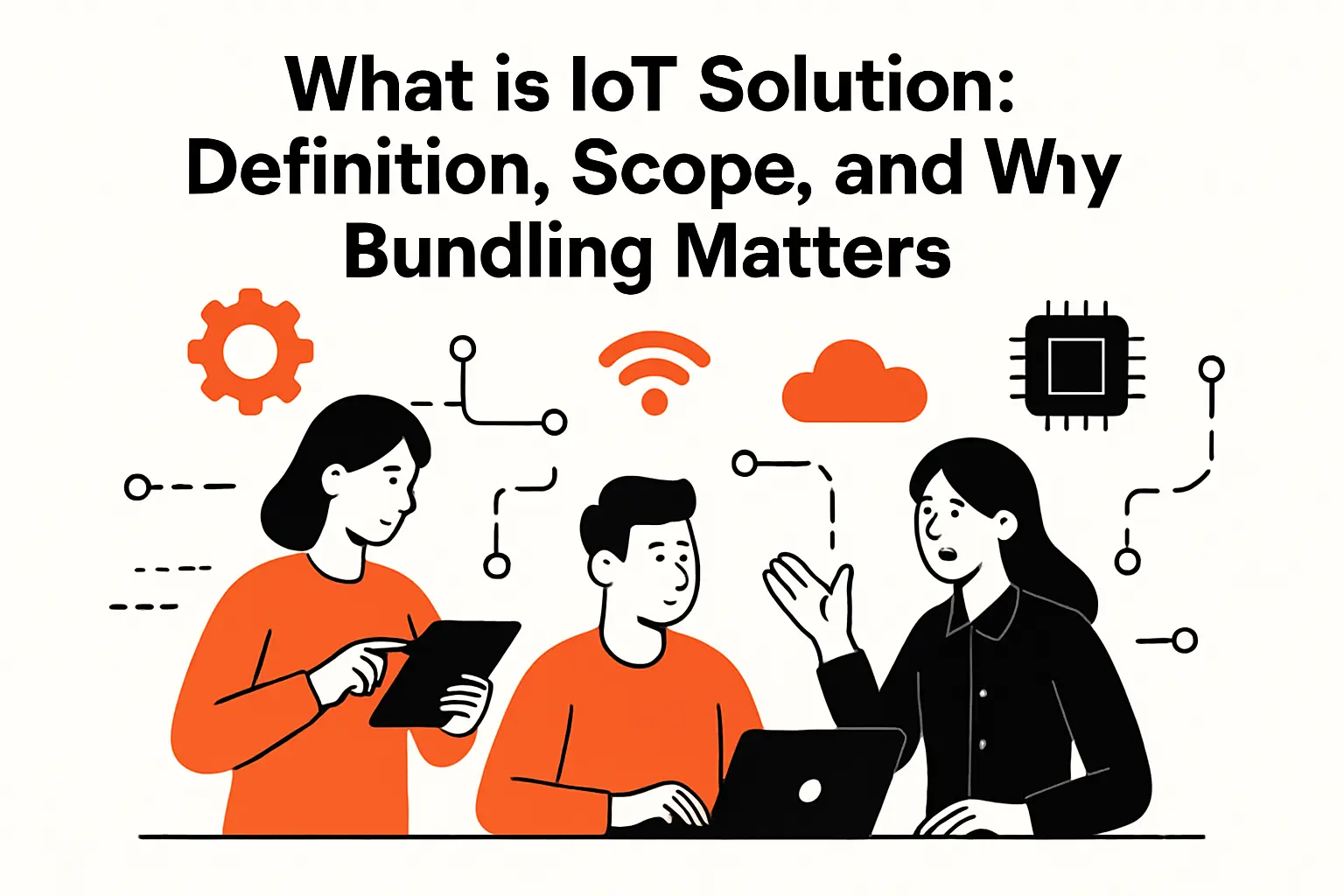
Market overview: IDC expects worldwide IoT investment to expected to surpass $1 trillion in 2026 as use cases mature and scale. That scale forces clarity about what we bundle and what we leave modular. In our experience, the definition of “IoT solution” is where budgets are saved or wasted.
1. Integrated bundle of technologies and sensors that solves a specific organizational problem
In our work, an IoT solution is a bundle with a purpose, not a shopping list. The bundle includes sensing, identity, connectivity, data handling, and a decision workflow. A practical example is leak detection that triggers a work order automatically. That outcome needs sensors, rules, escalation, and audit trails. Without those pieces, teams just collect alerts and burn out.
2. IoT solutions as software programs that leverage data captured by IoT devices
Most of the value sits in software, not in devices. The device captures signals, but the application turns signals into decisions. In a warehouse, vibration readings become a maintenance ticket, not a dashboard badge. At Techtide Solutions, we often start with the user interface first. Then we design backward into data models and ingestion patterns. That approach keeps “interesting data” from replacing “useful action.”
3. End-to-end IoT solution vs a single IoT device or a narrow point solution
A single device can be excellent and still fail as a solution. End-to-end means enrollment, provisioning, updates, monitoring, and offboarding are defined. It also means the workflow connects to business systems like ERP and ticketing. Point solutions often stop at “we can see it now.” Operators then copy values into spreadsheets and call it transformation. We prefer systems that remove human glue work entirely.
4. Bundling strategy: avoiding bundling too much or bundling too little
Bundling too much creates vendor lock, slow change cycles and too little creates integration chaos and fragile handoffs. Our rule is to bundle along failure boundaries and ownership boundaries. For example, device fleet management must be one coherent capability. Meanwhile, analytics can stay pluggable if downstream teams iterate quickly. The healthiest IoT programs define interfaces early and renegotiate them rarely.
IoT Foundations: Connected Objects, Ubiquitous Computing, and Industrial IoT
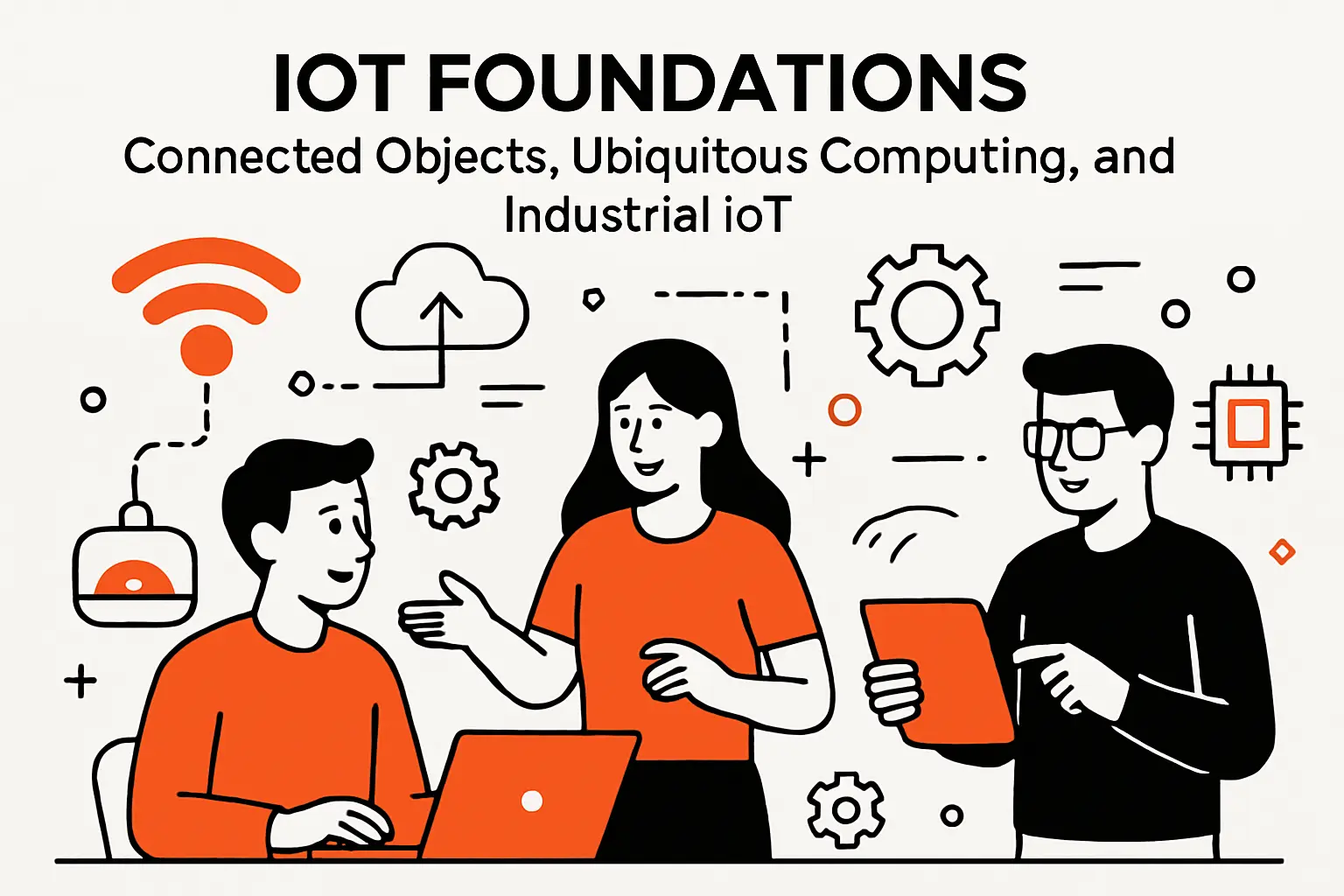
Market overview: McKinsey estimates IoT adoption could enable $5.5 trillion to $12.6 trillion in value globally by 2030 across consumer and enterprise settings. That spread tells us something important about foundations. IoT is not one market; it is many environments with different physics. We design differently for people, machines, and infrastructure.
1. Internet of Things: physical objects embedded with sensors, processing ability, software, and connectivity
IoT begins where a physical object gets a digital identity. That identity is linked to sensors, local processing, and a network path. In practice, “object” can mean a motor, a freezer, or a streetlight controller. Each object emits signals that are noisy and context dependent. Our teams model context as carefully as we model data schemas. Otherwise, “temperature” or “motion” becomes meaningless across sites.
2. Ubiquitous computing: small internet-connected computers embedded into everyday life and objects
Ubiquitous computing is IoT’s cultural substrate. It assumes compute disappears into routines and environments. That assumption changes how we build interfaces and alerts. Operators cannot babysit every device or every location. So we design for exception handling, not continuous attention. Good ubiquitous systems feel quiet until something truly matters.
3. Industrial internet of things: networked sensors and devices for industrial applications like manufacturing and energy management
Industrial IoT raises the bar on reliability and safety. Failures can stop production, damage equipment, or endanger people. That risk changes choices about redundancy, buffering, and local autonomy. For example, a line should keep running safely if cloud connectivity drops. We also see longer lifecycles in industrial settings than consumer ones. So we plan upgrades and security rotations as a multi-year program.
4. Cyber-physical systems as an enabling platform to connect previously disconnected physical machines
Cyber-physical systems connect control logic to sensed reality. The “cyber” part includes models, rules, and orchestration. The “physical” part includes inertia, wear, and non-linear behavior. In factories, we often integrate legacy controllers with modern gateways. That bridging work is where deep engineering matters most. When we do it well, old machines become first-class citizens in new workflows.
Core Components of an IoT Solution Stack
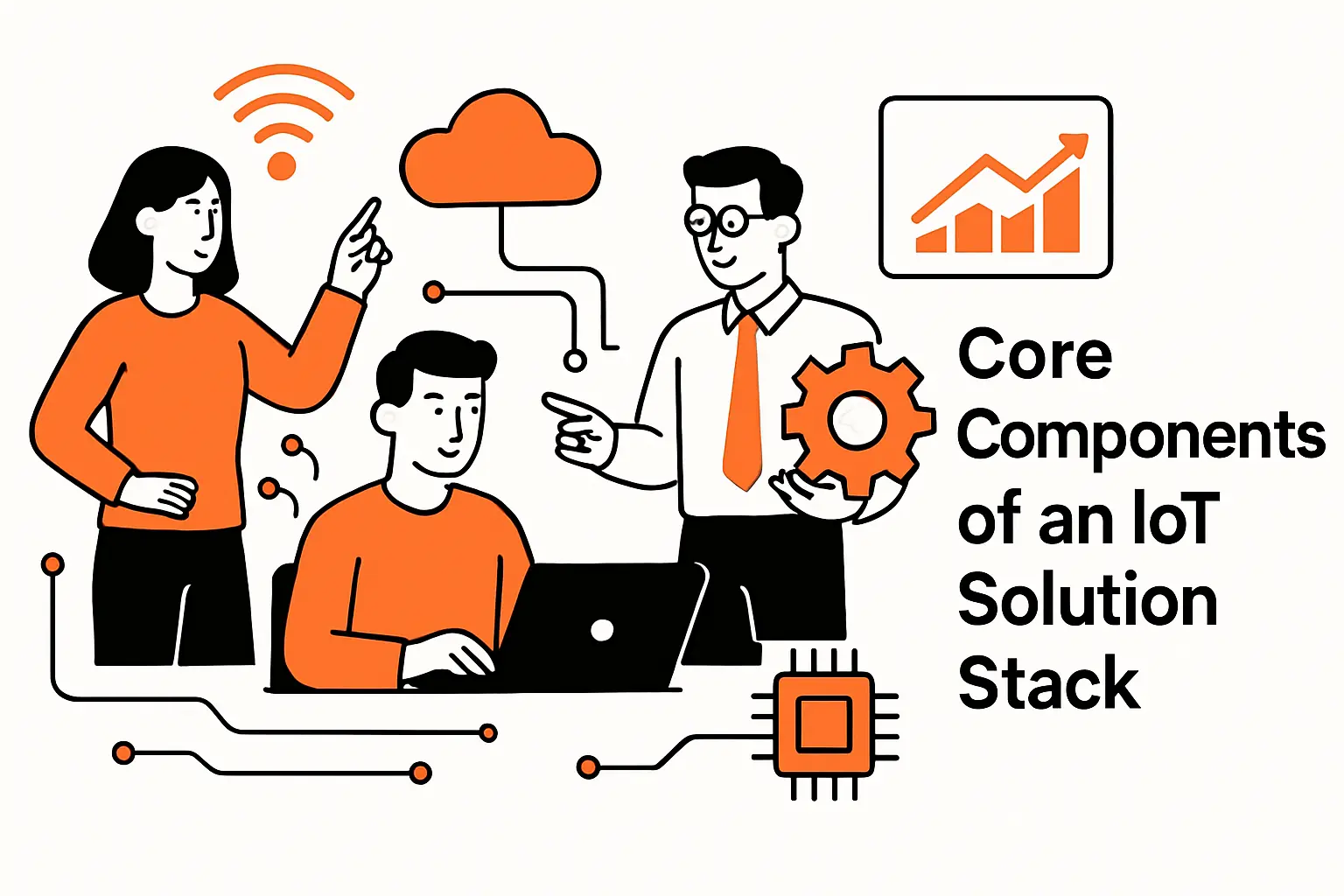
Market overview: Statista forecasts IoT connections will more than double from 19.8 billion in 2025 to more than 40.6 billion IoT devices by 2034, which pressures every layer of the stack. Scale punishes ad hoc design. It also makes “small” per-device costs become enterprise-sized bills. We build stacks that stay predictable under growth.
1. Devices and sensors that capture real-time data such as temperature, motion, location, and machine health
Devices are a mix of hardware constraints and software opportunity. Sensors drift, batteries sag, and enclosures fail in the field. Yet firmware can filter noise and add resilience. We like “truth in labeling” for measurements, including units and calibration metadata. That metadata belongs in the payload, not in tribal knowledge. When the device is honest, analytics becomes simpler and safer.
2. Connectivity layer to transmit data securely via cellular, Wi-Fi, satellite, and LPWAN options
Connectivity is not just bandwidth; it is reliability, cost, and coverage. A cold room can block signals that work fine in open space. A remote site might need satellite even for tiny payloads. We select networks using message size, latency tolerance, and power budgets. Then we test in the real environment, not in a lab. RF surprises are the most expensive surprises.
3. IoT cloud platform for centralized storage, computing, integration, and system visibility
The cloud platform is where devices become a fleet. It handles onboarding, policy, routing, and integration points. We often treat the platform as an event backbone, not a database. Events flow to storage, monitoring, and business workflows independently. That pattern reduces coupling and makes future changes cheaper. It also keeps “one big data lake” from becoming “one big failure domain.”
4. Analytics, AI, and machine learning that transform raw data into actionable intelligence
Analytics is the difference between sensing and solving. In many deployments, rules outperform machine learning at the start. Rules are explainable, fast to tune, and easy to audit. Over time, models can learn baselines and predict anomalies earlier. We like hybrid systems that keep a rules safety net underneath predictions. That keeps operators confident when models drift.
5. Development platforms and tools that support multiple workloads, devices, and clouds at scale
IoT development spans embedded code and web applications. That split creates coordination risk across teams and vendors. We reduce risk by defining shared contracts early, like payload schemas and command semantics. Tooling then enforces those contracts through automated tests. A simple contract test can prevent a fleet-wide outage. In IoT, one bad update multiplies quickly.
6. End-to-end security across devices, data transmissions, and continuous monitoring
Security in IoT is a lifecycle, not a checkbox. Devices must boot trusted code and refuse tampered updates. Data must be protected in transit and at rest. Access must be least-privilege, with strong identity for users and services. Monitoring must spot abnormal device behavior and credential misuse. When security is designed late, it becomes a patchwork that attackers exploit.
Connectivity and Network Architecture for IoT Solutions
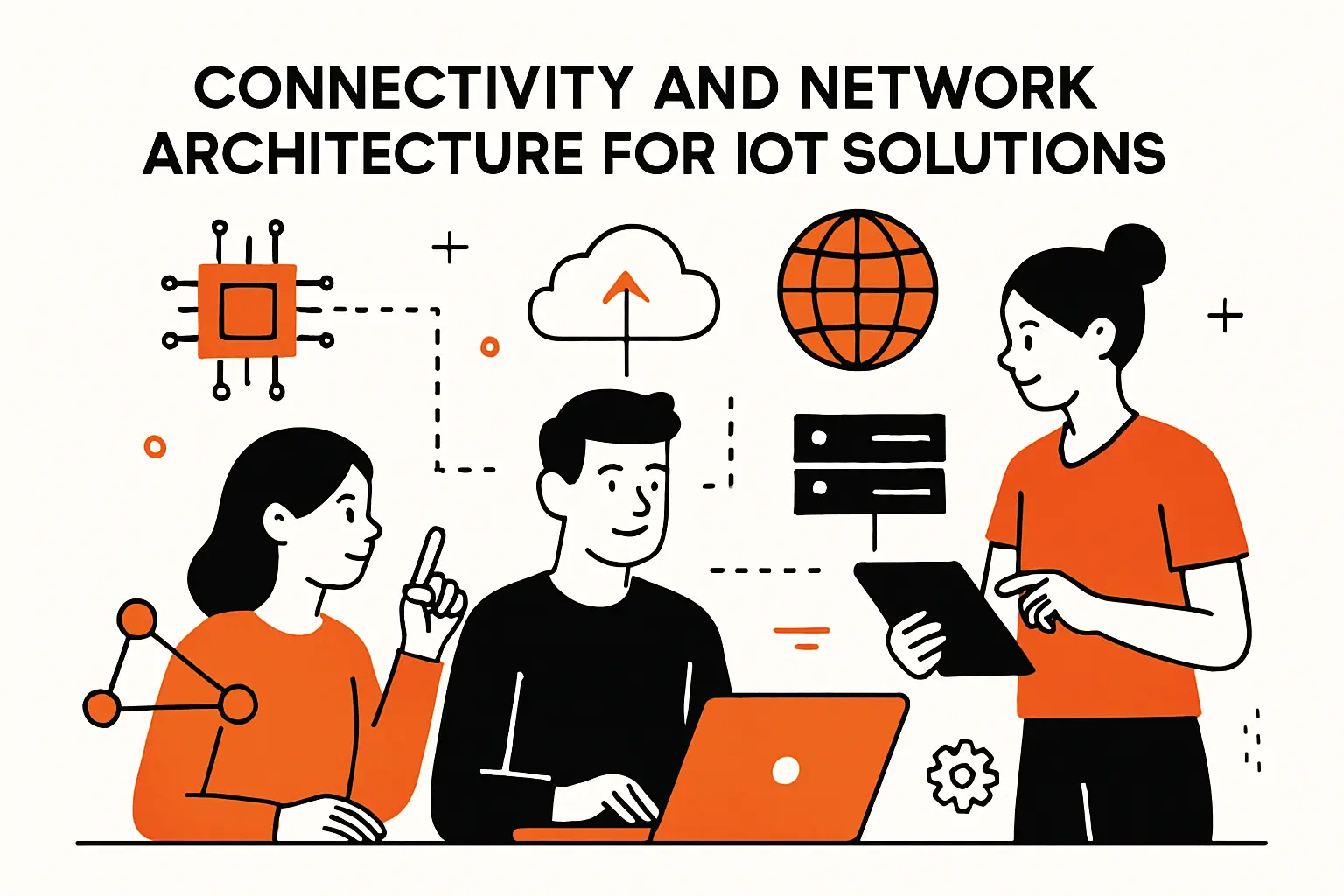
Market overview: Gartner reports 50% of critical enterprise applications will reside outside of centralized public cloud locations through 2027, which elevates edge and hybrid networking decisions. That shift changes where IoT workloads run and how traffic is routed. It also reshapes operational responsibility across teams. We see networks becoming product surfaces, not invisible plumbing.
1. Role of the network in IoT: connectivity, bandwidth, scale, security, and flexible deployment
The network determines what an IoT system can promise. Latency bounds decide whether automation is safe. Bandwidth limits decide whether video is feasible or wasteful. Scale affects addressing, routing, and broker sizing. Security depends on segmentation and identity-aware access. Flexibility matters because sites change, and mergers happen. We design networks that assume constant change, not stable perfection.
2. Wired Ethernet for fast, reliable, and secure LAN connectivity in offices and industrial settings
Ethernet remains the quiet workhorse of IoT connectivity. It is predictable, low-latency, and easier to segment than many wireless setups. In plants, wired links reduce interference and simplify troubleshooting. We often pair Ethernet with industrial enclosures and hardened switches. That pairing helps uptime far more than fancy analytics does. A stable physical layer is a business advantage.
3. Wi-Fi 802.11 connectivity for pervasive, secure, and high-throughput IoT environments
Wi-Fi is attractive because it rides existing infrastructure. Still, consumer-grade assumptions break quickly in enterprise IoT. Roaming, congestion, and misconfigured security cause silent data loss. We recommend a site survey and traffic modeling before large rollouts. In mixed environments, we also separate IoT traffic from corporate laptops. That separation limits blast radius during incidents.
4. Wi-Fi 6 and Wi-Fi 6E for serving large numbers of IoT devices with higher throughput and efficiency
Newer Wi-Fi generations help when device density becomes the problem. Efficiency features reduce airtime waste from chatty endpoints. That matters in hospitals, stadiums, and smart campuses. Yet better Wi-Fi does not fix poor device behavior. We still throttle telemetry and batch non-urgent updates. Network gains vanish if every device screams every second.
5. Ultra-reliable wireless backhaul for mission-critical, low-latency, mobile industrial use cases
Some environments need mobility with strict reliability. Think autonomous vehicles, yard tractors, or moving cranes. In these cases, backhaul must handle handoffs and temporary obstructions gracefully. We design for local safety behavior when links degrade. That includes cached routes, buffered commands, and clear fail states. The goal is safe degradation, not brittle perfection.
6. Network scalability and lightweight data transport: IPv6, 6LoWPAN, CoAP, MQTT, and ZeroMQ
Lightweight protocols keep devices cheap and power-efficient. MQTT is popular because it is simple and broker friendly. CoAP fits constrained devices with request-response patterns. IPv6 helps address scale and avoids awkward translation layers. At Techtide Solutions, we choose transport based on delivery semantics and operational tooling. The protocol choice must match observability, not just payload size.
7. Decentralized IoT and fog computing for latency-sensitive workloads and reduced cloud loading
Fog computing pushes decisions closer to devices. That shift cuts latency and reduces dependence on the internet. It also helps when data is sensitive or expensive to transmit. We often run filtering and rule evaluation at gateways. Then only meaningful events reach the cloud. This design keeps cloud costs stable as fleets grow.
8. IT and OT collaboration to successfully operate industrial IoT networks
Industrial IoT fails when IT and OT treat each other as outsiders. OT knows safety constraints and process realities. IT knows identity, patching, and monitoring discipline. Successful programs create shared runbooks and joint incident drills. We also define ownership for network segments and device classes. Collaboration becomes real when alarms have one clear responder.
Key Features and Business Value of Effective IoT Solutions
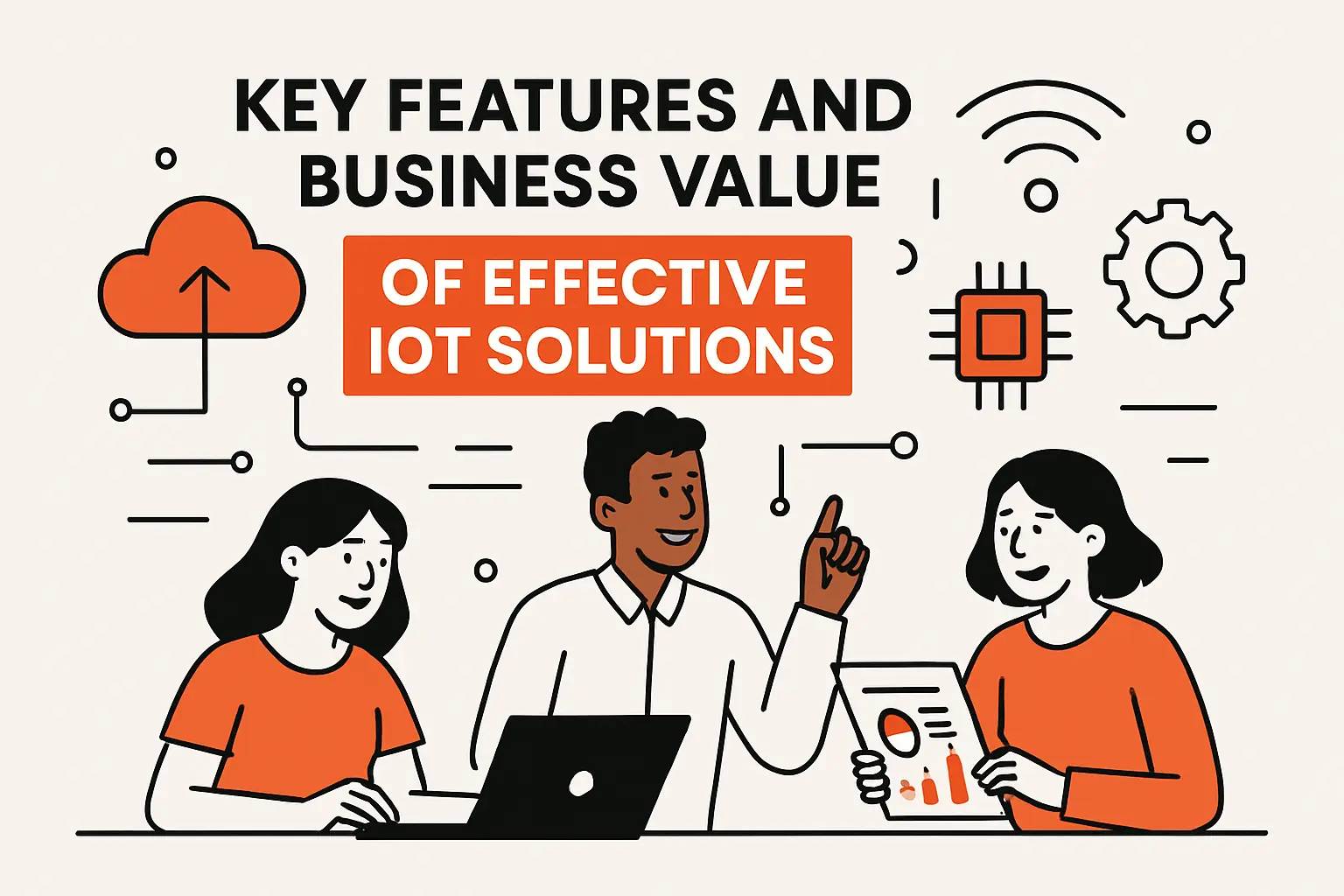
Market overview: Deloitte reports that in smart manufacturing, almost half (46%) are using industrial IoT (IIoT) solutions at facility or network scale. That adoption signals a shift from pilot thinking to operating-model thinking. Business value depends on productized operations, not clever prototypes. We focus on features that survive real workloads and real people.
1. Scalability to support thousands or millions of devices as deployments grow
Scalability is about operations as much as infrastructure. Provisioning must be automated and repeatable. Firmware rollout must be staged, observable, and reversible. Data pipelines must tolerate bursts and outages. We also plan for device churn, including replacements and retired assets. Scale is rarely a compute problem; it is usually a workflow problem.
2. Interoperability across diverse devices, systems, and environments without silos
Interoperability is where IoT value concentrates. Devices come from different vendors and speak different dialects. Business systems also vary across plants, regions, and acquisitions. We handle this with translation layers and canonical data models. The model becomes a contract between messy reality and clean software. When interoperability is ignored, the business pays forever in manual reconciliation.
3. Real-time monitoring and automation to reduce manual work and human error
Real-time monitoring matters when minutes change outcomes. Refrigeration excursions, safety alarms, and line stops fit this pattern. Automation matters when the response is predictable and repeatable. We automate ticket creation, escalation, and device remediation steps. Humans then handle exceptions and root cause analysis. This division keeps teams sharp and reduces alert fatigue.
4. Efficiency and cost reduction driven by continuous data streams and smarter decisions
Efficiency comes from better timing and better prioritization. Continuous data shows patterns that spot waste and drift early. For example, energy management improves when schedules follow actual occupancy. Maintenance improves when interventions follow degradation signals, not calendars. Our view is pragmatic: tie every stream to a decision. If a stream has no decision, it becomes a liability.
5. Low-cost sensors, easy installation, and longer battery life enabled by networking innovation
Hardware economics shape what businesses can deploy widely. Lower-cost sensors make more assets observable, not just critical ones. Easy installation reduces disruption and avoids specialist labor bottlenecks. Battery life improves when networks support low-power sleep patterns. We design telemetry around the power budget from day one. Power mistakes become truck rolls, and truck rolls destroy ROI.
6. Data as a driver of IoT value and the resulting privacy, security, and data ownership risks
IoT data often describes people, locations, and habits. That creates privacy expectations even in industrial settings. Ownership also gets complicated when vendors host platforms and analytics. We advise clients to define data rights in contracts early. We also classify data by sensitivity and retention needs. The uncomfortable truth is simple: more data increases both value and risk.
7. Data security and privacy principles: defense in depth, encryption at each stage, consent, and data minimization
Defense in depth means layers fail safely, not catastrophically. Encryption must cover device links, broker links, and storage access. Consent matters when sensing touches employees, tenants, or customers. Data minimization keeps only what decisions require. At Techtide Solutions, we also push for strong audit logs and immutable event trails. These practices turn “trust us” into “verify us.”
IoT Solution Examples and Common Use Cases Across Industries
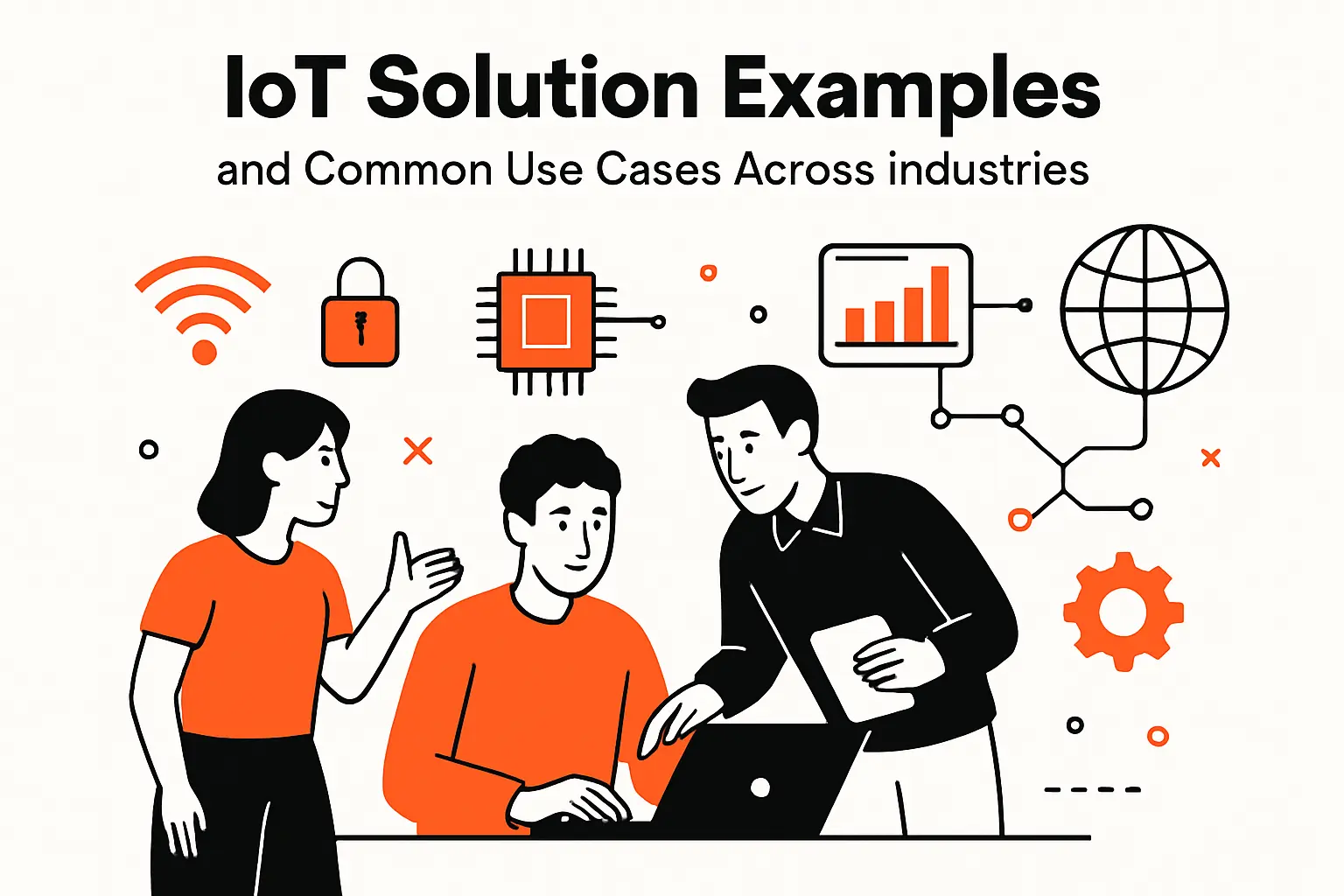
Market overview: IDC expects edge adoption to surge, noting Worldwide spending on edge computing is expected to be $232 billion in 2024 across hardware, software, and services. Edge matters because many IoT use cases cannot wait for cloud round trips. It also matters because bandwidth is never infinite. We build use cases around physical reality, not cloud convenience.
1. Refrigeration monitoring: replacing manual temperature checks with continuous sensor-based visibility
Refrigeration monitoring is a classic “small task, huge consequence” case. Manual checks are sparse and easy to falsify accidentally. Sensors provide continuous visibility and capture the exact excursion window. Our preferred workflow ties alarms to a containment playbook. That playbook includes verification, product isolation, and equipment inspection. The real win is traceability when auditors or insurers ask hard questions.
2. Vehicle asset tracking: location visibility plus customer-facing tools such as web apps for finding assets
Asset tracking starts as location, then becomes service quality. Customers want self-service views, not email threads. We often build role-based maps with geofences and last-seen health. For yard assets, “where is it” is only half the problem. “Is it usable” matters just as much. So we add utilization signals and maintenance status into the same view.
3. Fleet management and logistics: real-time GPS, video telematics, and predictive maintenance
Fleet systems mix safety, compliance, and economics. GPS gives route context, while telematics adds behavior and vehicle health. Predictive maintenance reduces breakdown surprises and missed deliveries. We architect fleets with store-and-forward, because coverage is uneven. We also separate driver identity from vehicle identity for clean audits. When data is trustworthy, dispatch decisions get much calmer.
4. Manufacturing: materials tracking, industrial automation with mobile robots and autonomous vehicles, and connected workforce
Manufacturing IoT thrives when it links materials, machines, and people. Materials tracking reduces search time and prevents wrong-part installs. Mobile automation needs precise coordination between routes, zones, and safety states. Connected workforce tools help technicians see context at the point of work. We often integrate with MES and maintenance systems to close loops. The best plants treat data like a production input, not a reporting artifact.
5. Connected roadways: traffic signal automation, video surveillance, dynamic road signs, and automated tolling
Roadway systems are operational technology in public space. Reliability is critical because failures affect safety and congestion. We design these systems with strong segmentation and strict command authorization. Video analytics can support incident response, but it must be governed carefully. Dynamic signage needs precise control and clear rollback states. Public agencies also require transparent audit trails, so we build for accountability.
6. Connected rail: improving asset visibility, passenger experience, safety, punctuality, and cost objectives
Rail IoT combines moving assets with long-lived infrastructure. Visibility includes rolling stock health, track conditions, and station systems. Passenger experience depends on reliable information, not just punctual trains. Safety requires early detection of component anomalies and environmental hazards. We often recommend edge processing on trains to handle intermittent connectivity. A rail network is a system of systems, so integration discipline is everything.
7. Cities and communities: sensors and cameras as a feedback system for public services and operations
City IoT works when it behaves like a feedback system. Sensors detect conditions, services note outcomes, and policies adapt. Typical domains include lighting, waste operations, and public safety coordination. We emphasize governance, because public trust is fragile. Data sharing agreements and retention rules must be explicit. When communities see clear benefits, adoption becomes easier to defend and fund.
8. Commercial real estate and smart buildings: monitoring for major issues, freeze risk, leaks, and indoor air quality
Smart buildings are about preventing surprises for tenants and owners. Leaks, freeze risk, and air quality issues damage reputation quickly. We integrate building signals with maintenance workflows and vendor dispatch. In multi-tenant settings, privacy boundaries matter as much as sensors. We also build tenant-friendly dashboards with clear, plain language. A building becomes “smart” when responses are fast and coordinated.
TechTide Solutions: Custom IoT Solutions Built Around Customer Needs
Market overview: IDC forecasts that global DX spending is forecast to reach $3.4 trillion in 2026, and IoT is one of its most physical expressions. That spending wave rewards teams who can translate business outcomes into shipping systems. Custom work matters when constraints are unique and legacy is real. We build IoT as a product, then operate it like one.
1. Requirements-first discovery and solution architecture aligned to business outcomes
Discovery is where we earn trust and prevent waste. We map outcomes into measurable behaviors and operational decisions. Then we identify actors, failure modes, and escalation paths. Our architects document assumptions and test them in the field. We also inventory existing systems and integration constraints early. When requirements are honest, architecture becomes a disciplined negotiation, not a guessing game.
2. Custom software development for device integration, cloud platforms, analytics, and customer dashboards
Custom development is often the glue that makes “end-to-end” real. We build device adapters, ingestion services, and workflow orchestration. We also build dashboards that reflect how operators think, not how engineers think. Our analytics layers focus on decisions, alerts, and evidence, not charts for their own sake. In regulated settings, we add strong audit trails and role-based visibility. The output is software that works during normal days and stressful days.
3. Deployment support, scaling strategy, and iterative optimization as requirements evolve
Deployment is where lab assumptions meet weather, people, and process. We support pilots with tight feedback loops and clear success criteria. Scaling then becomes a supply chain and operations problem, not a coding sprint. Our teams automate provisioning, monitoring, and update pipelines early. We also run post-incident reviews to improve reliability continuously. IoT systems live in the world, so iteration is not optional.
Conclusion: How to Select, Build, and Scale the Right IoT Solution

Selecting an IoT solution starts with one question: what decision must improve, and who owns it. From there, we choose sensing that is reliable enough, not perfect. Next, we design identity, onboarding, and updates as first-class capabilities. Then we pick connectivity and cloud patterns that match physics and operations. Finally, we build security and governance so the system can scale safely. If we at Techtide Solutions could leave one next step, it would be this. Write your “closed-loop” definition on one page, then test it on one site. Which loop in your organization would you automate first, if you had to defend the ROI in public?