
Market context: Gartner forecasts worldwide public cloud end‑user spending will total $723.4 billion, and that scale raises the cost of sloppy releases for every business. At TechTide Solutions, we treat deployment as a product surface. It is user experience in disguise. A “deployment” is not a button click. It is a chain of decisions about risk, observability, and reversibility. Our best releases feel boring. That boredom is engineered. This guide distills the playbook we use to ship safely, keep latency flat, and recover fast.
Plan and prepare for web app deployment best practices
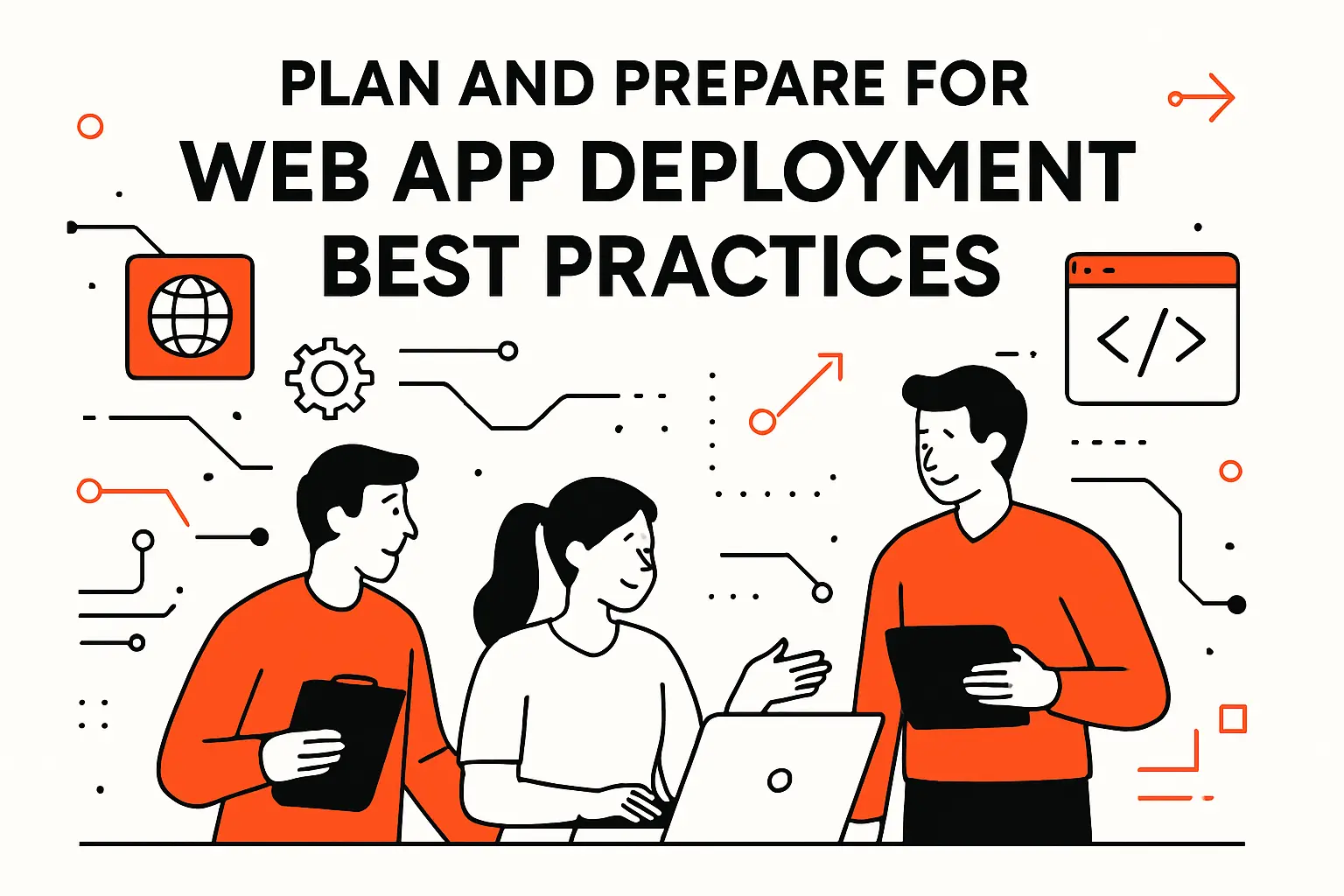
Market context: cost pressure is now inseparable from release pressure, and research firms keep linking cloud success to operational discipline. Flexera’s latest State of the Cloud messaging reinforces that tension, since 84% of organizations struggle to manage cloud spend and that reality punishes wasteful deployment patterns. Our stance is simple. Planning is how we buy back calm later. A small preflight ritual prevents large incident rituals.
1. Define deployment goals, performance targets, and rollback criteria
Before we touch tooling, we write down what “good” means for this release. That includes user outcomes and operational outcomes. Release goals must be observable. Otherwise, they are wishes. Rollback criteria must be ruthless. If the system violates them, we revert without debate.
In practice, we capture targets as a short contract. Each line maps to a metric we can watch. We also define who can approve a rollback. That removes hesitation during an incident.
- Start with user journeys, then map them to service health signals.
- Include error budgets, not just uptime aspirations.
- Document rollback triggers in the same place as release notes.
2. Select a deployment method and platform that fit your needs cloud serverless hybrid
Choosing a platform is choosing failure modes. Cloud, serverless, and hybrid each fail differently. At TechTide Solutions, we pick the simplest model that supports isolation. Isolation is the hidden superpower behind zero downtime. It lets us validate changes without exposing users.
For steady web workloads, Azure App Service can be a pragmatic baseline. For spiky event flows, serverless can reduce idle spend. And final the regulated environments, hybrid designs can keep data boundaries clear. The best choice depends on operational maturity. Tooling cannot compensate for unclear ownership.
- Prefer platforms with native traffic shifting and staging isolation.
- Favor services that support immutable artifacts over mutable servers.
- Plan for dependency boundaries, not just compute boundaries.
3. Establish version control and branching to support CI CD and staging
Version control is not a repository. It is an operating model for change. Branching strategy is where teams encode their appetite for parallel work. We prefer approaches that reduce long‑lived divergence. Merge pain is delayed risk, not avoided risk.
Staging becomes meaningful only when it mirrors production behavior. That requires disciplined branching and repeatable builds. In real projects, the fastest teams are rarely the most reckless. They are the most consistent. Consistency comes from predictable branching rules and enforced reviews.
- Keep branches short‑lived and release‑focused.
- Require pull requests for any production‑bound change.
- Tag artifacts so environments consume the same build output.
4. Design an environment configuration strategy using app settings and variables
Configuration is where good deployments go to die. We have seen flawless code fail due to a single wrong setting. Environment strategy must be explicit. It must cover defaults, overrides, and secret handling.
Our rule is separation. Code ships the same everywhere. Environments differ only by settings, identity, and external endpoints. That reduces drift. It also makes rollbacks safer. When a release fails, we want to revert code, not re‑learn configuration.
- Standardize naming for settings across environments.
- Keep non‑secret settings visible and reviewable.
- Automate validation of required variables before deployment.
CI CD automated testing and infrastructure as code
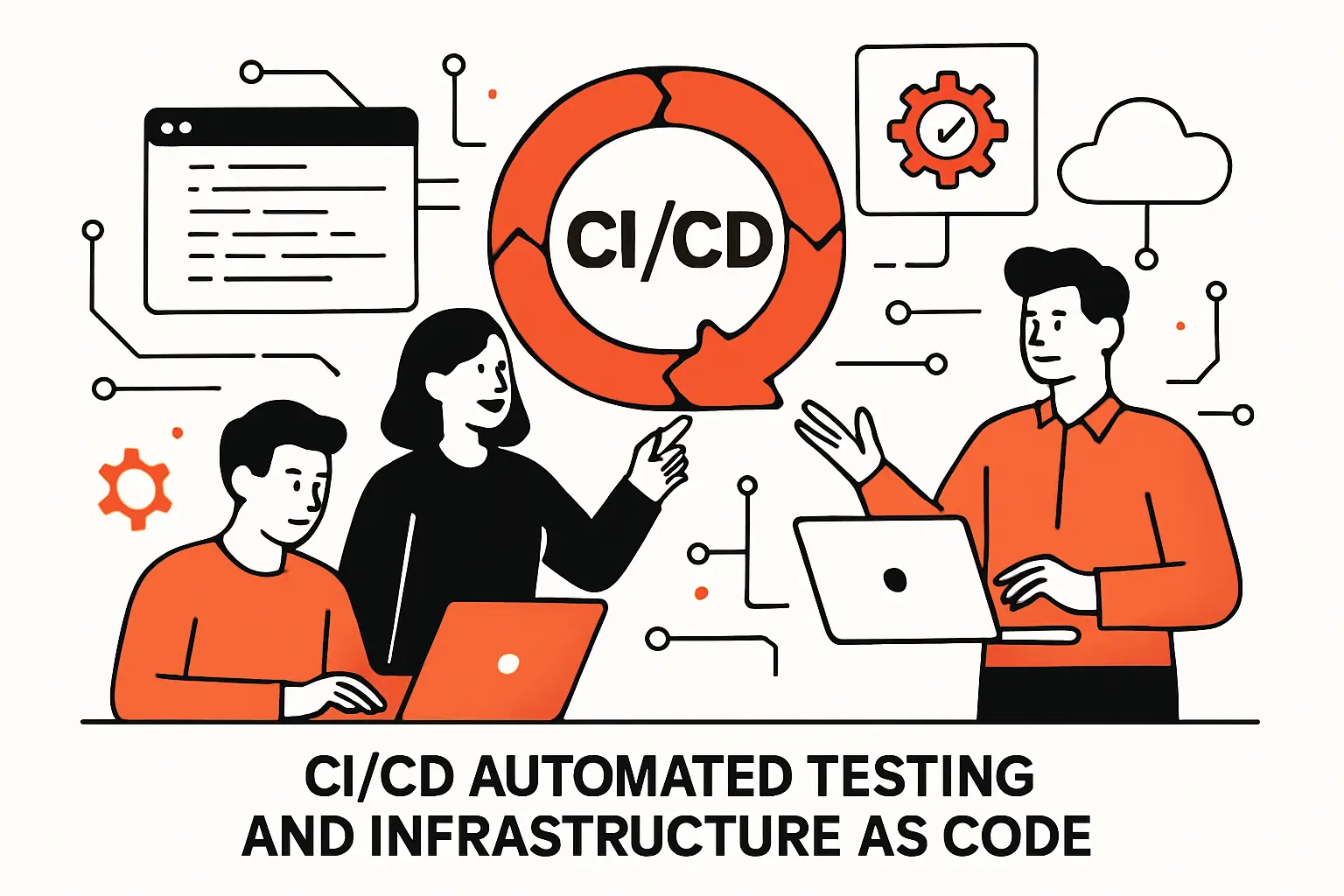
Market context: modern delivery research keeps pointing to system thinking, not heroics, as the driver of speed. The DORA research program has built its reputation on measuring performance through broad industry sampling. That research posture matters because deployment practices need external calibration. Internal anecdotes are never enough.
1. Automate builds tests and releases with CI CD pipelines tied to staging slots
Automation is how we prevent “special” deployments. Manual steps invite hidden variation. Variation creates mystery failures. We tie pipeline stages to isolated slots so we can validate the same artifact in a production‑like host. That keeps the runtime consistent.
In Azure App Service, deployment slots can represent environments with shared infrastructure. That makes swaps powerful. It also makes discipline mandatory. A slot should be treated as a first‑class environment with its own health gates.
- Use pipeline stages that enforce promotion, not re‑building.
- Gate production swaps on health checks and smoke tests.
- Promote artifacts, then update configuration through controlled steps.
2. Adopt automated unit integration and end to end tests to catch regressions
Testing is not a box to check. It is a feedback loop design problem. Unit tests protect logic boundaries. Integration tests protect contracts. End‑to‑end tests protect real workflows. When we skip layers, we pay later in incident time.
In our client work, regressions rarely come from “big” features. They come from surprising edges. A new header breaks a proxy. A serializer change breaks a consumer. Automated contract tests are the quiet fix. They catch drift before users do.
- Keep unit tests fast and ruthless about behavior.
- Run integration tests against realistic dependencies, not mocks.
- Use end‑to‑end suites as release gates, not developer toys.
3. Use ARM templates or Bicep for repeatable Azure App Service provisioning
Infrastructure as code is how we make environments reproducible. It turns tribal knowledge into versioned intent. In Azure, ARM templates and Bicep let us define the host, the slots, and the settings shape. That reduces configuration drift. It also makes audits easier.
We like Bicep for readability. We like repeatable modules for scale. The key is idempotency. Running the same template should converge the environment, not mutate it unpredictably. That single property prevents entire classes of “worked yesterday” outages.
- Model environments as code, not as console history.
- Parameterize environment differences, then lock the module surface.
- Review infrastructure changes like application changes.
4. Create and maintain a deployment checklist for web app deployment best practices
A checklist is not bureaucracy. It is distributed memory. Under pressure, memory fails first. We maintain a living checklist that matches our pipeline and platform. It covers prerequisites, validation, and post‑release confirmation. Each item exists because we once regretted skipping it.
For a healthcare platform we supported, a missing redirect rule caused a cascade of broken sessions. That was not a code issue. It was a checklist issue. Afterward, we added a simple “edge behavior” verification. The same class of problem never returned.
- Include pre‑deployment checks for settings, identity, and routing.
- Add release verification steps for user flows and observability.
- Review the checklist after incidents, then update it immediately.
Zero downtime release patterns slots rolling blue green and canary
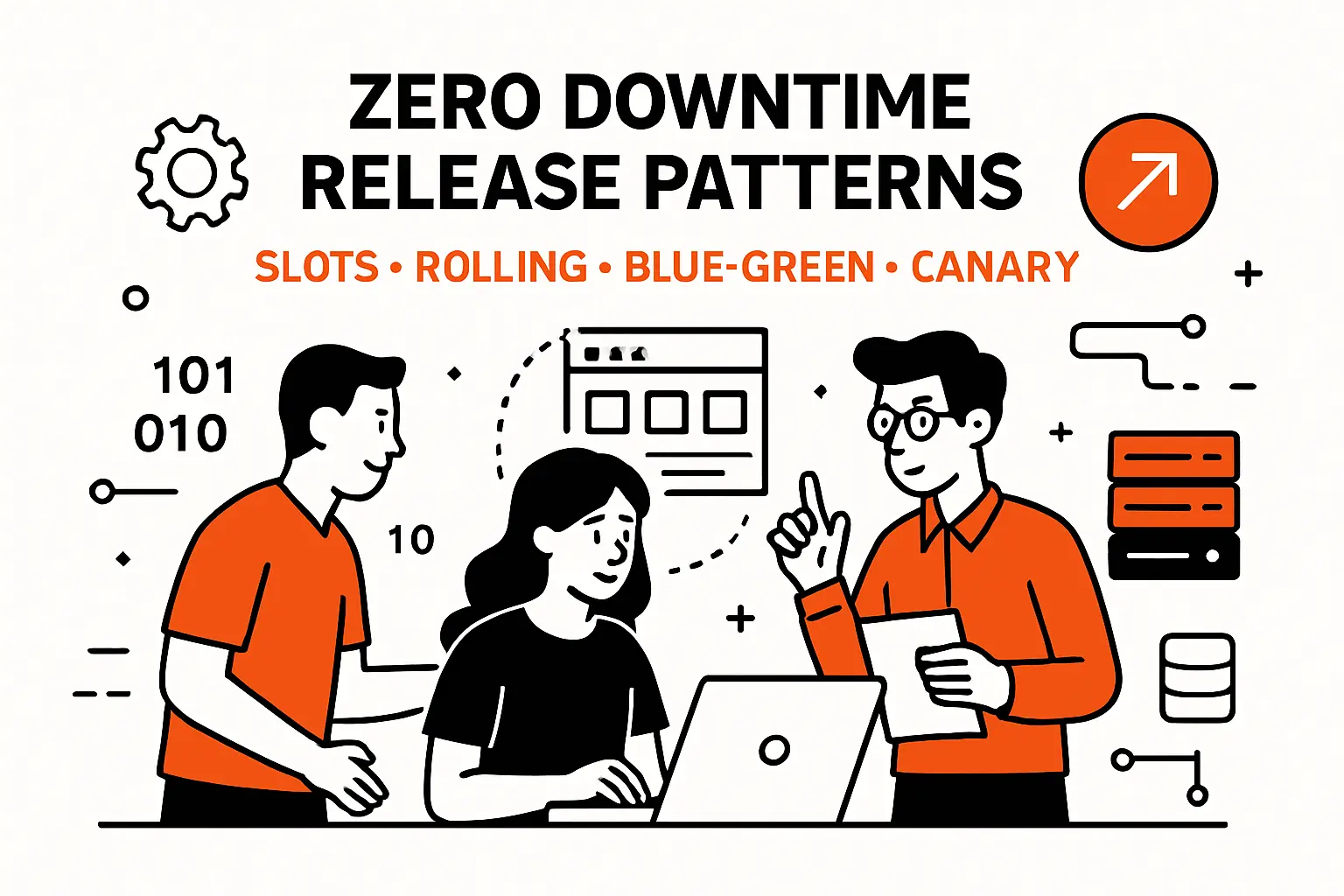
Market context: reliability research keeps highlighting that outages are increasingly expensive, even when they are less frequent. Uptime Institute research shows that 54% of surveyed operators reported their most recent significant outage crossed a major cost threshold, and that should harden every deployment conversation. At TechTide Solutions, we assume every release is a potential outage. That assumption drives safer patterns.
1. Use Azure deployment slots with swap and swap with preview to validate before go live
Slots are the most practical zero‑downtime lever in App Service. They give us a place to deploy, warm, and validate. Swap moves traffic without redeploying. Swap with preview lets us verify production settings before full promotion. That reduces surprise.
We treat the slot as a rehearsal stage. The app must start cleanly. Dependencies must respond. Startup logs must look normal. If any of those fail, we stop. Users should not become our test suite.
- Validate health endpoints before any swap action.
- Exercise critical flows against the slot, not just the homepage.
- Require human approval for the final promotion step.
2. Configure slot specific settings and warm up actions to avoid configuration drift
Slot swaps are powerful because they move runtime state. They can also move mistakes fast. Slot‑specific settings reduce that risk. They keep environment boundaries intact during swaps. Without them, staging can accidentally inherit production secrets or endpoints.
Warm‑up actions prevent cold starts and cache misses from hitting users. We often add a warm‑up routine that calls key endpoints. That routine should be lightweight. It should also be safe to run repeatedly.
- Mark environment‑unique variables so they do not swap.
- Warm critical routes that load templates and dependency clients.
- Record warm‑up success as a deployment signal in monitoring.
3. Adopt rolling updates to stagger changes and simplify rollback
Rolling updates reduce blast radius by design. They let us introduce changes gradually across instances. If errors appear, we can stop the roll. That is often less disruptive than an all‑at‑once swap. It is also easier to reason about capacity.
On platforms that support instance‑level updates, we watch key signals during each step. Latency, error rate, and saturation must remain stable. If the curve bends, we pause. Good rolling updates feel methodical, not frantic.
- Choose rollout steps that match your traffic volatility.
- Stop the rollout when health trends shift, not after alarms escalate.
- Keep rollback mechanics symmetrical with rollout mechanics.
4. Apply blue green or canary releases to gradually route traffic
Blue‑green is clarity. Canary is nuance. Both are about exposure control. Blue‑green gives a clean cutover point. Canary gives gradual feedback from real user behavior. We pick based on risk. High‑risk changes benefit from canary. Broad infrastructure shifts often fit blue‑green.
A mature canary requires strong telemetry. Without it, canary is guesswork. Feature flags help too. They decouple deploy from release. That separation is priceless during busy product cycles.
- Route traffic based on measurable cohorts, not intuition.
- Use feature flags to reduce change density per deployment.
- Define “success” before the first user request hits the canary.
5. Consider auto swap to promote warmed up releases with minimal interruption
Auto swap can reduce operator workload. It can also hide risk if used blindly. We use it only when warm‑up and health gates are trustworthy. Otherwise, automation promotes failure faster. That is not progress.
In a retail modernization project, auto swap worked well after we stabilized startup behavior. Before that, it amplified sporadic dependency timeouts. The lesson was plain. Automation should follow stability. Stability should not depend on automation.
- Enable auto swap only after repeated clean staging promotions.
- Keep an easy manual override path for operations teams.
- Log swap events as first‑class operational changes.
Configuration secrets and environment management
Market context: security researchers keep showing that configuration is part of the attack surface. Breaches do not need exotic exploits when secrets leak. IBM’s latest breach analysis reports a global average cost of $4.88 million, which reframes “just a connection string” as a material business risk. Our view is blunt. Secrets belong in secret systems, not in deployment convenience.
1. Store configuration in environment variables app settings and connection strings
Environment variables and App Service settings are the baseline. They give us runtime flexibility without changing code. Connection strings deserve extra care. They often imply privilege, not just location. We prefer managed identity where possible. When credentials are required, we rotate them and limit scope.
Configuration should also be typed in the team’s mind. Some values are safe, sensitive. Some are operational toggles. Treating them differently reduces accidental disclosure. It also reduces accidental outages from mis‑set toggles.
- Separate safe settings from secrets in storage and review flows.
- Prefer identity‑based access over shared credentials.
- Validate required settings during startup, then fail fast.
2. Mark secrets and connection strings as slot specific for safe staging swaps
Slot‑specific settings prevent cross‑environment contamination. That is the practical benefit. The strategic benefit is incident containment. If staging uses isolated secrets, then staging incidents stay in staging. That protects production data. It also protects compliance posture.
We have seen teams lose hours because staging swapped into production with the wrong endpoint. That mistake is avoidable. Slot boundaries must be treated as safety rails. When the rails are missing, a swap becomes a cliff edge.
- Keep production data access impossible from staging by default.
- Audit slot‑specific flags as part of release readiness reviews.
- Use least privilege for any credential that must exist.
3. Enable CORS and harden API endpoints when hosting RESTful services
CORS is often treated as a frontend nuisance. It is really an access control policy. When misconfigured, it can widen who can call your API. That can expose tokens, data, or rate limits. We keep CORS rules narrow. We also validate allowed origins through configuration, not ad hoc code.
API hardening also includes throttling and input validation. It includes clear error responses without leaking internals. Logging must avoid sensitive payloads. Security is rarely a single control. It is an ecosystem of small decisions.
- Allow only required origins, then review them regularly.
- Apply rate limits at the edge when possible.
- Sanitize logs so secrets never enter telemetry streams.
4. Set the deployment branch for your chosen deployment source
Branch selection is a governance decision. It defines what “production ready” means. We avoid deploying from a branch that is used for everyday experimentation. That pattern invites accidental releases. It also increases rollback ambiguity.
A clean deployment branch supports cleaner audits. It also supports clearer incident response. When something breaks, the question becomes simple. “What changed in the deployment branch?” That clarity reduces mean time to recovery. It also reduces blame.
- Pick a branch with strict review policies as the deployment source.
- Require tagged releases for production promotions when feasible.
- Automate branch protection so rules cannot be bypassed casually.
Performance scalability and reliability safeguards during deployment
Market context: performance is now part of brand identity, not a back‑office metric. Gartner and other research voices keep tying modernization value to user experience stability. That link becomes obvious during deployments. A “successful” release that slows down users is still a failure. Our operating rule is conservative. We protect latency as aggressively as we protect uptime.
1. Warm up slots and define applicationInitialization paths to prevent cold starts
Cold starts are a deployment tax. They hit the first users after a swap. That is the worst moment to surprise them. Warm‑up is the antidote. In App Service, we often define warm routes that load key code paths. We also prime dependency clients.
Initialization must be safe. It must not mutate production data. It should validate connectivity and cache templates. When teams treat warm‑up as optional, they accept random performance dips. Those dips erode trust. Trust is hard to win back.
- Warm routes that exercise dependency calls and template rendering.
- Keep warm actions idempotent and free of side effects.
- Expose warm‑up results through logs and health signals.
2. Use local cache with slots for high performance read only content
Local cache can reduce pressure on shared storage. It can also make performance more predictable during traffic spikes. The tradeoff is content consistency. That tradeoff is acceptable for truly read‑only assets. It is dangerous for dynamic content. We decide with care.
During deployments, cache can hide problems. A stale asset can mask a missing file. For that reason, we treat cache settings as part of release risk. We also include cache behavior in smoke tests. Caching is performance engineering, not a default toggle.
- Cache only assets that are safe to serve stale briefly.
- Verify asset integrity during warm‑up and smoke testing.
- Plan cache invalidation as part of the release design.
3. Temporarily scale out the App Service plan if CPU or memory is saturated
Capacity is a safety margin. Deployments consume that margin through restarts and warm‑up work. If the plan runs hot already, a swap can tip it over. We sometimes scale out temporarily to reduce deployment stress. That is a pragmatic choice when traffic is high.
Scaling decisions should be based on signals, not fear. We watch CPU, memory pressure, and request queue behavior. If saturation trends appear, we add headroom. After the release stabilizes, we scale back. Predictable spending beats surprise downtime.
- Measure saturation before the release window begins.
- Scale with a clear rollback path for cost control.
- Confirm post‑release headroom before reverting capacity changes.
4. Maintain a tested rollback plan and preserve the last known good releases
Rollback is not a plan if it has never been rehearsed. Under stress, untested rollback steps become improvisation. We preserve a last known good artifact. We also keep configuration snapshots. That makes rollback fast and boring.
In our incident reviews, slow rollbacks usually come from uncertainty. Teams hesitate because they lack confidence in the revert. Practice removes that hesitation. Clear criteria help too. If health signals cross a line, we revert. No debate is needed.
- Store immutable artifacts so you can redeploy without rebuilding.
- Rehearse rollbacks in non‑production environments regularly.
- Document what data changes cannot be rolled back automatically.
Post deployment monitoring logging and operations
Market context: research firms increasingly treat observability as a prerequisite for resilient digital products. That shift matches what we see in the field. Without monitoring, teams deploy blind. Blind deployments are slower, not faster. Our operational philosophy is steady. Instrumentation is part of the feature, not an accessory.
1. Monitor performance error rates and user experience with proactive alerts
Alerts must be actionable. Otherwise, they become background noise. We define alert conditions around user harm. We also tie alerts to runbooks. A page without a next step is just anxiety.
User experience signals matter as much as server signals. Synthetic checks can catch edge failures. Real user monitoring can reveal slowdowns that servers do not show. Together, they create coverage. Coverage is what lets teams ship frequently without fear.
- Alert on user‑visible failures, not internal counters alone.
- Link each alert to a clear investigation path.
- Review alert quality after each incident, then tune ruthlessly.
2. Enable diagnostic logging and error tracking to speed remediation
Logs are evidence. Traces are narratives. Metrics are headlines. We want all three. Diagnostic logging should capture platform events and application events. Error tracking should group failures by root cause patterns. That reduces triage time.
In many teams, the biggest delay is not fixing the bug. The delay is finding the bug. Good telemetry shrinks that delay. It also reduces blame. When data is clear, conversations become calmer and more technical.
- Standardize correlation identifiers across services.
- Capture structured logs that support query and aggregation.
- Protect sensitive fields through redaction at the source.
3. Schedule regular maintenance security updates and dependency reviews
Maintenance is a deployment practice, not a separate chore. Dependency drift creates surprise risk. Security fixes also create urgency. We prefer planned, small updates over delayed, large upgrades. Smaller changes are easier to verify and roll back.
In our delivery cadence, we reserve time for dependency review. We also track deprecated services and runtime changes. That prevents forced migrations. Forced migrations are where teams tend to cut corners. Corners are where incidents are born.
- Create a routine for dependency updates, then protect it.
- Track platform deprecations as part of technical risk.
- Test updates in staging with production‑like traffic patterns.
4. Implement backups and disaster recovery to protect against data loss
Backups are not only for disasters. They are for operator mistakes and bad migrations too. We ensure backups exist, and we also ensure restores work. A backup that cannot be restored is theater. We do not accept theater.
Disaster recovery is about recovery time and recovery certainty. That includes infrastructure recreation. It includes secret rotation. It includes DNS and routing. We treat DR as a system, not a single tool. The goal is dependable recovery, not perfect prevention.
- Test restore procedures as part of operational readiness.
- Store backup access separately from production access.
- Document recovery steps with clear owners and escalation paths.
How TechTide Solutions helps you apply web app deployment best practices

Market context: the most useful research trend we see is the shift from tool adoption to operating model adoption. Firms like Gartner and DORA keep emphasizing platform thinking and repeatability. That aligns with our approach. We do not “install CI/CD.” We help teams build a system for change. The output is confidence, not dashboards.
1. Collaborative discovery and architecture tailored to your goals and constraints
Discovery is where we prevent expensive rewrites. We map your deployment risks, your compliance boundaries, and your team workflow. Then we design the architecture around those truths. That includes runtime choices and environment topology. It also includes ownership boundaries.
We also ask uncomfortable questions early. Which dependencies are fragile? Which teams approve production changes? Where do secrets live today? Honest answers shorten the path to stable releases. They also reduce the temptation to “wing it” later.
- Align business priorities with release and rollback expectations.
- Map system dependencies into a clear deployment risk model.
- Choose patterns that match your team’s operational maturity.
2. Custom CI CD pipelines infrastructure as code and staging slot workflows
Our pipeline work focuses on repeatable promotion. We build pipelines that publish immutable artifacts, run tests, and deploy to slots. Infrastructure as code becomes the foundation. Slots become the validation surface. Together, they support safe velocity.
We also harden the workflow around approvals and auditability. That matters in regulated industries. It also matters in fast startups with investor scrutiny. A clean release history is a business asset. It reduces fear during incident calls and board meetings.
- Automate build and deploy steps to remove manual variance.
- Use slots for validation, then promote through controlled swaps.
- Keep infrastructure changes versioned and peer reviewed.
3. Release operations monitoring setup and ongoing optimization post launch
Launch is when reality begins. After launch, we tune alerts, dashboards, and runbooks. We also review deployment outcomes and incident patterns. That creates a feedback loop. Feedback loops are how systems improve.
In ongoing engagements, we often reduce noise first. Too many alerts make teams ignore alerts. We then strengthen health checks and error grouping. Over time, deployments become calmer. Calm deployments become more frequent. That is the compounding advantage.
- Instrument key flows so you can detect harm quickly.
- Build runbooks that match how engineers actually investigate.
- Iterate on release patterns based on observed failure modes.
Conclusion key takeaways for web app deployment best practices
Market context: deployment maturity is now a competitive differentiator, not a technical nicety. The same research signals we cited earlier point to the same conclusion. Speed without control is not speed. It is churn. At TechTide Solutions, we aim for steady delivery that protects users and revenue.
1. Automate and test everything to ship frequently with confidence
Automation removes variance. Testing removes hidden regressions. Together, they create trust in the pipeline. That trust changes team behavior. Engineers ship smaller changes more often. Smaller changes are easier to diagnose and revert.
Confidence is not a feeling. It is a property of the system. Build it deliberately, and releases stop being dramatic events.
2. Use slots and progressive delivery to achieve zero downtime
Slots provide isolation. Progressive delivery provides exposure control. Both reduce blast radius. That reduction is the essence of zero downtime. When failures happen, they stay contained.
Release patterns should match the business’s risk tolerance. The best teams choose the safest pattern that still supports momentum.
3. Protect configuration with environment variables and slot specific settings
Configuration drift is a silent killer. Slot‑specific settings prevent cross‑environment leakage. Environment variables keep code immutable across environments. Together, they support repeatable deployments.
Secrets deserve extra rigor. Treat them as production data, because they effectively are.
4. Instrument monitoring and keep a fast safe rollback path
Monitoring tells you what users feel. Rollback gives you a safe escape hatch. Without both, teams deploy with hope instead of knowledge. Hope is not an operational strategy.
If you want a practical next step, we suggest choosing a single service and rehearsing a full slot‑based rollback in staging. What would you learn if you did that this week?