

At TechTide Solutions, we’ve learned that “software development services” isn’t a single thing you buy like office furniture; it’s a menu of capabilities that shape how a business operates, competes, and adapts. Across industries, the organizations that thrive tend to treat software as an evolving system of decisions—technical, operational, and economic—rather than a one-time deliverable. In the sections below, we map the major service types to the practical outcomes executives care about: reliable delivery, controlled risk, and compounding business value.
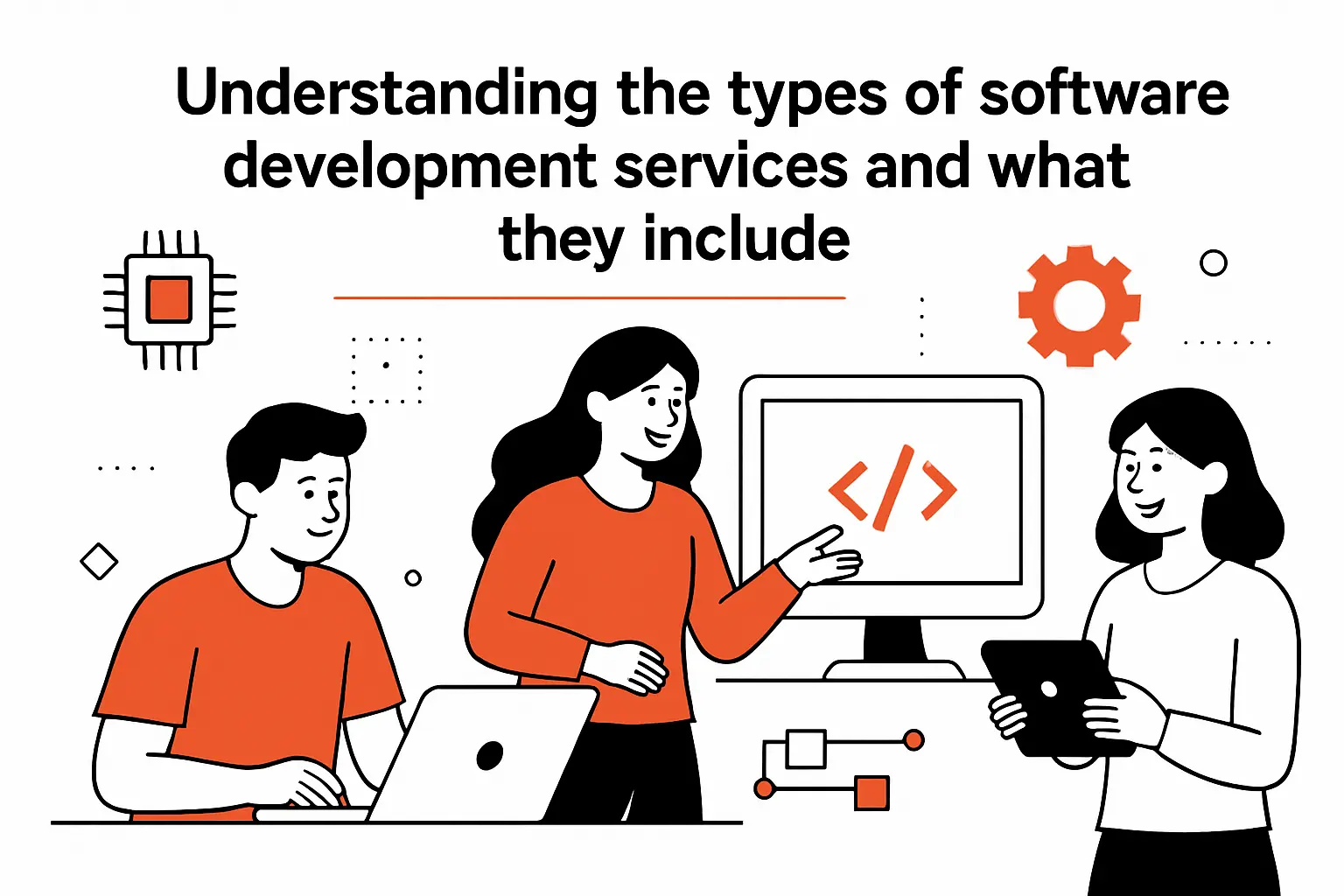
Understanding the types of software development services and what they include
1. What software development services are and the activities they cover
Software development services span far more than writing code. In our delivery work, the “service” usually begins with discovery: clarifying objectives, constraints, users, and existing systems, then translating those into requirements that an engineering team can implement and test. Architecture and design follow, not as abstract diagrams, but as concrete choices about data boundaries, failure modes, scalability, and security posture.
Execution includes implementation, automated testing, code review, infrastructure provisioning, deployment, observability, and incident response readiness. After release, the service continues through maintenance, performance tuning, security patching, and iterative product improvement driven by real usage. In other words, when a client asks us for “development,” we treat it as building and operating an outcome-driven capability, not just producing artifacts.
2. Why knowing different service types matters for budget, risk, and competitiveness
Budgeting becomes clearer when service types are explicit. A fixed-price web build, a long-running product engineering partnership, and a cloud migration program have fundamentally different cost drivers: uncertainty, integration depth, and operational burden. Without naming the service category, leaders often compare proposals as if every team is selling the same thing, which is how scope gaps quietly become “surprises” later.
Risk management also depends on categorization. For example, system integration work concentrates risk in data correctness and interoperability, while AI feature development concentrates risk in data quality, model drift, and compliance. Competitiveness, meanwhile, is shaped by how quickly a team can ship safely; selecting the wrong service type can slow delivery, inflate operational load, or lock the business into brittle tooling that competitors outgrow.
3. How service categories map to business outcomes like automation, efficiency, and growth
Different services create different kinds of leverage. Automation-focused work reduces cycle time and manual effort by embedding business rules into software workflows, which can unlock throughput without adding headcount. Efficiency-focused work often looks like modernization, performance engineering, or DevOps enablement, where the visible output is fewer incidents, faster releases, and less toil.
Growth-focused work typically centers on product development: new revenue experiences, self-serve onboarding, partner integrations, and data-informed personalization. Market context matters here; Gartner forecasts worldwide IT spending will total $6.08 trillion in the same environment where buyers demand faster value and higher reliability, which is why matching service types to business outcomes is no longer optional for modern leadership.
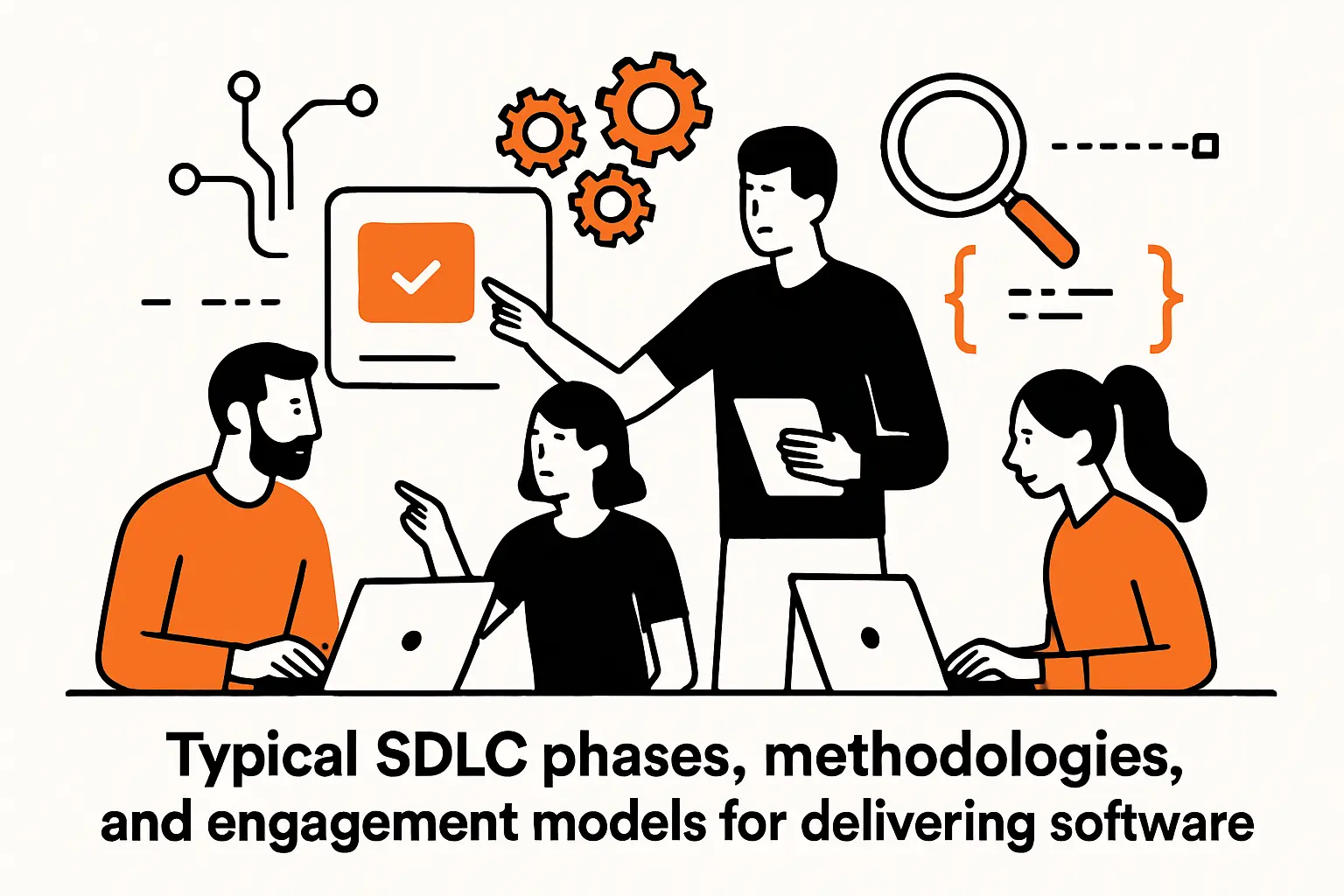
Typical SDLC phases, methodologies, and engagement models for delivering software
1. Requirement analysis and requirements management for setting project scope and success goals
Requirement analysis is the stage where a project either becomes clear and manageable or stays messy. In practice, we separate “nice to have” from “must have” by looking closely at user journeys, day-to-day business needs, and compliance rules. A good requirement should be easy to test and easy to understand. Anything less usually turns into confusion later.
Requirements management is the ongoing work of handling change. Instead of locking everything too early, we decide what can change safely and how those decisions will be written down. When someone asks, “Can we add this too?”, we turn that into clear trade-offs: how it affects the timeline, testing, security, and long-term maintenance.
Artifacts We Rely On in Real Projects
From our perspective, the most durable tool isn’t a template—it’s a shared language. A lightweight backlog with acceptance criteria, a dependency map, and a definition of done often prevents more rework than any single meeting, and it keeps business owners involved in choices that actually affect outcomes.
2. Design, early models, and proof of concept to check direction early
Design is the stage where we decide how the system should behave under pressure: when some parts fail, when connected services are slow, when traffic changes suddenly, and when user input is messy. Early models help us check the user experience, but they also help us test the technical direction—whether the data flow makes sense, whether the system connections can really work, and whether the security limits are practical.
A proof of concept is most useful when it helps rule out a bad idea early. For example, we have seen teams try to add live collaboration to a system that could not handle the speed or many users at once. A small, focused test can reveal that problem before a full build pushes the business down the wrong road. When leaders support early testing, they gain more confidence with a smaller investment instead of paying for expensive rework later.
3. Development, testing, release, and post-launch review and maintenance
Development is the part people can see, but it only works well when the support behind it is solid. During implementation, we focus on careful code review, clear branching rules, and automated testing that matches the level of risk. Testing is not a one-time step. It includes unit tests for logic, integration checks where systems connect, and full end-to-end testing for critical user journeys.
Release and post-launch review are where software meets the real world. Good observability—clear logs, metrics, tracing, and alerts—turns production into a feedback loop instead of a black box. Maintenance then becomes part of normal operations: update outside libraries, fix unusual edge cases, improve performance, and adapt to changing business rules without making the system unstable.
Why Maintenance Is a Product Strategy, Not a Tax
In our experience, maintenance maturity is what lets a business ship faster over time. Teams that neglect it accumulate brittle dependencies and deployment fear, while teams that invest in it gain the confidence to evolve features without breaking the foundation.
4. Common ways of working and delivery models, including Agile, step-by-step approaches, and DevOps
Ways of working are not beliefs to defend. They are tools for dealing with uncertainty. Agile works best when requirements may change and when decision-makers can give feedback often. A step-by-step delivery style lowers the risk of getting things wrong by releasing smaller pieces, learning from real use, and changing direction before too much time or money is spent.
DevOps is the operations side of that same idea. It shortens the gap between “the code is finished” and “the system is running safely.” Automating build, test, and release steps reduces human mistakes and makes releases more consistent. At TechTide Solutions, we treat DevOps as part of the product itself, because speed without safety just means failing faster.
5. Engagement options and team models: project-based, dedicated team, onshore, offshore, and nearshore
The way a team is set up affects how decisions are made and how quickly feedback moves. A project-based model works well when the scope is clear and the number of connections to other systems is small, because the contract can match a fixed set of results. A dedicated team works better when the product is still changing, because you are paying for steady progress and growing domain knowledge, not just one delivery.
Location choices also come with trade-offs. Onshore teams can make collaboration easier for work that needs a lot of shared context, while offshore or nearshore teams can give you more capacity if communication habits and documentation are strong. In our view, the best model is the one that keeps things clear: clear ownership, clear handoffs, and a delivery rhythm that stakeholders can realistically keep up with.
Custom software development vs off-the-shelf products and enterprise-grade solutions
1. When custom software development is the best fit for unique requirements
Custom development makes sense when software is a differentiator, not just an internal utility. If your workflows embody proprietary know-how—pricing logic, fulfillment orchestration, underwriting, or clinical pathways—then forcing the business into a generic product can erase the very advantage you’re trying to scale. Custom software also excels when integrations are deep and the “edge cases” are actually the core of the business.
From our vantage point, the strongest argument for custom work is strategic control. Custom systems can evolve with your market, protect data boundaries, and avoid dependency on a vendor’s roadmap. That said, custom is only worth it when the organization is ready to fund not just the build, but the operational lifecycle that follows.
2. Commercial off-the-shelf tradeoffs and customization considerations
Off-the-shelf software can be a pragmatic accelerator, especially for standardized functions like payroll, ticketing, or basic CRM. The trap appears when an organization buys a generic tool and then customizes it so heavily that upgrades become risky, support becomes complicated, and the team ends up maintaining a bespoke system with vendor constraints layered on top.
Customization decisions should be grounded in economics and resilience. If customization changes core data models or authentication flows, it can create long-term fragility. Alternatively, integrating a commercial product through stable APIs, event streams, or middleware often keeps the vendor relationship healthy while still letting the business build differentiated experiences on top.
3. Enterprise software development scope: planning, architecture, UX and UI, QA, and modernization
Enterprise software is less about “big codebases” and more about ecosystem complexity: identity systems, compliance demands, multiple user roles, long-lived data, and audit requirements. Planning and architecture must account for governance, segmentation of responsibilities, and the reality that multiple teams will change the system over time.
UX and UI in enterprise contexts are frequently underestimated. Internal tools must minimize cognitive load, reduce error rates, and support exception handling without punishing users. QA also shifts: test suites need to cover permissions, data correctness, integration behavior, and upgrade safety. Modernization becomes the long game—refactoring, platform upgrades, and incremental re-architecture that keeps the business running while the foundation is reinforced.
4. System integration and enterprise application integration for connecting tools and data flows
Integration work is where businesses either achieve “single source of truth” or end up with dueling spreadsheets. Good enterprise application integration treats data contracts as products: versioned schemas, clear ownership, and explicit error handling. When integrations are fragile, teams end up doing operational firefighting instead of improving capabilities.
In practice, we decide early whether an integration should be synchronous or asynchronous, whether it should be event-driven, and how to reconcile mismatched identifiers across systems. Real-world examples are everywhere: retailers syncing inventory between storefronts and warehouses, logistics firms reconciling shipments across carriers, and healthcare systems exchanging clinical data with strict privacy controls. The service value isn’t just “making systems talk,” but making them talk predictably, securely, and audibly.
Web development services across the stack: front-end, back-end, and full-stack
1. Web solutions spectrum: websites, web apps, and web portals built for browsers
Web development spans a spectrum. Marketing websites emphasize content performance, accessibility, and brand fidelity, while web applications prioritize interaction design, state management, and secure data access. Portals add another layer: role-based access, complex permissions, document workflows, and integration with internal systems.
For businesses, the web is often the first and most scalable distribution channel. A well-built browser experience can become a sales engine, a support surface, or an internal productivity platform. In our projects, the key is matching the build to the intent: a content-driven site should not inherit the complexity of an enterprise portal, and a portal should not be treated like a simple site with a login screen.
2. Cross-browser and mobile-browser compatibility as a core web quality requirement
Browser compatibility is a business requirement disguised as a technical detail. Different browsers and devices vary in rendering behavior, memory constraints, and security features, so “works on our laptops” is not a definition of done. Compatibility work involves responsive layout discipline, performance profiling, and testing against the browsers your users actually rely on.
Mobile-browser constraints often expose architectural weaknesses. Heavy pages, excessive client-side computation, or chatty network calls can turn a smooth desktop experience into a frustrating mobile experience. When teams treat compatibility as a first-class quality attribute, support tickets drop and adoption rises, because users stop encountering invisible barriers that make the product feel unreliable.
3. Front-end development for user-facing design, interactivity, and user experience
Front-end engineering is where user trust is either earned or lost. Visual polish matters, but consistency matters more: predictable navigation, understandable error states, and interactions that feel responsive even when the network is slow. We treat the front end as a system with architecture—component boundaries, state strategy, and performance budgets—not as an afterthought layer.
Accessibility is also part of quality. Semantic markup, keyboard navigation, and readable contrast aren’t just compliance checkboxes; they’re features that expand who can successfully use the software. In modern businesses, the front end is often the “product” customers experience, so front-end services are inseparable from brand and revenue outcomes.
4. Back-end development and server-side logic for performance, security, and data processing
Back-end development is where business logic becomes enforceable. Data modeling, authorization, validation, and workflow orchestration live here, and those decisions determine whether the system behaves correctly under real-world pressure. Performance is not only about speed; it’s about predictable latency, graceful degradation, and sensible resource use.
Security is deeply tied to server-side design. Authentication and authorization boundaries must be explicit, secrets must be handled carefully, and logging must support forensic analysis without leaking sensitive data. From our experience, the most expensive back-end failures are rarely exotic hacks; they’re ordinary oversights like inconsistent access control or unbounded queries that collapse under load.
5. Full-stack development for end-to-end ownership and rapid MVP delivery
Full-stack development works well when speed and coherence matter more than specialized depth, especially for early-stage products and internal tools. End-to-end ownership reduces handoff friction: the same team that designs a workflow also builds the API and the UI that consumes it. That alignment tends to produce simpler systems with fewer mismatched assumptions.
Still, full-stack does not mean “one person does everything forever.” As the product grows, specialization becomes valuable—security, data engineering, performance, and platform operations become their own disciplines. The strongest full-stack service we can offer is not heroics; it’s a clear path from MVP to maintainable scale without rewriting everything from scratch.
Mobile and desktop application development services: platform strategies and tradeoffs
1. Mobile app development approaches: native, hybrid, and cross-platform builds
Mobile strategy is a business decision expressed in code. Native development often provides the best platform fit, while hybrid and cross-platform approaches can accelerate delivery when teams need to support multiple devices with shared logic. Choosing the approach depends on performance requirements, UI complexity, offline needs, and how often the app must leverage device-specific features.
At TechTide Solutions, we push for explicit tradeoff conversations early. If a mobile app is the primary revenue channel, performance and polish usually justify deeper native investment. If the app is primarily a companion to an existing web platform, a shared-code approach may reduce time-to-value without sacrificing core reliability.
2. Native iOS and Android development for platform-specific performance and experience
Native development aligns with each platform’s design language and capabilities. That alignment matters for responsiveness, accessibility, and integration with system-level features like push notifications, secure storage, background tasks, and device biometrics. Native also tends to simplify debugging because the stack is closer to the platform’s standard tooling and performance profiling.
Platform nuance is a competitive edge when your product depends on feel. Fintech apps, messaging experiences, and media-rich products often win or lose on subtle interaction details. In these cases, native services can reduce friction, increase trust, and improve retention because the software behaves the way users instinctively expect.
3. Cross-platform frameworks for sharing codebases while supporting multiple devices
Cross-platform development can be a powerful multiplier when the business needs broad reach with constrained engineering capacity. Shared UI components and shared business logic reduce duplication and can speed iteration. The hidden cost appears when teams push too much platform-specific behavior into a shared abstraction and then fight the framework instead of leveraging it.
A sensible cross-platform strategy respects boundaries. Business rules, networking, and state management can often be shared effectively, while platform-specific UI patterns and deeply native features may need dedicated handling. When that line is drawn thoughtfully, cross-platform services deliver speed without turning the app into a lowest-common-denominator experience.
4. Desktop application development for offline capabilities and specialized workflows
Desktop applications remain essential when offline work, high-performance local processing, or deep system integration is required. Think of creative tools, industrial workflows, secure internal systems, or environments with unreliable connectivity. Desktop services also make sense when organizations need controlled distribution, strict device policies, or integration with specialized peripherals.
In our view, desktop development is often a “workflow integrity” play. A well-designed desktop app can reduce errors in complex tasks by guiding users through validated steps, caching data safely, and syncing changes reliably when connectivity returns. For certain businesses, that reliability is worth more than the convenience of being browser-only.
Cloud, SaaS, and DevOps services for scalable and continuously delivered software
1. Cloud software development and cloud computing for flexibility and scalability
Cloud development is not simply “hosting on someone else’s computers.” It’s a set of choices about elasticity, managed services, security boundaries, and operational responsibility. When done well, cloud services let businesses scale capacity with demand, shorten provisioning time, and standardize environments so teams stop debugging “it works on my machine” problems.
Market adoption reinforces the importance of getting cloud right. Gartner forecasts worldwide public cloud end-user spending will total $723.4 billion, and that spend is largely driven by organizations seeking speed, reliability, and access to advanced capabilities like managed databases and AI-ready infrastructure rather than raw servers.
2. Cloud-native development with microservices and containers
Cloud-native development aims to make software resilient by design. Containers standardize runtime environments, while service-oriented architectures can let teams deploy and scale components independently. That independence, however, introduces distributed systems complexity: network failures, partial outages, and consistency challenges become normal rather than exceptional.
For many businesses, the right approach is pragmatic cloud-native: modular boundaries where they add value, shared platforms where they reduce risk, and a disciplined approach to service contracts. We’ve seen companies succeed by starting with a well-structured modular monolith and extracting services only when organizational scale or operational needs demand it, because complexity should be earned, not assumed.
Operational Reality Check
In production, the hardest part of microservices is rarely coding; it’s observability, incident response, and version management across moving parts. Cloud-native services should therefore include logging and tracing conventions, deployment strategies that reduce blast radius, and clear ownership boundaries across teams.
3. Cloud service models: SaaS, PaaS, and IaaS and when to use each
SaaS, PaaS, and IaaS are shorthand for who owns what. SaaS maximizes speed by outsourcing most operational burden, making it attractive when differentiation is not in the underlying platform. PaaS provides managed building blocks—databases, queues, identity services—that reduce infrastructure toil while still allowing custom application logic. IaaS gives maximum control but also demands the most operational maturity.
Choosing a model is ultimately about focus. When a business needs to move quickly on customer value, SaaS or PaaS often keeps the team’s attention on product rather than servers. When compliance, data locality, or specialized performance constraints dominate, IaaS or hybrid strategies can be justified, provided the organization is prepared to operate the resulting complexity.
4. DevOps practices, automation, CI and CD, monitoring, and continuous deployment
DevOps is where software development services become repeatable delivery. Automation turns deployments into routines rather than ceremonies, while CI pipelines enforce quality gates continuously instead of relying on end-stage heroics. Monitoring and alerting convert runtime behavior into actionable signals, allowing teams to fix issues before customers become the detection mechanism.
From a business lens, DevOps services reduce lead time, lower risk per release, and improve resilience under change. The reliability community has documented these operational practices extensively; Google’s Site Reliability Engineering resources capture a practical view of service ownership, error budgeting, and operational discipline that we’ve found useful when guiding clients from “shipping code” to “running products.”
Specialized types of software development services: data, AI, embedded systems, and emerging tech
1. Data science development for analytics, prediction, and insight-driven decisions
Data science services sit at the intersection of business questions and messy reality. Teams often begin with a desire for dashboards or forecasting, but value appears only after data is cleaned, modeled, and governed. In practical terms, data science development includes feature engineering, experiment design, model evaluation, and the pipelines that keep data fresh and trustworthy.
In our experience, the hardest part is not algorithms; it’s semantics. If “customer,” “order,” or “active user” means different things across departments, then analytics becomes political rather than operational. Strong data services define a shared vocabulary, enforce data contracts, and ensure the business is making decisions based on consistent definitions rather than competing spreadsheets.
2. AI and machine learning development for intelligent features and automation
AI and machine learning services turn patterns in data into product capabilities: recommendations, anomaly detection, routing, classification, and intelligent search. The delivery challenge is that ML systems behave probabilistically, so quality must be defined differently than in deterministic software. Model performance, fairness, and drift monitoring become part of the acceptance criteria.
Organizational readiness matters as much as modeling technique. Without robust data pipelines, privacy controls, and a clear plan for human oversight, ML features can degrade quietly over time. We treat ML delivery as an operational system: versioned models, traceable training data, and deployment strategies that allow safe iteration rather than risky “big flips.”
3. Generative AI in software development: code generation, review, testing, and modernization support
Generative AI has moved from novelty to workflow accelerator, especially in software engineering tasks like scaffolding, refactoring suggestions, test generation drafts, and documentation. Strategic interest is also backed by macroeconomic research: McKinsey estimates generative AI could add $2.6 trillion to $4.4 trillion annually in value across use cases, which explains why so many businesses now expect their software vendors to have an opinionated stance on AI-assisted delivery.
Guardrails remain non-negotiable. When we integrate generative tooling into engineering workflows, we focus on governance: preventing sensitive data leakage, enforcing secure coding patterns, and requiring human review where correctness or security matters. The goal is not to replace engineering judgment; it’s to reduce toil so judgment can be applied where it counts.
Where We See the Best ROI
In practice, repetitive code transformations and test scaffolding are strong candidates for assistance, while architecture, threat modeling, and domain-critical logic still demand careful human ownership. That division keeps quality high while still capturing speed gains in the “boring but necessary” layers of development.
4. Database development services: design, integration, migration, and efficient data retrieval
Database services are often where performance and correctness are decided. Schema design must reflect real query patterns, not idealized entity diagrams, and indexing strategies must be informed by actual access paths. Integration work includes data ingestion, synchronization, and conflict resolution when multiple systems touch the same records.
Migration is especially delicate because it blends technical and operational risk. A safe migration plan addresses backfill strategy, dual writes where needed, rollback scenarios, and validation of data integrity. From our perspective, the best database services are invisible to users: the software feels faster, more reliable, and more consistent, even though the change happened deep in the foundation.
5. Embedded systems development for software-hardware integration in connected devices
Embedded development ties software behavior to physical reality. Device constraints—battery, memory, real-time response, and environmental conditions—shape architecture differently than in web platforms. Firmware updates, secure boot considerations, and safe recovery paths become central because a broken update can brick hardware in the field.
Business impact can be enormous. Connected devices in logistics, manufacturing, and healthcare often produce the data that powers analytics and automation upstream. Engineer embedded services for reliability and security so the organization gains trustworthy telemetry and predictable behavior, not a fleet of brittle endpoints that constantly need manual intervention.
Security Is Not Optional in Firmware
Hardware-rooted trust, signed updates, and careful key management are the difference between a manageable device ecosystem and a long-term liability. For that reason, embedded services should be delivered with threat modeling and update strategy as first-class deliverables, not late-stage add-ons.
6. Additional emerging categories including blockchain development and game development
Teams usually choose emerging categories for strategy, not for technical novelty. Use blockchain development when you need multi-party trust, auditability, or tamper resistance—otherwise, conventional cryptographic audit trails and strong access control often fit better. Game development services, meanwhile, often apply beyond entertainment, showing up in training simulations, interactive marketing, and immersive product education.
At TechTide Solutions, we evaluate emerging tech through a simple lens: does it reduce coordination cost, unlock new revenue experiences, or improve trust in the system? When the answer is unclear, we recommend a constrained experiment rather than a platform bet, because hype-driven architecture is how businesses end up funding complexity without capturing durable value.
7. Software development tools and environments that boost productivity and testing coverage
Tooling is a service category that many buyers forget to ask for, even though it shapes delivery speed and defect rates. Developer environments, automated linting, static analysis, dependency scanning, and reproducible builds reduce friction and improve consistency across teams. Testing infrastructure—mock services, seeded datasets, and reliable CI environments—turns “works locally” into “works predictably.”
Security tools increasingly matter as well, because modern applications depend on large ecosystems of third-party packages. NIST’s Secure Software Development Framework (SSDF) captures a clear set of practices for integrating security into the development lifecycle, and we’ve found it aligns well with practical service delivery: define security requirements early, protect the build pipeline, and respond to vulnerabilities as a routine operational motion.
TechTide Solutions: building custom software tailored to customer needs
1. Turning business goals into clear requirements, architecture, and delivery plans
Our approach starts with translation. Business goals tend to arrive as narratives—“reduce churn,” “speed up onboarding,” “eliminate manual approvals”—and we convert them into requirements we can build, test, and measure. Along the way, we surface constraints that materially affect outcomes: data availability, regulatory obligations, legacy dependencies, and operational readiness.
Architecture then becomes the bridge between aspiration and reality. We design boundaries that match how the business works, define data ownership, and choose integration patterns that minimize fragility. A delivery plan follows that respects risk: validate uncertain assumptions early, ship incrementally, and maintain a clear path from MVP to maintainable scale.
2. Developing end-to-end custom solutions across web apps, mobile apps, and cloud backends
End-to-end delivery is where we’re most effective, because it reduces the gaps that appear when multiple vendors split responsibility. Our teams build web applications, mobile experiences, and cloud backends as a coherent system with consistent security, shared domain language, and aligned observability. That cohesion matters when a single user action spans UI, API, database, and third-party services.
Real-world patterns repeat across sectors. We’ve built customer portals that reduce support load, internal workflow tools that replace email-driven approvals, and integration layers that turn scattered operational data into reliable system behavior. When the core architecture is clean, feature delivery becomes a steady cadence rather than a series of brittle hacks.
3. Ensuring long-term value with QA, DevOps automation, system integration, and ongoing support
Long-term value is earned after launch, not at launch. Our QA approach emphasizes risk-based testing, automation where it prevents regressions, and clear acceptance criteria tied to business outcomes. DevOps automation then turns releases into repeatable operations, reducing downtime and making improvements easier to ship.
System integration and ongoing support function as continuous partnerships, not ticket queues. Security risk is a practical business concern; IBM reports the global average cost of a data breach reached $4.88 million, and we’ve seen firsthand how disciplined patching, access control, and monitoring reduce both incident likelihood and incident impact in real production environments.
Conclusion: how to choose the best mix of software development services
1. Match service types to users, platforms, timelines, and integration requirements
Service selection improves when it starts with users and constraints instead of technology trends. Internal tools, customer-facing products, data platforms, and embedded systems each demand different success criteria and different risk controls. Platform strategy should follow reality: browser-first when distribution matters, mobile-first when engagement depends on device affordances, and cloud-first when scalability and speed of iteration are strategic advantages.
Integration requirements are the deciding factor more often than leaders expect. If your software must connect to identity providers, ERPs, data warehouses, and partner APIs, then you should budget integration services and architectural discipline as first-class work. Market sizing helps explain the gravity of these choices; Statista projects worldwide enterprise software revenue at US$316.69bn, and in that competitive landscape, execution quality is often the difference between software that compounds value and software that becomes operational drag.
2. Plan beyond launch: security, testing strategy, and maintenance as part of the decision
Beyond launch, the winners are the teams that plan for change. Embed security in design and delivery, not when you schedule a penetration test. Testing strategy should reflect business risk: protect the workflows that move money, change permissions, or handle sensitive data, and automate the checks that prevent regressions in those areas.
Maintenance is the final selection criterion that too many organizations ignore until it hurts. If you’re choosing a mix of software development services today, what is the next-step decision you can make this week—requirements clarity, delivery automation, integration governance, or security discipline—that will make every future release easier rather than harder?