
Startup project management is not “ceremony”; it is a survival mechanism that turns scarce time, scarce cash, and scarce attention into coherent delivery. In the broader software economy, Gartner estimated the enterprise software market reached $900 billion in 2024, and that scale matters because startups increasingly compete by composing the same kinds of software building blocks as incumbents—just with fewer people and less margin for error. At TechTide Solutions, we treat project management as the operating system that keeps product, engineering, and go-to-market from drifting into parallel universes.
1. Why startup project management matters for survival and scaling
1. Workflow efficiency: structured execution, progress tracking, and deadline visibility
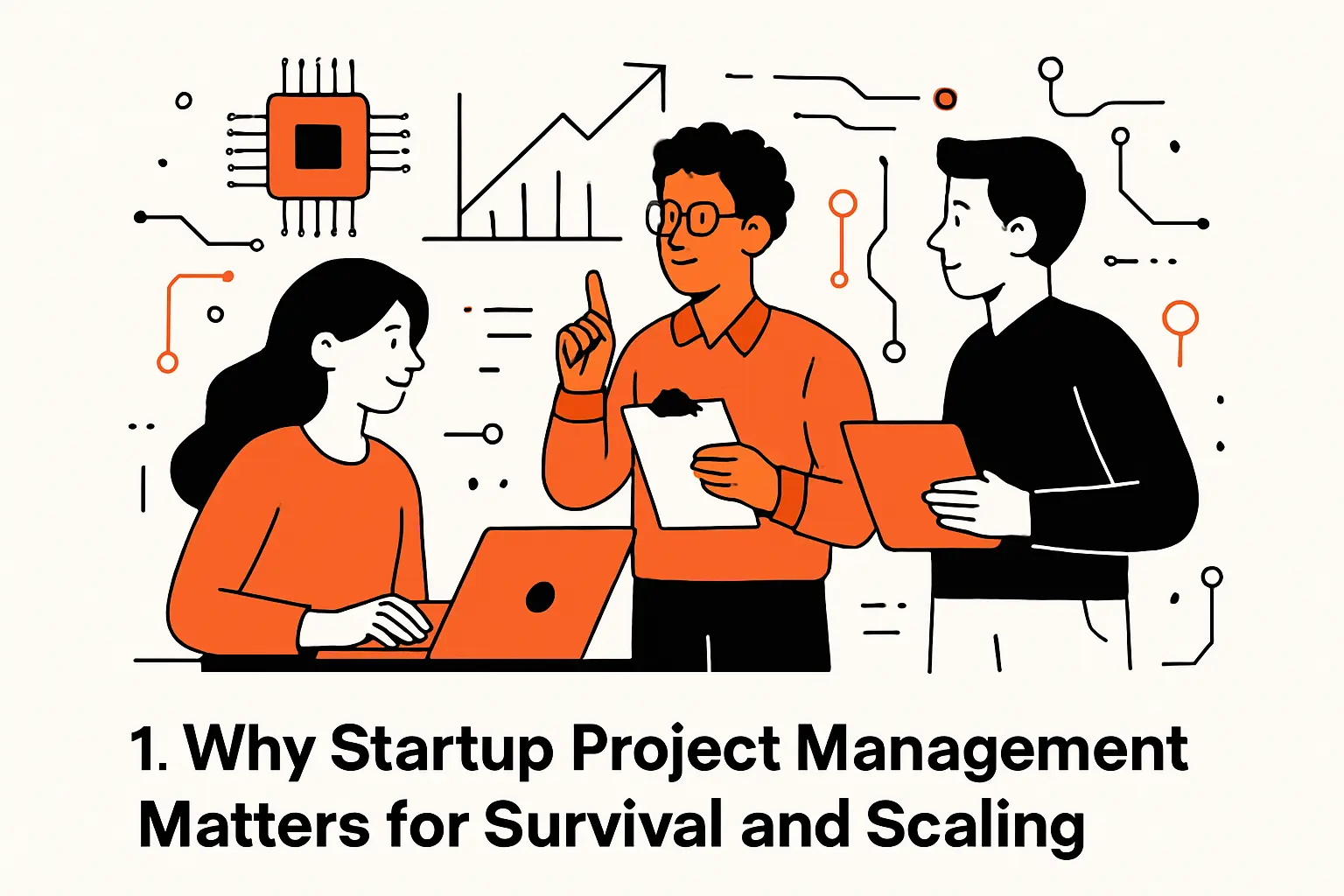
Execution speed in a startup is rarely about typing faster; it is about removing ambiguity so work can flow. A lightweight workflow turns “we should build X” into a chain of decisions: what “done” means, what must be validated first, and what dependencies can silently block progress. In our delivery teams, a clear backlog and a visible “in progress” column are less about micromanagement and more about making hidden queues visible before they become hidden fires.
Pragmatically, we aim for a single operational narrative: a short list of goals, a prioritized set of deliverables, and an explicit owner for each major outcome. Founders often underestimate how much deadline visibility shapes customer trust; missed promises create a reputational debt that is harder to refinance than technical debt. When a launch date is visible and connected to work items, a startup can have honest conversations early: “Do we cut scope, add capacity, or move the date?”
Real-world example: we have seen early-stage teams integrate product marketing milestones (demo scripts, onboarding emails, pricing page updates) into the same delivery board as engineering work. That small change stops the classic “engineering shipped, marketing isn’t ready” stall, because the workflow reflects reality: shipping is a cross-functional event, not a code event.
2. Risk reduction and business continuity in fast-changing environments
Startups live inside moving goalposts: customer needs shift, competitors copy features, platforms change APIs, and regulations show up uninvited. Project management becomes the discipline of noticing risk while it is still cheap. In our work, risk reduction looks like a few habits: documenting assumptions, tracking external dependencies, and forcing early visibility when an uncertainty can no longer be ignored.
Continuity is the underrated half of risk management. A startup can survive a late feature; it struggles to survive a late feature paired with a team member leaving, a vendor outage, or a security incident. That is why we encourage “bus-factor thinking” even for tiny teams: key workflows should be repeatable, access should be shared appropriately, and critical knowledge should not live exclusively in private chat messages.
Technically, continuity also means designing delivery so it can be resumed. When work is chunked into cohesive slices—each with tests, deployment steps, and a rollback story—another engineer can pick it up without reverse-engineering intent. Process is the scaffolding that makes that kind of modular execution normal rather than heroic.
3. Accountability, productivity, and resource discipline for lean teams
Lean teams do not fail because they lack effort; they fail because effort becomes diffused. Accountability is how a startup turns collective ambition into owned outcomes without creating bureaucracy. The pattern we see working best is simple: name a directly responsible individual for each deliverable, give them the authority to make local tradeoffs, and hold them accountable for surfacing risks early.
Resource discipline matters because every hour spent on low-leverage work is an hour not spent validating product-market fit or strengthening retention. In practice, that discipline shows up in small decisions: limiting work in progress, finishing before starting, and avoiding “maybe someday” tasks that create false momentum. A startup that cannot say no to tasks is usually a startup that cannot say yes to a strategy.
Culture is the final lever. When accountability is paired with psychological safety, people report bad news early, which is exactly what a founder needs. When accountability becomes blame, delays and defects hide until the worst possible moment, and the team ends up “managing the narrative” instead of managing the work.
2. Responsibilities, ownership, and the startup project manager role
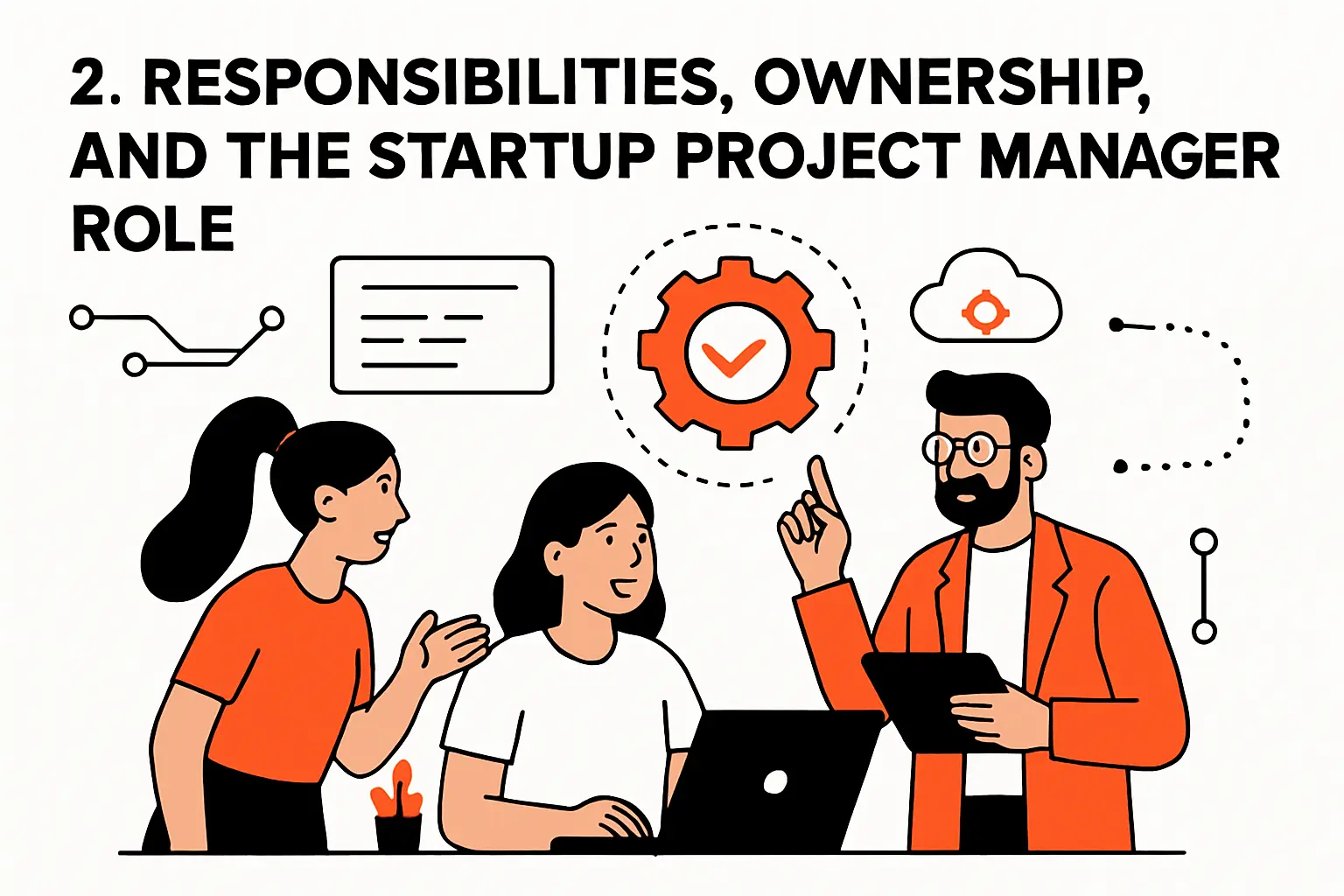
A startup project manager is not a meeting scheduler. The role is closer to an operating partner who turns company intent into execution. At TechTide Solutions, we’ve worked with visionary founders drained by coordination. We’ve also seen fast engineering teams repeatedly ship the wrong thing. In both cases, a capable PM changes the trajectory by translating strategy into decisions and decisions into delivery.
1. The PM as the bridge between founder goals and the delivery team
The founder speaks in outcomes: growth, retention, revenue, runway, partnerships, trust. The delivery team speaks in constraints: architecture, bandwidth, risk, interfaces, and testability. The PM’s bridge is not a document; it is an ongoing translation layer that turns goals into a coherent backlog, acceptance criteria, and a release narrative.
In our engagements, a strong PM keeps answering three questions in plain language. Why are we doing this? What does success look like? Just as important, what are we not doing right now? That last question is the secret weapon, because non-goals are where scope creep goes to die. When non-goals are explicit, engineers can make faster decisions without fear that every edge case is suddenly in scope.
On the ground, bridging also includes protecting engineers from thrash. When stakeholders bypass prioritization and drop urgent requests into chat, delivery becomes reactive. A PM who calmly funnels inputs through a visible triage process—without being a blocker—keeps the team focused while still honoring the business reality that priorities can shift.
2. Startup PM versus enterprise PM: broader duties, looser roles, faster pivots
Enterprise PMs often operate inside stable systems: mature teams, predictable budgets, and formal governance. Startup PMs live in a different ecosystem: role boundaries blur, and the PM may be part product manager, part analyst, part customer success translator, and part release manager. That breadth is not a badge of honor; it is a response to early-stage constraints.
In a startup, pivots are not exceptions—they are part of the operating rhythm. The PM must zoom out to reframe the goal, then zoom in to re-plan the next work slice without draining morale. From our perspective, that is the biggest difference. Enterprise PMs can lean on process to create alignment. Startup PMs usually have to create alignment first, then use minimal process to keep it.
Tools and artifacts also change. Enterprises can afford heavy documentation because the cost of misalignment across departments is enormous. Startups pay a different tax: documentation that is too heavy becomes a drag, while documentation that is too light becomes tribal knowledge. The startup PM’s craft is right-sizing the artifacts so the team stays fast without becoming fragile.
3. Decision-making models: when centralized technical leadership increases speed
Not every decision should be democratic, especially under deadline pressure. A startup often moves fastest when technical decision-making is centralized under a trusted lead (a CTO, staff engineer, or “architect on point”) who can resolve disputes and set standards. That centralization is healthy when it is transparent, documented, and paired with feedback loops.
At TechTide Solutions, we like decision models that reduce re-litigation. For example, a lightweight architecture decision record process captures the “why” behind a choice, so the team can stop debating it every time a new engineer joins. Similarly, a clear escalation path (“if it blocks delivery, we decide within a day”) prevents paralysis when tradeoffs get uncomfortable.
Centralized leadership becomes dangerous when it turns into bottlenecking. A practical guardrail is to centralize principles and interfaces while decentralizing implementation. When a lead sets the contract and the quality bar, teams can build in parallel with fewer collisions, and the PM can plan delivery with fewer surprise reversals.
3. Choosing a startup project management methodology
Methodology is not an identity; it is a tool. Startups sometimes adopt a named framework as a proxy for maturity, but the real maturity is choosing a method that fits your product uncertainty, team composition, and delivery risk. In research on organizational agility, McKinsey noted that agile transformations can unlock improvements of 30 to 50 percent across operational-performance metrics, and that framing matters because startups are typically trying to buy speed with better coordination, not with more headcount.
1. Scrum: sprints, daily communication, and feedback after each sprint
Scrum fits startups when the work is complex, customer feedback is essential, and the team needs a cadence that forces prioritization. The most important Scrum benefit is not the sprint; it is the recurring moment of truth where the team must show what is actually done. That “demo gravity” prevents long stretches of invisible work that only becomes visible when it is too late to course-correct.
In our experience, Scrum works best when product discovery and delivery are tightly coupled. A startup building a new onboarding flow, for instance, can run experiments in parallel with implementation: prototypes inform backlog items, and sprint reviews validate whether the team is learning. That cycle creates a healthy rhythm: learn, build, validate, adjust.
Scrum fails in startups when it becomes theater. If the sprint backlog is constantly overridden by ad hoc requests, daily standups become status reporting, and the retrospective becomes a complaint session, the framework is not the issue—leadership commitment is. A PM should protect the sprint boundary while still allowing controlled interrupts for true emergencies.
2. Kanban: visual workflow, flexible timelines, and rapid adaptation to change
Kanban shines when startup work arrives as a constant stream. Customer issues, infrastructure tasks, partner requests, and small product improvements all fit that pattern. Rather than timeboxing, Kanban emphasizes flow, which often suits teams supporting a live product while still shipping new features.
Visual workflow is the core. When work states are explicit—queued, in progress, in review, blocked, ready to ship—teams can spot constraints early. In our delivery practice, simply introducing a “blocked” state with a clear reason has prevented weeks of silent delay, because “blocked” forces a conversation: who can unblock it, and what tradeoff will we accept?
Kanban also encourages operational honesty. A work-in-progress limit is not a rule to enforce; it is a signal that context switching is eating the team. When the board shows too many items stuck in review, the problem is not “more tickets”; the problem is usually a missing quality gate, unclear acceptance criteria, or inadequate testing strategy.
3. Waterfall and Critical Path Method: when sequential planning and dependencies fit
Waterfall and critical path thinking are still useful when the work is genuinely sequential: data migrations, compliance-driven changes, platform deprecations, and infrastructure moves where dependencies dominate. Startups sometimes reject sequential planning on principle, but reality does not care about ideology. If a database schema must be migrated before a feature can safely ship, acknowledging that dependency is responsible, not old-fashioned.
Critical path thinking helps founders face a hard truth. Some tasks do not matter until a specific task is finished. No amount of parallel work will change that. For a startup integrating a payment provider, the critical path may include approvals, security reviews, integration testing, and go-live coordination. A PM who maps those dependencies early can prevent a classic surprise. The code may be ready, but non-code tasks can still block launch.
From a technical delivery angle, sequential planning pairs well with explicit risk buffers and validation gates. The trick is to keep planning crisp: define the milestones, define the acceptance criteria, and avoid pretending you can predict every edge case. Even in a sequential plan, feedback loops still belong—just at the right checkpoints.
4. Initiation and discovery: setting direction before building
Discovery is where a startup either buys clarity or buys regret. Founders often want to start building because it feels like progress. Yet building the wrong thing is the most expensive kind of movement. At TechTide Solutions, our stance is blunt: initiation is a delivery phase, not a prelude. It produces artifacts that reduce rework, including scope boundaries, risk lists, and testable definitions of success.
1. Project discovery: clarify scope, schedule, and early risks
Good discovery is a structured conversation that turns fuzzy intent into executable hypotheses. That usually includes stakeholder interviews, a user journey map, a lightweight technical review, and a first-pass delivery plan that highlights uncertainty. A PM’s job is not to create false certainty; it is to name what is known, what is unknown, and what must be proven first.
Customer validation belongs here, not later. In a well-known CB Insights analysis covered by CNBC, 42 percent of failed startups cited “no market need” as a reason for failure, and that single insight should haunt every kickoff meeting in a productive way. Before committing engineering effort, a startup should be able to articulate the target user, the painful job-to-be-done, and the measurable signal that the solution is working.
Early risks are often non-technical. Partnerships, legal constraints, and procurement timelines can become the real blockers. A discovery phase that surfaces these constraints gives the founder options: adjust scope, change sequencing, or choose a different approach before sunk costs harden the plan.
2. Set realistic goals and define deliverables early to limit scope creep
Scope creep is rarely malicious; it is usually the natural result of learning. The solution is not to forbid change—it is to manage change with explicit tradeoffs. In our delivery practice, we encourage startups to define deliverables in a way that is testable: “users can accomplish X without assistance” is better than “improve onboarding,” because the team can validate it.
Clarity requires subtraction. Alongside deliverables, we define exclusions: capabilities that sound related but are intentionally postponed. That list prevents the “while we’re here” phenomenon where a simple feature becomes a platform. When exclusions are documented, stakeholders can still request changes, but those requests become conscious decisions rather than accidental expansions.
Realistic goals also depend on acknowledging engineering constraints early. If the startup has legacy code, unknown data quality, or a brittle deployment pipeline, those realities must be part of the plan. A PM who pretends complexity does not exist may keep morale high for a week, but they will pay for it with disappointment later.
3. Agreements and governance: pricing model, written terms, and NDA alignment
Startups often treat agreements as paperwork, yet governance is how you prevent misunderstandings from turning into expensive conflict. When we engage with founders, we push for clarity on scope boundaries, change management, ownership of work products, and responsibilities for infrastructure, access, and approvals. That is not legal theater; it is operational hygiene.
Pricing models are part of governance because they shape behavior. A fixed-scope agreement encourages heavy up-front definition and strict change control, which can be useful for well-understood work but risky for ambiguous product exploration. A time-and-materials model, by contrast, rewards transparency and iterative learning, but it requires a strong PM discipline around prioritization so the startup does not “buy activity” instead of outcomes.
NDA alignment matters more than it appears. Teams move faster when they know what can be shared, where sensitive information lives, and how access is granted and revoked. For remote teams in particular, access governance is a daily operational reality, not a compliance checkbox.
5. Lightweight planning and documentation that still scales
Startups have a justified allergy to bureaucracy, but “no documentation” is not the same as “lean documentation.” We build lightweight systems that scale by focusing on high-leverage artifacts: a crisp product brief, a visible roadmap, and decision records that prevent circular debates. The goal is not to write more; the goal is to write the minimum that reduces rework and improves parallelism.
1. No fillers: right-size PRDs, plans, and meetings to what’s truly needed
We prefer documents that answer real questions. A right-sized PRD clarifies the user problem, success criteria, constraints, and acceptance checks. Anything that does not change a decision is optional. In our experience, startups get the most leverage from short documents that are actively used rather than long documents that are politely ignored.
Meeting discipline is part of planning. Instead of recurring meetings out of habit, we recommend meetings that exist to make decisions: backlog grooming to confirm priority, kickoff meetings to confirm scope boundaries, and retrospectives to improve execution. When meetings become status theater, they drain momentum and teach the team that communication is performance, not clarity.
Templates help without ossifying. A consistent structure for tickets, user stories, and risk notes makes collaboration smoother, especially when contractors or new hires join. Consistency is a scaling strategy because it reduces the cognitive load of figuring out “how we work” every time someone touches a new part of the system.
2. Overcommunicate the critical goals and deadlines, minimize noise on minutiae
Communication is not about volume; it is about signal. We push startups to overcommunicate a small set of critical goals so every contributor can make aligned micro-decisions. When the entire team knows the next release theme, the key quality bar, and the business deadline that matters, engineers can resolve edge cases without constantly escalating.
Noise, by contrast, is corrosive. Too many channels, too many partial updates, and too many competing priorities create a fog where nobody is sure what matters. A practical approach is to define a few “canonical” places for truth: the project board for task state, a short weekly narrative for stakeholders, and a decision log for technical choices.
We also treat asynchronous communication as a feature, not a compromise. Written updates reduce meeting load, create institutional memory, and make remote work feel less like an interruption parade. The trick is to set expectations: what must be documented, where it lives, and how quickly people should respond.
3. Architecture and design: define interfaces early, defer deeper decisions until needed
Architecture is where startups often overbuild. Our bias is to define interfaces early: APIs, data contracts, and integration boundaries. Then we defer deeper implementation choices until reality forces them. That approach lets teams build in parallel and reduces the risk that early architecture becomes a cage.
Interface first design is especially powerful in startups because it supports experimentation. A team can swap an internal implementation while preserving external behavior. As a result, iteration speeds up without constantly breaking other workstreams. When we build MVPs, we usually start with a thin vertical slice. Later, we harden the contract as real learnings accumulate.
Decision records are the glue. When the team captures why an approach was chosen, future refactors become less emotional and more rational. That is how you scale technical coherence without turning the startup into a committee.
6. Execution habits that keep projects moving
Execution is where the gap between plans and reality shows up, and startups cannot afford to live in that gap for long. At TechTide Solutions, we focus on habits that compound: ruthless prioritization, early integration, transparent reporting, and sustainable pacing. Tools can support these habits, but no tool can replace them.
1. Prioritize projects and tasks, work on the most critical items first
Priority is a resource allocation decision disguised as a list. A startup that treats everything as urgent ends up shipping nothing with confidence. We recommend forcing hard comparisons: which task most reduces customer pain, which item most reduces delivery risk, and which change most improves the business metric the founder actually cares about.
Sequencing is the hidden art. Some tasks unlock other tasks, while others merely feel productive. When we plan delivery, we look for “unlockers” early: foundational plumbing, risky unknowns, and integration points that could surprise us. That discipline shortens the feedback loop and makes later work calmer.
Tradeoffs should be explicit. If a feature is important but not urgent, write it down and schedule it; if it is urgent but not important, question why it exists. In the healthiest teams we have supported, priority is not a debate; it is a shared understanding reinforced by consistent decision-making.
2. Integrate and test early: protect QA time and avoid quality shortcuts
Early integration prevents late panic. When teams delay integration, they accumulate invisible incompatibilities: mismatched assumptions, brittle interfaces, and untested edge cases. Our approach is to integrate continuously so the system stays in a shippable state, even if not every feature is enabled.
Testing strategy is part of project management because quality is a schedule issue. A startup that “borrows” QA time to ship faster often pays back that debt with customer churn, support load, and emergency patches. Instead, we encourage a layered approach: automated checks for regressions, meaningful code review standards, and a clear definition of what must be manually validated before release.
Feature flags and staged rollouts help startups reconcile speed with safety. When changes can be enabled selectively, the team can ship infrastructure early, validate behavior, and reduce the blast radius of unexpected problems. That is not just engineering sophistication; it is business risk control.
3. Handling delays: communicate early, reduce scope first, then make tough tradeoffs
Delays are inevitable; silent delays are optional. The first rule we use is to surface schedule risk the moment it is detected, not when it becomes undeniable. Early communication creates options: re-sequence work, cut scope, or shift the release narrative in a way that preserves trust.
Scope reduction is usually the least painful lever. Cutting a non-essential integration or deferring a “nice-to-have” workflow can protect the core value of a release. In our experience, teams regret moving deadlines more than they regret trimming features, because deadline moves ripple into marketing, sales, and customer expectations.
Tough tradeoffs sometimes remain. When a startup must choose between quality and schedule, we advocate for protecting user trust: ship fewer things, but ship them reliably. A PM should frame the decision in business terms, not in engineering guilt, because leaders need clarity on consequences rather than technical drama.
4. Reporting cadence and transparency: dashboards, end-of-sprint reports, and templates
Reporting is not for vanity; it is for decision-making. A good status report tells stakeholders what changed, what is blocked, and what decision is needed. We prefer short narrative updates that highlight risk and tradeoffs, supported by dashboards that show work state without requiring interpretation gymnastics.
Communication quality is directly tied to project outcomes. In PMI’s research on communication, US$135 million is at risk for every US$1 billion spent on a project, and that kind of exposure is not reserved for enterprises; it simply shows up differently in startups, often as missed launches, lost customers, or burned-out teams. Transparency reduces that exposure because it turns hidden issues into managed issues.
Templates are the quiet enabler. When the team has a consistent end-of-iteration format—what shipped, what slipped, what we learned, what we will do next—stakeholders stop interrupting for ad hoc status. In turn, the PM spends less time producing updates and more time removing blockers.
5. Resource management: avoid overwork and underutilization, add buffers, enable remote work
Resource management is not spreadsheet theater; it is protecting the team’s ability to perform consistently. Overwork buys short-term speed at the cost of long-term execution, because fatigue degrades judgment and increases defects. Underutilization, on the other hand, often signals poor prioritization or unclear ownership rather than “too much capacity.”
Sustainable pacing requires designing work around real constraints. We encourage teams to plan with slack for interruptions, support load, and integration surprises, because startups operate in environments where “perfect focus” is rare. A PM who plans as if nothing unexpected will happen is effectively planning to fail.
Remote work can be a force multiplier when workflows are explicit. Clear ticket definitions, asynchronous updates, and documented decisions allow distributed contributors to operate without constant real-time coordination. From our side, the most successful remote teams treat communication as an engineering problem: they build systems that make progress visible even when people are offline.
7. Project management software for startups: selection criteria and tool options
Tooling decisions can feel trivial until tool sprawl becomes a tax. Startups buy tools to move faster, then lose time navigating fragmented information across chat, docs, tickets, and spreadsheets. The market’s growth reflects that pressure: in Gartner’s workplace collaboration analysis, the market was expected to reach $4.8 billion by 2023, and the practical takeaway for founders is that modern project management rarely lives in a single app—it lives in an ecosystem that must be intentionally connected.
1. Startup project management software must-haves: core features, transparency, and remote access
Startups should start with the must-haves rather than the shiny extras. Core capabilities include flexible task tracking, simple prioritization, searchable history, and visibility controls that match how your company shares information. Transparency matters because the tool becomes the shared memory of what was decided and why.
Remote access is no longer optional in practice, even for co-located teams. Founders travel, customers are in different regions, and contractors may contribute from afar. A tool that works well asynchronously—fast updates, clear notifications, and easy linking between tasks and decisions—reduces the coordination load that otherwise lands on the PM.
We also look for “workflow honesty.” If a tool makes it too easy to create tasks without owners, due context, or acceptance criteria, it silently encourages sloppy execution. The best tools nudge teams toward clarity without requiring heavyweight process.
2. Selection criteria: usability, onboarding, support, security safeguards, and value for money
Usability is strategy. If the tool is annoying, people will route around it, and the PM will end up maintaining a “shadow system” in spreadsheets and chat threads. We advise startups to evaluate tools by running a real pilot: create actual tickets, run a real planning session, and see whether the system supports your team’s thinking.
Onboarding is part of cost. A tool that requires extensive customization before it becomes usable often pushes startups into a trap where they maintain their tool instead of delivering product. Support quality matters too, especially when the tool becomes mission-critical; downtime or broken integrations can quickly turn into delivery delays.
Security is not only for regulated industries. Access control, auditability, and sane permission models become essential as soon as a startup has contractors, investors, or external partners touching project data. Value for money is the final filter, but we judge value by outcomes: does the tool reduce confusion, shorten cycle time, and improve decision-making?
3. Common tool choices across startups: Asana, Trello, Jira, Monday.com, ClickUp, Basecamp, Wrike, Airtable, ProofHub
Each tool tends to fit a different operating style. Trello is often a good starting point when a team needs an intuitive board and minimal configuration. Asana can work well when cross-functional coordination and structured task hierarchies matter. Jira is powerful for engineering-heavy organizations that want deep issue tracking, workflow customization, and tight integration with development pipelines.
Monday.com and ClickUp often appeal to startups that want flexibility across departments, combining tasks, lightweight reporting, and custom fields. Basecamp favors simplicity and a calmer communication style, which can be healthy for small teams that want fewer knobs. Wrike can be effective when a startup needs more advanced planning and portfolio-style views without fully entering enterprise complexity.
Airtable is a special case: it can function as a project system, a lightweight database, and an operations hub, which is why startups use it for content calendars, CRM-adjacent workflows, and launch coordination. ProofHub is often chosen by teams that want a more unified “one workspace” feel for tasks and collaboration, especially when client-facing work needs structure.
4. Integrations and automation: connect chats, docs, and code with dashboards and workflow rules
Integrations determine whether your tool is a hub or just another tab. In a modern startup stack, project work is distributed across chat, docs, code repositories, support inboxes, and analytics. A PM system should pull signals from those places: link pull requests to tickets, mirror release notes into a shared channel, and connect customer issues to roadmap decisions.
Automation should focus on reducing manual synchronization. When a merged code change can automatically update a ticket, the system stays accurate without someone playing librarian. Similarly, when a new customer support pattern automatically creates a backlog candidate, the product team stays closer to reality.
Dashboards become meaningful only when the underlying workflow is reliable. From our vantage point, the best automation is boring: consistent status transitions, predictable notifications, and a clear audit trail of who changed what and why. That “boring” is what makes scaling possible.
8. TechTide Solutions: custom solutions for startup project management

Off-the-shelf tools are a good starting point, yet startups eventually discover that their real workflow is a unique blend of product delivery, customer feedback, sales commitments, and operational constraints. At TechTide Solutions, we build custom systems when the startup’s execution model becomes a competitive advantage—or when tool sprawl becomes a drag that no amount of training can fix.
1. Custom workflow apps and dashboards tailored to customer needs
Custom workflow apps shine when a startup needs a unified view across systems. For example, a B2B startup may want a single dashboard that ties customer onboarding tasks to implementation status, support signals, and release readiness. Off-the-shelf tools can approximate this, but a tailored dashboard can encode the company’s actual operating logic.
In our builds, we emphasize clarity over complexity. A dashboard should answer operational questions quickly: what is blocked, what is at risk, and what decision is needed. When founders can see delivery health alongside customer impact, prioritization becomes more rational and less reactive.
We also design for evolution. Startups learn quickly, so the system must support change without becoming fragile. That usually means modular components, well-defined data contracts, and administrative controls that let the business adjust workflows without waiting for engineering.
2. Integrations and automation across tools: ticketing, docs, reporting, and collaboration
Integration work is often where the real leverage lives. A startup might keep its existing tools—say, one for issues, another for docs, another for chat—while adding an integration layer that creates a coherent operational view. Done well, integrations reduce duplicate data entry and prevent the “where is the truth?” problem that wastes hours every week.
At TechTide Solutions, we commonly automate the edges: intake forms that become tickets with the right metadata, release workflows that generate stakeholder updates, and reporting pipelines that pull from project data without manual copy-paste. Those automations create a measurable shift in how the team feels: fewer interruptions, fewer misunderstandings, and fewer “surprise” deadlines.
Security and permissions are part of integration design. As systems connect, access pathways multiply, so we enforce role-based controls and audit-friendly patterns. The goal is to let information flow to the right people without turning every integration into a risk.
3. Scalable MVP-to-growth delivery: evolving the system as your startup scales
MVP delivery is about learning fast; growth delivery is about learning fast without breaking trust. The project management system must evolve across that transition. Early on, a simple board and disciplined habits might be enough. As the startup grows, cross-team dependencies, release coordination, and stakeholder reporting become heavier, and the system must absorb that complexity without drowning the team.
Our approach is to evolve in layers. First, we stabilize the workflow: clear ownership, consistent definitions of done, and predictable release gates. Next, we improve visibility: dashboards, cross-project views, and integrated reporting. Finally, we add governance where it actually reduces risk, such as clearer change control for customer-facing commitments.
Scaling is also cultural. Tools can enforce fields and statuses, but they cannot enforce honesty. A startup that treats the system as a place to tell the truth about work will scale faster than a startup that treats the system as a place to look good.
9. Conclusion: building a repeatable startup project management system
A repeatable system is not about copying an enterprise playbook; it is about creating a rhythm that survives stress. Startups win when they can plan, execute, learn, and adjust without losing trust or burning out their teams. From our seat at TechTide Solutions, the “best” system is the one your team actually uses, because adoption is what turns process into outcomes.
1. Pick a methodology and toolset that match your team size, project complexity, and pace
Methodology choice should follow your reality. If you are building uncertain product features and need feedback loops, use an iteration-based method and protect the cadence. If you are handling continuous operational work, prioritize flow and visibility. When the work is dependency-heavy, acknowledge the sequence and manage the critical path with discipline.
Tool choice should also be pragmatic. A startup does not need the “perfect” tool; it needs a tool that supports clarity, ownership, and transparent progress. Once the tool is chosen, consistency matters more than optimization, because frequent tool switching resets habits and erodes shared memory.
Across all choices, we recommend deciding what “good enough” looks like and then committing. A team that endlessly debates process is often avoiding a harder conversation: what are we willing to stop doing so we can focus?
2. Establish lightweight rituals for planning, communication, and reporting
Rituals are how startups reduce decision fatigue. Planning rituals confirm priorities and prevent thrash. Communication rituals keep stakeholders aligned without constant meetings. Reporting rituals surface risk early and create a shared narrative that customers, investors, and internal teams can trust.
Lightweight does not mean casual. A short, consistent check-in can outperform a long, irregular meeting, because predictability creates psychological safety and operational stability. In our experience, the most effective rituals are the ones with clear inputs and outputs: a plan, a decision, a list of blockers, or a validated learning.
Clarity should be the guiding metric. If a ritual does not increase clarity, it is a candidate for removal or redesign. Startups stay fast by pruning process the same way they prune product features.
3. Iterate continuously: reduce friction, improve quality, and refine execution over time
Continuous improvement is what turns a startup from reactive to resilient. Retrospectives should produce specific changes: a tighter definition of done, a better intake process, improved code review norms, or a clearer escalation path. Each small improvement reduces friction, and reduced friction is effectively new capacity.
Quality deserves special attention because it compounds. A startup that repeatedly ships unstable releases trains customers not to trust updates. Conversely, a startup that ships fewer things but ships them reliably builds credibility, and credibility accelerates growth because customers become advocates rather than skeptics.
Next step: if TechTide Solutions sat with your team tomorrow, we would map one workflow first. Would it be customer feedback to backlog, ticket to release, or release to measurable impact?