

At TechTide Solutions, we tend to judge data structures the way we judge bridges: not by how elegant the blueprint looks, but by whether it reliably carries real load. Stacks and queues are famously “simple,” yet we keep seeing production systems fail in surprisingly costly ways because a team chose the wrong access semantics, hid complexity behind a convenient library call, or misunderstood what “limited access” really means under concurrency and scale.
From the outside, stacks and queues look like small tools in a big toolbox. Under the hood, though, they sit at the center of everything from parsing user input to scheduling distributed work, buffering network traffic, orchestrating CI pipelines, and isolating failure domains with backpressure. When we design software that has to stay correct under stress, we end up revisiting these structures—not as academic artifacts, but as operating principles.
Market context matters here because “basic” structures don’t stay basic once they’re embedded into cloud-native workloads that move fast and fail loudly. Gartner forecasts worldwide public cloud end-user spending to total $723.4 billion in 2025, and that kind of platform scale amplifies every small design decision we make about data movement, buffering, and ordering.
In the sections below, we’ll unpack stacks and queues as limited-access collections, drill into operations and implementations, and then connect the concepts to modern product engineering. Along the way, we’ll share the patterns we’ve found durable in real systems—especially the ones that stay reliable when requirements evolve and traffic surprises everyone.
Understanding stacks and queues data structures as limited-access collections
1. From random access arrays to sequential access linked lists
Arrays trained many of us to think in terms of “go to index, grab value,” which is wonderfully direct but also subtly misleading. A stack or queue is not primarily about where elements sit in memory; it’s about which elements are allowed to be touched next. That shift—from random access to constrained access—changes how we reason about correctness, not just performance.
In our experience, the healthiest mental model is to start with a contract: “Only this end is actionable right now.” Once we agree on the contract, we can choose an array, a linked list, or something more exotic as the storage engine. Arrays offer contiguous memory and predictable locality. Linked lists offer flexible growth and cheap insertion once you have the right pointer. Neither automatically makes a structure a stack or queue.
When a product team tells us, “We need to keep a history,” we rarely begin by debating arrays versus nodes. Instead, we ask what “next” means: next undo action, next job to process, next token to parse, next message to transmit. Limited-access collections are essentially a way of encoding that “nextness” into the data model so the rest of the system can stay simpler.
2. Semantics vs implementation: why a stack or queue is defined by how you use it
A stack is not “an array with push and pop,” and a queue is not “a linked list with enqueue and dequeue.” Those descriptions are popular because they’re easy to teach, but they miss the point that semantics come first. If we store elements in a dynamic array but restrict operations to “add at the top, remove from the top,” we have a stack. If we store elements in a linked list but remove from the middle, we no longer have a queue even if we keep calling it one in code reviews.
That distinction becomes practical when teams try to “optimize” by exposing extra methods. A common anti-pattern we’ve inherited in mature codebases is a “queue” object with a convenience method like removeById. The moment that happens, the structure stops protecting ordering, and every downstream component quietly begins to rely on accidental behavior.
So we treat stacks and queues as semantic adapters: they wrap an underlying collection and enforce a discipline. That discipline is valuable precisely because it prevents the rest of the code from becoming a tangle of special cases. Put differently, a stack or queue is a boundary that says, “You may proceed only in this order,” and boundaries are how complex systems survive.
3. Common interface ideas: push and pop compared with enqueue and dequeue
Interfaces matter because they guide the shape of thought. “Push” and “pop” carry a physical intuition: we add to the top, we remove from the top. “Enqueue” and “dequeue” carry a process intuition: we join a line, we get served in turn. In well-designed APIs, the verbs are not decoration; they prevent category mistakes.
From a design perspective, we like to keep stack operations minimal: push, pop, peek, and state queries. For queues, enqueue and dequeue are central, while front and rear visibility tends to be more nuanced because it can invite misuse. In many product systems, “rear” is operationally interesting for metrics and capacity planning, but functionally dangerous if exposed to business logic that might start “prioritizing” by grabbing the newest element.
One practical rule we follow is that interface names should force a developer to confront the ordering rule. If a team chooses “add” and “remove” instead of stack/queue verbs, we’ll often see subtle bugs creep in—especially when new engineers join and assume the collection behaves like a general-purpose list.
Stack fundamentals: LIFO ordering and core operations
1. Push, pop, peek, isEmpty, and size
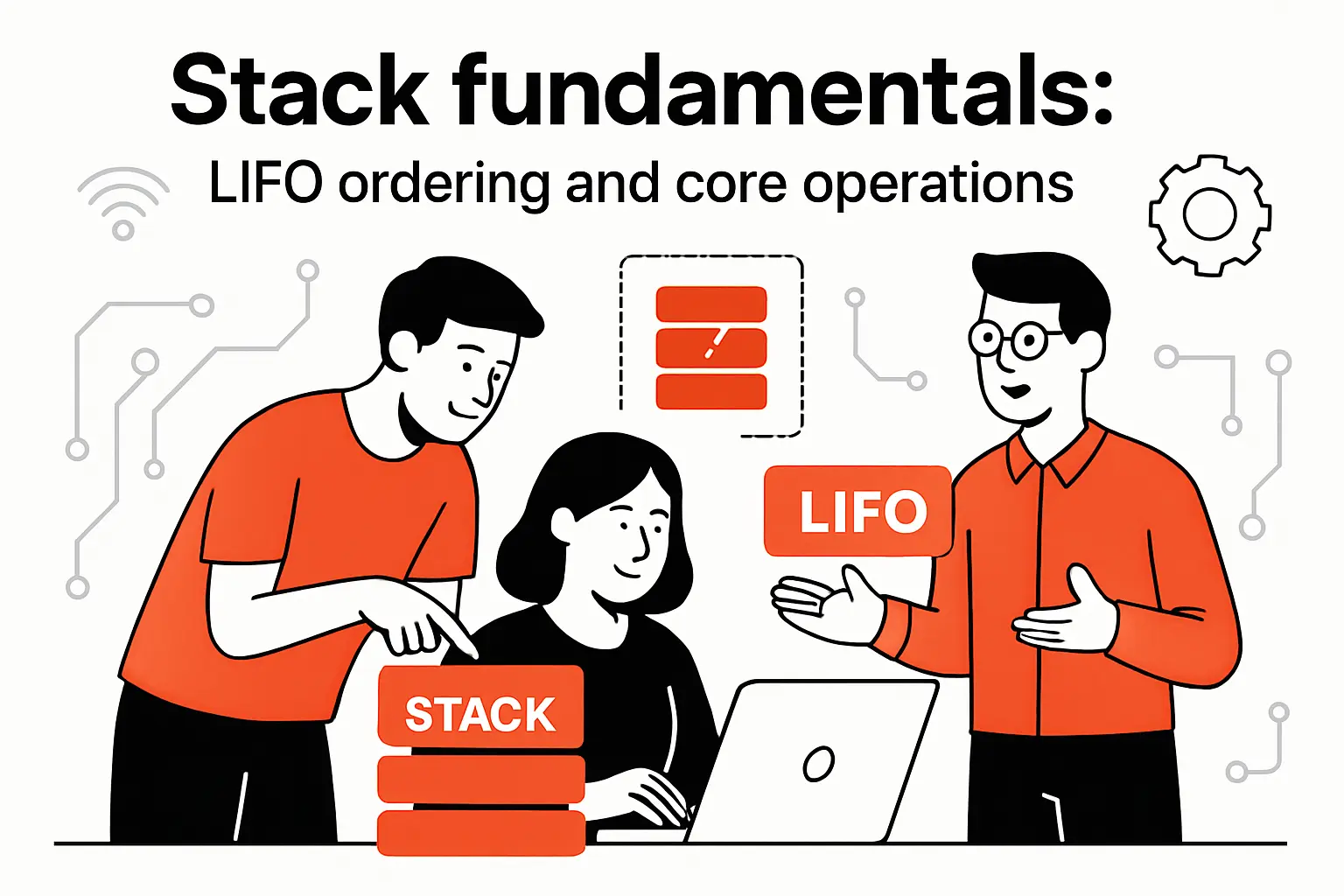
A stack enforces last-in, first-out ordering, which means the most recently added element is the first eligible for removal. Operationally, that gives us a clean way to model “most recent context wins,” a phrase that appears in many domains: undo history, nested parsing, scope tracking, and call execution frames.
In implementation discussions, we tend to separate two categories of operations. Mutators change the structure: push adds an element to the top, while pop removes and returns the top element. Observers inspect state: peek reads the top element without removing it, isEmpty reports whether any element exists, and size reports how many elements are currently stored.
In production code, edge behavior is where the real decisions hide. A pop on an empty stack can throw, return a sentinel, or return an optional type depending on language conventions. Each choice signals how the calling code should behave under unexpected conditions, and that signal matters. When a stack underflow indicates a logic bug, exceptions can be a gift. When underflow is normal, explicit “empty-aware” return types tend to make systems calmer.
2. Stacks as recursive structures and the role of the top element
Recursion is often introduced as a control-flow technique, yet it’s also a conceptual window into what stacks do. Every recursive call adds a frame; every return removes one. That “frame” is basically a structured record: parameters, local variables, and a return address. Even when we write iterative code, we frequently end up re-creating the same behavior with an explicit stack because it gives us more control.
The top element of a stack is special because it defines the current context. In a parser, the top might represent the most recent opening delimiter that has not yet been closed. In a UI workflow, the top might be the most recent navigation state. And in an interpreter, the top might be the current evaluation environment. That single “top” pointer becomes a narrative: what are we doing right now, and what do we return to when we’re done?
When we convert recursion to iteration, we’re essentially choosing to manage the stack ourselves. That choice can improve debuggability and prevent call-stack limits from becoming failure modes. It can also make concurrency safer by isolating state inside an explicit data structure rather than spreading it implicitly across execution frames.
3. Empty and full conditions in array-based stack designs
Array-based stacks are popular because they’re simple: store elements in an array and track an index that represents the current top. The empty condition is straightforward: the top index indicates no elements are present. The full condition is where design forks appear, especially in systems that need predictable latency.
In fixed-capacity stacks, “full” is a hard stop. That model is common in embedded systems, real-time scenarios, or tightly bounded memory budgets where dynamic allocation is either expensive or forbidden. In dynamically resizing stacks, “full” triggers growth, usually by allocating a larger array and copying elements over. The trade-off is not merely performance; it’s also failure behavior. Resizing can fail due to memory pressure, and it can introduce latency spikes that show up exactly when the system is under load.
At TechTide Solutions, we treat “full” as a product question as much as an engineering question. For some features, it is better to reject new actions explicitly than to degrade unpredictably. For others, growth is the right call, but it needs guardrails—telemetry, circuit breakers, and clear operational limits—so the stack doesn’t become an accidental sinkhole for unbounded state.
Queue fundamentals: FIFO ordering and core operations
1. Enqueue, dequeue, front, and rear behaviors
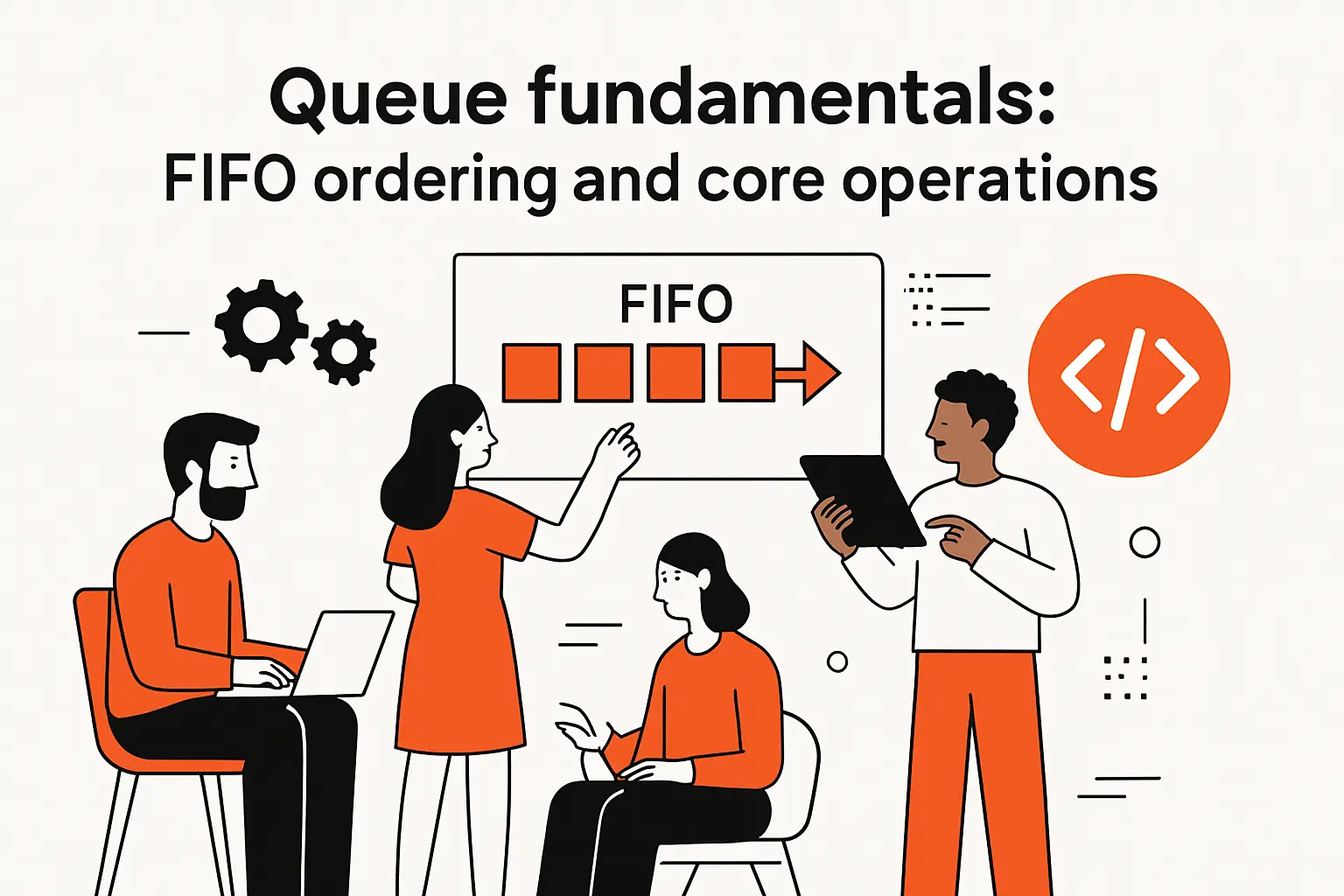
A queue enforces first-in, first-out ordering, which makes it the natural structure for fairness and ordered processing. If stacks model “most recent context,” queues model “arrival order,” and that is exactly what we want when workloads should be handled predictably.
Enqueue adds an element to the rear of the queue, while dequeue removes and returns the element at the front. The front is the next element to be processed; the rear is where new elements join. In a clean design, most business logic interacts with the front only indirectly—by dequeueing—because direct access to internals encourages out-of-band behavior that can quietly violate ordering.
From a system viewpoint, front and rear are also performance-sensitive. A poor implementation that shifts elements on every dequeue turns a queue into a time bomb. That’s why ring buffers, linked lists, or specialized deque structures show up so often in serious runtime libraries. Queues look humble, but they demand respect if they sit on a hot path.
2. Queue interface essentials: isEmpty, getFront, and clear
Queues need the same kind of state queries as stacks, but the semantics carry different implications. isEmpty is critical for consumers that poll for work or coordinate shutdown. getFront (sometimes called peek) is useful when a consumer needs to inspect the next element before committing to processing it, such as checking a message type before dispatch.
Clear is deceptively dangerous. In internal tooling, clearing a queue can be a safe way to reset state. In production, clearing can be catastrophic if it destroys work that has not been persisted elsewhere. For that reason, we typically treat clear as an administrative capability rather than a routine API. If a business process genuinely needs cancellation, we prefer explicit cancellation records, idempotent consumers, and durable logs rather than silent deletion.
Another interface concern is visibility for observability. Teams often want to know “how deep is the queue” or “how long has the front been waiting.” Those questions belong to metrics and instrumentation layers, not necessarily to the core queue API. Keeping the interface small reduces the temptation to treat the queue like a database.
3. Why queues model waiting lines and ordered processing
Waiting lines are the obvious analogy, yet the deeper reason queues fit so well is that they encode a policy: arrival order determines service order. That policy simplifies reasoning, especially when multiple producers feed work into a system and multiple consumers process it.
In distributed architectures, queues become the backbone of decoupling. A producer can enqueue work and move on. A consumer can process at its own pace. That separation gives the system elasticity and resilience, but it also raises questions about backpressure, retries, duplication, and ordering guarantees. In other words, the humble FIFO queue becomes an architectural commitment.
When we design processing pipelines, we treat queues as the “shape” of time. Work moves forward step by step. If a stage slows, the queue grows, signaling that the system needs scaling or the stage needs optimization. Without a queue—or without respecting its semantics—systems tend to hide pressure until they fail abruptly.
Key differences between stacks and queues data structures
1. Insertion and removal ends: same-end access versus front-and-rear access
The cleanest mechanical difference is where insertion and removal occur. A stack inserts and removes at the same end, which keeps the “active context” tightly bound to a single point. A queue inserts at the rear and removes from the front, which separates where work arrives from where work departs.
That separation changes how we design systems. With stacks, the latest addition is always the immediate candidate, which is perfect for nested structures and reversal patterns. With queues, the earliest addition stays visible and eventually becomes the next to process, which is perfect for fairness and throughput-oriented pipelines.
From a maintenance standpoint, these access rules also act like guardrails. A stack discourages peeking into older history; a queue discourages skipping ahead. When we see code that frequently “needs” to break those rules, we take it as a smell that the wrong structure is in use—or that the business requirement is actually a priority queue or deque disguised as a simple FIFO.
2. Real-world analogies: plates, pancakes, and service lines
Analogies are only useful if they map to behavior, not just imagery. Plates are the standard stack metaphor: add a plate to the top, remove a plate from the top. Pancakes work too, and they add a detail we like: the newest pancake is hottest and gets eaten first, which mirrors “most recent state matters most” in many interfaces.
Service lines are the queue metaphor: arrivals join the back, service happens at the front. That model captures fairness, but it also captures the emotional truth of queues: people notice when the ordering is violated. Users react the same way when a system processes requests out of order without explanation, particularly in finance, logistics, ticketing, and customer support.
At TechTide Solutions, we use analogies early in requirements workshops because they make ordering constraints legible to non-engineers. Once everyone agrees on the metaphor, we translate it into explicit semantics, then into an implementation that preserves those semantics under load and failure.
3. Operational efficiency expectations: constant-time core operations
Practically speaking, we expect the core operations of stacks and queues to be fast and predictable. That expectation is not academic; it shapes architecture. If enqueue or dequeue becomes expensive, producers start to block, consumers fall behind, and latency spreads across the system like a spill.
Efficiency is also about stability. A stack used for parsing should not suddenly degrade when an input is deeply nested. A queue used for buffering should not become slow merely because it has grown. When we choose an implementation, we’re often choosing which failure mode we prefer: bounded capacity with explicit rejection, or dynamic capacity with the risk of memory pressure and GC churn.
In our production reviews, we treat performance characteristics as part of the API contract. A “queue” that sometimes shifts elements is not just slower; it can change the timing of a whole workflow. Even when the application appears correct, timing shifts can expose races, amplify retry storms, or break user expectations in ways that are painful to debug.
Implementing stacks and queues: arrays, linked lists, and adapter-based designs
1. Stacks and queues as adapter abstractions over underlying collections
An adapter is a disciplined wrapper: it exposes a constrained interface over a more general structure. We lean on that idea heavily because it keeps the “shape” of data flow consistent even when the storage changes. A stack can wrap a dynamic array, a linked list, or even a persistent vector in functional programming. A queue can wrap a ring buffer, a list, or a pair of stacks in certain implementations.
What we like about adapter thinking is that it makes misuse harder. If the underlying collection has methods for random access, sorting, or deletion, the adapter should not expose them. That’s not purism; it’s defensive engineering. Teams change, code gets reused, and “temporary” shortcuts tend to fossilize into dependencies.
Design note from TechTide Solutions
When we build internal libraries, we often provide stack/queue interfaces that are intentionally boring. The goal is to force all interesting behavior—prioritization, cancellation, deduplication—into explicit higher-level components rather than hiding it inside “helpful” collection methods.
2. Array implementations: memory efficiency, simplicity, and fixed-size constraints
Array-backed stacks are straightforward, and array-backed queues can be straightforward if we use a ring buffer. Arrays typically provide good memory locality, which is friendly to CPU caches. That matters in tight loops, parsers, and runtime components where small overheads become large costs.
Simplicity is another advantage. An array and a couple of indices are easy to reason about and easy to test. In systems that must be audited—think safety, compliance, or high-assurance environments—simplicity often beats cleverness. We’d rather have predictable behavior and a clear boundary than a sophisticated structure that fails in surprising ways.
Fixed-size constraints are both a limitation and a feature. In an application-level feature like undo history, a fixed-capacity stack can prevent runaway memory growth by discarding the oldest entries or refusing new ones based on product policy. In an infrastructure queue, fixed capacity can enforce backpressure, which protects downstream systems from overload. And in both cases, the key is to align the constraint with a business decision rather than letting the runtime decide for us.
3. Linked list implementations: dynamic sizing with added pointer overhead
Linked lists buy us flexible growth without resizing, which can be attractive when we cannot tolerate copying. For stacks, a singly linked list can support push and pop at the head with minimal ceremony. For queues, a linked list with head and tail pointers supports enqueue at the tail and dequeue at the head cleanly.
That flexibility is not free. Pointer overhead increases memory usage, and scattered allocations can reduce cache friendliness. In managed runtimes, linked lists can also create GC pressure because every node becomes an object with its own lifecycle. In native environments, they can fragment memory and complicate allocator behavior.
Even so, linked lists remain useful when workloads are bursty and when capacity is hard to predict. They also shine when we want to splice or combine sequences, although at that point we should ask whether we’re still dealing with a pure stack or queue, or whether the domain is asking for a different abstraction.
Circular arrays and ring-buffer techniques for efficient queues
1. Wrap-around indexing with modulo arithmetic
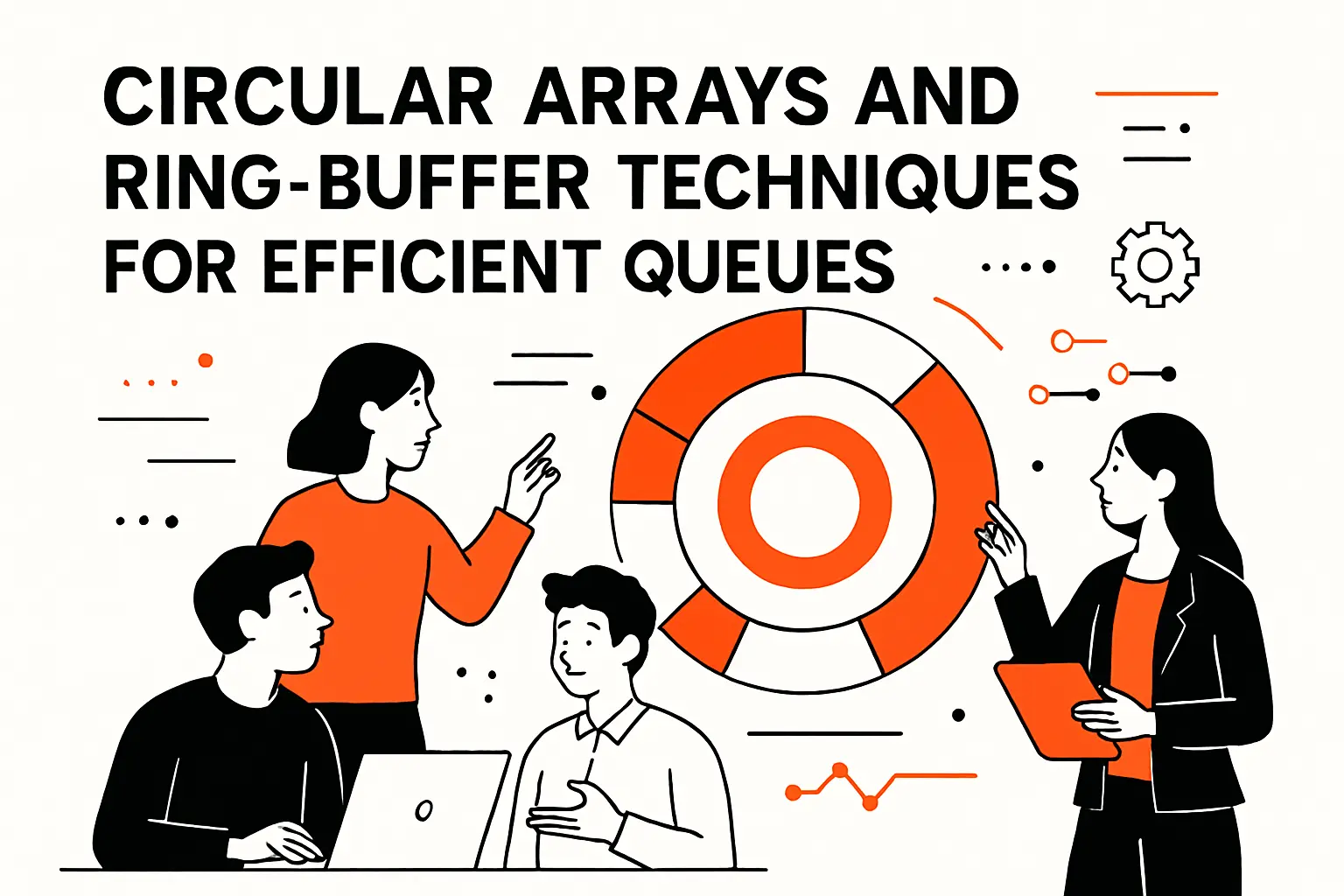
A ring buffer is the queue implementation we reach for when performance needs to be stable and memory needs to be controlled. Conceptually, we store elements in an array and treat the ends as connected. When the rear reaches the end of the array, it wraps back to the beginning, filling available space that earlier dequeues have freed.
The wrap-around mechanism is usually implemented with modulo arithmetic, but the deeper idea is that physical layout should not dictate logical order. The array is just a circular track; front and rear are runners moving around it. As long as we update indices consistently, the queue behaves like an ordered line even though elements might be physically split across the array boundary.
Operational payoff
In real systems, the payoff is predictable cost per operation. Instead of shifting elements or reallocating frequently, we update indices and store values. That stability makes ring buffers ideal for logging pipelines, streaming parsers, and event loops where jitter becomes user-visible latency.
2. Managing front, back, and current element count
Ring buffers look simple until we hit the core ambiguity: how do we distinguish empty from full when front equals rear? There are a few common strategies, and each one is a choice about invariants.
One approach keeps a separate count of elements. With a count, empty means count is zero, and full means count equals capacity. Another approach leaves one slot empty at all times, treating front equals rear as empty and preventing a truly full buffer. That approach simplifies state but sacrifices one slot of capacity, which may or may not matter depending on the domain.
In our implementations, we often choose a count because it makes metrics easier and reduces “off by one” reasoning during incident response. A clear count also plays well with backpressure logic: when the queue depth rises, we can throttle producers, scale consumers, or shed load based on policy.
3. Full-capacity handling: throwing exceptions versus resizing strategies
When a ring buffer reaches capacity, we must decide what “full” means operationally. In some systems, full indicates a bug or a violated assumption, and throwing an exception is appropriate. In others, full is a normal state under burst load, and the system should respond gracefully.
Resizing is one response, and it can work well when memory is plentiful and we prefer throughput over strict bounds. Still, resizing changes the operational profile: it introduces occasional expensive steps, and it can hide a downstream bottleneck by letting the buffer grow until the process runs out of memory.
Another response is to block producers or reject new entries. Blocking can be correct when producers are internal threads that can safely wait. Rejection can be correct when producers are external clients, where failing fast protects the system. Our rule of thumb is to connect the choice to user experience: would the user rather wait, retry, or get an immediate “busy” response? Once that’s answered, the data structure becomes a tool for enforcing the policy.
Where stacks and queues shine: practical applications and examples
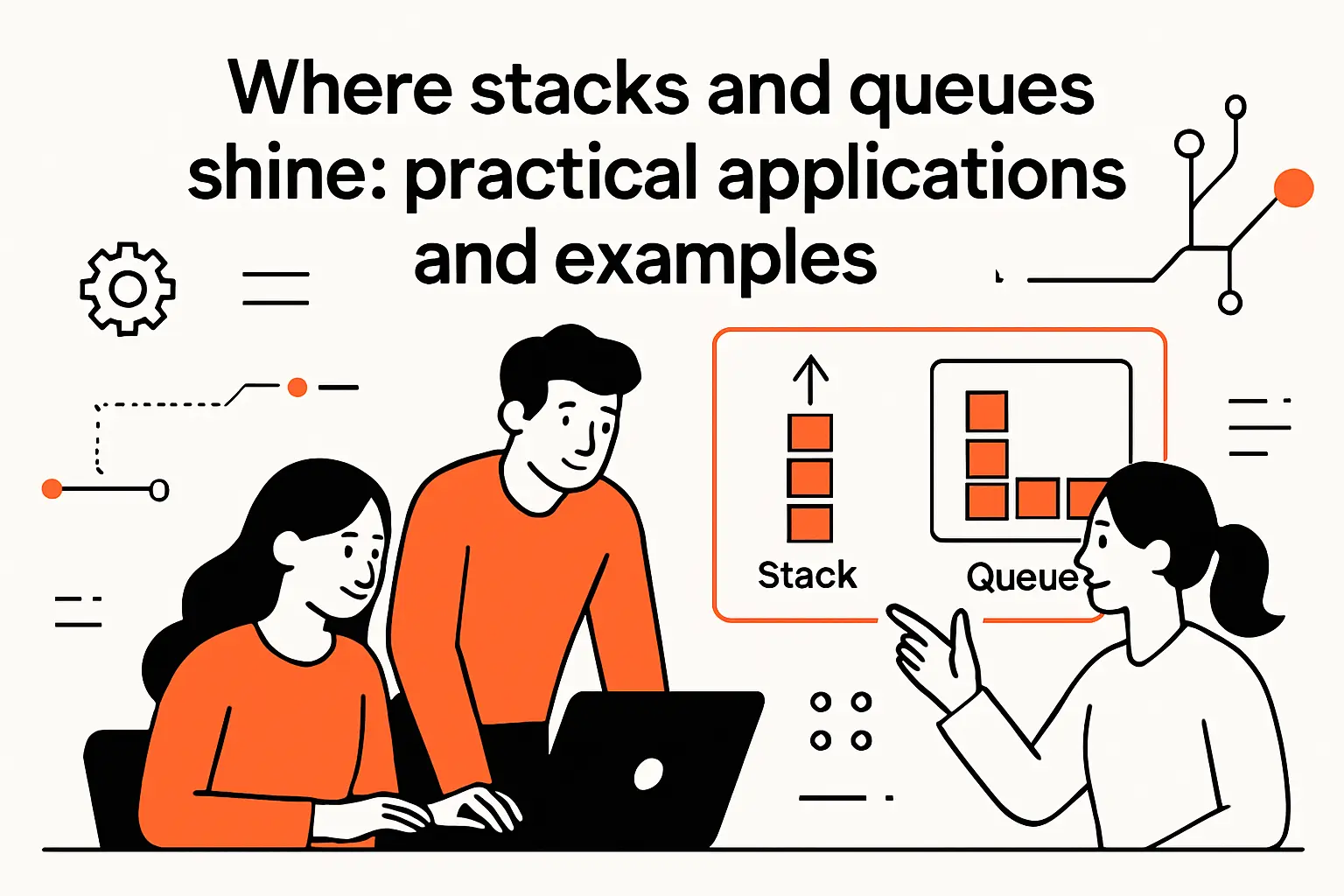
1. Stacks in software behavior: undo and redo, browser history, and call stacks
Undo and redo are the classic stack use case, and they remain one of the most instructive examples because they expose design details. Undo is naturally a stack because we reverse the most recent action first. Redo is usually another stack that collects actions we’ve undone, allowing us to reapply them in reverse-undo order.
Browser history has stack-like behavior in back navigation, but it’s a good reminder that real products often blend structures. A user can go back several steps, then navigate somewhere new, which truncates the “forward” path. That behavior is easiest to model with stack semantics plus explicit rules for when to clear the redo/forward stack. The structure encodes user expectations: the newest navigation context should be the easiest to reverse.
Call stacks are the invisible stacks we rely on every day. When debugging production issues, we often read stack traces as narratives: the top is the immediate failure context, and deeper frames are the path that led there. Understanding stacks helps teams interpret these narratives, especially when recursion, middleware chains, or layered frameworks generate deep call paths.
2. Stacks in algorithms: backtracking, depth-first search, and expression parsing
Backtracking is where stacks feel almost inevitable. In constraint solving, maze traversal, or decision exploration, we frequently choose a path, push state, and then pop back when we hit a dead end. The structure mirrors the cognitive process: commit, explore, retreat, try again.
Depth-first search is often taught recursively, but explicit stacks are frequently better in production because they make resource usage visible and controllable. With an explicit stack, we can pause traversal, checkpoint progress, or integrate traversal into cooperative scheduling. That control matters in systems that cannot afford to block or risk deep recursion.
Expression parsing is another enduring stack domain. Whether we’re converting infix notation to postfix, evaluating expressions, or validating nested delimiters in user input, stacks provide a clean way to represent “what still needs to be closed.” In product work, this shows up in query languages, templating engines, rule systems, and even rich-text editors where formatting is effectively a structured expression tree.
3. Queues in systems and algorithms: scheduling, buffering, pipelines, and breadth-first search
Scheduling is one of the most direct queue applications. Jobs arrive, jobs wait, jobs run. When fairness matters, FIFO queues are a natural baseline, even if real schedulers add priorities, time slicing, and aging. The foundational idea remains: ordered work is easier to reason about than “whatever happens to run next.”
Buffering is where queues become guardians of stability. Network stacks buffer packets, media players buffer frames, and message-driven systems buffer events. A queue can absorb burstiness, but it can also become a warning signal. Growing depth tells us that a consumer is slower than a producer, which is exactly the information operations teams need.
Breadth-first search is the algorithmic mirror of FIFO processing. By exploring neighbors in arrival order, BFS finds the shallowest path in unweighted graphs. Outside of textbooks, we see BFS-like thinking in social graph expansion, dependency resolution, and workflow engines that need to process tasks layer by layer rather than diving deep into one branch.
How TechTide Solutions builds custom solutions with stacks and queues data structures

1. Mapping product requirements to the right LIFO or FIFO data-handling semantics
We start by treating ordering as a product decision rather than an implementation detail. If the domain says “most recent wins,” LIFO semantics usually belong in the design. If the domain says “first come, first served,” FIFO semantics tend to be the ethical and operational default. Plenty of requirements are ambiguous, so we press for clarity with scenarios: What happens when two events arrive close together? Which should a user see first? What does “retry” mean in the presence of newer work?
During discovery, we also look for hidden constraints. Some products need strict ordering; others can tolerate eventual processing. Some require cancellation; others require audit trails. A stack can be perfect for reversible interactions, while a queue can be perfect for durable workflows. The wrong choice often “works” until load increases or edge cases pile up, and then the team pays interest on a semantic mismatch.
Once semantics are chosen, implementation becomes easier. The team no longer debates data structures in the abstract; we evaluate them against explicit ordering rules, capacity expectations, latency budgets, and failure behavior.
2. Engineering scalable features like history, undo, parsing, and workflow orchestration
History features are deceptively hard because they blend user experience and storage policy. For undo/redo, we commonly implement a command pattern with a stack of reversible actions, backed by domain-specific validation so that undo doesn’t violate business invariants. In collaborative apps, we often go further and separate local undo stacks from shared event logs to avoid confusing “my undo” with “global truth.”
Parsing work shows up more often than teams expect. A “simple” filter builder becomes a mini language. A configuration file gains nested scopes. A template system grows conditional logic. In those moments, stacks become the scaffolding that keeps parsing deterministic and debuggable. When performance matters, we’ll often choose iterative parsers with explicit stacks so we can recover gracefully from malformed input rather than crashing on deep nesting.
Workflow orchestration leans heavily on queues, but we rarely stop at a single FIFO. Real orchestration needs retries, dead-letter behavior, backoff, idempotency, and visibility. Our practice is to build a clear queue-based pipeline with explicit state transitions, then layer policy on top so the ordering rules remain intact even when failures happen.
3. Delivering production-ready implementations for web apps, mobile apps, and custom software systems
Production readiness is where theory meets consequences. In web apps, we often use queues to manage background tasks: sending emails, generating reports, syncing data, or processing uploads. For mobile apps, stacks show up in navigation state, offline action history, and optimistic UI updates that must roll back cleanly when the network disagrees.
On custom platforms, we treat stacks and queues as components that must be observable and testable. That means instrumenting depth, enqueue/dequeue rates, and failure reasons. It also means writing stress tests that simulate bursts, slow consumers, and cancellation storms. Too many teams test only the “happy path,” then discover in production that their queue grows without bounds or their stack accumulates invalid state after partial failures.
Modern developer tooling also reinforces the need for these fundamentals. A Stack Overflow survey reported 84% saying they use or plan to use AI tools in their development process, and many of those tools quietly rely on queues for task scheduling and stacks for structured reasoning steps; better fundamentals make teams more capable of auditing what their toolchain is actually doing.
Conclusion: choosing the right structure for correctness and performance
1. Quick selection checklist: when LIFO beats FIFO and when FIFO is essential
When we need “most recent context first,” we reach for a stack. Undo/redo, nested parsing, scoped evaluation, and backtracking all fit naturally because the latest decision is the first decision we want to reconsider. A stack also tends to simplify logic when work is inherently nested, because the structure mirrors the nesting.
If fairness, arrival order, or staged processing matters, we reach for a queue. Work scheduling, buffering, message pipelines, and breadth-oriented exploration align with FIFO because they keep time ordering explicit. A queue also helps with operational reasoning: depth becomes a signal, and backpressure becomes a policy lever.
Whenever a team says, “We need both behaviors depending on the case,” we pause and consider whether a deque, a priority queue, or a domain-specific scheduler is actually the right abstraction. Forcing a stack to behave like a queue, or vice versa, usually produces fragile code that fails at the edges.
2. Implementation fit: array, linked list, or circular buffer based on constraints and scale
Implementation choice should follow constraints. If we need tight memory locality and predictable overhead, arrays are often the best starting point. If we need stable performance for queues without shifting, ring buffers are a strong default. And if we need dynamic growth without resizing costs, linked lists can work, especially when throughput is moderate and allocation overhead is acceptable.
Constraints also include operational realities. In memory-constrained environments, bounded buffers with explicit backpressure are healthier than silent growth. In latency-sensitive services, predictable per-operation cost can matter more than raw throughput. And in managed runtimes, object allocation patterns can dominate performance, which is why we’re careful with linked structures on hot paths.
Above all, we try to preserve semantics through implementation changes. A queue that becomes “mostly FIFO unless we’re under load” is not a queue; it’s a source of user-facing weirdness. The structure exists to protect ordering, so the implementation must honor that promise.
3. Practical next steps: validate operations, complexity goals, and real-world use cases
A practical next step is to audit the stacks and queues already living in your system. Where are you relying on implicit stacks like recursion depth? Where are you relying on implicit queues like thread pools and event loops? Which components assume ordering, and which components casually violate it “just this once”?
From there, we recommend validating behavior with tests that reflect reality: bursts, slow consumers, partial failures, and cancellations. Instrument depth and wait time, then set operational thresholds that trigger alerts before customers notice. Finally, revisit interfaces and remove “escape hatches” that let business logic reach into internals and undermine ordering.
If you want a concrete starting point, we at TechTide Solutions suggest picking one workflow in your product—any place where work arrives, waits, and gets processed—and asking a blunt question: are we modeling this as a stack or a queue because it matches the domain, or because it happened to be convenient at the time?