
As Techtide Solutions, we’ve lived long enough in the engine room of digital transformation to know that software development is not a side show—it’s the business. The trajectory is unmistakable: worldwide IT spending is forecast to reach $5.43 trillion in 2025, signaling that software and the surrounding services remain the decisive levers of competitive advantage. In this essay, we braid fundamentals, process discipline, and practical tooling into a single narrative—the way we build products in the field—so leaders can translate strategy into shippable increments that customers adopt and love.
What is software development and why it matters
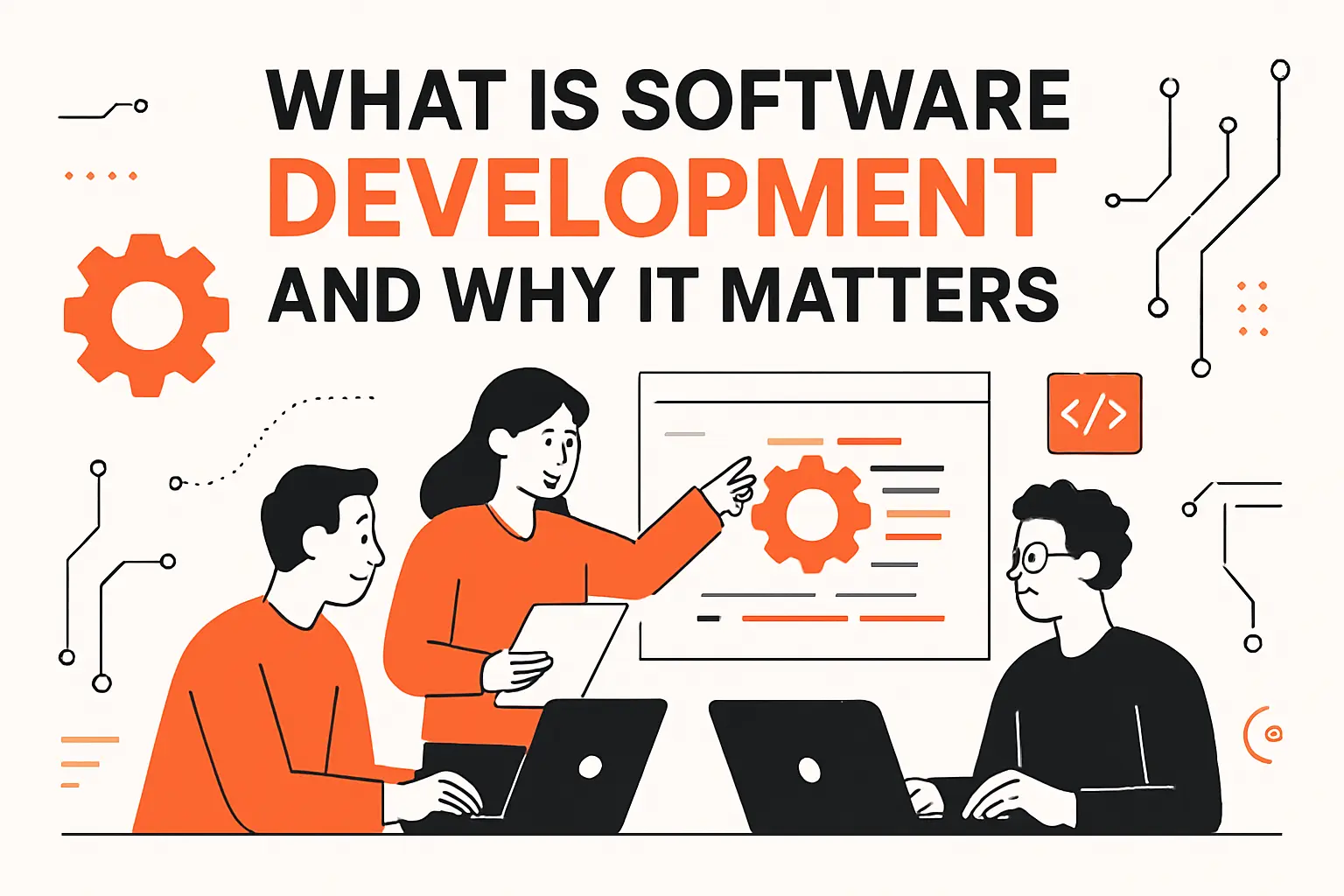
If we strip away the buzzwords, software development is a disciplined loop of understanding, designing, building, and learning at scale. The talent gravity behind that loop keeps intensifying; the global developer population is projected to reach 28.7 million in 2024, which mirrors the rising centrality of code in every sector. From our vantage point, the biggest shift isn’t the tools or frameworks—it’s that software is now embedded in how finance prices risk, how retailers orchestrate supply chains, and how healthcare personalizes pathways. The act of building software has become a frontline economic activity.
1. Definition, activities, and goals across the lifecycle
We define software development as the end‑to‑end practice of converting opportunity into outcomes through code. The activities are familiar but deceptively deep: discovery (to expose the crux of the problem), product shaping (to carve a viable sliver), architecture (to set constraints that enable speed), implementation (to produce working software), testing (to guard against regressions and drift), deployment (to operationalize), and feedback (to refine). The goal is not to write code; it’s to deliver change that sticks in the market.
In our projects—from a national health system’s eligibility platform to an industrial telemetry service—the pattern holds: the better we reduce ambiguity up front, the less risk we push downstream. We resist beginning with “solution architecture” before we can tell a clean story about the user’s job-to-be-done. When we do greenlight design, we set change as a design constraint: clear seams, well‑named boundaries, and a domain model that reflects the language of stakeholders. The fastest code is the code we don’t have to rewrite later.
As a rule of thumb, we ask three orienting questions before day one of coding: what are we really optimizing for, which trade‑offs will we accept, and how will we know we’re still winning after launch? Those prompts sound abstract, but they force attention toward the non‑negotiables—latency caps, regulatory obligations, data lineage, and the recovery envelope—long before they become blockers.
2. Roles and collaboration among developers, software engineers, and IT operations
Titles differ by organization, but the essential roles recur. Product management commits to outcomes and customer value; engineering crafts the solution within explicit constraints; design reduces friction across touchpoints; platform and SRE teams amplify feedback and reliability; security weaves threat modeling and controls throughout. The myth to bury is that development is a solitary sprint. In healthy teams, the center of gravity is collaboration, not handoff.
We’ve learned to banish role theater. A developer who can sit with the on‑call rotation writes different code. A designer who joins backlog refinement reframes constraints in humane terms. A product manager who watches error logs for a week develops a visceral sense for resilience. Most of all, the boundary between development and operations should be permeable. In our practice, “you build it, you own it” is less a slogan than a choreography: developers carry a beeper, ops gets a say in architecture, and security signs off on the threat model before sprint plans are finalized.
One heuristic we use is “shift humility left and right.” Left, into discovery: assume your initial mental model is incomplete. Right, into operations: assume the system’s behavior will surprise you in production. That posture shortens feedback loops and prevents the brittle overconfidence that plagues rewrites.
3. Ubiquity of software and its business impact
Software is everywhere, but the critical point is how it compounds. A workflow automated in claims processing frees cognitive bandwidth that product teams can reinvest in new offerings. A real‑time pricing engine doesn’t just optimize margins; it reshapes customer expectations and competitive response. We’ve watched a mid‑market logistics firm leapfrog incumbents not by spending more but by instrumenting every inch of its process and closing the loop between forecast and fulfillment.
The flip side is that substandard software erodes trust silently. Customers forgive the occasional glitch; they won’t forgive friction that feels intentional. That’s why we view accessibility, observability, and security as business concerns, not “compliance chores.” When we build with those in mind, we reduce hidden liabilities and expand the option set for future features. And as we’ll show, the mechanics of delivery—SDLC models, agile practices, and automation—are how we make that outcome repeatable.
Types of software and application domains
Modern portfolios rarely fit one box; organizations straddle packaged systems, custom services, cloud APIs, and edge devices. The commercial context tilts the calculus: subscription economics and cloud distribution have made SaaS the default for many categories, with revenue projected to reach $428.78 billion in 2025, yet we still find high‑impact seams where custom software pays back quickly. Our counsel: treat the portfolio as a product mix, and resist dogma.
1. System software, application software, programming software, embedded software
We draw distinctions that matter for architecture and operations:
- System software undergirds everything: operating systems, kernels, hypervisors, container runtimes, and the control planes that orchestrate them. When companies embrace platform engineering, they intentionally curate this layer—base images, ingress, secrets management—to standardize the “golden path.”
- Application software is where business differentiates: the customer‑facing flows, internal portals, and event‑driven backends that implement the domain. We focus relentlessly on isolating the domain model from infrastructural churn so app teams can deliver without platform whiplash.
- Programming software accelerates the act of building: IDEs, debuggers, static analyzers, and code intelligence. The trick is to bend them to your governance. We wire linters and security scanners to policy so “shift left” doesn’t mean “shift burden.”
- Embedded software sits in the physical world: controllers on factory lines, firmware on medical devices, or code that runs on in‑vehicle units. Here, the operational envelope—latency ceilings, power budgets, upgrade cadence—defines the art. We’ve shipped device fleets that update themselves safely without ever leaving operators in the dark about version drift.
These categories overlap in practice. A “plain” web app still relies on container orchestration and OS patches; embedded teams increasingly publish over‑the‑air releases; and programming tools are now infused with ML. Understanding the seams lets you regulate complexity instead of drowning in it.
2. Custom software versus commercial off the shelf
We gravitate to a portfolio lens: buy the commodity, build the advantage. Off‑the‑shelf systems are unbeatable for canonical processes—email, HR administration, accounting. But wherever the business differentiates—pricing logic, member journeys, clinical workflows—custom software keeps you from outsourcing your moat. In our advisory sessions, we map capability to strategic posture: “keep”, “invest”, or “disrupt.” Then we make choices that reflect that map, often blending packaged cores with custom edges.
Trade‑offs show up in unexpected places. With packaged software, upgrades shift from “if” to “when” and “how”—and the real cost sits in regression testing the customizations you layered on top. With custom builds, you own the burn. But ownership is an asset when it lets you respond in days to a regulatory change that would otherwise take quarters. The point is not ideology; it’s time‑to‑impact under real constraints.
We’ve seen COTS fail in two common ways: trying to make it be what it isn’t, and skipping the operational runway (data migration, identity, monitoring) that gives you control. We’ve seen custom fail when teams confuse “green‑field” with “no governance” or when they treat performance and security as late‑stage bolt‑ons. In both modes, fit‑for‑purpose architecture and integrated testing are the safety rails.
3. Front end, cloud native, and low code development
Front end today spans devices and contexts: mobile apps, responsive web, edge‑served components. We favor a design system approach because visual coherence and accessibility aren’t just niceties—they cut cognitive load for users and developers alike. On the backend, cloud native isn’t a buzzword; it’s a set of affordances (ephemeral compute, managed services, declarative infra) that let small teams move quickly without sacrificing reliability. We’re careful, though, not to mistake microservices for maturity. Sometimes a well‑drawn modular monolith is the saner default.
Low‑code and no‑code have arrived in earnest. In the right hands and with guardrails, they are powerful force multipliers for internal apps, automation, and data collection. The governance pivot is crucial: clarify which use cases can live on a citizen‑developer platform, how you audit and lifecycle those artifacts, and when to hand off to a product team. Done well, you boost throughput and keep entropy at bay. Done poorly, you create a brittle shadow estate. Our practice is to pair platform guardrails with coaching, not clamps.
Software development life cycle SDLC phases and models
Process is how we lower variance in outcomes. Yet process can calcify. We choose SDLC models to fit risk, not fashion, and we make the feedback loops explicit so we can steer. One sobering benchmark: large IT projects, on average, run 45% over budget, which is why we favor modular plans, short horizon bets, and progressive delivery. The discipline is to start small without thinking small.
1. Planning and requirements analysis to design
Planning isn’t Gantt charts; it’s ruthless alignment. Our discovery rhythm braids three threads: desirability (evidence that the user wants it), feasibility (architecture and platform paths that can deliver it), and viability (a business model that can sustain it). We use story‑mapping to visualize scope in terms users understand, then translate those slices into architecture seams. Threat modeling and privacy scoping happen here—not as theater, but to drive design choices with security in mind.
Design transforms ambiguity into constraints you can execute. We begin with contracts—domain events, APIs, and background jobs—because boundaries drive clarity. We make explicit decisions about consistency, idempotency, and fallback behavior. Can the system degrade gracefully if a dependency blinks? Is there a durable event log? Are PII flows confined to well‑guarded zones? We answer those questions in design, not during a production incident.
Documentation at this stage looks like living artifacts: ADRs that capture trade‑offs, lightweight sequence diagrams, and interface specs next to the code. We keep them humble and findable. The acid test is whether a new engineer can infer intent quickly without tribal knowledge.
2. Implementation, testing, and integration
We code for clarity first. Performance follows when the design gives you leverage. The pattern we favor is testability by design: pure functions where possible, explicit side‑effects behind ports and adapters, and seams that make mocking honest rather than contortive. This is what gives you fast, reliable tests that developers will actually run.
Testing spans multiple strata: unit tests for logic, contract tests for interfaces, integration tests for the dance between services, and exploratory tests to catch the weird. We fold non‑functional aspects into the same pipeline: security checks via SAST/DAST/secret scanning, accessibility tests against your design system, and performance budgets enforced by automated probes. This isn’t purity; it’s insurance that pays out every sprint.
Integration used to mean “throw it to ops.” In a cloud world, integration is continuous: feature flags to dark‑launch risky changes, canary releases to limit blast radius, and telemetry that shows whether real users get real value. We wire tracing and structured logs so we can tell causal stories, not just stack traces. In practice, that’s how we cut through noise and find root causes quickly.
3. Deployment, maintenance, and documentation
Deployments should be boring, and rollbacks should be reversible without panic. We default to immutable builds and declarative infrastructure so “what ran in staging” is the same artifact promoted to production. Maintenance means more than patch Tuesdays; it means dependency hygiene, schema change discipline, and a clear SLA/ SLO posture that reflects what the business can tolerate.
Documentation is too often treated as tax. We treat it as acceleration: onboarding guides that let a new teammate ship something small in their first week, runbooks that make incidents less scary, and architectural overviews that explain why the system looks the way it does. We’ve found that living docs right next to the code beat static wikis every time.
4. Security considerations and DevSecOps within the SDLC
Security is an architectural property, not a checklist. We embed it by default: modeling threats alongside user journeys, adopting least privilege from the start, and instrumenting detection so you can respond rather than scramble. The goal is to shrink time‑to‑mitigation, not to chase vulnerability counts. We treat SBOMs, signed artifacts, and explicit supply chain trust as table stakes. When we’ve brought DevSecOps into organizations, the breakthrough often comes from making security engineers co‑owners of the pipeline rather than external auditors. Suddenly, developer experience and risk posture pull in the same direction.
We also aim for humane, audit‑friendly control points: policy as code for access and network rules, automated evidence capture for change management, and environment parity so emergency fixes don’t spawn configuration drift. “Secure by default” and “self‑service” can coexist when platform teams expose paved roads and product squads commit to traveling them.
Agile software development principles, frameworks, and feedback

Agile is not a ceremony kit. It’s a commitment to fast learning and intentional constraints—small batches, visible work, tight loops. The organizational mood music has shifted toward this mode; in global human‑capital research, 85% say that organizations need to create more agile ways of organizing work, and we see the same signal in the field: when teams reduce batch size, they reduce blind spots. But technique without judgment can still dig holes. Success comes from pairing agile mechanics with product taste and an honest metric of value.
1. Agile values and principles guiding teams
The values are simple to say and hard to do: individuals and interactions over processes and tools, working software over comprehensive documents, customer collaboration over contract negotiation, and responding to change over following a plan. We translate these into everyday practices. For instance, “working software” means every sprint produces something demonstrable; not always end‑user visible, but always a tangible increment: a traced path through a service, a guarded endpoint, a hardened pipeline stage.
We’ve also learned where not to be agile in the narrow sense. Some decisions are one‑way doors—cryptographic choices, data residency, identity providers—and deserve the deliberation of a design review. You can still iterate, but you shouldn’t flail. The art is to isolate the one‑way door behind an interface so you can buy the option to replace it later if necessary.
2. Scrum, Kanban, and extreme programming
Scrum gives teams cadence and clarity: a steady heartbeat of planning, review, and retrospective. When we deploy Scrum on complex programs, we lighten the ceremony and sharpen the goals. Kanban is our go‑to when flow matters most—support teams, platform work, and cross‑cutting initiatives. We visualize work in progress, limit it, and watch for bottlenecks at column boundaries. Extreme programming injects the engineering hygiene that keeps speed from curdling: test‑driven design, pair programming for gnarly design seams, collective code ownership, and the courage to refactor.
The best teams blend. A product pod might run Scrum‑style sprints while the platform group runs Kanban across a shared board. XP practices cut across both. The important thing is not to perform the ritual but to honor the constraint: keep batches small, keep feedback fast, keep quality visible. We consider retrospectives the crown jewel; they’re the one ritual that, done honestly, keeps teams honest.
3. Iterative delivery with sprints, user stories, and continuous feedback loops
Iterative delivery begins with good stories. We write them as user intents, not technical tasks—“as a claims analyst, I can reconcile exceptions in a single view”—and pair each with acceptance criteria that testers can use and developers can’t misunderstand. We bind stories to outcomes by agreeing on a lightweight leading indicator for each milestone: time‑to‑complete for a workflow, adoption for a feature, or error rates for a fragile API.
Feedback loops span more than demos. We run usability tests on prototypes to catch UX issues early, and we use feature flags to invite early adopters into the tent. Observability isn’t just logs and traces; it’s also product analytics that tell you whether a new capability reduces toil or sparks confusion. The hardest part is saying no when reality contradicts our assumptions. We consider “delete unused feature” a victory condition, not a failure.
Tools and automation for effective delivery
Tooling and automation are not shortcuts; they’re multipliers. The vendor landscape is in flux as capital pours into AI‑infused developer platforms, with funding hitting $66.6B in Q1’25, and that momentum is reshaping how teams author, test, and release software. Our advice is to treat tools as part of the product: measure their impact, retire those that don’t earn their keep, and keep your golden path coherent.
1. Computer aided software engineering CASE categories and workbenches
CASE tooling has quietly matured into something more practical than its ancestors: model‑as‑truth where appropriate, code generation behind explicit contracts, and repositories that keep design artifacts close to source. We see value where tools build shared context—domain maps, sequence diagrams, and architecture decision records—without imposing a brittle meta‑model. The aim is not heavy architecture documentation, but synchronized understanding.
When CASE tooling earns its keep, it’s because it does three things well: it integrates with version control and CI so artifacts evolve in lockstep; it supports review workflows so the team can converse around a diagram like it’s code; and it exposes APIs so you can pull context into other tools. We’ve wired threat models into pipelines so changes that alter security posture automatically request a review. That is CASE at its practical best.
2. IDEs, version control, and project documentation
IDEs have become collaborative canvases. With code intelligence and assistive generation, they can propose a first draft faster than most developers can type. The danger is complacency. We coach teams to use assistive tools as accelerants, not oracles: paste less, reason more, and keep tests as the referee. Version control is the backbone; everything else props on it. We insist on clear branching strategies, small pull requests, and automated checks that gate merges on quality and security.
For documentation, we anchor on “docs‑as‑code.” Developers are more likely to update Markdown next to the module they just touched than a distant wiki. We add pre‑commit hooks that nudge for ADR updates when certain files change, and we include a documentation review in code reviews. The payoff is immediate: onboarding shortens, knowledge flows, and drift slows.
3. Build, test, and release automation with CI CD pipelines in software development
Automation is where we buy back time and reduce risk. We standardize CI/CD so teams can focus on product logic: pipeline templates with unit, integration, and security stages; container scans and policy checks; and traceable artifact promotion. Feature flags let us decouple deployment from release and run safe experiments. Progressive delivery—canaries, blue‑green switches, and synthetic tests—keeps incidents small and fixable.
We prefer opinionated platforms to DIY sprawl. That doesn’t mean rigidity; it means paved roads that get routine work out of your way. A shared build cache, consistent test runners, and centralized secrets trim minutes off every build and days off every release train. The best sign that automation is working is boredom: deploys feel like a non‑event, and rollbacks feel like a routine muscle memory.
TechTide Solutions: custom software development tailored to your needs
In a market where technology investment is both more strategic and more scrutinized, we earn trust by aligning our work to measurable outcomes and by designing for change from the outset. We’ve led engagements across sectors where the common denominator was not a framework but a stance: respect the domain, keep the increments small, and build observability into everything. That stance is how we reduce risk while moving quickly.
1. Collaborative discovery and requirements alignment
We start with a collaborative discovery aimed at compressing time to clarity. Our product strategists, architects, designers, and security leads sit with stakeholders, shadow front‑line users, and map the domain in their language. We center on three artifacts: a problem statement we can test, a thin‑slice scope that cheerfully fits into a few sprints, and a target architecture that can carry the first release without painting us into corners.
Where clients have legacy estates, we chart an integration path rather than a bypass. We identify the few junctions where a new capability has to interoperate with old systems—identity, payments, data stores—and we build those seams as APIs with explicit contracts. That makes the second and third increments faster because the hard edges are already defined. Throughout, we treat security and compliance as design partners. Controls are easier to satisfy when they’re first‑class citizens, not late‑stage hurdles.
2. Iterative development, quality assurance, and DevOps enablement
Once the thin slice is agreed, we build in tight loops. Engineers pair where it matters, test where it hurts, and automate what’s routine. Our QA teams don’t sit apart; they write acceptance tests, co‑design data fixtures, and shepherd exploratory testing to find edge cases. DevOps enablement runs alongside: we stand up pipelines, observability dashboards, and incident response runbooks from the first week so the first release isn’t the first time the system is “real.”
We emphasize platform empathy. If a client’s platform team provides golden paths, we adopt them; if not, we help define one. That is how we leave behind not just a product but a healthier delivery system. And because we’ve been on call for our own services, we build what we are willing to support. That ethos changes decisions in small ways that accumulate into reliability: idempotent operations, explicit timeouts, and feature flags everywhere.
3. Post deployment support, maintenance, and continuous improvement
Launch is a beginning. We treat the first months in production as a learning window: shorten the distance between signal and decision, prune unneeded features, and expand those that meet resistance in unexpected places. Our maintenance stance is proactive—dependency upgrades batched with care, vulnerabilities patched quickly, and performance tuned with evidence. We roll improvements into a rhythm that stakeholders can anticipate, which keeps change non‑threatening for users and support teams.
Continuous improvement includes people, not just code. We transfer practices, not only artifacts: playbooks for release management, facilitation guides for retrospectives, and templates for ADRs. Clients tell us that months later they still use the routines we leave behind. That is the highest compliment a delivery partner can receive.
Conclusion and next steps
Software’s frontier is widening again as assistive intelligence enters the toolchain and the product. The potential is meaningful; across use cases, generative AI could add $2.6 to $4.4 trillion annually, which is why we treat AI not as a bolt‑on but as a design consideration for both product and process. The leaders we work with are not chasing novelty; they’re using modern SDLC discipline, agile feedback, and platform automation to shrink time‑to‑learning and to convert learning into durable capabilities.
1. Choose models and practices that fit scope, risk, and constraints
There is no universal blueprint. A regulated workflow may benefit from a stage‑gated slice before it enters a faster sprint cadence. A high‑uncertainty product may demand discovery‑heavy sprints and guarded experiments rather than a big‑bang launch. Start with the risk and the outcome you seek, then pick the model that minimizes regret. And remember: you can change models mid‑stream when evidence tells you to.
When you choose a model, go all in on its constraints. If you pick Scrum, timebox and protect the sprint. If you pick Kanban, visualize and limit work in progress. If you adopt XP practices, treat tests and refactoring as first‑class work. Models are effective precisely because they restrict choice. Let them do their job.
2. Emphasize quality, security, and maintainability throughout the lifecycle
Quality is a system property. Bake it into design (clear boundaries), code (tests that matter), and operations (alerts that inform rather than alarm). Treat security as an outcome of design choices and platform controls, not paperwork. Prioritize maintainability—naming, structure, and documentation—because your future self is the most frequent reader of your code. In our experience, these investments pay back quickly in fewer incidents, quicker onboarding, and calmer releases.
When in doubt, bias toward decisions that keep options open. Write code that can be read, choose protocols and formats that don’t lock you in, and isolate vendor‑specific dependencies behind adapters. Technical debt is not a sin; unmanaged debt is. Make it visible and service it on a schedule.
3. Invest in skills, tooling, and team culture to sustain delivery
Tools are table stakes; culture is the multiplier. Invest in developer experience so teams can move without friction. Give them good pipelines, clear guidelines, and time to learn. Foster psychological safety so retrospectives surface the hard truths early. And create the conditions where product, design, engineering, platform, and security align on outcomes rather than defend silos.
We’d love to help you chart the next step. What’s the thinnest slice of your roadmap that, if delivered in weeks, would change the conversation with your customers or regulators? If you have a candidate in mind, let’s scope that slice together, choose the right SDLC model, and put the first increment into production with confidence.