
Before we disentangle definitions, we ground the conversation in the broader cloud economy: worldwide public cloud end‑user spending is forecast to reach $723.4 billion in 2025, a reminder that serverless thinking sits inside a rapidly expanding platform landscape rather than on its periphery. At Techtide Solutions, we see serverless as one of the few paradigms that simultaneously compresses delivery cycles, tightens reliability, and reframes cost discipline—all while encouraging event‑first design.
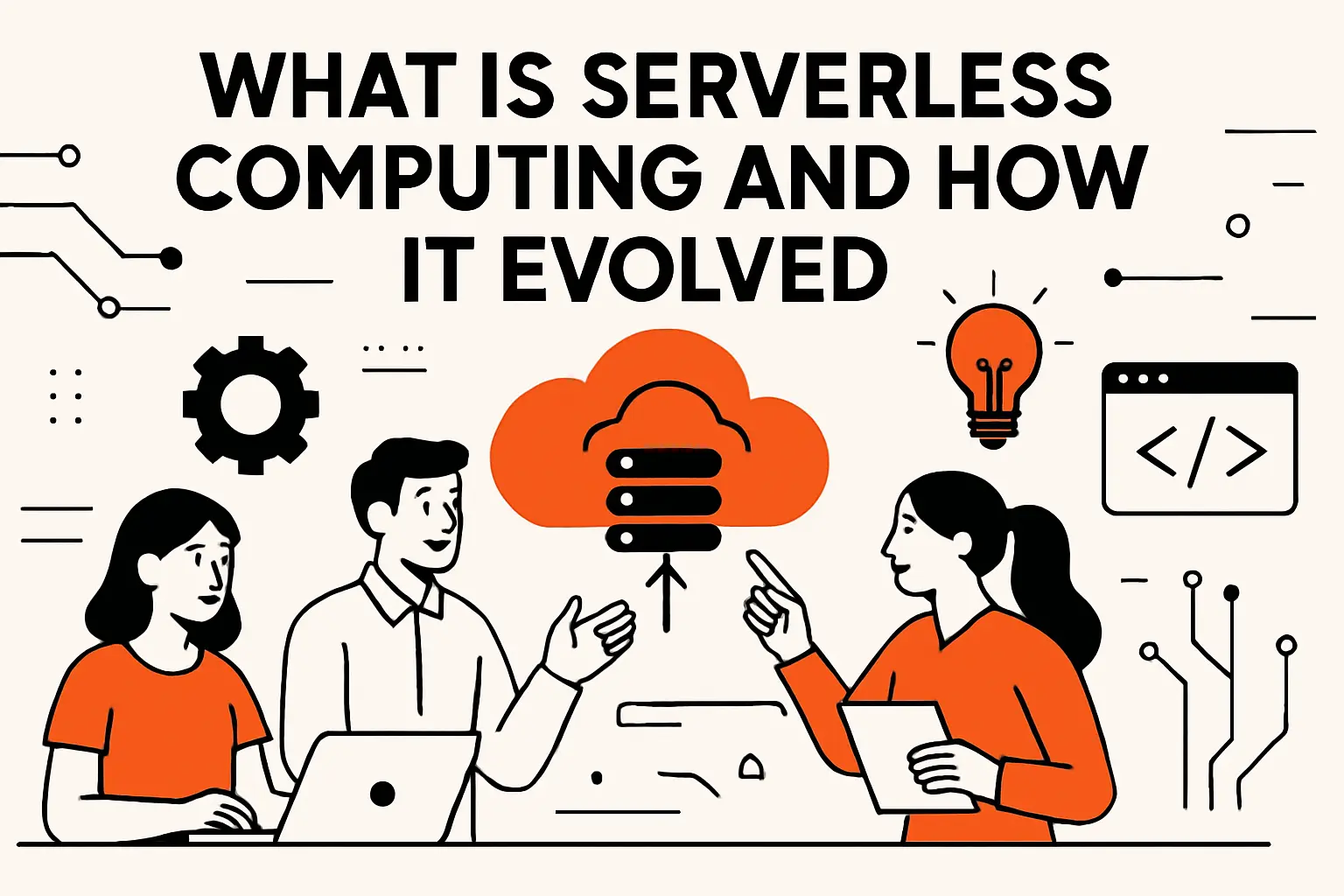
What is serverless computing and how it evolved
As a market context setter, consider that platform services—where most serverless capabilities are born and curated—are projected to reach US$206.43bn in 2025, underscoring how the “platform” tier has become the beating heart of modern application delivery. We approach serverless not as a magic trick that eliminates servers, but as an operating model that hides server management behind APIs, nudging teams to trade tickets and toil for higher‑level primitives and service‑level objectives.
1. A cloud model that removes server management from developers
Serverless replaces the gravitational pull of server administration—capacity planning, patching, OS hardening, and undifferentiated monitoring—with a fabric of managed services. Instead of choosing instance shapes or pre‑warming clusters, we author functions, build lightweight services, and bind them to events, queues, or HTTP routes. That shift changes the unit of work from “machine hours” to “business events,” a difference that’s more philosophical than cosmetic. Our teams have felt the cultural impact: product conversations center on workflows, domain nouns, and customer outcomes, not on fleet sizes or maintenance windows. In practice, we still care deeply about observability and performance, but we negotiate those through configuration and code rather than through server inventories or patch calendars.
We also find that serverless sharpens the boundary between code and data. Functions focus on pure input‑to‑output transformations, while state lives in durable stores—managed key‑value, document, graph, search, or stream systems—consciously decoupled from compute lifecycles. That separation introduces consistency questions and transactional trade‑offs, but it also aligns runtime costs and throughput with actual demand. In short: less scaffolding, more intent.
2. Event-driven execution with pay-per-use billing
Event‑driven execution is the practical embodiment of serverless: an external signal—an HTTP request, a message on a bus, a file landing in object storage, or a scheduled tick—awakens compute just in time to perform a bounded piece of work. Billing mirrors this behavior: instead of paying for capacity that sits idle, we pay for the time and resources consumed while doing the work. That alters architectural instincts. Rather than over‑provisioning for peaks, we embrace concurrency that scales on demand, then collapses back to zero between bursts. We’ve watched this model simplify the perennial “burst versus base load” calculus for marketing launches, payroll runs, and reporting cutoffs. The discipline it imposes—favor short‑lived handlers, minimize startup overhead, keep I/O predictable—makes codebase health a cost variable, not just a quality attribute.
In our experience, the pay‑for‑value model also pairs well with incremental delivery. We can ship a single function to validate a slice of a new customer journey or compliance workflow and pay only for the traffic it receives. That makes A/B trials, dark launches, and controlled canary releases a natural fit without forcing a wholesale platform migration.
3. Origins from early PaaS to FaaS and edge
Serverless didn’t spring fully formed. The lineage runs from early platform services that automated deploys and scaled processes behind a simple push, to function runtimes that abstracted the entire notion of a server. Along the way, container‑centric variants emerged, giving us the ergonomics of standard containers with serverless traits like scale‑to‑zero and managed ingress. The latest branch brings this model to the network’s edge, running code closer to users, devices, and data sources. The common thread is a steady migration of operational concern—from “you run it” to “your provider runs it”—and the co‑evolution of eventing, identity, and observability so that operations becomes a design input, not an afterthought. We view this as a cultural shift as much as a technical one: you don’t just deploy to serverless; you compose with it.
How serverless computing works and key components
The mechanics matter because the surrounding ecosystem is accelerating: private AI companies alone raised $100.4B in 2024, catalyzing demand for event‑driven data ingestion, streaming features, and low‑latency inference triggers. Under the hood, serverless leans on coordinated building blocks—functions, triggers, gateways, buses, and managed data services—knitted together by identity and policy, with IaC and CI/CD setting the guardrails.
1. Stateless functions in managed containers with autoscaling to zero
Function runtimes execute code inside tightly managed sandboxes or containers, provisioned just in time and torn down when they’re no longer needed. By default they’re stateless, so persistent state belongs in external stores. That statelessness simplifies horizontal scaling and isolates faults, but it requires explicit patterns for idempotency, retries, and compensation. We treat idempotency keys as first‑class citizens—derived from natural business identifiers—and we design handlers so that a duplicate event can be accepted, de‑duplicated, or safely ignored.
Scale‑to‑zero is both a feature and a constraint. It crushes idle cost but introduces cold‑start latency. To manage this, we keep deployment bundles lean, reduce runtime initialization, and avoid synchronous fan‑out in hot paths. Where latency predictability matters more than minimizing idle cost, provisioned capacity is a pragmatic counterweight. We also use separate concurrency budgets for batch and interactive pathways so that back‑pressure on one doesn’t starve the other.
2. Triggers from HTTP requests database changes file uploads and schedules
Triggers bind business semantics to compute. A public or private HTTP route fronts APIs and backends. A row insertion in a transactional store can emit a change event. A new object in storage kicks off virus scanning, metadata extraction, or transcoding. A scheduled tick drives routine jobs like certificate rotation or billing reconciliation. Our pattern library maps these triggers to consistency requirements: a message bus and dead‑letter queue for at‑least‑once delivery with replay; webhooks when we can push state changes outward to partners; or long‑polling when intermediaries don’t support callbacks.
We’re careful with trigger fan‑out. It’s tempting to wire a single event to many consumers, but that can produce cascading failures or unbounded retries if a downstream service misbehaves. We prefer a central event bus with declarative routing and policies that cap retries, park poison messages, and emit clear diagnostics for operators without revealing customer data.
3. API gateways event buses and managed data services integrate workloads
Gateways handle authN/authZ, request transformation, caching, and throttling—shifting cross‑cutting concerns out of business code. Event buses give us decoupled publish/subscribe semantics, routing rules, and schema controls. Managed stores—document, key‑value, columnar analytics, full‑text search—become the stateful backbone of architectures that otherwise remain ephemeral. We prefer schema‑evolution strategies that can handle additive fields and intentional deprecations without disrupting consumers. To keep complexity in check, we use domain‑oriented data products: each product owns ingress contracts, storage models, quality checks, and access policies, making lineage and governance auditable without central choke points.
In composite workflows, we decide between orchestration and choreography. Orchestrators make step order explicit and handle branching and compensation centrally. Choreography uses events as the coordination fabric, letting services react independently to domain changes. We choose based on failure semantics: highly regulated or multi‑party money movement often benefits from orchestration; loosely coupled analytics or growth features lean toward choreography.
4. Edge serverless runs functions closer to users to reduce latency
Running at the edge shifts computation into the network, trimming transit time and offloading origin workloads. Instead of sending every decision to a central region, we can gate traffic, localize content, or personalize experiences as close as practical to the requester. The design caveat: storage consistency becomes a spectrum. We favor immutable assets, cache stamps, and per‑request tokens that can be verified statelessly. When we must synchronize state across locations, we adopt conflict‑free data types or single‑writer patterns to avoid split‑brain headaches. Identity design matters here, too: audience‑scoped tokens, short‑lived credentials, and request‑bounded secrets keep edge code safe without inviting long‑lived keys into distributed environments.
Benefits of serverless computing for speed scale and cost

The why is as compelling as the how: the business value unlocked by cloud modernization is enormous—McKinsey estimates that $3 trillion is up for grabs, and in our practice, serverless has been a consistent lever for capturing a meaningful share of that upside through faster change cycles and leaner run‑time overheads.
1. No infrastructure management with built-in availability and fault tolerance
When the platform handles failover, rolling upgrades, and capacity headroom, teams move their attention to correctness, resiliency patterns, and incident response. Fault domains shrink to the scope of a function or microservice, making blast radii smaller and recovery simpler. We favor defensive coding at the edges—timeouts, circuit breakers, and jittered retries—combined with platform limits that prevent runaway concurrency. Rather than tuning clusters, we treat failure modes as design signals and capture them in tests and runbooks so the next incident becomes a non‑event.
A surprising benefit is how much change management becomes a product capability. With declarative pipelines and automated approvals, rollbacks are boring, and forward fixes can ride the same path as the original deploy. In a world where change is continual, boring is a feature.
2. Faster time to market with streamlined DevOps and polyglot support
Serverless reduces the lead time between an idea and a measurable customer impact. Packaging is minimal; bootstrapping new services is near‑instant; and platform capabilities—identity, rate limiting, secrets, streaming—are assembled rather than re‑implemented. Polyglot runtimes mean teams can pick the right language for the job or reuse proven libraries. We’ve seen this play out in greenfield products, but also in “surgical modernization,” where we carve a brittle piece of a monolith into a serverless microservice while the rest of the system remains undisturbed. Small wins accumulate quickly when change is cheap.
The dev experience improves, too. Ephemeral preview environments spin up on pull requests, secrets are injected safely, and tracing is present from the first “hello world.” Teams spend less time debate‑biking and more time measuring outcomes. Documentation becomes executable as runbooks, and design decisions are codified as IaC modules instead of confluence pages lost to time.
3. Pay for value with sub-second billing and no idle capacity
Because cost is correlated with actual use, product teams can reason about unit economics with clarity: how much does processing a customer order cost, end‑to‑end? When a feature has a known cost per operation, decisions on prioritization, pricing, or deprecation become clearer. This transparency fosters healthier conversations between engineering and finance: instead of arguing about aggregate cloud bills, we discuss cost per outcome and experiment confidently, knowing that turning off a feature turns off its spend.
There are caveats. Chatty microservices can inflate egress and invocation overheads, and promises of no idle cost tempt teams to split services more than necessary. We’ve learned to model cost in architecture reviews and to adopt “latency and cost budgets” as first‑class acceptance criteria. That keeps us honest and keeps features performing under the realities of network variability.
4. Resource efficiency and sustainability gains
Serverless platforms improve hardware utilization by multiplexing many tenants on finely sliced resources, letting providers keep machines busy while teams pay only for what they actually use. This consolidation can translate into meaningful sustainability benefits: fewer over‑provisioned machines sitting idle, more efficient packing of workloads, and reduced need for stand‑alone staging environments. We align these gains with internal sustainability scorecards by preferring asynchronous workflows for heavyweight tasks, avoiding unnecessary storage duplication, and placing edge logic where it reduces needless round‑trips. Sustainability isn’t an add‑on; it’s a property of efficient design.
Use cases and patterns where serverless excels
Demand patterns clearly favor architectures that can scale elastically and respond near the user or device. Analysts expect the edge computing market to reach 350 billion U.S. dollars by 2027, and in our field work this translates into backends that react in real time to customers, sensors, and content, without forcing every decision through a centralized origin.
1. API backends and web applications
Serverless is a natural fit for public APIs, internal service meshes, and backend‑for‑frontend patterns. Gateways handle authentication and throttles; functions or serverless containers implement business logic; and managed data services provide durable state. We often pair APIs with event emission: every state transition produces an event that downstream systems can consume for analytics, notifications, or audit. This reduces coupling and gives product teams downstream flexibility without turning the core into an integration hairball. Static and pre‑rendered content can be served from globally distributed caches, with lightweight edge code contextualizing content per request.
We’ve helped digital publishers, fintechs, and healthcare platforms move legacy endpoints off fragile VMs into serverless stacks with minimal customer‑visible changes, then layered on rate enforcement and abuse prevention formerly attempted in application code. The result: backends that are easier to extend and safer to expose.
2. Data processing stream processing and batch workflows
Data pipelines benefit from event‑driven elasticity. Streams capture clickstreams, telemetry, or transaction events; stateless functions enrich and validate; and batch stages materialize aggregates into warehouses and query engines. Rather than scheduling heavyweight ETL clusters, we use orchestrated steps that scale based on queue depth and back‑pressure signals. That makes nightly crunches and bursty traffic play nicely with interactive workloads without long‑lived compute soaking up budget.
For advanced analytics, we separate raw, refined, and curated zones with clear contracts. Schema registries and automated quality checks keep producers and consumers honest. When privacy or sovereignty rules apply, we push anonymization and tokenization as early in the pipeline as possible so that downstream services never see sensitive fields. Reprocessing is standard fare: producers emit reconstitutable events, and consumers can replay from bookmarks to rebuild derived views. That replayability is invaluable during incident recovery or model retuning.
3. Real-time file processing chatbots and scheduled tasks
File‑triggered compute is a classic serverless pattern: ingest an object, extract metadata, transform formats, and update indexes. Because storage emits events, we avoid polling and can chain actions while maintaining provenance. For conversational systems, serverless handlers provide stateless connectors to model endpoints, with context and safety controls resolved per request. Since latency matters for assistants and bots, we keep handler initialization light and push shared resources into managed caches or vector stores with strict TTLs.
Schedules are the quiet workhorses. Certificate renewals, subscription proration, ledger settlements, cache warming, compliance attestations—these all become predictable, declarative jobs rather than cron scattered across pets. We favor structured logs over ad‑hoc prints and propagate correlation IDs so that even the most humble nightly task offers clarity when something goes sideways.
4. Microservices and event-driven architectures
Serverless encourages microservices that align with domain boundaries, not technology layers. The event‑driven variant—where domain events carry meaning rather than just data—lets services evolve independently without breaking contracts. We model events with business names and avoid leaking internal structural details into public streams. Saga patterns handle long‑running, multi‑step changes with compensation. The outbox pattern ensures events are published atomically with data changes, keeping source‑of‑truth stores and event streams in lockstep. We measure success not by how many services we create, but by how regret‑free change becomes months later.
Challenges and trade-offs in serverless computing adoption
The macro backdrop favors careful investment: Deloitte’s analysis notes technology budgets rising from 8% of revenue in 2024 to 14% in 2025, so cloud leaders are scrutinizing ROI while continuing to fund foundational capabilities. Serverless clears that bar when teams make explicit trade‑offs and avoid cargo‑cult deployments.
1. Cold starts and constraints for long-running or stateful workloads
Cold starts arise when the platform spins up a fresh runtime to handle an event. In paths where users wait, that added latency is noticeable. Our mitigations include trimming dependency graphs, avoiding heavyweight global initializations, and using provisioned capacity selectively for endpoints that must respond quickly. For compute that runs long or needs specialized hardware, serverless may not be the right fit; platform‑managed containers or batch services usually play better. We try not to force square pegs into round holes: if a workflow requires durable in‑memory state, we step back and pick tools that embrace that requirement honestly.
Stateful needs aren’t blockers, but they require discipline. External state stores, optimistic concurrency, and idempotent handlers keep business guarantees intact even when a function is retried or events arrive out of order. We test these behaviors explicitly using fault‑injection, because success conditions often hide the edge cases where retries cause harm.
2. Vendor lock-in and limited control
Every managed feature is a trade: higher velocity and reduced toil in exchange for tighter coupling to provider semantics. To keep options open, we standardize on open event formats and portable interfaces. Where possible, we encapsulate provider specifics behind thin adapters, and we keep core domain logic free from SDK glue. When teams need a halfway house, we reach for serverless containers based on standard images, which offer clearer portability. But we avoid the fallacy of building to the “lowest common denominator.” Abstraction layers that hide provider capabilities can erase the very advantages that make serverless attractive. Instead, we write down exit strategies explicitly—what it would take to re‑home a workload—and keep data gravity in mind when making platform choices.
3. Testing debugging and observability across distributed functions
Distributed systems trade call stacks for event trails. We lean into structured logging, correlation and causation IDs, and trace propagation from the first line of code. Local testing uses emulators and contract tests; integration testing covers error paths and timeout handling; and synthetic probes exercise critical workflows continuously. We prefer observability that’s opinionated but non‑proprietary—OpenTelemetry for traces and metrics—so that insights travel with the system as it evolves. On the debugging front, replayable events and deterministic handlers are gifts: when an incident occurs, we can reproduce the exact stimulus that triggered the failure without guessing.
CI/CD is where reliability habits crystallize. We embed policy checks, secret scanning, and least‑privilege reviews into pipelines so deployments are both fast and safe. Canary strategies with automatic rollback keep customer impact contained. Post‑incident, we capture learnings in automated tests so that a once‑in‑a‑lifetime bug becomes a next‑time‑impossible scenario.
4. Security responsibilities and DevSecOps in a shared responsibility model
Shared responsibility is real: providers secure the underlying infrastructure, but identity, data access, secrets, and application logic are ours to own. We scope permissions per function or service, eliminate broad wildcard grants, and treat secrets as ephemeral—rotated regularly and delivered just in time. Edge code magnifies these stakes: we design with audience‑scoped tokens, avoid embedding credentials, and restrict egress where possible. Compliance becomes easier when every action is tied to policy artifacts and IaC modules, giving auditors a provable chain of custody from requirement to running system.
Finally, we align threat models with business reality. Public APIs demand abuse protection and rate enforcement; partner integrations require signature verification and replay prevention; analytical events need clear PII boundaries. The platform gives us excellent primitives, but the responsibility to assemble them coherently is squarely on us.
5. Not ideal for some high performance computing scenarios
Not every workload should be serverless. HPC tasks with sustained CPU or GPU needs, tight inter‑node coordination, or niche runtimes are better served by specialized compute services, batch schedulers, or dedicated clusters. Our guideline is simple: if the work is naturally event‑shaped and benefits from elastic concurrency, serverless shines; if it depends on long‑held resources and precise hardware control, choose tools crafted for that world.
Platforms and ecosystem for serverless computing
Provider ecosystems are investing aggressively: the cloud infrastructure services market reached $330 billion in 2024, with growth tailwinds from AI‑driven services and managed runtimes. In our client work, we rarely see “one best platform” in the abstract—the best fit depends on domain constraints, data gravity, and the surrounding portfolio of services a team already trusts.
1. AWS Azure Google Cloud and IBM Cloud offerings
Major providers converge on similar building blocks—function runtimes, serverless containers, API gateways, event routers, managed queues, and a family of database and analytics services. The meaningful differences show up in ergonomics, breadth of integrations, and the maturity of surrounding services like identity, policy, networking, and observability. For teams deep in a provider’s ecosystem, the gravitational pull of adjacent services is powerful; the fastest path is usually to double down on what you already use well, then fill gaps selectively rather than reshuffling your stack.
We guide customers to evaluate serverless offerings not as isolated services but as members of a cohort: how do gateways, buses, and data stores interoperate? Are IAM constructs expressive enough to encode least‑privilege policies cleanly? Do tracing and logs arrive in a format compatible with your central telemetry system? The answers determine day‑two operability more than any shiny announcement.
2. Cloudflare Workers and edge serverless
Edge platforms prioritize low‑latency execution, isolation models that start in a blink, and globally distributed routing. Workers‑style runtimes excel for request shaping, early auth, and tailored content delivery, and they increasingly reach into durable coordination constructs to synchronize state safely. We’ve put this pattern to work for personalization, fraud heuristics, and feature flags that must be evaluated near the user. The caveat is persistence: you either keep state outside hot paths or use specialized data structures that allow safe, fine‑grained coordination.
Observability at the edge deserves special care. Because code runs in many locations, centralizing traces and logs needs a thoughtful funnel that respects privacy and data residency. We adopt redaction at the source and push minimal, structured telemetry over secure channels so production forensics remain possible without over‑collecting.
3. Knative and Red Hat OpenShift Serverless on Kubernetes
When regulatory boundaries or data gravity dictate running on your own clusters or across multiple providers, Knative offers serverless semantics—request‑driven scale and scale‑to‑zero—on top of Kubernetes. It pairs naturally with eventing layers and autoscalers that operate on incoming request concurrency. OpenShift Serverless packages these ideas with enterprise‑grade operations and policy controls, especially valuable when teams want serverless ergonomics without leaving the comfort of their existing cluster practice. The trade‑off is that you own more of the surface area—capacity planning, cluster upgrades, and security posture—so the organizational maturity required is non‑trivial. We recommend this path for teams already fluent in containers who want to push into serverless without jumping clouds.
4. Serverless with containers including AWS Fargate and serverless Kubernetes
Serverless containers bridge the gap between functions and traditional services. You package an image and let the platform handle placement, scaling, and networking. This model is perfect for workloads that prefer standard web servers, specialized runtimes, or predictable startup profiles. We’ve used serverless containers to host GraphQL gateways, media processors, and feature services that benefit from container tooling yet still want pay‑for‑value behavior and minimal ops overhead. As always, portability is a function of how tightly you bind to provider‑specific extensions, so we encapsulate those choices behind interfaces and keep images lean and transparent.
TechTide Solutions: building custom serverless computing solutions
Market momentum across platforms and edge services keeps rising in step with the platform trends described earlier, and we translate that momentum into customized architectures rather than one‑size‑fits‑all templates. Our viewpoint is pragmatic: start with the business event, decide what “good” looks like in terms of reliability and cost, then let the architecture follow.
1. Discovery and architecture design aligned to business events and outcomes
Our discovery workshops begin with event‑storming to surface domain events and their timelines. That yields a map of triggers, decisions, state transitions, and external obligations. From there, we draft a target architecture that identifies which flows are synchronous (customer waits) and which are asynchronous (system catches up). We codify service boundaries as contracts and decide where orchestration clarifies accountability versus where choreography enables autonomy. We write down exit strategies up front—how a given choice would change if data gravity shifted or constraints evolved—so stakeholders understand trade‑offs without surprises later.
For regulated domains, we weave in auditability from day one. Every material state change emits a signed, immutable event; every data product declares ownership, quality gates, and access policies; every secret has a rotation schedule and a clear source of truth. These aren’t add‑ons—they’re the scaffolding that keeps velocity and trust in balance.
2. Implementation across major clouds and edge using infrastructure as code and CI CD
We implement via IaC modules that encode best practices: least‑privilege policies, curated runtime settings, reliable retry defaults, and logging schemas that align with centralized telemetry. CI/CD pipelines stitch the pieces together: static analysis, secret scanning, drift detection, and canary deploys adjust the safety dial without slowing teams down. Where edge execution amplifies business value, we push decisions outwards with lightweight handlers that enforce global policy while remaining context‑aware for each request.
Real work rarely fits perfect tutorials. We’ve had to create cross‑account event fabrics for multi‑brand retailers, reliable webhooks for partners that couldn’t sign requests, and hybrid flows where on‑prem systems publish and consume cloud events safely. In each case, the aim is the same: hide complexity behind clear contracts and keep the unit of change small enough that releases are unremarkable.
3. Observability security and cost optimization playbooks for serverless computing
Our playbooks turn principles into muscle memory. Observability means traces everywhere, structured logs by default, and dashboards that focus on user journeys, not just system metrics. For security, we start with identity and authorization—scoping permissions tightly, using short‑lived credentials, and treating secrets as workloads in their own right. Cost guardrails catch regressions early: policies flag overly chatty components, and reports generate per‑feature unit costs so product managers see the economic impact of design choices as they experiment.
We close the loop with learning rituals: post‑incident reviews, blamelessly conducted and codified as tests or IaC drift checks; architecture office hours where designers workshop early ideas; and “operability rehearsals” where we practice failure modes on purpose. These habits make a serverless system resilient not because the platform is perfect, but because the people and processes around it are thoughtful.
Conclusion and next steps

Across the ecosystem, analysts and operators alike see the same pattern: serverless matures by folding more responsibility into the platform while asking architects to think in events, contracts, and outcomes. The prize is not merely lower toil, but a tighter link between business ideas and running software. If your next initiative depends on rapid iteration, elastic scale, and auditable operations, serverless may be the shortest credible path from concept to consequence. Shall we map your business events into a serverless blueprint and identify the first slice we can ship with confidence?