
At Techtide Solutions, we treat “on-site vs off-site SEO” as a systems design question: what signals can we engineer directly inside the product, and what signals must be earned in the ecosystem around it? Done well, those two signal families reinforce each other; done poorly, they fight like mismatched microservices with no contract.
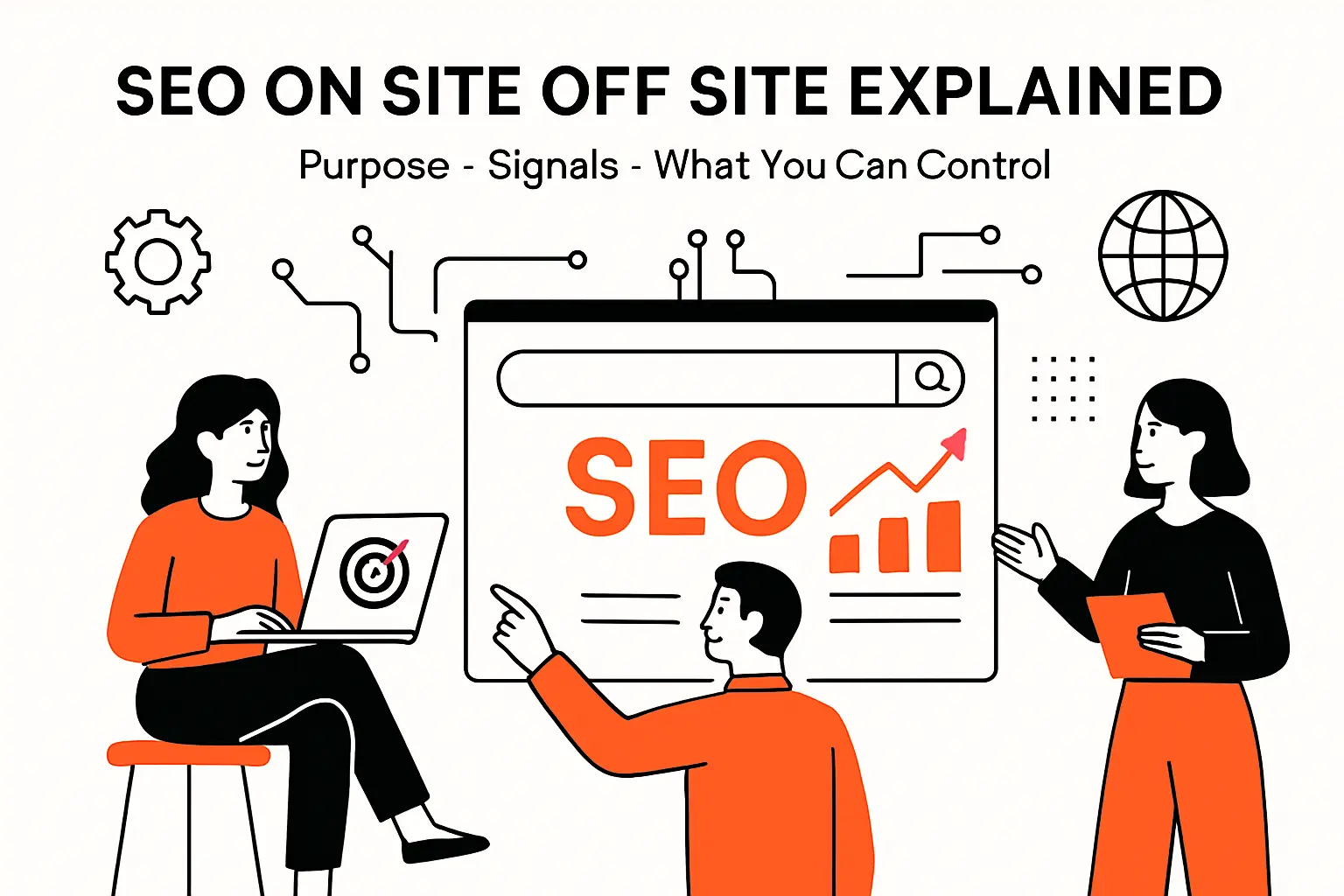
SEO on site off site explained: purpose, signals, and what you can control
Search visibility is no longer a side quest; for many businesses it’s the main storyline. Market overview: Statista’s market forecast estimated worldwide search advertising spend at US$355.10bn in 2025, and that economic gravity still shapes how executives think about “being found” even when the focus is organic.
1. On-site SEO goals: build trust and make content easy for search engines to read and understand
On-site SEO is where we get to be deliberate, almost architectural. From a crawling and rendering perspective, our job is to reduce ambiguity: clarify what each page is about, ensure critical content is accessible, and minimize the kinds of UI friction that make both users and bots bounce off.
Practically, on-site work spans information architecture, content design, and technical execution. Google itself frames baseline SEO as technical requirements, spam policies, and key best practices, and we like that framing because it mirrors software delivery: meet the minimum contract, avoid disallowed behavior, and then iterate toward quality.
What “trust” looks like in code and content
In our builds, trust isn’t a vibe; it’s a set of legible cues. Clear authorship, consistent navigation, predictable URLs, secure delivery, and content that answers a query without theatrics all combine into a page that feels “finished,” which matters more than teams expect.
2. Off-site SEO goals: prove value through external signals like links, mentions, and recommendations
Off-site SEO is the market’s feedback loop: other sites, platforms, and people vouch (or refuse to vouch) for your work. Links remain the most discussed artifact, but we also see reputation signals emerge through brand mentions, reviews, citations, and even how consistently a brand is referenced across the web.
In competitive categories, off-site signals act like third-party audits. A polished site with weak external validation can feel like a brand-new GitHub repo with beautiful README files but no stars, no forks, and no one building on it; technically sound, socially unproven.
Why off-site is not “just link building” anymore
We’ve watched the off-site landscape evolve toward credibility rather than volume. When search engines get better at discounting manipulation, the work shifts from “acquire links” to “earn attention,” which is slower but dramatically more durable.
3. Control and effort: on-site changes are implementable in-house, while off-site relies on relationships and outreach
Control is the cleanest dividing line. On-site SEO is implementable by your internal team (or a partner like us): code changes, content updates, design improvements, and structured data all land through a deploy pipeline you already own.
Off-site SEO, by contrast, is negotiated. Relationships, editorial decisions, community participation, partnerships, and PR are inherently distributed across other people’s timelines and incentives, which is why off-site work can feel less predictable and more political than technical teams prefer.
Operational reality: on-site has sprints, off-site has seasons
Inside product teams, we can plan on-site improvements as backlog items. Outside the product, we plan around editorial calendars, conference cycles, journalist availability, and community moments, then we measure momentum rather than “completion.”
4. Can you rank with only one: when it can work, and why competition usually forces a combined approach
Sometimes one side carries the other, at least temporarily. For a local business in a niche market, strong on-site fundamentals plus consistent local citations can be enough to win early visibility, especially when competitors have thin pages or broken UX.
Competition usually ends that honeymoon. In parallel, Gartner warned that traditional search engine volume may drop 25% by 2026, and we interpret that as pressure to make every click count: when opportunity shrinks, you can’t afford to be weak on either relevance (on-site) or authority (off-site).
Our rule of thumb
When we’re asked to “pick one,” we usually respond with a question: are you trying to be discoverable, or are you trying to be chosen? On-site helps you be understood; off-site helps you be trusted.
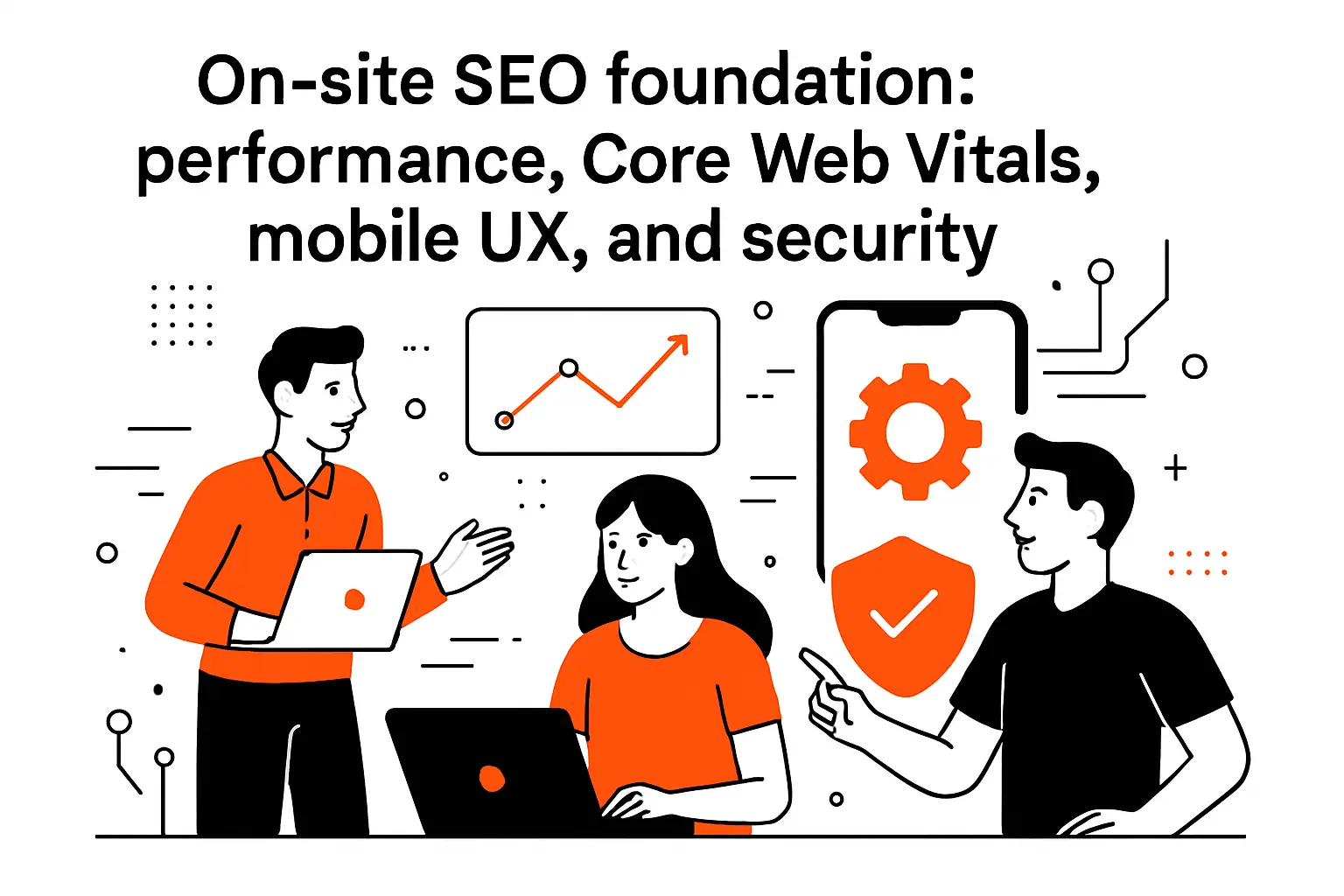
On-site SEO foundation: performance, Core Web Vitals, mobile UX, and security
Before we argue about keywords, we have to earn the right to compete. If a site is slow, janky, or insecure, content quality becomes a hostage to implementation details, and the business pays for it in lost conversions, higher support load, and weaker brand confidence.
From our engineering seat, SEO foundations are mostly product-quality foundations. Performance budgets, resilient rendering, accessibility, and security are not “marketing chores”; they are part of what makes a digital product credible.
1. Website performance optimization tactics: image compression, browser caching, lazy loading, code minification, and CDN usage
Performance optimization is a portfolio, not a single fix. In our audits, we typically see latency coming from a few recurring offenders: oversized media, render-blocking assets, chatty third-party scripts, and backend endpoints that were built for correctness but not for scale.
On the implementation side, we use tactics that compound rather than conflict:
- Compress images and serve modern formats where appropriate, so bytes stop dictating user patience.
- Cache static assets aggressively, because repeat visitors should not pay the “first visit tax” twice.
- Lazy-load non-critical media, while keeping primary content immediately available for both users and crawlers.
- Minify and bundle responsibly, then split code strategically so each page loads what it actually needs.
- Use a CDN when geography matters, because physics is undefeated and proximity still wins.
Business impact we see repeatedly
Faster pages reduce friction in the funnel. Lower friction increases completion rates, lowers acquisition waste, and makes paid traffic less painful—especially for companies whose CAC already keeps the CFO awake.
2. Core Web Vitals and page speed: focus areas including LCP, CLS, and interactivity metrics like FID or INP
Core Web Vitals give teams a shared vocabulary for user-perceived performance, which is more actionable than arguing over “feels fast.” Google documents how Core Web Vitals align with page experience signals in Google Search results, and we treat that as a product requirement rather than an SEO superstition.
From a technical lens, LCP tends to be about critical rendering path and backend response; CLS is often a design-system and asset-dimension problem; interactivity is where JavaScript discipline matters. Meanwhile, Google’s own guidance notes that INP has replaced FID as part of Core Web Vitals, which nudges teams to measure real interaction responsiveness instead of only first-input behavior.
Where teams trip up
In practice, we see “performance theater” when teams optimize lab scores but ship new third-party tags every week. Sustainable gains come from governance: performance budgets, code review checks, and a shared refusal to ship unnecessary scripts.
3. Mobile-friendliness: responsive layouts, readable fonts, and properly spaced tap targets
Mobile UX is SEO UX because mobile is where the web lives. Google’s mobile-first indexing documentation explicitly recommends Responsive Web Design as the easiest design pattern to implement and maintain, and we agree because it lowers complexity across design, content, and engineering.
On real projects, “mobile-friendly” often fails in subtle ways: hero sections that push content below the fold, sticky elements that trap taps, forms that fight autofill, and typography that looks elegant on desktop but becomes squint-worthy on phones.
Our practical checklist mindset
Instead of chasing pixel perfection, we validate mobile pages as journeys: can a user read, decide, and act without zooming, rage-tapping, or hunting for the next step?
4. Site trust signals: TLS and HTTPS, plus credibility basics like privacy and policy pages
Security is a ranking discussion, but it’s also a procurement discussion. Many B2B deals stall when a buyer’s security review flags missing HTTPS, weak policies, or unclear data handling—long before anyone asks about content marketing.
Google publicly stated that HTTPS started as a lightweight signal, initially affecting fewer than 1% of global queries, yet we’ve found the stronger benefit is user trust: modern browsers warn on insecure pages, and users interpret warnings as “this business is sloppy.”
Credibility basics we insist on
Policy pages, clear contact routes, and transparent data practices won’t magically rank a site. Still, they remove doubt, and removing doubt is one of the highest-leverage conversion tactics we know.
Keyword research and content quality: the on-site engine behind relevance
Keywords are not magic words; they’re demand signals. The real skill is mapping language to intent, then building content that satisfies that intent with clarity, specificity, and enough context that users stop searching.
At Techtide Solutions, we treat keyword research like product discovery. People tell you what they want by the questions they type, and your job is to answer like a domain expert, not like a brochure.
1. Keyword research and distribution: choosing the right terms and placing them across content elements
Keyword research begins with boundaries: what problems do we solve, for whom, and in what language do they describe the pain? Once we know that, we look for clusters of related terms that signal the same job-to-be-done, then we decide which page should “own” each cluster.
Distribution matters because search engines read structure. Titles, headings, body copy, internal links, and even navigation labels form a semantic map, and we want that map to be consistent rather than scattered across competing pages.
Example from the field
When we help a B2B SaaS team, we often find pricing questions and integration questions buried inside blog posts. Pulling that content into dedicated landing pages usually improves both user satisfaction and crawl clarity.
2. Keyword usage best practices: early placement, natural mentions in body copy, and keyword-aligned subheadings
Placement is about comprehension, not stuffing. If a page is truly about a topic, the term and its close variants naturally appear early, then recur where the explanation demands them.
Subheadings are where teams can be both user-friendly and search-friendly. A good subheading reads like a promise—“Here’s what we’ll answer next”—and it also helps algorithms segment the page into meaningful chunks.
What we avoid on purpose
In our reviews, we push back on robotic repetition. Over-optimization makes content feel untrustworthy, and untrustworthy content rarely becomes the page a buyer forwards to their team.
3. Content quality and readability: depth over fluff, scan-friendly formatting, and avoiding keyword stuffing
Quality content respects the reader’s time. That means fewer grand claims, more concrete explanations, and formatting that supports scanning: short paragraphs, purposeful lists, and examples that turn abstractions into decisions.
Depth is not length; depth is completeness. If a topic requires definitions, trade-offs, implementation notes, and common failure modes, we include them; if it doesn’t, we keep the page lean and link outward internally.
Why businesses should care
Readable content lowers support costs and improves sales enablement. Every time a prospect self-educates on your site instead of booking a call just to understand basics, your revenue team gets leverage.
4. Topic relevance enhancers: LSI keywords and intent-matching content that answers real questions
“LSI keywords” is often used loosely, but the useful idea is straightforward: real topics have neighborhoods of related terms. When content includes the surrounding vocabulary of a subject, it tends to read more naturally and cover the edges users actually care about.
Intent matching is where many SEO programs either shine or collapse. A page targeting “best” queries should compare and qualify; a page targeting “how to” queries should instruct; a page targeting “near me” queries should reassure and guide logistics.
Our content litmus test
After drafting, we ask: if a skeptical buyer lands here, do they leave with fewer questions, or just different questions?
Page-level optimization: titles, meta descriptions, URLs, images, and internal linking

Page-level SEO is the craft layer. It’s where we refine how a page presents itself to search engines and humans, and where small improvements compound across dozens or hundreds of URLs.
In our practice, this layer is also where engineering and marketing stop working in parallel and start working together, because templates, components, and CMS workflows determine whether good SEO is repeatable.
1. Page title optimization: clarity for readers and alignment with target keywords
Titles are not just a ranking lever; they’re a decision lever. Google’s documentation emphasizes that Title links are critical to giving users a quick insight into the content of a result, and we’ve seen that truth play out across industries.
Clarity wins over cleverness. When a title states who the page is for and what it delivers, it attracts the right click, which is often more valuable than a higher click volume from mismatched intent.
Pattern we use often
We like “Outcome + Audience + Constraint” titles, because they communicate value fast without turning into keyword soup.
2. Meta description optimization: concise value statements with appropriate keywords and actionable details
Meta descriptions sit in a weird middle ground: they aren’t a direct ranking factor in the simplistic way many people hope, but they influence whether a searcher chooses you. Google advises teams to Create unique descriptions for each page on your site, and uniqueness is the operative word.
A strong meta description reads like a micro-pitch: what this page covers, what makes it credible, and what a user can do next. For product pages, that might mean constraints, compatibility, or shipping/availability context; for articles, it might mean what questions are answered.
Operational tip
When we build CMS templates, we ensure editors can override descriptions per page, because auto-generated snippets often miss the nuance that sells.
3. URL structure: short, descriptive URLs that reinforce topic and keyword relevance
URLs are rarely the hero, but they can be the villain. Long parameter chains, inconsistent casing, and duplicated paths increase the risk of indexing confusion and analytics mess.
Descriptive URLs help humans too. When a sales rep drops a link into an email, a clean path builds confidence; when a user sees a messy path, skepticism rises.
Engineering perspective
We design URL patterns as stable contracts. Once a URL is public, we treat it like an API endpoint: change it only with a migration plan, redirects, and updated internal references.
4. Image optimization: filenames, alt text, and file choices that support accessibility and speed
Image SEO starts with accessibility. Alt text should describe what the image contributes, not just what it depicts, and filenames should be human-legible enough to survive being shared or saved.
Performance is the second pillar. Even a “fast” page can be sunk by oversized images, especially on mobile networks, and we often see this when teams upload marketing assets without a compression workflow.
How we make it scalable
Rather than relying on heroics, we automate: image processing pipelines, CMS constraints, and build-time optimization that makes the right thing the easy thing.
5. Internal linking strategy: descriptive anchor text, better navigation, and stronger topical relationships
Internal links are how you teach a search engine what you believe belongs together. They’re also how you guide a buyer from curiosity to confidence without forcing them to search your site like it’s a maze.
Anchor text should be descriptive, not generic. When links say “learn more,” both humans and algorithms lose context; when links say “compare implementation options,” the relationship becomes clear.
Our favorite internal linking move
We build “hub pages” for core topics, then link outward to specialist pages. That structure scales well as content grows and keeps authority concentrated instead of diluted.
Technical SEO support: crawlability, indexing, schema, and error cleanup
Technical SEO is where software engineering earns its keep. Even great content can underperform if crawlers can’t reach it, if rendering fails, or if duplicate pages fight for the same queries.
From our vantage point, technical SEO is largely about reducing entropy: fewer surprises for crawlers, fewer inconsistencies for analytics, and fewer hidden traps for users.
1. Crawlability essentials: robots guidance and XML sitemaps to help search engines find content
Crawlability begins with intent: what do we want indexed, and what do we want ignored? Google explains that A robots.txt file is used primarily to manage crawler traffic to your site, and we treat that file as production configuration—reviewed, versioned, and tested.
Sitemaps complement discovery, especially for large sites or frequently updated catalogs. Google’s sitemap guidance notes that Creating and submitting a Sitemap helps make sure that Google knows about all the pages on your site, which is particularly useful when internal linking can’t realistically expose every URL quickly.
Common engineering mistake
Blocking resources required for rendering can make pages look “empty” to crawlers. When we see that, we fix the underlying access pattern instead of hacking around symptoms.
2. Structured data and schema markup: clearer content context and eligibility for rich results
Structured data is a translation layer between your content and the search engine’s understanding of entities and relationships. Google’s structured data documentation states that Adding structured data can enable rich results, and the practical effect is often better-qualified clicks: users see more context before they visit.
We prefer maintainable approaches: generating JSON-LD from a single source of truth (CMS fields, product catalog data, or a knowledge graph) instead of sprinkling manual markup across templates like confetti.
Where it pays off most
For ecommerce, structured data can clarify products, availability, and reviews. For publishers, it can clarify authorship, breadcrumbs, and article context. And for local businesses, it can support local visibility when combined with consistent citations.
3. Site hygiene and error management: broken links, duplicate elements, redirects, and crawl issues
Site hygiene is boring, and boredom is a feature. Broken internal links waste crawl budget and frustrate users; duplicate titles blur relevance; thin pages clutter indexation; messy redirect chains slow everything down.
Operationally, we treat hygiene as a continuous practice. Monitoring, alerts, and periodic crawl audits prevent regression, especially after redesigns, CMS migrations, or aggressive content publishing pushes.
Real-world failure mode
We’ve seen “successful” redesigns accidentally orphan high-performing pages by changing navigation and removing internal links. The fix wasn’t just redirects; the fix was rebuilding the internal link graph so authority could flow again.
4. Technical readiness checklist: speed, mobile compatibility, secure connections, and clean architecture
A readiness checklist is valuable only if it’s enforceable. In our delivery process, we turn checklist items into acceptance criteria: performance budgets, accessibility checks, secure defaults, and crawl validation before launch.
Clean architecture matters because SEO is cumulative. If templates are inconsistent, if content types are ambiguous, or if routing rules are unpredictable, every future page inherits that confusion—and the business keeps paying interest on technical debt.
How we keep it practical
We aim for a small set of non-negotiables: stable URLs, consistent templates, crawlable navigation, fast rendering, and secure delivery. Everything else is optimization, not survival.
Off-site SEO signals that build authority outside your website
Authority is not declared; it’s observed. Off-site signals tell search engines that your site is part of a broader web conversation, and that other people find it valuable enough to reference.
In our view, off-site SEO is easiest when it’s aligned with real business behavior: partnerships, integrations, thought leadership, community participation, and customer success stories that naturally attract attention.
1. Backlinks as authority signals: earning links from reputable, relevant sources
Backlinks function like citations in academic writing. A link from a relevant, reputable site is a public claim that your content is worth referencing, and that’s more persuasive than a dozen low-quality placements.
Quality link earning usually comes from doing something linkable: publishing original research, building a useful tool, releasing a template, or writing a definitive guide that practitioners actually bookmark.
Our blunt observation
When teams chase “easy links,” they often end up with links that search engines discount and that real humans never click. When teams build assets with genuine utility, links appear as a byproduct of value.
2. Brand mentions and online reputation: linked and unlinked signals that strengthen credibility
Brand mentions are the shadow of real-world reputation. If communities talk about your product, if customers reference your guides, or if analysts include your company in roundups, that ambient visibility tends to correlate with authority.
Reputation also includes negative signals: unresolved complaints, confusing policies, or inconsistent information across platforms. In B2B, we’ve seen prospects validate a vendor by searching the brand name plus “review,” and the outcome of that search can decide a deal.
What we recommend focusing on
We encourage teams to strengthen the “proof” layer: case studies, transparent documentation, and clear positioning. Those assets make it easier for others to talk about you accurately, which is the best kind of mention.
3. Local SEO and citations: consistent NAP information and directory presence to support local visibility
Local SEO is off-site SEO with a phone number attached. Consistent business information across directories and maps helps search engines trust that a business is real, located where it claims, and reachable.
Citations matter most when the business has a physical footprint: clinics, restaurants, home services, legal practices, and multi-location brands. For those teams, inconsistency creates user confusion, and user confusion creates lost revenue.
Engineering meets operations here
We’ve helped clients centralize location data in a single system, then syndicate updates outward. That reduces “drift,” where old addresses linger online long after a business has moved.
4. Reviews and engagement: reputation management and trust signals that support long-term growth
Reviews are both social proof and operational feedback. A steady pattern of thoughtful reviews signals service quality, while recurring complaints reveal product gaps that SEO can’t paper over.
Engagement is the long game. When customers share your content, reference your brand, or recommend you in communities, off-site signals become more resilient than any single link campaign.
Our stance on reputation work
We prefer proactive reputation building: ask satisfied customers for reviews at the right moment, respond to criticism with specifics, and fix root causes. Manipulation rarely survives scrutiny for long.
Link building and outreach playbook: earning, amplifying, and protecting backlinks
Link building is often framed as a tactic, but we treat it as a process: create something worth citing, identify the audiences who benefit, and make it easy for them to discover and reference it.
Risk control matters as much as acquisition. Search engines have become more comfortable neutralizing manipulative patterns, so “more links” is not inherently “more ranking.”
1. Guest blogging outreach: a repeatable process for earning inbound links from relevant sites
Guest blogging can work when it’s aligned with expertise and audience fit. The strongest guest posts read like contributions, not advertisements: they solve a problem the host audience already has, and they include a reference back to a relevant resource on your site.
Process is what makes it repeatable. We define target publications, build topic angles based on their existing content gaps, pitch with specificity, then deliver drafts that match the publication’s editorial tone.
What we refuse to do
We avoid “guest post farms.” If a site exists primarily to publish contributed posts with little editorial oversight, the link equity is often low and the brand risk is high.
2. Content promotion for link acquisition: social amplification and publishing link-worthy assets like original research
Promotion is not optional because discovery is not guaranteed. Even excellent content can die quietly if it’s never placed in front of the people who would cite it.
We see the best results when promotion is multi-channel: social posts tailored to platform norms, outreach to newsletters, community participation, and direct contact with practitioners who have written about the topic before.
Asset types that naturally earn links
Tools, calculators, checklists, benchmarks, and original data tend to attract citations. If we can pair those assets with a clear methodology and a transparent scope, other writers feel safe referencing them.
3. Digital PR and brand features: journalist pitching, podcast participation, and research others cite
Digital PR is link building with editorial standards. Journalists and creators don’t want your product page; they want narratives, expert commentary, and credible evidence that supports a story their audience cares about.
Podcasts and webinars also matter because they create durable references. A strong interview can lead to show notes, citations, community sharing, and follow-on opportunities with other outlets.
How we keep it honest
We encourage founders and leaders to speak from real operational lessons: what broke, what was learned, and what trade-offs were made. Authenticity travels further than polished claims.
4. Link maintenance and risk control: recovering lost links, fixing broken backlinks, and managing harmful links
Links decay. Pages get redesigned, URLs change, publishers update content, and references disappear; without monitoring, a site can quietly lose authority it earned over years.
Search engines also fight manipulation aggressively. Google notes that SpamBrain is our AI-based spam-prevention system, and our takeaway is simple: if links were acquired to game rankings, they’re unlikely to remain valuable, and they may become a liability.
Maintenance actions we take often
We track link losses, reclaim broken backlinks with redirects or outreach, and evaluate suspicious patterns. When we find risky placements, we address the cause rather than hoping it goes unnoticed.
TechTide Solutions: custom development that supports SEO-ready digital products

SEO strategies succeed or fail in implementation. A content team can write brilliantly, but if the site’s rendering is fragile, templates are inconsistent, or publishing workflows are slow, the SEO program becomes a treadmill.
As a software development company, we focus on making SEO “baked into the product,” so teams can ship high-quality pages repeatedly without treating every update like a bespoke engineering project.
1. Building fast, mobile-first web experiences with custom web app development
Fast experiences are designed, not wished into existence. In our builds, we prioritize predictable rendering, efficient data loading, and front-end architecture that limits unnecessary JavaScript work during interaction.
Mobile-first isn’t a slogan in our process; it’s a constraint that sharpens decisions. When layouts, forms, and navigation work well on small screens, desktop experiences typically become cleaner too, because the design system has fewer excuses to sprawl.
Example approach we implement often
We like component-driven design systems paired with performance budgets. That combination keeps marketing pages, product pages, and content templates consistent while still giving teams flexibility to tell stories.
2. Developing technical SEO-friendly foundations: crawlable architecture, clean URLs, and structured data support
Technical SEO-friendly foundations are about removing accidental complexity. Clean routing, stable canonical patterns, and crawlable navigation prevent the “invisible content” problem where a page exists for users but not for search engines.
Structured data support works best when it’s systemic. We implement schema generation inside templates and content models, so editors don’t have to understand markup to publish pages that are eligible for rich results.
Where custom development beats plugins
Plugins can help, yet they often fail at scale when edge cases appear. Custom foundations let us align URLs, templates, and metadata rules with the business model rather than with generic assumptions.
3. Creating tailored integrations and automation for scalable content workflows and measurable performance
SEO becomes sustainable when workflows are sustainable. Automation can help teams publish consistently, update metadata safely, and measure outcomes without manual reporting that breaks every time the site changes.
Integration work is where we see outsized gains: connecting CMS data to analytics events, syncing product catalogs, generating internal links based on taxonomy, and implementing guardrails that prevent editors from publishing broken pages.
Our measurement philosophy
We instrument what matters: content performance by intent, conversion paths, and technical health indicators. When measurement is reliable, iteration becomes rational instead of reactive.
Conclusion: making SEO sustainable with an integrated on-site and off-site approach
Sustainable SEO is a balance of relevance and authority, executed through product quality and market credibility. On-site SEO makes your site understandable and usable; off-site SEO makes your brand believable and referenced.
At Techtide Solutions, we think of SEO as a long-running system: it needs clean inputs (content and technical quality), healthy external feedback (mentions and links), and continuous calibration (measurement and iteration).
1. Step-by-step execution plan: audit, optimize content and UX, improve internal structure, build links, and track performance
Start with an audit that’s brutally honest: technical health, content gaps, intent alignment, and competitive context. Next, prioritize UX and performance fixes that remove friction, then refine page-level SEO so the site communicates clearly.
After that foundation is stable, improve internal structure: navigation, internal linking, and content hubs that make topical relationships explicit. Only then do we push hard on outreach and digital PR, because authority earned on top of a messy site is harder to convert into results.
Tracking that actually helps decisions
We track rankings, but we don’t worship them. Pipeline contribution, qualified traffic, and conversion paths usually tell a clearer business story than a single vanity keyword ever will.
2. Expected timelines to impact: typical ranges for on-page, off-page, and technical improvements
On-page improvements can show impact relatively quickly once pages are re-crawled, particularly when changes clarify intent and reduce UX friction. Technical improvements vary: some fixes help almost immediately, while others require search engines to reprocess templates and internal relationships.
Off-page work generally takes longer because it depends on editorial cycles and relationship momentum. In our experience, authority building behaves less like a switch and more like a flywheel: slow to start, then increasingly self-reinforcing as the brand becomes easier to cite.
How we set expectations
We align on milestones rather than promises: technical stability, publishing cadence, outreach consistency, and measurable lifts in qualified traffic. That keeps teams focused on controllable inputs.
3. Iteration for growth: repeat audits, refine based on results, and balance relevance with authority over time
Iteration is where SEO turns from a campaign into an operating system. Repeating audits helps catch regressions, while refining content based on query data keeps relevance aligned with what customers actually ask.
Authority building should evolve too. As a site grows, we recommend shifting from opportunistic link chasing toward durable credibility: research, partnerships, community presence, and product-led resources that people reference because they genuinely help.
Next step
If we could ask only one question before you invest further, it would be this: are you building a site that search engines can understand, and a brand that other humans want to recommend?