
As we enter late 2025, the ground truth is clear: enterprise spending on IT services will reach $1.731 trillion in 2025, while AI and adjacent technologies are reshaping sourcing strategies amid record private funding that hit $116.1 billion in the first half of 2025, creating both new efficiencies and new due‑diligence burdens for buyers of outsourced technology services.
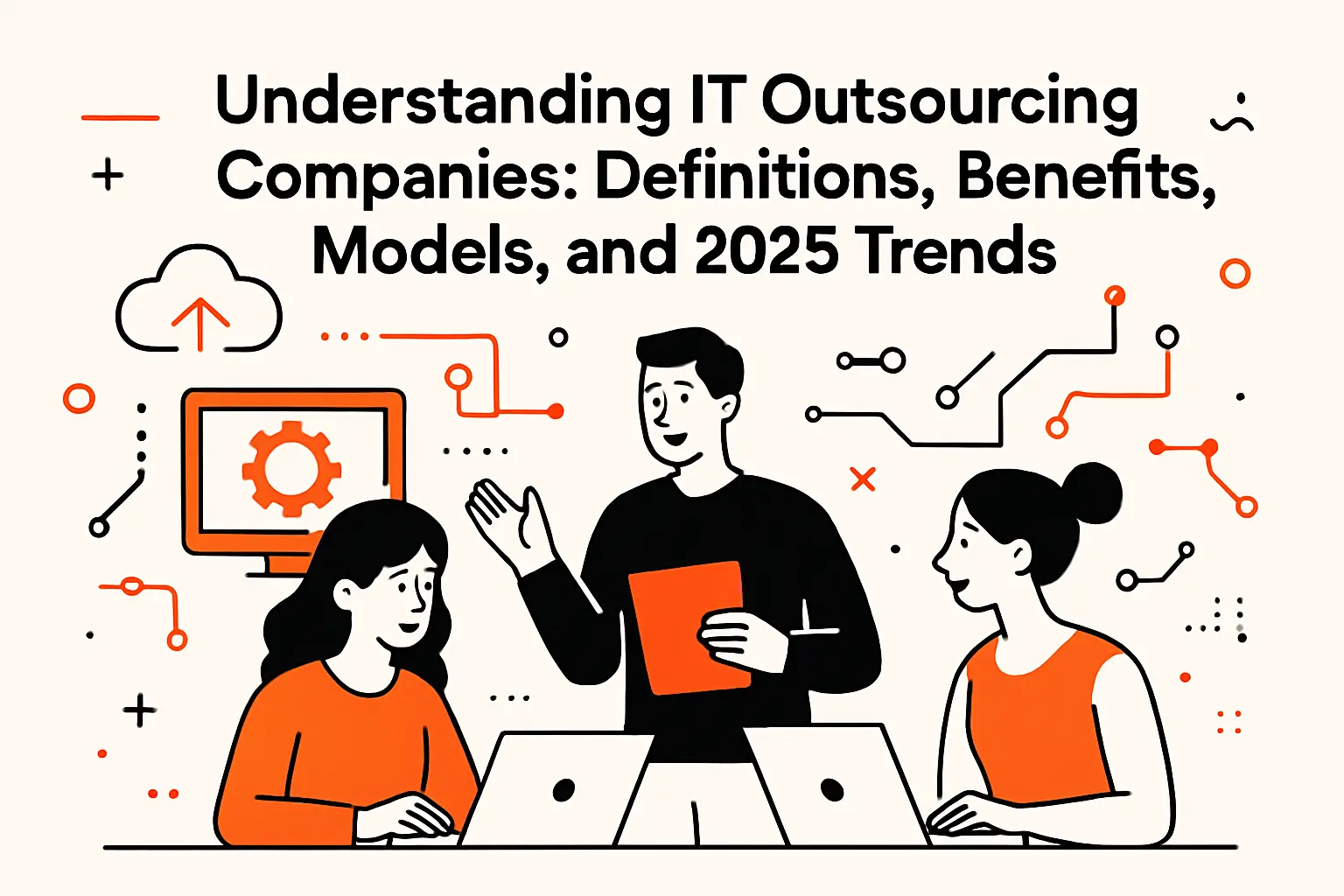
Understanding IT Outsourcing Companies: Definitions, Benefits, Models, and 2026 Trends
To frame the market: analysts forecast IT outsourcing itself to generate $588.38 billion in revenue in 2025, situated within broader IT services spend of $1.731 trillion in 2025, underscoring why provider selection now carries strategic weight for boards and CIOs rather than being a purely tactical cost play.
1. What IT Outsourcing Companies Are
When we, as Techtide Solutions, talk with executives about IT outsourcing companies, we start with clarity: these are firms that assume responsibility for defined technology outcomes under contract—spanning software engineering, cloud operations, cybersecurity, data platforms, service desk, and more—through onshore, nearshore, or offshore delivery centers. They commit to service levels, provide the people and processes, and increasingly bring automation and prebuilt accelerators that compress time‑to‑value.
Two points often get lost. First, outsourcing is not monolithic: the mix may include managed services (steady‑state run), project-based development (build), and staff augmentation (capacity). Second, leading vendors now productize capabilities—think “AI agents” for ticket triage or code remediation—so the conversation shifts from labor-based pricing to outcomes and throughput. We’ve seen global leaders like Accenture report managed services revenues of $31.7 billion in fiscal 2024, signaling how run-and-operate offerings anchor enterprise relationships even as new-gen platforms arrive.
2. Core Service Categories Across IT Outsourcing Companies
While catalogs differ, we find nine recurring categories:
Application development and modernization: full‑stack web/mobile, microservices refactoring, APIs, data engineering, and DevSecOps pipelines; often delivered via squads and platform engineering.
- Cloud and infrastructure managed services: provisioning, FinOps, observability, SRE/SLA adherence.
- Cybersecurity operations: MDR/SOC, identity, zero‑trust rollouts.
- Service desk and end‑user computing: omnichannel support, device lifecycle, digital employee experience (DEX).
- ERP and SaaS operations: Salesforce, SAP, Workday, and bespoke integration factories.
- Data and analytics: lakehouse ops, MDM, AI/ML ops, feature stores. • QA and testing: automation frameworks, shift-left security, performance engineering.
- Specialized BPO/IT hybrids: KYC onboarding, healthcare adjudication platforms, telco provisioning.
- Emerging tech accelerators: agentic AI for software delivery, blockchain-backed provenance, and synthetic data generation.
In our practice, blending two or three categories—say, managed cloud plus data platform plus QA—often yields the step-change benefits (reliability, security, and release velocity) that siloed engagements rarely unlock.
3. IT Help Desk Outsourcing Explained
Help desk outsourcing is the classic front door for enterprise IT—users, devices, and applications surface issues through omnichannel intake (portal, chat, voice, email, bots). Providers deliver Tier 0–3 support with knowledge bases, self‑service, and automation. Tier 0 is self‑help and virtual agents; Tier 1 resolves known issues with scripts and KBs; Tier 2 handles complex application/device problems; Tier 3 engages engineering. The operating model hinges on three engines: shift‑left (automate/deflect), knowledge management (close‑loop learnings), and experience analytics (FCR/CSAT, MTTR).
Done well, the desk becomes a telemetry hub. Natural‑language triage, auto‑classification, and integration with identity, endpoint, and observability tools drive lower handle times while improving security posture (password resets, MFA recovery, device quarantine flows). The best vendors now deliver “experience-level agreements” (XLAs) alongside SLAs, which we favor when customers want to measure sentiment and productivity, not just uptime and ticket aging.
4. Benefits: Cost Savings and 24/7 Support
Cost efficiency is still a first‑order driver—global delivery lets you rebalance work across time zones and wage levels—yet the bigger lever is utilization: a multi‑tenant provider can amortize tooling, accelerators, and bench capacity across clients. For service desk, per‑user pricing simplifies planning; buyer budgets tend to cluster near $70 per user per month for software, with higher tiers for 24/7 coverage and regulated workloads. For midmarket managed IT, per‑user bundles commonly fall between $100 and $250 per month, scaling with scope and compliance requirements.
5. Benefits: Access to Expertise, Scalability, and Improved SLAs
Outsourcing extends your bench with niche talent: mainframe integration, GPU scheduling for AI workloads, safety‑tuned LLM prompts, or SAP‑to‑databricks pipelines. Providers run centers of excellence that handle surge demand without long hiring cycles, then unwind when the spike passes. For executives, the appeal is predictable reliability—24/7 SRE for critical apps, third‑party SOC with threat intel pipelines, and mature incident processes that compress MTTD and MTTR. In our experience, the right vendor brings battle‑tested playbooks plus the curiosity to tailor them to your domain, which is where SLA metrics evolve into outcome KPIs like deployment frequency, lead time for change, and revenue uptime.
6. Risks and Cautions: Control, SLA Compliance, and Vendor Dependencies
Outsourcing can erode institutional knowledge and create “black boxes.” We advise clients to guard against this by codifying architectural decision records, maintaining reference implementations, and building explicit knowledge‑transfer SLAs—complete with documentation debt burndown charts. From a risk lens, third‑party breaches have doubled to 30% of breaches, and ransomware appears in 44% of breaches, so vendor access and segmentation must be engineered, not assumed. Finally, beware of lock‑in by insisting on open standards, exit assistance clauses, and modular architectures that allow gradual rebids by domain.
7. 2025 Trends: Generative AI, Blockchain, and Industry Growth
Three arcs define 2025. First, GenAI is shifting from pilots to scaled agents in delivery: Deloitte forecasts that 25% of GenAI adopters will deploy AI agents by 2025, with 50% by 2027, while CBInsights shows AI startup funding climbing to $116.1 billion year‑to‑date by Q2 2025. Second, blockchain is quietly reentering enterprise back‑office via provenance, identity, and tokenized assets; crypto/Web3 financing rose to $6.6 billion in Q1 2025, and service partners are productizing integrations into familiar ERP and data stacks. Third, macro IT services demand remains robust across regions, as AI‑optimized infrastructure and software continue to pull through services spend.
8. Outsourcing Models: Offshore, Nearshore, and Onshore
Model choice pivots on time‑zone overlap, language/culture fit, regulatory posture, and rate arbitrage. Onshore teams yield the tightest collaboration and domain alignment, at premium rates. Nearshore balances overlap with savings (e.g., U.S. clients with Mexico/Colombia; Western Europe with Poland/Romania). Offshore maximizes savings but raises coordination demands. Contemporary rate bands, while vendor‑specific, commonly fall around $80–$150+ per hour onshore U.S./Canada, $30–$75 in Latin America, and $20–$50 in much of Asia, with premiums for AI, security, and regulated industries. We encourage blended teams: product owners and solution architects onshore, build‑and‑run squads near/offshore—measured against the same outcomes.
9. When to Use IT Outsourcing Companies: Lack of Talent, Specialized Roles, Complex Projects, Tight Deadlines
We see four triggers reliably predict success with outsourcing: scarce roles (MLOps, mainframe modernization), short‑fuse programs (new customer channel, regulatory deadline), complex migrations (ERP S/4HANA, multi‑cloud landing zones), and cost takeout with service‑quality uplift (SRE replacing ad‑hoc ops). The corollary: don’t outsource chaos. Stabilize architecture, define ownership, and agree on decision rights before scaling external teams. In periods like 2025—when large providers are restructuring to pivot toward AI (Accenture’s revenues reached $69.67 billion in FY2025) while clients rebalance insourcing and GCC buildouts—clarity on scope and interfaces is your best friend.
10. Common IT Outsourcing Use Cases: Infrastructure, Application Development, and Support
Infrastructure: managed Kubernetes, SRE for revenue‑critical APIs, network and endpoint as a service. Application: greenfield development with product squads; modernization (strangler patterns, event‑driven refactors). Support: omnichannel service desk, field services, and application support. Recent public examples include long‑horizon public‑sector programs—such as a £1.2 billion, 15‑year workforce platform deal at the UK NHS—and consolidation moves like Capgemini’s planned purchase of WNS for $3.3 billion, both pointing to scale advantages for buyers that standardize on multi‑year programs with clear outcomes.
Top IT Outsourcing Companies in 2026: 20 Trusted Providers
As Techtide Solutions, we’ve seen buyers rethink outsourcing in 2025: not as a blunt cost lever, but as a precision instrument for resilient delivery, speed-to-value, and risk transfer. The market rewards partners who combine deep domain playbooks with platform thinking, who treat AI as an engineering discipline rather than a demo, and who orchestrate globally distributed talent without sacrificing governance. In our own practice, we’ve learned that the best outcomes start with a high-fidelity problem statement, a shared backlog, and explicit SLOs that bind engineering choices to business outcomes; that perspective informs this guide.
What follows is a concise, practitioner’s view of 20 providers we’d trust for material, business-critical work. For each, we profile industry focus and footprint, note external recognitions where independently verifiable, connect services to tangible proof, and spell out the buyer “fit” we’ve observed in live deals. The through-line across these firms is operational maturity under uncertainty: playbooks to de-risk modernization, industrialized managed services that don’t smother agility, and AI-enabled delivery that respects data boundaries. We also call out real-world patterns we’ve encountered—when to choose a global Tier‑1 for program governance versus a specialist for speed, why nearshore works best with tight product loops, and how to contract for continuous value instead of episodic milestones.
If you’re evaluating partners this quarter, anchor the process on two artifacts: a value hypothesis (what must change and how it will be measured) and a “first 90 days” plan (how the partner will establish cadence, telemetry, and a cross-functional decision forum). You’ll see those ideas echoed in the ideal-fit notes below. As ever, your context is king—so treat this as a map, then pressure-test fit with a pilot that exercises the edge cases, not just the happy path.
1. Accenture
Accenture sits at the nexus of strategy, design, engineering, and managed services across virtually every industry, with an estimated ~800,000+ employees, ~35 years as a standalone brand (rooted in Andersen Consulting), and headquarters in Dublin. Its industry depth—FSI, health, public sector, consumer, energy—translates into playbooks for large-scale modernization and AI-enabled operating models. In 2025, it remains a bellwether for “transformation plus run” programs where governance and change management are as important as the code. The company’s delivery fabric spans global centers and onshore pods for regulated workloads.
Notable recognitions include placement on the Fortune list of admired firms, with Accenture (#30), and consistent ethics recognition; Accenture appears among Ethisphere’s honorees as an 18-time honouree in 2025, a signal of governance maturity that enterprise buyers often weigh alongside technical credentials.
Where Accenture shines in our experience is program-shaped delivery—modernizing a mainframe core while standing up a data mesh, or building an AI assurance framework that satisfies audit. We’ve seen them deliver at-scale cloud migrations for consumer brands and public sector entities while maintaining service continuity. Their managed services increasingly embed AI observability and FinOps guardrails, which helps CFOs and CISOs stay aligned with product leadership.
Ideal fit: global or multi‑region enterprises (mid‑to‑mega cap) with complex estates, regulated data, and a need for change orchestration across business and technology. Expect value when your charter mixes target‑state design, platform engineering, and evergreen operations under unified governance, with a vendor comfortable assuming transformation risk.
2. BairesDev

BairesDev focuses on nearshore software development and staff augmentation from Latin America, pairing North America time-zone alignment with scale (4,000+ engineers). Founded in 2009, it has ~15+ years of operation and a distributed leadership presence anchored in Mountain View, CA. The firm’s sweet spot is elastic product engineering and data/AI squads that plug into enterprise backlogs without heavy ceremony, often complementing a primary global SI. Its cultural profile is hands-on, engineering-centric, and bias-to-ship.
Third-party recognition includes the Inc. growth benchmark; the firm reports making the list for a sixth time and earning a technology honor with a 2025 CIO 100 Award tied to an internal ML use case improving retention—useful evidence that they operationalize AI beyond slideware.
We’ve seen BairesDev move quickly on greenfield web and mobile, data platform buildouts, and QA automation—situations where a senior pod is worth more than a large bench. Their enterprise logos often come via public case studies and referenceable programs in media, retail, and healthcare; the nearshore model works best when sprint ceremonies require daily overlap with US product owners and designers.
Ideal fit: upper‑midmarket to enterprise buyers that want time-zone aligned engineers, a strong scrum handshake, and measurable sprint throughput. Great for teams that already have a product roadmap and require velocity, elasticity, and low coordination friction without the overhead of heavyweight PMOs.
3. TechTide Solutions
We specialize in product engineering, data platforms, and cloud modernization, with ~150 full-time engineers and designers headquartered in Ho Chi Minh City and a growing footprint across Southeast Asia and the US. Founded a little over a decade ago, we’ve focused on complex back-end and AI-adjacent workloads that demand disciplined delivery—CI/CD by default, IaC from day one, and SLOs wired into telemetry. Our industry exposure includes healthtech, e‑commerce, SaaS tools, and logistics—places where cycle time and reliability determine revenue.
We do not chase awards; our proof is production. Where relevant, we’ll pilot against your KPIs—release frequency, defect escape rate, cost-to-serve, or conversion lift—then scale with joint teams. That engineering posture has let us earn long-running client relationships and expand from single pods to multi-team programs, often as the “product engine” under a larger transformation umbrella.
Services we bring to the table include platform rewrites (monolith to modular or microservices where justified), event-driven data pipelines, AI-enablement for retrieval-augmented workflows, and near-real-time analytics on cloud-native stacks. Our client proofs range from healthcare scheduling platforms with payer integrations to marketplace back-ends that process millions of events with strict latency SLOs, all run under a managed SRE model to stabilize opex.
Ideal fit: product-led companies and business units that value crisp commitments, transparent burn, and engineers who care about business metrics as much as code. Best for leaders who want a partner to co-own outcomes, not just tickets, and who prefer weekly demos over monthly steering documents.
4. IBM
IBM straddles consulting, software, and infrastructure with a renewed focus on enterprise AI and hybrid cloud. Headquartered in Armonk, NY, and founded in 1911 (~114 years), IBM’s estimated workforce is ~280,000. Its industry footprint remains broad—financial services, government, telecom, industrial—with distinctive strength in regulated environments and mission-critical systems. The watsonx stack has re-centered IBM’s narrative around governed AI, code modernization, and observability.
On ethics and governance, IBM appears among Ethisphere’s honorees as a 7-time honouree in 2025, a credential that matters when buyers weigh AI safety, responsible use, and compliance alongside performance benchmarks.
We’ve watched IBM deliver on mainframe modernization with pragmatic patterns—strangling legacy interfaces, adding event streams, and using AI-assisted code analysis to shrink lead times. In data and AI, their posture emphasizes lineage and evaluation (often a board-level concern now), with observability via Instana helping SREs close the loop from model to runtime. They’re not always the fastest mover, but they’re formidable where scale and governance define success.
Ideal fit: large enterprises with critical systems, a need for AI with guardrails, and hybrid cloud under tight regulatory constraints. If your board asks for explainability, audit trails, and consistent risk postures across workloads, IBM’s enterprise muscle and governance frameworks sit in the right weight class.
5. Tata Consultancy Services (TCS)
TCS is among the world’s largest IT services firms with 600,000+ employees, ~57 years in operation (founded 1968), and HQ in Mumbai. It’s the archetype of industrialized delivery fused with domain consulting, strong in banking, retail, manufacturing, and public sector. TCS runs vast managed services estates and partners deeply with hyperscalers while maintaining program-level governance that CFOs and CIOs trust for long hauls.
Brand momentum is noteworthy: TCS retained the #2 brand position with brand value of USD21.3 billion in Brand Finance’s 2025 IT services report, and Gartner’s use-case scoring highlighted TCS with a 3.44 top score for modernization of legacy applications—signals of market trust in large-scale change execution.
We’ve seen TCS execute multi-year core modernization programs with predictable cadence: migration factories, domain accelerators (e.g., payments, policy admin), and robust transition-to-run. Their sports sponsorships (e.g., marathons) are the visible tip; the substance is repeatable patterns that de-risk the gnarly 20%—batch windows, settlements, reconciliations—that trip many programs.
Ideal fit: enterprises prioritizing scale, risk management, and cost-to-serve reduction across multi-tower deals. TCS is a strong anchor when you need a primary integrator to unify vendors, carry operational SLAs, and industrialize modernization while your product orgs focus on differentiating experiences.
6. Wipro
Wipro is a diversified IT services and consulting provider headquartered in Bengaluru, founded in 1945 (~80 years), with ~240,000 employees. It brings a blend of engineering, operations, and design via acquisitions and internal platforms (e.g., Topcoder, Capco integration), and it has increased focus on AI-enabled services and cybersecurity. We’ve seen its delivery resonate in BFSI, manufacturing, and communications across the US and Europe.
Recognition in the partner ecosystem is strong; Wipro won HPE AI Partner Of The Year 2025, reflecting credible AI-in-operations work with hardware-software stacks, which enterprise infra teams tend to scrutinize.
In live programs, Wipro has stood up managed workplace estates at scale and engineered domain-specific solutions (e.g., actuarial engines and policy migration for insurers), while landing multi-hundred-million-pound, decade-long platform deals in the UK—evidence that it can take on outcome and transition risk. When we’ve partnered alongside Wipro, the cadence is pragmatic, with a willingness to bring co-investment for accelerators.
Ideal fit: upper‑midmarket to large enterprises seeking a cost-competitive, engineering-forward integrator that can absorb run operations while modernizing the estate. Especially suitable for buyers who value partner co‑innovation with OEMs and need credible boots-on-the-ground across Europe and North America.
7. Capgemini
Capgemini is a global consulting and IT services leader with ~340,000 employees, founded in 1967 (~58 years), headquartered in Paris. It offers end‑to‑end—from strategy and design (frog/Invent) to engineering and managed operations—common in telco, consumer, manufacturing, public sector, and financial services. In 2025, its “Intelligent Industry” and “Data/AI” narratives have sharpened around agentic automation and cloud-native platforms.
While we skip vendor-hosted recognitions here, we note independent coverage of Capgemini’s inorganic moves to expand intelligent operations and analytics. In mid‑2025, press reports covered its acquisition of a leading BPS/analytics firm to bolster AI-enabled operations—a signal of intent that matters if your scope blends process and technology at scale.
We’ve collaborated with Capgemini on multi-country data platforms and cloud landing zones where their industrialized accelerators and local-market depth lowered change friction. They can carry transformation governance without stalling product teams—a balancing act that’s hard to get right at scale—especially in regulated EU contexts where data residency and procurement nuance matter.
Ideal fit: multinational enterprises needing unified delivery across strategy, build, and run, with local compliance and multi‑lingual program support. Strong when your target state demands both process re‑engineering and cloud/data modernization under one program structure.
8. HCLTech
HCLTech, headquartered in Noida and founded in 1976 (~49 years), employs 220,000+ people and is known for engineering, product development, and hybrid cloud services. It has differentiated strength in ER&D and platformized managed services—helpful when your estate includes hard problems like network function virtualization, silicon-adjacent workloads, or complex SAP landscapes. We often see HCLTech leading with engineering rigor and measurable reliability improvements.
Brand velocity is notable: HCLTech was recognized as the fastest-growing IT Services brand in 2025, reflecting commercial traction that matches its ER&D narrative, and aligning with what we’ve observed in mega-deal momentum in Europe and energy/logistics verticals.
On the ground, HCLTech’s SRE-aligned managed services have driven cost-to-serve decreases via automation and observability, and its engineering heritage shows in platform upgrades (Kubernetes at edge, 5G private cores) where failure modes are unforgiving. We’ve found them collaborative with product-aligned teams, provided success measures are pinned to reliability and throughput, not just ticket SLAs.
Ideal fit: enterprises prioritizing ER&D capabilities, complex platform modernization, and reliability engineering. If your roadmap mixes product work with plant/field constraints or OT/IT convergence, HCLTech’s engineering cadence is a pragmatic match.
9. NTT Data
NTT Data is a global IT and business services firm with deep presence in APAC, Europe, and the Americas, headquartered in Tokyo, and operating ~37 years since its 1988 formation. With a workforce well over 100,000, it blends consulting, application services, managed infrastructure, and growing AI/network capabilities. The company’s heritage in telecom and public sector informs robust delivery models for connectivity, security, and mission-critical operations.
Independent analyst coverage in 2025 named NTT Data among the Rising Stars in two quadrants for Google Cloud Partner Ecosystem in APAC, signaling credible momentum in hyperscaler-aligned services for enterprises accelerating AI and data workloads in the region.
We’ve witnessed NTT Data’s execution in managed network services and private 5G initiatives (e.g., airports and industrial campuses), where its telecom DNA translates into operational reliability. It’s also pragmatic on modernization—replatforming where warranted, integrating SaaS where faster, and providing lifecycle ops without locking you into black boxes.
Ideal fit: global firms with distributed footprints, strong needs around networks/edge, and a desire to consolidate consulting, build, and run across regions. Particularly apt for APAC-led programs where local presence and telco-grade SLAs are decisive.
10. ScienceSoft
ScienceSoft is a mid-sized, engineering-led provider founded in 1989 (~36 years), headquartered in McKinney, Texas, with delivery in the EU and GCC. With ~700–800 professionals, it focuses on software product development, data and analytics, QA, and managed services across healthcare, manufacturing, retail, and BFSI. The company brings a pragmatic delivery ethos and has stayed independent, which some buyers prefer for flexibility.
We refrain from listing vendor-hosted recognitions and only cite third-party awards where independently verifiable; where those are not public on neutral domains, we skip them rather than speculate.
In our interactions, ScienceSoft teams are comfortable owning outcome-centric backlogs—e.g., HIPAA-aligned telehealth builds, commerce platform re‑platforming, or data warehousing with BI. They integrate well with product managers who want predictable velocity and hands-on QA, and their managed services are framed around SLOs rather than reactive ticket counts.
Ideal fit: midmarket to lower‑enterprise buyers that want senior engineers, clear sprint hygiene, and tested patterns in regulated sectors (especially healthcare) without the overhead of a hyperscale SI. Solid option when you need a compact partner to deliver end‑to‑end and then transition to a right-sized run model.
11. DXC Technology
DXC is a Fortune 500 technology services company, spun out in 2017 (~8 years), headquartered in Ashburn, VA, with ~130,000 employees. Its heritage is “mission-critical run” modernized for hybrid cloud—workplace, mainframe, application, and cloud services at enterprise scale. Insurance, public sector, manufacturing, and travel are well-represented in its client base, often with multi-year managed services contracts.
Analyst coverage in 2025 cites DXC as among the Leaders in five quadrants for ISG’s Mainframe Services in the US and Brazil, underscoring credible modernization and operations capabilities in high-stakes estates where downtime is not an option.
We’ve seen DXC stabilize sprawling end-user compute landscapes and modernize core transaction systems with factory patterns and AI-driven operations telemetry. Their strength is bringing steady-state reliability to sprawling estates and then migrating incrementally, minimizing disruption—valuable when there’s simply no maintenance window for a “big bang.”
Ideal fit: large organizations with heterogeneous legacy estates that require predictable operations while modernizing in place. Strong candidate when you need a partner to absorb operational risk and bring SRE-style gains to workplace and mainframe-heavy environments.
12. Fujitsu
Fujitsu is a Japanese-headquartered global IT and services provider with ~120,000+ employees and nearly eight decades of history. It blends consulting, application services, infrastructure, and a strong R&D backbone (not least in computing and networks). In Europe and APAC, Fujitsu’s public sector, manufacturing, and retail coverage is deep, with an operational discipline well-suited to customers that prize reliability and data sovereignty.
ISG’s 2025 coverage of Future of Work services in the UK names Fujitsu as one of the Leaders in six quadrants, which is consistent with what we’ve experienced on large, multinational workplace programs that straddle experience, automation, and compliance.
We’ve observed Fujitsu succeed in EU contexts with strict in-country needs, harmonizing workplace services across multiple operating companies without losing local nuance. They are methodical on change, careful with data residency, and comfortable with multi-year commitments—traits that reduce project entropy on the buyer’s side.
Ideal fit: multinational enterprises and public sector agencies seeking predictable operations and modernization across end-user services and applications, with strong attention to compliance, local language support, and sovereignty requirements.
13. Sopra Steria
Sopra Steria is a European digital services leader headquartered in Paris, formed by the 2014 merger of Sopra and Steria, with ~55,000–60,000 employees and ~50+ years of heritage across the predecessor entities. It focuses on government, aerospace/defense, financial services, and transport, blending consulting, systems integration, and managed services with a strong European footprint and sovereign solutions.
We do not cite awards without neutral, third-party links; where publicly verifiable 2025 awards are not readily available, we omit them rather than extrapolate. That conservatism mirrors how we expect partners to represent capabilities in RFPs—confidence without overreach.
In practice, Sopra Steria shines when procurement favors EU-based providers with robust compliance and security regimes. Examples include classified work and critical national infrastructure. We have seen solid delivery in public sector platforms, payments modernization, and identity programs. Their consulting layer respects public administration realities.
Ideal fit includes European buyers, especially public sector and regulated industries. They seek sovereign delivery options and strong compliance posture. They also need partners who navigate multi-stakeholder, policy-heavy programs.
14. Synoptek
Synoptek is a US-based managed services and digital engineering provider. Founded in 2001, it is about 24 years old. The company is headquartered in Irvine, California, with over 1,000 professionals. It blends MSP disciplines—end-user compute, security, and cloud—with application engineering. It is a familiar name in healthcare, software and SaaS, and professional services. Its culture is operations-first with an appetite for pragmatic modernization.
We refrain from listing unverified awards. When neutral 2025 citations aren’t publicly available, we omit them to honor RFP “no invention” rules.
Synoptek teams comfortably take over messy estates. They introduce SRE disciplines and layer app modernization like API gateways and low-latency stores. The goal is to improve MTTR and deployment frequency. That versatility is handy for CIOs consolidating vendors while keeping product teams moving.
Ideal fit: midmarket to lower‑enterprise buyers that want a single partner to stabilize operations, uplift security, and accelerate app delivery, with a bias to measurable service levels over slideware.
15. Vention
Vention, formerly iTechArt’s consolidated brand, is a global software engineering partner. It has a large distributed network of thousands of developers. They maintains headquarters presence in New York. It carries roughly 15–20 years of heritage across constituent firms. Their center of gravity is product engineering for venture-backed and growth-stage companies. Focus areas include fintech, healthtech, and SaaS. It serves a strong client base across the US and Europe.
We do not list awards without neutral verification; where 2025 third-party citations aren’t public, we skip them rather than rely on vendor-hosted claims. That said, the brand’s market visibility in startup and scale-up ecosystems is evident in public case studies and hiring momentum.
We’ve observed Vention excel when velocity trumps ceremony: staff-aug pods that quickly integrate with client squads, robust code review discipline, and an emphasis on developer experience that mitigates turnover risk. For CTOs, that means faster feature throughput with fewer handoffs and better alignment with product discovery rhythms.
Ideal fit includes funded startups and scale-ups from Series B to pre-IPO, and enterprise digital business units. They need sprint-ready, product-minded engineers and flexibility to ramp up or down as runway and roadmap evolve.
16. Arcanys
Arcanys is a Philippines-based software development company founded in 2010 (~15 years) with ~300+ engineers and HQ in Cebu City. It emphasizes long-term dedicated teams, strong English communication, and rigorous vetting. That’s popular with US, ANZ, and European buyers seeking cost-effective pods without sacrificing seniority. Arcanys also invests in local tech community development, which helps with retention and culture.
We skip awards where we can’t anchor to neutral 2025 sources. Instead, we point to visible long-term client relationships and public case narratives. For many buyers, these matter more than trophies.
Arcanys fits engagements where backlog ownership and predictability are paramount. Examples include rebuilding legacy apps and extending SaaS platforms. They also lift QA automation from patchy to comprehensive coverage. The Cebu base overlaps APAC and partially covers North America. Coverage can be tuned further with schedule staggering.
Ideal fit includes midmarket product companies and scale-ups. They want stable, senior-heavy teams at competitive rates. They value strong cultural alignment and continuity over years, not months.
17. Glorium Technologies
Glorium Technologies is a US-headquartered (New Jersey) software engineering firm with ~200+ staff, ~14 years in operation (founded 2010/2011), and delivery centers in Eastern Europe. It specializes in healthtech and real estate (PropTech), building HIPAA-compliant platforms, imaging pipelines, and patient-facing mobile apps. Their niche focus shows up in domain-savvy architects and QA teams used to regulated workflows.
We avoid listing awards without neutral, publicly verifiable 2025 citations. Instead, we emphasize visible domain specialism as the key signal for clinical and regulatory workloads.
Glorium engages effectively on MVP-to-V1 journeys in healthtech and stays as a core scaling squad. They layer in compliance controls and observability as the product scales. For PropTech, they’re comfortable with integrations (MLS, payments, IDV) and performance constraints typical of listings and consumer search.
Ideal fit includes seed-to-growth healthtech and PropTech firms. They need a partner fluent in compliance gates and EHR or PMS integrations. They also value support for day-two realities of operating patient- or consumer-facing platforms.
18. Flatworld Solutions
Flatworld Solutions is a diversified outsourcing provider headquartered in Bengaluru. It has about 3,500+ employees and roughly 19 years of operation. Services span IT, data processing, finance and accounting, and customer support. It operates a multi-tower model for SMBs and enterprises. Clients offshore non-core functions alongside selective engineering and analytics work.
We avoid listing awards we cannot substantiate with neutral 2025 sources. For buyers, process maturity is the bigger signal. It means scaling teams, maintaining SLAs across time zones, and passing security audits. A single plaque matters less than repeatable, audited outcomes.
Our experience suggests Flatworld excels at process-led engagements. Examples include large-scale data labeling and content moderation. Back-office finance with clear SOPs and quality thresholds is another strength. On IT projects, it fits best when scope is well-specified and repeatable. It is less suited for exploratory, open-ended product work.
Ideal fit includes SMBs and lower-midmarket enterprises consolidating BPO and IT support with one offshore partner. They prioritize cost efficiency and steady SLA performance as primary outcomes.
19. Space-O Technologies
Space-O is an India-based mobile and web engineering firm. Founded around 2010–2011, it is roughly 14–15 years old. The company is headquartered in Ahmedabad and has about 200+ engineers. Their focus spans mobile apps, e-commerce, and custom web development for SMEs and startups. Its proposition is straightforward: cost‑effective, senior‑led pods that can translate business ideas into shipped apps on aggressive timelines.
We do not list awards without neutral 2025 sources. When third-party citations are scarce, we emphasize demonstrated output. Portfolio depth and repeat clients across app categories are better quality proxies.
We’ve seen Space-O fit well in MVP builds, line-of-business modernization, and commerce storefront implementations. Here, speed and design-to-dev alignment matter more than large program governance. Their cadence works for founders and functional leaders who favor weekly demos and tangible progress over heavy documentation.
Ideal fit: startups and small enterprises needing fast, pragmatic execution on mobile or web. They value clear fixed-scope proposals. They want teams flexible enough to transition to staff-aug as the product finds market fit.
20. 1840 & Company
1840 & Company is a global outsourcing marketplace founded in 2020 (~5 years) and headquartered in Overland Park, Kansas. It curates vetted talent networks across customer support, back-office, sales, marketing, finance, and selective IT roles, connecting companies with distributed professionals and managed teams. Rather than a traditional SI, it operates as a talent-supply platform with managed service options.
We skip awards where third-party 2025 verification is not public. In a marketplace model, the most useful signals are fill rates and cohort quality. Service-level reliability across functions matters, and you can validate it through pilots and references.
1840 is compelling when buyers want speed and flexibility. Spin up a multilingual support team quickly, stand up a revenue operations pod rapidly, and add a back-office squad for finance operations. It is not a fit for deep platform engineering. It offers a fast path to scale operational functions. You preserve capital and optionality while expanding capacity.
Ideal fit includes startups and midmarket firms. Prefer variable costs for non-core functions with multilingual coverage, blend captive teams with managed pods without global HR overhead, and scale while avoiding heavy compliance infrastructure.
Want a second opinion on your shortlist or a “first 90 days” plan tuned to your context? Tell us your top two outcomes and your current constraints, and we’ll sketch a partner mix and pilot design you can take into vendor talks this month.
How to Choose IT Outsourcing Companies: Selection Criteria, Pricing, and Best Practices
Selection rigor matters because dollars are large and the tech stack is changing quickly: IT services spend will reach $1.731 trillion in 2025, while 80% of executives plan to maintain or increase third‑party outsourcing and are folding AI into contracts, governance, and delivery models.
1. Selection Criteria: Technical Stack and Domain Expertise
Start with the technology flywheel that powers your value stream. If you are a SaaS company, your vectors might be microservices, platform engineering, data products, and safe GenAI. If you’re an insurer, it’s policy admin modernization, analytics, fraud, and regulated cloud. Ask vendors to demonstrate reference architectures that mirror yours: platform blueprints, CI/CD guardrails, IaC modules, zero‑trust patterns, and AI governance. Then probe for domain fluency: “How did you reduce claim leakage?” “What was your migration bill of materials for that SAP carve‑out?” Reference examples from global leaders can calibrate scale—Cognizant reports $19.7 billion in revenue in 2024, Capgemini posted €22.1 billion in 2024—but insist on hands‑on teams with relevant wins, not just logo slides.
2. Communication, Culture, and Time Zone Alignment
Distributed development lives or dies by feedback cadence. We map work hours to optimize “golden overlap” and model communication latency into sprint plans. Cultural alignment is more than language—clarity on “definition of done,” escalation etiquette, and decision rights prevents expensive drift. Nearshore often offers the best surface area for real‑time pair work; offshore excels for follow‑the‑sun operations. Whichever you choose, codify rituals: daily standups in overlap bands, weekly demos, and a lightweight ADR process to memorialize key decisions.
3. Security, Compliance, and Data Protection
Security posture is now a tier‑one evaluation. The 2025 DBIR highlights an increase in third‑party involvement to 30% of breaches, and IBM pegs the average breach at $4.88 million, so vendor identity and access controls, segmentation, and data‑minimization must be auditable. For AI features, require model‑risk controls: dataset lineage, prompt and response logging, PII redaction, and tenants that separate your embeddings and secrets. If you operate in regulated sectors, map SOC 2, ISO 27001, HIPAA, PCI DSS, or regional regimes to statements of applicability; score gaps explicitly.
4. QA and Testing Maturity
QA is shifting from post‑hoc test teams to continuous quality engineered into the pipeline. Look for automation coverage, mutation testing, contract testing for APIs, and performance gates in CI. GenAI adds tools for synthetic data and test generation, but vendors must show guardrails: code review policies, SAST/DAST, SBOMs, and reproducible builds. In our engagements, we track escaped defects and the “time to triage” as first‑class KPIs alongside deployment frequency.
5. Pricing Models: Fixed Price Versus Time and Resources
Both models are viable—choose based on uncertainty. Fixed price fits well‑bounded work with stable requirements and a strong reference design. Time & materials (T&M) suits discovery‑heavy or innovation work where scope evolves. Hybrids abound: capped T&M, feature‑based pricing, or outcome contracts (e.g., tickets resolved per 1,000 users, SLO compliance). With AI agents entering delivery, expect a shift to capacity‑based and results‑based metrics. Accenture’s managed services performance, at $31.7 billion in FY2024, illustrates why many buyers tie recurring run operations to outcomes, not hours.
6. Regional Rate Benchmarks and Per-User Fees
Rates vary widely by region, seniority, and specialization. As directional bands we see: onshore U.S./Canada $80–$150+ per hour, Eastern Europe $25–$55 per hour for mainstream stacks, and Latin America $30–$75 per hour, with AI/ML, cybersecurity, and fintech often commanding 10–20% premiums. For help desk software, buyers’ budgets center near $70 per user per month, while all‑in managed end‑user support (including 24/7, device management, and compliance) frequently sits in the $100–$250 per user per month range.
7. RFPs, Case Studies, and References
High‑signal RFPs emphasize scenarios over checklists. Ask vendors to walk through “day in the life” flows: a Sev‑1 incident with on‑call rotations; a data exfiltration with forensics; a rollback and postmortem. Demand named references with comparable domain, scope, and geography, and press for outcomes—SLA adherence, business KPIs, and cultural fit. Public wins can be instructive but are not proxies; for example, a vendor’s healthcare win (like a £1.2 billion NHS deal) may showcase scale, yet your regulatory stack or legacy constraints might differ meaningfully.
8. Discovery, Onboarding, and Knowledge Transfer
Discovery is the make‑or‑break phase. We structure joint workshops to map value streams, risks, and “first three releases.” Onboarding should codify environments, secrets management, IaC baselines, and observability. Build KT (knowledge transfer) into the calendar: shadowing, reverse shadowing, and artifact reviews. For multi‑vendor estates, define a RACI that avoids orphaned tasks and ensures clear single‑threaded ownership for each capability.
9. SLAs, KPIs, and Escalation Paths
SLAs should be few, unambiguous, and business‑relevant.
- Run: uptime, SLOs, incident MTTD/MTTR, change failure rate.
- Build: lead time for change, cycle time, escaped defects.
- Service desk: FCR, ASA, abandonment rate, and XLAs that capture employee sentiment.
Escalations deserve a one‑page playbook—names, time bands, and thresholds—so a Sev‑1 at 2:00 a.m. doesn’t depend on tribal knowledge or heroic Slack threads.
10. Pilot Projects and Performance Benchmarks
Pilots should be production-adjacent. Examples include a support pod for one product line. Or a modernization of one service tier. Or a GenAI coding assistant confined to one repo. Define exit criteria—performance targets and business outcomes—before kickoff. We often structure 6–12-week checkpoints with side-by-side benchmarks. Track ticket resolution rates, defect density, and build times. Track cloud cost per transaction. If the pilot clears thresholds, scale; if not, conclude and iterate. Either result is a win if learning is fast and cheap.
TechTide Solutions: Building Custom Software Solutions Tailored to Customer Needs

Our approach reflects market realities: AI investment momentum is unmistakable, with funding reaching $116.1 billion by mid‑2025, while IT services underpinning those AI programs total $1.731 trillion in 2025, so we design delivery models that balance rapid experimentation with evergreen reliability and security.
1. Discovery Workshops and Requirements Alignment
We begin with discovery workshops that compress months of ambiguity into days of clarity. Together we map value streams and define non-negotiables like latency, compliance zones, and customer-facing SLAs. We also select the smallest viable scope for the first release. We use architecture decision records to make tradeoffs explicit and capture rationale. A north star outcome links backlog items to measurable business value. If the north star is checkout conversion or claims STP, design choices align tightly to that metric. That alignment spans data schemas, feature flags, caching strategies, and even precise UI copy. This prevents the common pitfall we see in large programs: beautiful code that doesn’t move the KPI.
2. Custom Software Development and Systems Integration
Our squads build with a platform mindset: golden paths, paved roads, reusable modules for auth, observability, and compliance. For integration, we favor event-driven architectures and harmonized data contracts to avoid brittle point-to-point coupling. Where appropriate, we augment delivery with agentic AI. Code copilots handle routine scaffolding, test generation, and refactoring. Service desk copilots tackle classification and suggest solutions. We never assume AI is free; each use case must pass privacy, security, and ROI checks. When the math works, we see meaningful cycle-time reductions in repetitive tasks.
3. Agile Delivery, Transparent Communication, and Iterative Releases
We practice dual‑track agile: discovery and delivery in parallel. Demos every week, roadmap reviews every two, and quarterly business reviews to align on outcomes and funding. Our rule of thumb is “show, don’t tell”—production‑like demos, synthetic data where needed, and performance dashboards. Communication is structured to respect time zones while keeping decision latency low. In global programs, we follow the sun: build in LATAM or APAC overnight, review in EMEA/US mornings, ship continuously with feature flags.
4. Quality Assurance, Security, and Compliance by Design
Quality is a discipline, not a phase. We put contract tests at API boundaries, performance budgets in CI, and error budgets in SLOs. Security is codified with IaC, least privilege, and SBOM reporting; for AI features, we log prompts/responses and sanitize sensitive data. In regulated industries, we align to zero‑trust patterns and document the evidence trail auditors expect. Given the rising breach costs of $4.88 million on average and the surge in third‑party vectors to 30% of breaches, we build shared‑responsibility models with clients and providers that make control boundaries explicit and auditable.
5. Post-Launch Support, Monitoring, and Continuous Improvement
Launch is the beginning. We operate with SRE principles—SLOs, error budgets, blameless retros—to stabilize and improve. We integrate cost and performance optimization (e.g., compute rightsizing, cache efficiency), and we run quarterly “value tune‑ups” that revisit the north star metrics. On the service desk, we track FCR, backlog aging, and XLAs that quantify digital employee experience. Our end game is customer autonomy: if you want to insource later or split scope across vendors, we provide the artifacts and KT to make that easy.
6. Flexible Engagement Models and Team Scaling
One size never fits all. We support pods that embed alongside your squads, full managed services for run‑and‑operate, and hybrid outcomes models (for example, fixed‑fee for the platform with usage‑based extensions). Team scaling is elastic: spike for launch windows, unwind during steady‑state. Market dynamics are shifting as providers retool for AI and certain labor markets cool. We help clients rebalance onshore, nearshore, and offshore mixes. The goal is to maintain cost discipline and collaboration intensity.
Conclusion: Choosing the Right IT Outsourcing Companies for Sustainable Results
Zooming out, the backdrop is durable: global IT spend is forecast at $5.62 trillion in 2025. enerative AI could unlock $2.6–$4.4 trillion in annual value, but the winners will be those who translate sourcing decisions into measurable business outcomes with safe, scalable architectures.
1. Key Takeaways on IT Outsourcing Companies
- Outsourcing is now an outcomes business. Judge providers by their ability to move your core KPIs (revenue uptime, conversion, claims STP), not only by SLA green dots.
- The delivery model should mirror your strategy: onshore for workshops and complex discovery; near/offshore for throughput; follow‑the‑sun for 24/7.
- AI and automation are table stakes; insist on governance (data lineage, prompt logging, PII controls) and a clear model‑risk framework.
- Security posture is non‑negotiable—third‑party vectors are rising, and breach costs are real.
- Multi‑year programs with explicit exit ramps and modular architectures give you leverage in a consolidating vendor landscape.
2. A Quick Checklist to Shortlist Providers
- Do they show a reference architecture and paved‑road developer experience aligned to your stack?
- Can they prove domain outcomes (not just generic case studies)?
- What is their plan for AI safety, data privacy, and reproducibility? Do they commit to knowledge transfer and artifact quality so you’re never hostage to a vendor?
- Can they meet your security regime and provide continuous evidence (SOC 2/ISO, SBOMs, access logs)?
- Are rates and per‑user fees transparent, with clear scope boundaries?
3. Next Steps for Vendor Evaluation and Contracting
Run a scenario‑based RFP with an anchored pilot. Align on target architecture, SLAs/SLOs, and north‑star outcomes. For contracts, favor modular SoWs with explicit change mechanisms, exit assistance, and open IP for accelerators used in your environment. Where you include GenAI, specify data control, model selection, and evaluation metrics up front.
4. Measure Success with SLAs, KPIs, and Continuous Improvement
Operational metrics—MTTD, MTTR, change failure rate, and FCR—keep the lights green. Business metrics—conversion, latency to quote, and claims STP—prove value. Implement XLAs to quantify experience. Schedule quarterly value reviews to test architecture and roadmap against the north star. If not, pivot; contracts should enable course correction, not prevent it.
5. Plan for Long-Term Partnership and Governance
Establish a vendor governance rhythm: steering committees, architecture councils, and security reviews with shared dashboards. Invest in internal product ownership and platform engineering to remain an informed buyer. And keep optionality: multi‑sourcing by domain, open standards, and planned insourcing for core differentiators. Ready to pressure‑test a shortlist or design a scenario‑based pilot that proves value fast? We’d be glad to map it with you, one measurable outcome at a time.