
IoT cloud architecture is the end-to-end blueprint that lets physical devices produce data, move it safely, and turn it into outcomes inside cloud services. From our perspective at Techtide Solutions, it is less about drawing boxes for “device” and “cloud” and more about defining durable contracts: how telemetry is shaped, how identity is proven, how commands are authorized, and how the organization operationalizes what it learns.
1. What iot cloud architecture is and why it matters
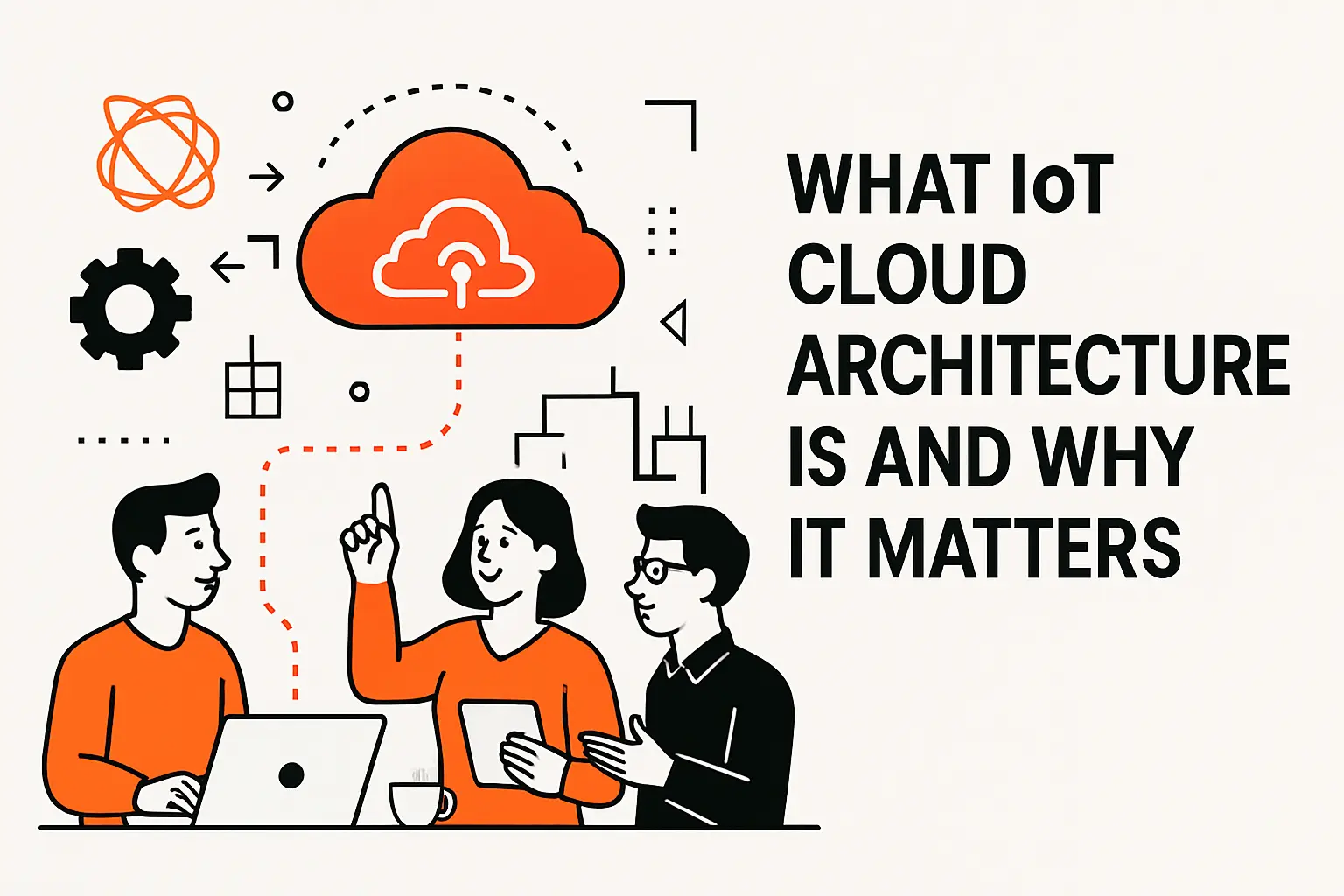
1. Definition: connecting smart devices to cloud services for data manipulation and actionable insights
Under that definition, “cloud” is not merely storage. Instead, it is the coordination plane where device fleets become manageable, analytics become repeatable, and product capabilities become shippable. Consider a refrigerated supply chain scenario: sensors in trailers publish temperature and door events; the cloud correlates those events with route context, alerts a dispatcher, and writes an auditable record that can resolve disputes. Because the value is in the decision, not the packet, architecture must explicitly design for correctness, latency expectations, and failure tolerance.
Operationally, we treat IoT cloud architecture as a product surface. Device onboarding, telemetry quality, alerting semantics, and user permissions are all part of “what we ship,” whether the customer calls it a platform, a connected product, or a digital transformation initiative.
2. Why IoT needs cloud: high data volume plus real-time and near real-time processing demands
In IoT, data arrives continuously, unevenly, and often unreliably. Edge networks flap, devices reboot, clocks drift, and payloads change across firmware versions. Cloud is the practical place to normalize that chaos: it gives us elastic compute for bursts, managed messaging for fan-in, and consistent policy enforcement for who can see what.
From a market lens, IoT is not a niche anymore; Statista’s market outlook expects global IoT revenue to reach approximately US$2,227 billion in 2028, which helps explain why so many businesses now treat connected systems as core infrastructure rather than experimental projects. That scale forces architectural discipline: backpressure strategies, idempotent processing, schema evolution, and automated remediation are no longer “nice-to-haves.”
Latency is the other pressure. Some decisions must happen quickly (machine safety, alarm triage, access control), while others can be aggregated for richer insight (predictive maintenance, demand forecasting). Cloud enables both, provided we are deliberate about which decisions belong at the edge and which belong centrally.
3. Business outcomes: workflow automation, operational efficiency, and cost reduction
Business outcomes are the reason IoT exists at all. When we design architectures for customers, we map telemetry to decisions, decisions to actions, and actions to measurable impact. A connected building that only visualizes HVAC data is interesting; a connected building that automatically detects faults, creates work orders, and tracks resolution time is transformative.
Automation is usually the first unlock. Rules engines and event-driven workflows can route exceptions to the right team, trigger remote diagnostics, or throttle usage during peak cost windows. Efficiency follows when data is trustworthy: maintenance crews stop “truck-rolling” for non-issues, operations teams reduce downtime through earlier warnings, and product teams prioritize fixes using real usage evidence instead of anecdotes.
Cost reduction is real, but it is rarely a single lever. Savings typically come from a portfolio of improvements—fewer failures, faster root-cause analysis, better energy management, and reduced manual reporting—supported by an architecture that is reliable enough to become the system of record.
2. Reference architectures and tiers: edge, platform, and enterprise viewpoints
1. Heterogeneous IoT environments and the role of the IoT gateway
IoT environments are heterogeneous by default. Devices vary in compute capability, power budget, connectivity, and vendor protocol; meanwhile, business constraints vary by geography, compliance posture, and operational maturity. A gateway becomes the pragmatic “translator and traffic cop” that bridges constrained networks to modern cloud endpoints.
In our delivery work, gateways often serve four distinct roles. First, they terminate local protocols and speak cloud-friendly protocols upstream. Second, they buffer during outages so that data loss is minimized. Third, they enforce local policy—what is allowed to leave the site, when it can leave, and how it is encrypted. Fourth, they provide a manageable surface for updates and configuration, especially when the fleet includes legacy equipment that cannot be patched directly.
When gateways are treated as first-class components rather than ad hoc adapters, architectures become easier to secure and evolve. That mindset also prevents “protocol sprawl,” where every device team invents a new ingestion pattern and the platform team is left cleaning it up.
2. Edge tier responsibilities: proximity networks, public networks, and safe data movement
The edge tier is where physics meets software. Proximity networks (industrial buses, local wireless, building networks) often have deterministic characteristics, while public networks (cellular, broadband) are probabilistic and adversarial. Architecture at the edge is about making that boundary survivable.
Practically, the edge tier should handle normalization, filtering, buffering, and local integrity checks. When we see architectures fail, the culprit is frequently misplaced responsibility: critical validation left for the cloud, or complex analytics jammed into underpowered devices. A balanced edge design performs lightweight “first-pass” computation and defers expensive correlation to the platform tier, while still ensuring that safety and basic resilience are not outsourced to the network.
Safe data movement is also an edge obligation. Secure tunnels, certificate-based identity, and constrained outbound-only patterns reduce attack surface. Just as importantly, edge logs and health signals must exist so that operations teams can diagnose problems without guessing whether the issue is the device, the gateway, the carrier, or the cloud endpoint.
3. Platform tier responsibilities: provider cloud services for processing, analytics, visualization, and APIs
The platform tier is where connected-device chaos becomes usable data products. Message ingestion, stream handling, device identity, authorization, storage, analytics, and API exposure all live here. At Techtide Solutions, we view this tier as the “shared runway” that allows multiple device lines and business teams to move faster without reinventing core plumbing.
Cloud economics matter because platform responsibilities are compute-heavy and operationally sensitive. Gartner forecasts worldwide public cloud end-user spending will total $723.4 billion in 2025, and that level of investment is one reason managed services have become the default building blocks for IoT platforms. Using managed ingestion, managed observability, and managed databases lets teams focus on product differentiation rather than undifferentiated operations.
APIs are the platform’s “public face.” Because downstream systems depend on them, API design must anticipate evolution: versioning strategy, schema compatibility, and clear semantics for event ordering and device state. When we get those pieces right early, product velocity improves dramatically.
4. Enterprise tier and user layer: end-user applications plus enterprise applications and data sources
The enterprise tier is where IoT becomes a business system instead of a telemetry project. Dashboards, mobile apps, maintenance systems, customer portals, data warehouses, and identity providers all converge here. Most organizations already have mature enterprise tooling, so the IoT architecture must integrate rather than compete.
We typically see two integration modes. One mode is operational: pushing alerts into ticketing, synchronizing asset registries, and enabling secure remote actions from existing operator consoles. The other mode is analytical: blending IoT time series with ERP, CRM, and supply-chain data so leaders can ask better questions about performance, cost, and customer outcomes.
Adoption lives or dies at this tier. If the user experience is slow, confusing, or untrusted, operators will revert to spreadsheets and tribal knowledge. For that reason, we treat UX, access control, and auditability as architectural concerns, not just application polish.
3. Core iot cloud architecture layers and how data flows end to end
1. Perception and sensing layer: sensors, actuators, identification technologies, and smart devices
The perception layer is the physical interface: sensors measure temperature, vibration, location, pressure, and more; actuators open valves, change setpoints, or start motors; identification technologies bind “what we measured” to “which asset.” Architecture begins here because quality problems at the source become expensive downstream.
In our builds, we push for explicit data contracts even at the device layer. Units, sampling assumptions, calibration metadata, and timestamp strategy should be documented and testable. Without that rigor, analytics teams end up debating whether a spike is a real anomaly or a firmware artifact.
Actuation deserves special caution. A cloud-triggered command that changes physical behavior must be governed by safety constraints, authorization checks, and clear feedback loops. When a command is sent, the system should confirm execution state, handle retries safely, and record the business context that justified the action.
2. Network and transport layer: gateways, edge devices, and connectivity options from proximity to wide area
The network and transport layer is the delivery mechanism for telemetry and commands. Connectivity may be local (within a facility), wide-area (across regions), or opportunistic (when connectivity is intermittent). Because networks fail in mundane ways, transport design must assume partial failure as the steady state, not the exception.
From a technical standpoint, transport decisions include protocol choice, session behavior, keepalive strategy, payload framing, and encryption approach. Operationally, the layer also includes monitoring: link quality, reconnect storms, message backlog, and gateway resource pressure. Those metrics are not mere “ops details”; they shape product decisions, like how aggressively to compress payloads or how to batch transmissions for battery-sensitive devices.
On the command path, transport must also prevent foot-guns. Idempotency keys, monotonic command sequencing where appropriate, and “last known good configuration” patterns help ensure that retries do not create unsafe device behavior.
3. Processing layer: filtering, storage, event handling, analytics, and machine learning
The processing layer turns raw events into decisions and durable records. This is where filtering removes noise, enrichment adds context (asset metadata, customer tenancy, geofences), and storage choices determine how quickly the business can ask questions later.
Event-Driven Thinking Beats Batch-Only Thinking
Event handling is the architectural backbone of most successful IoT systems we have seen. When telemetry is treated as a stream of facts, downstream services can subscribe to what they need: alerting engines watch for thresholds, digital-twin services maintain state, and analytics pipelines land data into long-term stores. That decoupling is how we avoid monolith ingestion code that nobody dares to change.
Analytics Needs Governance, Not Just Compute
Machine learning often enters as a promise—predict failures, optimize energy, detect anomalies—but it only works when the system can explain itself. Feature quality, lineage, and reproducibility matter. A model that cannot be audited will eventually be ignored by operators who are accountable for real-world outcomes.
4. Application and user-business layers: dashboards, visualization, rules engines, and automated workflows
The application layer is where humans and business processes touch the system. It includes dashboards for operations, mobile interfaces for field teams, customer portals for connected products, and automation surfaces for workflows. Even in highly automated environments, humans remain the exception handlers, so the application layer must be designed for clarity under stress.
Rules engines are often underestimated. A well-designed rules layer lets non-platform teams create business logic without redeploying ingestion code. At Techtide Solutions, we prefer rules that are explicit, versioned, testable, and observable, because “invisible automation” is how organizations end up with surprise behaviors that nobody can trace.
Visualization is not merely charts. Good dashboards encode operational intent: what “normal” looks like, what must be acted on now, and what can wait. When dashboards are built on consistent semantic models—assets, sites, fleets, alarms, work orders—users stop hunting and start deciding.
5. Process layer: governance, operations, management, and business system coordination
The process layer is where architecture becomes sustainable. Governance defines who can onboard devices, who can deploy firmware, who can change alert thresholds, and who can access customer data. Operations define how incidents are handled, how capacity is planned, and how changes are rolled out safely.
In our experience, the process layer is also where IoT programs either earn trust or lose it. Without clear operational playbooks, teams fall back to heroics: logging into random gateways, applying manual patches, and “fixing it live” in ways that create future outages. With governance, the system becomes boring in the best way—predictable, auditable, and resilient.
Business system coordination belongs here too. IoT often triggers cross-team actions: maintenance, customer success, supply chain, compliance, and finance. When architecture explicitly models those handoffs, the connected system stops being a technical novelty and starts being an organizational capability.
4. Connectivity and ingestion endpoints for device telemetry
1. Ingestion endpoint choices: MQTT endpoints and HTTPS endpoints for connected devices
Telemetry ingestion begins with a deceptively simple question: how do devices talk to the platform? MQTT endpoints are commonly used for lightweight publish/subscribe patterns, while HTTPS endpoints are often used for request/response submissions or occasional device check-ins. Neither is universally “better”; they encode different assumptions about sessions, fan-out, and state.
MQTT tends to fit long-lived device connectivity, frequent small messages, and scenarios where commands are sent back down the same channel. HTTPS tends to fit stateless uploads, simpler firewall traversal in some environments, and integration patterns where devices behave more like clients posting batches of observations.
Architecturally, we choose based on device constraints, network realities, and the downstream processing model. When a fleet spans multiple vendors, a gateway pattern can hide that heterogeneity by translating device-native protocols into a single ingestion contract.
2. MQTT implementation options: full MQTT broker versus connector to backend messaging
MQTT can be implemented as a full broker that manages topics, subscriptions, retained messages, and session state, or as a thin ingestion facade that forwards payloads into backend messaging systems. The difference matters because it determines where complexity lives.
A full broker model can simplify device development by offering a familiar publish/subscribe abstraction and built-in session semantics. At the same time, brokers become critical infrastructure: they must be secured, observed, scaled, and upgraded without destabilizing the fleet. A connector model can reduce broker feature surface and treat MQTT as a transport shim, pushing durability and routing into backend services that may already be standardized within the organization.
From our viewpoint, the best choice is the one the team can operate confidently. A feature-rich broker that cannot be maintained becomes a liability, while a simpler connector that aligns with existing platform capabilities can compound long-term velocity.
3. Transformation and connectivity services: secure connectivity, scalable messaging, and data transformation
Connectivity services are the “front desk” of the IoT platform: they authenticate devices, terminate encryption, enforce quotas, and route messages into internal domains. Transformation services then convert payloads into consistent schemas, attach tenant and asset context, and validate business rules before downstream systems see the data.
In real deployments, transformation also includes mitigation patterns. Deduplication handles reconnect storms that replay buffered data. Normalization handles vendor-specific quirks such as swapped units or inconsistent timestamps. Redaction protects sensitive fields when payloads cross boundaries into broader enterprise analytics environments.
Security is inseparable from transformation. Payload validation prevents injection-style abuse, and strict topic or endpoint authorization prevents noisy or compromised devices from polluting the fleet’s overall data quality. When these patterns are designed early, downstream analytics becomes easier because the “garbage in, garbage out” problem is reduced at the perimeter.
4. Scaling ingestion traffic: load balancing patterns for large fleets of edge devices
Scaling ingestion is not just a matter of adding more servers. Large fleets create pathological behaviors: synchronized reconnects after a regional outage, bursty telemetry after buffered uploads, and uneven load due to geographic time patterns. Load balancing must therefore be paired with backpressure, fairness, and graceful degradation.
At Techtide Solutions, we aim for designs where ingestion can shed non-critical work under stress while preserving correctness for critical flows. Strategies include isolating tenants, separating command and telemetry planes, and using queue-based buffering so downstream processors can catch up without dropping messages unpredictably.
Operationally, scaling also requires observability that is fleet-aware. It is not enough to know that the platform is “healthy”; teams must know which device cohorts are failing, which gateways are overloaded, and which payload types are causing downstream hotspots.
5. Data ingestion and analytics pipelines from raw streams to decisions
1. Cloud sources and internal aggregate layer: where IoT and SaaS data begins its journey
IoT data rarely lives alone. Most real use cases require joining telemetry with enterprise context: asset registries, customer accounts, maintenance history, inventory, and sometimes external signals such as weather or logistics events. The pipeline therefore begins with multiple sources, even if the IoT stream is the loudest one.
An internal aggregate layer is where we create a consistent “business view” across these sources. Asset identity is reconciled, tenant boundaries are enforced, and reference data is cached or replicated to support low-latency enrichment. When this layer is missing, analytics teams end up repeatedly rebuilding the same joins, and application teams implement contradictory mappings that break customer trust.
From our experience, the aggregate layer benefits from product thinking: clear ownership, a published schema, and change management that treats downstream consumers as customers who deserve stability.
2. Ingestion framework layer: moving structured, semi-structured, and unstructured data into analytics
IoT payloads range from tightly structured sensor readings to semi-structured diagnostics and occasional unstructured logs. An ingestion framework should therefore support multiple shapes without becoming a “wild west” of inconsistent conventions. The trick is to allow flexibility at the edges while enforcing standards at the seams.
We prefer ingestion designs that explicitly separate concerns. One stage focuses on transport and durability: accept, acknowledge, and persist safely. Another stage focuses on interpretation: parse, validate, and normalize. A later stage focuses on analytics readiness: partitioning strategies, schema evolution rules, and metadata that allows efficient retrieval by time, asset, and tenant.
When those responsibilities blur, ingestion code becomes brittle. Conversely, when stages are clear, teams can iterate on analytics features without destabilizing device connectivity.
3. Reporting layer zones: raw zone, useable zone, and final zone for insight generation
A zoned reporting approach is one of the most practical patterns for making IoT analytics trustworthy. A raw zone stores ingested data in its original form for audit and replay. A usable zone stores normalized, validated, and enriched data that is safe for broad consumption. A final zone stores curated outputs aligned to specific business questions, such as operational KPIs, reliability metrics, or customer-facing summaries.
In our implementations, the zones are not just storage folders; they encode governance. Access controls often tighten around raw data because it may contain sensitive fields. Data quality checks gate promotion into the usable zone. Business definitions are locked down in the final zone so that executives do not debate which calculation is “the truth” in every meeting.
Because IoT evolves continuously, zoned reporting also makes change safer. When device firmware changes payload shape, the raw zone still captures it, while transformations can be updated and tested before downstream dashboards are affected.
4. Outbound services and storage: APIs and managed access for internal and external data sharing
Outbound services determine how insights leave the analytics environment and become action. Internal consumers might include maintenance systems, workflow automation, customer support tooling, and executive dashboards. External consumers might include partners or customers who need programmatic access to their own device data.
APIs should be designed as stable products. That means consistent pagination, clear filtering semantics, predictable error models, and explicit authorization. Just as importantly, outbound services should support event-driven patterns so that consumers can react to changes without polling and without creating unnecessary platform load.
Managed access is also about risk containment. Rate limits, scoped tokens, audit logs, and tenant isolation ensure that sharing does not become data leakage. Done well, outbound services transform IoT from an internal experiment into an ecosystem capability.
6. Deployment models for iot cloud architecture: centralized, edge, and hybrid
1. Centralized cloud model: a single cloud hub for storage, processing, and scaling
A centralized cloud model places ingestion, processing, storage, and applications into a primary cloud environment. For many organizations, this is the fastest path to value because it reduces operational fragmentation and concentrates expertise. Centralization also simplifies governance: data policies and access controls can be applied consistently.
From a technical standpoint, centralized models favor unified observability and shared services. Device identity, telemetry routing, and analytics pipelines are standardized, which reduces integration overhead. Product teams benefit as well: features like dashboards, alerting, and remote commands can be delivered uniformly across customer cohorts.
Trade-offs exist. Centralization may struggle with intermittent connectivity, strict data residency constraints, or ultra-low-latency control loops. In those scenarios, edge or hybrid approaches become more appropriate, but a centralized hub often remains the “brain” for long-term insight.
2. Edge cloud model: pre-processing and local decisions for lower latency and reduced bandwidth
An edge-plus-cloud setup moves important computing closer to the devices. Local processing can filter noise, combine signals, and make fast decisions without waiting for data to travel to the cloud and back. In industrial environments, that can make the difference between a system that stays safe and one that does not perform reliably.
Edge systems also reduce network load by sending summaries or unusual events instead of constant raw device data. But edge systems also make operations harder. Software updates, settings management, security fixes, and log collection all need to work in places that may not have much local IT help.
When we design systems with a lot of edge computing, we bring cloud-style discipline to the edge. We use settings defined in code, automate rollouts, track device health, and clearly define which data stays local and which data gets sent to central systems.
3. Hybrid cloud model: balancing real-time edge needs with deep cloud analysis and compliance constraints
Hybrid models blend edge execution with cloud-scale analytics. They are common when organizations need local autonomy for operations but also want centralized learning across sites and fleets. Hybrid is also a governance answer when some data must remain within specific environments, while derived insights can be shared more broadly.
Architecturally, hybrid demands clear partitioning. Local tiers handle immediate control loops and critical buffering. Cloud tiers handle fleet-level analytics, cross-site correlation, long-term storage, and product experiences. Synchronization becomes the challenge: identity, configuration, and data lineage must remain consistent even when connectivity is imperfect.
From our viewpoint, hybrid succeeds when explicit non-functional requirements decide “what runs where,” not organizational politics. Once we agree on responsibilities, we can test the design systematically against outage scenarios and operational realities.
4. Choosing the right cloud provider services: ingestion, analytics, visualization, automation, and device management
Choosing cloud services is ultimately about matching operational maturity to product needs. Managed ingestion reduces the burden of running always-on brokers. Managed stream processing accelerates real-time analytics. And managed visualization can speed dashboards for internal stakeholders. Managed automation can bridge IoT signals into workflows that actually change outcomes.
At Techtide Solutions, we evaluate services through a pragmatic lens: operability, security posture, integration fit, and escape hatches. Vendor lock-in is not inherently bad if it buys reliability and speed, but it becomes dangerous when architectures depend on proprietary behaviors without a fallback strategy.
Device management deserves special attention because it is the long tail cost center. Onboarding, inventory, configuration, firmware updates, and fleet health are persistent needs. When provider services handle these well, teams avoid building brittle bespoke tooling that becomes a maintenance tax for years.
7. Device management, identity, and security across the IoT stack
1. Device management essentials: telemetry and state handling plus updates and configuration rollback
Device management is the difference between a demo and a real system. A fleet must be onboarded, named, assigned to tenants, grouped by cohort, and monitored for health. Telemetry alone is not enough; state handling is equally important, because operators need to know what configuration is intended versus what configuration is actually running.
Updates are the sharp edge. Firmware and configuration changes must be staged, validated, and reversible. We favor rollout patterns that support canary cohorts, automatic rollback on health degradation, and strong audit trails. Without those practices, updates become organizational trauma, and teams stop improving devices because they fear breaking production.
Configuration management also needs ergonomics. If an operator cannot confidently answer “what changed” and “who changed it,” then troubleshooting becomes guesswork, and guesswork becomes downtime.
2. Device authentication and credential management: certificates, tokens, username-password, and external providers
Identity is foundational: the platform must know which device is speaking, whether it is allowed to speak, and what it is allowed to do. In IoT, authentication methods range from public key certificates to short-lived tokens to simpler credential pairs, sometimes backed by external identity providers for enterprise alignment.
From our viewpoint, the best credential strategy is the one that is secure in practice, not just in theory. Certificate-based identity can be highly robust, but it must be paired with provisioning processes, rotation workflows, and revocation capability. Token-based approaches can reduce long-lived secrets on devices, but they require secure bootstrapping and careful handling of refresh logic under intermittent connectivity.
Operational hygiene matters as much as cryptography. Don’t share secrets across devices, don’t let manufacturing processes leak credentials, and give support teams safe mechanisms to quarantine compromised devices without disrupting the entire fleet.
3. Security as a cross-cutting layer: physical device protection through application access controls
Security is not a single layer; it is a property of the whole system. Physical device protection matters because attackers can touch devices in the real world. Secure boot, tamper resistance, and protected key storage reduce the risk of cloning or malicious firmware. Network security matters because devices often operate on untrusted networks. Application security matters because dashboards and APIs are the most visible attack surfaces.
The business stakes are not abstract. IBM reports the global average cost of a data breach reached $4.88 million in 2024, and IoT expands the attack surface in ways that can cascade into operational disruption. That reality is why we design for least privilege, tenant isolation, strong auditing, and secure defaults across the stack.
Cross-cutting security also means building for incident response. Centralize logs and make them trustworthy, ensure every device action is attributable, and design the architecture to support containment actions that stay safe—even under pressure.
4. Interoperability for long-term scale: standard protocols, standardized data formats, and open APIs
Interoperability is a long-term survival trait. IoT programs rarely stay within one vendor ecosystem, and device lifecycles often outlast platform choices. Standard protocols help reduce coupling, while standardized data formats keep analytics and applications from becoming bespoke per device type.
Open APIs are the practical tool of interoperability. They allow enterprise systems to integrate predictably, and they allow future teams to extend the platform without reverse engineering internal services. From our experience, API governance—naming conventions, consistent error contracts, and durable authorization models—pays compounding dividends as the platform grows.
Interoperability is also cultural. Teams must resist the temptation to solve every integration problem with a one-off adapter. A consistent model for assets, telemetry, events, and commands becomes the shared language that keeps the architecture coherent.
8. TechTide Solutions: building custom iot cloud architecture tailored to your customers
1. Architecture discovery and solution design aligned to real-world use cases and customer requirements
Architecture planning is where we prove we are ready to build. Before we choose protocols or cloud services, we work with the people involved to understand the real business needs: where the devices are used, who is responsible for them, what counts as a failure, and which decisions should be handled automatically and which should stay with people. Those answers shape everything from how data comes in to how long it is kept and how access is managed.
In our workshops, we focus on the exact use case. Predictive maintenance, remote monitoring, compliance reporting, and connected customer experiences all need different things. Once those priorities are clear, we can design the right balance between edge and cloud, the right data rules, and the right control model.
Solution design also means planning for change. Device fleets grow, product teams release new features, and compliance demands become stricter. A strong architecture prepares for that by using schemas that can be updated over time, services that are kept separate, and operations that are easy to monitor.
2. Custom development delivery: cloud backends, integrations, and web and mobile apps for dashboards and control
Delivery is where plans meet real limits. Our teams build cloud systems that can reliably receive and process device data, while also allowing secure remote control when needed. We connect the platform to business systems so IoT signals lead to real actions instead of sitting in separate charts.
On the product side, screens and mobile tools need to match how operators actually work. Field workers need quick access to equipment details and safe remote actions. Operations teams need alert handling that cuts down noise. Product teams need data views that show how customers really use features.
In our view, strong delivery happens step by step and is guided by testing. Device test tools, recorded device data that can be played back, and phased rollout environments help us check system behavior before we affect real device groups. That discipline matters even more in connected systems, where software mistakes can turn into physical problems or large-scale outages.
3. Operate and evolve: monitoring, data-flow management, scalability improvements, and security hardening over time
Operating an IoT platform is a continuous commitment. Monitoring must cover not only cloud services, but also device cohorts, gateway health, message backlog, and downstream consumer performance. Data-flow management becomes its own discipline: govern schema changes, quarantine bad payloads, and validate transformations as devices evolve.
Real usage patterns usually drive scalability improvements. As fleets grow, bottlenecks shift from ingestion to processing to analytics queries to dashboard load. We instrument the system so decisions stay evidence-based, then we improve the highest-impact constraint while keeping the architecture understandable.
Security hardening is never “done.” Threat models evolve, dependencies age, and new integrations introduce risk. Over time, we help customers tighten identity workflows, improve auditing, and adopt safer rollout practices so that the platform becomes more resilient as it becomes more critical.
9. Conclusion: a practical roadmap to a scalable and governed iot cloud architecture
1. Implementation checklist: connectivity, ingestion, data quality, analytics, device operations, and governance
A practical roadmap starts with foundations and builds upward. Choose connectivity based on device constraints and operational realities, then secure it with strong identity and authorization. Build ingestion for resilience with buffering, idempotency, and fleet-aware observability. Enforce data quality through contracts, validation, and lineage so analytics stays trustworthy.
Analytics should follow a zoned approach so raw events remain auditable while curated outputs remain stable. Device operations must include onboarding, inventory, configuration management, and safe updates with rollback capability. Set governance for ownership, approval paths, audit trails, and incident response playbooks so teams can operate the system calmly, not heroically.
Across all of it, we recommend designing for change. Schema evolution, API stability, and interoperability are what keep today’s connected system from becoming tomorrow’s legacy burden.
2. Next steps: pilot with a focused use case, iterate with metrics, then scale across fleets and regions
The best next step is a focused pilot that is narrow enough to ship and meaningful enough to matter. A well-chosen pilot forces the architecture to prove itself: devices must authenticate, telemetry must be trustworthy, dashboards must drive decisions, and operations must handle failures without panic. After that, let metrics that reflect outcomes guide iteration—not vanity telemetry volume.
Scaling comes last, and it should be deliberate. Fleet expansion increases operational complexity, expands the security surface, and raises the stakes for governance. With a solid foundation, though, scaling becomes a repeatable process rather than a risky leap.
If we were to sit down together and pick one pilot that your teams could ship quickly, which operational decision would you most want to automate first—and what would “trustworthy enough to scale” look like for your organization?