
As Techtide Solutions, we’ve spent the last decade designing and operating IoT systems that bridge physical operations and digital intelligence, and the inflection point in 2025 is unmistakable: connected endpoints are compounding, while AI at the edge is maturing from novelty to necessity. Market signals underscore the urgency—global IoT connections are projected to climb from 19.8 billion in 2025 to 40.6 billion by 2034, and the value creation opportunity could reach $5.5 trillion to $12.6 trillion by 2030. We’ve learned that the winners aren’t merely deploying sensors; they’re curating data flows, automating decisions, and stitching embedded, mobile, and cloud into coherent operating systems for the business.
What IoT App Development Companies Do
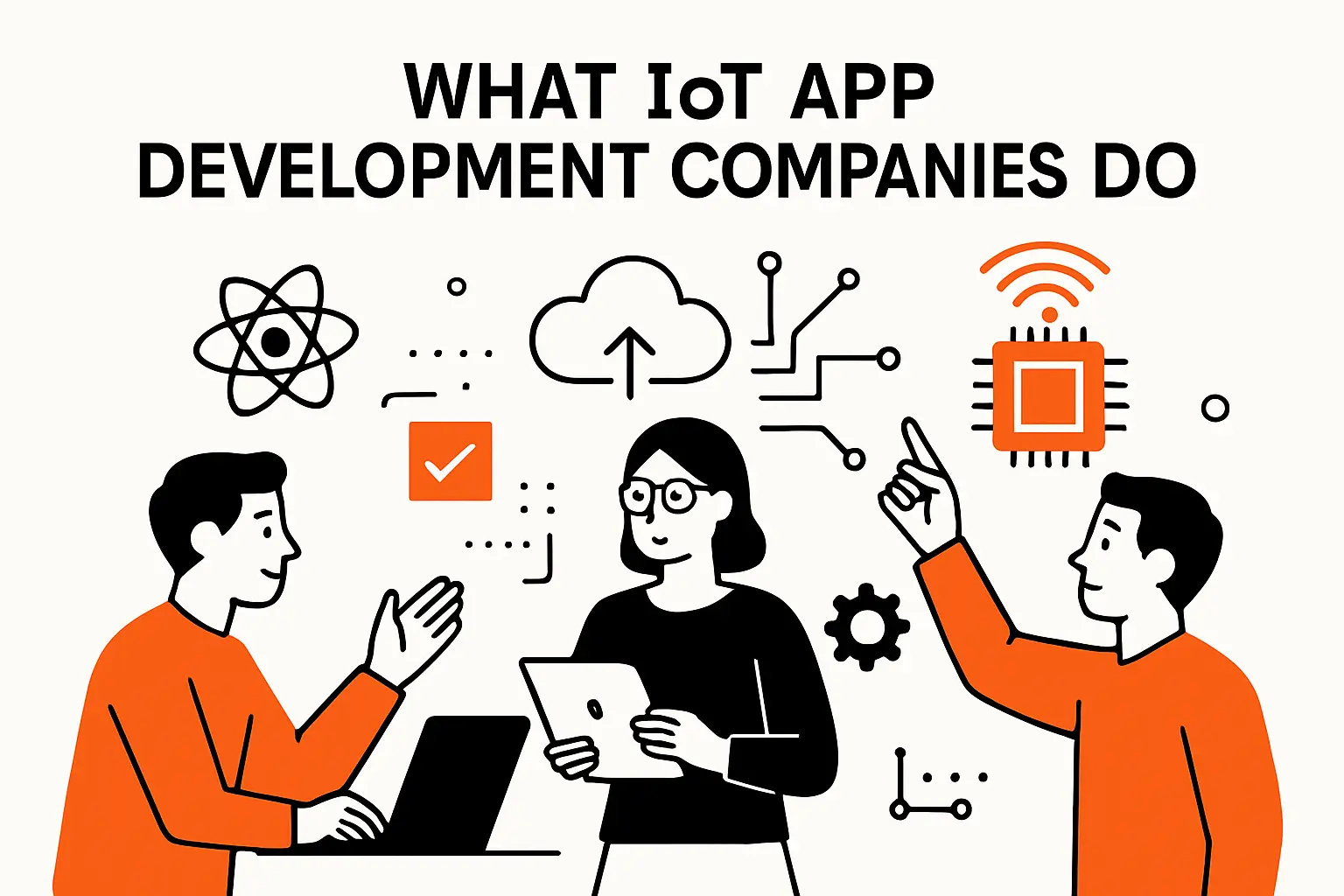
As the IoT stack sprawls from silicon to SaaS, companies like ours orchestrate the glue between devices, data, and decisions. The demand spans consumer, industrial, and healthcare use cases—the consumer segment alone comprises around 60 percent of connected devices in 2025, while B2B settings concentrate most of the value creation potential at roughly 65 percent. In practice, “IoT app development” means aligning product strategy, embedded software, connectivity, data pipelines, AI/analytics, and user experiences into a dependable, secure whole.
1. Core Capabilities of iot app development companies
IoT Consulting and Strategy
We start by clarifying the value thesis: what decisions will be better, faster, or cheaper once assets become data-emitting? In our experience, strategy is a portfolio exercise—some use cases pay back in quarters (e.g., condition monitoring) while others reshape business models (e.g., usage-based warranties). We map device populations, data gravity, regulatory constraints, and change management realities. A practical strategy includes a telemetry backlog, analytics road map, and an adoption plan for operators who will live with the system every shift.
IoT Mobile App Development
Mobile apps are the field lens into machines and spaces; they must operate offline, degrade gracefully, and respect the nuances of Bluetooth, Wi‑Fi, or cellular coverage. We harden apps for field realities: intermittent connectivity, glove-mode UIs, and ruggedized provisioning flows. A good IoT mobile app lets technicians commission devices in minutes, visualize sensor streams at the edge, and capture annotated observations that enrich the analytics loop.
IoT Web Application Development
Web consoles anchor multi-tenant operations: fleet overviews, role-based access, and granular controls. We design for observability—health dashboards, event timelines, and drill-down to device twins. The best web apps treat realtime and historical data as a continuum: operators can pivot from a live alarm to a multi-month trend analysis without leaving context. We emphasize auditability, with change logs and policy-driven entitlements that stand up to compliance scrutiny.
Embedded Software Development
Firmware determines the reliability and cost envelope of a deployment. We optimize for power budgets, secure boot, OTA safety nets, and local fail-safe behavior. Stateless designs can simplify OTA risk, but edge inference often justifies stateful modules; we reconcile both with robust versioning and rollback. Lessons learned: over-enthusiastic sampling can starve batteries; compression and event-driven telemetry often deliver better insight per joule than firehose streams.
IoT Cloud Development
Cloud is the clearinghouse for device identities, rules, data pipelines, and analytics services. We build ingestion layers with backpressure protection, schema evolution, and hot/cold storage tiering. Instead of monoliths, we bias to event-driven microservices, routing cleanly between telemetry processing, command-and-control, alerts, and digital-twin state management. Multi-region rollouts are table stakes for critical operations, and we bake in infrastructure as code so environments are reproducible.
IoT Integration and Implementation
Integrations are where projects soar or stall. We connect SCADA, MES/ERP, EHR, and CRM systems so IoT data enriches existing workflows. Our rule of thumb: translate device semantics into business semantics early. For example, “vibration RMS exceeded” becomes “Line 3 spindle imbalance risk,” which then maps to maintenance orders. We also reconcile heterogeneous identities—device serials, asset tags, user accounts—into a unified graph to support cross-system traceability.
IoT Analytics and Visualization
Analytics turns telemetry into levers for action. We start with descriptive views—SPC charts, anomaly heatmaps—then progress to predictive and prescriptive models. The visualization must support investigative reasoning: slice by shift, equipment class, or environment and compare cohorts. We’ve seen the biggest payoffs when operators can annotate anomalies and feed that context back into active learning loops that refine models over time.
Wearable App Development
Wearables raise the bar on privacy, battery life, and form-factor ergonomics. Whether building for worker safety, fitness, or clinical trials, we minimize on-device compute, encrypt BLE characteristics, and manage pairing with assurance. Intelligent duty cycling and context awareness—e.g., adjusting sample rates during high-risk activities—extend battery life without sacrificing fidelity. For medical use, we coordinate with IRB expectations and ePRO workflows.
AIoT
AI at the edge reduces latency and uplink costs. We deploy tinyML or quantized models for anomaly detection, activity recognition, and sensor fusion, often with on-device drift monitoring. When the edge flags events, the cloud adjudicates with higher-precision models. This creates a negotiation between bandwidth, battery, and business value—an explicit design space that we document for stakeholders, not a black box.
IIoT
Industrial IoT demands determinism, safety, and coexistence with legacy PLCs. We integrate OPC UA, Modbus, and historian systems and implement buffered data paths to survive planned outages. In brownfield plants, RF interference and electrical noise can derail otherwise sound designs; we conduct site surveys, validate antenna placement, and simulate worst-case packet loss to harden the solution before scale-out.
IoMT
Medical IoT trades in data that clinicians and patients rely on. We design with HIPAA/GDPR in mind, apply secure elements for identity, and isolate PHI in transit and at rest. Clinical-grade reliability means traceable firmware, immutable audit logs, and post-market surveillance hooks. We coordinate with QA teams for test suites that mimic physiological edge cases and measurement artifacts, including motion and ambient interference.
Prototyping and Proof of Concept
PoCs should prove two things: the physics (sensing fidelity) and the economics (unit cost, per-device cloud). We instrument prototypes with diagnostics and synthetic fault injection to surface failure modes early. A good PoC limits scope to one killer metric—e.g., unplanned downtime hours avoided—so stakeholders can greenlight the next tranche with confidence and clarity.
UX and UI Design
IoT UX is not just screens; it’s the choreography of people and machines. We design for moments: commissioning, exception handling, shift handoffs. Micro-interactions matter—sub-second feedback on pairing, unambiguous status LEDs, and tap targets that acknowledge gloved hands. We also include “explainability” affordances so operators can see why an alert fired and trust grows with use.
Quality Assurance and Testing
We test across dimensions: protocol fuzzing, OTA chaos, latency under backhaul contention, and security pen tests that target both the device and the backend. Environmental chambers and vibration rigs reveal physical-world failure modes that unit tests can’t. We favor canary deployments and staged rollouts with kill switches, so defects don’t become field-scale incidents.
Application Maintenance and Support
IoT systems are living organisms. We maintain device fleets with over-the-air patching, certificate rotation, and component EOL management. Observability includes device heartbeats, shadow state drift, and data pipeline SLOs. Success is quiet: uptime stays high, alerts are meaningful, and operators barely think about the plumbing because it just works.
2. Business Benefits From IoT App Development
Operational Efficiency
IoT’s first dividend is waste reduction—energy, time, materials. By instrumenting assets and correlating signals, we identify chronic micro-stoppages that camouflaged themselves as “the way it is.” Efficiency gains compound when insights loop into scheduling, maintenance, and worker enablement. The guiding question isn’t “Can we measure it?” but “Can we act on it without burdening the frontline?”
Data-Driven Insights
IoT data—properly modeled—becomes a living reference of how operations really perform. We’ve seen clients evolve from periodic audits to continuous improvement when process capability metrics are computed in near real time. The payoff is cultural as much as technical: teams align around shared ground truth, accelerating consensus on what to fix next.
Automation and Real-Time Monitoring
Automation anchored to live device state reduces cognitive load and response times. Whether it’s closing a control loop on a compressor or escalating a safety threshold breach to a supervisor’s smartwatch, the goal is right action at the right time. We set guardrails—rate limits, hysteresis, human-in-the-loop thresholds—so automations stay reliable under noisy data.
Scalability and Security
Well-architected IoT platforms add devices without re-architecting. Identity lifecycles, tenant isolation, and zero-trust network principles keep risk in check as fleets grow. We treat security as an economic enabler; fewer breaches, fewer emergency patches, fewer operator workarounds. Resilience is a feature users feel, not just a line in a compliance document.
3. Project Initiation for IoT Apps
Define Use Case and Requirements
We co-create a field-validated use case: define the actor, the trigger, the action, and the measurable outcome. Requirements include device constraints (power, compute), environmental factors (RF noise, temperature), and business systems touchpoints. We align on KPIs and ensure they’re instrumentable from day one—no KPI should require a future refactor to measure.
Engage a Trusted IoT App Partner
Strong partners bring embedded, mobile, cloud, and data chops under one roof, plus empathy for the human workflows that make or break adoption. We share architectural decision records so clients understand tradeoffs. Our best engagements feel like a joint venture: we bring the toolkit; the client brings domain nuance; we build a durable capability together.
Build an MVP and Iterate
MVP means minimum viable operation, not just product. We design a thin but complete slice: device provisioning, telemetry, basic analytics, alerting, and a way to recover from faults. Then we iterate in the field, tightening loops between user feedback, data patterns, and model updates. Momentum beats perfection when the system can evolve safely.
Top iot app development companies for 2025
We at Techtide Solutions have spent the past year neck-deep in sensors, firmware, and cloud telemetry, advising clients on how to turn connected devices into durable business value. The Internet of Things has matured from scattered proofs-of-concept to platform-first programs that demand predictable reliability, rigorous security, and a clear ROI story. Device fleets are scaling briskly—IoT Analytics estimated 18.8 billion by the end of 2024—and regulators now shape go-to-market with security marks and lifecycle obligations, culminating in the U.S. launch of the Cyber Trust Mark on January 07, 2025. We’ve learned that the partners who thrive in 2025 are the ones who treat IoT as a socio-technical system: they marry embedded engineering with data pipelines, compliance, and field operations, then iterate quickly without cutting corners on safety.
To help buyers benchmark their choices, we compiled twenty IoT app development firms that we believe will matter most in 2025. Our lens is pragmatic: industrial readiness (from hardware to cloud), evidence of execution (public case studies and client references), and organizational maturity (process, security, and scale). We include platform vendors alongside service specialists where their ecosystems shape buyer outcomes. When we highlight awards, we cite external verification; when facts aren’t public, we say “data not available.” And because IoT is ultimately about outcomes, we close each profile with who we think they fit best. The names you’ll meet below range from boutique studios with edge-AI chops to global integrators with regulated-industry experience. If a theme runs through them all, it’s that execution beats hype—and that’s doubly true in IoT.
1. Flatirons
Overview: Flatirons (Flatirons Development) is a product engineering studio focused on web, mobile, and data-driven applications, with selective work touching IoT backends and companion apps. We estimate 10–50 employees, ~7 years in operation, and a headquarters presence in Boulder, Colorado, with nearshore talent hubs in Colombia and Brazil. The firm positions itself as a hands-on partner for startups and product teams seeking iterative delivery and polished UX.
Awards: data not available.
Services & proof: Flatirons emphasizes product strategy, UX/UI, and full‑stack execution for greenfield or modernization work, often building HIPAA‑conscious SaaS and event‑driven backends. Where IoT is involved, they typically own the device companion app and the data visualization layer while coordinating with hardware partners. Public case studies showcase transformations in healthcare, HR tech, and education; specific IoT device brands are not publicly named, but the portfolio reflects disciplined delivery patterns across regulated and data‑intensive verticals.
Ideal Fit: We’d shortlist Flatirons for seed‑to‑Series B teams that need a nimble, design‑forward partner to build companion apps and cloud services around existing device firmware. Teams that value close collaboration, mid‑market budgets, and rapid iteration—without sacrificing QA—should see strong alignment. Buyers who need in‑house RF design or safety‑critical certification would likely need a hardware specialist in parallel.
2. Matellio
Overview: Matellio is a global software engineering studio covering custom software, mobile, AI/ML, and IoT/IIoT solutions. We estimate ~250+ employees, ~11 years in operation (founded mid‑2010s), and a U.S. headquarters footprint in San Jose with distributed delivery in India, the U.K., and the U.S. Their portfolio spans logistics, healthcare, manufacturing, and BFSI, with an emphasis on cloud‑native builds and systems integration.
Awards: data not available.
Services & proof: In IoT, Matellio typically owns device data ingestion, rules engines, dashboards, and mobile apps, integrating with hyperscaler stacks and common IoT PaaS (AWS IoT, Azure IoT) while coordinating with device ODMs. Their public portfolio highlights fleet tracking, healthcare workflow apps, and edge‑assisted telemetry use cases. Based on our read, they are comfortable with multi‑tenant SaaS and compliance‑oriented delivery (e.g., audit trails, role models) rather than building custom silicon or RF firmware from scratch.
Ideal Fit: Consider Matellio if you’re a mid‑market enterprise or funded startup that needs an end‑to‑end software layer around commercial sensors—especially where mobile UX, role‑based access, and analytics matter. They suit buyers who want nearshore/offshore leverage with U.S. product management touchpoints, and who plan to iterate on a roadmap rather than ship a one‑off MVP.
3. TechTide Solutions
Overview: We are TechTide Solutions, a software development company delivering custom web, mobile, and data applications, with growing work in IoT companion apps, device management portals, and event‑stream analytics. Our estimated team size is 50–200 with core delivery in Ho Chi Minh City, Vietnam, and client stakeholders across North America and APAC. We’ve been operating since 2022, bringing product rigor, secure coding, and test automation to connected-product programs.
Awards: data not available.
Services & proof: Our IoT practice centers on API design for device fleets, telemetry pipelines, asset tracking, and control surfaces tailored for plant managers and field ops. We’ve shipped native and cross‑platform apps, implemented time‑series storage and rule engines, and integrated compliance guardrails such as encryption at rest/in transit, secure OTA workflows, and secrets management. Where clients bring their own firmware, we align sprint cadences across device and cloud teams; where firmware is in flux, we create emulators and simulators to de‑risk schedules.
Ideal Fit: We’re a strong fit for growth‑stage firms that already have hardware direction but need software velocity and predictable delivery on the cloud/mobile experience. If you’re instrumenting assets for condition‑based maintenance, unifying telemetry for finance and operations, or launching a customer‑facing companion app with rigorous QA, we’re designed for that cadence.
4. TechAhead
Overview: TechAhead is a long‑standing digital product engineering company delivering mobile, cloud, and IoT solutions for enterprises and scaleups. We estimate 200–300 employees, ~15+ years in operation (late 2000s), and headquarters presence in Agoura Hills, California, with large delivery in India. The company blends product thinking with platform experience, including smart home and industrial telemetry projects.
Awards: TechAhead publicized being ranked #1 globally in Spring 2025 by Clutch in the app development category, reflecting strong client reviews and delivery momentum.
Services & proof: We’ve seen TechAhead lean into companion apps, cloud backends, and AI‑assisted features (e.g., anomaly detection, personalization) over bespoke hardware, with public case narratives ranging from smart building controls to consumer IoT for energy savings. The common thread is secure mobile, well‑structured data models, and orchestration that respects low‑power device constraints—what matters when you’re nudging energy costs down 10–30% without annoying end users.
Ideal Fit: Shortlist TechAhead if you’re a mid‑to‑large enterprise seeking a polished customer experience across mobile and web with a steady stream of iterative features, or you want a seasoned team that can weave AI/analytics into IoT without bloating your cloud bill. Global brands that need scale, SLA discipline, and design depth will find the engagement model familiar.
5. Itransition
Overview: Itransition is a global software engineering company delivering enterprise systems, data platforms, and product development at scale, with a robust presence in IoT‑adjacent domains like manufacturing, retail, and healthcare. We estimate 3,000+ employees, ~25+ years in operation (founded 1998), and a broad international footprint with U.S. presence (e.g., Decatur, GA) and European delivery centers. Their size brings process maturity and domain coverage.
Awards: data not available.
Services & proof: Itransition’s case library spans everything from ERP integration to data lakes and ML‑powered recommendations; in IoT, that translates to ingestion pipelines, device identity, and near‑real‑time dashboards for plant or fleet operators. We’ve seen them succeed in programs where integration depth matters—bridging legacy MES/SCADA or retail POS to modern cloud stacks—rather than crafting custom RF firmware. The firm’s governance and QA are suited to multi‑year transformations with complex stakeholder maps.
Ideal Fit: Consider Itransition if you’re a global or upper mid‑market enterprise with hundreds to thousands of assets to instrument, data governance requirements, and a need to tie IoT signals to financial and supply‑chain systems. Buyers who want exhaustive documentation, predictable release trains, and optional managed services over time will appreciate the operating model.
6. Velvetech
Overview: Velvetech is a U.S. software development company focused on custom applications, data engineering, CRM integration, and IoT/embedded solutions for SMB and mid‑market clients. We estimate ~150 employees, ~20+ years in operation (founded 2004), and headquarters in Sunny Isles Beach, Florida, with an additional Chicago office. They combine business‑process automation with product engineering under one roof.
Awards: data not available.
Services & proof: Velvetech’s IoT portfolio includes cold‑chain monitoring, fitness studio automation, and industrial telemetry with attention to device‑to‑cloud reliability and business outcomes like spoilage reduction or utilization lift. Their longer multi‑project partnerships in insurance, healthcare, and energy suggest strong account stewardship and the ability to support both greenfield apps and legacy modernization that IoT projects often require.
Ideal Fit: If you’re an operations‑minded SMB or mid‑market team chasing measurable KPIs—reduced cycle times, fewer quality escapes, higher asset uptime—Velvetech brings practical build‑and‑integrate muscle. They suit buyers who prefer a single partner for web/mobile, data, and device integration, and who need pragmatic timelines over pure R&D.
7. AppZoro
Overview: AppZoro is a mobile and custom software studio with IoT experience in transportation, logistics, and startup ecosystems. We estimate 10–50 employees, ~8–9 years in operation (mid‑2010s), and headquarters in Atlanta, Georgia. The firm’s profile skews toward pragmatic, budget‑sensitive builds with an emphasis on clear communication and iterative delivery.
Awards: AppZoro appears on Clutch’s Top Web Development Companies for Minority Owned in Georgia rankings (updated October 2025), reflecting verified client reviews and domain focus in their region.
Services & proof: In IoT, AppZoro focuses on the application layer—Android/iOS companions, admin consoles, and basic analytics—leaving hardware design to OEM partners. Case examples in public forums include logistics and service‑industry apps, with evidence of shipping to stores and maintaining post‑launch improvements. Budgets typically match early‑stage to lower mid‑market expectations where speed and responsiveness are prized.
Ideal Fit: AppZoro fits founders and lean teams who need to stand up a device companion app or management console quickly and sensibly, with runway to refine UX and features. If you value hands‑on project management and straightforward pricing, and your hardware is commercial‑off‑the‑shelf, they’re a practical candidate list addition.
8. Very Technology
Overview: Very is a specialist IoT and connected‑hardware firm that bridges industrial design, embedded software, and cloud application development. We estimate 50–200 employees, ~14+ years in operation (founded 2011), and a headquarters presence in Bozeman, Montana with distributed U.S. teams. They’re known for rapid prototyping, edge‑to‑cloud pipelines, and productization discipline across regulated and consumer contexts.
Awards: Very ranked No. 2621 (2022) on the Inc. 5000 list, signaling sustained growth and operational maturity at scale.
Services & proof: Public case studies highlight smart pools, connected energy equipment, and industrial anomaly detection—patterns that require solid OTA strategies, device identity, and robust data modeling. We’ve interacted with Very teams who can stand up demo hardware, firmware, and an AWS IoT backbone in weeks, but who also plan for manufacturability and field support. That balance—shipping fast while architecting for the messy reality of device fleets—is harder than it looks, and they do it well.
Ideal Fit: If you’re commercializing a new device category or scaling from pilot to thousands of units, and you want one partner accountable for firmware, cloud, and UX, Very should be on your longlist. They particularly suit buyers who need design‑research depth, strong program management, and a security‑first posture baked into pipelines.
9. Mobcoder
Overview: Mobcoder is a product development company focusing on mobile, web, AI, and selective IoT initiatives. We estimate 100–200 employees, ~10+ years in operation (founded mid‑2010s), and distributed delivery with U.S. client coverage, historically highlighting Seattle and European offices. Their narrative leans toward UX‑centric apps with data features layered in.
Awards: data not available.
Services & proof: In IoT programs, Mobcoder typically builds the customer‑facing app and the management console, wiring event telemetry to notifications and basic analytics while working alongside OEMs for firmware. Public posts and third‑party directories reference projects in fitness devices and mobility; the throughline is strong front‑end craft, stable APIs, and measured sprints with post‑launch support.
Ideal Fit: For product leads who want a polished cross‑platform companion app and an admin tool that can evolve with customer feedback, Mobcoder offers a balanced cost/speed profile. They’re a sensible pick when your team brings domain expertise but needs an execution partner who will sweat the UX details and keep releases on track.
10. N-iX
Overview: N‑iX is a large Eastern European engineering partner covering cloud, data, and embedded across telecom, manufacturing, automotive, and fintech. We estimate 2,000+ employees, ~20+ years in operation (founded early 2000s), and headquarters in Lviv, Ukraine with EU/US delivery hubs. Their scale and recruiting bench make them comfortable with multi‑team programs.
Awards: data not available.
Services & proof: For IoT, N‑iX often tackles embedded Linux, BSP customization, and device middleware alongside cloud ingestion and analytics, particularly where latency and availability matter (e.g., industrial connectivity, automotive). The organization’s strength lies in assembling blended teams—firmware, platform, data science—capable of owning subsystems and interfacing with client architects over multi‑quarter roadmaps.
Ideal Fit: Choose N‑iX if you need to scale engineering capacity across device, edge, and cloud simultaneously, and you have enterprise processes to match. They fit enterprises and upper mid‑market buyers who require security reviews, documentation rigor, and the ability to rotate specialists in without losing velocity.
11. Stormotion
Overview: Stormotion is a boutique product studio known for mobile and web applications with a footprint in connected products. We estimate 10–50 employees, ~8–10 years in operation, and a dual European footprint (Germany/Ukraine). Their calling card is lean product thinking and modern app development with TypeScript and React Native expertise.
Awards: data not available.
Services & proof: In IoT, Stormotion’s sweet spot is mobile companion apps, admin dashboards, and cloud glue code that turn sensor data into simple user experiences. The team tends to ship crisp MVPs and iterate tightly with founders, favoring developer experience and automated testing to keep quality high despite small team sizes.
Ideal Fit: If you’re an early‑stage startup or a business unit testing a connected add‑on, Stormotion offers the velocity and focus to get your v1 into hands quickly. Expect a collaborative cadence, pragmatic scoping, and thoughtful UX over heavy process or sprawling enterprise integrations.
12. Softeq
Overview: Softeq is a Houston‑based engineering firm with deep experience in embedded systems, hardware design, and cloud applications—one of the more hardware‑forward partners on this list. We estimate 300–600 employees, ~25+ years in operation (founded late 1990s), and a history of serving energy, industrial, and healthcare clients where ruggedization and safety matter.
Awards: data not available.
Services & proof: Softeq can take a product from board‑level design and firmware through mobile apps and fleet backends, which matters for industrial buyers who need someone accountable across the stack. We’ve seen them succeed where RF constraints, environmental stress, or certification (e.g., IEC, UL) is a gating factor; they also understand the support burden of thousands of deployed devices and plan accordingly.
Ideal Fit: If your roadmap includes custom hardware, tricky power budgets, or certification hurdles—and you want a single integrator capable of end‑to‑end engineering—Softeq is a prime candidate. They’re an especially good fit for energy, logistics, and medtech teams that need audit‑ready processes and durable designs.
13. Intellectsoft
Overview: Intellectsoft is a software engineering company covering enterprise mobility, digital platforms, and emerging tech for Fortune 1000 and mid‑market clients. We estimate 300–600 employees, ~15+ years in operation (founded late 2000s), and a U.S. headquarters presence historically tied to Silicon Valley with European delivery. Their practice includes IoT solutions for asset monitoring and smart environments.
Awards: data not available.
Services & proof: Intellectsoft’s public messaging highlights secure enterprise mobile, integrations with major ERPs/CRMs, and data‑rich UX—elements that map cleanly to IoT control planes and analytics. Typical IoT work involves gateway configuration, device identity, OTA coordination with OEMs, and dashboards tuned for executive visibility and field usability.
Ideal Fit: Consider Intellectsoft if you’re an enterprise digital leader who needs IoT experiences to slot into an existing security and governance framework, with executive buy‑in dependent on crisp reporting and integration to systems of record. They’re comfortable with multi‑stakeholder programs and staged rollouts.
14. Yalantis
Overview: Yalantis is a Ukrainian‑rooted software development company delivering cloud, mobile, and data solutions for logistics, healthcare, and real estate—plus IoT‑enabled scenarios in smart building and telematics. We estimate 300–600 employees, ~15+ years in operation (founded late 2000s), with EU presence complementing delivery from Ukraine.
Awards: data not available.
Services & proof: Yalantis tends to take on verticalized problems—asset tracking, energy dashboards, building systems—and deliver thoughtful UX, data models, and integration layers. Their approach is particularly suited to buyers who need a blend of enterprise‑grade security, cross‑platform apps, and cloud cost discipline rather than bare‑metal firmware innovation.
Ideal Fit: We’d match Yalantis with mid‑market operators and proptech/logistics innovators who want a reliable partner to translate operational goals into usable apps and dashboards, then iterate as adoption grows. Expect well‑structured delivery and comfort with both greenfield and modernization.
15. Siemens MindSphere
Overview: MindSphere (Siemens’ industrial IoT lineage, now aligned with Siemens’ broader industrial IoT/Insights Hub offerings) is a platform ecosystem rather than a services boutique, anchoring device connectivity, digital twins, and analytics for manufacturing, energy, and infrastructure. Siemens is a century‑old global engineering leader with headquarters in Munich, Germany, and a workforce in the hundreds of thousands; MindSphere entered the market in the mid‑to‑late 2010s and continues under the Siemens Xcelerator umbrella.
Awards: data not available.
Services & proof: For buyers committed to Siemens automation products (PLCs, drives) or the Xcelerator portfolio, MindSphere‑aligned services accelerate connectivity, asset models, and dashboards, with partner SI ecosystems to implement use cases like predictive maintenance and OEE analytics. The strength here is proven industrial depth and reference architectures that simplify scale and security across plants.
Ideal Fit: Choose Siemens’ industrial IoT stack if your manufacturing or infrastructure environment already runs Siemens controls, and you want a supported path to cross‑site visibility, analytics, and lifecycle services. Enterprises that want an opinionated, industrial‑grade platform with broad partner coverage will benefit most.
16. Oxagile
Overview: Oxagile is a software engineering company that began with video platforms and expanded into data, AI, and IoT, serving media, healthcare, and industrial clients. We estimate 500–1,000 employees, ~18–20 years in operation (mid‑2000s), and U.S./EU presence. Their video lineage translates well to sensor‑rich environments where streaming, analytics, and low‑latency UX matter.
Awards: data not available.
Services & proof: For IoT programs with heavy AV telemetry—computer vision, video QA, or inspection flows—Oxagile brings compression know‑how, edge pipelines, and real‑time dashboards. We’ve seen them excel in programs that blend CV models with device orchestration, balancing compute between edge and cloud to keep costs in check without sacrificing accuracy.
Ideal Fit: If your IoT roadmap leans on cameras, ML inference at the edge, and content delivery at scale, Oxagile is a credible, battle‑tested option. Expect structured processes, MLOps literacy, and sensitivity to end‑user performance in bandwidth‑constrained settings.
17. Webisoft
Overview: Webisoft is a Montreal‑based software consultancy specializing in product development, cloud, and Web3/IoT experiments for startups and mid‑market firms. We estimate 10–50 employees, ~8–10 years in operation, and a client base spread across North America. Their culture is entrepreneurial, with a bias toward prototype‑to‑production sprints.
Awards: data not available.
Services & proof: In IoT, Webisoft typically takes on the application layer and lightweight device integration, using modern JavaScript stacks and managed cloud to keep speed high and complexity low. For founders testing market appetite with connected features, they’re adept at scoping, building MVPs that feel polished, and instrumenting the analytics to validate product‑market fit.
Ideal Fit: If you need a builder that feels like an extension of your startup team and can bridge emerging tech with solid engineering habits, Webisoft is a pragmatic choice. They’re best for early pilots and first releases where insight velocity matters as much as the code itself.
18. Mobidev
Overview: MobiDev is a software development company delivering mobile, web, data, and IoT solutions for mid‑market clients, with roots in Eastern Europe and a U.S. commercial presence. We estimate 300–600 employees, ~15+ years in operation (founded late 2000s), and broad experience across retail, manufacturing, and healthcare. They’re process‑mature and comfortable with long‑term client engagements.
Awards: data not available.
Services & proof: Their IoT delivery typically includes cross‑platform companion apps, device management portals, and analytics tied to operations KPIs. We’ve seen MobiDev lean into structured QA, CI/CD, and maintainability—habits that pay dividends once fleets scale and OTA becomes routine. Case narratives suggest comfort with both greenfield and modernization paths.
Ideal Fit: Pick MobiDev if your priorities are predictable releases, documentation, and a patient, iterative path to scaling features on top of stable device connectivity. They suit mid‑market operations teams who want sensible UX, steady support, and data models aligned with financial and operational reporting.
19. Intellias
Overview: Intellias is a large engineering partner serving automotive, mobility, BFSI, and industrial sectors, with extensive embedded, cloud, and data capabilities. We estimate 2,500–3,500 employees, ~20+ years in operation (founded early 2000s), headquartered in Lviv, Ukraine with global delivery. The company’s automotive and location‑based lineage shows up in rigorous safety and systems engineering.
Awards: data not available.
Services & proof: Intellias is comfortable with complex embedded stacks, functional safety constraints, and scalable cloud pipelines—traits that translate well to industrial IoT and connected mobility. Public signals over the years have included mapping and telematics programs; in our experience, they can take on domain‑heavy challenges where edge constraints and compliance (e.g., ISO, ASPICE) shape delivery.
Ideal Fit: If you need a partner for sophisticated embedded plus cloud programs—fleet telemetry, ADAS‑adjacent services, or plant‑floor integration—and you operate under strict quality systems, Intellias aligns with that rigor. Expect mature governance and the ability to scale teams without losing cohesion.
20. Appinventiv
Overview: Appinventiv is a global product engineering company known for mobile, cloud, and AI‑driven solutions, with a growing body of work in connected devices for retail, health, and consumer electronics. We estimate 1,000+ employees, ~10+ years in operation (mid‑2010s), and headquarters in Noida, India with international client coverage. They pair design craft with throughput at scale.
Awards: data not available.
Services & proof: For IoT, Appinventiv typically owns the app experience, device onboarding flows, and cloud analytics, blending growth‑oriented UX with solid engineering fundamentals. They’re adept at managing multi‑brand device catalogs and designing interfaces that simplify setup and troubleshooting—critical for consumer adoption and support costs.
Ideal Fit: If your connected product depends on an excellent mobile experience, rapid feature experimentation, and the ability to support multiple device SKUs across markets, Appinventiv is worth a close look. Want help mapping these options to your budget, certification path, and go‑to‑market timeline? We’re happy to share a short‑list and a 90‑day pilot plan tailored to your use case.
How To Evaluate iot app development companies: Services, Tech Stack, and Industries
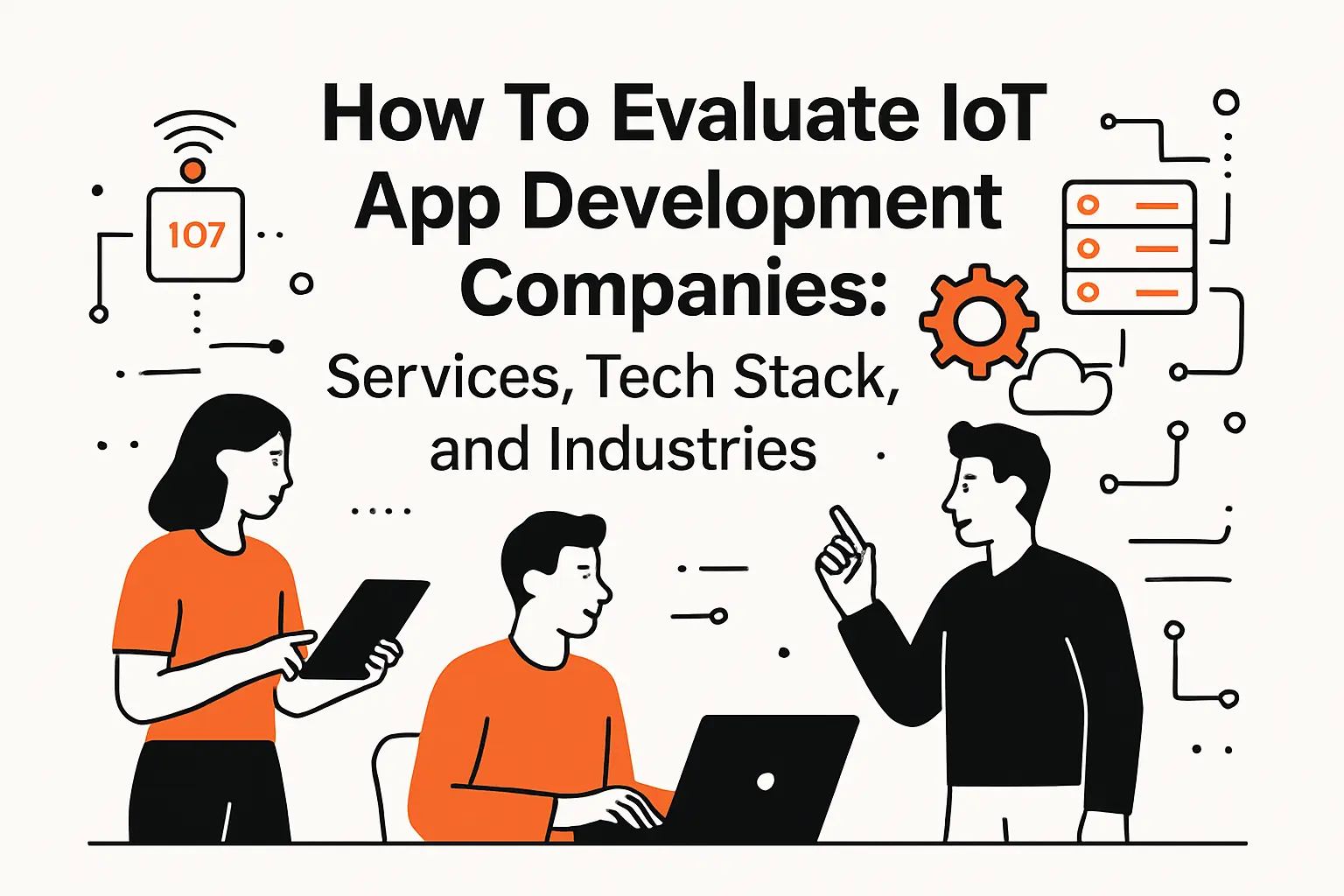
Selection starts with outcomes, not features, and the best signal is proof of scaled delivery in your domain. Evidence is growing that operational excellence and competitive edge hinge on smart operations. 92 percent of manufacturers see smart manufacturing as the main driver for competitiveness over the next three years, and the enterprise value pool for IoT remains predominantly B2B at about 65 percent. When we evaluate partners on behalf of clients, we look for keystone capabilities across embedded, connectivity, data, and change management.
1. Common Industry Verticals
Healthcare
IoMT spans remote patient monitoring, connected devices, and hospital asset tracking. We prioritize clinical-grade reliability and privacy by design—secure elements, tamper-evident logs, and rigorous OTA discipline. Practical wins include vital-sign triage, infusion pump fleet visibility, and cold-chain integrity for biologics. Clinician experience is paramount; alerts must integrate into existing workflows without alarm fatigue.
Sports and Fitness
Wearables and smart equipment capture biomechanical signals that inform training and injury prevention. We tailor BLE power profiles for comfort and battery longevity and recreate insights in coach dashboards that compare athletes over time and context. The trick is translating high-rate sensor streams into coaching cues, not just graphs.
Retail and eCommerce
Smart shelving, beacons, and connected POS systems close the loop between traffic, inventory, and promotion. We integrate IoT data with OMS and CDP platforms so actions are attributable: price changes, planogram shifts, or workforce allocation. Edge compute helps filter video analytics for privacy and cost control, forwarding only meaningful events.
Travel and Hospitality
Guest experience gets real-time personalization via occupancy sensors, environmental controls, and mobile keys. We isolate guest networks, apply short-lived credentials, and ensure room devices can be wiped between stays. Operationally, predictive maintenance on HVAC and elevators reduces unplanned outages that damage guest satisfaction.
Wearables
From fitness bands to industrial PPE, wearables challenge UX and security assumptions. We design pairing rituals that feel effortless yet secure, and data schemas that respect user consent. Battery budgets drive algorithm choices—feature engineering at the edge often beats heavyweight models for on-body devices.
Smart Homes and Smart Cities
In homes, fragmentation of hubs and standards is the headache; in cities, the challenge is scale across bureaus and vendors. We favor Matter/Thread where appropriate, and in municipalities, we move slowly and explicitly—governance, SLAs, and public safety interfaces trump speed.
Manufacturing
IIoT thrives when connected machines feed quality and maintenance models that operators trust. We respect production rhythms: deployments happen during changeovers, and operator training is part of the deliverable. Cross-shift knowledge capture—annotations, photos, context—is often the sleeper feature that accelerates improvement.
Automotive
Vehicles are sensor platforms on wheels; connected diagnostics, telematics, and ADAS telemetry fuel safety and new services. We integrate with automotive-grade OS stacks, prioritize functional safety, and treat OTA like air traffic control—no ambiguous states, ever. Data minimization is critical to reduce liability footprints.
Finance
Banks and insurers leverage IoT for branch operations, ATM telemetry, and usage-based policies. We align telemetry with risk models and regulatory expectations, and keep a tight rein on data lineage. For insurers, real-time policy adjustments hinge on trustworthy device identity and tamper resistance.
Oil and Gas
Remote assets, harsh environments, and safety-critical operations demand ruggedized hardware and LPWAN connectivity. We engineer for sparse backhaul, local buffering, and exception-based reporting. Analytics fuse vibration, flow, and corrosion metrics to prioritize field crew dispatches that matter.
Transportation and Logistics
From reefer trucks to last-mile robotics, logistics IoT is about timeline integrity. We combine GNSS, inertial sensors, and door/status inputs with geofenced business rules. The end product is proactive ETA updates and exception handling that tamps down customer anxiety and detention fees.
2. Connectivity Technologies
Bluetooth
BLE rules for short-range, low-power interactions: commissioning, wearables, asset tags. We harden pairing flows, rotate keys, and mitigate channel congestion. Mesh helps in dense deployments, but we validate coexistence with Wi‑Fi to avoid spectral elbowing.
NFC
NFC shines for tap-to-provision or secure interactions in crowded RF environments. We use it for bootstrapping zero-touch onboarding, exchanging just enough cryptographic material to secure subsequent sessions over BLE or Wi‑Fi.
Wi‑Fi
Wi‑Fi is bandwidth-friendly but energy-hungry. For mains-powered devices and camera workloads, it’s a natural fit. We employ WPA3, isolate VLANs, and plan for roaming. For battery-powered nodes, we lean on power-save modes and event-driven wakeups.
4G LTE
LTE offers ubiquitous coverage for mobile assets. We architect APN policies, SIM lifecycle management, and cost controls for bursty telemetry profiles. Where latency tolerance is generous, we compress and batch to reduce data charges without losing observability.
5G
5G matters for URLLC and massive-device density, particularly in private networks. We collaborate with carriers or deploy private 5G for factories and campuses where deterministic QoS and isolation are crucial. The radio is only half the story; slicing, orchestration, and security policies complete the value.
3. Protocols and Standards
Beacon
BLE beacons enable micro-location and proximity triggers. We tune TX power and advertising intervals for battery life and design privacy-preserving rotations to limit tracking. Calibration in situ matters; human bodies and metal fixtures warp RF behavior in surprising ways.
Modbus
Still omnipresent in industrial gear, Modbus requires rigorous mapping and error handling. We sandbox gateways, enforce allowlists, and monitor for register anomalies that hint at misconfiguration—or worse, tampering.
BLE
Beyond beacons, BLE GATT services carry structured data with modest overhead. We define custom characteristics carefully—clear semantics, versioning, and defensive parsing to survive edge-case packets and vendor quirks.
TCP/IP
The workhorse for reliable streams. We manage congestion windows and keepalives mindful of cellular realities, and consider protocol offload in MCUs to reduce firmware complexity and power draw.
UDP
Great for low-latency, lossy-tolerant telemetry. We add application-level ACKs where delivery matters and test aggressively across NAT, firewalls, and spotty links. Observability for packet loss distributions is key to setting sane alert thresholds.
MQTT
MQTT’s publish/subscribe model maps neatly to IoT fleets. We enforce TLS, client certs, and topic ACLs per tenant. Retained messages, will messages, and QoS semantics are powerful—used judiciously—to keep state synchronized and failure-resilient.
4. IoT Platforms
Azure IoT Hub
Strong device identity, twin management, and PnP capabilities simplify fleet control. We pair Hub with Event Hubs, Functions, and Databricks for scalable analytics. Azure’s Defender integration adds security posture visibility that ops teams appreciate.
AWS IoT
AWS excels with IoT Core, Device Defender, and SiteWise for industrial telemetry models. We lean on IoT Rules Engine to route events, and use Greengrass for edge orchestration. Identity and topic policies are our first line of multitenancy defense.
Arduino
Ideal for rapid prototyping and education, Arduino accelerates early experiments. We use it to validate sensors and UX concepts before moving to production-grade silicon and toolchains. It shrinks time-to-learning even if it’s not the final BOM.
NodeMCU
For Wi‑Fi prototypes, NodeMCU on ESP8266 gets ideas off the ground quickly. We treat it as a lab tool, proving network flows and payload schemas before graduating to industrial modules with secure elements and longer lifecycles.
Beacons
Beacon platforms coordinate fleets for retail, events, and logistics. We select devices with programmable TX power and Eddystone/iBeacon support, then build geofencing logic in the app layer. Analytics focus on dwell time and path flows rather than raw RSSI noise.
ESP32
ESP32 is a sweet spot for cost, dual-core capability, and integrated radios. We harden it with secure boot, flash encryption, and partitioning strategies that support safe OTA. Its versatility reduces BOM risk in early-stage products.
5. Frameworks and Languages for IoT Apps
Node.js
Great for event-driven backends and gateways. We use Node.js to implement lightweight protocol translators, MQTT bridges, and admin APIs. Its ecosystem speeds delivery, provided we manage dependencies and memory footprints carefully.
Python
Data science’s lingua franca is also a workhorse for edge scripts and backend analytics. We adopt Python for ETL jobs, model training, and quick diagnostics, wrapping performance-critical paths in native extensions when needed.
.NET MAUI
When enterprises want cross-platform mobile/desktop clients with shared code, .NET MAUI delivers. We integrate native BLE/Wi‑Fi stacks, secure keystores, and enterprise identity providers for SSO. Tooling and performance have matured enough for demanding field apps.
Flutter
Flutter is our go-to for fluid UIs and rapid iteration. We bridge to native modules for radio stacks and hardware access. Its rendering model helps maintain 60fps even when visualizing dense telemetry or live maps.
React
React powers web consoles and cross-platform experiences with React Native. We complement it with TypeScript and state machines for predictable behavior, especially in multi-step provisioning and troubleshooting flows.
6. Data and Analytics Tools
Apache Kafka
Kafka buffers the world between device bursts and analytic consumers. We partition by device or site, enforce schema evolution, and attach stream processors for real-time anomalies, enriching telemetry with asset metadata on the fly.
Apache Spark
Spark handles feature extraction, model training, and batch computations. We use it to compute rolling capability indices and to backtest alert thresholds against months of history before enabling them in production.
Grafana
Grafana anchors operational visibility. We prebuild panels for device health, pipeline latency, and alert volumes, and we standardize labeling so teams can compose dashboards safely without query roulette.
Power BI
For business stakeholders, Power BI translates telemetry into decisions—downtime cost, SLA adherence, and energy spend. We model semantic layers that speak finance and operations, not just engineering.
TensorFlow
TensorFlow—and its lite variants—supports edge and cloud inference. We quantize models, test for drift, and add uncertainty estimates so automations can defer to humans when confidence dips. The aim is trustworthy autonomy, not blind automation.
7. Selection Criteria When Hiring iot app development companies
Proven Expertise and Portfolio
Ask for scaled references in your sector and environment. Pilots impress; fleets prove resilience. Request uptime stats and OTA histories that show calm evolution, not firefighting.
Knowledge of IoT Protocols and Technology
From BLE characteristics to MQTT topic design and secure boot, your partner should be fluent across the stack. Probe for war stories: packet storms, OTA rollbacks, RF interference—the scars teach reliability.
Secure, Scalable Architecture
Look for zero-trust posture, strong identity, and isolation at every boundary. Multi-tenant designs should prove that one customer’s misstep can’t cascade into another’s environment.
End-to-End Capabilities From Embedded to Cloud
Fragmented vendors slow projects and create accountability gaps. A unified team accelerates discovery-to-scale, harmonizing device, mobile, cloud, and data lifecycles.
UI and UX Quality
Operator experience determines adoption. Review commissioning flows, offline behavior, and how the UI explains alerts. If frontline users struggle, your ROI will stall.
Integration With Legacy Systems
Your partner should treat MES/ERP/EHR as part of the product. Verify experience with your exact systems, data models, and security controls to avoid brittle glue code.
Transparent Communication and Process
Expect architecture decision records, threat models, and test evidence. Cadence beats heroics; look for crisp demos, release notes, and honest risk registers.
Post-Launch Maintenance and Support
IoT is a marathon. Ensure the team offers device lifecycle management, certificate rotation, and incident response. SLAs should cover telemetry pipelines and OTA safety.
Positive Client Reviews and References
Talk to customers who lived through scale-up and a critical incident. You’re gauging not perfection, but humility, speed of remediation, and learning velocity.
TechTide Solutions: Software Development Company Building Custom IoT App Solutions Aligned With Customer Needs
Clients engage us for outcomes: safer operations, fewer outages, richer services, and happier customers. The macro context favors action—enterprise IT spending is forecast to reach $5.61 trillion in 2025, and IoT endpoint electronics revenue growth is projected at 8.7 percent in 2025, so the budgetary tide is there to harness if solutions show business value. Our approach is pragmatic: ship the smallest system that can operate safely, measure impact quickly, and evolve in tight loops with the people who rely on it.
What we deliver looks like a stack, but feels like a service
On the device side, we select hardware with lifecycle and supply-chain resilience in mind, implement secure boot, and design OTA pipelines that make upgrades boring. The data plane, we codify schemas and retention policies, tier storage for cost/performance, and build backpressure so bursty fleets don’t topple ingestion. The application layer, we craft mobile and web experiences that make the state of the world legible—what’s healthy, what’s at risk, and what needs attention now.
Our opinions are forged on factory floors, in hospitals, and across logistics yards. A few hard-won lessons we apply consistently:
- Design for failure first. If a device loses backhaul for a day, it should degrade gracefully, buffer intelligently, and self-heal when links return.
- Prefer explainable signals over opaque scores. An operator will trust a “bearing temperature rose 12°C above baseline” alert faster than an abstract anomaly score.
- Budget energy as carefully as compute. The most accurate model is irrelevant if it kills a battery months before service intervals.
- Instrument the human loop. Annotations, photos, and operator confirmation provide labeled data that improve models and trust.
- Document tradeoffs. When we choose MQTT over HTTP, quantized models over float32, or LPWAN over Wi‑Fi, we write down why, so future teams can reason and adapt.
We’ve delivered remote monitoring for dispersed industrial assets, wearables that keep field teams safer, and patient-facing apps that harmonize with clinical workflows. In each, the magic is not a single algorithm; it’s the choreography across embedded, app, and cloud that turns noisy reality into resilient decisions.
Conclusion and Next Steps
The IoT runway in front of us is long and lucrative: device connections are forecast to scale from 19.8 billion in 2025 to 40.6 billion by 2034, and the economic upside could reach $5.5 trillion to $12.6 trillion by 2030. But value doesn’t arrive by itself; it’s built—use case by use case, device by device, and day by day in the hands of operators, clinicians, and customers. Our bias is to start small, ship safely, measure impact, and scale what works.
If you’re considering an IoT initiative for 2025, we suggest a conversation that begins with the decision you want to accelerate or improve, not the sensor you want to buy. Shall we co-design a thin, end-to-end pilot that proves the physics and the economics in 90 days—and sets the stage for a system your teams will love to use?