
At Techtide Solutions, we’ve spent years shipping software in the blast radius of ambitious game teams: build systems that never sleep, backend services that must scale smoothly, and internal tools that either keep production moving—or quietly strangle it. That vantage point has made us opinionated. A “AAA game” is not a genre, and it’s not merely a large budget. It’s a promise: to players, to platform partners, and to your own studio culture.
Before we get tactical, we anchor ourselves in a market reality that shapes every roadmap decision. Market overview: Bain estimates the global video game market reached $219 billion in 2024, which is big enough to fund moonshots, but competitive enough to punish teams that confuse “more” with “better.”
So when we talk about making a AAA game, we’re really talking about building a production organism that can survive its own ambition. In our experience, studios fail less often because of talent and more often because of misalignment: the wrong engine decisions made too late, the wrong pipelines built too early, or the wrong assumptions about what players will forgive. The roadmap below is how we think about reducing that risk while protecting the creative spark that made the concept worth pursuing in the first place.
How to make a aaa game: defining “AAA” scope, quality bar, and expectations
1. AAA characteristics: ambition, scale, and blockbuster-level production values
From our seat, “AAA” starts with ambition, but it gets certified by execution. The hallmark is not simply content volume; it’s the feeling that every system—combat, traversal, UI, cinematics, audio, networking—has been treated as a first-class citizen. Players may not name your render pipeline, but they will absolutely feel your frame pacing, your input latency, and your camera logic in the first minute.
In practice, AAA production values are an orchestration problem. A great combat designer without a great animation pipeline ships “floaty.” A great narrative team without systemic quest tooling ships “brittle.” And a great art team without a predictable build process ships “late.” The defining trait is a studio’s ability to keep those disciplines marching in the same direction for a long time without burning out the people doing the marching.
Our litmus test: player disbelief must stay suspended
When we evaluate AAA projects, we look for the invisible seams: loading transitions that hide work, animation blending that preserves weight, world simulation that avoids “theme park” stiffness, and UI that respects the player’s time. Blockbuster games like Red Dead Redemption 2 and God of War show that polish is often the accumulation of thousands of “small” decisions that were never treated as small.
2. AAA vs AA vs indie: differences in resources, team size, and player expectations
AA and indie teams can absolutely out-innovate AAA teams; we’ve seen it repeatedly. What changes is the expectation gradient. Players accept sharper edges from an indie if the core idea is fresh, the art direction is coherent, and the value proposition is honest. Meanwhile, AAA players often expect a kind of frictionless competence: save systems that never corrupt, accessibility options that are thoughtful, and performance that doesn’t collapse when the screen gets busy.
Rather than framing this as a hierarchy, we treat it as a contract. Indie contracts are often “we tried something bold.” AA contracts are often “we delivered a focused fantasy.” AAA contracts are often “we delivered a complete world, and we’ll keep it healthy.” That last clause—ongoing health—is why AAA studios increasingly behave like service operators, even when the game is sold as a premium product.
Expectation management is a production tool
One of the most practical differences is how you message scope. An indie can say “we’re a small team” and earn patience. A AAA studio rarely gets that luxury; if you market cinematic immersion, players will judge you on animation quality, facial performance, and scene direction even when the gameplay loop is your real strength. Stated differently: the more “AAA” your marketing, the more “AAA” your QA and optimization must become.
3. Modern AAA standards: cinematic storytelling, advanced tech, and multi-platform readiness
Modern AAA standards have expanded in three directions at once. First, cinematic presentation has become table stakes for many categories of blockbuster releases, which means writing, performance capture, facial rigs, and cinematic tools can no longer be “later.” Second, advanced tech has moved from novelty to baseline: dynamic lighting, robust streaming worlds, sophisticated animation graphs, and physics-driven interactions are now expected to behave consistently. Third, multi-platform readiness is no longer “porting”; it’s architecture.
Under the hood, multi-platform means deterministic content cooking, platform-aware memory budgets, flexible input abstraction, and a build pipeline that can spit out reliable artifacts for every target without heroics. From a business perspective, it also means certification planning and compliance work becomes part of the main schedule, not a bolt-on at the end.
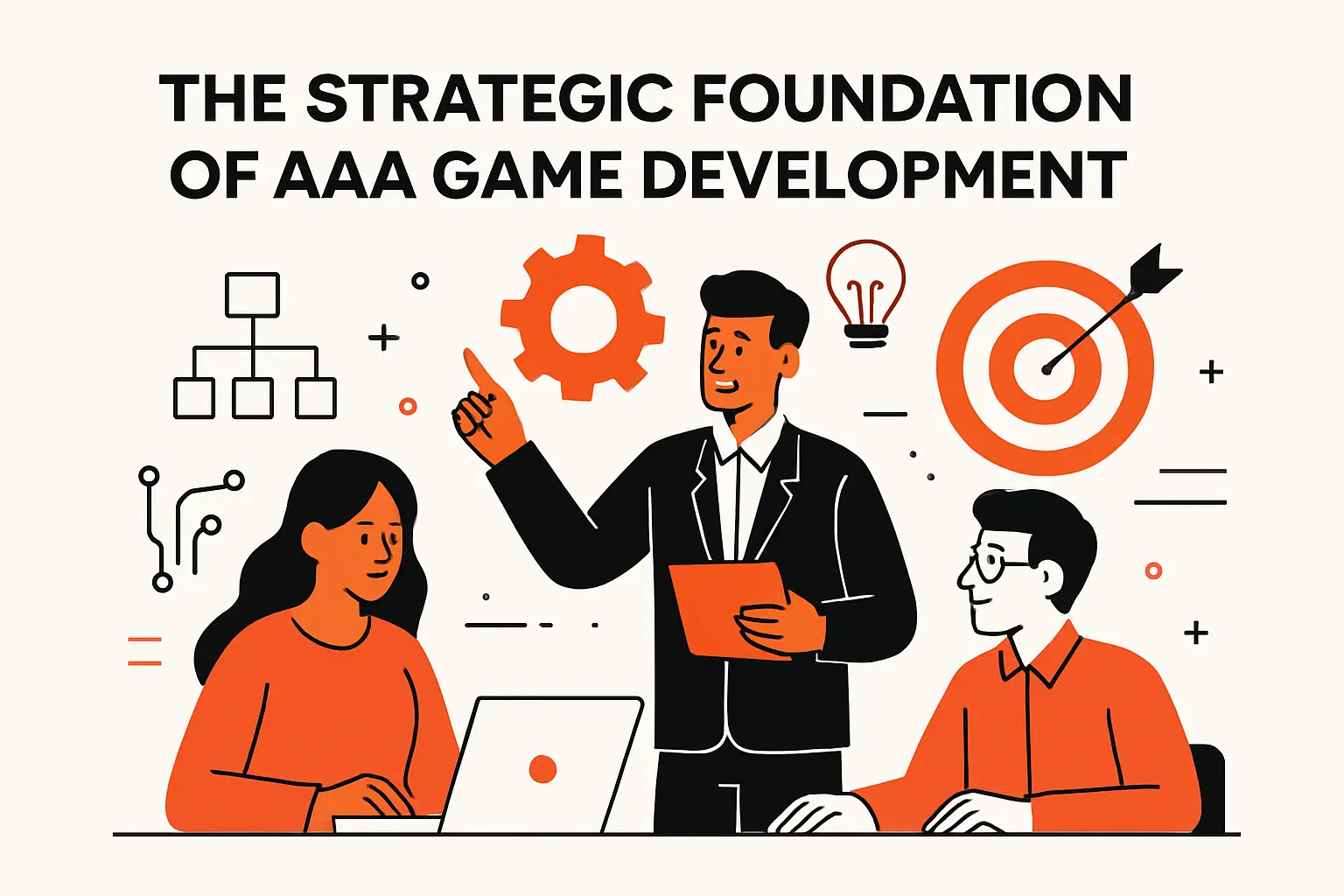
The strategic foundation of AAA game development
1. What makes a game “AAA” beyond budget: quality, organization, and engagement systems
Budget buys options, not outcomes. In our experience, “AAA” is earned by organizational clarity: a studio that can convert creative goals into measurable acceptance criteria without draining the soul out of them. Quality is not a department; it’s a system that starts at design intent and runs through code reviews, content validation, performance budgets, and release discipline.
Engagement systems are the other half of the modern foundation. Even single-player games now ship with telemetry hooks, patch pipelines, community channels, and some degree of post-launch content planning. That doesn’t mean every game should become a live service. It does mean every AAA studio benefits from thinking like an operator: how do we detect issues early, respond quickly, and protect player trust when something breaks?
Live service is a strategic choice, not a default
The appetite for ongoing games is real, and studios feel the pull. Still, the same recent GDC State of the Game Industry reporting noted that 33% noted that they are working on a live-service title, which we interpret as a warning label as much as a trend line: the market is crowded, and operational excellence becomes a differentiator.
2. Balancing art, technology, and market vision to avoid misalignment
Misalignment is the silent killer of AAA schedules. Art wants fidelity, technology wants feasibility, design wants responsiveness, and the market wants differentiation. When those vectors point in different directions, you get expensive rework: reauthoring assets because the renderer changed, rewriting systems because the camera language changed, rebuilding levels because traversal changed.
Instead of letting departments negotiate in the dark, we like explicit “quality gates” that combine creative intent with technical constraints. For example, if the vision demands dense crowds, the tech team must define crowd simulation limits early, the animation team must create scalable rigs, and design must avoid missions that require deterministic crowd behavior if the system is probabilistic.
Decision hygiene beats decision speed
Rushing decisions often produces slow outcomes because reversals cost more than deliberation. A disciplined studio documents trade-offs in a living decision log: what we chose, why we chose it, what we deferred, and what would force us to revisit the choice. That artifact becomes a shield against “drive-by scope creep,” especially when stakeholders change mid-project.
3. Building sustainable IP and player trust through long-term thinking and support
Sustainable IP is less about lore bibles and more about consistency. Players trust worlds that follow their own rules and studios that follow through on promises. From a product standpoint, sustainability means your game can evolve without collapsing under its own technical debt: content pipelines that can accept new assets, backend services that can scale, and tooling that lets teams ship updates without reinventing the wheel.
Support strategy also shapes design. If you plan to patch frequently, you need modular systems, robust versioning of save data, and a deployment pipeline that can roll forward and roll back safely. On the community side, trust is built through clarity: acknowledging issues, explaining priorities, and avoiding the classic trap of overpromising fixes that you cannot responsibly deliver.
Concept development and pre-production planning
1. Market analysis, player preferences, and identifying gaps worth building for
Market analysis is not a slide deck; it’s a filter that protects the team from building a beautiful thing nobody asked for. We start by mapping the genre landscape: what players praise, what they complain about, and what patterns have become stale. Review mining, community forum analysis, and competitor teardowns are all useful, but only if they feed concrete design hypotheses.
Opportunity lives in gaps, not copies. If extraction shooters are crowded, a gap might be social onboarding, clarity of progression, or anti-cheat trust. If open-world RPGs feel bloated, a gap might be tighter narrative pacing, richer systemic reactivity, or genuinely meaningful faction choices. The goal is to articulate a “why us” that survives contact with a publisher greenlight meeting.
Global audience reality changes the bar
Scale matters because your audience is not small. Newzoo’s market reporting estimates a player base of 3.6B in 2025, and that breadth is exactly why accessibility, localization readiness, and performance across a wide range of hardware profiles are no longer “nice-to-have” features for AAA ambitions.
2. World-building, character foundations, visual direction, and technical feasibility checks
World-building is where AAA projects often fall in love with themselves. That’s not inherently bad; passion fuels endurance. The risk is when narrative scope outpaces systemic capability. A faction-heavy political drama needs dialogue tooling, branching logic, state tracking, and cinematic capacity. A survival sandbox needs crafting depth, simulation rules, and content scalability. Every world premise quietly implies a tech stack.
Visual direction is the bridge between dream and execution. We prefer early style targets that define materials, lighting mood, silhouette language, and readability rules. That single step prevents the common failure mode where teams “chase realism” without articulating what realism means for UI, animation exaggeration, and environmental contrast.
Feasibility is a prototype, not a meeting
When feasibility is debated instead of tested, optimism wins—and schedules lose. Even in early concept, we advocate building tiny “physics truths,” “streaming truths,” and “animation truths” that reveal whether your fantasy is computationally affordable. A short experiment that fails fast is a gift compared to a long production that fails late.
3. From ideas to blueprint: concept validation before heavy production spend
Concept validation is where we separate “cool” from “cohesive.” A strong concept can be described in a sentence, but it can also be decomposed into pillars: core loop, progression logic, player expression, and replay incentives. If a proposed feature does not reinforce a pillar, it is either a distraction or a future expansion, not a day-one requirement.
Validation also includes stakeholder alignment. Publishers and investors will ask: what is the hook, what is the risk, and what is the proof? A small but convincing playable target, a believable production plan, and a crisp differentiation thesis do more work than a thousand pages of lore. In our experience, teams that earn trust early buy themselves creative freedom later.
Blueprinting the game: GDD, prototyping, and vertical slice
1. Creating a Game Design Document that aligns mechanics, narrative, and experience goals
A Game Design Document is not a monument; it’s a coordination mechanism. We like GDDs that express intent and constraints rather than drowning the team in speculative detail. The best documents connect mechanics to emotional outcomes: how combat supports story stakes, how traversal supports exploration tone, and how progression supports long-term motivation.
Clarity matters most where disciplines intersect. Animation needs to know the verbs. Engineering needs to know the state model. UI needs to know information hierarchy. QA needs to know acceptance criteria. A good GDD reduces rework by making implicit assumptions explicit, especially around “edge cases” like fail states, co-op desync scenarios, or save/load interactions.
Design is a contract with production
We’ve watched teams implode because the GDD functioned like a wish list. A production-aware GDD includes performance budgets, content throughput assumptions, and “definition of done” checklists. That doesn’t make it less creative; it makes it shippable.
2. Prototyping to test feasibility and the “fun factor” early
Prototype work earns its keep when it answers hard questions quickly. The “fun factor” is often found in tuning—weapon feel, camera response, animation timing, audio feedback—so prototypes should be built to support iteration, not perfection. Greybox levels, placeholder assets, and crude UI are fine if the loop is honest.
Feasibility prototypes should be ruthless. If you want systemic fire that spreads, prototype it in an ugly test scene and measure how it behaves under stress. If you want physics-driven destruction, prototype it with a performance profiler visible on screen so nobody can pretend the cost is imaginary. Early honesty is cheaper than late heroics.
Prototypes also test team communication
Cross-discipline prototyping forces shared language. Designers learn what “expensive” actually means. Engineers learn what “feel” actually demands. Artists learn what “readable” looks like in motion. That mutual calibration is itself a deliverable.
3. Vertical slice as a polished proof-of-vision and quality benchmark
A vertical slice is not “a small build.” It’s a microcosm that proves you can hit the quality bar across the stack. Ideally, it includes representative art, final-ish lighting, authentic gameplay pacing, and the real pipeline that will produce the full game. When studios cheat here—hand-tuning everything, bypassing tools, ignoring performance—they pay it back with interest later.
We treat the slice as a benchmark for three things: player experience, production throughput, and technical architecture. If it takes heroic manual work to ship a tiny slice, scaling up will be painful. If it only works on a developer machine, scaling out will be brutal. And f it feels great but requires rewrites to become maintainable, the slice has done its job by revealing the trade-off while you can still pivot.
Production stage: team structure, pipelines, and genre-fit priorities
1. Assembling a multidisciplinary team across design, engineering, art, audio, and QA
AAA production is a collaboration engine. You need designers who can formalize player intent, engineers who can build robust systems, artists who can create worlds that read at speed, audio teams who can make feedback visceral, and QA embedded early enough to prevent systemic bugs from fossilizing. The most underestimated roles are often production, tools engineering, and build/release engineering—because they don’t “show” in trailers, yet they determine whether trailers are even possible.
Hiring strategy also matters. A team full of specialists can move fast within their lane but stall at the intersections. A team full of generalists can prototype quickly but struggle to reach elite fidelity. Healthy AAA orgs mix both, then invest in rituals—playtests, triage, build reviews—that keep disciplines aligned.
Org design is part of game design
If you want a systemic sandbox, you need systems designers and engineers who thrive in emergent complexity. If you want a cinematic action game, you need animators, cinematic designers, and tools that support scene composition. Team composition should mirror product intent, not industry fashion.
2. Coordinating large-scale production with iterative builds, workflows, and specialized pipelines
Coordination is where AAA becomes a software logistics problem. Iterative builds must be predictable, because everyone depends on them: designers need fresh content, QA needs stable branches, artists need feedback loops, and producers need reliable burndown signals. When builds are fragile, the studio spends its most expensive hours waiting.
Workflow maturity looks boring from the outside, but it’s the backbone of velocity. Asset naming conventions, content validation, automated checks, branch policies, and regression pipelines are what keep large teams from stepping on each other. From our side, this is also where custom internal tools can pay off dramatically: dashboards that explain build health, bots that enforce standards, and systems that make the “right way” the easy way.
Specialized pipelines win when they reduce cognitive load
A great pipeline removes guesswork. Artists should not wonder whether an asset is compliant. Designers should not wonder whether a level will stream. Engineers should not wonder which build is safe to test. The pipeline should answer those questions before a human has to ask them.
3. Aligning specializations to genre needs so effort matches what matters most
AAA failures often come from spending effort where the genre doesn’t reward it. A competitive shooter lives and dies on netcode feel, animation readability, recoil clarity, and map flow. A narrative RPG lives and dies on quest pacing, character writing, systemic consistency, and world believability. An open-world adventure lives and dies on traversal joy, streaming stability, and environmental storytelling.
Genre-fit prioritization is a form of restraint. It gives the team permission to say, “We will not chase every feature that looks impressive in another game.” From a production perspective, it also gives you a budget for excellence. If your differentiator is combat depth, you invest in animation blending, hit reactions, telegraph readability, and tuning tools—rather than blowing your schedule on a crafting system nobody asked for.
Technology and tools powering AAA games
1. Rendering systems: modern lighting, shaders, and high-fidelity visual pipelines
Rendering is where “AAA” becomes instantly visible, and that visibility creates risk. High-fidelity lighting and materials demand consistency across environments, characters, cinematics, and UI. The difficult part is not getting a beautiful screenshot; it’s keeping the game readable when the player sprints through a chaotic scene full of particles, shadows, and camera motion.
On the pipeline side, high-fidelity rendering requires disciplined asset authoring. Materials need standardized parameterization. Texture memory needs budgets that content teams can understand. Shader variants need governance so compile times don’t spiral. As a software company, we’re especially sensitive to the build-time tax: every extra permutation multiplies iteration cost, which quietly reduces quality because teams stop iterating.
Where we see studios stumble: “final lighting” too late
Lighting is a gameplay tool, not a finishing step. If you discover late that your nighttime scenes obscure enemies or your interiors crush contrast, you end up with reactive hacks: glowing outlines, over-bright emissives, or inconsistent exposure rules. Earlier lighting standards prevent that cascade.
2. Physics and simulation: collisions, destructibles, cloth, fluids, and world reactivity
Physics sells weight, and weight sells reality. Players may forgive stylization, but they rarely forgive inconsistency: bullets that hit invisible walls, ragdolls that explode, vehicles that clip through terrain, or cloth that jitters in cutscenes. Simulation systems also have a habit of interacting in surprising ways, which means they demand robust debugging tools and deterministic test scenarios.
Destruction, cloth, and fluids are particularly tricky because they sit at the intersection of art direction and performance. A spectacular collapse is worthless if it breaks gameplay readability or tanks performance during a boss fight. We encourage studios to decide early which simulations are “hero moments” and which are background flavor, then architect budgets and LOD strategies accordingly.
Simulation needs authoring constraints
The best physics system still fails if content creators can unknowingly build invalid setups. Collision primitives, joint limits, and destructible constraints should be validated by tooling before they reach the main branch. That’s a classic place where internal automation prevents entire classes of late bugs.
3. Backend infrastructure: networking, databases, analytics, and live multiplayer services
Backend is where modern AAA ambition often becomes non-negotiable, even for primarily single-player experiences. Patch delivery, entitlements, telemetry, crash reporting, user accounts, matchmaking, and moderation all lean on reliable services. A studio that treats backend as an afterthought often ends up with painful launch-day surprises, because scale is not something you “add” at the end.
AI is also reshaping how teams build tools and services, and we think it’s worth treating that as an engineering reality, not marketing hype. Reuters reported that 87% of video game developers are employing AI agents, and we see the same trend in practice: teams using automation to speed up content tagging, detect regressions, summarize telemetry, and accelerate support workflows. Still, we remain cautious: without guardrails, AI can multiply errors as easily as it multiplies output.
Live ops starts as architecture
When we design backend systems for studios, we focus on observability, graceful degradation, and operational ergonomics. A resilient service is not only about uptime; it’s about making incidents understandable. Clear logs, actionable alerts, and safe rollout mechanisms are what keep a live game from becoming an always-on fire drill.
Design and artistry in AAA games
1. Art direction as the visual identity that shapes brand legacy
Art direction is not “graphics quality.” It’s the set of rules that makes a game recognizable in a single frame. The best AAA art direction creates coherence across character silhouettes, color palettes, material choices, UI language, and animation style. That coherence is what lets a franchise endure across sequels, spin-offs, and adaptations without losing its identity.
From a production standpoint, art direction also reduces waste. When artists know the rules, they can make thousands of assets that all belong to the same world. When rules are unclear, you get endless revision cycles: “make it more gritty,” “make it more grounded,” “make it more stylized,” until nobody is sure what “right” looks like. We prefer explicit reference packs, paint-overs, and “golden assets” that define the standard.
Readability is a business requirement
Clarity affects reviews, streaming, and retention. If combat is visually noisy or UI is confusing, players churn—especially in an era where the next game is always a download away. Art direction that supports readability is not a compromise; it’s a competitive advantage.
2. Character creation pipeline: concept, modeling, texturing, rigging, animation, and engine integration
Characters are where AAA teams spend enormous effort, and the pipeline must be engineered to protect that investment. A character pipeline is not just sculpting and texturing; it includes topology standards, rig compatibility, animation constraints, facial systems, cloth and hair strategies, and runtime performance budgets. When those pieces don’t align, you end up with characters that look stunning in the viewer but fail in gameplay.
Engine integration is the part that often gets underestimated. Materials must match the renderer’s expectations. Animation graphs must support gameplay responsiveness. IK systems must behave on uneven ground. Facial animation must survive camera distance changes. Each handoff is a chance for quality to degrade unless the pipeline includes validation, previews, and clear ownership.
Tooling is the hidden multiplier
A studio with strong character tools can iterate on performance, costume variants, and animation sets quickly. A studio without them burns weeks on manual fixes and inconsistent exports. From our perspective, this is one of the clearest areas where custom internal software directly converts into on-screen quality.
3. Cinematics and interactive storytelling: dialogue, performance, and emotional immersion
Cinematics are no longer “non-interactive breaks.” Even when the player is not controlling movement, they are evaluating tone, authenticity, and pacing. Strong storytelling comes from performance: voice direction, facial nuance, body language, and camera grammar. Games like The Last of Us and Cyberpunk 2077 illustrate how easily the emotional spell breaks when animation, lighting, and dialogue pacing don’t harmonize.
Interactive storytelling raises the bar further because the game must respect player agency. Branching dialogue, systemic consequences, and reactive world states require robust narrative tooling and disciplined state management. We’re especially wary of “branch explosion,” where writers produce content that the game cannot realistically track or surface. In AAA, narrative ambition must be paired with technical humility so the player experiences coherence, not contradiction.
AAA quality strategy: optimization, QA, and go-to-market execution
1. Performance optimization techniques: visibility management, asset strategies, and modern upscaling
Optimization is not the final polish pass; it’s a parallel production track. Visibility management, streaming discipline, and asset strategies must be baked into how content is made, not tacked on after levels are built. The simplest way to think about it is this: every asset and system either respects budgets or silently steals from them.
Modern upscaling and reconstruction techniques can help, but they do not absolve teams from fundamentals. Overdraw, shader complexity, animation costs, physics spikes, and garbage collection patterns still matter. We also emphasize performance culture: profiling that is routine, budgets that are visible, and regressions that are treated like bugs rather than “expected” fallout.
Optimization is a communication discipline
Artists need feedback that maps to their world: texture density views, material cost overlays, and streaming heatmaps. Engineers need telemetry that points to real bottlenecks. Designers need constraints that don’t feel arbitrary. When those feedback loops exist, optimization becomes incremental instead of traumatic.
2. QA and certification: regression, balance, performance checks, and compatibility coverage
QA strategy has to match AAA complexity. Regression testing is not optional when builds change daily and content changes hourly. Balance testing is not optional when player progression can be tuned into frustration by a single variable. Compatibility coverage is not optional when players run a wide range of hardware configurations and expect stability anyway.
We also treat certification as a first-class production stream. Platform requirements shape save systems, networking behaviors, error handling, and UI. Leaving that to the end is a classic schedule trap, because compliance failures create a scramble that steals time from bug fixing and performance work.
Crunch is not a quality plan
Pressure always exists near deadlines, yet relying on burnout is a strategic failure. The IGDA’s developer survey reporting noted that 28% said their job involved crunch time, and our view is blunt: crunch may increase hours, but it often decreases judgment, which is the resource you most need when shipping complex software.
3. Marketing, launch, and post-launch support: building hype, engaging community, and shipping stability
Launch is a coordination event across marketing, engineering, community, and operations. Great trailers and influencer partnerships can create momentum, but momentum amplifies reality. If the first-wave experience is unstable, the conversation becomes about bugs rather than the fantasy you built. If the onboarding is confusing, streamers will broadcast that confusion at scale.
Post-launch support is where AAA studios either build legacy or bleed trust. Patch cadence, communication tone, and prioritization clarity matter as much as the fixes themselves. We advise teams to plan support like a product line: define what “healthy” means, instrument the game to detect drift, and build an internal muscle for rapid, low-risk releases.
TechTide Solutions: building custom software to support AAA game development teams
1. Custom internal tools for pipelines, asset workflows, and build automation tailored to your process
At Techtide Solutions, we don’t pretend every studio should work the same way. Some teams need a better asset review workflow; others need a build pipeline that can survive constant content churn; still others need tools that let designers iterate without waiting on engineering. Our approach starts by mapping the real bottlenecks: where do people wait, where do mistakes repeat, and where does “tribal knowledge” substitute for reliable systems?
From there, we build pragmatic tooling: asset validation services, automated content checks, build orchestration dashboards, and integrations that connect version control, task tracking, and CI in a studio-friendly way. The goal is not to add more software. The goal is to remove friction so creative teams can do creative work.
We optimize for adoption, not novelty
A tool that artists avoid is not a tool; it’s shelfware. We prioritize fast UX, clear feedback, and workflows that match how teams already think. When internal tools feel like an ally, compliance becomes natural and quality rises without constant policing.
2. Scalable backend services and analytics platforms designed around player needs and live operations
Backend systems should be built for the game you’re actually running, not the game you imagine on a calm day. We design services for authentication, player inventory, matchmaking, telemetry ingestion, and live configuration with operational realities in mind: incident response, scaling behavior, and safe migrations. Analytics platforms matter here because you cannot fix what you cannot see.
Player needs shape architecture more than many teams expect. If players demand fast matchmaking, you need low-latency region strategies and robust queue logic. If players demand fair competition, you need anti-cheat integration, anomaly detection, and careful economy design. And if players demand stability, you need deployment discipline and rollback capability. Live operations is a product, and we build it like one.
Observability is the difference between “down” and “degraded”
We’ve seen launches saved by good dashboards and ruined by missing logs. When a studio can see what’s happening, they can make trade-offs quickly: disable a feature flag, throttle an endpoint, or shift load. When a studio is blind, every decision becomes guesswork.
3. Delivery approach: requirements discovery, rapid iteration, and integration into existing studio stacks
Delivery succeeds when we respect the studio’s reality. Our engagements begin with requirements discovery that includes producers, artists, designers, engineers, and QA—because each group experiences pipeline pain differently. Next, we prototype quickly to confirm we’re solving the right problem, then iterate with real users embedded in the feedback loop.
Integration is where many vendor tools fail, so we treat it as core scope. Studios already have engines, repositories, build farms, and security constraints. Rather than forcing a rip-and-replace, we build adapters, plugins, and service layers that fit into the existing stack. The result is usually less disruption, faster time-to-value, and a smoother path to long-term ownership by the studio.
Conclusion: reality checks and next steps for aspiring AAA creators
1. Time and scale reality: why AAA work is measured in person-years, not solo sprints
AAA dreams are inspiring, yet they require sober math. The work spans art, engineering, narrative, audio, QA, release operations, and community stewardship—and each of those domains has its own depth. A solo sprint mindset can be useful for prototyping, but AAA shipping is an endurance sport that rewards planning, communication, and tooling as much as raw talent.
From our perspective, the healthiest teams treat sustainability as a competitive advantage. Stable pipelines, humane schedules, and clear priorities don’t just protect people; they protect quality. When the team can iterate calmly, the game gets better—steadily, predictably, and without the chaos tax.
2. Applying indie lessons to AAA thinking: respect genre “anchors,” and remember gameplay must deliver
Indie teams often teach the best lesson: players forgive simplicity, but they do not forgive boredom. AAA teams can learn from that discipline by protecting gameplay anchors: the core loop must feel good, the controls must be trustworthy, and the feedback must be satisfying. A cinematic wrapper cannot rescue a hollow interaction model.
Genre anchors also keep scope honest. If you’re making an action RPG, combat readability and build variety matter more than a sprawling crafting tree. If you’re making a stealth game, AI perception and level affordances matter more than collectible volume. Respecting anchors is how you avoid spending a fortune on features that don’t move the needle.
3. Turning the roadmap into a plan: aligning vision, scope, team capacity, and post-launch commitments
The roadmap becomes real when you translate it into a plan that can survive stress: a validated concept, a production-aware GDD, prototypes that prove feasibility, a vertical slice that proves quality, and pipelines that scale. Along the way, the studio must choose what it will support after launch—because AAA expectations rarely stop at release day.
So here’s our next-step suggestion: pick a single slice of your dream game—one combat encounter, one traversal loop, one narrative moment—and build it using the same pipelines and standards you’d use in production. After you do that, what breaks first: the design, the tech, the pipeline, or the schedule?