
We’re Techtide Solutions, and we’ve shipped enough smart contracts, storefronts, and creator tools to know that “minting an NFT” is only the visible tip of a much bigger product iceberg: rights, metadata permanence, marketplace fit, and security all decide whether your drop thrives or fizzles. To calibrate expectations, the global NFT market’s revenue is forecast to reach US$504.3m in 2025, which means creators who treat NFTs as products—validated, secured, and marketed—tend to outlast hype cycles as the category matures and professionalizes.
What NFTs Are And What You Need To Begin
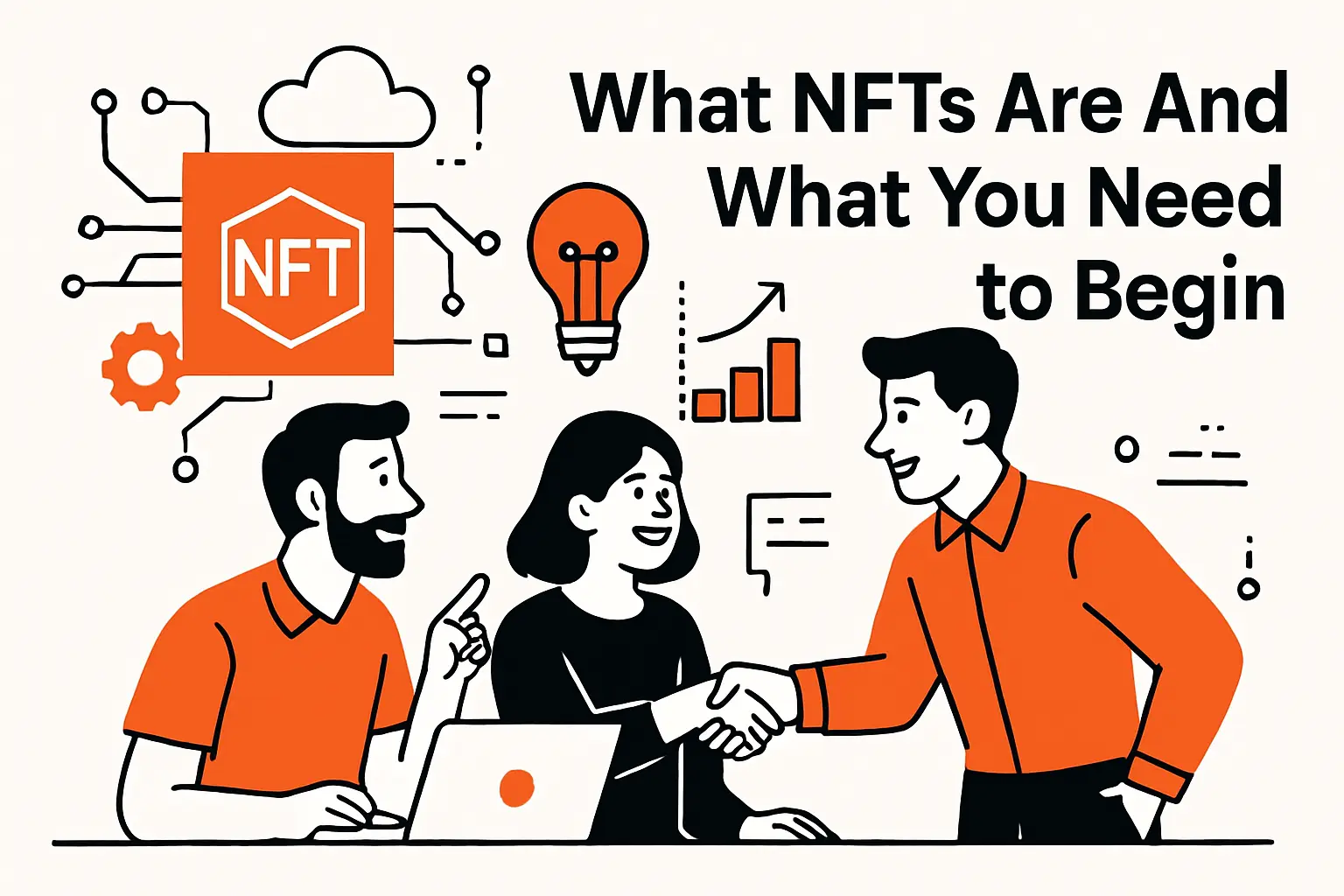
When we talk about NFTs in 2025, we’re really talking about a toolset for programmable ownership—useful for art and media today, and increasingly relevant to tokenized assets tomorrow. The broader tokenization wave could reach $4 trillion to $5 trillion by 2030, which helps explain why brands and platforms still invest in creator rails even in slower markets: the rails you lay for a single artwork today may later carry loyalty passes, event tickets, or financial rights.
1. Definition And Core Use Cases
Non‑fungible tokens are unique, on‑chain identifiers (token IDs) issued by a smart contract that map to off‑chain or on‑chain media and metadata. In practice, the power is not in the file but in the verifiable, programmable pointer—ownership plus logic. We group use cases into four buckets:
- Digital art and collectibles: editioned drops, 1/1s, generative series, and collection mechanics like burn-to-redeem.
- Utility passes: token‑gated communities, subscription access, event ticketing, and loyalty programs.
- Gaming assets: interoperable items and skins, where transferability and provenance matter as much as visuals.
- Asset wrappers: rights to music splits, media IP, membership perks, or off‑chain claims represented on‑chain.
Our view: the more your NFT encodes real utility—access, discounts, or redeemable rights—the less you’re exposed to market mood swings. We’ve watched creators pivot from “collect this image” to “own this access key,” then see retention climb because the token now does something tangible.
2. Ownership Uniqueness And On‑Chain Metadata
Uniqueness is achieved by the combination of contract address + token ID. Two technical decisions shape durability:
- Where you store metadata: IPFS and Arweave hash-address content, making it tamper-evident. Centralized URLs can break; content addressing resists rot.
- How you design the token standard: ERC‑721 gives you one token per ID; ERC‑1155 allows multiple copies per ID, which suits editions and game items. For both, tokenURI points to a JSON object with attributes your marketplace can index.
For long‑lived projects, we freeze metadata post-reveal and keep a canonical, human‑readable README in the JSON explaining license and rights. That extra markdown prevents confusion years later when your community asks, “What exactly do I own?”
3. Rights And Copyright Considerations
Minting does not transfer copyright by default. You, the issuer, decide the license: permissive (CC0), personal-use, or commercial with thresholds and restrictions. We advise clients to write the license into the metadata and mirror it on a public repository. If you tokenize music or photography, verify you have the rights to the underlying work and any samples or likeness. Contracts can also encode access to private content or downloads, but be clear: on‑chain ownership of a token ≠ off‑chain licensing unless you specify it.
4. Basic Requirements Digital File Crypto Wallet And Funds
At minimum you’ll need (a) a high‑quality digital file, (b) a wallet (MetaMask, Coinbase Wallet, Rainbow, Trust Wallet, or a hardware wallet like Ledger for cold storage), and (c) funds for gas if you’re minting on a network that doesn’t subsidize it. From experience, the biggest time‑saver is a tidy asset pipeline: a consistent filename scheme, final‑form exports, and a metadata spreadsheet you can convert to JSON without hand-editing.
The Practical Steps: How To Create An NFT
We’ll walk through a creator‑tested flow you can follow today. While market cycles ebb and flow, the build discipline we outline—version your assets, verify contracts, and plan metadata—serves creators in any climate. In the same analysis we cited above, tokenization is expanding pragmatically in waves; your first drop should mirror that pragmatism by shipping the smallest viable collection and learning from real buyers before you scale.
1. Create Or Digitize Your Artwork Audio Video Or Collectible
Start with your master file in a final format (PNG, JPG, GIF, WEBP, or MP4 are widely supported). Export a consistent preview dimension (square or landscape) and keep an archival original. If you’re scanning IRL art, capture in high‑bit‑depth and color‑correct before down‑resing for web. We also recommend a “story card” image (text + visual) you can reuse on marketplace pages and social posts—the sellers who package their narrative usually outperform those who don’t.
2. Choose Your Blockchain Weighing Fees Speed Security And Sustainability
Pick a chain like you would pick a logistics network: where will your collectors already be? Ethereum mainnet has deep liquidity and tooling; EVM L2s offer lower fees; Solana caters to high‑throughput drops; Flow has strong consumer‑app integrations. Cross‑listing is common, but fragmentation can dilute your attention. A good rule: start where your community is, then bridge demand rather than supply.
3. Set Up And Fund A Crypto Wallet
Install a reputable wallet, create a hardware‑backed vault for long‑term storage, and a separate hot wallet for minting. Back up your seed phrase offline. For teams, use multisig or smart‑account wallets so no single person holds keys to the kingdom. Fund your minting wallet with a small amount first and run a test transaction; you’ll catch mistakes early.
4. Pick A Marketplace And Connect Your Wallet
OpenSea, Rarible, SuperRare, and Crypto.com each serve different segments: open platforms with self‑serve tooling versus curated galleries with tighter onboarding. Your choice affects royalties enforcement, drop mechanics, and discovery. If you value edition mechanics and programmable drops, shortlist platforms with those primitives built‑in or that let you bring your own contract.
5. Upload Media Add Metadata And Mint
Metadata is your product page in machine‑readable form: name, description, attributes, external link, and license. Decide on reveal strategy upfront (pre‑reveal placeholder versus immediate reveal), and freeze URIs after reveal to protect collector trust. If you’re using IPFS, pin redundantly with two pinning services; if Arweave, mirror the JSON on IPFS to hedge storage ecosystems.
6. List For Sale Fixed Price Timed Auction Or Open Bids
Sales mechanics influence perceived scarcity: fixed price for accessibility, timed auctions to capture demand spikes, and open bids to let whales signal interest. We typically pair a small fixed‑price edition (to widen the collector base) with one or two 1/1 timed auctions (to anchor value) and an allowlist for early supporters.
Choosing Blockchains Wallets And Marketplaces
We choose infrastructure as deliberately as we design art. Tokenization isn’t just art—real‑world asset rails are arriving, with tokenized real estate alone projected to reach US$4 trillion by 2035; so your chain and marketplace choices should anticipate utility beyond pictures. That means thinking about fees, royalties enforcement, interoperability, and your collectors’ default wallets.
1. Ethereum And EVM Chains Versus Alternatives Like Solana And Flow
Ethereum gives you maximal composability: DeFi hooks, on‑chain registries, and the richest NFT indexers. EVM L2s (Base, Arbitrum, Optimism, Polygon) lower gas and are fine for open editions and frequent drops. Solana’s runtime favors high‑throughput mints and gaming‑grade inventory; Flow continues to power consumer‑facing collectibles. The right choice follows your collector base and your mechanics: for example, if you plan redeemable burns and on‑chain allowlists, EVM standards and tooling can save weeks of custom work.
2. Wallet Options Metamask Coinbase Wallet Ledger Nano X Rainbow Trust Wallet
Hot wallets (MetaMask, Rainbow, Trust) are easy for day‑to‑day creation and signing; hardware wallets (Ledger) reduce risk for treasury storage and high‑value listings. For teams, consider multisig or smart‑account wallets so you can rotate signers if someone leaves. Always split roles: creator wallet for minting, treasury wallet for proceeds, and a separate admin for contract controls.
3. Marketplace Fit And Supported Chains OpenSea Rarible SuperRare Crypto.com
OpenSea and Rarible excel in open minting and editions; SuperRare remains selective for 1/1 art; Crypto.com’s curated pathway helps creators tap a mainstream user base. Don’t over‑optimize for “homepage features.” Instead, optimize for the operations you’ll repeat: metadata control, earnings settings, allowlists, and analytics you can act on.
4. Security And Scam Awareness For Creators
Security posture is a sales feature. Phishing DMs, malicious signing prompts, and approval drainers target creators precisely because your collections attract buyers. A few non‑negotiables we enforce on client launches: never sign blind signatures; use a burner wallet for testing; verify contract addresses; and remember that marketplaces state clearly that they will not solicit funds from you directly—for example, OpenSea notes that gas is paid to validators and it will never ask you to send funds to a private wallet address. Anchor that policy in your team playbook and share it with collaborators.
Minting Options On Major Platforms And From Scratch
You can mint through no‑code studios, self‑serve creator flows, or by deploying your own contract. We prefer to start teams on a no‑code path to validate demand, then graduate to custom contracts for branding, mechanics, and integrations once the audience shows up. The trick is choosing a path that keeps your metadata, royalties logic, and ownership under your control.
1. How to create an nft on OpenSea
On OpenSea, click Studio, then “Create new.” You can either create a Drop (collectors mint directly to their wallets) or a Collection item (you mint to your wallet and list later). At a high level: deploy your contract, set collection details, configure earnings, upload media and metadata, then mint and list. If you’re brand‑new, the “Collection or item” flow is simpler: it mints an ERC‑1155 item to your wallet, with an adjustable supply and traits you can define. The platform’s help guide lays this out in a step‑by‑step workflow, including where each flow shows items and how reveal conditions work.
2. OpenSea Studio Deploy A Contract Choose An EVM Chain Mint ERC‑1155 Items And Set Creator Earnings
Deploying via OpenSea Studio lets you choose contract type (proxy or standard), chain, branding, and drop mechanics. The “Create Collection” path produces an ERC‑1155 collection suited to editions; the “Create Drop” path deploys an ERC‑721 drop where collectors mint during scheduled stages. After deployment, set your creator earnings and, if your contract supports the newer C‑variants, you can actually enforce them at checkout. The documentation also clarifies that you can set up earnings, add payout addresses, and enforce on compatible contracts—a practical way to keep your margin intact across secondary sales.
3. Crypto.com NFT Creator Onboarding Supported Chains File Types And Limits
Crypto.com offers a creator application and a simple self‑mint flow across multiple chains with clear fees and constraints: a base mint fee of $3 and a primary listing fee of 1.99% when your self‑minted NFT sells the first time, plus a new‑creator safeguard that freezes both payout and withdrawals for 30 days. Supported media include images and MP4; the help page lists size caps—images up to 30MB and MP4 up to 60MB—so plan your exports accordingly.
4. Rarible Lazy Minting Option
Rarible’s “lazy minting” lets you list now and mint at purchase—meaning the buyer triggers the on‑chain mint and pays the gas. If you want to test designs or price points without upfront costs, it’s a useful lever, especially for early‑stage creators experimenting with editions. The support docs describe it plainly: you can create ERC‑721 and ERC‑1155 items “for free” with minting deferred until sale.
5. Zora And Manifold For Quick No‑Code Minting
Zora provides a protocol and tooling to spin up mints and editions with lean overhead; Manifold Studio focuses on giving you a self‑deployed creator contract so provenance is unambiguous and extensible. We often use Manifold when a client wants to own the contract namespace and still launch no‑code claim pages, auctions, or burn‑to‑redeem mechanics, and Zora when they want low‑friction editions that plug into a vibrant creator ecosystem. Both let you scale from simple editions to more advanced mechanics without rewriting your stack.
6. Developer Path Write And Deploy An ERC‑721 Contract With Hardhat OpenZeppelin And IPFS
When you outgrow no‑code, stand up a repo with Hardhat, import OpenZeppelin’s ERC‑721 or ERC‑1155 base, and implement tokenURI with content‑addressed URIs (ipfs:// or ar://). Audit approvals and transfer hooks; add EIP‑2981 if you want on‑chain royalty metadata. Use a pinning service for assets and JSON, then deploy to your target chain. Finally, test integration against your marketplace of choice (metadata refresh, trait indexing, and supply caps) before listing.
Costs Royalties And Sales Settings To Know
Plan your unit economics like a product P&L: creation costs, listing fees, royalties treatment, and take‑rates across marketplaces. Venture and creator tooling ebb and flow with macro funding cycles—global venture funding to blockchain and crypto companies reached $26.8B in 2022—but your per‑mint margin, not market sentiment, will decide whether you can keep shipping.
1. Gas Fees And When Lazy Minting Defers Costs
Gas is paid to validators, not marketplaces. Lazy minting defers gas to the buyer at purchase; traditional minting pays gas upfront to write the token to chain. When you expect high demand, pre‑minting can prevent slow‑motion reveals and congestion. When you’re exploring demand, lazy minting lowers your downside. We steer new creators to a hybrid: pre‑mint the flagship pieces, lazy‑mint the long‑tail editions.
2. OpenSea 2.5 Percent Commission And Crypto.com 3 Dollar Mint Plus 1.99 Percent Primary Listing Fee
Headlines and screenshots float around, so here’s the up‑to‑date reality: OpenSea’s platform fee for selling NFTs moved to 1.0% on September 15, 2025, per its official changelog. On Crypto.com’s creator flow, you’ll pay a base mint fee of $3 and a primary listing fee of 1.99% when your self‑minted item sells the first time. Read the fine print and model the take‑rate against your price and expected sell‑through; those small percentages compound across editions.
3. Royalties Creator Earnings And Secondary Sales Settings
“Royalties” on NFTs are not universal law; they are conventions enforced at marketplace or contract level. On OpenSea Studio, you can configure creator earnings and, with newer C‑standard contracts, enforce them at the point of sale, up to a maximum of 10%. Elsewhere, some platforms let you propose earnings and rely on marketplace cooperation. Treat earnings like a product lever: align the rate with collector expectations and your roadmap, and document it in metadata and docs so there’s no ambiguity later.
4. Sales Formats Fixed Price Timed Auction And Open Bid
Each format optimizes for a different objective. Fixed price maximizes reach; timed auctions surface willingness to pay during a defined window; open bids gauge interest without committing supply. For creators with smaller audiences, we pair a modest fixed‑price edition with a single timed auction and an open‑bid catch‑all for whales who missed the window.
5. Supported File Formats And Size Limits
Formats vary by marketplace. On Crypto.com’s creator flow, supported images have a cap of 30MB, while MP4 can go up to 60MB. Keep your archival originals safe, and pre‑compress copies for web previews to speed marketplace rendering.
6. Weekly Creation Limits And 30 Day Freeze For New Crypto.com Creators
Operational constraints matter: Crypto.com creators can mint up to 50 collectibles per week, and new creators see funds and withdrawals frozen for the initial 30 days. Build your release calendar with these gates in mind so you don’t promise utility you can’t deliver during the freeze window.
TechTide Solutions Builds Custom NFT Platforms And Smart Contracts Tailored To Your Needs
We’ve helped independent artists, record labels, and brands ship drops that hold up months later because the plumbing is solid: metadata is tamper‑evident, royalties logic is transparent, and infrastructure is right‑sized for the audience. As tokenized use cases broaden (and, per the same enterprise forecasts we referenced earlier, push into real‑world assets), we architect for portability—so your “art token” today can become a “membership token” or “access pass” tomorrow without ripping and replacing your stack.
Our typical engagement covers discovery (use‑case and audience), technical design (chain, contract, metadata), build (contracts, mint pages, or marketplace integrations), and go‑to‑market (claim flows, analytics hooks, wallet messaging). We also run pre‑launch threat modeling to close the gaps scammers exploit in naming, metadata updates, and approvals.
Conclusion Key Takeaways For Creating And Selling Your First NFT
Entering NFTs today is less about chasing a windfall and more about product discipline. The forecasted category revenue we cited earlier situates NFTs as a steady, specialized channel—big enough to matter but small enough that craftsmanship still wins. The creators who ship consistently, document rights, and preserve trust tend to earn repeat collectors.
1. Start Simple Validate Demand Then Iterate
Launch a tight, well‑messaged drop before you scale editions or chains. Use lazy minting where it helps and pre‑mint when demand justifies it. A clean pipeline and consistent reveals earn you day‑two sales that casual flippers miss.
2. Prioritize Security Compliance And Transparent Metadata
Security is part of the product. Hardware‑back the treasury, split roles across wallets, document licenses in metadata, and avoid mutable endpoints once you reveal. Nothing kills a collection faster than post‑mint confusion about rights or a preventable security lapse.
3. Audience And Marketing Drive Sales As Much As Minting Flow
The mint is not the message—your story is. Draft your buyer journey like a funnel: teaser, allowlist, claim, reveal, and post‑mint utility. When in doubt, ask existing collectors what utility they’ll actually use next month, not just what sounds exciting today. And if you want a partner to pressure‑test the plan, we’re here—what do you want your first drop to accomplish, specifically, in its first 30 days?